
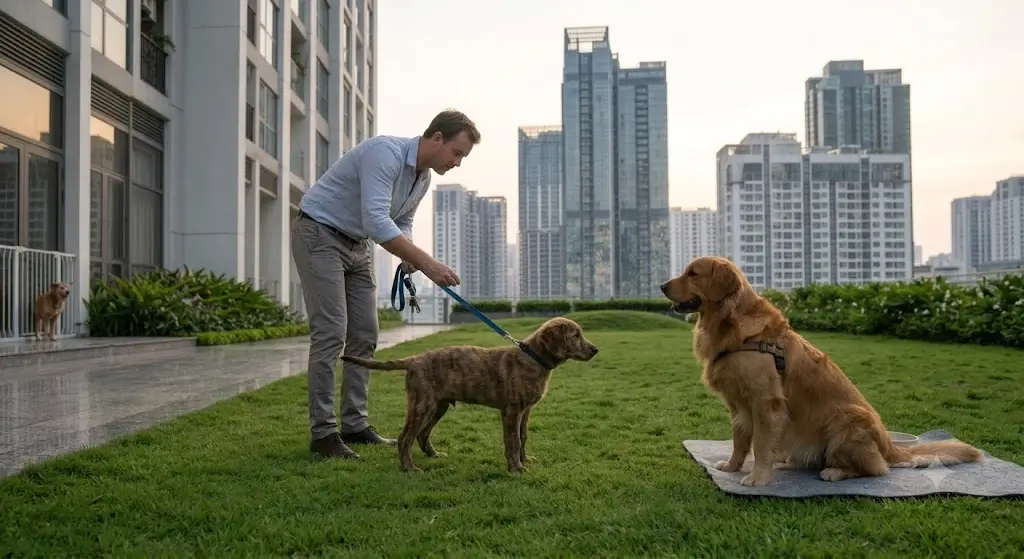
House Training a Puppy With Other Dogs
House training a puppy in a home with other dogs can be easier when the older dogs already use the right bathroom area—but it can also become confusing when puppies copy the wrong behavior, compete for attention, or have unrestricted access to the house.
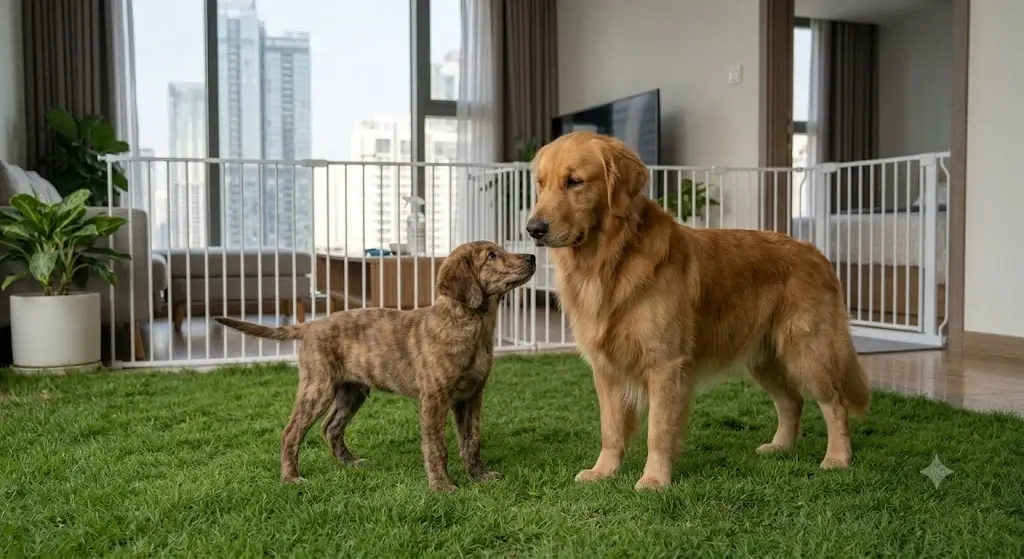
Can You House Train a Puppy With Other Dogs in the House?
Yes. A puppy can become reliably house trained while living with one or more other dogs.
In fact, resident dogs can sometimes make the process easier because the puppy observes where the household normally goes outside, follows established routines, and learns that trips to the potty area are a normal part of the day.
The complication is that puppies do not automatically understand which behaviors they should copy. A puppy may copy another dog going outside, but it may also copy indoor accidents, door barking, rushing around the house, or eliminating in a previously soiled location.
Why House Training Is Different in a Multi-Dog Home
A single-puppy household gives the owner more control over when the puppy wakes, eats, plays, rests, and goes outside.
With multiple dogs, the puppy’s environment is more active. A resident dog may suddenly start playing, another dog may need to go outside, and the puppy may become distracted before eliminating.
The result is an important distinction:
Social learning
The puppy observes what the other dogs do.
Individual learning
The puppy still needs direct reinforcement and supervision.
Environmental management
The owner controls access and prevents rehearsal of unwanted behavior.
Do Puppies Learn Potty Training From Older Dogs?
They can learn useful household routines by observing other dogs, but an older dog’s behavior should not be considered a substitute for puppy training.
The resident dog may help the puppy notice that everyone heads toward the door at certain times. The puppy may also follow another dog to the yard and investigate the area.
But the puppy still needs to learn the specific sequence:
That sequence should be practiced deliberately rather than left entirely to imitation.
The Biggest Mistake: Assuming the Puppy Will Follow the Older Dog
An older dog may be fully reliable in the house while the puppy continues having accidents.
This is normal. The older dog has years of experience with the household’s expectations. The puppy is still developing the physical control, environmental awareness, and behavioral history needed for reliable house training.
If you simply open the door and let all the dogs move freely together, the puppy may spend the entire outdoor trip playing instead of eliminating. If your puppy regularly freezes outdoors, read our guide on what to do when your puppy won’t go potty outside.
Should You Take All the Dogs Out Together?
Sometimes. A group potty trip can be efficient and can help establish a household routine, but it is not always the best training arrangement for a young puppy.
If the puppy becomes distracted by the other dogs, give the puppy a short individual potty opportunity first. Once the puppy eliminates, the dogs can interact.
Puppy goes to potty area → quiet opportunity to eliminate → immediate reward → group interaction or play.
This teaches the puppy that the purpose of the first part of the outdoor trip is elimination, not simply running around with the other dogs.
When Individual Potty Trips Work Better
Take the puppy separately when:
- The puppy becomes too excited around the other dogs.
- The puppy repeatedly plays without eliminating.
- The resident dogs distract the puppy.
- You need to observe the puppy’s bathroom behavior closely.
- The puppy has recently had an accident.
- You are trying to establish a reliable potty cue.
Individual trips do not mean the puppy must always be separated. They are simply a training tool for moments when group activity interferes with the primary objective.
A Two-Stage Outdoor Routine
One of the most effective approaches for multi-dog households is to divide the outdoor trip into two stages.
| Stage | What happens | Training purpose |
|---|---|---|
| Stage 1 | Quiet potty opportunity | Focus on elimination |
| Stage 2 | Play, exploration, or social time | Makes successful elimination predictably lead to something enjoyable |
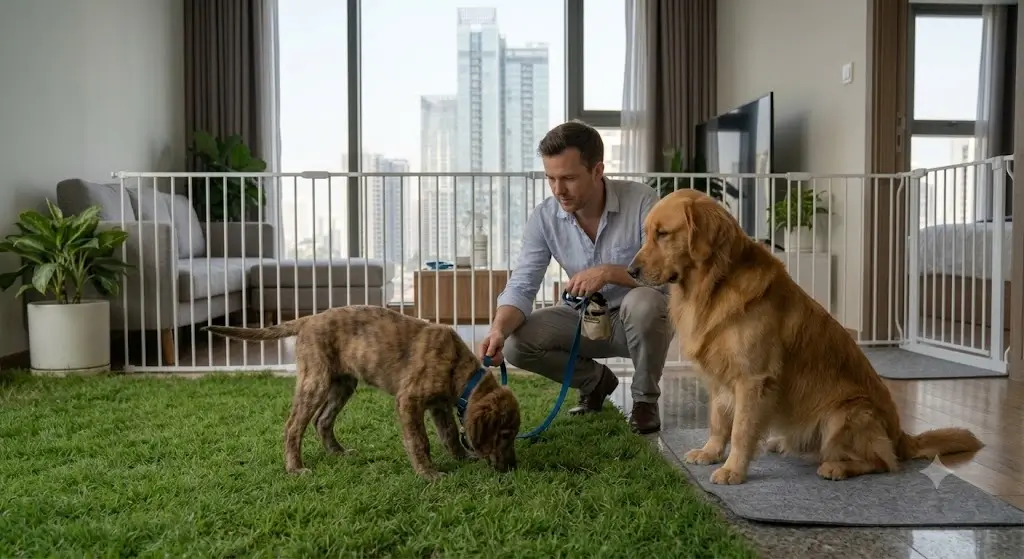
This structure is particularly useful for puppies who think every trip outside is an invitation to play.
How to Prevent the Puppy From Copying Indoor Accidents
A puppy may investigate places where another dog has eliminated indoors. Residual odor can make that location more likely to attract another accident.
Clean indoor accidents promptly with an enzymatic pet cleaner appropriate for the surface. Ordinary household cleaning may remove the visible stain while leaving odor compounds detectable to a dog’s much stronger sense of smell.
If one area repeatedly attracts accidents, temporarily restrict access and follow our complete checklist on how to clean up puppy accidents properly.
Can an Older Dog Make Puppy Potty Training Worse?
Yes, but usually indirectly.
The older dog may not be doing anything wrong. The problem can arise when the puppy becomes so focused on the other dog that it misses its own bathroom signals.
For example, a puppy may begin sniffing the ground, then immediately chase another dog. Ten minutes later, the puppy comes back indoors and has an accident.
In this situation, the solution is not to blame the older dog. Give the puppy a calmer opportunity to finish the bathroom routine before allowing free interaction.
What If the Older Dog Has Indoor Accidents?
This is one of the situations where separate management becomes especially important.
If an older dog is currently eliminating indoors, the puppy should not be allowed unrestricted access to those locations.
Manage the older dog’s bathroom needs and the puppy’s training separately. Clean previous accidents thoroughly, supervise both dogs when practical, and prevent the puppy from repeatedly investigating contaminated areas. If the spot becomes habitual, see our guide on when a puppy keeps peeing in the same spot.
House Training a Puppy With Multiple Dogs: The Potty Schedule
A multi-dog household still needs a puppy-specific schedule. The other dogs’ schedules can be used as convenient anchors, but they should not replace the puppy’s needs.
| Event | Puppy action | Multi-dog strategy |
|---|---|---|
| Wake-up | Potty promptly | Older dogs can accompany puppy if they do not distract. |
| After meal | Potty opportunity | Keep the puppy focused before group play. |
| After nap | Potty promptly | Take puppy first if necessary. |
| After active play | Potty opportunity | Pause group activity before going outside. |
| Before bedtime | Final planned opportunity | Keep the trip calm rather than turning it into playtime. |
Use the Resident Dogs as Routine Anchors
One advantage of a multi-dog household is that the older dogs already create natural transitions.
When the resident dogs regularly go outside after waking, before bedtime, or at meal-related times, the puppy can join those transitions.
This gives the puppy repeated exposure to a consistent household pattern:
The routine becomes easier for the owner because the existing dogs help create predictable transition points. If you reside in an apartment, align these anchors with our strategies for high-rise apartment house training.
Why the Puppy May Forget to Potty When Playing With Other Dogs
Play produces intense environmental stimulation. A puppy that needed to eliminate a few minutes earlier may become temporarily focused on chasing, wrestling, sniffing, or exploring.
That does not necessarily mean the puppy no longer needs to go.
If the puppy routinely comes indoors after an exciting outdoor play session and then has an accident, change the order:
- Take the puppy to the potty location.
- Wait quietly for the opportunity to eliminate.
- Reward the correct behavior.
- Allow appropriate play afterward.
The puppy begins learning that elimination comes before the fun part.
Should You Reward the Puppy if the Other Dogs Are Nearby?
Yes. The puppy should receive clear, immediate reinforcement for its own successful behavior.
Do not assume that because the other dogs are present, the puppy understands why it is being rewarded.
Use a consistent verbal marker or praise immediately after the puppy finishes eliminating, followed by the reward you normally use.
Should the Older Dog Get a Reward Too?
There is nothing wrong with maintaining the older dog’s normal reinforcement routine, but the puppy’s reward should remain clear.
If the older dog rushes toward every treat, use a practical setup that prevents the puppy from losing the reward opportunity to the resident dog.
For some households, giving both dogs a small reward after the puppy successfully eliminates can turn the event into a calm household ritual—as long as the puppy still receives immediate feedback for its own behavior.
What If the Other Dogs Bark at the Door?
Door excitement can cause the puppy to rush toward the door for the wrong reason.
If possible, create a predictable departure routine rather than allowing every outdoor trip to begin with frantic movement.
The puppy can learn that the door opening is part of a sequence, not a signal to race through the house.
Use gates, leashes, or other appropriate management tools when necessary to maintain safety and control during transitions.
How to Handle the Puppy When Another Dog Needs to Go Out
This is an excellent opportunity for training.
If an older dog needs a bathroom break but the puppy has just returned inside, you do not necessarily need to send the puppy outside again immediately. The correct decision depends on when the puppy last eliminated and the puppy’s individual needs.
If the puppy does need another opportunity, make the trip purposeful rather than turning it automatically into extended play.
What If the Puppy Follows the Other Dog but Doesn’t Potty?
This is common.
Following the other dog gets the puppy to the correct location, but location alone does not guarantee elimination.
Give the puppy a quiet period. Avoid turning the entire trip into play before the puppy has had a chance to eliminate.
If nothing happens, return indoors under close supervision rather than giving the puppy unrestricted freedom. Try again at an appropriate interval based on the puppy’s needs.
Crate Training With Other Dogs in the Home
A crate can provide a predictable resting space while other dogs are moving around the house.
This can be useful when the puppy becomes overly excited by resident dogs and has difficulty settling.
However, the crate should not become a punishment area or a replacement for adequate interaction and bathroom opportunities. For dimension specifications, check our puppy crate size guide.
The puppy should learn that its crate is a safe resting location, while the other dogs’ movements are normal background activity. If training without a crate is preferred, consult our protocol on potty training without a crate.
Using a Puppy Pen in a Multi-Dog Home
A puppy pen can provide more controlled space than unrestricted household access.
It can be especially useful when the puppy needs a break from energetic resident dogs or when direct supervision is temporarily unavailable.
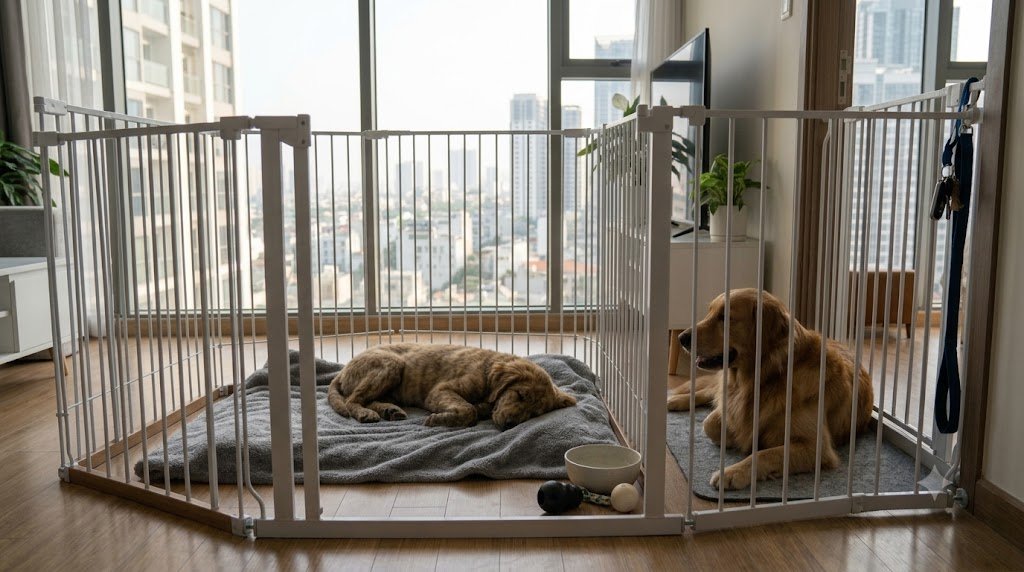
The setup should be puppy-proofed and appropriate for the puppy’s needs. It should not be treated as a permanent substitute for training, exercise, social interaction, and bathroom opportunities. In tighter living quarters, review our spatial setups in house training a puppy in a small home.
How to Prevent the Puppy From Chasing the Older Dog After a Potty Trip
If the puppy immediately launches into play after eliminating, that is not necessarily a problem. The important part is making sure elimination happened first.
If the puppy becomes so excited that it cannot eliminate, temporarily separate the two stages:
Quiet reward.
Play second.
Over time, the puppy can learn that completing the bathroom routine opens the door to the more exciting part of the outing.
How to House Train Two Puppies at the Same Time
Two puppies require even more deliberate individual training.
It is tempting to treat them as one unit, but each puppy needs its own bathroom history and reinforcement.
Take them together when practical, but separate them for training sessions when one puppy’s behavior is preventing the other from focusing.
Track accidents by puppy rather than simply recording that “the puppies had an accident.” This gives you much more useful information.
How to House Train a Puppy With a Senior Dog
A senior dog may have a very different energy level from a young puppy.
Do not require the senior dog to participate in every puppy potty trip or play session.
Give the puppy its own training opportunities while protecting the senior dog’s rest and normal routine.
If the senior dog already has reliable outdoor habits, those habits can provide a useful model without requiring constant interaction.
What If the Resident Dog Guards the Door or Yard?
A puppy needs a calm and safe route to its bathroom area.
If another dog blocks the doorway, rushes the puppy, guards a resource, or creates conflict around the yard, separate the dogs during potty training.
House training should not require the puppy to compete with another dog for access to the bathroom location.
If there is serious aggression or repeated conflict between the dogs, seek qualified professional behavior assistance rather than trying to solve the problem through forced interaction.
What to Do When the Puppy Has an Accident in Front of the Other Dogs
Stay neutral and manage the situation.
- Interrupt calmly if you catch the puppy in the act.
- Take the puppy to the appropriate potty location when practical.
- Clean the indoor area thoroughly.
- Review what happened immediately beforehand.
- Adjust supervision or timing if necessary.
Do not punish the puppy in front of the other dogs. The goal is to teach the correct behavior, not create fear around elimination.
Why Multi-Dog Homes Can Produce “Mystery” Accidents
When several dogs live together, owners sometimes cannot immediately tell which dog eliminated.
This makes accurate record keeping more important.
If necessary, temporarily increase supervision or use appropriate separation so you can identify which dog is responsible for accidents.
Knowing which dog, when, where, and after what event turns a vague problem into something you can actually solve.
A Simple Multi-Dog Accident Log
| Time | Dog | Last potty | What happened before? |
|---|---|---|---|
| 8:10 AM | Puppy | 7:20 AM | High-energy play |
| 11:45 AM | Puppy | 10:00 AM | Nap |
The examples above are illustrative. The value comes from recording your own household’s pattern.
House Training Around Feeding Multiple Dogs
Feeding several dogs can complicate the puppy’s potty schedule because meals may happen at different times.
Feed according to the veterinarian-approved routine appropriate for each dog rather than forcing every dog onto the puppy’s schedule simply for convenience.
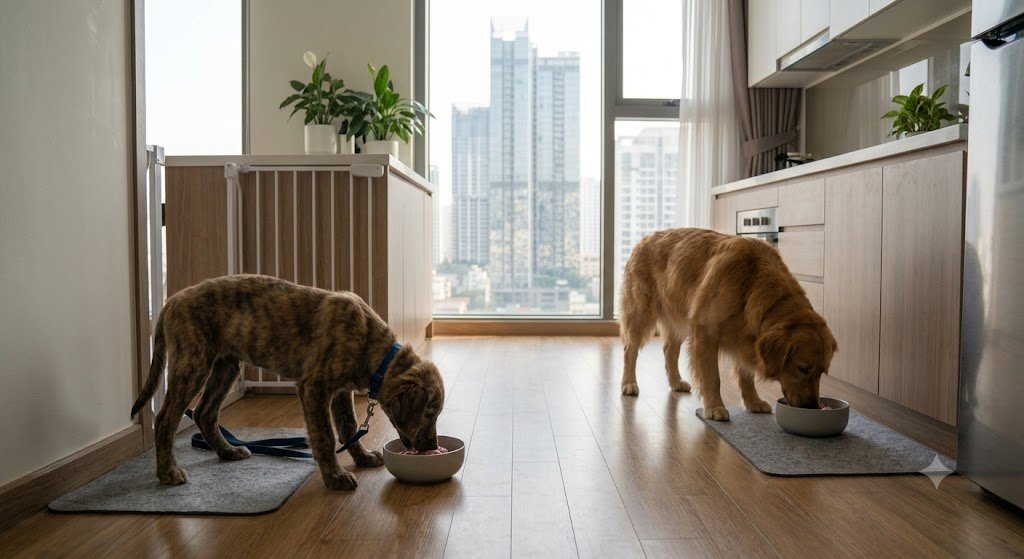
After the puppy eats, remember that a post-meal bathroom opportunity may be appropriate even if the older dogs have already gone outside.
Don’t Let the Other Dogs Control the Puppy Training Schedule
A common multi-dog mistake is waiting for the older dog to signal that it is time to go outside.
That may work for the adult dog, but the puppy may need a bathroom opportunity sooner.
Use the older dog’s schedule as a convenient framework, then add puppy-specific trips around waking, eating, sleeping, activity, and observed signals. If progress seems halted, follow our step-by-step diagnostic for what to do when house training stalls.
How to Teach a Puppy to Signal the Door With Other Dogs Around
Once the puppy begins reliably eliminating outside, you can start paying attention to its pre-potty signals.
Some puppies approach the door, sniff, pace, circle, whine, or look toward the owner. Others provide subtler signals.
Resident dogs can make this harder to observe because they may also approach the door for reasons unrelated to elimination.
For that reason, interpret the puppy’s signals in context rather than assuming every trip to the door means the same thing.
The Role of Supervision in a Multi-Dog Household
Supervision is not simply watching the puppy. It means being able to intervene before an accident is completed.
When the puppy is playing with other dogs, visual supervision can be more difficult because attention naturally shifts toward the group.
During the early training stage, use shorter play sessions, controlled spaces, and predictable potty breaks.
When Should You Increase the Puppy’s Freedom?
Do not increase freedom simply because the puppy has gone several days without an accident.
Look for a broader pattern of reliability across different situations, including after meals, after naps, during play, and when the household is active.
Then expand access gradually—one room, one area, or one situation at a time.
If accidents return, reduce freedom and increase supervision again. If nighttime errors occur, refer to our specialized protocol on why your puppy keeps having accidents overnight.
Multi-Dog House Training: What Not to Do
Do not assume imitation is enough
The puppy still needs individual teaching.
Do not let play replace potty time
Excitement can distract the puppy from eliminating.
Do not punish indoor accidents
Use accidents to improve management and timing.
Do not ignore the older dog’s accidents
The puppy can encounter the same contaminated area repeatedly.
Do not force dogs to train together
Separate training is appropriate when another dog causes distraction or conflict.
Do not expand freedom too quickly
Reliability should determine access.
A Practical Daily Routine for a Multi-Dog Home
The following example shows how a household can combine group routines with puppy-specific training.
| Routine | Puppy | Resident dogs |
|---|---|---|
| Morning wake-up | Immediate potty opportunity | Normal morning trip |
| Breakfast | Separate puppy meal if needed | Normal meal routine |
| Post-meal | Focused potty opportunity | Normal schedule |
| Play | Supervised interaction | Normal interaction |
| After nap | Potty first | No change required |
| Evening | Puppy-specific potty opportunities | Normal routine |
| Bedtime | Final potty opportunity | Normal bedtime trip |
What If the Puppy Is Doing Well Until Another Dog Comes Inside?
Changes in household activity can temporarily increase excitement and reduce the puppy’s ability to focus.
When guests, another dog, or a highly stimulating event occurs, temporarily return to closer supervision.
The goal is not to permanently restrict the puppy. It is to prevent a high-distraction environment from causing repeated accidents while the puppy is still learning.
When a Multi-Dog House Training Problem May Be Medical
A sudden change in elimination behavior deserves attention, particularly when a puppy that was previously doing well begins having frequent accidents without an obvious environmental explanation.
Signs such as unusually frequent urination, difficulty urinating, blood in the urine, diarrhea, vomiting, marked changes in thirst, lethargy, or other concerning symptoms warrant veterinary attention.
House-training advice should not be used to explain away a possible medical problem.
The Multi-Dog Puppy House Training Checklist
- Train the puppy as an individual.
- Use resident dogs as routine models, not as the entire training system.
- Take the puppy out after waking.
- Provide appropriate post-meal potty opportunities.
- Take the puppy out after naps and energetic play.
- Separate the puppy for focused potty trips when other dogs are distracting.
- Reward successful elimination immediately.
- Keep play after potty when possible.
- Clean indoor accidents thoroughly.
- Restrict access to repeatedly soiled areas.
- Do not punish accidents.
- Protect senior or low-energy resident dogs from excessive puppy interaction.
- Track which dog is responsible for accidents when necessary.
- Increase puppy freedom gradually.
- Reassess sudden changes in elimination with a veterinarian when appropriate.
Frequently Asked Questions
Can you house train a puppy with other dogs in the house?
Yes. A puppy can be successfully house trained in a multi-dog home. Resident dogs can provide useful routine cues, but the puppy still needs individual supervision, potty opportunities, and reinforcement.
Do puppies learn potty training from older dogs?
Puppies can learn household routines by observing older dogs, including following them outside. However, observation does not replace direct house training and reinforcement.
Should I take my puppy outside with my other dogs?
You can take them together when the puppy remains focused on eliminating. If the other dogs cause excessive excitement or distraction, give the puppy a separate potty opportunity before allowing group play.
Why does my puppy play outside instead of going potty?
Other dogs, smells, movement, and outdoor activity can distract a puppy. Give the puppy a calm potty opportunity first, reward successful elimination, and then allow appropriate play.
Can an older dog make puppy house training harder?
Yes, indirectly. An older dog may distract the puppy, create excessive excitement, or have indoor accidents that leave residual odors. Management and individual puppy training can reduce these problems.
What if my older dog has accidents in the house?
Clean accidents thoroughly, restrict the puppy’s access to repeatedly soiled areas, and manage the older dog’s bathroom needs separately. Persistent or sudden accidents in an adult dog may warrant veterinary evaluation.
Should I crate my puppy when the other dogs are loose?
A crate can provide a safe resting space when introduced appropriately, particularly when the puppy needs a break from active dogs. It should not replace appropriate bathroom opportunities, interaction, exercise, and rest.
How do I house train two puppies at the same time?
Train each puppy individually while also using group routines when practical. Track accidents by puppy, provide separate training opportunities when necessary, and avoid assuming that one puppy’s progress represents the other puppy’s progress.
When should I give my puppy more freedom around other dogs?
Increase freedom gradually after the puppy demonstrates reliable house-training behavior across different situations. If accidents return, reduce access and increase supervision again.
The Best Multi-Dog House Training Strategy
Use the older dogs to create the routine, but give the puppy its own training path.
A puppy living with other dogs does not need to be isolated from the household. It needs clear bathroom opportunities, controlled exposure to distractions, immediate reinforcement for successful elimination, and enough supervision to prevent repeated mistakes. When group routines and individual puppy training work together, the resident dogs become an advantage rather than a source of confusion.
