
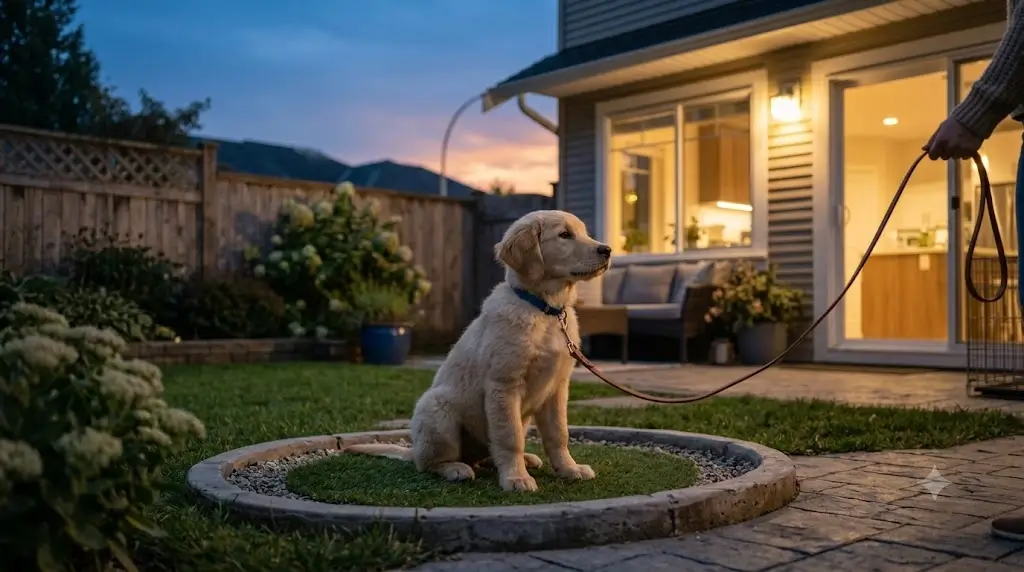
Puppy Won’t Go Potty Outside: Why It Happens & How to Fix It
If your puppy refuses to pee or poop outside and then has an accident shortly after coming indoors, the problem is usually about timing, environment, distraction or learned routine—not stubbornness. Here’s how to diagnose the pattern and build a more reliable outdoor potty routine.
If your puppy won’t go potty outside, make the outdoor trip calm, boring and predictable. Take the puppy to the same bathroom area, give it a focused opportunity to eliminate, and avoid immediately rewarding a failed trip with unrestricted indoor freedom. If the puppy does not go, supervise closely indoors and try again. Reward successful outdoor elimination immediately.
Why Won’t My Puppy Go Potty Outside?
A puppy can physically need to eliminate while still refusing to do it in the place you have chosen.
Outdoor environments contain far more competing information than a quiet indoor room. Cars, people, smells, sounds, grass, rain, insects and other animals can all change how a puppy behaves.
The most useful first step is to identify what happens immediately before the puppy gives up on the outdoor trip.
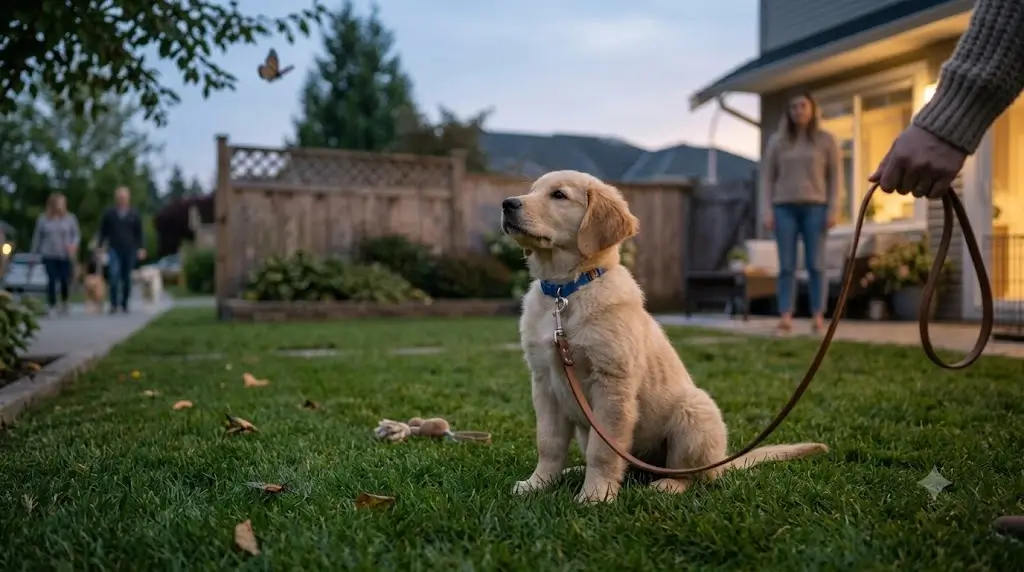
1. The puppy is distracted
A young puppy may treat the backyard or sidewalk as an exploration area rather than a bathroom.
If every outdoor trip turns into sniffing, chasing leaves, greeting people or playing, the puppy may never settle long enough to eliminate.
2. The puppy has not learned the outdoor location yet
House training requires more than taking a puppy outside. The puppy has to learn that a particular behavior—urinating or defecating—is desirable in a particular location.
Until that association becomes reliable, the puppy may eliminate wherever the urge becomes strong enough.
3. The outdoor environment is uncomfortable
Rain, cold surfaces, strong wind, loud traffic, unfamiliar dogs or a busy apartment entrance can make a puppy reluctant to remain outside.
A puppy that repeatedly runs back toward the door may be telling you that the environment is competing with the potty-training goal.
4. The puppy gets too much freedom after a failed potty trip
This creates a common pattern:
Outside → no potty → back indoors → freedom → accident.
The solution is not to punish the accident. The solution is to prevent the puppy from immediately rehearsing the indoor behavior.
5. The puppy simply does not need to go yet
Owners sometimes expect every trip outside to produce a pee or poop. That is not realistic.
Bathroom timing changes with food, water, sleep, activity and the puppy’s individual development.
6. The puppy has developed an indoor surface preference
Puppies can develop preferences for particular surfaces such as carpet, tile, pee pads or other familiar locations.
If a puppy has repeatedly eliminated on one surface indoors, grass or another outdoor surface may initially feel unfamiliar.
Why Does My Puppy Wait Until We Come Inside?
This is one of the most frustrating house-training patterns: you spend time outside, the puppy does nothing, you return indoors, and the puppy immediately urinates or poops. If you are struggling with this cycle, read our detailed guide on why your puppy goes outside but still has accidents.
The puppy may have been distracted outside, may not have felt comfortable enough to eliminate, or may have learned that indoor surfaces are the familiar bathroom location.
It does not mean the puppy is deliberately trying to make training difficult.
The “back inside and accident” pattern
Suppose the puppy needs to pee but spends ten minutes outside sniffing and watching the environment. You return indoors and allow unrestricted access to the living room.
The puppy may then choose a familiar indoor surface.
A better strategy is:
- Take the puppy to the designated potty location.
- Keep the trip calm and focused.
- If the puppy eliminates, reward immediately.
- If the puppy does not eliminate, return indoors.
- Supervise closely or use appropriate short-term confinement.
- Try the outdoor potty location again.
How to Get a Puppy to Potty Outside: Step-by-Step
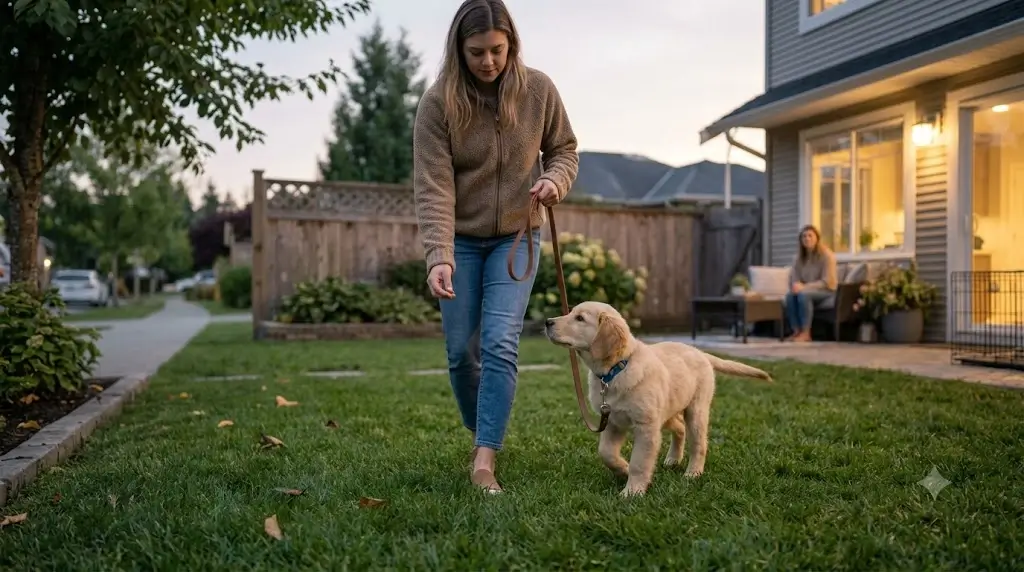
1 Choose one predictable bathroom location
When practical, take the puppy to the same area rather than changing locations every trip.
A consistent smell and surface can make the purpose of the trip easier to understand.
2 Go outside at the right times
Potty trips are especially useful after waking, after meals, after drinking, after active play and before bedtime.
The exact frequency should be adapted to the individual puppy.
3 Keep the puppy focused
During the initial bathroom opportunity, minimize games and unnecessary stimulation.
Give the puppy a chance to sniff and settle, but keep the purpose of the trip clear.
4 Reward immediately after elimination
Timing matters. Reward the puppy shortly after it successfully pees or poops outside.
The puppy can then begin associating outdoor elimination with a positive consequence.
5 Add play after potty when appropriate
For puppies that love outdoor exploration, making play the reward after successful elimination can be useful.
This creates a simple sequence: potty first, fun second.
Choose a Potty Location That Makes Sense for Your Puppy
Location is often overlooked.
A puppy that refuses to potty on a busy sidewalk may have no issue eliminating in a quiet patch of grass. Conversely, a puppy accustomed to grass may hesitate on concrete.
| Outdoor Situation | Possible Problem | Adjustment |
|---|---|---|
| Busy sidewalk | People, traffic and noise | Try a quieter location. |
| Wet grass | Uncomfortable surface | Use a sheltered area when possible. |
| Large open yard | Too many distractions | Start with a smaller designated area. |
| Apartment entrance | High activity | Find a calmer nearby potty area. |
| New neighborhood | Unfamiliar smells and sounds | Allow gradual acclimation. |
What If Your Puppy Won’t Potty Outside in the Rain or Cold?
Weather can change a puppy’s willingness to remain outdoors. A puppy may be willing to step outside but unwilling to stand on wet grass long enough to eliminate.
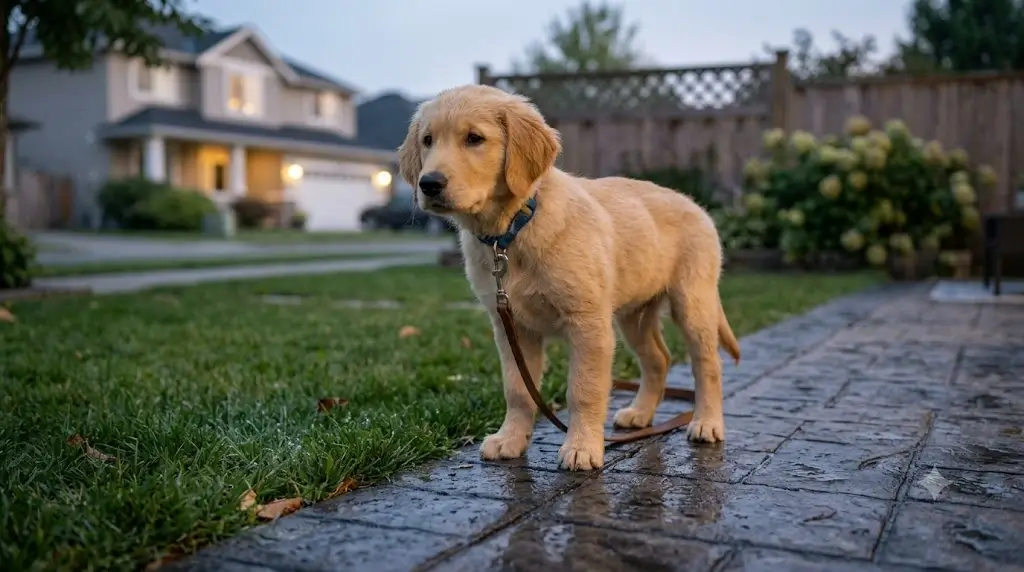
Make the bathroom location as practical as possible. A covered or sheltered area can help where available. Keep the trip focused rather than turning bad weather into a long outdoor session.
Do not force prolonged exposure to uncomfortable conditions.
Puppies have different tolerances for heat, cold, rain and other environmental conditions. When weather is extreme, prioritize safe conditions and follow appropriate veterinary or local animal welfare guidance.
What If My Puppy Won’t Poop Outside but Will Pee?
Peeing and pooping do not always occur on the same schedule. A puppy may urinate quickly and then want to return inside before defecating.
If poop is the recurring problem, give the puppy a little more focused opportunity after it has urinated rather than assuming the entire bathroom trip is finished. If unaddressed, this pattern can lead to late-night bowel accidents; see what to do when your puppy poops in the house at night.
If the puppy still does not poop, return indoors with close supervision and provide another opportunity later.
What If My Puppy Won’t Pee Outside but Pees Inside?
This pattern often indicates that the puppy has not yet formed a strong association between outdoor elimination and reinforcement. It can also happen when the puppy is distracted outside or uncomfortable with the environment.
Focus on predictable timing, a consistent location and immediate reinforcement when the puppy finally urinates outdoors.
When Should You Take a Puppy Outside to Potty?
There is no single schedule that fits every puppy. Instead, use predictable events as triggers for bathroom opportunities.
| Trigger | Why It Matters |
|---|---|
| After waking | A puppy may need to eliminate after sleeping. |
| After eating | Eating can stimulate bowel activity. |
| After active play | Activity can increase the need for a bathroom break. |
| After a significant drink | Increased fluid intake can affect urination timing. |
| Before bedtime | A final opportunity can reduce overnight accidents (learn how to handle it if your puppy wakes up to pee at night). |
| After returning from confinement | The puppy may need an immediate bathroom opportunity. |
How Long Should You Wait Outside for a Puppy to Potty?
The goal is not to make the puppy stand outside indefinitely. A better approach is a focused bathroom opportunity followed by a controlled response if the puppy does not eliminate.
If the puppy does not potty, go back indoors and prevent unsupervised access to the home. Then try again based on the puppy’s likely bathroom timing.
Think in cycles, not endurance:
Focused outdoor trip → successful potty → reward and freedom.
Or:
Focused outdoor trip → no potty → supervised indoors → repeat.
Should You Use a Potty Command?
A verbal cue can become useful after the puppy begins naturally eliminating outdoors. For example, choose a short phrase such as “go potty” and say it calmly while the puppy is already beginning to eliminate.
Over repeated successful repetitions, the phrase can become associated with the behavior. Avoid repeating the cue continuously when the puppy has no reason to eliminate.
8 Mistakes That Can Make Outdoor Potty Training Harder
Mistake #1: Turning every potty trip into playtime
The puppy may learn that going outside means exploring rather than eliminating.
Mistake #2: Giving complete indoor freedom after a failed trip
This creates an easy opportunity for an indoor accident.
Mistake #3: Punishing indoor accidents
Punishment can create confusion or anxiety without teaching the desired outdoor behavior.
Mistake #4: Changing the potty location constantly
A predictable location can make the bathroom task easier to understand.
Mistake #5: Rewarding too late
The longer the delay between elimination and reward, the less clear the association can become.
Mistake #6: Assuming “outside” automatically means “bathroom”
Puppies need to learn the specific behavior and location.
Mistake #7: Ignoring environmental stress
Fear, noise, weather and unfamiliar surroundings can affect elimination.
Mistake #8: Ignoring sudden changes in bathroom behavior
A sudden change can warrant consideration of a health issue rather than more intensive training.
Can a Crate Help When a Puppy Refuses to Potty Outside?
Appropriate confinement can help prevent the puppy from immediately eliminating indoors after a failed outdoor trip.
The principle is simple: if the puppy has not eliminated, it should not immediately receive unrestricted access to every room. If multiple indoor messes are already occurring daily, follow our management guide for when your puppy has too many accidents.
A crate can be one management option when introduced positively and used appropriately. It should never be used as punishment, and a puppy should not be expected to hold its bladder or bowels beyond what is reasonable for its developmental stage.
Puppy Won’t Go Potty Outside After Coming Home
A change in environment can temporarily disrupt bathroom habits. A puppy moving into a new home may be dealing with unfamiliar sounds, smells, surfaces, people and routines.
During the adjustment period, make the potty location especially predictable and keep the sequence consistent.
Puppy Won’t Potty Outside on Walks
Some puppies are more interested in exploring a walk than eliminating. If the puppy consistently refuses to potty during walks, separate the bathroom trip from the exercise walk when practical.
Take the puppy to a quiet designated location first. Once the puppy successfully eliminates, the walk can become the reward.
Puppy Won’t Potty Outside in an Apartment
Apartment living adds timing and access challenges. An owner may need to navigate elevators, hallways, stairs or building entrances before reaching the designated outdoor area.
During early house training, prepare the leash and necessary equipment before the puppy becomes desperate to eliminate.
If the building’s designated outdoor area is too far away for a young puppy to reach reliably, discuss a practical temporary bathroom strategy with your veterinarian or qualified trainer.
Puppy Suddenly Refuses to Potty Outside
A sudden refusal deserves more attention than a puppy that has never been reliable outdoors.
First look for environmental changes:
- New landscaping or construction.
- A new neighborhood dog.
- Heavy rain or extreme temperatures.
- A frightening sound or event.
- A change in household routine.
- A change in food or treats.
- A change in stool or urination.
If no obvious explanation exists and the behavioral change persists, consider a veterinary evaluation.
When a Puppy Not Pottying May Be a Medical Problem
Training advice is appropriate when a puppy is physically able to eliminate but has not learned where to do it. It is not appropriate to assume every refusal is behavioral.
Seek veterinary guidance when:
- The puppy repeatedly strains without producing urine or stool.
- The puppy appears painful or distressed when trying to eliminate.
- There is blood in urine or stool.
- Repeated vomiting occurs.
- The puppy becomes unusually lethargic or weak.
- Appetite changes significantly.
- Bathroom behavior changes suddenly and persists.
- You are concerned the puppy cannot physically eliminate.
A Simple 3-Day Reset for a Puppy That Refuses to Potty Outside
If the puppy is otherwise healthy and the problem is clearly behavioral, temporarily simplify the routine.
1 Day 1: Reduce variables
Use one primary bathroom location, predictable meal times and consistent potty-trip triggers.
2 Day 2: Reinforce every success
Immediately reward successful outdoor elimination. Keep a simple record of when the puppy pees and poops.
3 Day 3: Identify the pattern
Compare successful and unsuccessful trips. Look for the role of meals, sleep, play, weather, distractions and location.
The objective is not to force a puppy to eliminate on command. The objective is to create enough predictable successful repetitions that outdoor elimination becomes the puppy’s normal routine.
Bottom Line
When a puppy won’t go potty outside, don’t assume stubbornness. First determine whether the puppy is distracted, uncomfortable, unfamiliar with the location, not ready to eliminate, or receiving too much freedom after an unsuccessful potty trip.
Use a consistent bathroom location, predictable potty triggers, focused outdoor trips and immediate reinforcement after successful elimination.
If the puppy does not go, return indoors under close supervision rather than allowing immediate unsupervised access to the house. Then provide another opportunity.
Most importantly, distinguish a training problem from a potential health problem. Sudden or persistent changes, straining, pain, vomiting, blood, marked lethargy or an apparent inability to eliminate warrant veterinary attention.
Frequently Asked Questions
Why won’t my puppy go potty outside?
Common reasons include distraction, unfamiliar surroundings, weather, fear, inconsistent timing, insufficient outdoor focus and an established preference for eliminating indoors.
Why does my puppy wait until we come inside to pee?
The puppy may be distracted outside or may not yet understand that outdoors is the designated bathroom location. Supervised indoor time followed by another focused outdoor opportunity can help.
How long should I wait for my puppy to potty outside?
Give the puppy a calm, focused opportunity rather than turning the trip into an extended play session. If the puppy does not eliminate, supervise indoors and try again later.
Should I reward my puppy for going potty outside?
Yes. Immediate positive reinforcement after successful outdoor elimination helps strengthen the association between the bathroom behavior and the outdoor location.
What should I do if my puppy won’t pee or poop outside?
Keep the trip calm and focused, use a consistent bathroom area, return indoors under close supervision if the puppy does not eliminate, and provide another outdoor opportunity.
When should I worry if my puppy won’t potty?
Contact a veterinarian if the puppy appears unable to urinate or defecate, repeatedly strains, appears painful, develops vomiting or marked lethargy, has blood, or shows another concerning health change.
