
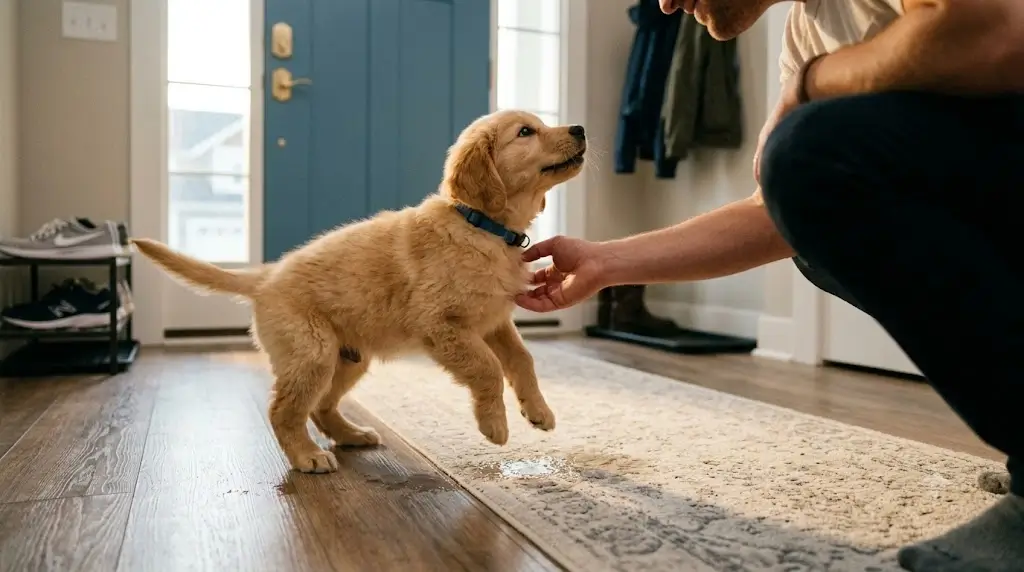
Puppy Pees When Excited: Why It Happens & How to Help
If your puppy pees during greetings, play, visitors or other exciting moments, the accident may be tied to arousal rather than a failure to understand where to potty. Learn how to recognize excitement urination, reduce predictable triggers and build calmer greeting routines.
Puppies can pee when they become highly excited, especially during greetings, play or when visitors arrive. The most useful response is usually management rather than punishment: give the puppy a bathroom opportunity before predictable excitement, keep greetings calm and brief, reward relaxed behavior and gradually teach the puppy that exciting situations do not require an uncontrolled burst of activity.
Why Does My Puppy Pee When Excited?
Some puppies urinate during moments of intense excitement. Common triggers include seeing a favorite person, greeting visitors, returning home, vigorous play or a sudden burst of attention.
Puppies are still developing bladder control and emotional regulation. A puppy that can normally use the correct bathroom area may still have difficulty maintaining control during a very stimulating interaction.
This is why the context of the accident matters.
If accidents happen almost exclusively when the puppy becomes excited, the training strategy should address both bladder timing and excitement level.
Excitement can happen very quickly
A puppy may remain dry while calmly resting and then have an accident within seconds of a highly stimulating greeting.
That pattern is different from a puppy that wanders around the house and repeatedly eliminates without a predictable trigger.
What Does Excitement Urination Look Like?
Look for a consistent relationship between the accident and a specific exciting event.
| Pattern | What It May Suggest | Useful Response |
|---|---|---|
| Pees immediately when you return home | Greeting excitement | Make arrivals quiet and predictable. |
| Pees when visitors approach | High arousal during social greetings | Lower greeting intensity and manage access. |
| Pees during energetic play | Overstimulation plus bladder timing | Use shorter play sessions and bathroom breaks. |
| Accidents happen throughout the day | May be broader house-training or medical issue | Review potty routine and consider veterinary guidance. |
| Sudden new urinary accidents | Possible change in health or routine | Investigate rather than assuming excitement. |
Is Excitement Peeing a House-Training Problem?
It can overlap with house training, but the two problems are not identical.
A puppy that has not yet learned a reliable bathroom routine may simply have accidents because it has waited too long. If your dog holds it inside and struggles once in the yard, see our guide for when your puppy won’t go potty outside.
A puppy that normally uses the correct bathroom location but repeatedly urinates only during intense greetings presents a different pattern.
“Does my puppy have accidents because it has not learned where to eliminate, or because a specific exciting situation causes a loss of control?”
The answer determines whether you need to focus primarily on potty scheduling, excitement management or both.
Excitement Urination vs. Submissive Urination
These behaviors can overlap, and owners sometimes use the terms interchangeably. The important point is to focus on the situation and the puppy’s body language rather than trying to assign a label from one accident.
Excitement-related urination is commonly associated with energetic greetings or high arousal.
Urination associated with social pressure can occur in different circumstances, such as when a puppy is approached or feels intimidated.
If the puppy appears uncomfortable, fearful or overwhelmed, reduce social pressure instead of increasing interaction.
Puppy Pees When You Come Home
Coming home can create one of the strongest predictable excitement triggers in a puppy’s day.
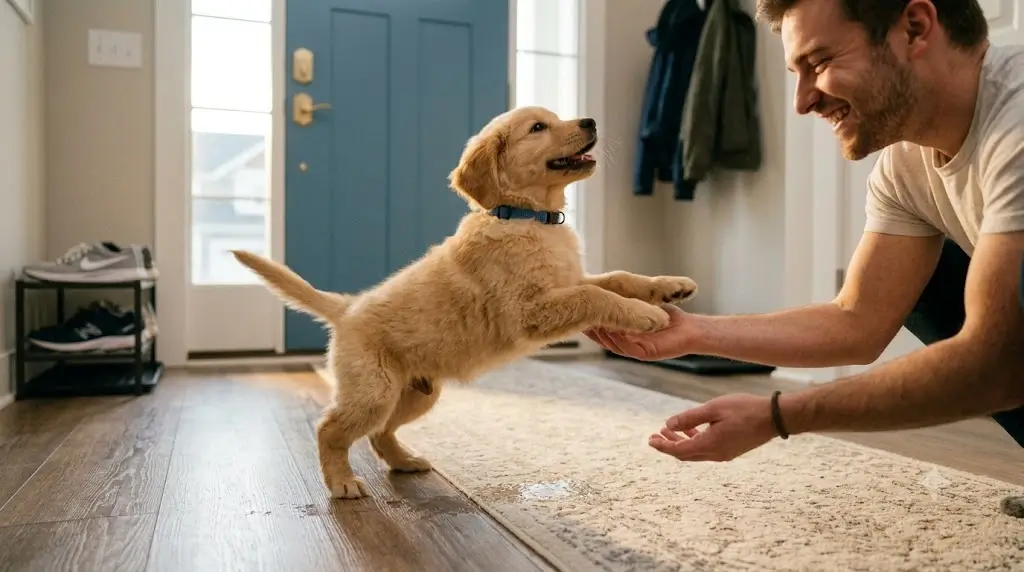
The puppy may hear the door, see you, run toward you, receive immediate attention and become highly aroused within seconds.
Change the first few minutes
Instead of turning the reunion into an immediate high-energy greeting, make the arrival routine boring and predictable.
- Enter calmly.
- Avoid immediately leaning over the puppy.
- Keep your voice and movements relaxed.
- If appropriate, take the puppy to its bathroom area promptly. If doorway hesitation occurs during these transitions, learn what to do when your puppy refuses to go outside.
- Give enthusiastic attention after the puppy has settled.
The goal is not to ignore the puppy indefinitely. It is to move the most intense part of the greeting away from the moment when an accident is most likely.
Puppy Pees When Visitors Come Over
Visitors introduce several exciting variables at once: doorbells, knocking, footsteps, unfamiliar smells, voices and direct attention.
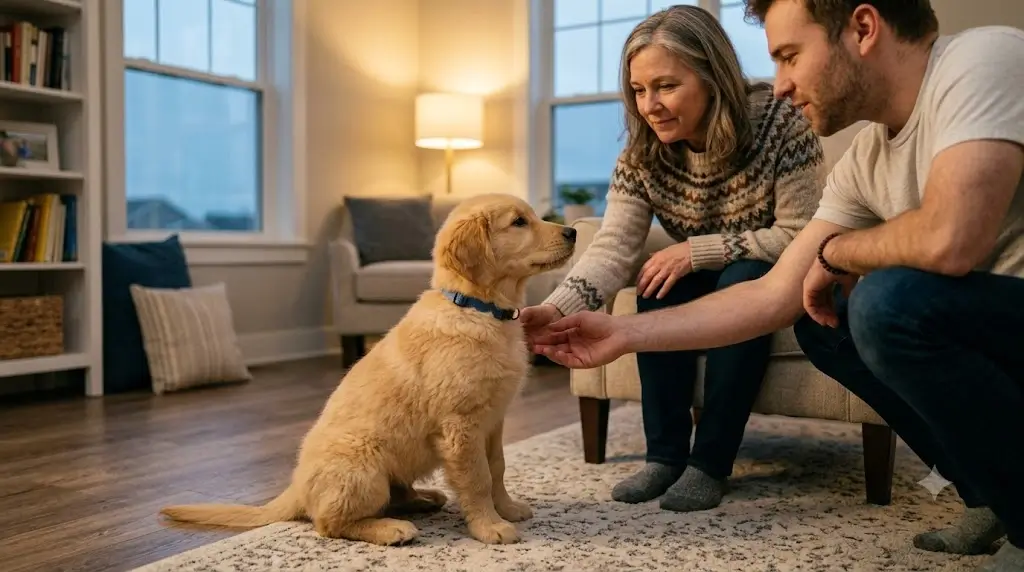
A puppy that is already close to its bladder limit may have an accident before the greeting even settles down.
Use a visitor routine
1 Bathroom opportunity first
If you know someone is coming over, give the puppy an appropriate opportunity to eliminate beforehand.
2 Control the first greeting
Avoid allowing a visitor to immediately rush toward or excite the puppy.
3 Reward calm behavior
Ask visitors to reinforce calm behavior rather than encouraging jumping, squealing or frantic interaction.
4 Increase interaction gradually
Once the puppy settles, normal petting and play can resume.
Puppy Pees During Play
Energetic play can make a puppy move, vocalize and interact continuously for several minutes. If the puppy’s bladder is already reasonably full, that extra activity may make an accident more likely.
You can reduce this by adding bathroom opportunities to the play routine.
Watch for the transition point
Some puppies become increasingly frantic as play continues. Instead of waiting until the puppy has an accident, interrupt the session while the puppy is still responsive and give it an appropriate bathroom opportunity.
Afterward, resume play at a slightly lower intensity.
Puppy Pees When People Pet It
Direct attention can be extremely exciting for a young puppy. Bending over the puppy, reaching toward its face, using a high-pitched voice and prolonged petting can increase arousal quickly.
Ask family members and visitors to interact more calmly during the early stages of training.
- Approach from the side rather than looming directly overhead.
- Keep the initial greeting brief.
- Use a calmer voice.
- Reward the puppy for standing or sitting calmly.
- Pause interaction if arousal becomes excessive.
Puppy Pees When Picked Up
Being lifted can produce a sudden combination of excitement, physical pressure and loss of control.
If your puppy repeatedly urinates when picked up, consider changing the sequence.
Give the puppy a bathroom opportunity before predictable handling, keep the lift calm and brief, and avoid making every pickup an intense social event.
If the puppy appears uncomfortable with being handled, do not assume the issue is simply excitement. Discuss persistent handling sensitivity with a qualified trainer or veterinarian.
How to Prevent a Puppy From Peeing When Excited
Prevention works best when you identify the situations that reliably produce accidents.
| Trigger | Before the Event | During the Event |
|---|---|---|
| Owner arrives home | Plan a bathroom opportunity. | Keep the greeting calm. |
| Visitors | Potty break before arrival. | Control greeting intensity. |
| Play | Consider recent bathroom timing. | Use breaks before over-arousal. |
| Children interacting | Explain the calm greeting routine. | Supervise and interrupt excessive excitement. |
| Training class or social event | Allow an appropriate bathroom opportunity. | Build in calm breaks. |
The 3-Part Strategy That Usually Works Best
1 Empty the bladder before predictable excitement
If you know a visitor is arriving or a play session is about to begin, don’t wait until the puppy is already highly excited.
2 Lower the intensity of the trigger
Quiet greetings, controlled movement and short interactions give the puppy a better chance of staying regulated.
3 Reinforce calm behavior
When the puppy can remain calm during a greeting, reward that behavior. Over time, calm behavior becomes part of the greeting routine.
Step-by-Step Training Plan for Excitement Peeing
Practice outside the most difficult real-life situations first. The goal is to teach the puppy what to do before the excitement reaches its peak.
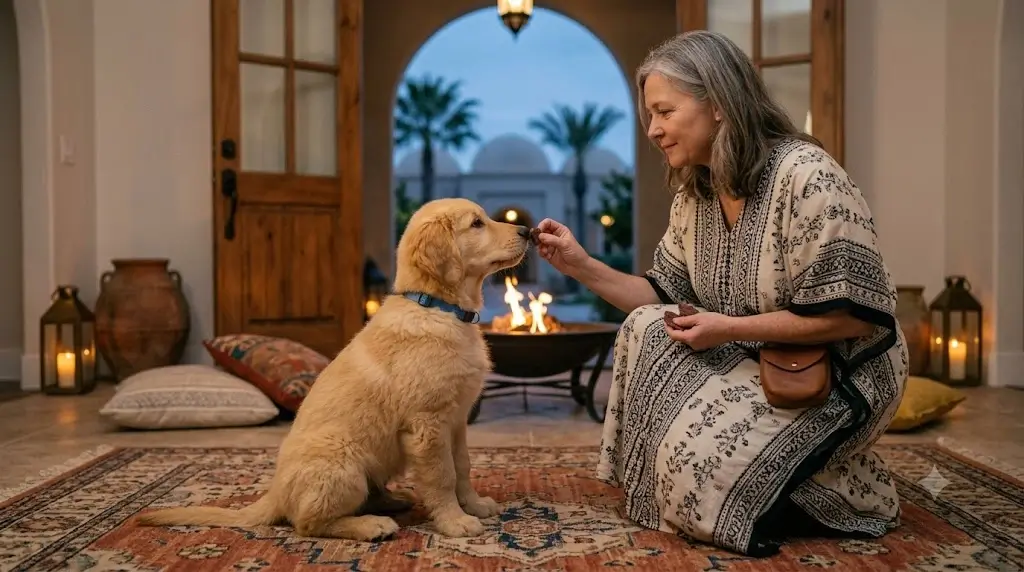
1 Teach a calm greeting indoors
Have a family member approach quietly. Reward the puppy for remaining relatively calm rather than immediately escalating into jumping or frantic movement.
2 Add movement
Practice the person leaving and returning without turning every repetition into a major event.
3 Increase greeting intensity gradually
Introduce slightly more exciting greetings only after the puppy can remain relatively calm at the easier level.
4 Practice with one familiar visitor
Give the visitor clear instructions before the puppy sees them. Consistency is important.
5 Generalize to different visitors
Once the routine works with familiar people, practice with different people and environments.
What Should Visitors Do?
Visitors can either help the training process or accidentally make the problem worse.
- Enter calmly.
- Do not immediately crowd the puppy.
- Keep voices moderate.
- Wait for the puppy to settle.
- Reward calm interaction.
- Follow the owner’s bathroom routine.
What If Your Puppy Is Excited Every Time Someone Comes Home?
Make the arrival sequence predictable.
For example, the routine can be:
- Person enters.
- Calm greeting.
- Puppy gets a bathroom opportunity if appropriate.
- Puppy returns indoors.
- Normal attention and play begin once the puppy is settled.
Repeating the same sequence reduces the novelty of the event and gives the puppy a predictable pattern to follow.
Should You Ignore Your Puppy?
Complete social isolation is not the goal.
The useful distinction is between calm attention and attention that increases arousal.
You can interact with the puppy while keeping your movements, voice and timing calm enough that the puppy has a chance to remain regulated.
Should You Punish a Puppy for Peeing When Excited?
No. Punishment does not teach the puppy how to regulate excitement or prevent the underlying trigger.
It can also make greetings and human interaction more stressful, especially if the puppy already feels uncertain during social situations.
Clean the accident without making it a major event, then modify the next greeting or play session.
How Long Does Excitement Peeing Last?
The pattern varies between puppies.
Young puppies often improve as bladder control, maturity and emotional regulation develop. Training and management can also reduce how often accidents occur.
Avoid promising a specific age when every puppy will stop. A better measure is whether accidents become less frequent and whether the puppy can remain calm during increasingly exciting situations.
When Excitement Peeing Is Not the Whole Explanation
If a puppy has accidents in many unrelated situations, do not assume excitement is the cause simply because a few accidents occurred during greetings. If overnight disruptions are also occurring, check how to handle when your puppy wakes up to pee at night.
Review:
- Bathroom frequency.
- Time since the last elimination.
- Water intake and routine changes.
- Supervision inside the home.
- Whether the puppy reliably eliminates outdoors.
- Whether accidents occur during sleep or rest.
- Whether urination appears painful or unusually frequent.
7 Mistakes That Can Make Excitement Peeing Harder to Manage
1. Waiting until the puppy is already frantic
Prevention is easier before arousal reaches its peak.
2. Letting visitors create chaotic greetings
A puppy cannot practice calm greetings if every visitor immediately turns the entrance into a high-energy event.
3. Skipping the bathroom opportunity
Even a puppy with good progress can have limited bladder capacity. Excitement can make timing more difficult.
4. Punishing the accident
The punishment does not teach an alternative behavior for the next greeting.
5. Making play too intense
Extremely energetic play can push the puppy beyond the level at which it can respond calmly.
6. Expecting perfect control immediately
Puppy development matters. Training should account for age, experience and current bladder control.
7. Ignoring a sudden change
A new urinary pattern deserves attention rather than automatically being classified as excitement urination.
When Should You Call a Veterinarian?
Excitement-related accidents can be part of puppy development, but urinary changes can also have medical causes.
- Urinary accidents suddenly become much more frequent.
- The puppy strains to urinate.
- The puppy appears painful when urinating.
- The puppy repeatedly attempts to urinate but produces little urine.
- There is blood or another unusual change in the urine.
- Excessive thirst or other significant changes appear.
- Accidents occur even when the puppy is relaxed and resting.
- The puppy develops other concerning symptoms.
A veterinarian can help determine whether the urinary behavior is related to development, training, environment or a medical issue.
A Simple Daily Routine to Reduce Excitement Accidents
| Situation | Recommended Routine |
|---|---|
| Morning | Bathroom opportunity before high-energy interaction. |
| Owner returns home | Calm greeting followed by appropriate bathroom access. |
| Before play | Consider whether the puppy is due for a bathroom break. |
| During energetic play | Use short breaks before arousal becomes excessive. |
| Before visitors arrive | Bathroom opportunity and controlled greeting setup. |
| After visitors settle | Allow normal interaction once the puppy is calmer. |
Want a Structured Puppy Training Plan?
If you are working on bathroom schedules, calming overstimulated greetings, and building reliable house training routines, check our complete guide.
Bottom Line
A puppy that pees when excited is not necessarily failing at house training. The pattern matters.
If accidents occur mainly during greetings, visitors or energetic play, focus on the predictable excitement trigger. Give the puppy a bathroom opportunity beforehand, lower the intensity of the interaction and reward calm behavior.
Do not punish the accident. Instead, change the circumstances that lead up to it and give the puppy repeated opportunities to practice calmer responses.
If urinary accidents become frequent, occur outside exciting situations or are accompanied by discomfort or other physical changes, veterinary guidance is appropriate.
Frequently Asked Questions
Why does my puppy pee when excited?
Some puppies urinate during highly exciting greetings, play or other stimulating situations. Young puppies may have less reliable bladder control and may also have difficulty regulating their response when arousal rises.
Is excitement peeing the same as a house-training accident?
Not necessarily. A puppy that reliably eliminates in the correct place but has accidents specifically during intense greetings may have a situation-specific problem rather than a general house-training failure.
How do I stop my puppy from peeing when excited?
Give the puppy a bathroom opportunity before predictable excitement, keep greetings calm, reduce intense interaction at first and reinforce relaxed behavior.
Why does my puppy pee when people come over?
Visitors can cause a rapid increase in excitement through doorbells, movement, voices and direct attention. A calm visitor routine can reduce the intensity of the greeting.
What is the difference between excitement urination and overnight house soiling?
Excitement urination happens instantaneously during high-energy social triggers like greetings. In contrast, overnight issues are tied to digestion timing, sleep cycles, or confinement management—see our full breakdown on why a puppy poops in the house at night.
When should I call a veterinarian about puppy accidents?
Contact a veterinarian when urinary behavior changes suddenly, accidents occur frequently without an obvious excitement trigger, urination appears painful or difficult, or other signs of illness are present.
