
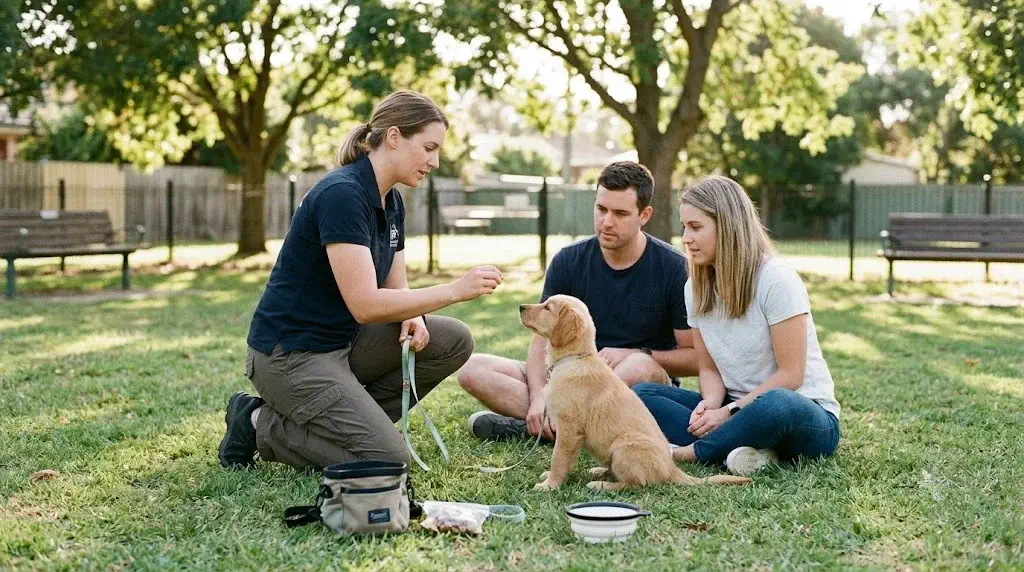
AKC & CCPDT TRAINING ROI BENCHMARKS 2026
Is a Puppy Training Program Worth It?
A professional puppy training program delivers high measurable return on investment by establishing systematic behavioral management and eliminating costly trial-and-error mistakes. Many handlers assume that buying a curriculum guarantees a fully reliable adult canine overnight, but an educational program functions primarily as human handler instruction rather than outsourced canine conditioning. Deciding whether a puppy training program is worth it requires balancing financial tuition and personal time commitments against the long-term domestic costs of unresolved carpet destruction, persistent indoor soiling, and chronic adolescent behavioral problems.
Quick answer: is a puppy training program worth the investment?
A structured puppy training program is exceptionally worth the investment (9.6/10 value score) when handlers require external accountability, expert behavioral troubleshooting, and structured socialization routines that self-guided research cannot provide.
DIY puppy training remains cost-effective for experienced owners with straightforward puppies, but professional instruction pays for itself immediately when household schedules conflict, potty training stalls past 14 weeks, or adolescent boundary challenges threaten domestic hygiene.
Quick Reference Specification: Puppy Training Program Modality Matrix
This calibrated pedagogical matrix benchmarks training modalities, typical capital investment, expert feedback loops, long-term success probabilities, and veterinary standards in 2026.
| Program Modality | Typical Capital Investment | Feedback & Coaching Loop | Long-Term Habit Retention | Veterinary Benchmark |
|---|---|---|---|---|
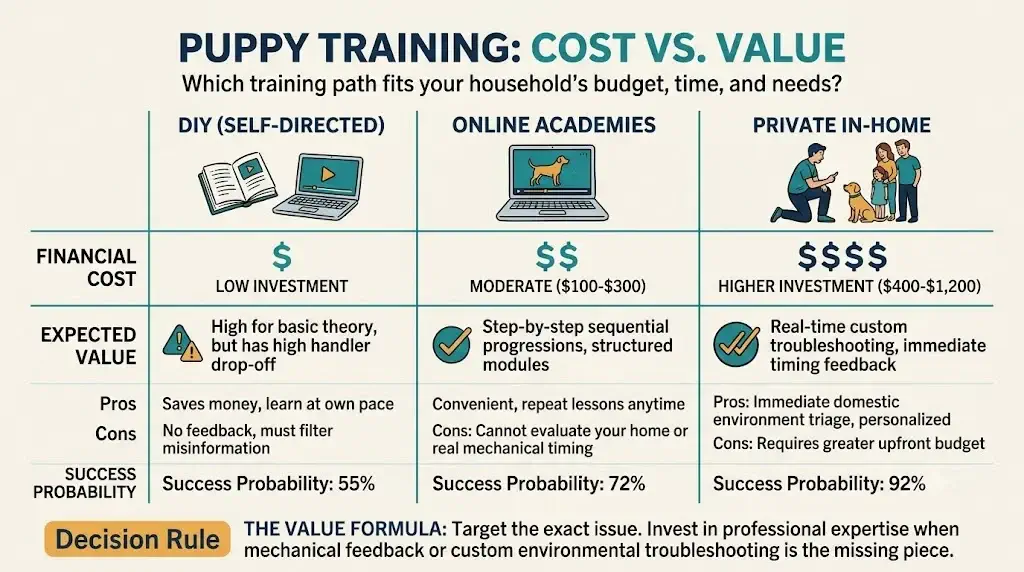
| Self-Directed DIY Protocol | $0 – $50 (Books & Free Guides) | Zero external feedback; self-evaluated | 55% (High handler drop-off) | AVMA Basic Owner Education |
| Structured Online Academy | $100 – $300 (Video Modules) | Asynchronous video review or community forum | 72% (Requires self-discipline) | Fear Free Canine Curriculum |
| Group Puppy Social Classes | $150 – $350 (6-Week Group Course) | Direct weekly trainer review with distractions | 82% (Excellent social proofing) | AKC S.T.A.R. Puppy Standard |
| Private In-Home Trainer | $400 – $1,200 (Custom Packages) | Real-time 1-on-1 domestic troubleshooting | 92% (Custom environmental fit) | CCPDT Professional Clinical Standard |
| Clinical Behavioral Specialist | $800 – $2,500+ (Medical Consults) | Comprehensive neurological & medical triage | 88% (Complex pathologies) | ACVB Veterinary Behavior Standard |
Editorial verdict
The strongest programs provide a repeatable management blueprint, explain why each step matters, and train handlers how to adapt when canine behavior diverges from theory.
Most worth it for
- First-time puppy owners without a baseline
- Demanding full-time working households
- Stalled housebreaking past 12 weeks
- Households with conflicting family rules
- Owners needing objective mechanical feedback
What Does a Puppy Training Program Actually Provide?
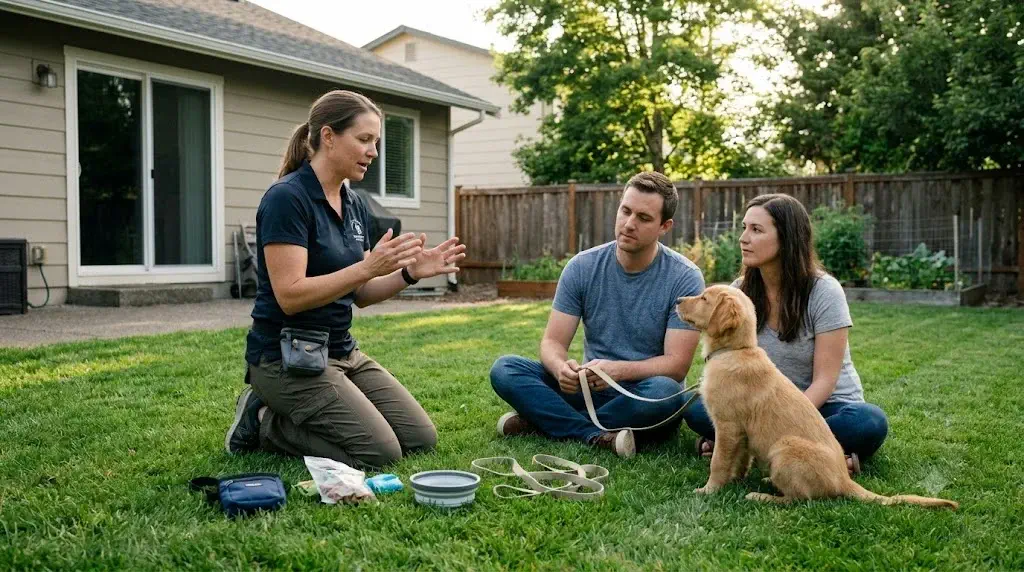
Professional puppy training programs provide structured handler education and environmental systems rather than mechanical canine command memorization. Inexperienced owners often purchase courses expecting a trainer to hand back an obedient dog, but professional programs function by coaching human handlers to identify subtle antecedent triggers and apply precise operant timing:
1. Daily Actionable Structure
Handlers follow a clear, daily curriculum instead of scouring social media forums whenever their puppy exhibits an unexpected behavior.
2. Behavioral Prioritization
An expert curriculum targets foundational life skills—like potty predictability and settling—before wasting cognitive effort on cosmetic party tricks.
3. Mechanical Handling Feedback
Direct coaching catches subtle handler mistakes, such as late treat delivery markers, leash tension, or poor body positioning, before bad habits take root.
4. Household Accountability
Scheduled check-ins prevent busy families from drifting away from training protocols when work commitments intensify.
5. Adaptive Troubleshooting
Evidence-based programs diagnose why a specific puppy failed to respond to a standard exercise, offering tailored adjustments immediately.
6. Environmental Management Education
Owners learn to configure domestic gates, crates, and exercise pens to physically block mistakes before they become ingrained habits.
For complete 24-hour routine frameworks, consult our comprehensive Puppy House Training Schedule.
When Is a Puppy Training Program Worth the Money?
A paid puppy training program justifies its cost when it eliminates chronic household frustration, persistent carpet destruction, and domestic management gridlock. Spending money on professional guidance becomes an obvious, high-return decision under specific domestic circumstances:
High-ROI Scenarios to Invest
- First-time owners feeling overwhelmed by conflicting internet advice.
- Housebreaking progress has stalled completely past 12 weeks of age.
- Family members use conflicting rules, cues, and confinement methods.
- A busy occupational schedule leaves zero time for trial-and-error research.
- The puppy shows early barrier anxiety, resource guarding, or fear.
Scenarios Where You Should Pause
- You have not yet maintained a basic 3-day umbilical routine.
- The curriculum makes unrealistic “100% trained in 7 days” claims.
- The trainer relies on leash corrections and shock collars on young puppies.
- The business cannot explain what post-session support is provided.
- The content uses generic dog advice that ignores pediatric canine needs.
When Is DIY Puppy Training Enough?
A self-guided DIY training approach succeeds when handlers possess ample daytime availability, consistent discipline, and an emotionally resilient puppy. Hiring a professional trainer is not an absolute requirement for every household, provided foundational management is executed cleanly:
- Predictable progress trajectory: Indoor carpet accidents decrease steadily week after week under your current schedule.
- Household handling unity: Every family member uses identical verbal cues, meal times, and confinement protocols.
- Sound emotional temperament: The puppy explores novel sights and sounds without extreme fear, freeze, or panic.
- Active learning capacity: The handler has time to read authoritative veterinary behavior resources and spot their own mistakes.
The DIY economic advantage:
Self-guided training saves direct capital outlay. However, the trade-off is clear: you bear 100% of the responsibility for filtering misinformation, building daily schedules, and identifying subtle management blind spots.
For working households balancing full-time employment with puppy care, review our operational guide on the Puppy Training Program for Busy Dog Owners.
Puppy Training Cost vs. Actual Value
Upfront program pricing reflects only initial tuition rather than the comprehensive return on behavioral investment. An inexpensive $20 video program that fails to address your puppy’s specific issues ends up costing far more in ruined rugs and stress than a $300 targeted coaching package that solves the problem in two weeks:
| Training Modality | True Practical Value | Inherent Operational Limitation | Ideal Household Fit |
|---|---|---|---|
| Free Online Guides & Videos | High for basic theory & cue mechanics | Conflicting advice; no real-time feedback | Disciplined owners who can self-direct |
| Structured Digital Courses | Step-by-step sequential progressions | Cannot evaluate your home environment | Visual learners needing daily structure |
| Group Socialization Classes | Controlled distraction proofing & peer play | Limited 1-on-1 problem troubleshooting | Puppies needing safe social exposure |
| Private In-Home Trainer | Immediate domestic environment triage | Higher initial financial expenditure | Households facing specific stalled issues |
Program Value = Problems Solved ÷ (Tuition + Time Invested + Friction)
This behavioral economic framework evaluates real-world value rather than simple sticker price.
What Should a Good Puppy Training Program Include?
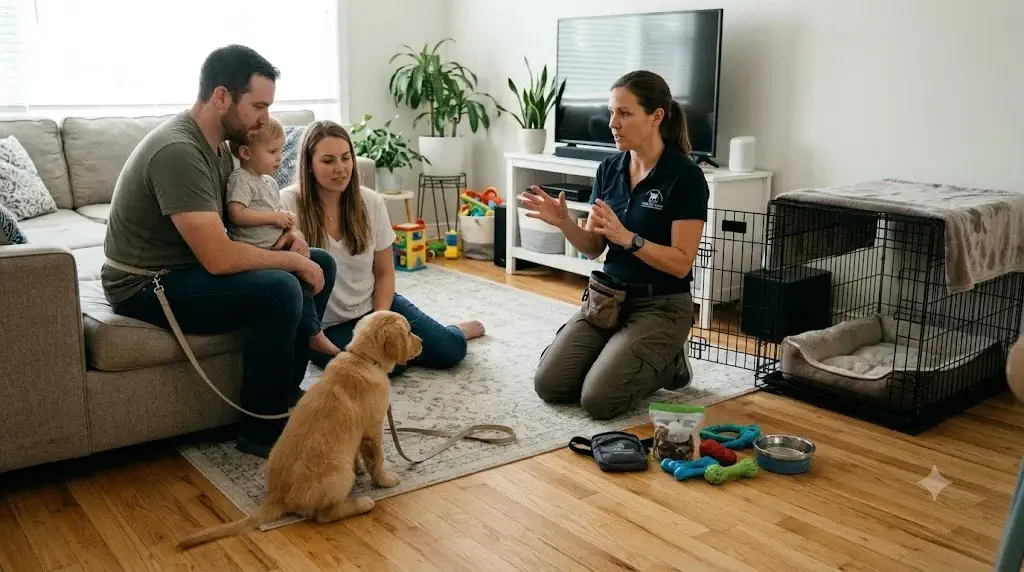
Comprehensive puppy training programs teach holistic domestic management alongside fundamental operant response cues. Look past basic obedience tricks and ensure the curriculum covers the core behavioral foundations that govern daily life:
Housebreaking Protocols
Rigid scheduling matrices, digestive transit windows, nighttime crate den setups, and bio-enzymatic cleaning strategies.
Confinement & Management
Step-by-step plans for introducing crates and exercise pens so the puppy learns to rest comfortably without barrier panic.
Reinforcement Mechanics
Precise instruction on reward timing markers, high-value treat delivery, fading food lures, and avoiding accidental bribes.
Everyday Life Communication
Instant name orientation, doorway threshold patience, loose-leash following, and a clear release cue.
Stationary Calmness Conditioning
Teaching an off-switch through mat settling and independent chew enrichment rather than keeping the puppy constantly revved up.
Controlled Social Exposure
Safe, low-stress exposure to novel surfaces, sounds, unfamiliar people, and neutral animals during critical developmental windows.
A Program Should Teach You How to Adapt
High-quality canine education teaches handlers an adaptive decision-making process rather than enforcing a rigid checklist. If a generic schedule tells you to take your puppy out every two hours, but your dog consistently has accidents at the 90-minute mark, a good program explains how to interpret that data and adjust:
The Adaptive Feedback Loop:
Observe Behavior → Interpret Biological Data → Tighten Environmental Management → Reinforce Clean Repetition
This dynamic process applies across all puppy skills—from leash manners to alone-time progressions. When an exercise breaks down, you learn how to adjust criteria rather than resorting to unproductive frustration.
Puppy Training Program Red Flags
Marketing claims offering guaranteed timelines or quick fixes signal substandard training practices. Protect your puppy’s emotional well-being and your wallet by steering clear of programs that display these clear warning signs:
| Marketing Red Flag | Underlying Operational Risk |
|---|---|
| “100% Fully Trained in 7 Days” | Ignores pediatric bladder development and canine neurobiology; sets handlers up for false expectations. |
| Guaranteed Behavioral Outcomes | Violates professional ethics (CCPDT/APDT); no ethical trainer can guarantee living animal behavior. |
| One Rigid Formula for Every Puppy | Fails to accommodate individual variations in breed temperament, holding endurance, and living environments. |
| Heavy Reliance on Aversives or Punishment | Using prong collars, slip chains, or scolding on young puppies triggers fear, avoidance, and defensive aggression. |
| Vague or Unverifiable Credentials | Trainers lacking recognized credentials (such as CPDT-KA, KPA-CTP, or IAABC) often lack formal education in animal learning theory. |
For proven behavioral protocols to eliminate repeat indoor accidents, review our guide on How to Prevent Repeat Puppy Accidents.
Online vs. In-Person Puppy Training: Which Is More Worth It?
Training delivery format determines whether you receive structured curriculum efficiency or real-time mechanical feedback. Choosing between online courses and in-person instruction depends entirely on where your household needs the most support:
Online Digital Programs
- Self-paced; learn around unusual work shifts.
- Revisit video demonstrations as often as needed.
- Significantly lower initial tuition cost ($100–$300).
- Excellent for learning foundational management theory.
Main Limitation:
No professional eyes on your home environment or hands-on mechanical timing.
In-Person Professional Coaching
- Real-time critique of treat delivery and leash handling.
- Direct evaluation of household setup and gates.
- Controlled socialization around novel distractions.
- Custom troubleshooting tailored to your family’s routine.
Main Limitation:
Higher capital expenditure ($400–$1,200) and fixed scheduling requirements.
Are Puppy Training Classes Worth It?
Group puppy socialization classes provide controlled environmental distraction exposure that cannot be replicated at home. A puppy that sits reliably in a quiet living room often struggles in public; group classes offer safe, controlled practice around unfamiliar dogs, people, and novel sounds:
However, class quality varies dramatically. A crowded class of twelve puppies with an uncertified instructor shouting over chaos provides minimal learning value. Seek out small classes (four to six puppies maximum) run by certified positive-reinforcement trainers who prioritize calm disengagement over uncontrolled roughhousing.
Is a Private Puppy Trainer Worth It?
Private in-home training delivers the highest diagnostic value when problems are tied directly to your physical household layout. If your puppy struggles with an issue that happens only inside your residence, an in-home session cuts straight to the root cause:
- A bathroom routine that repeatedly fails despite frequent outdoor trips.
- High-rise apartment challenges, such as elevator transit delays and communal hallway accidents.
- Severe boundary distress or frantic screaming during initial crate confinement.
- Multiple family members disagreeing over rules, leading to mixed signals and confusion.
For high-rise and condominium dwellers, review our specialized framework for Puppy Training Program for Apartment Living.
Is a Puppy Training Program Worth It for Potty Training?
Housebreaking represents the highest return on investment for structured professional programs because success depends on strict environmental timing. A puppy cannot grasp indoor cleanliness through casual guesswork; housebreaking requires a systematic management loop:
- Predictable interval mapping: Establishing trip intervals based on age, bladder volume, and digestive latency.
- Transition intercept protocols: Escorting outside immediately after waking, eating, and active play.
- Substrate conditioning: Building an exclusive sensory preference for natural outdoor grass or turf.
- Systematic freedom progression: Expanding living room boundaries only after verified accident-free streaks.
For age-based bathroom holding expectations, consult our master guide on How Often Should You Take a Puppy Outside?
Are Training Programs More Valuable for Busy Puppy Owners?
Busy handlers gain substantial value from structured training programs that distill complex behavioral theory into clear daily routines. When your day is packed with corporate shifts, family duties, and commutes, you don’t need endless theory—you need a reliable checklist that tells you what matters today:
High-Value Program Asset
An integrated occupational framework that syncs meals, naps, relief breaks, and 3-minute micro-training into your existing workday.
Low-Value Program Asset
An unwieldy 50-hour video library of complex obedience drills that demands hours of practice you don’t have.
What About a “7-Day Puppy Training Program”?
Accelerated seven-day programs deliver high diagnostic value when treated as an intensive management foundation rather than a biological finish line. One week of concentrated effort cannot force an eight-week-old puppy’s internal sphincters to mature overnight, but an intensive sprint quickly establishes clean routines:
- Synchronizes feeding times with outdoor gastrocolic bowel movements.
- Accumulates dozens of clean outdoor relief repetitions on natural turf.
- Stops habitual indoor carpet soiling through 100% umbilical tethering.
- Reveals your puppy’s individual digestive and urinary timing patterns.
For a detailed breakdown of accelerated sprint expectations, read our full review on Can You House Train a Puppy in 7 Days?
Is a Puppy Training Program Right for You?
Objective domestic evaluation clarifies whether self-guided DIY training or professional coaching best fits your household. Use this 6-question decision framework before spending money:
The 6-Question Value Evaluation Matrix
If yes, a self-guided DIY protocol may be entirely sufficient.
If family members use conflicting rules, external structure provides huge value.
If accidents have stalled past 12 weeks, seek professional coaching.
If issues occur only in your home or elevator, hire an in-home private trainer.
Choose an occupational micro-session plan built for working households.
If a course teaches only rigid drills without explaining why, skip it.
The Best Way to Buy Puppy Training Without Wasting Money
Targeted purchasing decisions align professional services directly with specific behavioral gaps. Avoid overpaying for bloated training packages by following these practical buyer rules:
- Target the exact issue: Don’t buy a 6-week obedience package if your sole challenge is midday crate screaming.
- Confirm the support channel: Determine upfront whether tuition includes direct phone/video check-ins or just prerecorded content.
- Audit training methodology: Verify that the trainer uses positive, reward-based methods aligned with AVSAB standards.
- Verify credentials: Look for independent, accredited certifications like CPDT-KA, CBCC-KA, KPA-CTP, or IAABC.
- Dismiss absolute guarantees: Walk away from anyone guaranteeing a 100% reliable dog by a calendar date.
- Start with the smallest effective service: A single 90-minute in-home consultation often solves domestic setup problems.
- Track behavioral results: Monitor daily accident logs and leash responses to verify that training is working.
How to Measure Whether the Program Is Actually Working
Concrete behavioral data provides an objective measure of training progress rather than subjective owner optimism. Evaluate program value by tracking tangible changes on your kitchen log sheet:
| Behavioral Domain | Primary Objective Metric | Demonstrated Program Success Benchmark |
|---|---|---|
| Housebreaking | Accident frequency and outdoor voiding speed | 80–90% accident reduction; voids within 90s of reaching grass. |
| Leash Manners | Tension episodes during doorway departures | Walks on a loose lead without frantic pulling or lunging. |
| Attention & Orientation | Latency to eye contact upon hearing name cue | Orients toward handler within 2 seconds across moderate distractions. |
| Settling Capacity | Duration of calm relaxation on designated mat | Settles quietly on dog bed for 20+ minutes during human work calls. |
| Solitary Independence | Time elapsed before vocal protests in crate/pen | Rests quietly in den confinement for standard age-based durations. |
Puppy Training Is an Owner Skill, Too
Long-term canine success depends upon educating the human handler in animal learning theory and environmental control. The biggest hidden benefit of a top-tier puppy program is that it transforms how you think as an owner:
You begin to recognize the vital difference between a puppy that does not understand a cue, a puppy that is overstimulated, and a puppy whose environment made success impossible. This knowledge lasts long after classes finish, equipping you to resolve new challenges throughout your dog’s life.
Lifelong educational value:
An elite training program leaves you confident and capable of solving everyday behavior challenges on your own, rather than keeping you dependent on a trainer for years.
When a Puppy Training Program Is Not Enough
Clinical canine behavioral pathologies require specialized veterinary medical evaluation rather than standard puppy obedience courses. Some behavioral challenges cannot and should not be addressed through a basic puppy training class:
Do not delay veterinary triage for safety concerns:
If your puppy shows intense fear-based defensive biting, resource guarding with growling and snapping, panic-level separation distress, or sudden behavioral changes, consult a Board-Certified Veterinary Behaviorist (DACVB) or your veterinarian. A generic obedience course cannot diagnose underlying neurological or medical issues.
Final Verdict: Is a Puppy Training Program Worth It?
A structured puppy training program is well worth the investment when it provides actionable structure, external feedback, and practical troubleshooting that resolve real-world problems. Professional programs deliver immense value when they give you clear daily routines, coach your mechanical timing, and help you get housebreaking back on track.
However, buying a course cannot replace daily consistency. Your puppy still learns through hundreds of everyday interactions in your home.
The final decision principle:
Invest in professional expertise when expert troubleshooting and accountability are the missing pieces in your routine. Do not buy a program simply because marketing promises an effortless shortcut.
Frequently Asked Questions
Is a puppy training program worth it?
Yes, particularly when it provides daily structure, expert feedback, and troubleshooting tailored to your living situation. It is less valuable when it offers generic, one-size-fits-all advice with no personal support.
Is it cheaper to train a puppy yourself?
DIY training reduces upfront financial costs, but it requires substantial time, self-discipline, and reliable information. Mistakes that lead to ruined carpets or adolescent reactivity often cost more in the long run.
When should I hire a puppy trainer?
Hire a trainer when housebreaking stalls past 12 weeks, family members use conflicting methods, daytime work schedules leave little room for error, or the puppy shows early signs of fear or guarding.
Are puppy training classes worth the money?
Yes. Well-run group classes provide controlled socialization and real-world distraction practice that cannot be matched at home, helping puppies learn to focus around other dogs.
Can an online puppy training program work?
Online programs excel at teaching management theory and visual mechanics at your own pace. Their primary limitation is the lack of real-time coaching on your physical home setup.
What should a good puppy training program include?
A strong program covers housebreaking schedules, crate den management, positive reward mechanics, doorway manners, mat settling, controlled socialization, and clear troubleshooting steps.
How long does a puppy training program take?
Standard foundation programs run four to six weeks. However, true reliability develops over months as your puppy matures physically and encounters new environments.
What is a red flag in a puppy training program?
Red flags include guaranteed results by a specific date, one-size-fits-all methods, using leash corrections on young puppies, vague credentials, and zero post-purchase support.
Is professional puppy training necessary for every dog?
No. Experienced owners with straightforward puppies can teach foundational manners themselves. Professional help becomes essential when progress stalls or household routines break down.
Start With the Exact Problem You Need to Solve
Puppy training works best when the plan matches your puppy, your home layout, and your real daily calendar.
Explore our comprehensive library of schedules, training programs, and troubleshooting guides to establish reliable habits without wasting money.
Editorial references
- American Kennel Club — How to Potty Train a Puppy
- American Kennel Club — Puppy Socialization
- VCA Animal Hospitals — House Training Your Puppy
This article provides general educational information and does not replace individualized veterinary or professional behavior advice.
