
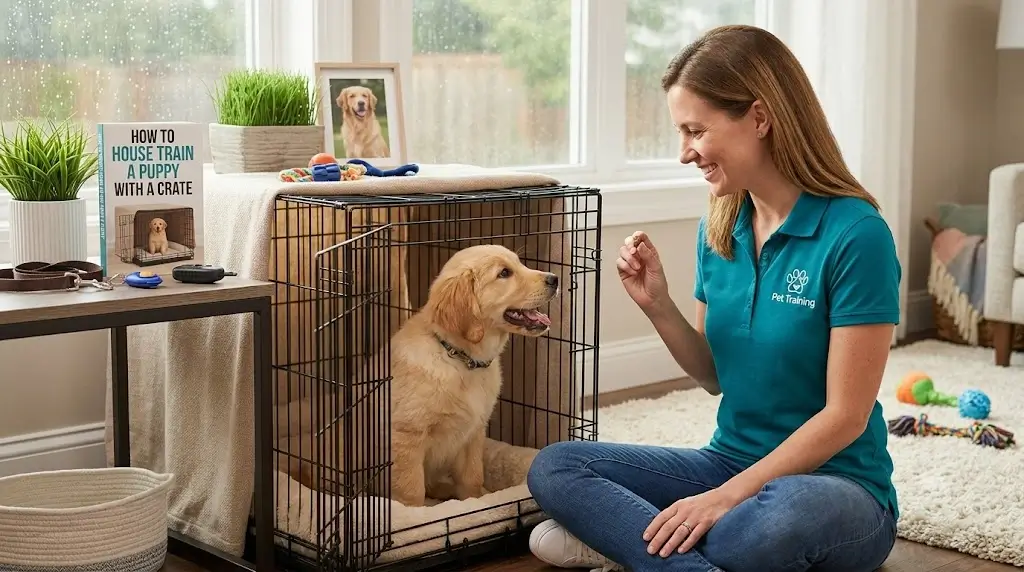
How to House Train a Puppy With a Crate
Crate training can make house training more manageable by controlling
unsupervised access to the home and creating predictable transitions
between rest, bathroom trips, rewards, and supervised activity. This
guide shows how to use a crate as part of a complete puppy house-training
system without relying on excessive confinement.
Quick Answer: How Do You House Train a Puppy With a Crate?
Use the crate as a management tool, not as the entire training method.
Introduce the crate positively, establish predictable bathroom opportunities, take your puppy to the designated bathroom location after crate rest, reward successful elimination immediately, supervise the puppy during free activity, and gradually increase household freedom as reliability improves.
The core cycle is:
Bathroom → Reward → Supervised Freedom → Crate Rest → Bathroom → Reward.
Timing must be adjusted for each puppy. A crate does not provide unlimited bladder control and should never be used to avoid necessary bathroom breaks.
How Crate-Based House Training Works
House training becomes easier to manage when the puppy’s environment matches its current level of reliability.
A young puppy with unrestricted access to every room has frequent opportunities to eliminate without notice. A puppy resting comfortably in an appropriately introduced crate cannot wander or rehearse unwanted bathroom habits.
When the puppy leaves the crate, you can immediately direct the next step: a controlled bathroom opportunity.
| Part of the process | Purpose |
|---|---|
| Crate | Provides controlled rest and limits unsupervised access. |
| Bathroom trip | Provides the opportunity to eliminate in the desired location. |
| Reward | Reinforces successful elimination in the desired location. |
| Supervision | Reduces the chance of an accident during free activity. |
| Gradual freedom | Matches household access to the puppy’s reliability. |
What to Do Before You Start
Successful crate house training begins before the puppy spends any meaningful time inside the crate. Prepare the environment so the puppy moves from crate to bathroom location quickly and consistently.
Prepare these five things:
- An appropriately sized crate.
- A clearly defined bathroom location.
- A predictable daily routine.
- Small, high-value rewards for successful behavior.
- A plan for supervision when the puppy is outside the crate.
If your home has multiple exits, pick one consistent route to use during the early stages.
Choose the Right Crate Size
The crate should allow the puppy to stand, turn around, lie down, and reposition comfortably. It should not be large enough to serve as separate sleeping and elimination zones.
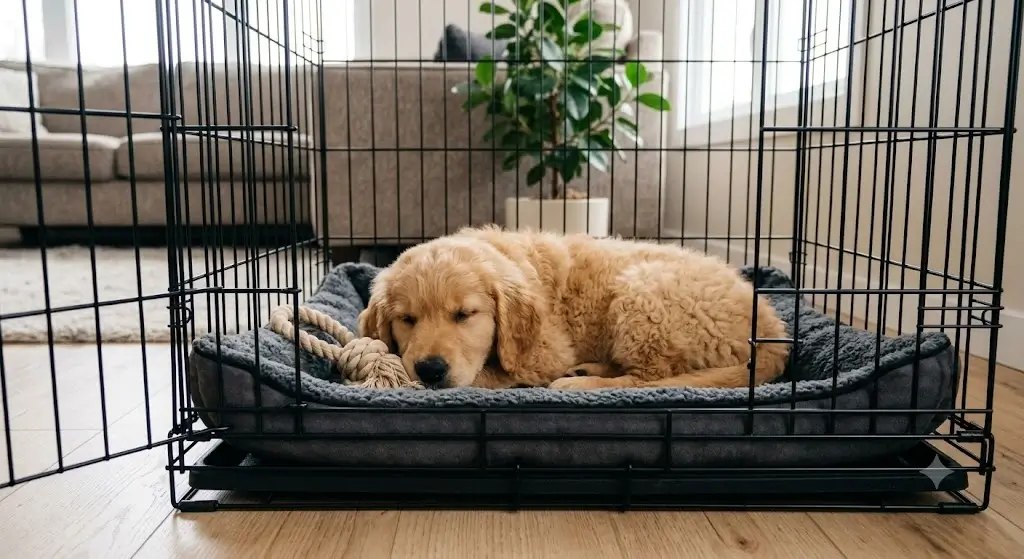
| Crate feature | What to look for |
|---|---|
| Length | Enough space to lie down fully and change position comfortably. |
| Height | Enough headroom for normal standing posture. |
| Width | Enough room to turn around without restriction. |
| Growth adjustment | A divider panel to adjust usable space as the puppy grows. |
Check manufacturer sizing guidance against your puppy’s current measurements and expected adult build.
Introduce the Crate Before Using It for House Training
Do not make the first crate experience a long confinement. The puppy must first learn that entering the crate is safe and rewarding.
- Leave the door open: Allow the puppy to investigate the crate at its own pace.
- Create positive associations: Offer high-value treats, meals, and calm praise inside the crate.
- Practice brief door closures: Close the door for a few seconds while the puppy is calm, then open it before distress begins.
- Increase duration gradually: Extend crate time in small, manageable increments.
- Practice while nearby: Teach the puppy that crating does not signal your immediate disappearance.
Choose One Bathroom Location
The puppy needs a clear answer to one simple question: Where should I go?
Pick a single designated outdoor spot—such as a specific patch of grass in the yard or a designated relief zone outside an apartment complex. Consistency accelerates recognition and habit formation.
Build a Puppy Crate House-Training Schedule
Structure your schedule around natural biological transition points rather than a rigid, arbitrary timer.
| Trigger | What to consider |
|---|---|
| Immediately after waking | Sleep lowers body activity; waking triggers bladder urgency. |
| After eating | The gastrocolic reflex stimulates elimination shortly after meals. |
| After drinking | Fluid intake quickly increases bladder fullness in puppies. |
| After active play | Physical exertion accelerates digestive and urinary activity. |
| Before bedtime | A final trip ensures an empty bladder before overnight rest. |
| Immediately after crate rest | Transition directly to the relief area before granting free movement. |
For a complete template, refer to the Puppy House Training Schedule.
Step-by-Step: How to House Train a Puppy With a Crate
- Take the puppy to the bathroom location: Start each cycle with an immediate opportunity to eliminate.
- Reward successful elimination: Praise and reward immediately when the puppy finishes.
- Allow supervised activity: Provide supervised playtime, training, or exploration.
- Watch for bathroom signals: Look for sniffing, circling, pacing, or sudden detachment from play.
- Use the crate for rest: Settle the puppy into the crate for an appropriate nap or downtime.
- Take the puppy outside immediately after rest: Move directly from the crate to the bathroom area.
- Repeat consistently: Predictable repetition reinforces the entire habit loop.
Core cycle
Bathroom → Reward → Supervised Freedom → Crate Rest → Bathroom → Reward
What to Do After Your Puppy Leaves the Crate
The transition out of the crate is critical. Never release a puppy from rest directly into unrestricted house exploration.
- Open the crate calmly without overexcitement.
- Guide or carry the puppy straight to the bathroom area.
- Give the puppy 3–5 minutes to eliminate.
- Reward immediately upon completion.
- Begin supervised indoor activity.
How to Reward Outdoor Potty Success
Puppies learn via immediate association. Reinforce the behavior within 1–2 seconds of completion.
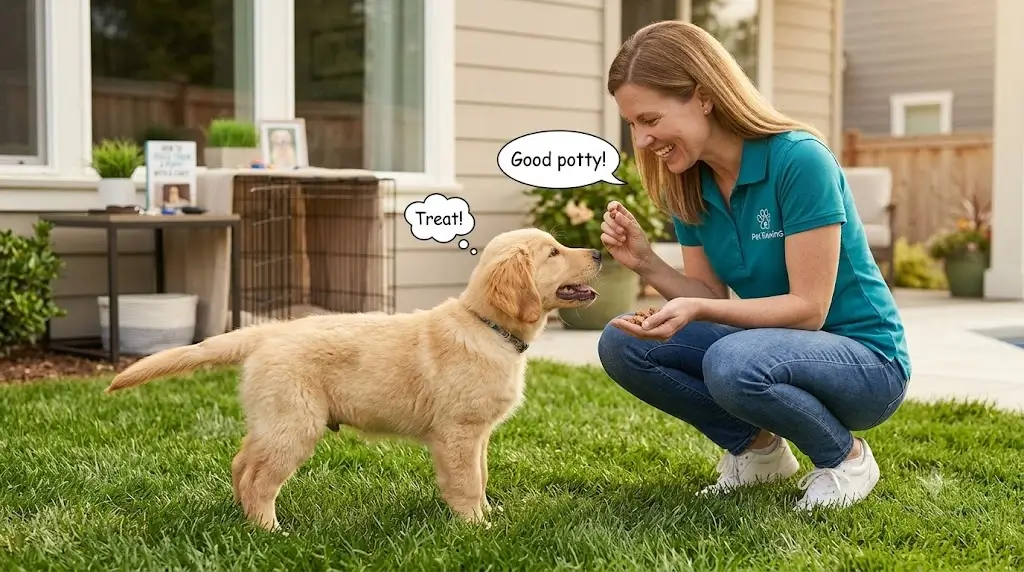
After rewarding, spend an extra 1–2 minutes exploring or playing so the puppy does not associate going potty with the immediate end of outdoor fun.
Supervise Your Puppy After Bathroom Trips
A successful bathroom trip is not a blank check for full house access. Keep the puppy within direct eyesight.
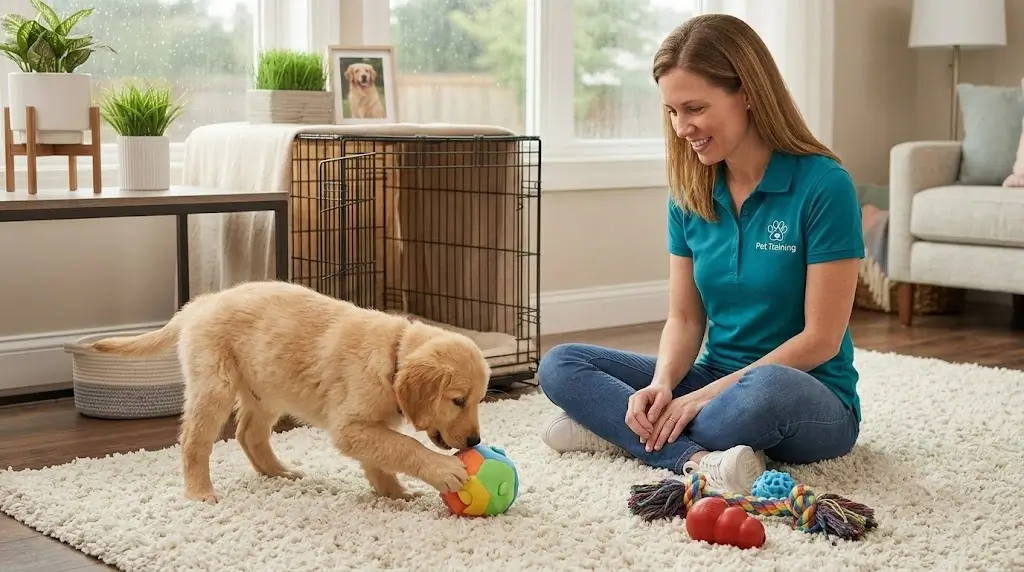
Useful management tools:
- Active eyes-on supervision in the same room.
- Puppy-proofed playpens or baby gates.
- The “umbilical cord” method (attaching a light leash to your waist).
- Keeping doors closed to unused rooms.
Gradually Increase Freedom
Expand household freedom only as the puppy demonstrates sustained reliability.
| Stage | Management approach |
|---|---|
| Early training | Single room + 100% active supervision + crate rest. |
| Improving reliability | Expanded multi-room supervised area. |
| Consistent success | Short intervals of semi-independent exploration. |
| Strong reliability | Full household access with standard routines. |
If accidents increase after granting more space, temporarily scale back to the previous successful stage.
Using a Crate to House Train a Puppy at Night
A crate provides a safe sleeping space and alerts you when the puppy wakes up needing relief.
- Wind down active play 30–60 minutes before bedtime.
- Offer a final bathroom opportunity immediately before crating.
- Place the crate in your bedroom early on so you can hear distress cues.
- Keep nighttime bathroom breaks strictly business: quiet, dark, and boring.
- Return the puppy straight to the crate without playtime.
For detailed overnight routines, see How to House Train a Puppy at Night.
How to House Train a Puppy With a Crate While You Work
Crates are rest tools, not long-term holding pens. Young puppies cannot physically hold their bladder through a full 8-hour workday.
If you work full-time away from home, arrange for a midday drop-in visit, neighbor, or pet sitter. Read our complete guide on House Training a Puppy While Working Full Time.
What to Do If Your Puppy Has an Accident in the Crate
An accident inside a crate indicates a breakdown in scheduling, sizing, or health:
- Review confinement duration: Was the interval longer than the puppy’s physical capacity?
- Check crate dimensions: Is the crate too large, allowing an elimination corner?
- Review food and hydration: Did timing or diet change recently?
- Clean thoroughly: Use an enzymatic cleaner to remove all residual scent markers.
- Rule out medical causes: Check for signs of UTIs, giardia, or digestive upsets.
Common Mistakes When House Training a Puppy With a Crate
- Treating the crate as the teacher: The crate prevents errors; your outdoor reward routine does the teaching.
- Excessive confinement: Forcing puppies beyond their bladder capacity leads to crate soiling.
- Unrestricted freedom after crating: Skipping the immediate outdoor transition causes predictable accidents.
- Expanding access too fast: Opening the whole house before habits are solidified.
- Delayed rewards: Rewarding after coming back inside instead of the exact moment of outdoor elimination.
- Punishing accidents: Creates fear around elimination in front of the handler.
How to House Train a Puppy With a Crate in an Apartment
Apartment living introduces transit delays (hallways, elevators, stairs) between crate and potty spots:
- Keep leash, poop bags, and shoes by the door for immediate departures.
- Carry young puppies through common areas until they reach the designated outdoor area.
- Stick to the exact same exit route and relief spot every time.
See the dedicated walkthrough: House Training a Puppy in an Apartment.
How to House Train a Puppy With a Crate Without a Yard
A private yard is convenient but not mandatory. Use consistent public curbside areas or designated pet relief zones, and prepare for seasonal weather variations in advance.
How to Know When Your Puppy Is Ready for More Freedom
Base freedom decisions on clear behavioral milestones, not chronological age:
Signs of progress
- Zero indoor accidents for 2–3 consecutive weeks in the current zone.
- Clear, recognizable signaling at the door or toward the handler.
- Immediate elimination upon reaching the designated outdoor spot.
- Ability to settle calmly outside the crate during supervised free time.
Daily Crate House-Training Checklist
- Immediate bathroom trip after every wake-up and crate exit?
- Bathroom opportunities provided after meals, drinks, and active play?
- Crate used strictly for calm rest, not correction or punishment?
- Immediate reward delivered within seconds of outdoor elimination?
- Active supervision maintained during all indoor freedom periods?
- Accidents cleaned with pet-safe enzymatic cleaner?
How Long Does Crate-Based House Training Take?
Most puppies achieve dependable house training between 4 and 6 months of age, though full reliability across an entire home often takes up to 8–12 months depending on consistency, breed, and development.
For timeline expectations, visit How Long Does It Take to House Train a Puppy?.
What If the Puppy Does Not Seem to Improve?
If progress stalls, simplify the environment:
- Restrict free range back to a single supervised room or playpen.
- Shorten the intervals between outdoor bathroom trips.
- Keep an elimination log to identify hidden daily patterns.
- Consult your veterinarian to test for urinary tract infections or digestive parasites.
The Most Effective Crate House-Training Formula
Control the Environment
↓
Provide the Bathroom Opportunity
↓
Reward Success Promptly
↓
Supervise Freedom
↓
Rest in the Crate
↓
Repeat
Frequently Asked Questions
Can you house train a puppy with a crate?
Yes. A crate limits unsupervised indoor wandering during rest periods and sets up predictable transitions to outdoor bathroom breaks. It works as a management tool alongside supervision and positive reinforcement.
Should I take my puppy outside immediately after crate time?
Yes. Waking from crate rest is one of the highest-probability triggers for elimination. Moving directly outside prevents immediate accidents indoors.
How long can a puppy stay in a crate during the day?
A general guideline for daytime crating is age in months converted to hours (e.g., a 3-month-old puppy can manage roughly 3 hours), with a practical daytime cap of 4 hours for young puppies.
What if my puppy has an accident in the crate?
Clean the area with an enzymatic spray, ensure the crate is not excessively large, reduce the duration between outings, and consult a vet if accidents occur frequently or without warning.
Can I crate my puppy while I work full-time?
Not for a continuous 8-hour stretch. Young puppies require midday bathroom breaks, exercise, and interaction via a dog walker, family member, or pet sitter.
