
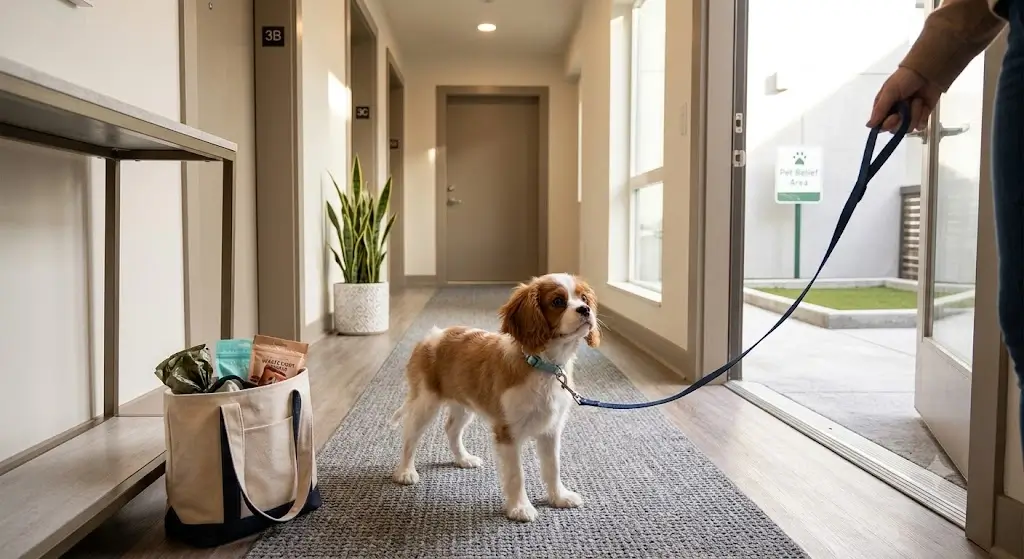
House Training a Puppy Without a Yard
You do not need a private yard to successfully house train a puppy. The key is creating a reliable bathroom system: choose an appropriate elimination location, account for travel time, maintain predictable timing, supervise closely, and reinforce successful habits.
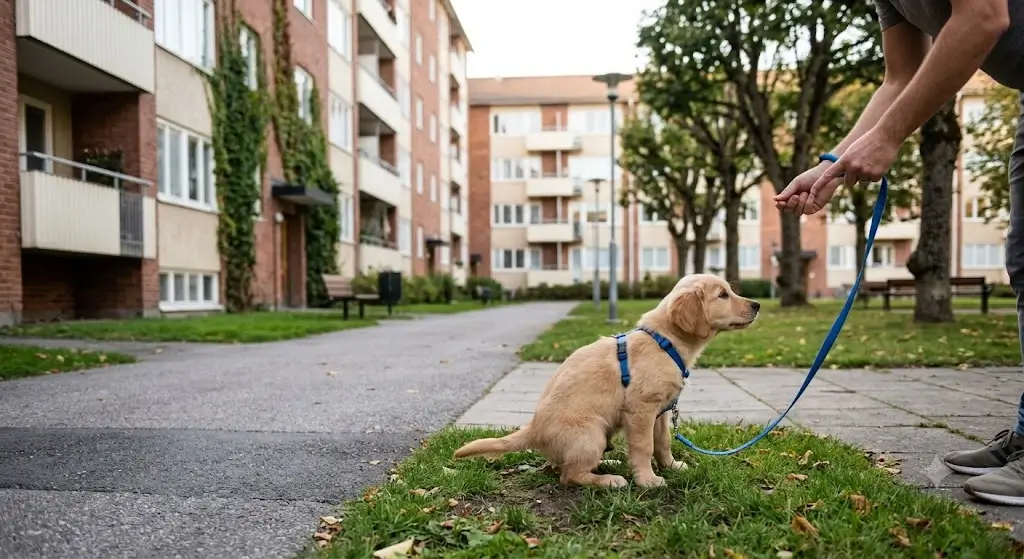
Quick Answer: Can You House Train a Puppy Without a Yard?
Yes. A private yard is convenient, but it is not a requirement. Effectively house training a puppy without a yard comes down to teaching your dog to eliminate in an appropriate outdoor location reached by leash, or using a carefully managed indoor toilet area when circumstances require it. To understand the foundational principles, check out our general guide on how to house train a puppy.
The biggest difference is logistics. Without a yard, your puppy must travel from the home to a sidewalk, grass patch, dog-relief station, or courtyard. Your schedule simply needs to account for that total travel time.
Do Puppies Need a Yard to Be House Trained?
No. A yard is simply one convenient bathroom destination. House training is about teaching a puppy where elimination is appropriate and helping them succeed often enough that the behavior becomes second nature.
A private yard reduces the distance to the bathroom area. When potty training a puppy without a yard, owners simply solve the distance challenge through proactive timing and route planning.
A yard is a location. House training is a behavior.Your puppy can master the routine without having private access to outdoor grass.
This approach is essential for anyone living in apartments, condominiums, urban townhomes, or multi-story buildings where outdoor relief areas are several minutes away.
Where Can a Puppy Go Potty If You Do Not Have a Yard?
The appropriate location depends on your living space, property rules, and municipal bylaws. The core requirement is that the area is permitted, clean, and safe for a young dog.
| Location | Potential advantage | Important consideration |
|---|---|---|
| Apartment dog-relief area | Designed specifically for pet owners. | Follow community rules and sanitation requirements. |
| Nearby permitted grass | Creates a consistent outdoor target. | Confirm that dogs are legally allowed. |
| Shared courtyard | Minimizes travel time from the unit. | Ensure building regulations permit pet use. |
| Urban dog-relief zone | Convenient in dense city neighborhoods. | Observe local leash and sanitation laws. |
| Indoor puppy toilet | Practical when outdoor access is restricted. | Establishes an indoor elimination target. |
How to Choose the Best Bathroom Location
Consistency speeds up learning. If a puppy is taken to a different spot every time, environmental distractions can slow down the house-training process.
Look for these characteristics
- Permitted and dog-friendly.
- Protected from heavy vehicle and foot traffic.
- Reasonably close to your home entrance.
- Accessible at all hours, including late night.
- Equipped or suitable for easy waste disposal.
- Practical across varying weather conditions.
A spot 90 seconds away is far more effective for early training than a scenic park 5 minutes away, especially when timing is critical.
Build a Reliable Bathroom Route
When you are house training a puppy without a yard, the journey from crate to grass becomes an integral part of the routine.
Map out the quickest, low-distraction route from your puppy’s area to the elimination target.
Puppy wakes → clip leash → exit unit → hallway/elevator → building lobby → potty spot → reward.
If your puppy is already at maximum urgency before leaving the apartment, accidents in the hallway or elevator become much more likely. Start the trip before urgency peaks.
Prepare the route before you need it
- Keep the leash and collar right next to the front door.
- Store waste bags, treats, and keys in an easy-grab spot.
- Identify the fastest exit door and stairwell/elevator option.
- Have weather gear (jackets, umbrella) ready to go.
Create a No-Yard Puppy Bathroom Schedule
A consistent routine should revolve around predictable biological events rather than rigid hourly intervals alone. If you need a structured day-by-day roadmap, follow our step-by-step 7-day puppy house training plan.
| Situation | What to do | Why it matters without a yard |
|---|---|---|
| Immediately after waking | Head outside promptly. | Travel time through the building requires immediate action. |
| 15–30 minutes after meals | Offer a planned potty break. | Digestion stimulates the gastrocolic reflex quickly. |
| After active play sessions | Watch closely and head out. | Physical activity accelerates the need to eliminate. |
| Immediately after naps | Carry or leash the puppy out. | Bladder control is lowest right after sleeping. |
| Right before bedtime | Take one final dedicated trip. | Sets the puppy up for an accident-free night. |
For more detailed timing benchmarks, read our guide on how often a puppy should go outside.
Learn Your Puppy’s Bathroom Signals
Recognizing subtle pre-potty signals gives you the head start needed to navigate stairs or elevators before an accident occurs.
Key warning signs to watch for:
- Abrupt floor sniffing or frantic wandering.
- Circling in one area.
- Restlessness or pacing.
- Moving toward the hallway or door.
- Sudden pauses during energetic play.
- Sneaking away toward quiet corners.
Supervision Is Crucial Without a Yard
Unrestricted access gives puppies too many hidden corners to eliminate unnoticed. Active supervision is the backbone of successful training in an apartment or yard-free home.
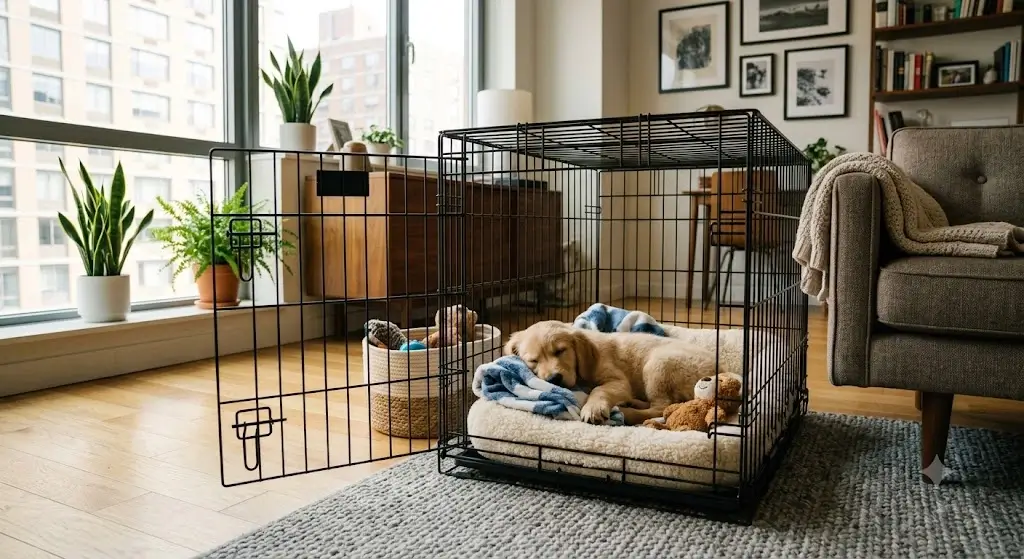
During active supervision
Keep your puppy in your direct line of sight (or on an indoor tether) so you can catch early body language instantly.
When you cannot supervise
Use a properly sized crate or puppy playpen. Confinement is a proactive management tool to prevent unmonitored mistakes while routines are still forming.
After successful potty trips
Reward your puppy with supervised freedom in the home, expanding their space gradually as reliability improves.
How to Reward Outdoor Elimination
Positive reinforcement must be delivered within seconds of the behavior to build a clear association.
As soon as your puppy finishes eliminating at the designated spot, offer immediate praise and a high-value treat on the spot. Do not wait until you get back inside the apartment.
Arrive at spot → puppy goes potty → immediate treat & praise → continue walk/play.
Should You Use Puppy Pads If You Do Not Have a Yard?
Pee pads can be helpful if long building travel times or health considerations make immediate outdoor access impractical. However, they teach puppies that eliminating on soft indoor textures is acceptable.
When pads make sense
- High-rise apartments with long elevator wait times.
- Young puppies completing their initial vaccination series.
- Extreme severe weather events.
- Mobility limitations for the owner.
The trade-off
If outdoor elimination is your long-term goal, transitioning off pads requires extra consistency to avoid confusing your dog about indoor rules.
What About Indoor Grass Potty Systems?
Real or synthetic grass patches placed on a balcony or designated indoor tray provide a closer approximation to outdoor terrain than standard paper pads.
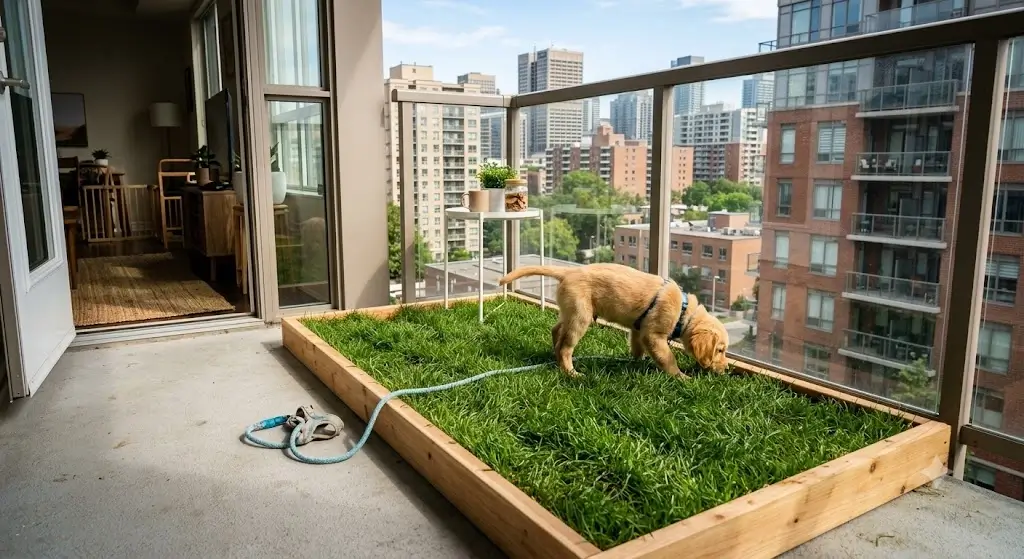
How to transition from indoor grass to outdoor training
- Keep the indoor grass unit in one consistent spot.
- Introduce regular outdoor potty trips around key routine milestones.
- Reward outdoor success immediately with high-value treats.
- Gradually phase out access to the indoor turf as outdoor reliability grows.
- Increase direct supervision during the transition phase.
Overcoming Common Apartment Challenges
Living in multi-unit buildings brings specific logistical hurdles. For in-depth strategies tailored to high-rises and condos, refer to our comprehensive guide on house training a puppy in an apartment.
| Apartment problem | Practical response |
|---|---|
| Elevator delays | Leave 5 minutes earlier and carry young pups to prevent accidents. |
| Relief area is distant | Build the transit time directly into your schedule. |
| Multiple flights of stairs | Carry small puppies down until their bladder control improves. |
| Late-night trips | Keep a dedicated night kit (shoes, leash, flashlight) by the door. |
| Severe weather | Use rain jackets, paw towels, and keep visits short and focused. |
What to Do When Accidents Happen
Accidents are diagnostic feedback, not willful disobedience. When an indoor mistake happens, assess what part of the routine failed:
- Did the puppy show a subtle signal that went unnoticed?
- Was the interval between outdoor breaks too long?
- Did the journey through the building take longer than usual?
- Was the puppy left unmonitored with free run of the room?
Checklist: Successfully House Training a Puppy Without a Yard
- Establish one consistent, permitted outdoor potty destination.
- Time the complete transit route from your apartment to the grass.
- Keep walking gear and high-value rewards ready by the entrance.
- Take the puppy out immediately after waking, eating, and playing.
- Learn your puppy’s individual restlessness and sniffing cues.
- Use crate management or tethering when active supervision is not possible.
- Reward elimination on-site within 2–3 seconds of finishing.
- Clean all indoor mistakes with dedicated enzymatic formulas.
- Maintain realistic expectations and consistent schedules.
Frequently Asked Questions
How hard is house training a puppy without a yard?
While it requires more planning and frequent trips down hallways or elevators, house training a puppy without a yard is entirely manageable with a predictable schedule, consistent routes, and vigilant supervision.
Where can a puppy go potty without a private yard?
Designated building dog-relief areas, nearby public grass strips, quiet sidewalk tree wells, or balcony grass boxes are common options depending on local regulations and lease terms.
How long does it take to house train a puppy in an apartment?
Most puppies establish solid habits within 4 to 8 months of consistent training. Progress depends heavily on schedule consistency, active supervision, and prompt positive reinforcement rather than the presence of a yard.
