
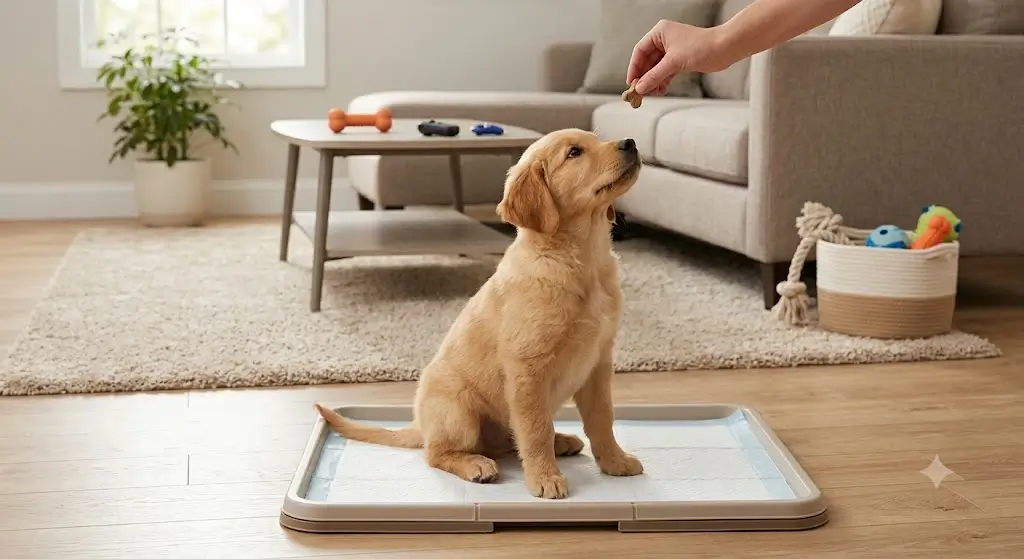
How to Train a Puppy to Use Pee Pads
Pee pad training gives a puppy a defined indoor bathroom location, but
success depends on more than putting a pad on the floor. The puppy needs
a consistent location, predictable bathroom opportunities, close
supervision, immediate reinforcement, and a clear plan for handling
accidents.
Quick Answer: How Do You Train a Puppy to Use Pee Pads?
The easiest way to teach a puppy to use pee pads is to control the environment and make the correct bathroom location predictable.
Put the pad in one consistent location, guide the puppy to it around predictable bathroom times (after waking, eating, or playing), supervise closely until the puppy eliminates, reward immediately with praise or treats, and keep the puppy in a manageable supervised area between bathroom breaks.
If the puppy repeatedly misses the pad, do not simply scatter more pads across the house. Reduce freedom, increase supervision, refine timing, and make the designated pad area easier to access.
When Pee Pad Training Makes Sense
Pee pads are useful when an indoor bathroom option is part of the household’s long-term plan or when outdoor access is temporarily restricted.
They are practical in apartment buildings, during extreme weather conditions, for owners with mobility challenges, or for young unvaccinated puppies awaiting full immunization.
Clarify your long-term destination before establishing the routine:
| Long-term goal | Training implication |
|---|---|
| Indoor pad use | Keep the pad location consistent and reinforce reliable indoor use. |
| Outdoor bathroom only | Use pads as a temporary setup; plan an outdoor transition schedule early. |
| Indoor + outdoor hybrid | Teach distinct surface cues and reinforce desired behavior at both locations. |
Set Up the Training Area Before You Start
A puppy should not have to roam the entire home searching for a bathroom spot. Set up an accessible, clearly demarcated training zone.
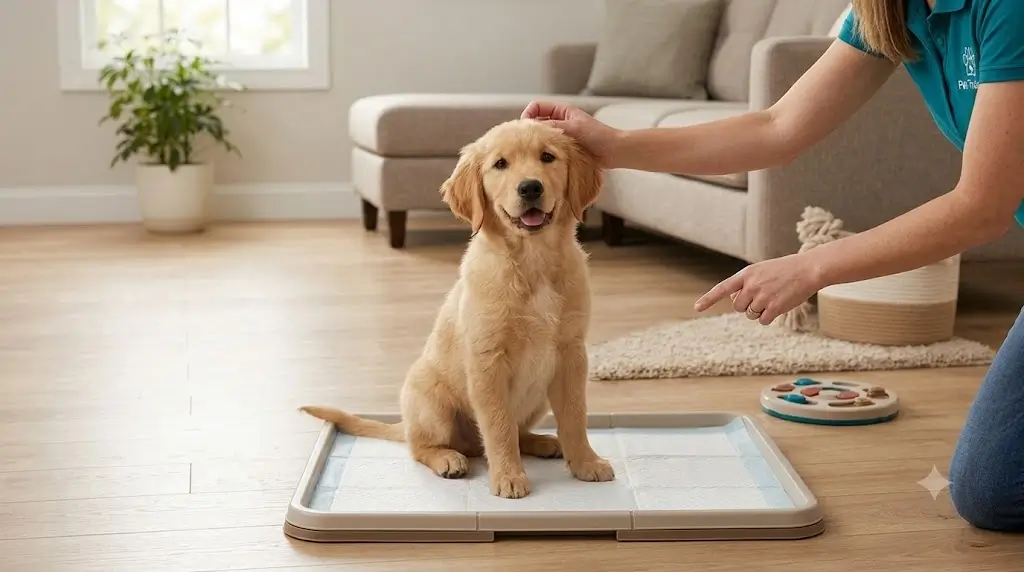
Essential setup checklist:
- A non-slip pee pad holder or tray to prevent sliding and chewing.
- Absorbent, leak-proof training pads.
- Washable, hard-surface flooring whenever possible.
- High-value training treats stored near the pad area.
- Playpens or baby gates to restrict access to unsupervised rooms.
- A pet-safe enzymatic cleaning spray for prompt accident cleanups.
Choose the Right Pee Pad Location
Location is critical for success. The pad must remain accessible during urgent moments while staying separated from sleeping and feeding stations.
A good pee pad location is:
- Easily accessible with a clear line of sight.
- Kept in the exact same spot throughout the training phase.
- Positioned away from high-traffic household walkways.
- Placed away from feeding bowls and sleeping crates.
- Located on easy-to-clean flooring rather than deep-pile rugs.
Avoid shifting the pad around the home during early training; consistent placement accelerates spatial learning.
Introduce Your Puppy to the Pee Pad
Allow your puppy to explore the pad naturally without pressure or forceful handling.
- Place the puppy near the pad: Let the puppy sniff and inspect the surface calmly.
- Keep interactions calm: Avoid turning the pad area into an active play zone.
- Watch for elimination cues: Look for sniffing, circling, or sudden restlessness.
- Wait for elimination: Allow several quiet minutes rather than physically pinning the puppy to the pad.
- Reward immediately: Deliver treats and quiet praise the moment elimination finishes.
Know When to Take Your Puppy to the Pee Pad
Proactive timing prevents accidents before they happen. Take the puppy to the pad around natural biological transitions:
| Situation / Trigger | Training response |
|---|---|
| Immediately after waking | Guide the puppy straight to the pad before any indoor activity. |
| 10–20 minutes after meals | Digestive activity naturally stimulates elimination reflexes. |
| Shortly after drinking | Puppy bladders fill rapidly after fluid intake. |
| After intense play sessions | Excitement and movement trigger urgent elimination needs. |
| Before and after naps | Make pad trips a mandatory bookend to every rest period. |
| Before bedtime | Offer a final bathroom opportunity to ensure a calm night. |
| Sniffing or circling behaviors | Guide the puppy immediately to the pad without waiting. |
Step-by-Step: How to Train a Puppy to Use Pee Pads
- Confine initial territory: Keep the puppy in a safe, restricted zone or playpen.
- Set one permanent pad spot: Eliminate confusion by keeping the pad stationary.
- Anticipate bathroom needs: Monitor timing triggers and pre-elimination signals.
- Guide calmly to the pad: Walk the puppy to the pad using a leash or gentle redirection.
- Allow sufficient time: Give the puppy 3–5 minutes to settle and eliminate.
- Reward immediately: Offer praise and high-value treats within 1–2 seconds of completion.
- Grant supervised freedom: Allow monitored exploration or playtime after successful elimination.
- Repeat consistently: Maintain the cycle to reinforce long-term bathroom habits.
Core training cycle
Predict the Need → Guide to Pad → Elimination & Immediate Reward → Supervised Freedom → Repeat
Reward Correct Pee Pad Use
Immediate reinforcement creates a clear connection between the pad surface and a positive outcome.
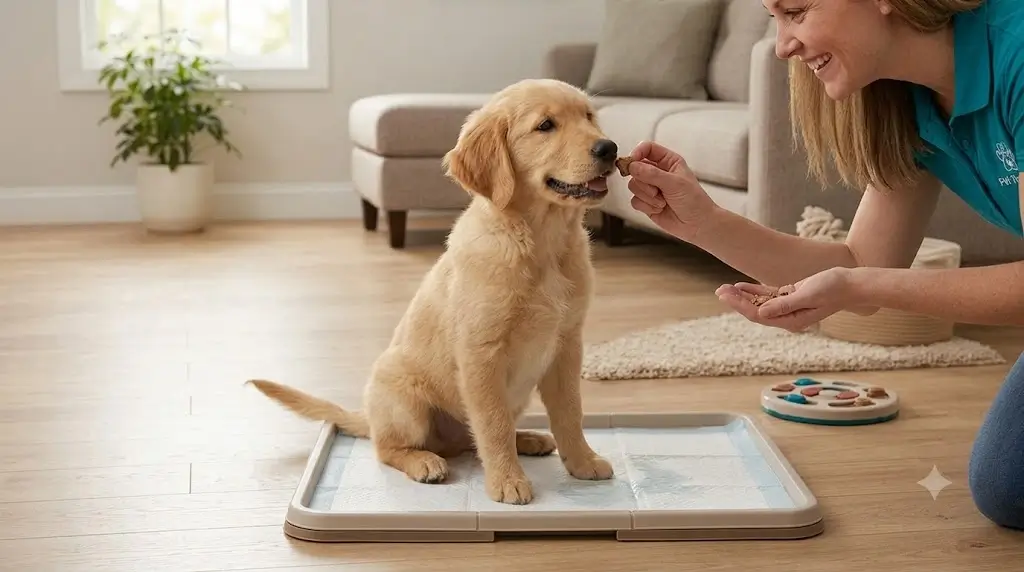
Once pad usage becomes consistent, gradually transition from continuous food rewards to intermittent treats combined with verbal praise.
Supervise Your Puppy Between Bathroom Trips
Unsupervised freedom is the leading cause of house-training setbacks. During early stages, manage the puppy’s environment carefully.
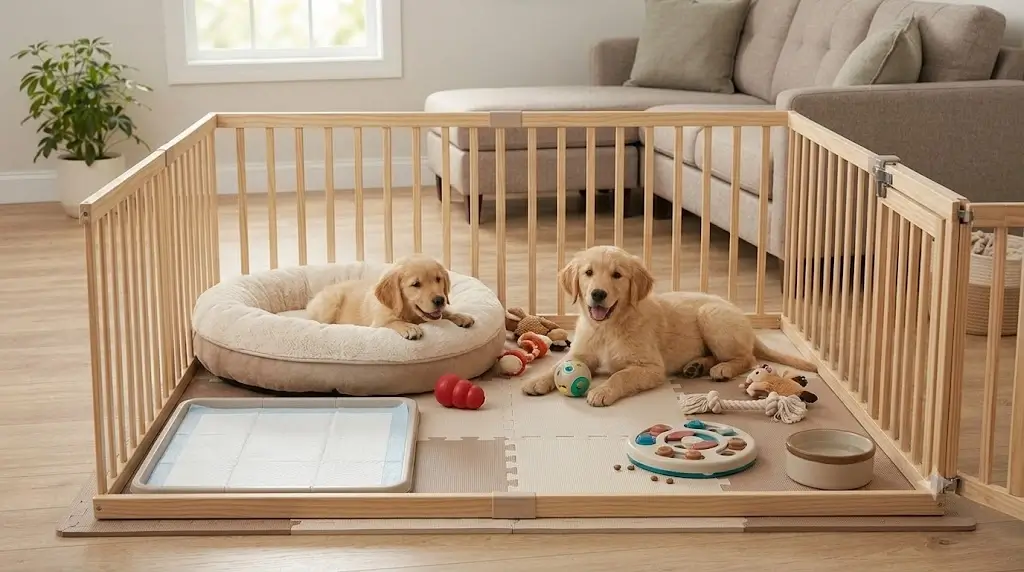
Practical management options:
- Active, eyes-on supervision in the same room.
- Puppy playpens or exercise pens placed over washable floors.
- Closing doors and using baby gates to block access to carpeted areas.
- Removing rugs, mats, and absorbent floor coverings temporarily.
- Incorporating structured crate rest between active supervised periods.
Gradually Increase Freedom
Expand household freedom only as the puppy demonstrates sustained reliability.
| Stage | Management approach |
|---|---|
| Early training | Single room or playpen + 100% active supervision. |
| Improving reliability | Expanded multi-room supervised area with easy pad access. |
| Consistent success | Short intervals of semi-independent movement. |
| Strong reliability | Full living area access with consistent pad trips. |
If accidents increase after granting more space, temporarily scale back to the previous successful stage.
Build a Pee Pad Training Schedule
A predictable schedule eliminates guesswork. Track meals, water intake, naps, and elimination times to identify your puppy’s daily rhythm.
| Time / Event | Recommended action |
|---|---|
| Morning wake-up | Immediate trip to the pad before breakfast or play. |
| Post-breakfast | Second bathroom trip 15–20 minutes after eating. |
| Mid-morning nap wake-up | Immediate redirection to the pad. |
| Post-playtime | Pause interactive play and offer a pad break. |
| Post-dinner | Dedicated pad opportunity following evening meal. |
| Nighttime wind-down | Final bathroom visit right before sleeping. |
For a complete daily framework, see the Puppy House Training Schedule.
What to Do When Your Puppy Misses the Pee Pad
Accidents provide diagnostic information about your supervision, timing, or setup.
If caught in the act:
- Remain calm and avoid yelling.
- Interrupt gently and redirect the puppy directly onto the pad.
- Allow the puppy to finish on the pad, then reward calmly.
If discovered after the fact:
Never scold or punish a puppy after an accident. Puppies cannot connect delayed punishment with past actions, which fosters anxiety and hidden elimination.
Troubleshooting checklist
- Was the puppy given too much unsupervised space?
- Was the route to the pad blocked or too far away?
- Did the accident occur immediately after waking, eating, or playing?
- Were subtle pre-elimination signals overlooked?
- Has the pad location been moved recently?
How to Clean Pee Pad Accidents
Puppies naturally return to spots marked by residual pheromones. Standard household cleaners often fail to break down uric acid crystals completely.
Saturate soiled areas thoroughly with an enzymatic cleaner designed specifically for pet messes. Keep the puppy out of the area until the surface is completely dry and deodorized.
Teach Your Puppy to Signal When It Needs the Pee Pad
Learn to recognize subtle behavioral cues before an accident occurs:
- Intense floor sniffing while walking in tight circles.
- Abruptly disengaging from toys, chew items, or games.
- Pacing or moving toward room perimeters and corners.
- Heading repeatedly toward previous accident locations.
- Moving intentionally toward the pad area.
When you spot these behaviors, guide the puppy to the pad immediately and reward successful elimination.
Should You Use Multiple Pee Pads?
Multiple pads can help in multi-level homes or large living spaces, but excessive pads can dilute the clarity of the designated bathroom spot.
| Living situation | Recommended approach |
|---|---|
| Single-room playpen / Small apartment | One dedicated pad location is clearest and most effective. |
| Large single-story home | One primary pad, with a temporary secondary pad in heavily used areas. |
| Multi-story house | One pad per active living floor during the early learning phase. |
| Transitioning to outdoors | Gradually eliminate secondary pads to consolidate the bathroom routine. |
Using Pee Pads With Crate Training
Crates and pee pads serve distinct functions within a house-training plan.
A crate is a clean, secure resting den. A pee pad is an elimination surface. Avoid lining the entire bottom of a sleeping crate with pee pads, as this encourages the puppy to soil its sleeping quarters.
If combining both methods, see our guide on How to House Train a Puppy With a Crate for complete spatial and routine guidelines.
Pee Pad Training a Puppy in an Apartment
Pee pads offer a practical solution for high-rise living where elevator delays and shared hallways make fast outdoor trips difficult for young puppies.
Place the pad on a washable balcony or bathroom tile, away from rugs. For full apartment strategies, visit our detailed guide on House Training a Puppy in an Apartment.
Pee Pad Training While Working Full Time
When work schedules prevent regular outdoor breaks, set up a puppy-proofed “long-term confinement area” using an exercise pen.
Place a bed, water bowl, and safe toys at one end, and a pee pad holder at the opposite end to ensure your puppy maintains consistent bathroom habits during work hours.
How to Transition From Pee Pads to Going Outside
If your ultimate goal is outdoor elimination, transition systematically:
- Establish outdoor routines: Take the puppy to a specific outdoor spot after every nap and meal.
- Move the pad progressively: Gradually shift the indoor pad closer to the exterior exit door.
- Move the pad outside: Place a pad directly on the outdoor grass or relief area.
- Phase out the pad: Cut the pad into smaller pieces before removing it completely once grass habits are formed.
- Reward outdoor success heavily: Provide premium treats exclusively for outdoor elimination.
Common Pee Pad Training Mistakes
- Moving the pad frequently: Shifting locations disrupts spatial conditioning.
- Granting early unmonitored freedom: Free roaming leads directly to unobserved accidents.
- Passive waiting: Reacting only after accidents occur rather than maintaining proactive schedules.
- Scattering too many pads: Teaches the puppy that all floor surfaces are potential bathrooms.
- Delayed reinforcement: Waiting until returning to the couch to reward dilutes learning.
- Using punishment: Increases anxiety and encourages hidden elimination behind furniture.
How to Know If Pee Pad Training Is Working
Positive indicators
- Puppy walks toward the pad independently when needing relief.
- Accidents outside the pad perimeter decrease steadily week over week.
- Puppy eliminates promptly within 1–2 minutes of reaching the pad.
- Clear signaling behaviors (pacing, whining, door checking) emerge.
- Reliability holds steady as supervised space expands.
What If My Puppy Refuses to Use the Pee Pad?
If your puppy avoids or chews the pad, audit the training environment:
- Instability: Use a locking pad frame if the pad slides, bunches up, or rustles loudly.
- Location issues: Move the pad away from noisy appliances, drafty doors, or feeding areas.
- Target confusion: Clean prior accident areas with enzymatic formula to eliminate competing scent cues.
- Chewing habits: Use a grate-topped pad holder or reusable fabric pads if disposable pads are treated as toys.
If bathroom habits shift abruptly, or if you observe straining, discomfort, or blood in the urine, consult a veterinarian promptly.
How Long Does Pee Pad Training Take?
Most puppies grasp basic pee pad mechanics within 2–4 weeks of consistent management. Full reliability across wider living areas typically develops between 4 and 6 months of age as bladder control matures.
For broader developmental timelines, explore How Long Does It Take to House Train a Puppy?.
Simple Daily Pee Pad Training Checklist
- Is the pad secured in its permanent, designated location?
- Did the puppy visit the pad immediately upon morning wake-up?
- Were pad breaks offered 15–20 minutes after meals and heavy play?
- Were successes rewarded within 1–2 seconds with high-value praise/treats?
- Is the puppy under active supervision during all free-roaming time?
- Were all accidents cleaned with pet-safe enzymatic formula?
The Core Pee Pad Training Formula
Predict the Need
↓
Guide to the Designated Pad
↓
Wait for Elimination
↓
Reward Immediately
↓
Supervise Freedom
↓
Repeat Consistently
Frequently Asked Questions
How do you train a puppy to use pee pads?
Position the pad in a fixed, accessible spot. Guide the puppy to the pad after waking, eating, and playing. Supervise closely, reward immediately upon elimination, and restrict indoor freedom until habits solidify.
Where should I put a puppy pee pad?
Place the pad in a quiet, low-traffic area with washable flooring (such as a bathroom, laundry room, or playpen), keeping it clearly separated from bedding and food bowls.
How often should I take my puppy to the pee pad?
Take young puppies to the pad every 1–2 hours while awake, as well as immediately after waking, eating, drinking, and ending active play sessions.
Why does my puppy miss the pee pad?
Common causes include excessive unsupervised freedom, missing pre-elimination cues, an unstable or shifting pad, confusing rug textures, or lingering urine odors on nearby floors.
Can you transition a puppy from pee pads to going outside?
Yes. Move the pad gradually toward the door, place it outside on the grass, heavily reward outdoor successes, and phase the pad out as outdoor reliability builds.
Is pee pad training better than outdoor house training?
Neither is universally superior. Pee pads work well for apartments, bad weather, and owners with mobility limitations, whereas outdoor training avoids the secondary step of transitioning away from pads later.
