

How Long Does It Take to House Train a Puppy? Realistic Timelines by Age
Most puppies improve with consistent training over several weeks, but becoming reliably house trained can take longer. Here is how to judge progress by age, accidents, supervision, routine, and real-world reliability instead of expecting a single deadline.
Quick Answer: How Long Does Puppy House Training Take?
There is no universal number of days or weeks that guarantees a puppy will be completely house trained.
Many puppies make noticeable progress within the first few weeks of consistent training, while reliable house training can take several weeks to several months depending on age, development, supervision, routine, environment, and the individual puppy. To build a strong foundation from day one, review our complete guide on how to house train a puppy.
The better question is not “How many days will this take?” but “Is the puppy becoming more reliable over time?”
Typical Puppy House-Training Timeline
A puppy house-training timeline should be viewed as a progression of skills rather than a fixed deadline.
| Training stage | What you may see | Owner priority |
|---|---|---|
| Days 1–7 | Frequent bathroom needs and inconsistent signaling | Supervision, frequent trips, immediate reinforcement |
| Weeks 2–4 | More predictable patterns and fewer preventable accidents | Build consistency and recognize triggers |
| Weeks 4–8+ | Increasing reliability with a controlled routine | Gradually expand freedom |
| Later months | Greater reliability across normal household situations | Maintain routine while testing independence |
These are planning stages, not promises. Some puppies move through them faster, while others require more time.
What Does “Fully House Trained” Actually Means?
House training is not simply the ability to avoid accidents while the owner is watching.
A reliably house-trained puppy should be able to follow the household bathroom routine across ordinary situations without requiring constant emergency intervention.
That includes situations such as:
- Normal morning routines.
- Meals and drinking.
- Play sessions.
- Naps.
- Short periods without direct supervision.
- Visitors.
- Changes in activity.
- Normal overnight sleeping.
The final stage of house training is therefore about reliability, not simply age.
How Long Does It Take to House Train an 8-Week-Old Puppy?
An 8-week-old puppy is just beginning the process. At this age, the owner should expect management to do much of the work.
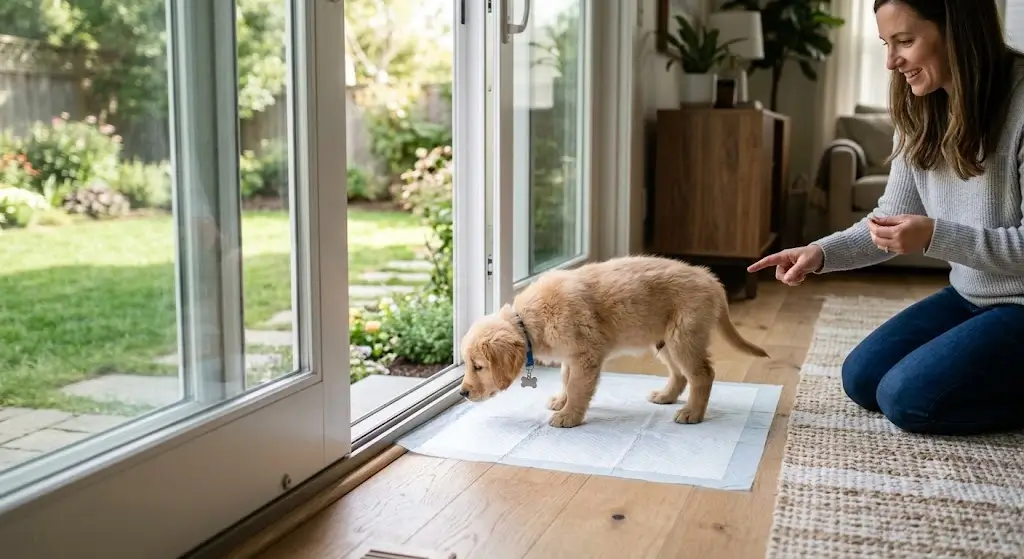
The puppy may not yet reliably recognize the need to eliminate early enough to reach the door, communicate the need, and wait for the owner to respond.
During the first weeks, success should be measured by:
- More successful trips to the correct location.
- Fewer preventable accidents.
- More predictable elimination patterns.
- Better response to the bathroom routine.
- Longer periods of successful supervision.
How Long Does It Take to House Train a 3-Month-Old Puppy?
Around three months, many puppies can begin showing a more predictable pattern when the household has maintained a consistent routine.
This is often the stage where owners can identify specific triggers: waking, meals, drinking, play, naps, and bedtime. If your puppy urinates outside but refuses to defecate, troubleshoot specific hurdles like why a puppy won’t poop outside before assuming training has completely stalled.
If accidents are still frequent, the answer is usually not to punish the puppy. Instead, examine whether bathroom trips are frequent enough and whether the puppy is receiving too much unsupervised freedom.
How Long Does It Take to House Train a 4-Month-Old Puppy?
A four-month-old puppy may be considerably more predictable than an eight-week-old puppy, but occasional accidents can still occur.
At this stage, progress is better evaluated by frequency and context: Is the puppy having fewer accidents? Can it remain successful for longer supervised periods? Does it use the correct location consistently?
If those measures are improving, the training is moving in the right direction even if the puppy is not yet perfect.
How Long Does It Take to House Train a Puppy by 6 Months?
Many puppies can be substantially more reliable by six months, but there is still considerable individual variation.
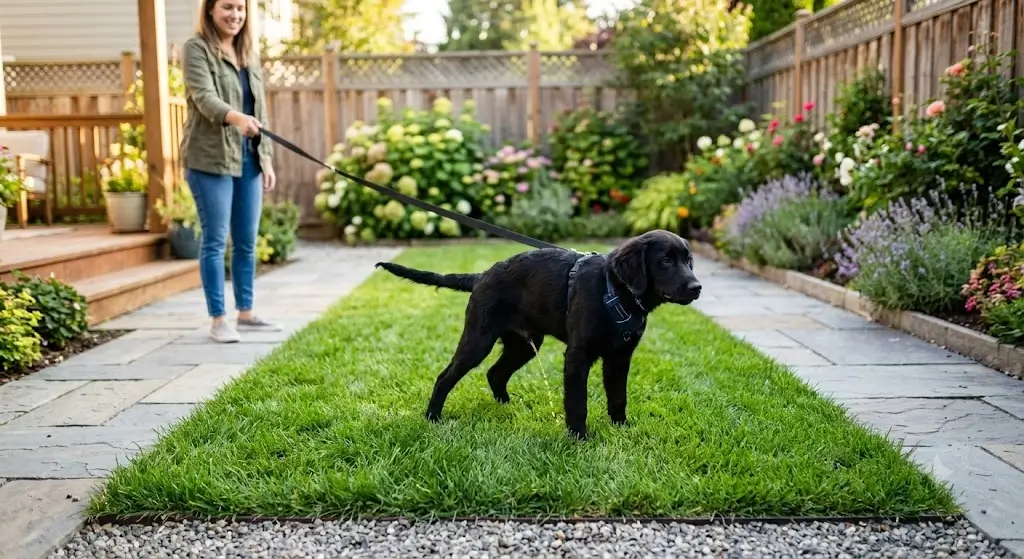
A puppy that is still having frequent unexplained accidents at this age deserves a closer review of training consistency, supervision, bathroom access, and routine.
If the behavior changed suddenly after a period of successful house training, consider environmental and medical explanations rather than assuming the puppy has simply forgotten its training.
What Makes Puppy House Training Faster or Slower?
The training timeline is influenced by several variables. Age is only one of them.
1. Consistency
Puppies learn from repeated patterns. A household that changes the routine constantly makes it harder for the puppy to predict what happens next.
2. Supervision
Close supervision reduces opportunities for mistakes and allows the owner to recognize early behavioral signals.
3. Bathroom access
A puppy that must travel through a long hallway, wait for an elevator, or cross a large home has less margin for error than a puppy with quick access to the designated location.
4. Age and development
Younger puppies generally need more frequent opportunities and more management.
5. Previous learning
A puppy arriving from a different environment may already have learned certain routines. The new home may require a transition period.
6. Household schedule
Consistent meal, sleep, play, and bathroom patterns can make elimination easier to anticipate.
7. Individual differences
Puppies do not all develop at exactly the same pace. Comparing one puppy directly with another can create unrealistic expectations.
How Do You Know If House Training Is Working?
Look for trends rather than a single perfect day.
| Progress signal | What it tells you |
|---|---|
| Accidents are becoming less frequent | The management plan is likely improving success. |
| Puppy eliminates quickly outside | The puppy is learning the purpose of the bathroom trip. |
| Puppy begins approaching the door | A communication pattern may be developing. |
| Longer supervised periods are successful | Freedom may be increased gradually. |
| Accidents cluster after specific events | The schedule needs an adjustment around that trigger. |
A downward trend in accidents is more meaningful than expecting zero accidents immediately.
How Many Accidents Are Normal During House Training?
There is no universal number of acceptable accidents because the context matters.
One accident in a new environment is different from repeated accidents every day despite a consistent routine.
The useful question is whether accidents are becoming:
- Less frequent.
- More predictable.
- Associated with identifiable schedule mistakes.
- Easier to prevent with supervision.
Why Do Puppies Regress After Making Progress?
House training is not always a straight line. A puppy can appear highly reliable and then begin having accidents again.
Common reasons include:
- Moving to a new home.
- Travel.
- Visitors.
- Changes in meal times.
- Changes in sleep patterns.
- Too much new freedom.
- Changes in confinement arrangements.
- Excitement or unusual activity.
- Illness or another medical issue.
When regression occurs, return temporarily to the last routine where the puppy was successful. Once reliability returns, freedom can be expanded again gradually.
How to Make Puppy House Training More Efficient
The goal should not be to force a puppy through training as quickly as possible. A better goal is to reduce preventable mistakes while creating repeated successful repetitions.

1. Use predictable bathroom opportunities
Take the puppy out around predictable events such as waking, meals, naps, play, and bedtime.
2. Supervise indoor freedom
Early in training, unrestricted access to the entire house creates more opportunities for mistakes.
3. Reward correct behavior
Reinforce successful elimination in the designated location immediately and consistently.
4. Clean accidents correctly
Thorough cleaning matters because lingering odor can make previously soiled locations more attractive to the puppy.
5. Follow a structured system
If you want a clear step-by-step roadmap to streamline the process, consider using a 7-day puppy house training plan to align your daily routine.
6. Increase freedom gradually
Reliability should earn additional freedom. If accidents increase, reduce the area temporarily and rebuild success.
How Bathroom Frequency and Schedule Affect the Timeline
The frequency of bathroom opportunities has a direct effect on how many successful repetitions a puppy receives.
A puppy that is given appropriate opportunities throughout the day has more chances to practice the desired behavior than a puppy that is left waiting for long periods.
This does not mean taking the puppy outside every few minutes. It means combining an age-appropriate routine with event-based trips.
- How often: bathroom frequency.
- Schedule: when bathroom trips fit into the day.
- Timeline: how long the puppy takes to become reliably trained.
These are related but different search intents. Keeping them separate also creates a cleaner site structure.
How Long Does It Take to House Train a Puppy in an Apartment?
Apartment living does not automatically make house training take longer, but the logistics can make timing more demanding.
The puppy may need to travel through a hallway, enter an elevator, cross a lobby, or reach a designated outdoor area before it can eliminate.
That means owners should respond to early signals and start the trip before the puppy reaches an urgent point.
When Slow House Training May Need Veterinary Attention
A longer training timeline does not automatically indicate a medical problem. Puppies develop at different rates.
However, persistent or unusual elimination patterns deserve attention, especially if they appear suddenly or are accompanied by other changes.
Training should not be used to explain away a significant change in normal elimination behavior.
A Better Way to Measure House-Training Progress
Instead of setting a deadline such as “my puppy must be trained in two weeks,” use measurable milestones.
- Accidents become less frequent.
- The puppy follows a predictable bathroom routine.
- The puppy begins recognizing the designated location.
- The puppy remains successful during supervised freedom.
- Bathroom signals become easier to recognize.
- Freedom can be increased without a rise in accidents.
- The puppy remains reliable when the normal routine changes.
This approach gives the owner a much more useful measure of progress than an arbitrary number of days.
Frequently Asked Questions
How long does it take to house train a puppy?
Many puppies make substantial progress within several weeks, but reliable house training can take several weeks to several months. The timeline depends on age, consistency, supervision, environment, and individual development.
What is the fastest way to house train a puppy?
The most efficient approach is consistent supervision, frequent bathroom opportunities, predictable routines, immediate reinforcement for correct elimination, and gradual expansion of indoor freedom.
How long does it take to potty train an 8-week-old puppy?
An 8-week-old puppy is just beginning house training, so the process commonly takes several weeks or longer. Reliable results depend on consistency and individual development.
Is it normal for a 4-month-old puppy to still have accidents?
Occasional accidents can still happen at four months, especially after excitement, routine changes, inadequate supervision, or intervals between bathroom trips that are too long.
When is a puppy considered fully house trained?
A puppy is reliably house trained when it consistently eliminates in the appropriate location across normal household situations with very few or no indoor accidents over time.
Why is my puppy taking so long to house train?
Common reasons include inconsistent timing, excessive unsupervised freedom, long intervals between bathroom opportunities, unclear routines, environmental changes, and individual developmental differences.
Can a puppy regress after being house trained?
Yes. Temporary setbacks can occur after travel, changes in routine, household changes, adolescence, illness, or other disruptions. A sudden unexplained change should be discussed with a veterinarian.
