
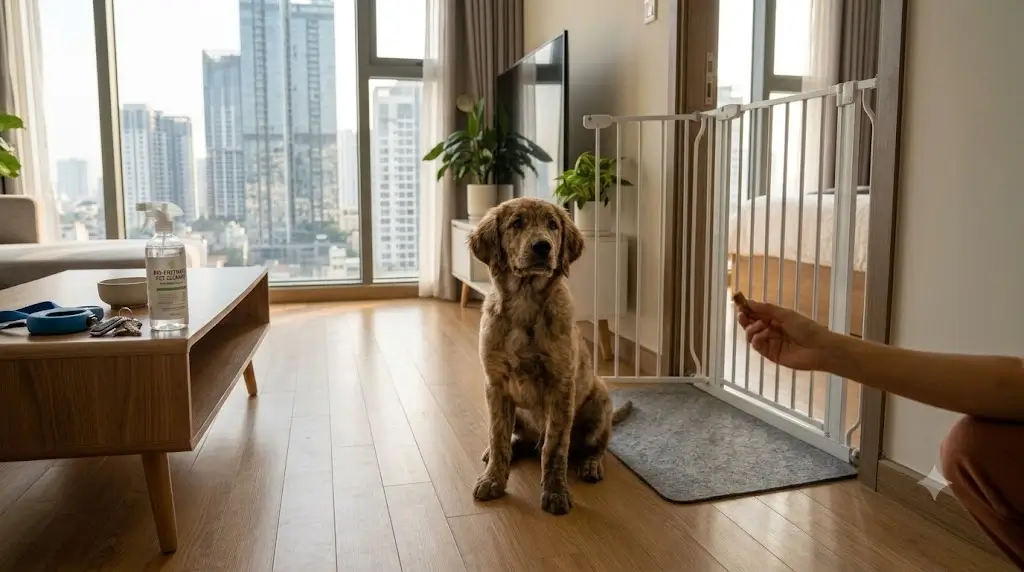
House Training a Puppy When You’re Away at Work
House training a puppy while you are away at work requires a different strategy from training when someone is home all day. The key is to build a routine around your puppy’s actual bathroom needs, prevent unsupervised mistakes, and create a reliable care plan for the hours you cannot be there.
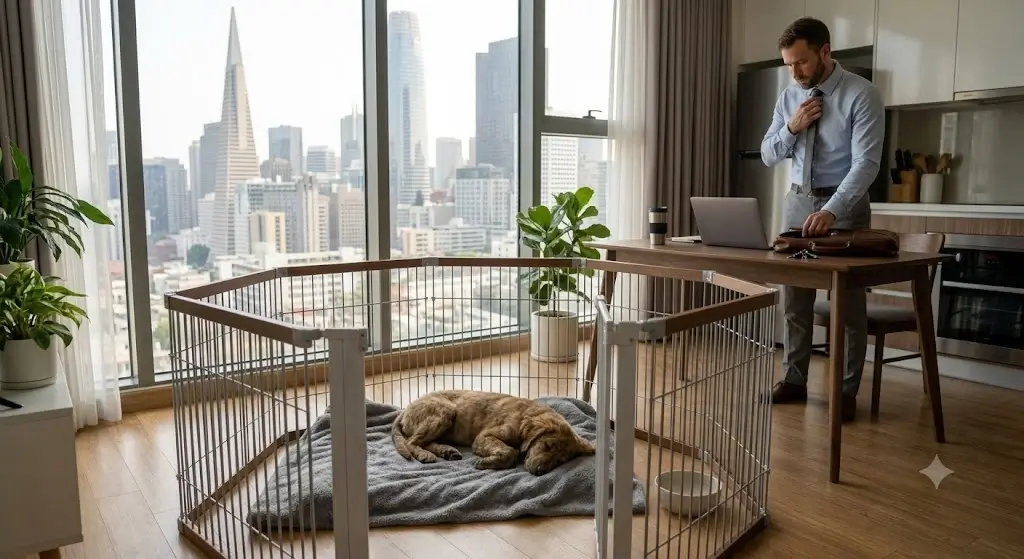
Can You House Train a Puppy If You Work Full-Time?
Yes. Working full-time does not prevent you from house training a puppy, but it changes how the training system needs to be designed.
The biggest mistake is treating the workday as one long period during which the puppy is expected to remain clean. Young puppies have developing bladder and bowel control, and their needs vary according to age, size, sleep, meals, activity, water intake, health, and individual development.
Instead of asking, “How can my puppy hold it until I get home?” ask, “How can I make sure my puppy has an appropriate bathroom opportunity before an accident becomes likely?”
Why a Traditional 9-to-5 Schedule Can Be Difficult for a Young Puppy
A typical U.S. workday may involve eight or more hours away from home, plus commuting time. That can create a longer absence than the puppy can reasonably manage, especially during the early stages of house training.
There are also bathroom triggers that do not follow your employment schedule. A puppy may need to eliminate after waking, after eating, after drinking, after active play, or after a nap.
That means a schedule that works for an adult dog may be inappropriate for a young puppy.
| Workday factor | Why it matters |
|---|---|
| Commute | Adds time to the puppy’s total period without direct care. |
| Fixed lunch break | May not coincide with the puppy’s actual potty window. |
| Overtime | Can unexpectedly extend the puppy’s time alone. |
| Meetings after work | Can delay the first post-work interaction. |
| Variable shifts | Make a fixed daily routine harder to maintain. |
The First Step: Calculate the Puppy Care Gap
Before choosing a crate, puppy pad, dog walker, or daycare arrangement, calculate the actual period your puppy will be without direct care.
Do not count only the hours printed on your employment schedule. Include the commute and any other time when nobody can provide a potty break.
Time you leave home → time a responsible person can next provide a potty opportunity.
Then add your commute and any predictable schedule extensions.
This simple calculation often reveals why accidents are happening. The issue may not be poor training at all. The puppy may simply have been left without an appropriate bathroom opportunity for too long.
How Long Can a Puppy Stay Home Alone?
There is no universal number of hours that is appropriate for every puppy. Age is important, but it is not the only factor.
A puppy’s physical ability to remain clean, comfort with being alone, sleep schedule, previous training, health, and daily routine all affect the answer.
Avoid using a popular age-based bladder formula as a guarantee. Such formulas can be useful as rough planning references, but they should never be treated as a promise that a puppy can comfortably wait that long.
The Best House-Training Strategy for People Who Work Outside the Home
A strong workday system has six parts:
1. Pre-work potty
Start the day with a predictable bathroom opportunity.
2. Midday care
Provide a potty break when the puppy needs one.
3. Controlled space
Prevent unsupervised access to the entire house.
4. After-work trip
Make the first priority after returning home the puppy’s needs.
5. Consistency
Repeat the same sequence every workday.
6. Gradual freedom
Expand household access only after reliable success.
Build the Morning Around the Puppy, Not the Alarm Clock
The morning routine establishes the first major house-training opportunity of the day.
A useful sequence is:
- Wake up.
- Take the puppy to the designated potty location.
- Allow appropriate elimination time.
- Provide breakfast according to the normal feeding schedule.
- Offer another potty opportunity after eating when appropriate.
- Provide suitable movement or interaction.
- Prepare the puppy for the planned daytime care arrangement.
The exact timing should be based on your puppy rather than copied from another household. If you live in an apartment where morning transit takes longer, apply our specific framework for house training a puppy in a high-rise apartment.
Why the Midday Potty Break Matters
For many puppies, the midday break is the most important piece of a full-time workday house-training plan.
The purpose is not simply to “let the puppy out.” A good midday visit can provide a bathroom opportunity, fresh water, appropriate interaction, and a chance to observe whether the puppy is showing any unusual elimination patterns.
For very young puppies, one midday visit may not be sufficient. The correct frequency depends on the puppy’s individual needs.
Who Can Provide the Midday Puppy Break?
The best option depends on your household, location, budget, and the puppy’s temperament.
| Option | Best suited for | Potential limitation |
|---|---|---|
| Household member | Homes with someone available during the day. | Schedule may change. |
| Trusted dog walker | Owners needing predictable daytime visits. | Requires careful selection and scheduling. |
| Pet sitter | Puppies needing more individual attention. | Can cost more than a short walk. |
| Dog daycare | Some puppies that are socially and developmentally suited to group care. | Not appropriate for every puppy or every day. |
| Flexible work arrangement | Owners who can occasionally work from home. | Not available to every employee. |
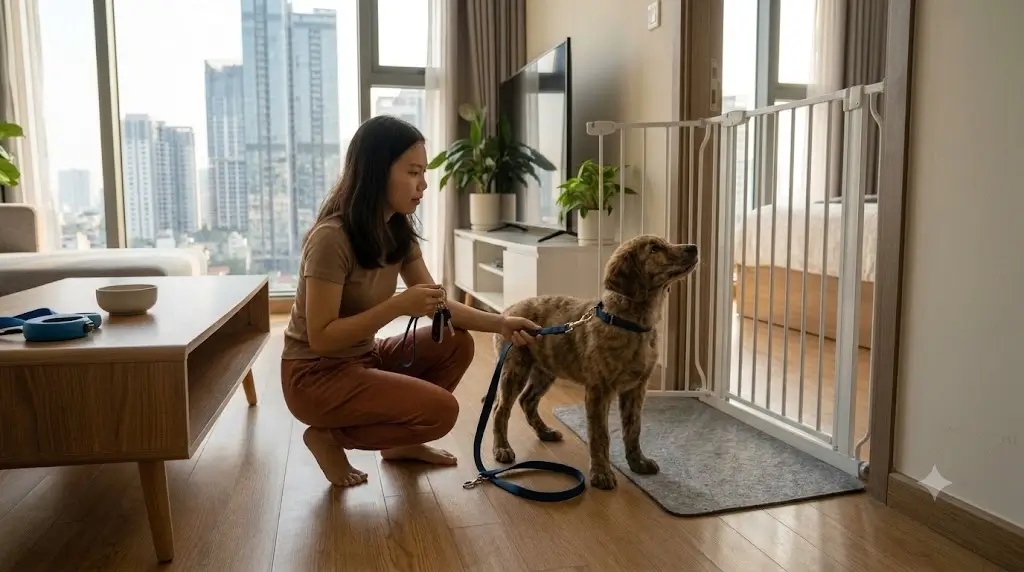
How to Choose a Reliable Puppy Caregiver
For house training, reliability is more important than simply having someone visit the home.
A caregiver should understand the puppy’s potty location, routine, feeding schedule, access restrictions, and reward system.
Give written instructions rather than relying on memory. Include:
- Where the puppy should eliminate.
- Where the puppy should remain after the potty break.
- When food is offered.
- Where fresh water is available.
- What reward is used after successful elimination.
- Which rooms are off limits.
- What to do if the puppy does not eliminate.
- What to do if an accident occurs.
What Should the Puppy Do Between Potty Breaks?
The puppy should not automatically have unrestricted access to the entire house just because someone has left for work.
Use a safe, puppy-proofed environment appropriate for the puppy’s age and temperament. This may include a crate for appropriate rest periods, a puppy pen, or a gated room. If you prefer to avoid a crate during working hours, review our complete methodology on how to potty train a puppy without a crate.
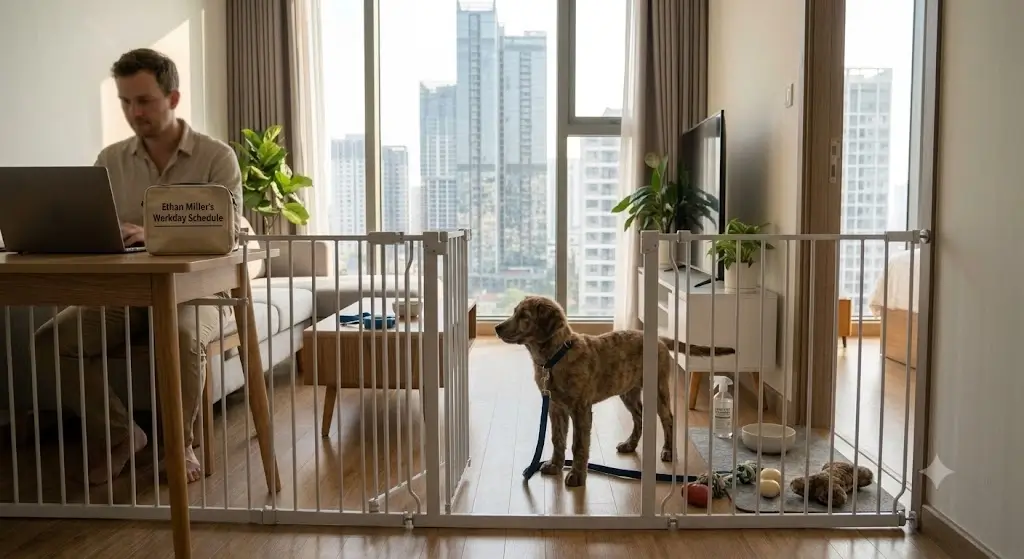
The goal is to reduce opportunities for hidden accidents while still providing appropriate rest, water, enrichment, and movement.
Crate Training and a Full Workday Are Not the Same Thing
A crate can be a useful house-training management tool, but it should not be used as a way to make a puppy endure an unnecessarily long workday without a bathroom break.
Crate use should be age-appropriate, introduced positively, and balanced with exercise, interaction, feeding, water, sleep, and bathroom opportunities. For precise crate sizing and dividers, consult our puppy crate size guide.
If the puppy regularly soils the crate because the absence is too long, the answer is usually to change the daytime care plan rather than simply use a larger crate or expect the puppy to hold it.
Should You Use Puppy Pads While You’re at Work?
Indoor potty pads can be useful in some living situations, especially when outdoor access is genuinely impractical during part of the day. However, they should be introduced deliberately.
If your long-term goal is outdoor-only house training, using an indoor toilet area creates a second acceptable location. That does not make pads “wrong,” but it means the training strategy should be intentional.
Keep the indoor toilet location consistent and clearly separated from sleeping and feeding areas when possible. In tight residential spaces, follow our layout advice in house training a puppy in a small home.
A Workday Schedule for a Puppy Owner
This example demonstrates how a workday can be structured. It is not a universal puppy schedule.
| Time | Routine | House-training purpose |
|---|---|---|
| 6:15 AM | Wake | First potty opportunity |
| 6:45 AM | Breakfast | Potty opportunity afterward when needed |
| 7:30 AM | Owner prepares for work | Puppy enters planned daytime setup |
| 10:00 AM | Caregiver visit | Potty + appropriate interaction |
| 1:00 PM | Second care window if needed | Additional potty opportunity |
| 5:30 PM | Owner returns | Prompt potty opportunity |
| Evening | Meal, activity, rest | Potty opportunities around predictable events |
| Bedtime | Sleep routine | Final planned potty opportunity |
The Most Important Part of the Schedule Is Not the Clock
A puppy does not understand that 12:00 PM is lunchtime because your phone says noon. What matters is the relationship between events.
For example:
Eat → potty opportunity
Nap → potty
Active play → potty
Caregiver arrives → potty
Owner returns → potty
This event-based approach is especially useful when your work schedule changes from day to day.
What to Do When You Come Home to an Accident
If you find an accident when you return from work, avoid punishment or confrontation. The puppy cannot connect a delayed correction with an earlier elimination event in the way humans often assume.
Instead:
- Clean the area thoroughly with an enzymatic solution.
- Identify when the accident probably occurred.
- Compare that time with the puppy’s care schedule.
- Determine whether the potty interval was too long.
- Adjust the next day’s care plan.
The accident should be treated as useful information about the management system. To permanently remove biological odor markers that trigger repeat peeing, read how to clean up puppy accidents properly.
A Simple Accident Investigation
| Question | What it can reveal |
|---|---|
| When was the last potty opportunity? | Whether the interval was realistic. |
| Did the puppy recently eat? | Whether a post-meal break was missed. |
| Did the puppy wake from sleep? | Whether a post-nap opportunity was missed. |
| Was the caregiver delayed? | Whether the backup plan needs improvement. |
| Did this happen repeatedly? | Whether the routine needs structural changes. |
What If Your Puppy Has an Accident in the Same Place Every Day?
Repeated accidents in one location often indicate a combination of access, odor, routine, and timing.
Clean the area thoroughly with a pet-appropriate enzymatic cleaner, restrict access when possible, and examine whether the puppy is consistently reaching that location during a predictable period of the workday.
If the accident occurs while the puppy is alone, the problem may be the length of the care interval rather than the room itself. If marking habits continue, refer to our protocol on how to handle when a puppy keeps peeing in the same spot.
How to Prevent Your Puppy From Wandering While You’re at Work
A puppy with unrestricted access to multiple rooms has more opportunities to eliminate outside your view.
Use physical boundaries such as gates or a puppy-proofed room when appropriate. The exact setup should provide enough space for safe resting and movement without creating a large collection of hidden potty locations.
As reliability improves, gradually expand the puppy’s territory.
Should You Leave Water Available While You’re at Work?
Fresh water is an important part of normal puppy care. Do not deliberately restrict water simply to reduce the chance of an accident.
Instead, manage the puppy’s bathroom opportunities around normal drinking and feeding patterns. If your puppy suddenly drinks much more than usual or has a major change in urination, consult a veterinarian rather than restricting access to water.
How to Make the First Week Easier
The first week should focus on preventing avoidable mistakes rather than testing how long the puppy can remain alone.
- Keep the morning routine consistent.
- Use the same potty location.
- Arrange daytime care before bringing the puppy home.
- Limit unsupervised access to the house.
- Track successful and unsuccessful potty attempts.
- Reward appropriate elimination.
- Clean accidents thoroughly.
- Review the schedule at the end of each day.
The goal is to create a repeatable system before increasing the puppy’s freedom.
How to Adjust the Routine as Your Puppy Gets Older
House training is not a one-time event. The management requirements should change as the puppy develops greater reliability.
When accidents decrease, you can test longer intervals carefully. If the puppy remains successful, continue. If accidents increase, shorten the interval again.
You can also gradually increase household access while maintaining the same basic potty routine.
Stage 1
High supervision and frequent potty opportunities.
Stage 2
Predictable daytime caregiver breaks.
Stage 3
Gradually longer successful intervals.
Stage 4
Greater freedom with continued routine.
What If You Work Irregular Hours?
Shift workers and people with changing schedules should build the routine around events rather than a rigid clock.
For example, the sequence might be:
This structure remains useful whether your shift starts at 6 AM, 10 AM, or later in the day.
What If You Cannot Afford Daily Dog Walking?
You do not necessarily need the same paid service every day. Look at the actual care gap and build the least complicated reliable solution.
Possible approaches include sharing responsibilities with household members, arranging occasional help on the longest workdays, adjusting work hours when possible, using a trusted neighbor or family member, or combining different forms of care.
The objective is not to buy the most expensive service. It is to prevent a predictable period of unmet bathroom needs.
Should Puppies Go to Dog Daycare Every Workday?
Not necessarily. Daycare can be useful for some puppies, but it is not automatically the best house-training solution.
Consider the puppy’s temperament, vaccination status, developmental needs, ability to rest, tolerance for group environments, and the quality of the facility.
Some puppies benefit more from a quiet individual potty visit than from spending the entire day in a busy group environment.
How to Teach the Puppy What to Do When You Return Home
Your return home is another important training transition.
Instead of immediately turning the return into a long play session, take the puppy to the appropriate potty location when needed. Once the puppy has had the opportunity to eliminate, continue with exercise, attention, feeding, or other normal activities.
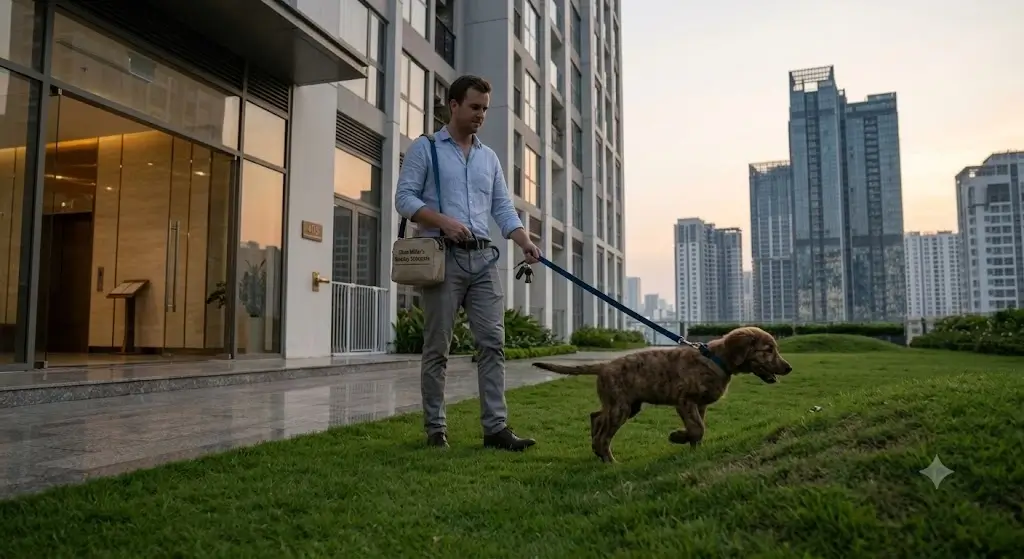
This creates a predictable pattern: owner returns → bathroom opportunity → normal evening routine.
Don’t Let Your Workday Create a Weekend Training Problem
One often-overlooked issue is inconsistency between weekdays and weekends.
If a puppy receives frequent opportunities during the weekend but is left for long periods on weekdays, the difference can make the overall routine harder to understand.
The exact clock times do not need to match. Keep the important sequence consistent:
- Potty after waking.
- Potty opportunities around meals.
- Potty after naps and active play.
- Reasonable daytime bathroom access.
- Consistent reinforcement.
Common Mistakes When House Training a Puppy While Working
Expecting an entire workday of holding
The puppy’s physical development may not support it.
Skipping the midday plan
A workday needs deliberate daytime care.
Giving too much freedom
Unsupervised access increases opportunities for accidents.
Punishing accidents
Punishment does not teach the desired bathroom location.
Changing caregivers constantly
Inconsistent routines can make management harder.
Ignoring sudden changes
Unexpected potty changes can sometimes have a medical cause.
How to Know if Your House-Training Plan Is Working
Do not judge the plan solely by whether there was an accident today.
Look for a trend across several days:
- Fewer indoor accidents.
- More successful potty trips.
- More predictable elimination patterns.
- Better response to the designated potty location.
- Increasing ability to remain clean between appropriate opportunities.
- Less need for constant supervision.
Progress means the management system is gradually becoming less intensive while successful behavior becomes more reliable. If your training stops progressing altogether, see our troubleshooting guide on what to do when house training stalls.
When a House-Training Regression Needs More Attention
If a puppy that was previously doing well suddenly starts having frequent accidents, do not automatically assume the puppy has “forgotten” its training.
Review recent changes first: feeding schedule, household routine, caregiver, environment, stress, access to the home, or changes in time alone.
If elimination changes are sudden, persistent, unusually frequent, painful, or accompanied by other signs of illness, veterinary evaluation is appropriate.
The Away-at-Work House Training Checklist
- Calculate the real daily care gap, including commuting.
- Match daytime care to your puppy’s actual needs.
- Give a potty opportunity after waking.
- Plan potty opportunities around meals and activity.
- Arrange midday care before the puppy comes home.
- Keep the puppy in a safe, controlled environment while alone.
- Do not use a crate as a substitute for needed bathroom breaks.
- Decide intentionally whether indoor pads are part of your plan.
- Reward successful elimination promptly.
- Clean accidents thoroughly.
- Never punish accidents after the fact.
- Increase freedom gradually as reliability improves.
- Reassess the plan whenever the puppy’s needs change.
Frequently Asked Questions
Can you house train a puppy if you work full-time?
Yes. Working full-time does not prevent house training, but the puppy needs a daytime care plan that provides appropriate bathroom opportunities based on age, development, health, activity, and individual needs.
How long can a puppy stay home alone?
There is no universal number of hours that works for every puppy. Age, development, health, sleep, feeding, previous training, and individual bladder control all affect how long a puppy can reasonably remain without a bathroom opportunity.
Does a puppy need a midday potty break while I am at work?
Many young puppies need one or more daytime potty opportunities while their owners are at work. The correct frequency depends on the puppy’s individual needs and should not be determined by an arbitrary work schedule.
Should I crate my puppy while I am at work?
A crate can be a useful management and resting area when used appropriately, but it should not be used to make a puppy remain confined for an unnecessarily long period without bathroom access.
Should I use puppy pads while I am at work?
Puppy pads can be a practical backup in some households, especially when outdoor access is temporarily impractical. If outdoor-only elimination is the long-term goal, the indoor potty location should be used deliberately while outdoor training continues.
What should I do if my puppy has an accident while I am at work?
Clean the area thoroughly, avoid punishment, and examine the timing of the accident. Compare the accident with the puppy’s last potty opportunity and determine whether the daytime care interval needs to be shortened.
Who can let my puppy out while I am at work?
Depending on the household, options can include a family member, partner, trusted neighbor, professional dog walker, pet sitter, or an appropriate daycare arrangement. The best choice is one that reliably matches the puppy’s bathroom and care needs.
How do I house train a puppy when I work a full-time job?
Build a predictable morning routine, arrange appropriate daytime potty breaks, restrict unsupervised access to the home, reward successful elimination, clean accidents thoroughly, and gradually increase freedom as the puppy becomes reliable.
The Real Secret to House Training While You Work
Don’t make the puppy adapt to an impossible workday. Build the workday around realistic puppy care.
House training succeeds when the puppy repeatedly gets the opportunity to eliminate in the right place before an accident becomes likely. For people who work outside the home, that usually means combining a consistent morning routine, scheduled daytime help, controlled access to the house, appropriate confinement, immediate reinforcement, and gradual increases in freedom.
