
CALIBRATED US METRICS
Puppy Training Pad Size Guide: What Size Pad Does Your Puppy Need?
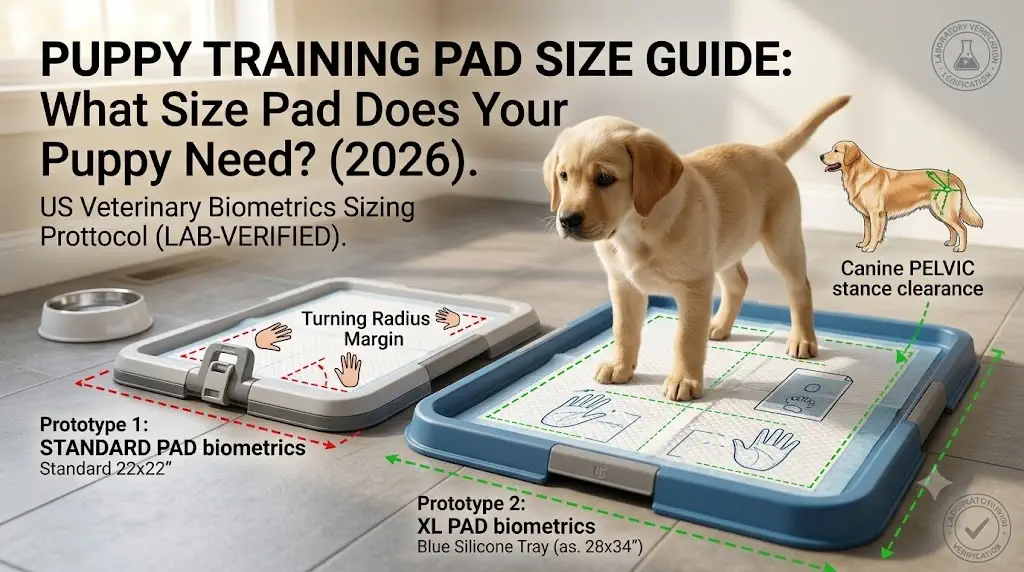
The right puppy training pad should be large enough for your puppy to step on, turn around, and finish without regularly reaching the edge. For many toy and small puppies, a pad around 22 × 22 or 22 × 23 inches is a practical starting point. Medium puppies may need approximately 24 × 30 to 24 × 35 inches, while larger puppies often benefit from 28 × 34 inches or more.
But there is no universal puppy pad size chart based on breed or weight. Dogs of the same weight can have very different body proportions and potty habits, and manufacturers use different dimensions for labels such as Large and XL.
That is why the most reliable approach is to use your puppy’s current size as a starting point, then adjust based on how accurately the puppy uses the pad. The American Kennel Club (AKC) notes that choosing appropriate indoor elimination targets prevents spatial confusion, reducing peripheral runoff and subfloor saturation during early housebreaking.
Quick Reference Specification: Puppy Training Pad Sizing Matrix
This calibrated biometric sizing matrix correlates puppy weight categories, outer footprint dimensions, functional absorbent core area, and necessary rotational clearances.
| Weight Category | Standard Outer Dimensions | Usable Absorbent Core Size | Turning Radius Margin | Primary Risk Factor |
|---|---|---|---|---|
| Toy (< 15 lbs) | 17 × 24 to 22 × 22 inches | 15 × 21 to 19 × 19 inches | +4 to 6 inches body buffer | Edge misses on unanchored mats |
| Small (15–25 lbs) | 22 × 22 to 24 × 24 inches | 19 × 19 to 21 × 21 inches | +6 inches body buffer | Elongated spine overshoot |
| Medium (25–40 lbs) | 23 × 24 to 24 × 35 inches | 20 × 21 to 21 × 31 inches | +8 inches body buffer | Puddle pooling near margins |
| Large (40–70 lbs) | 24 × 35 to 28 × 34 inches | 21 × 31 to 24 × 29 inches | +10 inches body buffer | Paw wetness / edge step-off |
| Extra Large (70–90+ lbs) | 28 × 34 to 30 × 36 inches | 24 × 29 to 26 × 32 inches | +12 inches body buffer | High fluid strike-through volume |
| Giant (90+ lbs) | 30 × 36 to 27.5 × 44 inches+ | 26 × 32 to 24 × 40 inches | +14 inches body buffer | Rapid capacity overwhelming |
Quick Puppy Training Pad Size Chart
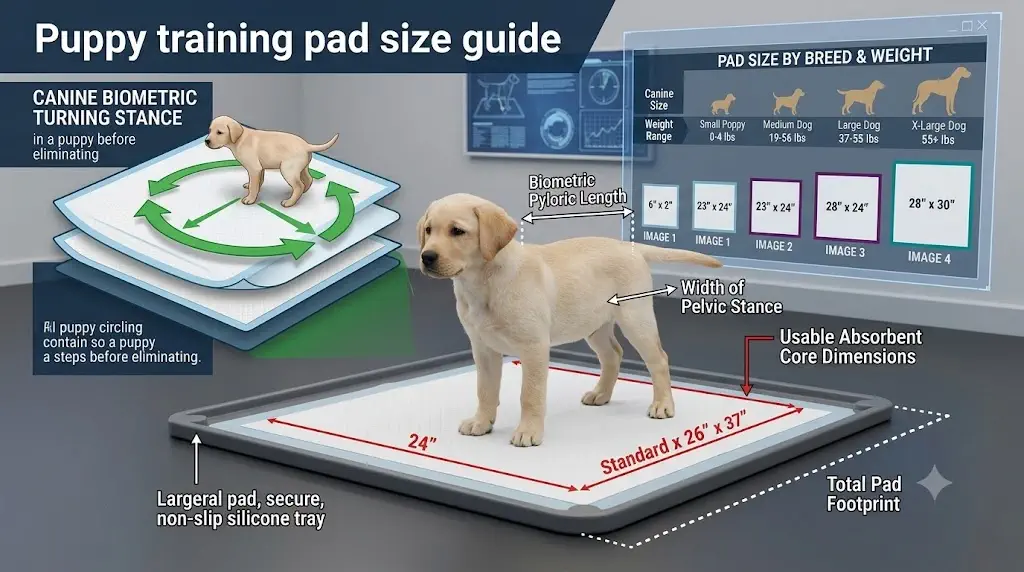
Canine anatomical proportions determine the minimum surface area required for reliable elimination accuracy. The following matrix outlines practical starting dimensions based on developmental weight classes:
| Puppy Size | Approximate Weight | Starting Pad Size | When to Consider Larger |
|---|---|---|---|
| Toy / Extra Small | Under 15 lb | 17 × 24 to 22 × 22 in | Frequent edge misses |
| Small | 15–25 lb | 22 × 22 to 24 × 24 in | Large stance or repeated misses |
| Small / Medium | 25–40 lb | 23 × 24 to 24 × 35 in | Pad feels crowded during use |
| Medium / Large | 40–70 lb | 24 × 35 to 28 × 34 in | Rear paws or urine reach the edge |
| Large | 70–90+ lb | 28 × 34 to 30 × 36 in+ | Repeated edge accidents |
| Giant | 90+ lb | 30 × 36 in or larger | Insufficient coverage |
Use this chart as a starting point, not a strict rule. Pad dimensions vary between manufacturers. For example, one current product line lists Large at 22 × 23 inches, XL at 28 × 34 inches, and XXL at 27.5 × 44 inches.
What Is the Standard Puppy Training Pad Size?
Standard puppy pads measure approximately 22 × 22 inches across the North American pet manufacturing sector. While no single regulatory body enforces standardized sizing, 22 × 22 inches serves as the baseline square specification for entry-level housebreaking.
Some commercial brands produce slightly rectangular variations, such as 22 × 23 inches or 23 × 24 inches. Others market these intermediate dimensions as “Large” sheets despite offering negligible surface increases over baseline models.
For that reason, compare the actual length and width in inches rather than assuming that every “regular” or “large” pad provides identical square footage.
What Size Puppy Pad Does My Puppy Need?
Developmental stage dictates required surface area as skeletal frames expand during puppyhood. Calibrate pad selection across these six canine growth brackets:
Toy Puppies: Under 15 Pounds
For very small puppies, start with a compact pad around 17 × 24 to 22 × 22 inches.
This size provides a manageable target without unnecessarily taking up a large section of the floor. It can work well for puppies such as Chihuahuas, Yorkshire Terriers, Maltese, and Toy Poodles.
If the puppy consistently uses the center, there is usually little reason to move to a much larger pad simply because a larger option exists.
Small Puppies: 15–25 Pounds
A 22 × 22 to 24 × 24-inch pad is a reasonable starting range for many small puppies.
However, body shape matters. A long-bodied puppy may need more length even when its weight is relatively low.
Small-to-Medium Puppies: 25–40 Pounds
Consider moving toward 23 × 24 to 24 × 35 inches as your puppy grows.
The additional surface area gives the puppy more room to position itself and can reduce accidents that occur when the puppy steps onto the pad but finishes close to an edge.
Medium Puppies: 40–70 Pounds
For medium-to-large puppies, approximately 24 × 35 to 28 × 34 inches provides substantially more usable coverage.
This can be particularly helpful for active puppies that move around before eliminating or dogs with a larger natural stance.
Large Puppies: 70–90+ Pounds
Large puppies may be better served by a pad around 28 × 34 inches or larger.
If the puppy regularly reaches the edge even after learning the correct potty location, additional surface area can make the target easier to use.
Giant-Breed Puppies: 90+ Pounds
Giant-breed puppies may require 30 × 36 inches or larger, depending on their body size and the available training area.
Extra-large formats can provide considerably more coverage. Current products on the market include pads around 27.5 × 44 inches, illustrating how much larger a giant-format pad can be than a standard square pad.
Puppy Training Pad Size by Breed
Breed morphology establishes predictable skeletal dimensions and elimination stance requirements. The following matrix provides starting pad guidelines across common breed classifications:
| Breed Type | Examples | Starting Pad Size |
|---|---|---|
| Toy | Chihuahua, Yorkie, Maltese, Toy Poodle | 17 × 24 to 22 × 22 in |
| Small | Shih Tzu, Pug, small Dachshund | 22 × 22 to 24 × 24 in |
| Small / Medium | Beagle, Cocker Spaniel, French Bulldog | 23 × 24 to 24 × 35 in |
| Medium | Border Collie, Australian Shepherd | 24 × 35 to 28 × 34 in |
| Large | Golden Retriever, Labrador Retriever, Husky | 28 × 34 in+ |
| Giant | Great Dane, Mastiff, Newfoundland | 30 × 36 in+ |
These are practical starting ranges rather than breed-specific requirements. A puppy’s actual potty stance and accident pattern are better indicators of whether the pad is large enough.
How to Choose Puppy Pad Size by Weight
Body mass correlates with urine output volume but fails to reflect skeletal length accurately. Weight provides an initial estimate, yet structural anatomy creates significant variations:
Two puppies weighing 20 pounds may have very different body lengths, stances, and potty habits. One may comfortably use a 22 × 22-inch pad, while the other may benefit from a longer rectangular pad.
Use weight to choose your starting point, then watch the puppy actually use the pad.
How to Choose Puppy Pad Size by Body Length
Crown-to-rump body length dictates the physical margin needed for unhindered elimination squats. Measuring physical dimensions prevents the edge misses common with weight-only charts:
Watch your puppy during a normal potty break and ask:
- Can all four paws comfortably remain on the pad?
- Does the puppy have enough room to turn around?
- Does the puppy’s rear regularly approach an edge?
- Does the puppy move forward or backward during elimination?
- Does urine repeatedly land close to the same edge?
If the answer to several of these questions is yes, a larger or longer pad may be appropriate.
What Size Puppy Pad Should You Use for an Apartment?
Urban living spaces require balancing target surface coverage against available room square footage. Apartment housebreaking introduces strict physical boundaries:
A small puppy may work well with a 22 × 22-inch pad, while a larger puppy may need 28 × 34 inches or more. The correct choice is the largest practical size that fits the designated potty area without blocking normal foot traffic.
Measure the available floor space before buying a large-format pad. Remember to leave room around the potty station so the puppy can approach it comfortably.
For the complete apartment training strategy, see our guide to house training a puppy in an apartment.
What Size Puppy Pad Should You Use in a Crate?
Crate interior dimensions must preserve a puppy’s instinctual den cleanliness by limiting excess floor space. Placing oversized pads inside sleeping enclosures can disrupt housebreaking progression:
A crate should provide an appropriate resting area rather than encourage the puppy to divide the space into a bed and bathroom. If you are determining the correct crate dimensions, start with the puppy’s crate requirements rather than the size of the pad.
Our puppy crate size guide explains how to choose the correct crate dimensions for growth and potty training.
Should You Buy a Larger Puppy Pad as Your Puppy Grows?
Rapid musculoskeletal development necessitates periodic surface upgrades during early growth stages. A puppy may start on a compact pad and eventually need more surface area as its body grows.
However, growth alone does not mean you must immediately move to the next size. If the current pad still provides enough room and the puppy uses it reliably, there is no advantage to changing sizes unnecessarily.
Instead, look for a change in performance:
- The puppy starts stepping off the pad while eliminating.
- Urine repeatedly lands close to an edge.
- The puppy no longer has enough room to turn comfortably.
- The pad becomes saturated too quickly for your routine.
- The puppy’s larger body makes accurate positioning difficult.
When Should You Size Up Your Puppy Training Pad?
Consistent peripheral misses indicate that the canine turning radius exceeds functional absorbent borders. Spatial overshoot requires an immediate dimensional adjustment:
For example, if your puppy consistently walks onto the pad, starts eliminating, and the urine lands just beyond the same edge, increasing the pad size may solve a coverage problem.
But if your puppy completely ignores the pad and chooses another part of the room, buying a larger pad is unlikely to fix the underlying training issue.
When a Larger Pad Will Not Solve the Problem
Behavioral and environmental training errors cannot be corrected solely by expanding pad dimensions. The following diagnostic guide isolates hardware sizing issues from behavioral training deficits:
| Observed Potty Problem | Likely Root Cause & Hardware Adjustment |
|---|---|
| Urine lands just outside the edge | Coverage issue; try a larger pad |
| Puppy stands on pad but walks away before going | Training deficit; review timing and supervision |
| Puppy ignores the pad completely | Spatial confusion; review pad training and placement |
| Pad slides across the floor | Instability; use a suitable holder or stable setup |
| Pad becomes saturated | Capacity failure; consider higher absorbency or more frequent changes |
| Puppy repeatedly chooses one spot beside pad | Boundary misalignment; increase coverage and reinforce the intended location |
Size should solve a coverage problem. Training problems require a training adjustment.
Does the Absorbent Core Matter When Comparing Pad Sizes?
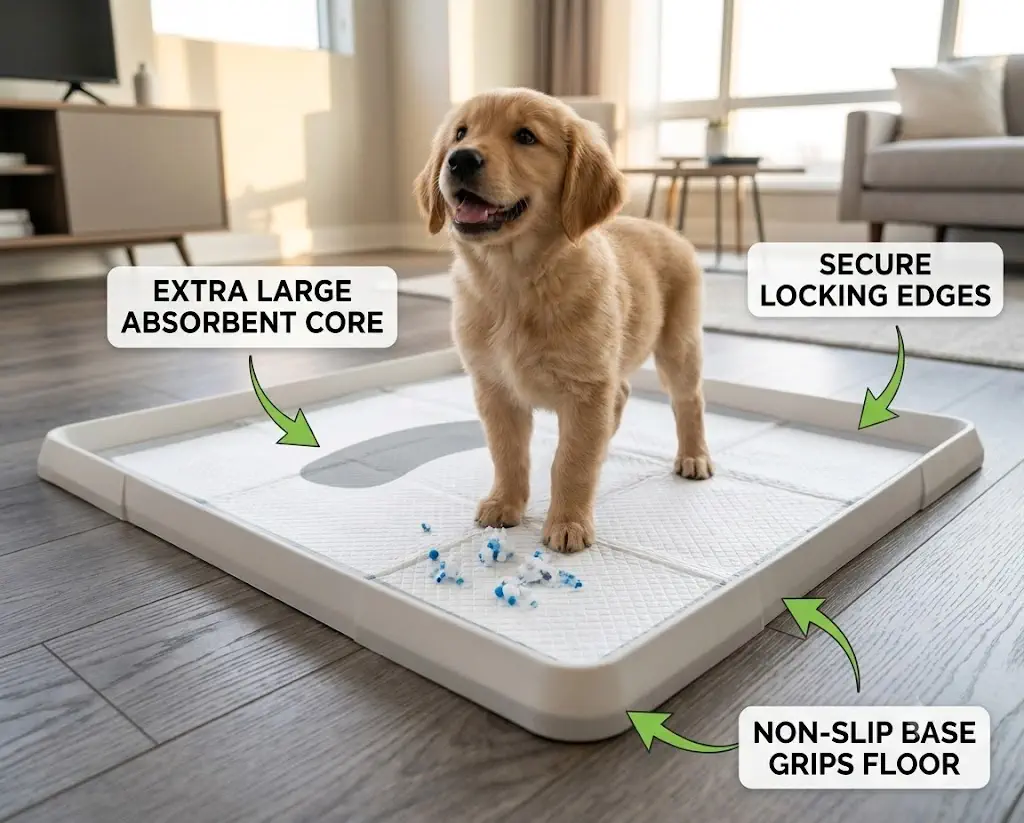
Functional absorbent core dimensions represent the actual usable fluid strike-through target zone. Outside sheet dimensions include non-absorbent plastic borders that distort sizing comparisons:
For example, a current 28 × 34-inch pad lists an absorbent core of approximately 24 × 29 inches.
This matters when comparing two products with similar outside dimensions. A larger-looking border does not necessarily mean a larger usable absorbent area.
When shopping, compare:
- Overall pad dimensions
- Absorbent core dimensions when provided
- Border construction
- Available floor space
- Your puppy’s actual potty stance
Are Large and XL Puppy Pads the Same Size?
Marketing labels vary across pet product manufacturers without standardized dimension guidelines. Commercial designations create significant consumer sizing discrepancies:
For example, one current product line lists its Large pad at 22 × 23 inches, XL at 28 × 34 inches, and XXL at 27.5 × 44 inches.
That is why you should always check the dimensions in inches before ordering.
Is a Bigger Puppy Pad Always Better?
Oversized training pads create unnecessary floor obstruction without offering operational benefits for small puppies. Optimal equipment selection focuses on biometric proportionality:
A very large pad can take up unnecessary floor space and may be inconvenient in a small apartment or dedicated indoor potty area.
The goal is to find the smallest practical pad that gives your puppy a reliable target.
If a 22 × 22-inch pad works consistently for your small puppy, moving to a 34 × 28-inch pad may provide little benefit. Conversely, if a large puppy repeatedly misses the edge, using a larger pad can be a simple and useful adjustment.
One Pad or Two Smaller Pads?
Single oversized pads eliminate fluid-leaking junction seams that occur when overlapping smaller sheets. Multi-pad arrangements invite subfloor contamination along border gaps:
Using two pads can make sense when additional coverage is temporarily needed, but the arrangement can create seams where urine reaches the floor.
If your puppy has outgrown a standard pad, moving to a larger format is generally a cleaner approach than continually adding smaller pads.
How to Measure Your Puppy for a Training Pad
Canine biometric measurements establish the required perimeter clearance before purchasing equipment. Follow this 5-step measurement procedure:
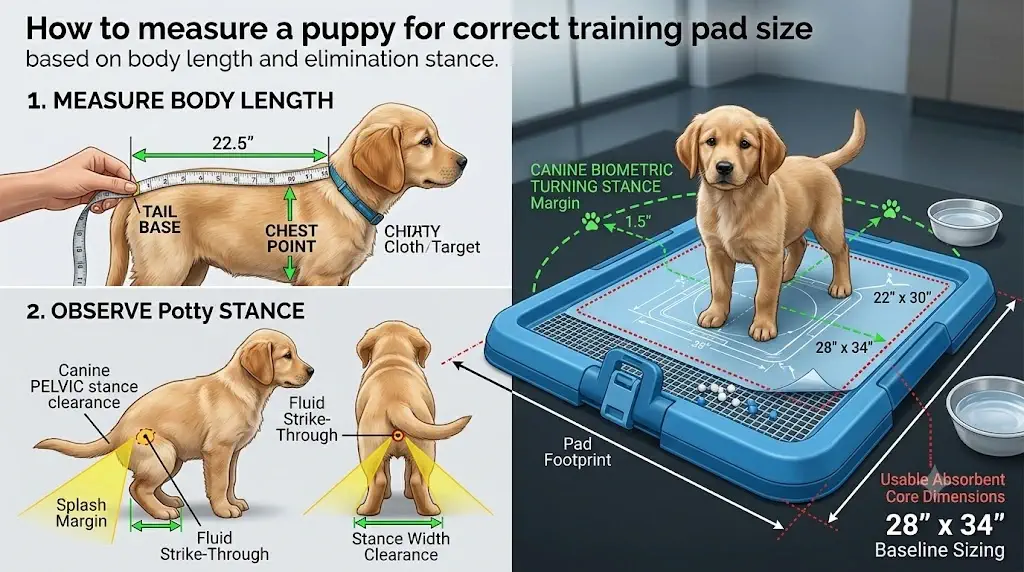
- Measure Body Length: Record the distance in inches from the cranial tip of the chest to the base of the tail while standing.
- Observe the Potty Stance: Measure the width between the lateral edges of the hind paws during squatting.
- Calculate Turning Radius: Add 6 to 8 inches to the body length to account for natural pre-elimination circling.
- Inspect Splash Patterns: Check how far urine radiates outward on current test pads.
- Verify Floor Fit: Ensure the calculated dimensions fit within your apartment bathroom or exercise pen without bunching against baseboards.
You do not need a mathematically exact formula. The purpose of measuring is simply to avoid choosing a pad that is obviously too small for your puppy.
Puppy Training Pad Size Guide for Common Situations
Household spatial layouts dictate appropriate training pad formats across diverse living environments. The following matrix provides practical hardware recommendations:
| Household Potty Scenario | Recommended Starting Approach |
|---|---|
| Tiny puppy in a small apartment | Compact standard pad (17 × 24 or 22 × 22 in) |
| Small puppy with reliable aim | Standard square pad (22 × 22 to 22 × 23 in) |
| Small puppy with frequent edge misses | Move up one size (24 × 24 or 24 × 30 in) |
| Medium puppy | Intermediate rectangle (24 × 30 to 24 × 35 in) |
| Large puppy | Extra-large pad (28 × 34 in or larger) |
| Giant-breed puppy | Giant-format chassis (30 × 36 in+ or 27.5 × 44 in) |
| Multiple puppies sharing one area | Increase total coverage substantially (Dual XL stations) |
| Puppy repeatedly missing one edge | Increase pad size or reposition away from room walls |
Puppy Training Pad Size Mistakes to Avoid
Purchasing errors compromise puppy spatial conditioning and increase cleaning labor. Avoid these five frequent sizing missteps:
1. Choosing by Marketing Labels Alone
“Large” and “XL” mean different things across brands. Always compare the actual measurements in inches.
2. Choosing Based Only on Weight
Weight does not tell you how much floor space a puppy uses while eliminating. Body proportions and stance width matter far more.
3. Ignoring the Puppy’s Growth Curve
A pad that worked perfectly at eight weeks becomes inadequate by week fourteen as skeletal length doubles.
4. Assuming Every Accident Means the Pad Is Too Small
A puppy may miss because of timing, incomplete training, distraction, movement, or poor placement. Increasing pad size is not always the correct fix.
5. Comparing Only the Outside Dimensions
Some products feature wide border margins and a tiny central absorbent core. Always compare usable core square inches.
Frequently Asked Questions (FAQ)
What is the best puppy training pad size for most puppies?
What size puppy pad does a 10-pound puppy need?
What size puppy pad does a 20-pound puppy need?
What size puppy pad does a 30-pound puppy need?
What size puppy pad does a 50-pound puppy need?
Are 22 × 22-inch puppy pads big enough?
Are XL puppy pads better for large puppies?
Should puppy pad size increase as a puppy grows?
Can a puppy pad be too big?
Why does my puppy pee beside the pad?
Should I use two puppy pads instead of one large pad?
Bottom Line
The best puppy training pad size gives your puppy enough room to step on, turn, position, and finish without regularly reaching the edge.
Use approximately 22 × 22 inches as a starting point for many toy and small puppies, move toward 24 × 30 to 24 × 35 inches for medium puppies, and consider 28 × 34 inches or larger for larger puppies. Giant-breed puppies may need substantially more coverage.
Most importantly, do not rely on the words Standard, Large, or XL. Those labels vary between manufacturers. Compare the actual dimensions, watch how your puppy uses the pad, and size up when repeated edge misses show that the current target is no longer large enough.
