
EMERGENCY TRIAGE PROTOCOL
Puppy Eats Pee Pads: Why It Happens and How to Stop It
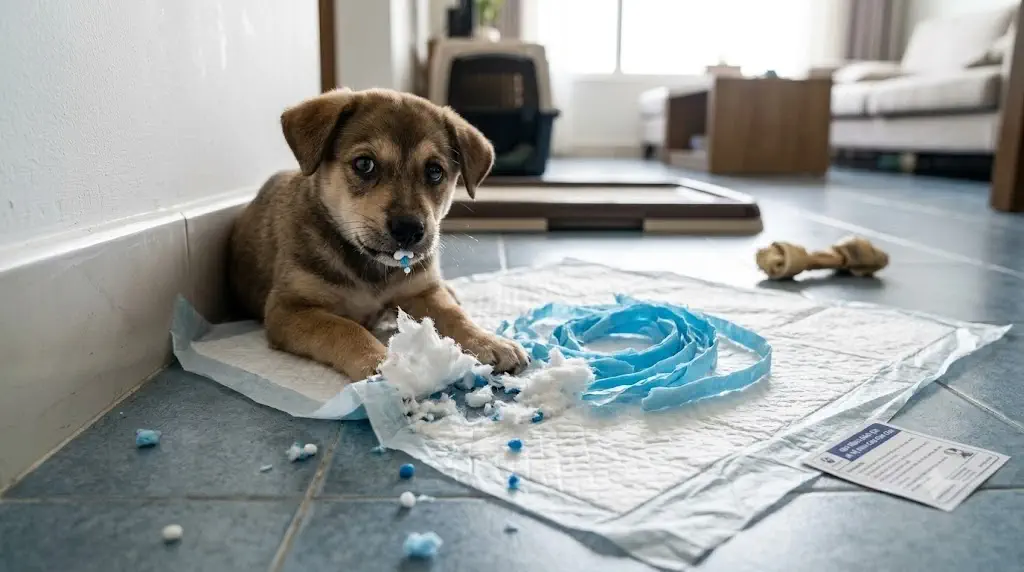
If your puppy eats pee pads, treat the behavior as both an acute medical risk and a mechanical training failure that requires immediate environmental containment. Puppies naturally investigate novel textures with their mouths, and a disposable training pad represents a high-interest target due to its crinkly plastic backing, shredded fluff pulp, and concentrated ammonia scent markers. The immediate objective is isolating the puppy from loose cellulose while establishing secure physical boundaries.
When a puppy swallows synthetic pad fragments, foreign material does not readily digest or break down in gastric acid. The superabsorbent polymer (SAP) contained within the core swells up to 50 times its original mass upon contact with digestive fluids, creating a high probability of mechanical gastrointestinal obstruction. Veterinary emergency consensus mandates immediate professional triage whenever synthetic liner ingestion occurs.
The American Kennel Club (AKC) confirms that exploratory pica and teething drives peak between 8 and 20 weeks of age, making loose training pads primary targets for destructive ingestion. This clinical and behavioral guide details the physiological risks of swallowed pad material, immediate veterinary triage protocols, and proven hardware strategies to stop pad destruction permanently.
Quick Reference Specification: Veterinary Risk Matrix & Hardware Intervention
This calibrated triage specification benchmarks clinical ingestion severity levels, biological mechanisms, and physical hardware interventions for puppies exhibiting pee-pad pica.
| Ingestion Severity | Core Material Swallowed | Primary Biological Hazard | Clinical Action Window | Recommended Hardware Solution |
|---|---|---|---|---|
| Level 1: Edge Nibbling | Outer plastic rim fragments | Minor mucosal irritation | Monitor 24–48 hrs for stool passage | Snap-clamp pad frame (IRIS USA) |
| Level 2: Center Fluff Tearing | Fluff pulp + small SAP granules | Partial transit delay, dehydration | Contact vet within 2–4 hours | Dry-paw mesh grate tray (Richell/CH24) |
| Level 3: Bolus Ingestion | Large poly film + SAP matrix | Complete mechanical bowel obstruction | Immediate emergency vet triage (< 2 hrs) | Enclosed grate system or Real-grass sod |
Why Does My Puppy Eat Pee Pads?
Canine exploratory behavior and sensory enrichment drives compel young puppies to chew soft disposable training materials. When puppies interact with pads, oral investigation acts as their primary cognitive sensory tool:
- Exploration: Puppies investigate unfamiliar textures, scents, and tactile surfaces using their mouths.
- Teething Discomfort: Deciduous teeth shed between 12 and 24 weeks of age, prompting puppies to seek soft, yielding materials to soothe inflamed gingival tissue.
- Rewarding Texture: The non-woven spunbond top sheet and crinkly polyethylene backing provide auditory and mechanical chewing feedback.
- Kinetic Movement: An unanchored training pad that bunches, slides, or flips underfoot triggers canine predatory prey-shaking reflexes.
- Territorial Pheromone Attraction: A soiled pad contains concentrated urea and ammonia scents that encourage dogs to investigate, scratch, and lick the elimination target.
- Under-Stimulation & Boredom: Puppies confined to small exercise pens without sufficient mental enrichment turn accessible floor substrates into self-soothing chew items.
- Accidental Reinforcement: Owners who shout, lunge, or chase a puppy clutching a pee pad accidentally initiate a high-arousal game of keep-away.
- Habitual Rehearsal: Unsupervised access allows puppies to repeat shredding cycles until pad destruction becomes an ingrained motor habit.
Not every puppy that chews a pad exhibits nutritional deficiencies or systemic illness. In the vast majority of cases, pad chewing represents an instinctual canine behavior intersecting with an unanchored, vulnerable indoor toilet setup.
Is It Dangerous for a Puppy to Eat a Pee Pad?
Swallowed pee pad fragments cause mechanical gastrointestinal blockages and dangerous intestinal intussusception. Disposable pads are manufactured from non-digestible synthetic compounds, including polyethylene backing film, polyester non-woven topsheets, bleached wood pulp, and sodium polyacrylate polymers.
The American Kennel Club (AKC) warns that foreign-body ingestion is one of the most common causes of emergency veterinary exploratory laparotomies in dogs under six months of age. The primary threat stems from the pad’s superabsorbent polymer core: when dry sodium polyacrylate crystals enter the stomach and small intestine, they absorb surrounding digestive secretions, expanding rapidly into a dense, gelatinous bolus that occludes the narrow pyloric outflow or the ileocecal valve.
If the swallowed backing consists of torn plastic sheeting, the film can act as a linear foreign body. As intestinal peristalsis attempts to move the obstruction downstream, the bowel can plicate (accordion-fold) along the plastic, causing severe pressure necrosis, tissue perforation, and fatal septic peritonitis. PetMD explicitly instructs pet parents to contact an emergency veterinary hospital immediately upon discovering pad ingestion rather than attempting home remedies.
What Should I Do If My Puppy Ate a Pee Pad?
Emergency veterinary triage requires immediate clinical assessment before swallowed polymers migrate past the stomach pylorus. If you witness or suspect pad ingestion, execute this immediate response protocol:
- Estimate Missing Surface Area: Piece together the shredded pad remnants to calculate the square inches of swallowed polymer and plastic.
- Record Ingestion Timestamps: Note the exact time elapsed since the puppy had unsupervised access to the pad.
- Document Ingestion State: Determine whether the missing sections contained concentrated urine salts or feces.
- Verify Weight and Breed: Small toy breeds (under 10 lbs) possess narrow intestinal lumens and face exponentially higher obstruction risks than giant breeds.
- Preserve Packaging: Retrieve the commercial box or packaging so emergency clinicians can identify specific gel additives, scents, or attractant chemistries.
Never induce vomiting with hydrogen peroxide without direct veterinary supervision. Sodium polyacrylate gel masses can become lodged in the esophagus during emesis, increasing the risk of chemical aspiration pneumonia. Veterinary clinicians utilize controlled intravenous emetic agents (such as apomorphine or ropinirole) only when clinically indicated based on radiography.
Signs That a Swallowed Pee Pad May Be Causing a Problem
Intestinal foreign-body obstructions manifest through persistent emesis, acute abdominal distension, and severe systemic depression. If your puppy ingested synthetic pad material, monitor for clinical symptoms over the critical 72-hour transit window:
- Unproductive Vomiting & Retching: Repeated attempts to vomit, particularly after drinking water, indicating upper gastrointestinal tract occlusion.
- Anorexia: Complete refusal of meals, high-value training treats, or fluids.
- Lethargy & Depression: Reluctance to walk, abnormal withdrawal, and lack of social response.
- Severe Abdominal Guarding: Whining, arched spine posture (“prayer position”), or growling when the abdominal wall is palpatated.
- Absence of Stool or Hemorrhagic Diarrhea: Tenesmus (straining without passing stool) or passing dark, tarry feces (melena) caused by intestinal mucosal ulceration.
- Tachycardia & Pale Mucous Membranes: Rapid heart rate and pale gums indicating severe shock or septic fluid loss.
If any of these clinical indicators emerge, transport your dog immediately to the nearest 24-hour emergency animal hospital. Intestinal ischemia can result in irreversible bowel perforation within 12 to 24 hours of complete occlusion.
Why Puppies Shred Pee Pads
Mechanical pad shredding functions as a tactile gateway behavior that precedes ingestion. Puppies rarely ingest intact pads; destruction begins at unanchored borders where loose cellulose fibers invite play:
- Corner Exposure: Puppies target loose corner margins where teeth can easily pry the sheet off the subfloor.
- Boredom in Confinement: Being isolated in an exercise pen without active physical or cognitive outlets causes puppies to view the floor pad as a shredding puzzle.
- Texture Shredding Pleasure: The physical action of ripping pulp releases instinctual foraging satisfaction.
- Excess Physical Energy: Puppies left unexercised channel kinetic frustration directly into clawing and scratching elimination pads.
Effective intervention demands replacing loose sheets with mechanically secured boundaries and channeling destructive energy into appropriate canine-safe items.
How to Stop a Puppy From Eating Pee Pads
Preventing pee pad destruction requires mechanical hardware containment combined with active behavioral redirection. Implement this 6-point operational blueprint:
1. Anchor the Sheet Inside a Protective Frame
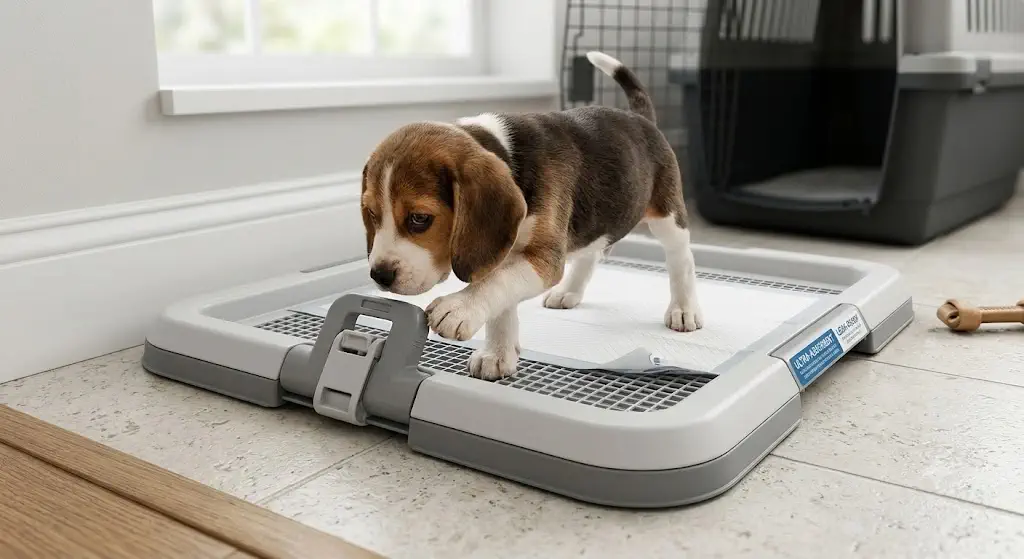
A loose pad invites destruction. Enclose the pad inside a snap-clamp holder or an elevated mesh grate that locks all perimeter edges beneath rigid polypropylene dams.
2. Supervise Every Elimination Session
Stand beside the potty station during elimination. The exact moment elimination concludes, immediately guide the puppy off the surface before they turn around to investigate the substrate.
3. Restrict Unsupervised Floor Access
Never leave loose disposable pads inside unsupervised playpens. If you cannot monitor the station, transition the puppy to a chew-proof crate or an elevated grate toilet system.
4. Provide Biological Chewing Alternatives
Channel natural teething impulses toward frozen rubber Kong toys, textured nylon bones, or natural beef tendons. Reinforce that pee pads function exclusively as elimination targets, while toys absorb chewing force.
5. Extinguish Chase and Keep-Away Games
If your puppy grabs a pad corner, avoid lunging or chasing them. Stand still, present a high-value treat (freeze-dried liver), and trade the pad calmly once the dog releases tension.
6. Clean Soiled Areas Instantly with Enzymes
Dispose of soiled pads immediately. Lingering urine scents encourage territorial paw scratching that quickly leads to fabric tearing.
Should I Use a Pee Pad Holder if My Puppy Eats Pads?
Dedicated pad holders eliminate accessible corners and prevent puppies from dragging loose pads across the floor. Mechanical snap-locks clamp the perimeter borders flat, removing the loose flap that triggers chewing reflexes.
However, a standard open clamping frame leaves the center absorbent core exposed. For determined puppies that dig directly into the center of the sheet, an open holder must be upgraded to a dry-paw perforated grate system.
Should I Switch From Disposable Pads to Washable Pads?
Washable fabric pee pads resist claw shredding due to high-tensile polyester fibers and tear-resistant polyurethane backings. Unlike paper pads that shred into ingestible fluff, multi-layer washable pads lack loose cellulose layers.
While heavy fabric reduces ingestion hazards, teething puppies can still chew stitched hems if the mat is left unanchored. To evaluate reinforced non-shred fabrics, explore our comprehensive review of the best washable puppy pee pads.
Could an Indoor Dog Potty Be Better Than a Pee Pad?
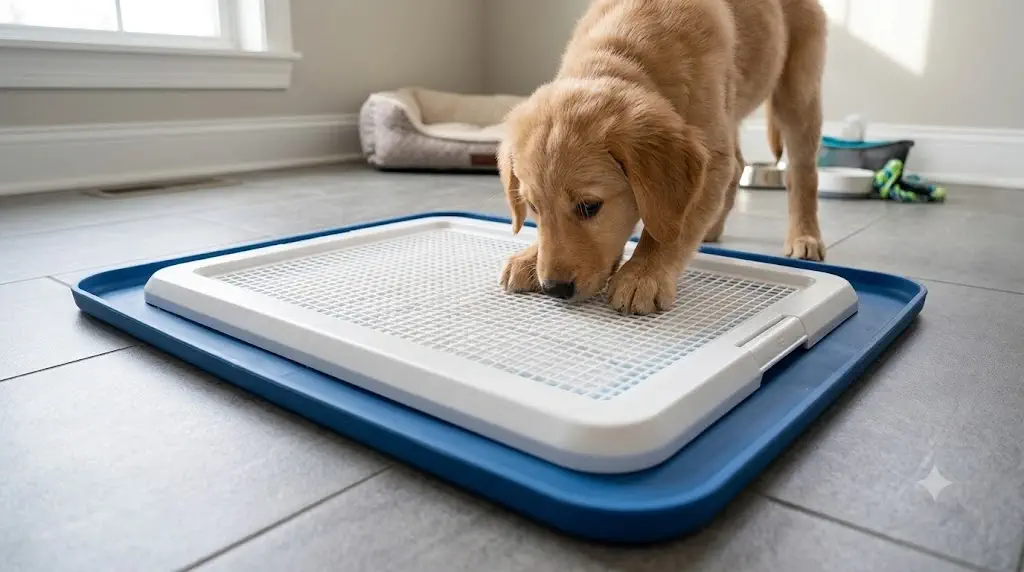
Grated indoor dog potties physically separate canine paws and teeth from absorbent substrates beneath a rigid barrier. By positioning a heavy-duty plastic or stainless-steel lattice over the absorbent pad, urine drains into the basin while the puppy stands on an indestructible surface.
For chronic pad-destroying puppies, an enclosed tray or real-grass sod box completely eliminates paper pica risks. Review top-rated mechanical systems in our laboratory audit of the best indoor dog potty systems.
How to Train a Puppy Not to Eat the Pee Pad
Structured operant conditioning teaches puppies that elimination substrates provide rewards only for biological elimination. Execute this 4-step sequence:
- Leashed Station Entry: Escort the puppy to the potty pad on a short 4-foot leash immediately after wake-up or feeding windows.
- Ignore Investigative Chewing: If the puppy sniffs or paws the pad edge, gently restrict leash mobility without speaking, maintaining neutral energy.
- Reinforce Completion Promptly: The moment urination finishes, mark with a verbal “Yes!” and deliver a treat while the puppy is standing upright.
- Immediate Spatial Exit: Step backward off the pad immediately, enticing the puppy off the surface to prevent post-elimination investigating.
Teach “Leave It” for Pee-Pad Safety
Impulse control training conditions puppies to disengage from tempting floor objects on verbal cue. Building a reliable “leave it” response prevents emergency ingestion incidents:
- Stage 1 (Closed Fist): Present a low-value treat inside a closed fist. Allow the puppy to lick or sniff; the instant they pull back, mark and reward from your other hand.
- Stage 2 (Open Hand): Present the treat on an open palm. If the puppy lunges, close your fingers. Reward only when the puppy offers voluntary eye contact.
- Stage 3 (Floor Placement): Place an inert object (such as a clean paper pad corner) on the floor. Issue the “Leave it” cue and reward heavily when the puppy steps back.
Mastering impulse control ensures that accidental pad contact can be halted verbally before teeth tear into the absorbent matrix.
What If My Puppy Eats Used Pee Pads?
Soiled puppy pads carry concentrated enteric bacterial loads that cause acute gastroenteritis when ingested. Swallowing urine-saturated cellulose introduces concentrated uric salts, coliform bacteria, and gastrointestinal pathogens into the upper digestive tract.
Dispose of soiled pads immediately upon use. If your puppy ingests feces or contaminated pad sections, monitor closely for secondary bacterial infections, fever, and acute vomiting, and alert your attending veterinarian immediately.
What If My Puppy Eats the Pee Pad Every Time?
Chronic pad destruction requires an immediate transition to chew-proof hardware platforms. When a puppy shreds every disposable sheet provided, continuing to use loose pads risks intestinal obstruction.
Immediately remove all loose paper pads from the home. Upgrade to an elevated dry-paw mesh grate potty tray or an all-natural grass turf box. Eliminating access to shreddable cellulose breaks the behavioral reinforcement loop completely.
Why Punishment Is Not the Answer
Aversive physical punishment induces fear-based elimination avoidance and accelerates destructive shredding behaviors. Shouting, hitting, or rubbing a puppy’s snout into shredded debris damages the human-animal bond.
Puppies subjected to punishment learn that eliminating in the presence of humans is dangerous, leading them to hide behind furniture or under beds to urinate. Focus entirely on structural prevention, leashed supervision, and rewarding approved elimination habits.
Can Boredom Cause a Puppy to Eat Pee Pads?
Cognitive under-stimulation directly increases destructive chewing and exploratory pica in young dogs. Confining high-drive working breeds to playpens with nothing to manipulate inevitably directs energy toward floor substrates.
Incorporate interactive puzzle toys, snuffle mats, daily obedience drills, and supervised outdoor sensory walks. Providing 20 to 30 minutes of structured mental engagement dramatically reduces destructive indoor chewing.
Does Eating Pee Pads Mean My Puppy Has a Nutritional Deficiency?
Pee pad pica in puppies stems almost exclusively from behavioral exploration rather than clinical malnutrition. While mineral deficiencies or severe gastrointestinal malabsorption can trigger pica in adult canines, puppy chewing is overwhelmingly developmental.
Do not alter commercial puppy diets or introduce unverified mineral supplements without veterinary bloodwork. Consult your veterinarian to ensure your puppy’s caloric and micronutrient intake matches their projected breed growth curve.
How to Make a Pee-Pad Area Safer
Environmental design standards minimize ingestion hazards and reinforce spatial housebreaking boundaries. Configure your indoor potty station to these parameters:
- Zero Loose Edge Margins: Utilize snap-locking frames that conceal all four outer sheet margins.
- Isolated Elimination Zones: Position the potty station well away from sleeping crates, food bowls, and toy baskets.
- High-Friction Base Stability: Ensure the tray chassis features heavy rubber feet to stop sliding during vigorous pacing.
- Bio-Enzymatic Subfloor Sanitization: Clean surrounding subfloors with bio-enzymatic sprays to eliminate lingering uric acid markers.
Puppy Eats Pee Pad vs Puppy Chews Pee Pad
Clinical risks escalate dramatically when chewing transitions into true gastrointestinal ingestion. The following diagnostic matrix outlines behavioral stages and required interventions:
| Observed Canine Behavior | Primary Medical & Training Concern | Mandatory Protocol Response |
|---|---|---|
| Sniffs / Circles Surface | Normal elimination investigation | Allow behavior; reward prompt voiding |
| Chews / Nibbles Border | Teething stimulation / unanchored edge | Interrupt with “Leave it”; provide rubber chew toy |
| Drags Pad Across Room | Play motor pattern / kinetic prey instinct | Anchor pad inside heavy snap-clamp tray |
| Shreds Pad into Pieces | High ingestion risk / destructive pica | Remove loose sheets; install protective mesh grate |
| Swallows Small Fragment | Foreign-body ingestion / partial blockage | Contact vet; monitor appetite and stool transit |
| Swallows Large Section | High risk of complete mechanical obstruction | Immediate emergency vet triage; do not induce vomiting |
| Vomiting Post-Ingestion | Active gastrointestinal blockage confirmed | Transport immediately to veterinary ER for surgical imaging |
What If My Puppy Swallowed a Whole Pee Pad?
Ingesting an entire training pad constitutes a life-threatening veterinary emergency requiring surgical intervention. A whole pad cannot pass through a canine pyloric sphincter or ileocecal junction.
Do not wait for clinical symptoms such as vomiting or collapse to emerge. Transport your puppy to an emergency surgical facility immediately. Clinicians will perform abdominal radiography (X-rays) or ultrasound, followed by endoscopic retrieval or emergency gastrotomy before the material enters the small intestine.
How to Prevent Pee-Pad Eating in the Future
A zero-tolerance management strategy eliminates access to vulnerable disposable materials. Maintain these core operational standards:
- Deploy Chew-Proof Grates: Lock disposable sheets beneath elevated perforated grids.
- Enforce Supervised Potty Outings: Supervise all indoor bathroom sessions on a leash until impulse control is established.
- Reward Instant Elimination: Deliver high-value rewards the second elimination finishes.
- Rotate Mental Enrichment Toys: Provide daily cognitive chewing outlets away from the bathroom zone.
- Discard Soiled Pads Promptly: Remove used sheets before territorial investigation begins.
- Gradually Expand Freedom: Grant house privileges only as your puppy demonstrates reliable environmental impulse control.
Frequently Asked Questions (FAQ)
Why does my puppy eat pee pads?
Is it dangerous if my puppy eats a pee pad?
What should I do if my puppy swallowed part of a pee pad?
Can a puppy digest a pee pad?
Should I make my puppy vomit after eating a pee pad?
Can a pee-pad holder stop my puppy from eating pads?
Should I switch to washable puppy pads?
Would an indoor dog potty be better?
Why does my puppy shred the pee pad after using it?
Should I punish my puppy for eating the pee pad?
What symptoms should I watch for after my puppy eats a pee pad?
When should I call the veterinarian?
Bottom Line: Stop the Access, Keep the Potty Routine
A puppy eating pee pads is usually a combination of normal puppy chewing and an overly accessible potty surface—but swallowed pieces can create a genuine safety concern.
If your puppy only chews the pad, focus on supervision, a stable potty setup, prompt removal after use, and appropriate chewing alternatives. If the puppy repeatedly shreds pads, consider a secured holder or a more structured indoor potty system.
If your puppy has swallowed part or all of a pee pad, contact your veterinarian rather than assuming it will pass safely. Do not induce vomiting unless specifically instructed by a veterinarian. Foreign-body obstructions can be serious and may require veterinary treatment.
The long-term goal is simple: teach your puppy that the pee pad is for pottying—not chewing. Consistent supervision and management make that distinction much easier to learn.
