
COMPARATIVE FIELD AUDIT 2026
Grass Potty vs Pee Pads: Which Is Better for Puppies?
Choose a grass potty if your puppy will eventually potty on grass outside and you want an indoor surface that resembles the outdoor target. Choose pee pads if portability, convenience, and easy replacement matter more.
Both systems can work for puppies, especially when frequent outdoor trips are difficult. The bigger difference is the surface your puppy learns to use: a pee pad provides an absorbent fabric-like target, while a grass potty uses artificial turf or real grass, usually over a tray.
That surface difference matters because puppies can develop preferences for where and on what type of surface they eliminate. AKC specifically notes that artificial turf can help puppies make a connection to real grass outside.
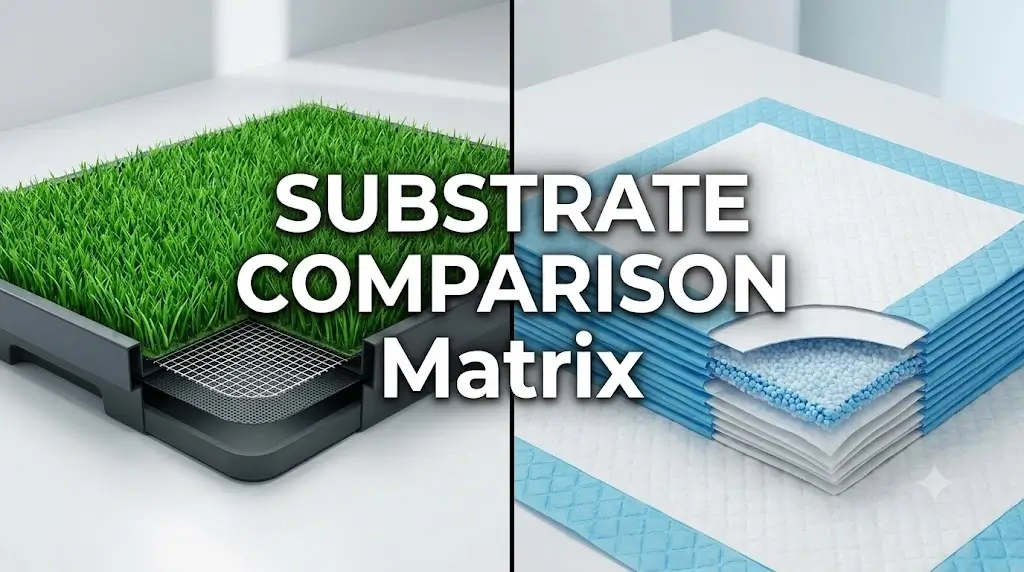
Quick Reference Specification: Grass Potty vs. Pee Pad Comparison Matrix
This calibrated technical matrix compares core substrate composition, fluid processing mechanics, behavioral conditioning impact, and long-term maintenance logistics.
| Evaluation Metric | Synthetic Turf Potty | Real Fresh Grass Patch | Disposable Pee Pad | Washable Fabric Pad |
|---|---|---|---|---|
| Surface Texture Type | Polypropylene synthetic grass blades | Living soil & real hydroponic turf | Non-woven quilted fabric layer | Brushed polyester or cotton blend |
| Fluid Containment | Flow-through grate into plastic reservoir | Natural soil absorption & roots | Superabsorbent polymer (SAP) gel | High-density inner soaker layer |
| Substrate Conditioning | High correlation to natural grass | Identical to outdoor lawn | High risk of rug/blanket confusion | Moderate risk of rug confusion |
| Daily Maintenance | Tray emptying & turf water rinse | Spot solid waste removal only | Fold, toss, and replace sheet | Bin collection & machine laundry |
| Mobility & Travel | Bulky, requires rinse access | Heavy (15–25 lbs), non-portable | Ultra-portable (packs flat) | Portable, requires wet storage bag |
| Destructive Chewing Risk | Low (clamped borders on trays) | Moderate (puppy digging in dirt) | High (loose sheets invite shredding) | Moderate (chew-resistant hems) |
Grass Potty vs Pee Pads: Quick Answer
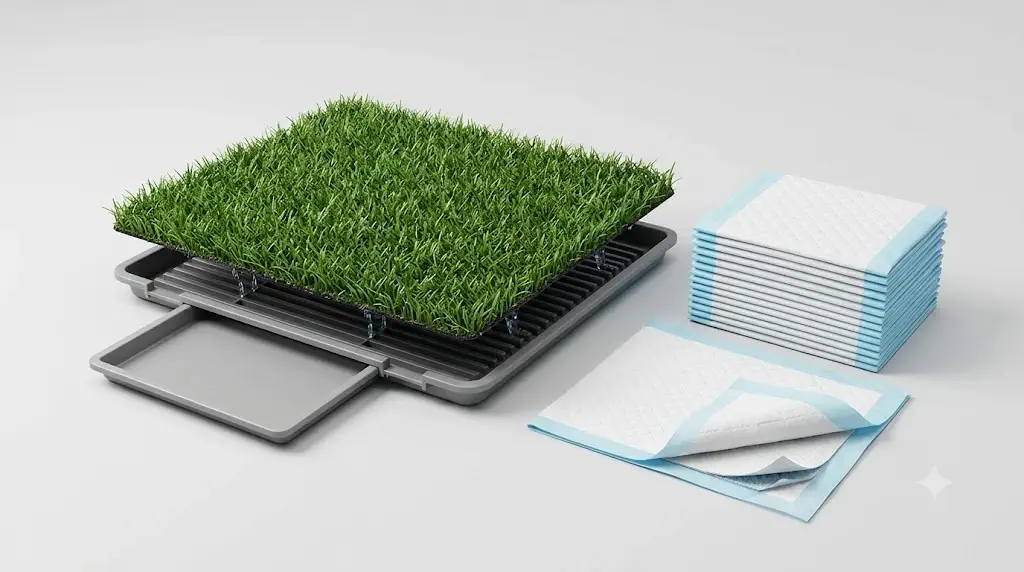
Substrate tactile conditioning determines whether a puppy transfers indoor potty habits to outdoor lawns successfully. The following side-by-side comparison outlines the critical operational trade-offs between both indoor elimination systems:
| Factor | Grass Potty | Pee Pads |
|---|---|---|
| Outdoor grass transition | Advantage | Usually requires a surface transition |
| Initial setup | More involved | Very simple |
| Portability | Limited | Excellent |
| Cleanup | Requires washing/rinsing | Very easy with disposable pads |
| Reusability | Usually reusable | Disposable or washable |
| Apartment use | Very good | Very good |
| Odor control | Depends on cleaning frequency | Depends on replacement frequency |
| Pad shredding | Less exposed surface to grab | Potential issue with loose pads |
| Long-term indoor use | Good | Good |
| Travel | Less convenient | Better |
What Is the Difference Between a Grass Potty and a Pee Pad?
Physical material composition establishes the sensory tactile difference between grass systems and fabric pads. A pee pad is an absorbent sheet designed to give a puppy a designated indoor elimination surface. Disposable versions are thrown away after use, while washable versions can be laundered and reused.
A grass potty is an indoor or outdoor potty station that uses artificial turf or real grass. Many systems place the grass over a tray that collects urine or other waste.
AKC describes artificial turf as one of the indoor potty options available to puppy owners and notes that it can help puppies connect the indoor surface with real grass outside.
So the fundamental difference is not simply “disposable versus reusable.” It is pad surface versus grass-like surface.
When Should You Choose a Grass Potty?
Long-term outdoor lawn routines make grass potty systems the superior behavioral foundation for puppies. A grass potty is particularly appealing when you want your puppy to eventually eliminate on grass outdoors.
Choose Grass If Outdoor Grass Is the Final Goal
If your puppy will eventually use a backyard, lawn, or grassy outdoor area, starting with a grass-like surface can make the indoor-to-outdoor transition more intuitive.
Dogs can develop preferences for particular surfaces. AKC notes that a puppy accustomed to one surface may hesitate when introduced to another, which is why matching the indoor surface to the eventual outdoor surface can be useful.
Choose Grass If You Want a Dedicated Potty Station
A grass potty normally has a defined footprint, making it easier to establish one permanent indoor bathroom location.
This can be useful when you want to avoid loose pads being moved around the home.
Choose Grass If Your Puppy Shreds Loose Pads
Some puppies treat loose pee pads as something to grab, pull, or chew. A grass system can reduce access to a loose disposable sheet, although puppies still need supervision around any potty material they might chew.
AKC also identifies pad shredding as one disadvantage of disposable puppy pads.
When Should You Choose Pee Pads?
High mobility demands make disposable pee pads the practical choice for travel and temporary care. Pee pads are usually the better option when convenience and flexibility are your priorities.
Choose Pee Pads for Travel
Disposable pads are lightweight, easy to pack, and simple to replace. That makes them practical for road trips, hotels, visits to friends, or other temporary locations.
AKC specifically highlights the portability of pee pads for apartment living and travel.
Choose Pee Pads for Temporary Indoor Training
If your puppy only needs an indoor backup while they are very young, recovering from a temporary limitation, or living somewhere with difficult outdoor access, pads provide a simple solution.
Very young puppies need frequent bathroom opportunities, and apartment layouts can make getting outside quickly difficult. AKC recognizes indoor potty options as useful in these situations.
Choose Pee Pads If You Want Minimal Equipment
A disposable pad can be placed directly in the designated potty area. There is no grass insert, collection tray, or separate cleaning process.
That simplicity is the biggest reason pads remain popular.
Grass Potty vs Pee Pads for Outdoor Potty Training
Turf substrate conditioning provides the biological bridge needed for instinctive outdoor elimination. Grass has the surface advantage.
If your long-term goal is for your puppy to eliminate on grass outdoors, a grass potty gives the puppy an indoor surface that more closely resembles the eventual target.
Pee pads can still be used successfully, but the puppy may need to learn that the acceptable surface has changed from a pad to grass.
This does not mean a grass potty guarantees faster outdoor training. Training still depends on supervision, timing, consistency, and reinforcement. AKC emphasizes these fundamentals regardless of whether the puppy uses an indoor potty or goes outside.
Does a Grass Potty Make Outdoor Transition Easier?
Familiar paw tactile feedback reduces outdoor bathroom hesitation but cannot eliminate the transition process. It can, but it does not eliminate the need for transition training.
The potential advantage is surface familiarity. A puppy that regularly eliminates on artificial turf may already understand that a grass-like surface is an acceptable bathroom area.
However, the puppy still has to learn the new location, outdoor distractions, timing, and environmental conditions.
Think of grass as reducing one possible change—not as a shortcut around potty training.
Grass Potty vs Pee Pads for Apartments
High-density urban dwellings require matching potty hardware to available floor space and balcony layouts. Both are strong apartment options. The better choice depends on whether you prioritize compact convenience or a permanent indoor bathroom station.
| Apartment Situation | Better Starting Choice |
|---|---|
| Very limited floor space | Pee pad |
| Need something portable | Pee pad |
| Temporary indoor backup | Pee pad |
| Permanent indoor potty area | Grass potty |
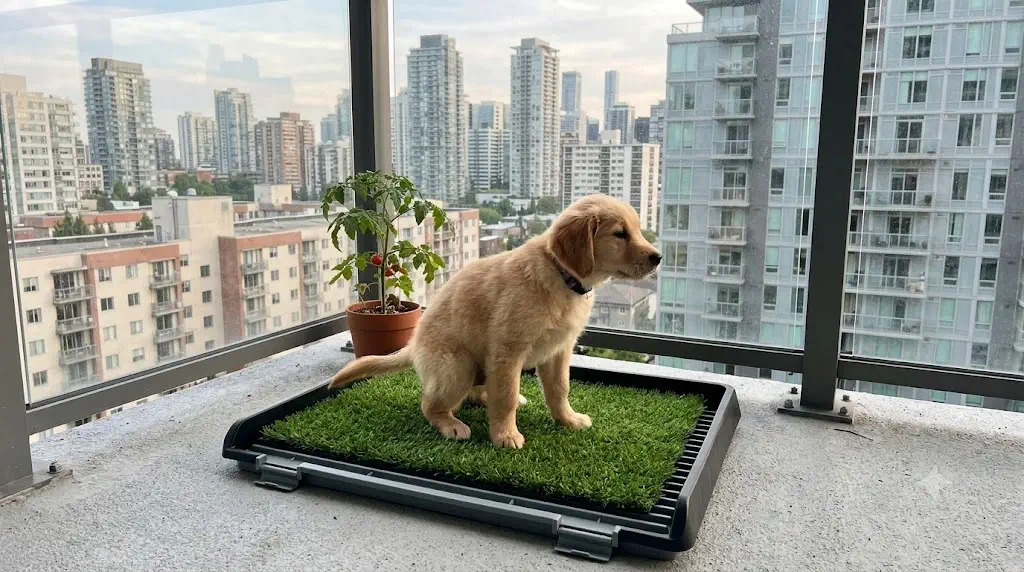
| Balcony potty setup | Grass potty |
| Want a grass-like surface | Grass potty |
| Puppy shreds loose pads | Grass potty |
| Need quick disposable cleanup | Pee pad |
AKC specifically lists both pee pads and grass patches as practical solutions for apartment dogs that cannot always get outside quickly.
For the complete apartment-specific training routine, see our guide to house training a puppy in an apartment.
Grass Potty vs Pee Pads for Small Puppies
Small metabolic reserves demand frequent bathroom access regardless of the chosen indoor equipment. Small puppies often need more frequent bathroom breaks because of their small bladders and individual metabolism.
A pee pad can be convenient because it creates an immediate indoor option. A grass potty can be useful when you want to establish a dedicated station from the beginning.
Neither option removes the need for frequent potty opportunities. The puppy’s age and individual needs should determine how often you offer access to the toilet area.
Grass Potty vs Pee Pads for Large Puppies
Heavier body mass requires reinforced tray frames and wider turning clearance to prevent spills. Large puppies need enough surface area to comfortably enter, turn, position themselves, and eliminate without reaching the edge.
With pee pads, this may mean moving from standard to XL or giant formats. With grass systems, choose a potty large enough for the puppy’s body and stance.
Do not choose based only on the label “XL.” Measure the actual usable surface and compare it with your puppy’s current size.
Which Has Better Odor Control?
Maintenance frequency dictates odor control efficiency across both synthetic polymers and living turf. Neither automatically wins.
Odor is mainly a maintenance issue.
Disposable pee pads make odor management straightforward because the entire soiled pad can be removed. But leaving a heavily used pad in place for too long can still create odor.
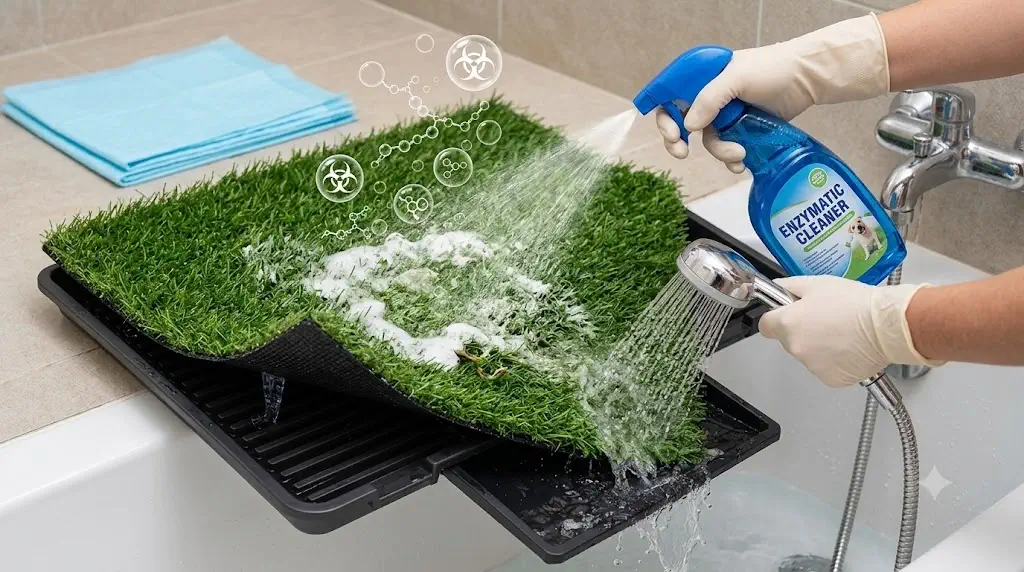
Grass systems are reusable, but the turf and tray need regular cleaning. Artificial grass that remains dirty can develop odor even if the surrounding area looks clean.
The better system is the one you can maintain consistently.
Which Is Easier to Clean?
Disposable substrates minimize cleaning labor by trading maintenance time for recurring product replacement. The practical sanitation tasks vary significantly:
| Cleaning Task | Grass Potty | Pee Pad |
|---|---|---|
| Remove urine | Clean grass/tray | Replace disposable pad |
| Daily maintenance | Moderate | Low |
| Washing required | Usually | Only for washable pads |
| Waste volume | Lower with reusable system | Higher with disposables |
| Travel cleanup | Less convenient | Very convenient |
If convenience is your primary concern, disposable pee pads have the simpler cleanup process. If reducing disposable waste is important, a reusable grass system can make more sense.
Which Costs Less?
Upfront equipment investments offset cumulative disposable sheet expenses over extended training periods. The answer depends on how long you use the system.
Pee pads generally have a lower starting cost but disposable versions create a recurring expense every time a pad is replaced.
Grass potty systems require more equipment initially, but the grass and tray can be reused. That means the ongoing cost may be different over months of use.
There is no universal cost winner because pad consumption, cleaning frequency, replacement parts, and the length of use vary between households.
Grass Potty vs Pee Pads for Puppies That Chew
Enclosed perimeter grates restrict puppy access to loose fabric edges that stimulate chewing instincts. If your puppy grabs and shreds every loose pad, a grass potty can be worth trying.
Disposable pads can be tempting because they are lightweight and easy for a puppy to grab. AKC identifies shredding as one of the practical disadvantages of disposable pads.
A tray-based grass system can make the potty surface less accessible as a loose object.
However, a puppy that chews the grass, tray components, or other potty materials still needs supervision. Choose materials appropriate for pets and remove damaged components.
Can Puppies Learn to Use Both Grass and Pee Pads?
Dual-substrate training increases cognitive confusion unless owners maintain strictly segregated locations. Yes, but consistency is important.
You can use a pee pad as a backup while maintaining a grass potty as the primary indoor toilet. However, giving a puppy several unrelated bathroom locations can make the rules less clear.
AKC warns that teaching multiple acceptable elimination options can make housetraining more complicated because the puppy is learning more than one place to go.
If you need both, keep the locations clearly defined rather than placing pads randomly around the house.
Which Is Better for Balcony Potty Training?
Self-contained grass trays withstand outdoor wind and rain better than unanchored paper pads. A grass potty is often the more natural fit for a dedicated balcony setup.
A tray-based grass system can create a defined toilet area while keeping the potty surface contained.
Pee pads can also work on a balcony if they are protected from wind and positioned securely. The main consideration is preventing the pad from moving and ensuring waste does not create a sanitation problem.
Check your building’s rules before establishing a permanent balcony potty area.
Which Is Better During Bad Weather?
Indoor elimination stations protect vulnerable young canines during severe environmental temperature drops. Either indoor option can provide a useful backup.
Extreme heat, severe cold, heavy rain, or other difficult weather can make outdoor potty trips less practical. An indoor potty area can give the puppy an approved alternative when getting outside quickly is difficult.
However, an indoor option should not become an excuse to ignore the puppy’s normal potty routine when outdoor trips are practical.
Grass Potty vs Pee Pads: Training Difficulty
Operant conditioning principles govern puppy housebreaking speed regardless of the target material chosen. Neither is automatically easier to train.
The training process is essentially:
- Choose one clearly defined potty location.
- Bring the puppy there at appropriate times.
- Supervise closely.
- Wait for elimination.
- Reward immediately after successful use.
- Clean accidents thoroughly.
- Repeat consistently.
AKC recommends consistency, supervision, frequent opportunities, and positive reinforcement as core parts of successful puppy housetraining.
Which Surface Will Your Puppy Prefer?
Early neonatal sensory imprinting dictates whether canines naturally favor turf fibers or soft pads. Pay attention to what your puppy naturally seeks out.
Some puppies readily accept pads. Others seem more interested in grass, turf, concrete, or other surfaces.
This matters because dogs can develop surface preferences. A puppy accustomed to eliminating on grass may hesitate when presented with a completely different indoor surface.
If your puppy strongly prefers grass, a grass potty may be easier to introduce than a pad. If the puppy readily accepts a pad, there may be little reason to change systems simply because grass is available.
Grass Potty vs Pee Pads: Decision Guide
Household lifestyle criteria determine the most practical indoor potty equipment for each living scenario. Use the following decision matrix to select the ideal option:
| Your Priority | Better Choice | Reason |
|---|---|---|
| Eventually potty on outdoor grass | Grass potty | Closer surface match |
| Lowest setup complexity | Pee pads | Minimal equipment |
| Frequent travel | Pee pads | Easy to pack and replace |
| Permanent indoor bathroom | Grass potty | Dedicated reusable station |
| Small apartment | Either | Choose based on space and routine |
| Balcony potty | Grass potty | Defined grass-like station |
| Puppy shreds loose pads | Grass potty | Less exposed loose material |
| Fastest cleanup | Disposable pee pads | Remove and replace |
| Reusable indoor system | Grass potty | Designed for repeated use |
| Temporary backup toilet | Pee pads | Simple and inexpensive |
How to Choose Between Grass and Pee Pads
Six fundamental operational questions guide puppy owners toward the correct indoor equipment selection. Ask these six questions before buying:
- Where should my dog eliminate long term? If the answer is grass, consider starting with grass.
- Is indoor potty training temporary? If yes, pee pads may be simpler.
- Will I travel frequently? If yes, disposable pads are much easier to transport.
- Does my puppy shred pads? If yes, consider a protected grass or tray system.
- How much cleaning can I handle? Pads are easier to replace; grass systems require washing.
- How much space do I have? Measure the area before choosing the system.
How to Transition From Pee Pads to Grass
Gradual substrate substitution prevents regression when introducing a puppy to artificial or real grass. If your puppy already uses pee pads and you want to introduce grass, make the change gradually:
- Place the grass potty near the existing pad: Position the new turf within the puppy’s established spatial territory.
- Keep the location consistent: Maintain identical station coordinates to avoid confusing the puppy.
- Encourage investigation without forcing the puppy onto it: Allow natural curiosity and scent checking.
- Reward successful elimination on the grass: Deliver high-value praise and treats immediately upon voiding.
- Gradually reduce reliance on the old pad: Fold the pad smaller or remove it entirely once turf use is consistent.
- Continue reinforcing the grass potty every time it is used correctly: Solidify the new substrate habit through repetition.
Do not assume that simply placing a piece of artificial grass beside the old pad will immediately change the puppy’s preference. Surface changes can require patience and repetition.
How to Transition From a Grass Potty to Outdoor Grass
Outdoor environmental stimulation requires proactive scheduling to migrate learned turf habits outside. The same principle applies in the opposite direction.
Start taking your puppy to the outdoor potty area at predictable times. Give the puppy enough opportunity to eliminate outside, and reward successful outdoor potty behavior immediately.
Over time, make outdoor trips the primary potty routine while gradually reducing dependence on the indoor grass station.
For a dedicated transition plan, see our guide to transitioning from pee pads to outside.
Do Grass Potty Systems Replace Outdoor Potty Training?
Indoor potty stations serve as convenience alternatives rather than permanent substitutes for outdoor housebreaking. No.
A grass potty is an indoor or designated alternative bathroom. It does not automatically teach a puppy to wait for outdoor trips.
If outdoor potty training is your final objective, continue giving the puppy frequent opportunities to eliminate outside as their age and circumstances allow.
Indoor potty systems are most useful when they solve a genuine access problem rather than simply replacing outdoor training without a reason.
Common Mistakes to Avoid
Inconsistent station management causes canine confusion and delays indoor housebreaking success. Avoid these five frequent pitfalls:
Changing Surfaces Too Quickly
A puppy that has learned one surface may not immediately understand another. Make surface changes gradually.
Moving the Potty Location Constantly
Keep the approved toilet area consistent while your puppy is learning.
Using Pads Everywhere
Multiple random pads can make it less clear which areas are intended for elimination.
Assuming Grass Guarantees Faster Training
Surface similarity can help, but training still requires supervision, timing, consistency, and reinforcement.
Ignoring Cleaning
Reusable grass systems need regular cleaning. Disposable pads should also be changed promptly enough to keep the potty area sanitary.
Frequently Asked Questions (FAQ)
Is grass potty better than pee pads?
Are grass potties good for puppies?
Do puppies prefer grass or pee pads?
Will a grass potty make potty training easier?
Can I use pee pads if I eventually want my puppy to potty outside?
Can I use both a grass potty and pee pads?
Are grass potties good for apartment dogs?
Are pee pads better for traveling?
Do grass potties smell?
Can a puppy transition from a pee pad to grass?
Can a puppy transition from artificial grass to real grass?
Should I choose artificial grass or real grass?
Bottom Line: Grass Potty or Pee Pads?
The optimal indoor potty system balances your ultimate outdoor housebreaking goals with realistic daily sanitation capacity.
Choose a grass potty if your puppy needs a regular indoor bathroom and you want the indoor surface to resemble outdoor grass.
Choose pee pads if you want the simplest, most portable, and easiest-to-replace option.
For many apartment puppies, either system can work. The deciding factor is usually the long-term plan. If indoor potty use is temporary and outdoor grass is the ultimate destination, a grass surface may provide a useful bridge. If convenience, travel, or quick cleanup is more important, pee pads remain the simpler choice.
Most importantly, remember that the potty surface is only one part of the process. Consistent location, appropriate timing, supervision, and immediate positive reinforcement matter more than whether the target is grass or a pad.
