
PUPPY CRATE TRAINING & NIGHTTIME ROUTINES
Puppy Crate Training at Night: How to Help Your Puppy Sleep
Puppy crate training at night works best when bedtime is predictable, the crate is comfortable, and nighttime potty needs are handled calmly.
Young puppies often cannot sleep through the entire night without a bathroom break. The goal is therefore not to force a puppy to hold it longer than they comfortably can. Instead, establish a consistent bedtime routine, place the crate where you can respond when necessary, and gradually teach the puppy that nighttime means sleeping rather than playing.
Some puppies settle immediately, while others cry or wake repeatedly during the first few nights. Individual differences are normal. A gradual, positive approach is more useful than trying to make the puppy tolerate a long nighttime session immediately.
Puppy Crate Training at Night: The Short Answer
The simplest nighttime routine is:
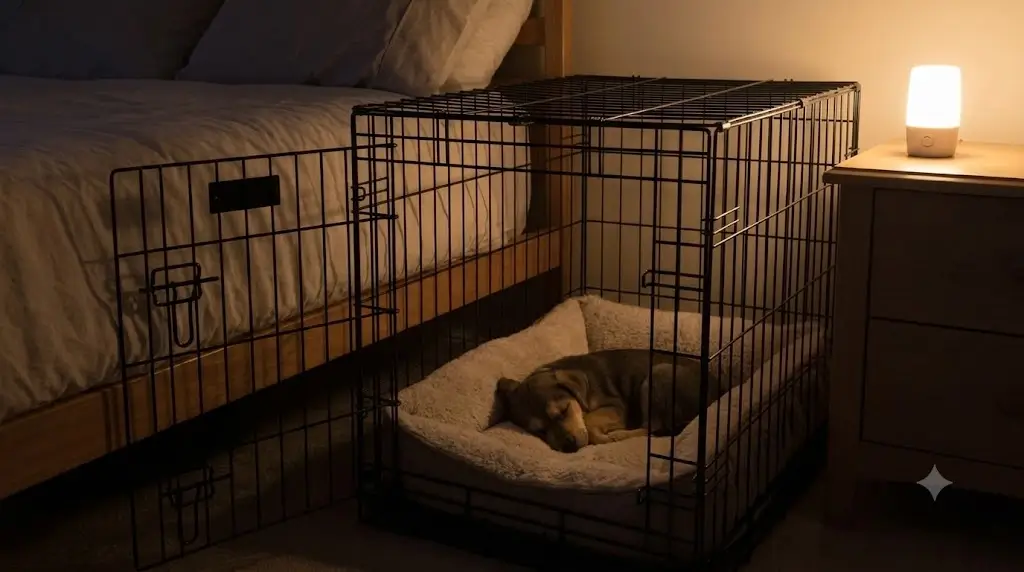
During the first nights, keep the crate near your bedroom so you can hear your puppy. If the puppy wakes and genuinely needs to eliminate, take them out for a brief, boring potty trip and return them to the crate.
Avoid turning nighttime wake-ups into playtime, feeding sessions, or extended interaction. The message should be simple: nighttime is for sleeping.
Should a Puppy Sleep in a Crate at Night?
Yes. A properly introduced crate can be part of a puppy’s nighttime sleeping routine.
A crate provides a consistent sleeping location and can help owners manage nighttime potty training. The American Kennel Club specifically recommends using the crate for nighttime sleep and emphasizes that the crate should be a safe, positive place rather than punishment.
However, nighttime crating does not mean a young puppy should be expected to remain confined until morning regardless of bathroom needs. Very young puppies often require one or two nocturnal bio-breaks until sphincter control strengthens.
Where Should the Puppy Crate Be at Night?
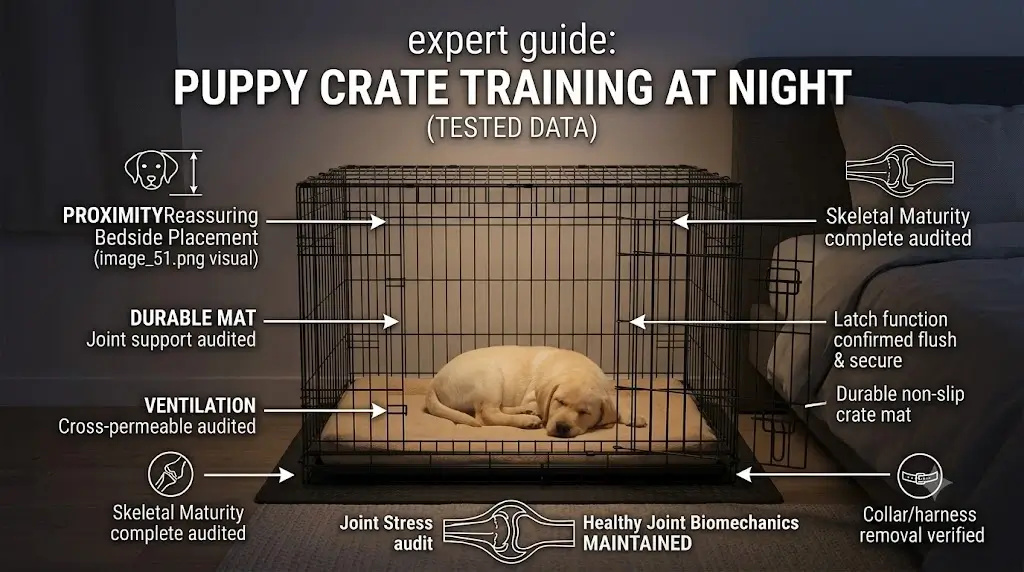
For a new puppy, placing the crate in or near your bedroom is often the easiest starting point.
Being close to you can help a puppy feel more secure during the transition from sleeping with their mother and littermates to sleeping alone in a new home. It also makes it easier to hear whether your puppy wakes and needs to go outside.
Good nighttime crate locations
- Directly beside your bed: Allows you to lower a hand to reassure the puppy without getting up.
- Near the bedroom door: Excellent if you need a quick, unobstructed exit route for midnight trips.
- Quiet guest room: Only once the puppy has developed established bladder control and crate confidence.
For detailed spatial safety and flooring stability rules, check our full guide on How to Set Up a Puppy Crate.
The Best Bedtime Routine for a Puppy in a Crate
Consistency matters more than a specific clock hour.
30–60 minutes before bed
- Wind down active play and high-energy games.
- Restrict unrestricted water access to prevent nighttime bladder overfills.
- Spend quiet, calming family time in low lighting.
- Prepare the crate interior with clean, chew-safe bedding.
Immediately before bed
- Take the puppy on leash to the designated outdoor elimination area.
- Wait patiently for them to fully void their bladder.
- Quietly praise elimination and escort them directly indoors.
- Toss a small reward into the crate to encourage voluntary entry.
- Close and latch the crate door quietly.
- Turn off overhead lights to establish a sleep cue.
Coordinate this bedtime wind-down with our structured Puppy Crate Training Schedule to balance daytime naps with nighttime sleep.
Example Puppy Crate Training at Night Schedule
The exact times should match your household routine. The sequence matters more than the clock.
| Time | Example Routine |
|---|---|
| 6:00 PM | Dinner |
| 6:15–6:30 PM | Post-dinner potty trip |
| 6:30–8:00 PM | Family interaction, mental games, and scheduled outdoor breaks |
| 8:00–9:00 PM | Calmer activity; remove free-access water bowls |
| 9:30 PM | Final quiet decompression period |
| 10:00 PM | Final outdoor potty → crate → lights out |
| 2:00–3:00 AM | Quiet, low-light potty break (for puppies under 12 weeks) |
| 6:30 AM | Immediate outdoor potty trip after morning wake-up |
How to Handle a Puppy Crying in the Crate at Night
The first question is not simply “Should I ignore the crying?” The better question is: why is the puppy crying?
| Situation | Probable Cause | Action to Take |
|---|---|---|
| Mild whining immediately after door closes | Protest / FOMO | Ignore for 10–15 minutes; allow puppy to self-soothe |
| Sudden whining after 3–4 hours of sound sleep | Urgent potty pressure | Quiet, boring bathroom trip on leash immediately |
| Frantic scratching, biting bars, thrashing | Confinement panic | Reset training; place crate adjacent to bed to soothe |
How to Handle a Nighttime Potty Break
Make nighttime bathroom breaks intentionally boring so your puppy does not perceive midnight as playtime:
- Keep lights low and voices to a quiet whisper.
- Leash the puppy right out of the crate without excited greeting.
- Carry young puppies outside to prevent mid-hallway accidents.
- Give them 3 to 5 minutes at the designated elimination spot.
- Deliver calm verbal praise once they finish; do not initiate play or offer meals.
- Return directly inside and guide them back into the crate.
- Close the latch and return to sleep immediately.
Should You Cover the Puppy Crate at Night?
A fitted crate cover can block early morning sunlight and reduce ambient visual triggers that wake light sleepers. Benchmark vetted models and airflow standards in our guide to the Best Puppy Crate Covers.
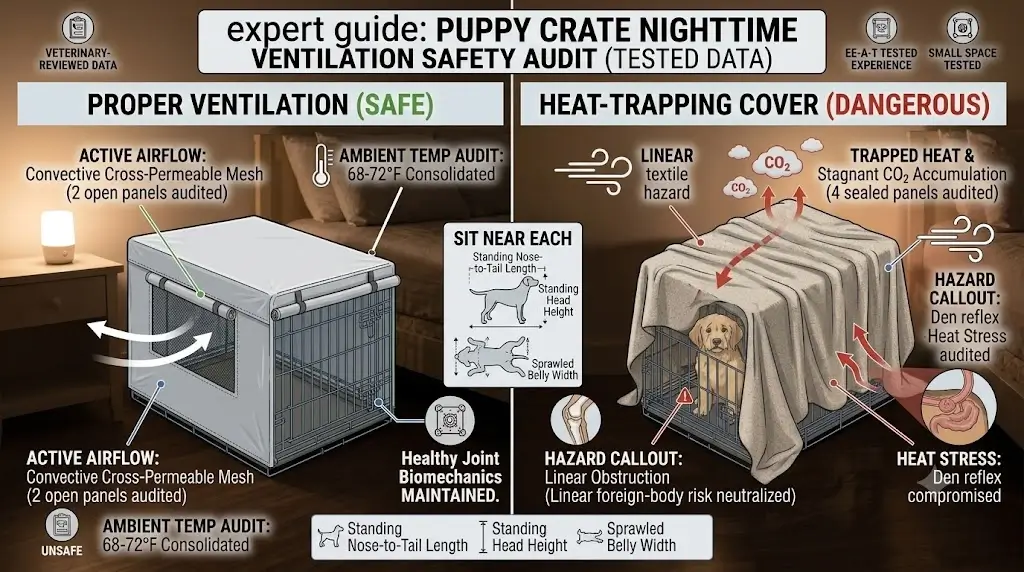
If using a crate cover overnight:
- Never drop all four flaps tightly; maintain cross-ventilation.
- Use a tailored cover rather than loose household blankets that puppies can ingest.
- Check that the room temperature stays within 68°F–72°F (20°C–22°C).
Nighttime Crate Training Checklist
- ☐ Sized correctly with space to sprawl naturally
- ☐ Placed beside the bed for the first 1–2 weeks
- ☐ Durable, non-chewable sleeping pad installed
- ☐ Collars, tags, and harnesses removed for safety
- ☐ Water access cut off 2 hours prior to sleep
- ☐ Final outdoor potty break completed immediately before crating
- ☐ Low ambient lighting and white noise machine running if needed
- ☐ Quiet, leash-only protocol established for midnight wake-ups
Frequently Asked Questions
Is it OK to crate a puppy at night?
Yes. When introduced gradually and paired with age-appropriate bathroom breaks, a crate provides den security and prevents nocturnal household hazards.
Where should my puppy sleep on their first night home?
Keep the crate right next to your bed. Smelling your presence eases the intense separation anxiety of leaving their mother and littermates.
When do puppies start sleeping through the night without a potty trip?
Most puppies develop the bladder capacity to sleep 7–8 hours continuously between 14 and 16 weeks of age, though giant and toy breeds vary significantly.
What if my puppy pees in their crate overnight?
Never punish the puppy. Clean the mess with an enzymatic cleaner, replace the pad, and set an earlier alarm for the next night to beat their bladder limit.
Final Verdict: Make Nighttime Predictable
Successful puppy crate training at night is built around routine, appropriate potty breaks, and calm repetition—not forcing a puppy to endure a long night immediately.
Start with the crate near your bedroom, establish a consistent bedtime, take your puppy out immediately before sleep, and keep any nighttime potty trips brief and boring. As biological sphincter control matures, nocturnal interruptions will fade naturally into peaceful, full-night sleep.
