
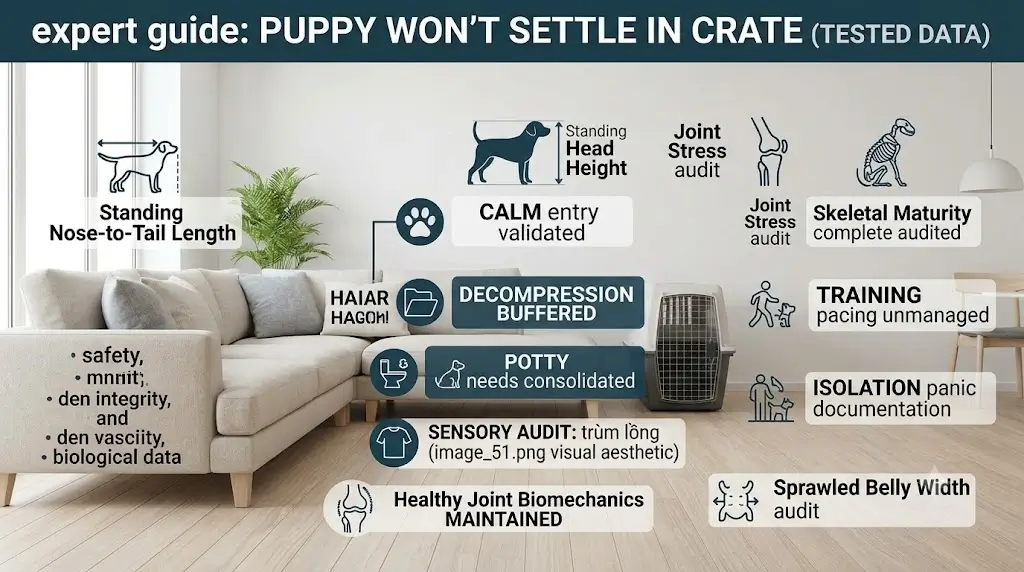
PUPPY CRATE TRAINING & BEHAVIOR TROUBLESHOOTING
Puppy Won’t Settle in Crate: Why It Happens and How to Help
If your puppy won’t settle in the crate, don’t assume the crate itself is the problem. Puppies may struggle to settle because they need to potty, are overtired or overstimulated, have had too much crate time, have not learned how to relax alone, or have progressed through training too quickly.
The most effective solution is usually to make crate time easier rather than simply making it longer. Meet your puppy’s immediate needs, create a predictable routine, reward calm behavior, and increase crate duration gradually. The goal is not merely to make your puppy stay inside the crate; it is to teach your puppy that the crate is a safe place where relaxing is worthwhile.
Quick Answer: Why Won’t My Puppy Settle in the Crate?
The most common reasons include:
- They need to go potty.
- They have too much energy or are overstimulated.
- They are overtired and having difficulty switching off.
- They have been crated longer than they can comfortably handle.
- The crate is uncomfortable, poorly positioned, or too exposed.
- They have not developed positive associations with the crate yet.
- The training progression moved too quickly.
- They are uncomfortable being separated from you.
If the puppy is becoming increasingly distressed rather than gradually calmer, stop increasing the difficulty. A puppy that cannot settle is often telling you that the current step is too difficult.
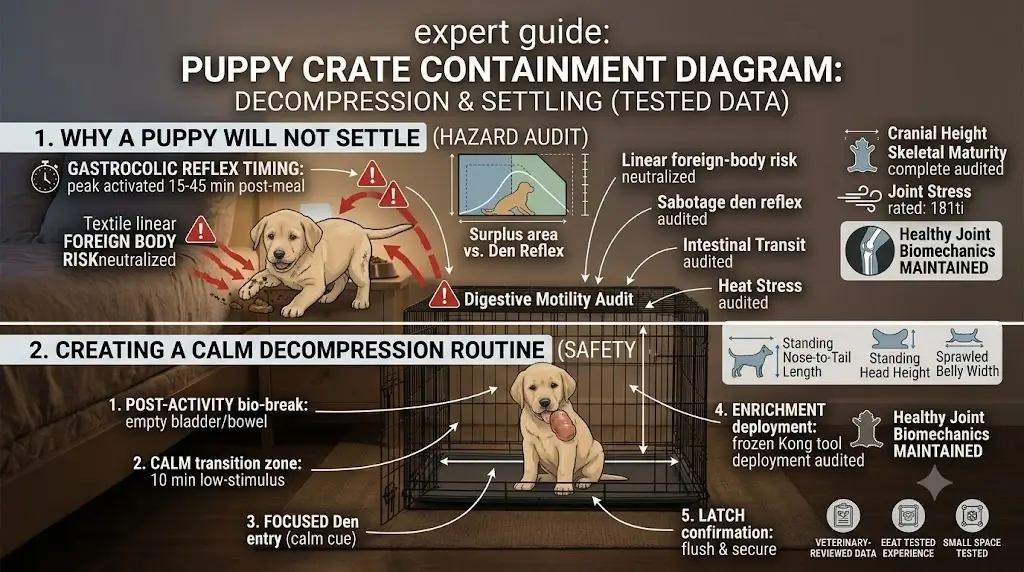
What “Settling in the Crate” Should Look Like
Settling does not mean your puppy must immediately fall asleep.
A successful early session may simply look like this:
- Walks into the crate voluntarily.
- Takes a treat or appropriate enrichment item.
- Looks around briefly.
- Lies down.
- Chews quietly.
- Remains relaxed while you stay nearby.
Over time, the puppy should become better at relaxing without constant interaction from you. The American Kennel Club recommends rewarding calm behavior and building crate time gradually rather than expecting a puppy to tolerate long periods immediately.
1. Take Your Puppy Out to Potty First
Before troubleshooting crate behavior, eliminate the simplest explanation: your puppy may need a bathroom break.
A young puppy has limited bladder control, and potty needs can change quickly after waking, eating, drinking, playing, or becoming excited. If you put a puppy into the crate immediately after one of these triggers, settling may be much harder.
A practical sequence is:
For puppies still learning house training, don’t expect them to remain settled if they are physically uncomfortable because they need to eliminate.
To coordinate daytime naps with mandatory bathroom breaks, refer to our structured Puppy Crate Training Schedule.
2. Check Whether Your Puppy Is Overtired or Overstimulated
This is one of the easiest problems to overlook.
A puppy that has been playing, exploring, meeting people, training, or dealing with household activity may look as though it needs more exercise. In reality, the puppy may be too stimulated to settle.
Common signs include:
- Constant movement and frantic pacing.
- Pawing at the crate door or wire panels.
- Switching repeatedly between toys without focusing.
- Whining despite having recently gone potty.
- Difficulty lying down or keeping their head relaxed.
- Sudden bursts of activity when you expected sleep.
Instead of adding more excitement, try a short transition period before crate time. Lower the household activity, use calm movements, and give your puppy an opportunity to decompress. Structured rest and routine scheduled quiet periods help young dogs learn to settle.
3. Make the Crate a Place for Calm Activities
If every crate session means the end of fun, your puppy may naturally resist going inside.
Instead, reserve some of your puppy’s favorite appropriate enrichment for crate time:
- Food-stuffed enrichment toys appropriate for your puppy.
- A safe chew your puppy already handles appropriately.
- A portion of the puppy’s meal delivered in or near the crate.
- Small rewards for voluntarily entering.
The important part is the association: crate predicts good, calm things. Using food, toys, praise, and other positive experiences builds an enduring den association.
4. Stop Expecting Too Much Too Soon
One of the biggest mistakes is treating a puppy’s first successful five-minute session as proof that the puppy is ready for thirty or sixty minutes.
Crate training works better when duration is increased gradually:
| What Your Puppy Can Do | Next Step |
|---|---|
| Enters voluntarily | Reward entry |
| Stays calmly with door open | Practice brief door closures |
| Remains calm with door closed | Add small amounts of time |
| Settles while you sit nearby | Add small amounts of distance |
| Handles short absences calmly | Gradually practice longer absences |
If whining, barking, or restlessness suddenly increases, the previous step was probably easier for your puppy than the current one. Reduce the difficulty and rebuild from there.
5. Reward Calmness, Not Just Crate Entry
Getting into the crate is only the first behavior you want. You also want your puppy to learn that quiet, relaxed behavior inside the crate is valuable.
For example, if your puppy enters the crate, lies down, and remains calm for several seconds, quietly reward that behavior. Keep your response calm so you do not accidentally turn relaxation into another exciting interaction.
Over repeated sessions, your puppy begins to understand: Go inside → relax → good things happen.
Reinforcing calm behavior in the crate rather than reacting to barking or frantic escape attempts stabilizes the den habit.
6. Don’t Automatically Let the Puppy Out for Whining
If every burst of whining immediately opens the crate door, your puppy can learn that whining makes confinement end.
For ordinary training sessions, try to wait for a brief moment of quiet before opening the door, provided your puppy’s basic needs have been met and the puppy is not becoming distressed.
However, potty training changes the equation. A young puppy that is whining after an appropriate amount of time may genuinely need to eliminate. Take the puppy out calmly, give them the opportunity to potty, and return to the crate without turning the break into a play session. Respond calmly to legitimate biological needs while avoiding reinforcing routine demands.
7. Look at the Crate Location
A crate can be perfectly comfortable and still be difficult to settle in if it is placed in the wrong part of the house.
Consider whether the crate is:
- Directly beside constant household traffic.
- Near loud appliances.
- In an isolated room where the puppy feels separated from everyone.
- In direct sunlight or an excessively warm location.
- Positioned where people constantly walk past the puppy.
For a new puppy, being close to family can be reassuring. At night, placing the crate in or near the bedroom can make it easier to respond to legitimate potty needs and may help the puppy feel less isolated.
8. Check the Crate Size
The crate should provide enough room for your puppy to stand, turn around, lie down, and rest comfortably. Too little space can make the puppy uncomfortable. Too much space can make management harder during house training.
For a growing puppy, a wire crate designed around expected adult size can be used with a divider panel so the usable area adapts as the puppy grows without enabling corner elimination. Discover top-rated models in our guide to the Best Puppy Crates With Dividers.
9. Consider Whether the Crate Feels Too Exposed
Some puppies settle more easily when the crate feels visually contained rather than completely exposed to household activity.
If you use a cover, maintain good ventilation and avoid creating excessive heat. You can also experiment with positioning the crate so that the puppy has fewer visual distractions while still remaining safely connected to the household. Discover vetted models in our evaluation of the Best Puppy Crate Covers.
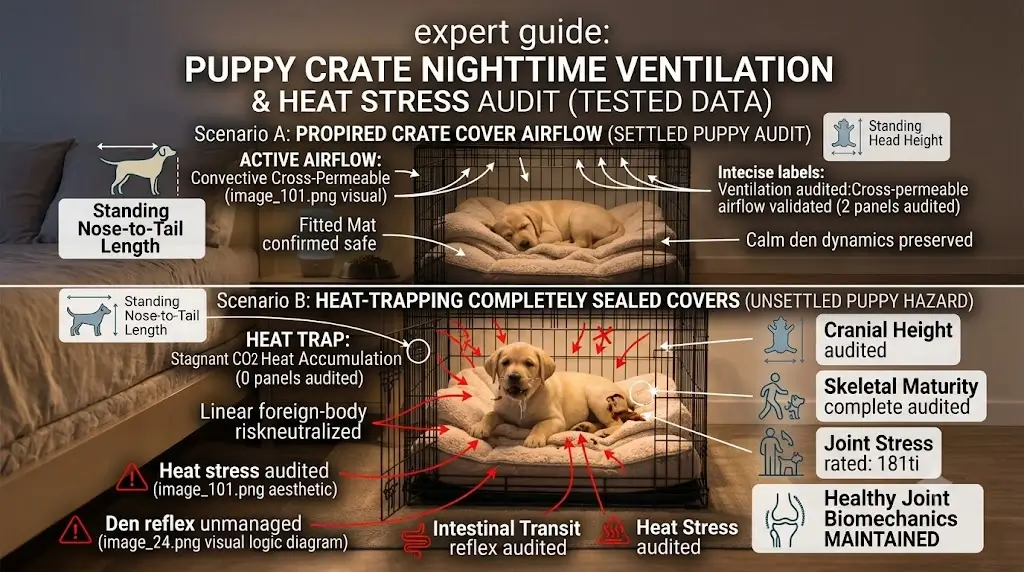
The response is individual. If covering the crate makes your puppy more restless, remove it rather than assuming every puppy needs an enclosed den setup.
10. Give Your Puppy a Predictable Pre-Crate Routine
Puppies generally benefit from predictable routines. A consistent sequence makes crate time easier to anticipate instead of making it feel like a sudden interruption.
A useful daytime pattern can be:
- Wake up.
- Go potty.
- Eat or have a short activity period, depending on the schedule.
- Go potty again when appropriate.
- Calm down.
- Enter the crate.
- Receive appropriate enrichment.
- Rest.
The exact timing should be adjusted to the individual puppy rather than treated as a rigid universal schedule. If your puppy regularly becomes restless at the same point in the day, look for a pattern rather than simply adding more crate time.
11. What to Do When Your Puppy Whines in the Crate
First, identify what the whining is communicating:
| Possible Reason | What to Check |
|---|---|
| Potty need | Time since last bathroom break and recent activity |
| Too much time | Whether the current duration exceeds the puppy’s comfort level |
| Too much stimulation | Noise, movement, visitors, play, or household activity |
| Needs more gradual training | Whether duration or distance increased too quickly |
| Discomfort | Temperature, bedding, crate location, or physical comfort |
| Fear or significant distress | Whether the puppy is becoming increasingly panicked rather than settling |
Do not treat every type of vocalization as identical. The appropriate response depends on the cause.
12. What If Your Puppy Settles When You’re Beside the Crate?
That is useful diagnostic information. It suggests your puppy may be comfortable with the crate itself but not yet comfortable with distance from you.
Start with the easiest version:
- Sit beside the crate.
- Reward calm behavior.
- Stand up briefly.
- Sit back down before the puppy becomes distressed.
- Repeat.
- Gradually increase the distance.
Don’t jump directly from sitting beside the crate to leaving the house. Alone-time training and crate training overlap, but they are not exactly the same skill. A puppy needs to learn that your movement away from the crate does not automatically mean something bad is happening. Build alone time gradually and shorten confinement when a puppy is struggling rather than allowing them to become overwhelmed.
13. What If Your Puppy Won’t Settle at Night?
Nighttime crate problems need slightly different troubleshooting.
Before bedtime:
- Keep the evening routine predictable.
- Give the puppy an appropriate final potty opportunity.
- Keep the environment calm as bedtime approaches.
- Place the crate in a location where the puppy does not feel unnecessarily isolated.
- Be prepared for nighttime potty breaks if the puppy is still too young to make it through the night.
If the puppy wakes and genuinely needs to potty, keep the trip quiet and boring. Afterward, return the puppy to the crate rather than turning the middle of the night into playtime.
14. Don’t Use the Crate as Punishment
If the crate becomes the place where your puppy is sent after doing something wrong, settling can become harder. The puppy may begin to associate the crate with your frustration instead of rest and safety.
Use a neutral or positive tone when sending your puppy to the crate. Reward voluntary entry and calm behavior. Keep the crate a positive space and avoid punishment-based crating.
15. Avoid the “Cry It Out” Trap
There is an important difference between giving a puppy a chance to settle and repeatedly leaving a distressed puppy to escalate.
If your puppy is mildly vocal and then begins relaxing, you can give them a moment to settle. But if the puppy is becoming increasingly stressed, the answer is not necessarily to wait longer. Instead, make the next session easier.
Allowing puppies to “cry it out” as a routine crate-training strategy creates negative associations with the enclosure. Keep periods short and let puppies out before they show acute stress.
16. A Simple Reset Plan for a Puppy Who Won’t Settle
If your puppy has suddenly stopped settling, temporarily return to easier training.
Day 1: Rebuild the Association
- Leave the crate door open.
- Reward voluntary approaches.
- Feed some meals near or inside the crate.
- Allow the puppy to enter and leave without pressure.
Day 2: Practice Brief Calm Sessions
- Start with the puppy already calm.
- Give an appropriate enrichment item.
- Close the door briefly.
- Reward calm behavior.
- Open the door during a quiet moment.
Day 3 and Beyond: Increase One Variable at a Time
Change only one major factor at a time: duration, distance, distraction, or time of day. If the puppy struggles, reduce that variable and repeat an easier version.
17. A Practical Troubleshooting Checklist
When your puppy won’t settle, ask these questions in order:
- When did the puppy last potty?
- Has the puppy eaten or drunk recently?
- Has the puppy just finished active play?
- Could the puppy be overtired?
- How long has the puppy already been in the crate?
- Has crate duration recently increased?
- Is the crate comfortable and correctly sized?
- Is the location too noisy or distracting?
- Does the puppy settle when you remain nearby?
- Are calm behaviors being rewarded?
- Has the crate accidentally become associated with punishment?
- Is the puppy mildly protesting, or genuinely distressed?
When Should You Get Professional Help?
Some crate problems go beyond ordinary puppy adjustment.
If your puppy consistently shows significant distress, becomes increasingly fearful of the crate, or appears unable to cope even when you substantially reduce the difficulty, consider stopping the current crate-training progression and seeking help from a qualified trainer or veterinary behavior professional.
Also consider veterinary advice if restlessness is accompanied by signs of illness, pain, unusual elimination, digestive problems, or a sudden major change from previously normal behavior.
Common Mistakes That Make Settling Harder
- Increasing crate time too quickly.
- Putting the puppy in the crate without a potty opportunity when one is needed.
- Using the crate only when the owner leaves.
- Using the crate as punishment.
- Releasing the puppy every time whining starts without considering the cause.
- Ignoring genuine distress.
- Making crate sessions overly exciting.
- Expecting a young puppy to behave like an adult dog.
- Changing the routine constantly.
- Assuming more exercise is always the answer.
How Long Does It Take a Puppy to Learn to Settle?
There is no universal number of days. Some puppies adapt quickly, while others need much more gradual practice. Age, previous experience, temperament, household environment, and the quality of the training progression all matter.
What matters more than the calendar is the direction of progress. A puppy that goes from 30 seconds of calm to two minutes of calm is making progress even if the puppy is not yet ready for a long crate session.
Puppy Won’t Settle in Crate: Quick Decision Guide
| What You See | Best First Adjustment |
|---|---|
| Whines immediately | Check potty needs and reduce training difficulty |
| Restless after playing | Use a calmer transition before crate time |
| Settles beside you | Practice gradual distance |
| Settles briefly, then becomes noisy | Shorten the session |
| Only struggles at night | Review bedtime and potty routine |
| Suddenly stops settling | Check routine, environment, comfort, and health |
| Shows intense distress | Stop increasing crate difficulty and seek professional guidance |
Frequently Asked Questions
Why won’t my puppy settle in the crate?
Your puppy may need to potty, be overtired, be overstimulated, have too much energy, be uncomfortable, or simply be progressing through crate training too quickly. Start by checking basic needs and then reduce the difficulty of the training session.
Should I ignore my puppy whining in the crate?
Not automatically. First determine whether the puppy needs to potty or is becoming genuinely distressed. For ordinary mild protest during training, avoid teaching that whining immediately opens the door; for genuine needs or significant distress, respond appropriately.
Should I let my puppy cry in the crate?
A brief period of mild vocalization is different from escalating distress. The goal should be gradual learning, not prolonged distress. If your puppy repeatedly becomes stressed, make the session easier.
How do I teach my puppy to calm down in the crate?
Start with short sessions when the puppy is already reasonably calm. Reward voluntary entry and quiet behavior, provide appropriate enrichment, and gradually increase duration and distance.
Why does my puppy settle beside me but not when I leave?
Your puppy may be comfortable with the crate but still learning to be alone. Practice very small increases in distance rather than immediately leaving for extended periods.
Should I put a blanket over the crate?
A cover can reduce visual stimulation for some puppies, but it is not required. If you use one, maintain good ventilation and prevent overheating. If covering the crate makes your puppy more unsettled, remove it.
Should I exercise my puppy before putting them in the crate?
Some activity can help a puppy transition toward rest, but more exercise is not always better. Excessive excitement immediately before crating can make settling harder. Aim for an appropriate activity level followed by a calm transition.
Why does my puppy bark when I put them in the crate?
Barking can reflect frustration, attention-seeking, a potty need, excess stimulation, fear, or insufficient crate-training progression. Look at when the barking starts and what happened immediately beforehand.
Should I feed my puppy in the crate?
Feeding near or inside the crate can help create positive associations when done comfortably. You can begin with meals near the entrance and gradually move food farther inside if your puppy is hesitant.
Can the wrong crate size make settling harder?
Yes. A crate should be large enough for the puppy to stand, turn around, lie down, and rest comfortably. A growing puppy can use a divider so the usable area can be adjusted.
Why does my puppy settle during the day but not at night?
Nighttime problems can involve potty needs, separation from the family, a different routine, or difficulty transitioning to sleep. A predictable bedtime routine and a crate near the bedroom can help.
When should I stop crate training and get help?
If your puppy repeatedly shows significant distress or panic despite making the sessions shorter and easier, stop increasing the difficulty and seek guidance from a qualified trainer or veterinary behavior professional.
Bottom Line
If your puppy won’t settle in the crate, the answer is usually not to force longer crate sessions. First check potty needs, comfort, stimulation, timing, and crate duration. Then return to a level your puppy can handle and reward calm behavior there.
The goal is to build a puppy that voluntarily enters the crate, feels comfortable inside, and gradually learns that quiet rest is normal. A predictable routine, positive reinforcement, gradual progression, and appropriate expectations are more useful than simply waiting for the puppy to “get used to it.”
Crate training is a skill, not a test of endurance. When your puppy struggles, make the next repetition easier, build confidence, and progress only when the puppy is ready.
