
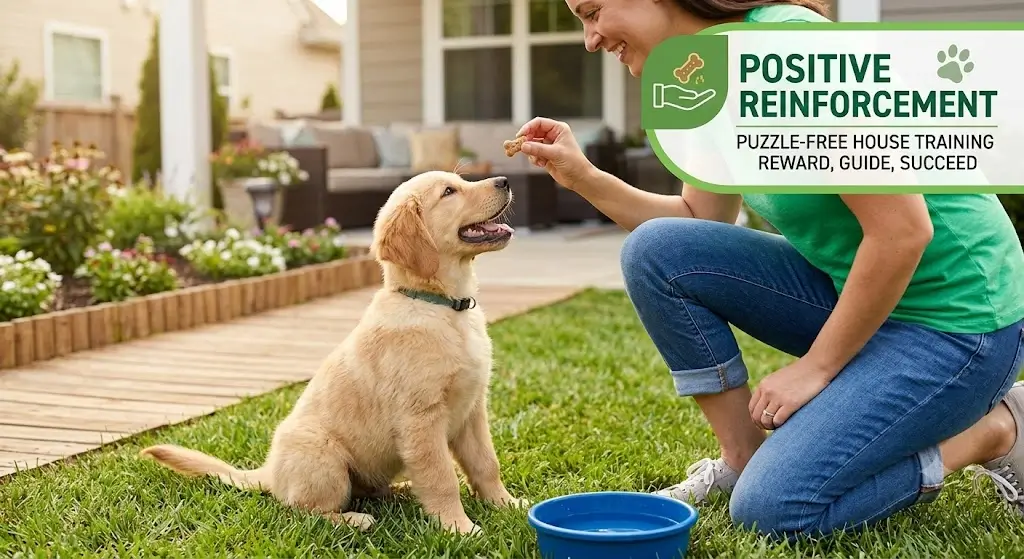
Positive Reinforcement for House Training
Positive reinforcement makes puppy house training easier to understand by rewarding the behavior you want repeated. The most effective system combines immediate rewards with predictable bathroom opportunities, supervision, controlled freedom, and consistent accident management.
Quick Answer
Positive reinforcement for house training means rewarding a puppy immediately after it eliminates in the correct bathroom location, making that behavior more likely to happen again.
The reward alone is not the entire training system. Reliable house training comes from combining reinforcement with good timing, supervision, controlled access to the home, a consistent bathroom location, and appropriate management when you cannot watch the puppy.
During early training, reward successful elimination consistently. As the behavior becomes dependable, you can gradually reduce the puppy’s reliance on food rewards while maintaining praise and other appropriate reinforcement.
What Is Positive Reinforcement?
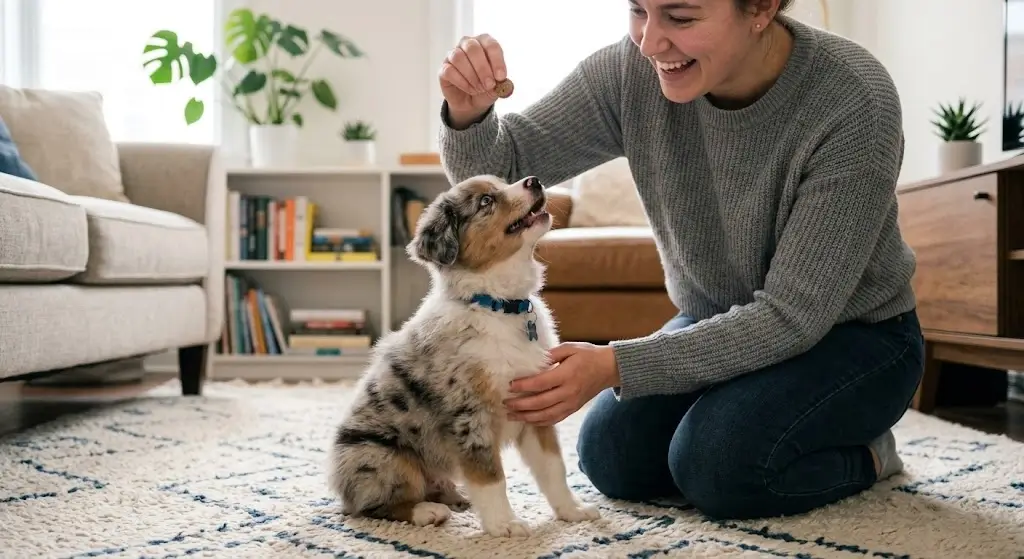
Positive reinforcement is a learning principle in which a consequence is added after a behavior and that consequence increases the likelihood that the behavior will happen again.
In house training, the target behavior might be eliminating in a designated bathroom area.
When the puppy finishes in that location and receives a reward, the reward is intended to increase the value of repeating the behavior.
Correct Bathroom Behavior → Reward → Greater Likelihood of Repeating It
This is different from simply giving a puppy treats at random times. The reward has a training function only when it is connected closely enough to the behavior that the puppy can learn the association.
Why Positive Reinforcement Works for House Training
A puppy has to learn two separate things during house training: where elimination is appropriate and what behavior is worth repeating.
Positive reinforcement addresses the second part while your bathroom setup, timing, and supervision address the first.
A strong system therefore looks like this:
| Training component | Purpose |
|---|---|
| Consistent bathroom location | Makes the desired location predictable. |
| Predictable timing | Creates more opportunities for successful behavior. |
| Supervision | Reduces opportunities to rehearse accidents. |
| Immediate reinforcement | Strengthens successful elimination behavior. |
| Controlled freedom | Prevents premature access to the entire home. |
| Thorough cleaning | Reduces residual odor at previous accident sites. |
Positive Reinforcement vs. Simply Giving a Treat
This distinction matters because not every treat is reinforcement.
Suppose a puppy urinates in the correct bathroom location and receives a treat several minutes later while playing in another room. The puppy may enjoy the treat, but the connection to the bathroom behavior is weaker.
If the reward consistently follows the desired behavior at the right moment, it is much more useful as a training consequence.
Why Timing Matters in Puppy House Training
Timing is one of the most important variables in reward-based training.
The puppy needs to be able to distinguish which behavior produced the reward. If too much time passes, other behaviors may occur between elimination and reinforcement.
A useful sequence is:
- Guide the puppy to the correct bathroom location.
- Wait calmly for elimination.
- Allow the puppy to finish.
- Deliver the reward promptly.
- Then resume normal activity.
The reward should not accidentally become a distraction that causes the puppy to stop before finishing.
Choosing the Right Reward for Puppy House Training
The best reward is the one the individual puppy finds motivating and that you can deliver consistently.
Common options include:
- Small puppy-safe food treats.
- Verbal praise.
- Brief play.
- Access to a preferred activity.
- Affection when the puppy enjoys it.
Food is often convenient because it can be delivered quickly and consistently, but it is not the only possible reinforcer.
What makes a good training reward?
- Small enough to deliver frequently.
- Safe and appropriate for the individual puppy.
- Easy to carry.
- Fast for the puppy to consume.
- Motivating enough to matter.
Treat size should remain appropriate for the puppy. Training should not require large quantities of food.
Step-by-Step Positive Reinforcement House Training
- Choose the final bathroom behavior. Decide whether the puppy should eliminate outdoors, on a designated indoor surface, or use an indoor system temporarily before transitioning.
- Create a consistent bathroom location. Make the intended location easy to identify and access.
- Predict likely bathroom opportunities. Use waking, meals, naps, drinking, play, and individual signals as useful triggers.
- Guide the puppy to the location. Do not wait until an accident is already happening if you can reasonably predict the need.
- Wait quietly. Avoid excessive excitement while the puppy is supposed to eliminate.
- Reward immediately after successful elimination. Make the consequence clearly connected to the behavior.
- Continue supervising. A successful bathroom trip does not mean the puppy is ready for unlimited freedom.
- Repeat the same process. Consistency creates more opportunities for the desired behavior to become reliable.
Build the Bathroom Routine Before Expecting Reliability
Positive reinforcement cannot compensate for a bathroom routine that consistently asks the puppy to succeed beyond its current ability.
Provide frequent enough opportunities for the puppy to succeed, then reinforce those successes.
| Trigger | Training response |
|---|---|
| Waking | Guide the puppy to the bathroom location. |
| After eating | Provide a predictable bathroom opportunity. |
| After drinking | Increase observation for bathroom behavior. |
| After play | Offer another bathroom opportunity. |
| After naps | Return to the bathroom routine. |
| Before bedtime | Provide a final planned opportunity. |
For a dedicated schedule, see Puppy House Training Schedule.
Use Positive Reinforcement to Teach Bathroom Signals
Once a puppy is reliably eliminating in the correct location, you can begin reinforcing behaviors that help communicate the need for a bathroom trip.
Potential signals include:
- Standing near the door.
- Looking toward the owner and then toward the exit.
- Touching a designated bell or signal.
- Moving toward the established bathroom area.
The specific signal is less important than consistency.
Avoid expecting the puppy to invent a sophisticated signal on its own. Teach the signal gradually and reinforce appropriate use.
Related guide: How to Teach a Puppy to Ask to Go Outside.
How to Handle Accidents With Positive Reinforcement
An accident is not a behavior you need to punish after the fact. It is useful information about the current training system.
If you catch the puppy before elimination:
- Interrupt calmly if necessary.
- Guide the puppy toward the correct bathroom location.
- Allow the puppy an opportunity to finish there.
- Reward successful elimination.
If you discover the accident afterward:
- Do not punish the puppy.
- Clean the area thoroughly.
- Review the timing that preceded the accident.
- Increase supervision or bathroom opportunities if needed.
- Continue reinforcing successful behavior.
Why Punishment Is Not the Same as Positive Reinforcement
Positive reinforcement focuses on strengthening the behavior you want. Punishing an accident does not automatically teach the puppy which location or behavior should replace it.
If the puppy eliminates in the wrong place and is corrected afterward, the desired bathroom location may still be unclear.
A more useful training response is:
Prevent: improve supervision and timing.
Guide: bring the puppy to the correct location.
Reinforce: reward successful elimination.
Clean: remove residual odor from accidents.
The goal is to increase successful repetitions of the desired behavior, not simply to react to mistakes.
Positive Reinforcement and Crate Training
A crate can support house training by helping owners manage periods when they cannot actively supervise the puppy.
The crate itself should also be introduced using positive associations. It should be a safe resting area rather than a punishment zone.
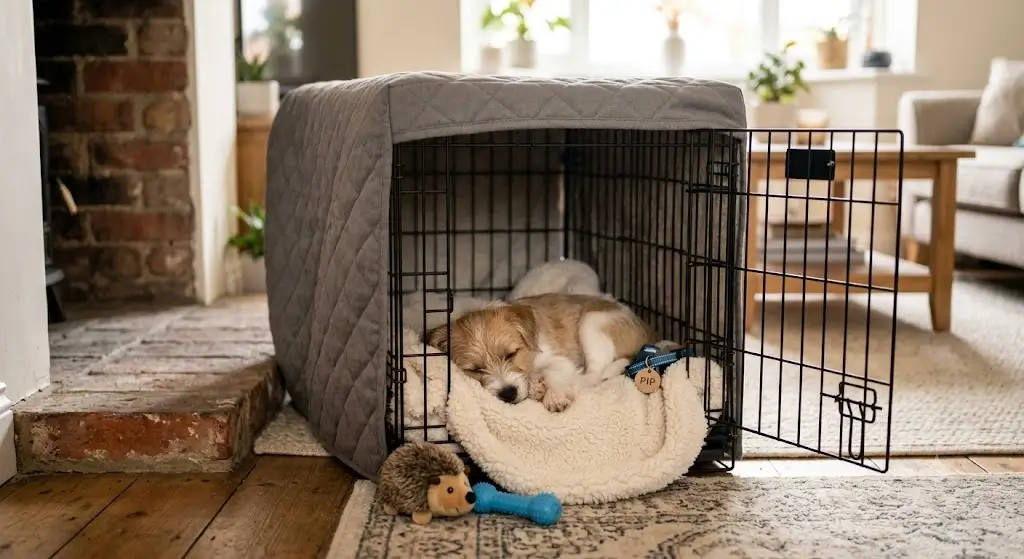
A useful training sequence may be:
Rest → Bathroom Opportunity → Successful Elimination → Reward → Supervised Activity
See How Crate Training Helps With House Training for the crate-specific strategy.
Using Positive Reinforcement With Pee Pads
Positive reinforcement can be used whether the desired bathroom location is outdoors or inside on a pee pad.
With pee pads, the training sequence is:
- Bring the puppy to the designated pad area.
- Wait calmly.
- Allow elimination to finish.
- Reward promptly.
- Repeat consistently.
Keep the bathroom area predictable. Scattering pads across multiple rooms can make the location rule less clear.
See How to Train a Puppy to Use Pee Pads for the complete pad-training system.
Positive Reinforcement for Outdoor Puppy Potty Training
Outdoor house training uses the same reinforcement principle but changes the target location.
The puppy should learn that eliminating outdoors produces a useful consequence.
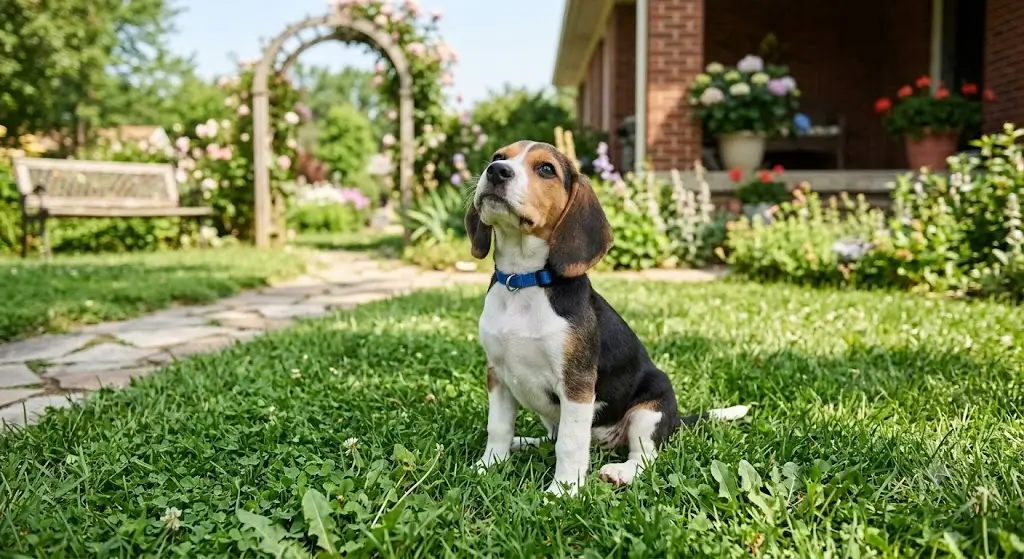
The basic sequence is:
Go Outside → Reach Bathroom Area → Eliminate → Reward → Return to Normal Activity
The reward should follow the desired behavior rather than being used only to lure the puppy outside.
This distinction helps maintain the purpose of the reward: reinforcing successful elimination in the correct location.
Sample Positive Reinforcement House Training Schedule
The following is a framework rather than a universal timetable. Individual puppies differ in their bathroom needs and development.
| Daily event | Action | Reinforcement |
|---|---|---|
| Morning wake-up | Bathroom opportunity immediately | Reward successful elimination |
| Breakfast | Bathroom opportunity afterward | Reward correct location |
| Nap ends | Guide to bathroom area | Reward successful elimination |
| Active play | Offer bathroom opportunity | Reward successful elimination |
| Meals and drinking | Observe and provide opportunities | Reinforce correct behavior |
| Before bed | Final bathroom opportunity | Reward success |
Do not make the puppy wait for the next scheduled time if it is showing a genuine need to eliminate.
Common Positive Reinforcement House Training Mistakes
1. Rewarding too late
A delayed reward can weaken the connection between the bathroom behavior and its consequence.
2. Rewarding before the puppy finishes
Excitement around the reward can distract a puppy from completing the behavior.
3. Using a reward that is not motivating
If the puppy does not value the consequence, it may not strengthen the behavior effectively.
4. Depending on treats without fixing management
Rewards cannot compensate for giving a young puppy more freedom than it can currently handle.
5. Rewarding random behavior
The training reward should have a clear relationship to the behavior you want to increase.
6. Stopping reinforcement too early
A puppy that succeeds for a few days may not yet be reliable across different rooms, distractions, and routines.
7. Ignoring accidents
Positive reinforcement is not passive. You still need to clean accidents, identify management failures, and adjust the environment.
When Should You Fade Food Rewards?
You do not need to depend on food rewards forever.
Early in training, consistent reinforcement can help establish the behavior. Once the puppy becomes reliable, you can gradually reduce the frequency of food rewards while continuing praise, access to preferred activities, and other appropriate reinforcement.
A practical progression:
| Training stage | Reward approach |
|---|---|
| New behavior | Frequent and consistent reinforcement |
| Improving reliability | Continue strong reinforcement while adding other rewards |
| Established behavior | Gradually reduce food dependence |
| Maintenance | Continue reinforcing appropriate behavior periodically |
If reliability drops after reducing rewards, increase reinforcement again temporarily rather than assuming the puppy has forgotten the behavior.
What to Do When House Training Regresses
Regression can happen when a puppy gains freedom too quickly, the household routine changes, the puppy moves to a new environment, or supervision decreases.
Return temporarily to the most successful previous management level:
- Increase supervision.
- Restore predictable bathroom opportunities.
- Reduce unnecessary freedom.
- Increase reinforcement for successful elimination.
- Clean accident locations thoroughly.
- Expand freedom again gradually.
Positive Reinforcement House Training Troubleshooting
My puppy goes potty correctly but does not seem interested in the treat.
The reward may not be sufficiently motivating, the puppy may be distracted, or the timing may be poor. Try a smaller, appropriate reward with greater value to the puppy and deliver it promptly after successful elimination.
My puppy waits until coming back inside.
Review the bathroom environment, timing, distractions, and whether the puppy has learned that elimination outdoors is followed by a positive consequence. Stay in the bathroom area long enough for the puppy to have a reasonable opportunity to eliminate.
My puppy gets excited when I reach for the treats.
Keep the reward low-key until the puppy finishes. You can carry the reward discreetly and deliver it after the behavior instead of showing it beforehand.
My puppy only goes potty when treats are visible.
Avoid using the treat as a constant lure. Instead, keep the reward available but deliver it after successful elimination. As reliability develops, gradually vary the reinforcement system.
My puppy has accidents even though I reward successful potty trips.
Examine management as well as reinforcement. The puppy may need more frequent bathroom opportunities, closer supervision, less freedom, easier access to the correct location, or more thorough accident cleanup.
The Positive Reinforcement House Training Formula
Predict
↓
Guide
↓
Wait
↓
Correct Elimination
↓
Reward Promptly
↓
Repeat
↓
Gradually Increase Freedom
This approach keeps the training focused on the behavior you want to see more often. It also makes accidents useful feedback instead of turning them into a punishment event.
Frequently Asked Questions
What is positive reinforcement in puppy house training?
Positive reinforcement means adding a reward after a desired behavior so that behavior becomes more likely to occur again. During house training, the reward follows elimination in the correct bathroom location.
How do I use positive reinforcement to potty train a puppy?
Provide predictable bathroom opportunities, guide the puppy to the correct location, wait for elimination, and deliver a suitable reward promptly after the puppy finishes.
What is the best reward for puppy potty training?
A small, safe, motivating treat is often practical, but praise, play, access to a preferred activity, or another suitable reward can also reinforce correct behavior.
Should I reward my puppy every time it goes potty in the right place?
Consistent reinforcement is particularly useful during early training. As the behavior becomes reliable, owners can gradually reduce dependence on food rewards while continuing other forms of reinforcement.
Should I punish my puppy for potty accidents?
Punishing a puppy after an accident does not teach the correct bathroom location. A better approach is to manage access, improve timing, clean the area thoroughly, and reinforce successful elimination in the intended location.
What if my puppy ignores the treat after going potty?
Check whether the reward is sufficiently motivating, whether it is delivered promptly, and whether the puppy is distracted or overstimulated. You can also use praise or another suitable reinforcer.
Can positive reinforcement work with pee pads?
Yes. The same reinforcement principle can be used when teaching a puppy to eliminate on a designated pee pad or indoor bathroom surface.
What if my puppy keeps having accidents despite rewards?
Rewards are only one part of house training. Review bathroom timing, supervision, access to the correct location, confinement, accident cleanup, and the puppy’s individual needs.
