
How Crate Training Helps With House Training a Puppy: The Essential Management Guide
Understanding how crate training supports house training begins with recognizing that a crate is an environmental management tool, not a complete training system on its own. When properly introduced, it provides a safe, controlled space during short rest periods when direct supervision is impossible, preventing unsupervised accidents and establishing a predictable potty routine.
Quick Answer: How Does Crate Training Help Potty Train a Puppy?
Crate training helps with house training primarily by structuring environmental management. When a puppy is comfortable in an appropriately sized crate, it prevents unsupervised wandering during rest periods. This controlled setup makes subsequent outdoor bathroom trips far more predictable, timely, and successful.
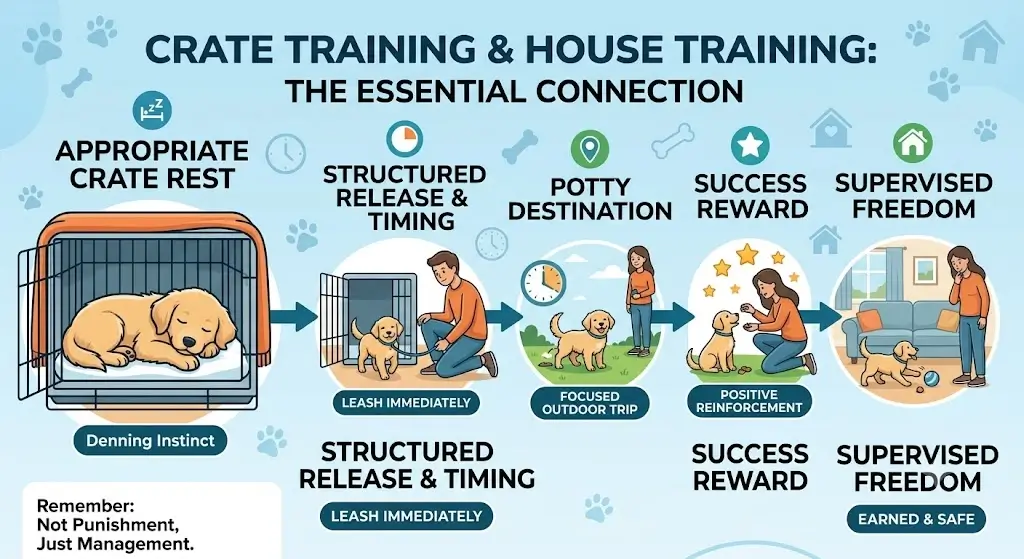
A reliable daily framework is: Appropriate crate rest → focused release → immediate bathroom opportunity → immediate reward → supervised indoor activity.
A crate must never be used as punishment or as a substitute for frequent bathroom breaks, exercise, and attentive care. It is a supportive tool within house training, not a shortcut around the process.
Understanding the True Role of a Crate in House Training
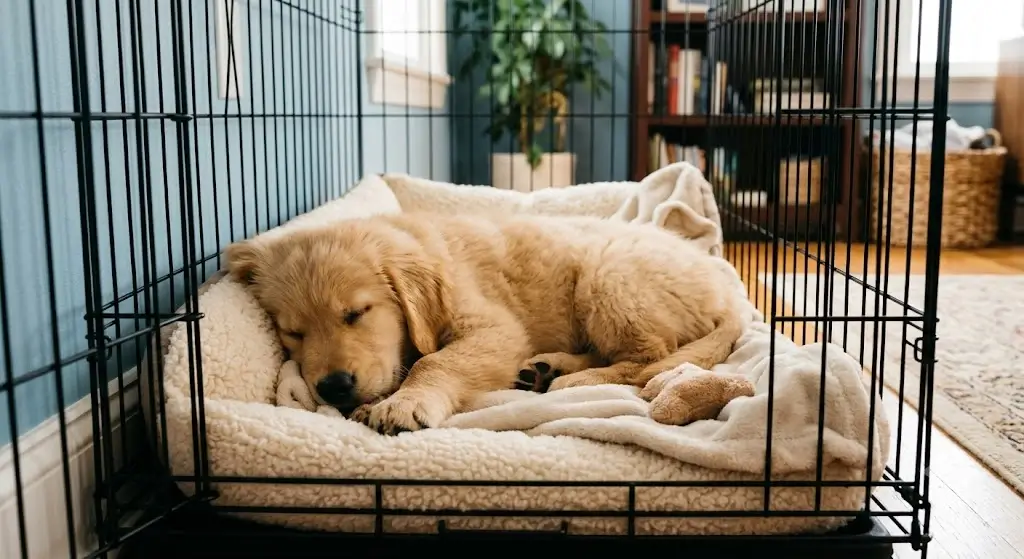
A crate is best understood as a proactive environmental management tool. It controls the puppy’s environment during short rest periods when direct, continuous supervision is not feasible.
Successful house training requires distinguishing between teaching the desired bathroom location and preventing indoor accidents. Crate management excels at the latter.
By limiting uncontrolled access to the home between scheduled outdoor trips, crate training eliminates opportunities for indoor habits to form.
The crate itself does not teach a puppy WHERE to go potty. Instead, it prevents them from practicing WHERE NOT to go, giving you reliable opportunities to reward them in the correct outdoor location.
The Biology Behind Crate Potty Training
Crate training leverages a puppy’s natural instinct to keep its immediate sleeping area clean. This biological denning predisposition is why proper crate sizing is critical.
However, instinct cannot override physical bladder limitations. Young puppies cannot hold their urine indefinitely, regardless of their natural cleanliness instincts, if confined for too long.
Use the denning instinct to build cleanliness habits, not to extend confinement duration. For details on age-appropriate timing, see How Long Can a Puppy Hold Its Bladder?.
The Transition: The Crate-to-Potty Sequence
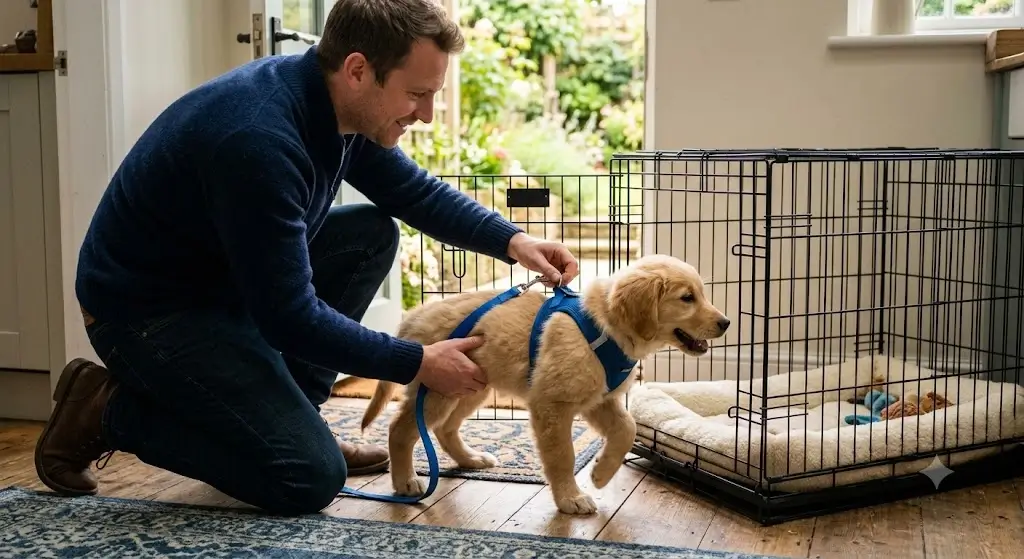
The most impactful aspect of crate training is the structured transition out of confinement. Executing this sequence calmly builds a consistent, reliable routine.
- Prepare the outdoor exit route. Have your shoes, leash, and waste bags ready beforehand to avoid delays.
- Open the crate door calmly. A relaxed release prevents overexcitement and sudden accidents. Carry very young puppies if needed.
- Move directly to the outdoor potty spot. Walk with purpose and avoid indoor detours or play sessions.
- Wait for the puppy to eliminate. Stand quietly and give them a few minutes to focus.
- Reward successful elimination promptly. Deliver high-value praise and treats immediately at the spot.
- Begin structured activity or freedom. After success, your puppy earns supervised playtime or indoor freedom.
Crate Setup and Introduction Before House-Training Management
Before using confinement as a management strategy, you must build positive associations with the crate. Proper introduction ensures the space feels safe rather than stressful.
- Place the crate in a central, family area. Keep your puppy connected to household activity rather than isolated.
- Introduce it gradually with positive reinforcement. Use treats, toys, and gentle verbal praise to reward voluntary entry.
- Feed regular meals inside with the door open. Build strong positive associations with the space.
- Practice closing the door for brief moments while present. Gradually increase the duration and your distance as comfort grows.
Never force a distressed puppy into a crate or ignore persistent panic. Crate training must be progressive. If severe distress or separation anxiety occurs, pause confinement, reassess your steps, and consult a certified trainer.
Choosing the Correct Crate Size for House-Training Success
Selecting the correct dimensions is essential for maintaining the denning instinct without compromising comfort.
| Crate Characteristic | Why It Matters for House Training |
|---|---|
| Enough room to stand | Allows natural posture and prevents muscle cramping. |
| Enough room to turn around | Allows repositioning and comfortable settling. |
| Enough room to lie down flat | Ensures restful sleep rather than restricted crouching. |
| No excessive unused space | Preserves the clean resting area; excess space often leads to using one corner for sleep and another as a bathroom. |
Divider panels are useful for adjusting the internal dimensions as your puppy grows.
Immediate Post-Crate Transition is Crucial
The moment confinement ends is the highest-probability window for either an accident or a successful potty break. Guiding your puppy directly outside determines the success of this routine.
Always use a leash for post-crate outdoor trips. Keeping your puppy on a leash ensures you direct the route, eliminate indoor wandering, and stand close enough to deliver immediate rewards.
How Crate Training Helps with Nighttime Potty Breaks
A crate provides a secure, enclosed sleeping area that discourages nighttime wandering and makes wakefulness cues easier to hear. This clarity simplifies managing nighttime bathroom needs.
For a complete overnight management plan, see our comprehensive guide: How to House Train a Puppy at Night.
Using a Crate When Working Full Time: Strategic Rest Management
Crates help organize morning, midday, and evening routines, but young puppies cannot remain crated for an entire workday. Working owners must balance short crate sessions with larger exercise pens or midday dog-walking support.
For complete 24-hour schedules tailored to working owners, explore House Training a Puppy While Working Full Time.
Management vs. Supervision: When to Crate and When to Watch
Effective potty training relies on balancing active observation with structured confinement.
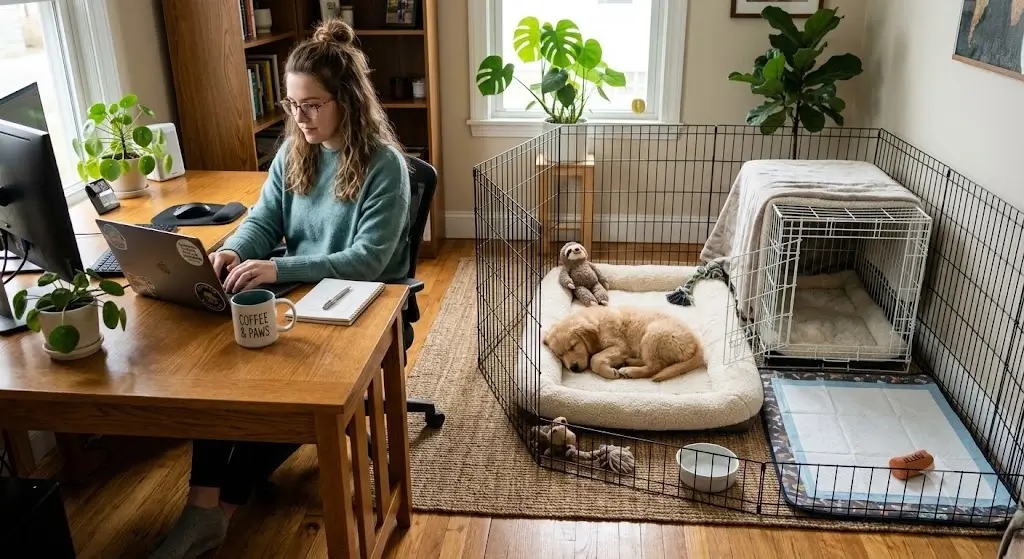 lled rest while balancing developmental limits.
| Situation | Preferred Management Style | Role of Crate Management |
|---|---|---|
| Actively engaging with puppy (play, training) | Direct supervision with appropriate indoor freedom. | None (unless it is a scheduled nap). |
| Short periods without direct focus (cooking, showering, calls) | Appropriate crate rest or safe pen confinement. | Accident prevention and impulse control. |
| Puppy just awakened (morning, post-nap) | Immediate transition to outdoor bathroom spot. | Key training transition for reinforcement. |
Crate Accidents and Mistakes
Accidents inside a crate are rarely behavioral defiance; they typically point to scheduling miscalculations, excessive confinement time, or medical conditions. If an accident occurs, adjust the schedule immediately.
Never punish a crate accident. A puppy cannot connect retrospective punishment to a past action. Clean the soiled area with an enzymatic cleaner and increase the frequency of outdoor bathroom breaks.
Crate + House-Training Success Checklist
- Choose an appropriately sized crate that is safe, secure, and clean.
- Introduce the crate gradually using positive reinforcement.
- Build calm, voluntary associations with the resting space.
- Never use the crate as a tool for punishment.
- Confine only for age-appropriate, realistic durations.
- Maintain a predictable, biology-aligned potty schedule.
- Transition immediately from crate exit to the outdoor spot.
- Reward outdoor elimination the second it happens.
- Track accidents and adjust timing promptly when mistakes occur.
- Consult a veterinarian if sudden elimination changes or frequent accidents persist.
A Practical Formula for House Training Success
To maintain consistency throughout the day, follow this repeatable framework:
Appropriate Rest → Focused Release → Potty Destination → Success Reward → Supervised Freedom → Return to Rest Sequence.
Confinement durations will adjust as your puppy grows, but this foundational flow keeps house training predictable and effective.
How Crate Management Fits Into the Entire House-Training System
While a crate simplifies environmental control, it remains one component of a broader housetraining plan. It serves management purposes rather than behavioral teaching.
| Crate Management Solves: | It Does NOT Replace: |
|---|---|
| Unsupervised indoor mistakes during rest | Teaching the designated outdoor location |
| Restless wandering between planned breaks | Daily exercise, socialization, and play |
| Accidental indoor scent marking | Biological maturation of bladder capacity |
A complete house-training program integrates environmental management, proactive scheduling, clear location cues, and immediate positive reinforcement.
Frequently Asked Questions about Crate Potty Training
Does crate training help with house training a puppy?
Yes. When introduced positively, crate training prevents indoor accidents during unsupervised rest, creates clear daily schedules, and leverages natural cleanliness instincts to structure timely outdoor breaks.
How long does crate potty training take?
Timelines depend on the puppy’s age, breed, and developmental progress. Crate management provides immediate structure, but reliable bladder control generally takes several months of consistent scheduling and positive reinforcement.
What size crate should I use for house training?
Choose a crate that allows your puppy to stand, turn around, and lie down comfortably without extra open space that could encourage creating a separate elimination corner.
What if my puppy is scared of the crate?
Do not force confinement on a fearful puppy. Pause management crating, restart with slow positive conditioning using treats and meals, and seek professional guidance if severe anxiety continues.
Does crate training prevent accidents completely?
A crate prevents unsupervised accidents while the puppy rests inside, but it does not teach them where to go on its own. Success comes from the immediate, structured transition to the outdoor spot upon release.
