
How to Reward a Puppy for Going Outside: The Positive-Reinforcement Potty Training Guide
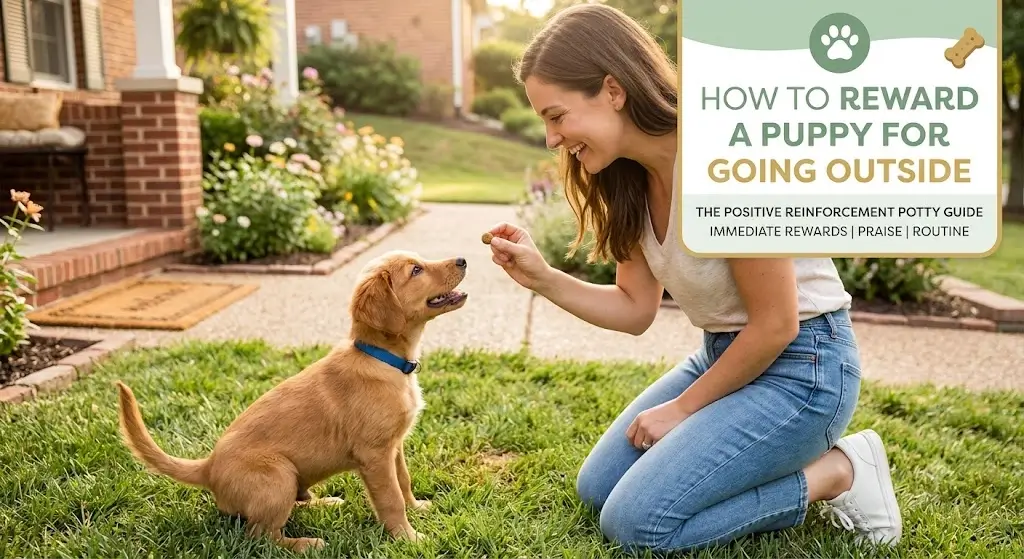
The most effective way to reward a puppy for going potty outside is to make the consequence immediate, clear, and meaningful: let the puppy finish, praise the behavior, and deliver a small reward right away while you are still outside. The timing matters because a reward delivered after returning indoors can be unclear to the puppy; they may associate it with coming inside rather than eliminating outdoors.
Successful outdoor potty training is not just about carrying treats. Puppies need frequent opportunities to succeed, a consistent potty location, supervision, predictable routines, and rewards for the behavior you want repeated.
Take your puppy to the same outdoor potty area, wait quietly, and let them finish. Immediately after they finish, calmly praise them and give a small, appealing treat. Then allow a brief sniff, walk, or play opportunity when appropriate. This teaches the puppy that eliminating outside produces valuable outcomes.
How to Reward a Puppy for Going Outside
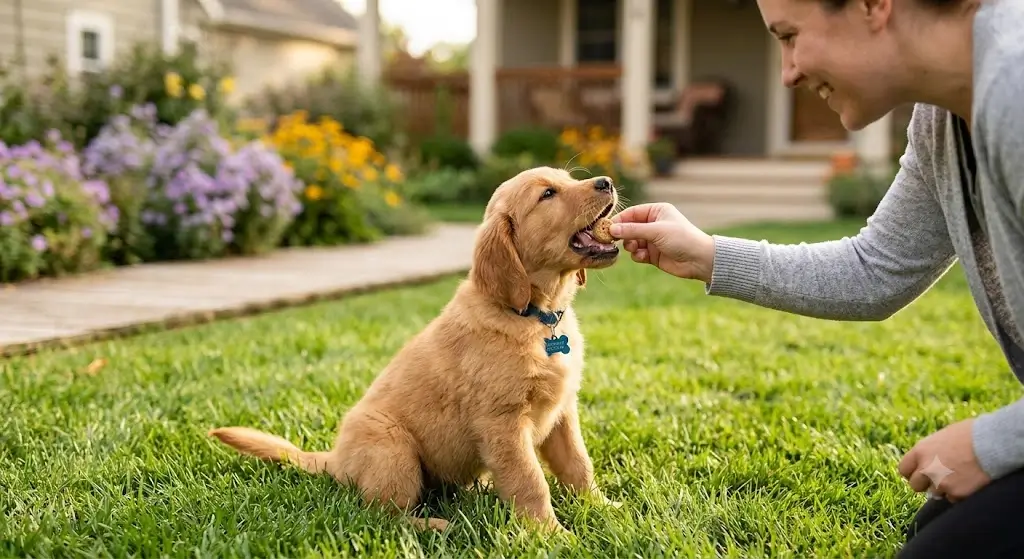
Use this five-step sequence every time your puppy successfully eliminates outdoors:
- Take the puppy to the designated potty area.
- Wait without turning the trip into a play session.
- Let the puppy finish completely.
- Praise and reward immediately.
- Follow the reward with appropriate freedom, sniffing, walking, or play.
The critical moment is immediately after the desired behavior. AKC specifically recommends rewarding puppies as soon as they eliminate in the correct location, and its reward-training guidance explains that delayed rewards can make it harder for dogs to identify what behavior earned the reward.
The reward is not simply “a treat.” The puppy needs to experience a predictable chain:
go to potty area → eliminate outside → reward happens immediately.
Repeating that chain gives the puppy useful information about which behavior earns reinforcement.
Why Reward Timing Matters So Much
Dogs learn from consequences, but the consequence has to be close enough to the behavior for the connection to be clear. AKC notes that if a treat arrives too late, a dog may not understand what earned it. When learning how to house train a puppy, giving a reward after the puppy has already walked back inside can accidentally make the timing ambiguous.
The Correct Timing
Keep the reward with you before going outside. Once the puppy has finished urinating or defecating, immediately mark the success with praise and provide the treat.
The Common Timing Mistake
A common mistake is waiting until the puppy comes back into the house before offering the treat. That creates a much weaker association between the reward and outdoor elimination.
If you have to walk several steps back to the house, keep the reward available so the puppy can receive it near the potty location.
What Should You Give a Puppy as a Potty Reward?
Food is not the only possible reward. The best reinforcement is whatever the individual puppy actually values. AKC notes that rewards can include food, praise, toys, play, or access to something the dog enjoys.
| Reward | Best Use | Advantage |
|---|---|---|
| Small food treat | Early potty training | Fast and easy to deliver |
| Praise | Every successful trip | No extra calories |
| Sniffing | After successful potty | Naturally rewarding outdoor activity |
| Short play | Puppies motivated by interaction | Turns success into positive outdoor experience |
| Extra freedom | After potty is completed | Teaches that pottying unlocks enjoyable activities |
AKC recommends choosing rewards from the puppy’s perspective. A reward only works as reinforcement if the puppy actually values it.
How Big Should the Potty Training Treat Be?
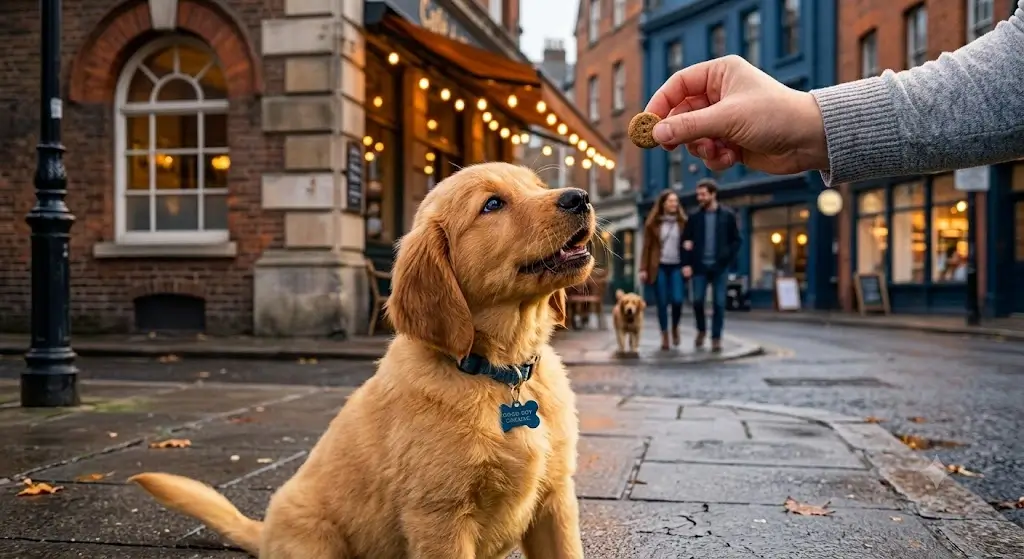
Potty-training rewards should generally be small because the puppy may receive many rewards throughout the day. AKC specifically recommends small treats for house training because they can be given frequently without contributing as much to overfeeding.
The goal is not to give a large snack after every successful potty trip. The goal is to create a meaningful consequence that can be delivered quickly and repeatedly.
A Practical Rule
Use a treat small enough for rapid consumption and frequent reinforcement. If your puppy is receiving many training treats in a day, account for them as part of the puppy’s overall diet and follow your veterinarian’s guidance on appropriate nutrition.
Should You Reward Pee and Poop Separately?
Yes. Reward both urinating and defecating outdoors when they occur in the desired location.
The puppy is learning a location-based behavior: eliminating in the designated outdoor area. Both forms of elimination should therefore produce the same basic positive consequence.
If the puppy urinates but does not defecate, reward the successful urination but continue supervising if you know the puppy is likely to need another bathroom break soon.
AKC recommends praising and rewarding puppies when they eliminate in the correct outdoor location and notes that repeated successful reinforcement helps puppies understand that going outside is worthwhile.
Should You Praise Your Puppy Before or After They Go?
The strongest reward should come after the puppy has finished eliminating. Excessive excitement before or during the process can distract some puppies.
A calm verbal cue can be used while the puppy is beginning to eliminate. Once they finish, increase the enthusiasm of your praise and provide the reward.
This is also how a potty cue can eventually be taught. AKC recommends introducing a verbal cue while the dog is actively performing the behavior, then pairing completion with praise and a reward.
Use a Consistent Potty Spot
Taking your puppy to the same designated outdoor area can make the routine easier to understand. AKC recommends establishing a “potty spot” and repeatedly taking the puppy there.
A familiar location can also contain residual scent cues that tell the puppy this is an appropriate place to eliminate.
Recommended Routine
- Leave through the same door when practical.
- Walk directly to the designated potty area.
- Keep the puppy focused on the bathroom task.
- Wait quietly.
- Use the same potty cue if you are teaching one.
- Reward immediately after elimination.
- Then provide appropriate outdoor enrichment.
Consistency reduces the number of decisions the puppy has to make during each potty trip.
Why You Should Not Rush Back Inside After a Puppy Potties
There is an important distinction between rewarding the puppy for going outside and making the puppy think that pottying immediately ends outdoor time.
If every successful potty trip is followed by an immediate return indoors, some puppies may learn to delay elimination because they want to remain outside.
AKC specifically recommends allowing appropriate outdoor activity after successful elimination rather than always ending the trip immediately. Sniffing, walking, or play can become additional environmental rewards.
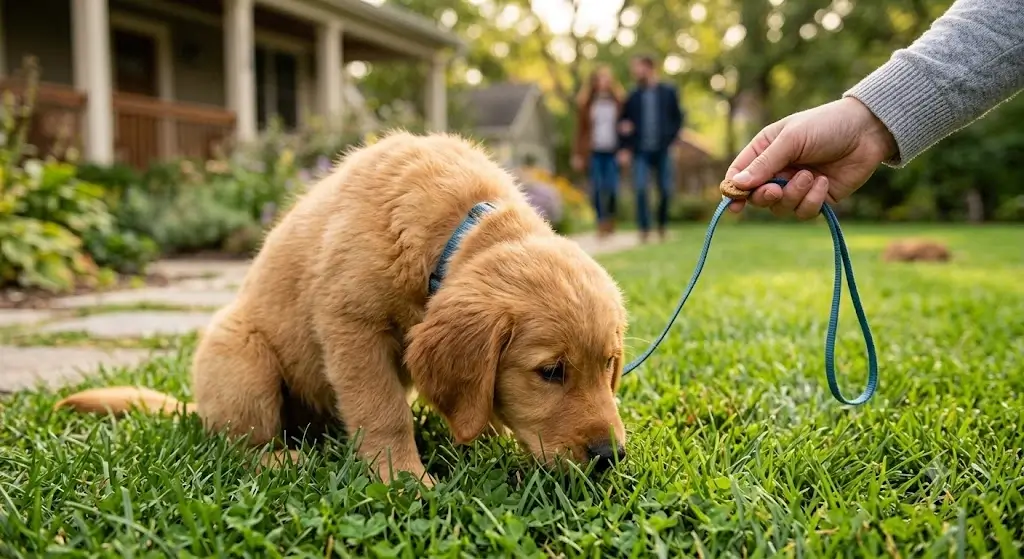
Potty → praise → treat → short sniff/walk/play → return inside.
How to Use the “Potty First, Then Play” Strategy
Outdoor distractions can make puppies forget why they went outside. One useful structure is to make the first part of the trip boring and predictable, then make the rest of the outing more rewarding after the puppy eliminates.
- Go directly to the potty location.
- Keep the puppy near the designated area.
- Wait quietly.
- Reward immediately after successful elimination.
- Then begin the fun portion of the outing.
AKC describes this combination of rewards as useful because food, praise, sniffing, exploration, and play can all reinforce successful potty behavior.
What If Your Puppy Gets Distracted Outside?
Puppies can become distracted by smells, sounds, people, animals, weather, and movement. A puppy that does not potty outside is not necessarily refusing to learn.
Start by making the potty trip predictable and low-distraction. Use the same area, keep the puppy supervised, and give them time to settle.
If the puppy does not eliminate, return indoors only under close supervision and try again after a short interval. AKC recommends returning to close supervision when a puppy refuses to potty outside rather than giving unrestricted indoor freedom.
How to Reward a Puppy Who Finally Goes Outside
Some puppies take several attempts before they understand the routine. When the puppy finally eliminates outside after a difficult trip, make the reward especially clear.
Use enthusiastic verbal praise, a valued treat, and an appropriate opportunity to sniff or explore. The goal is to make the successful behavior stand out from an ordinary outdoor trip.
AKC notes that reward intensity can be adjusted according to how challenging the training situation is. More difficult environments may require a more valuable reward.
How to Choose the Right Potty Training Reward
Not every puppy is motivated by the same thing. Instead of assuming that one specific treat is universally best, create a simple reward hierarchy.
| Reward Level | Example | Use |
|---|---|---|
| Low | Regular praise | Easy successes |
| Medium | Small favorite treat | Normal potty trips |
| High | Especially valued treat + praise | Difficult environments or major breakthroughs |
| Environmental | Sniffing, exploring, walking | After successful elimination |
The important principle is to choose a reward the puppy genuinely values. AKC’s reward-training guidance recommends evaluating rewards from the dog’s perspective rather than assuming a particular food, toy, or form of praise is automatically reinforcing.
How Often Should You Reward a Puppy for Going Outside?
During the early learning stage, reward successful outdoor elimination consistently. The puppy needs enough repetitions to recognize the pattern.
Young puppies also need frequent opportunities to practice. AKC recommends taking puppies out after events such as eating, drinking, waking, and playing, while recognizing that very young puppies have limited bladder control.
Reward frequency can gradually change as the puppy becomes reliable. The objective is not to maintain a high-value food reward forever. The objective is to establish the outdoor habit strongly enough that the behavior becomes routine.
When Should You Take a Puppy Outside to Maximize Successful Rewards?
Rewarding a behavior is much easier when you give the puppy plenty of opportunities to perform that behavior correctly.
Useful potty-trip triggers include:
- Immediately after waking.
- After eating.
- After drinking.
- After active play.
- After naps.
- Before bedtime.
- When the puppy begins sniffing or circling.
- When the puppy shows other individual pre-potty signals.
AKC identifies sniffing, circling, and changes in body posture as common signs that a puppy may need to eliminate.
How to Teach a Puppy “Go Potty”
A potty cue is easiest to teach after the puppy already has a reliable opportunity to eliminate in the desired location.
- Take the puppy to the designated potty area.
- Wait while the puppy searches for a spot.
- As the puppy begins to eliminate, calmly say the chosen cue.
- Allow the puppy to finish.
- Praise and reward immediately.
- Repeat the same sequence consistently.
Over repeated sessions, the puppy can begin connecting the verbal cue with the behavior. AKC recommends capturing the natural behavior first and gradually pairing the cue with the act of eliminating.
Avoid repeating the cue over and over before the puppy understands it. The word should become meaningful through repeated association with the actual behavior.
Should You Use a Clicker to Reward Outdoor Potty Training?
A clicker is optional. You can use a verbal marker such as “yes” if that is easier for your household.
The useful feature of a marker is precision. It can identify the exact moment the puppy performed the desired behavior, after which the food reward follows.
AKC explains that a marker can improve reward timing because it allows the trainer to identify the desired behavior precisely before delivering the actual reward.
For basic house training, however, a consistent verbal marker plus an immediate treat is usually simpler than adding equipment.
What If Your Puppy Only Goes Outside When You Have Treats?
This is a common concern. The answer is not to stop rewarding successful potty behavior too early.
First establish the behavior consistently. Once the puppy is reliably eliminating outside, you can gradually vary the type and value of reinforcement while continuing to praise successful behavior.
Environmental rewards can also become part of the reinforcement system. A successful potty trip can lead to sniffing, a short walk, play, or additional outdoor exploration. AKC specifically identifies these environmental activities as useful rewards.
Do not think of food as the only reward. Build a reinforcement package in which food, praise, freedom, sniffing, walking, and play all support the habit.
How to Fade Treat Rewards Without Losing the Habit
Once outdoor potty behavior is well established, you can gradually reduce reliance on food while continuing to reinforce successful behavior in other ways.
A practical progression is:
- Early stage: treat after nearly every successful outdoor potty.
- Established routine: continue praise every time while varying food rewards.
- Reliable behavior: use environmental rewards more often.
- Maintenance: continue occasional meaningful reinforcement rather than eliminating all rewards.
This should be gradual rather than abrupt. If accidents increase after reducing reinforcement, increase supervision and reward frequency again.
Should You Reward a Puppy for Asking to Go Outside?
Yes. If your puppy communicates a genuine need to go outside, that behavior is useful and should be supported.
Some owners teach a bell or another door signal. The important distinction is that the signal should lead to an opportunity to potty rather than becoming a way for the puppy to obtain unlimited attention.
AKC describes bell training as one possible method for teaching a puppy to communicate that they need to go outside.
When the puppy signals, take them outside promptly, allow them to eliminate, and reward the actual outdoor potty behavior.
How to Reward a Puppy in Bad Weather
Rain, snow, heat, wind, and unfamiliar outdoor conditions can make potty training harder. The reward system should remain consistent even when the environment changes.
AKC recommends pairing outdoor pottying with rewards and positive experiences during difficult weather rather than allowing bad weather to become a negative association with going outside.
Rainy-Day Strategy
- Choose the most practical sheltered potty area available.
- Keep the puppy supervised.
- Use the normal potty cue.
- Reward immediately after elimination.
- Add a pleasant outdoor activity when conditions are safe and appropriate.
The purpose is to teach the puppy that weather does not change the basic rule: outdoor elimination is still valuable.
What If the Puppy Goes Outside but Does Not Potty?
Do not automatically reward the puppy simply for standing outside if the behavior you are teaching is outdoor elimination.
Instead, give the puppy a reasonable opportunity to eliminate, then return indoors under close supervision if they do not go. Try again after an appropriate interval. (If you are also using indoor pads as an interim step, check out our guide on how to train a puppy to use pee pads).
This prevents a long outdoor play session from replacing the bathroom task and helps preserve the distinction between “potty trip” and “play trip.”
AKC recommends returning to close supervision and providing another opportunity when a puppy becomes distracted or refuses to potty outside.
What To Do If Your Puppy Has An Indoor Accident
Accidents are part of the learning process for many puppies, particularly when they are young and still developing bladder and bowel control. If frequent mistakes keep happening, learn more about why does my puppy keep peeing in the house to address underlying schedule or management gaps.
Do not punish the puppy for the accident. Punishment does not teach the desired outdoor behavior and can make the training relationship more difficult.
If you catch the puppy beginning to eliminate indoors, calmly interrupt and take them outside. If they finish outside, reward that outdoor behavior.
Clean the indoor area thoroughly with an appropriate odor-removing pet cleaner so residual scent does not encourage repeated use of the same location.
Why Punishment Is Not a Replacement for Rewarding Outdoor Pottying
Potty training is about teaching the puppy where the desired behavior should happen. Reward-based training gives the puppy information about the correct choice.
AKC’s puppy housetraining guidance specifically recommends rewarding correct outdoor elimination and avoiding punishment for accidents.
If an accident happens, focus on three things:
- Clean the area.
- Improve supervision.
- Create more opportunities to reward outdoor success.
Rewarding Outdoor Potty Training for Very Young Puppies
Very young puppies have limited physical control, so success depends heavily on management rather than expecting the puppy to “hold it” for long periods.
AKC notes that puppies around eight weeks old have particularly limited bladder control and require frequent outdoor opportunities. Its guidance also recommends potty trips after meals, drinking, waking, and play.
The younger the puppy, the more important it is to prevent accidents before they occur. Every successful outdoor elimination becomes another repetition of the behavior you want.
Rewarding a Puppy After Pooping Outside
Pooping outdoors deserves the same immediate reinforcement as urinating outdoors.
Wait until the puppy has finished, then praise and reward. Avoid interrupting the puppy while they are still eliminating because the goal is to reinforce completion in the correct location.
Afterward, allow a short period of appropriate sniffing or walking if your schedule and environment allow it.
Rewarding a Puppy for Going Outside at Night
Nighttime potty trips should usually be calm and boring until the puppy eliminates. Once they finish, give the reward promptly but avoid turning the trip into an energetic play session.
AKC specifically recommends a small high-value food reward or calm praise for late-night potty trips because an energetic game can make the puppy fully awake when everyone needs to return to sleep.
Quiet trip → potty → immediate small reward → straight back to sleep.
How to Reward a Puppy for Going Outside in a New Place
Puppies eventually need to generalize outdoor potty behavior beyond their usual yard or potty area.
Continue using the same verbal cue and reward immediately after elimination. When the environment is more distracting, a higher-value reward may be useful.
AKC’s reward-training guidance explains that difficult environments contain competing distractions, so reinforcement may need to be frequent or valuable enough to remain meaningful to the dog.
Common Mistakes When Rewarding a Puppy for Going Outside
1. Rewarding Too Late
Waiting until the puppy is back inside weakens the association between the reward and outdoor elimination.
2. Giving a Reward Before the Puppy Goes
The main reward should follow the desired behavior. Otherwise, the puppy may not understand what earned it.
3. Using a Treat the Puppy Does Not Care About
A reward only has training value if the puppy finds it rewarding.
4. Ending Outdoor Time Immediately Every Time
Allowing appropriate sniffing, walking, or play after successful pottying can make outdoor elimination compatible with continued access to enjoyable activities.
5. Giving Too Much Indoor Freedom Too Soon
If the puppy has not yet established reliable habits, close supervision gives you more opportunities to prevent mistakes and create successful outdoor repetitions.
6. Punishing Accidents
Punishment does not teach the puppy where you want them to eliminate. Rewarding correct behavior and improving management are more useful training strategies.
A Simple 7-Day Reward Routine
A structured routine can help new owners apply the same reinforcement pattern consistently. For a full daily breakdown, follow our dedicated 7-day puppy house training plan.
| Stage | Main Goal | Reward Strategy |
|---|---|---|
| Days 1–2 | Create predictable outdoor routine | Immediate treat + praise every success |
| Days 3–4 | Strengthen location association | Same potty area + immediate reward |
| Days 5–6 | Add potty cue | Cue during behavior + treat after completion |
| Day 7+ | Build reliability | Continue praise; gradually diversify rewards as appropriate |
This is a training framework, not a guarantee that every puppy will be house-trained in seven days. Age, prior experience, physical development, consistency, and individual learning speed all affect the timeline.
How Long Should You Reward Outdoor Pottying?
Continue strong reinforcement while the behavior is being learned. Once outdoor elimination is reliable, you can gradually vary the food component while retaining praise and environmental rewards.
There is no universal date when every puppy should stop receiving treats. A puppy that is still having frequent accidents needs more management and reinforcement than a puppy that has demonstrated a reliable outdoor routine for a long period.
What If Potty Training Suddenly Gets Worse?
A sudden change after previously reliable house training deserves attention. Do not assume the puppy has simply become stubborn.
Review the routine first: has the puppy’s schedule changed, are bathroom opportunities less frequent, or has the puppy gained more freedom than they can handle?
Persistent or unexplained house-soiling problems can sometimes have a medical component. AKC recommends veterinary evaluation when a dog remains difficult to housetrain despite consistent training.
If the problem persists, a qualified positive-reinforcement trainer or veterinary behavior professional can help identify the underlying training or behavioral issue.
Outdoor Potty Reward Checklist
- ☐ Treats are ready before leaving the house.
- ☐ Puppy goes to the same designated potty area.
- ☐ Potty trip begins calmly.
- ☐ Puppy has enough time to eliminate.
- ☐ Potty cue is used consistently if teaching one.
- ☐ Puppy finishes eliminating before receiving the main reward.
- ☐ Reward is delivered immediately.
- ☐ Reward is something the puppy genuinely values.
- ☐ Praise accompanies successful elimination.
- ☐ Appropriate sniffing, walking, or play follows when practical.
- ☐ Indoor accidents are handled without punishment.
- ☐ Supervision is increased if accidents increase.
Frequently Asked Questions
How do I reward my puppy for going potty outside?
Immediately after the puppy finishes eliminating outside, praise them and give a small valued treat. You can then provide an appropriate opportunity to sniff, walk, or play. Immediate reinforcement helps the puppy connect the reward to outdoor elimination.
Should I give my puppy a treat every time they go outside?
During early potty training, consistent rewards after successful outdoor elimination are useful. As the behavior becomes reliable, you can gradually vary the reward while continuing praise and other forms of reinforcement.
How quickly should I reward my puppy after they pee outside?
Reward as soon as possible after the puppy finishes. Delayed rewards can make it harder for the puppy to understand which behavior earned the reward.
Should I reward my puppy for pooping outside?
Yes. Pooping in the correct outdoor location should receive the same basic positive reinforcement as urinating there.
What is the best treat for potty training a puppy?
The best reward is one your individual puppy values and can eat quickly. Small treats are practical because potty training can require many repetitions.
Can praise alone reward a puppy for going outside?
Yes, if the puppy genuinely finds praise rewarding. Food is often useful during early training because it provides a clear and consistent consequence, but praise, play, sniffing, and exploration can also function as rewards.
Should I play with my puppy after they potty outside?
Usually, an appropriate amount of outdoor activity after successful pottying can be useful. It prevents the puppy from learning that eliminating immediately ends outdoor time.
Why should I not give the treat after going back inside?
The delay can make the reward ambiguous. The puppy may associate it with walking through the door or another behavior instead of eliminating outside.
What if my puppy does not potty outside?
Keep the puppy supervised, return outside after a short interval, and continue providing opportunities. Avoid giving unrestricted indoor freedom immediately after an unsuccessful potty trip.
Should I punish my puppy for an indoor accident?
No. Clean the area, improve supervision, and increase opportunities to reward successful outdoor elimination. AKC recommends positive reinforcement rather than punishment for house-training mistakes.
How do I teach my puppy the words “go potty”?
Begin using the cue calmly as the puppy starts eliminating, then praise and reward after they finish. Repeating the same cue-behavior-reward sequence helps establish the association.
Can sniffing be a reward after potty training?
Yes. Sniffing and exploring can be valuable environmental rewards for many dogs. They can be especially useful after the puppy successfully eliminates.
How long does it take to potty train a puppy?
There is no universal timeline. Age, physical development, previous experience, supervision, routine, and consistency all affect how quickly a puppy becomes reliable.
Final Takeaway
Rewarding a puppy for going outside is less about finding a magical treat and more about getting the training mechanics right. The puppy needs frequent opportunities to succeed, a predictable outdoor location, immediate feedback, and a consequence they actually value.
The simplest effective sequence is: take the puppy out → wait for elimination → let them finish → praise immediately → give a small reward → allow appropriate outdoor enjoyment.
Consistency matters more than making every reward elaborate. AKC’s current potty-training guidance emphasizes supervision, predictable routines, frequent opportunities, positive reinforcement, and immediate rewards for successful outdoor elimination.
If accidents happen, treat them as information about the training setup rather than as a reason to punish the puppy. Increase supervision, provide more frequent opportunities, clean accidents thoroughly, and create more chances to reinforce the behavior you want.
The One Rule to Remember
Reward the puppy where the behavior happens, as soon as the behavior is finished.
For outdoor potty training, that means praise and reward immediately after the puppy finishes outside—not several minutes later after returning indoors.
Editorial & Training Note
This guide is based on reward-based puppy housetraining principles and current American Kennel Club guidance on potty-training routines, reward timing, potty cues, environmental reinforcement, and handling accidents. Individual puppies differ in age, physical control, motivation, and learning speed. Persistent or sudden house-soiling problems should be discussed with a veterinarian, particularly when consistent training and management are not resolving the issue.
