
PUPPY CRATE TRAINING & DAILY ROUTINES
Puppy Crate Training Schedule: Age-by-Age Daily Routine
The best puppy crate training schedule alternates potty breaks, activity, meals, and appropriately timed crate rest instead of keeping a puppy in the crate for long, fixed blocks.
A practical rhythm is: potty → activity → potty → crate rest → potty after waking. Meals should happen on a consistent schedule, and very young puppies usually need additional potty opportunities after eating, drinking, playing, and waking.
The schedule below is a starting framework rather than a rigid clock. Puppy age, bladder development, sleep needs, temperament, household routine, and training progress all affect how much crate time is appropriate.
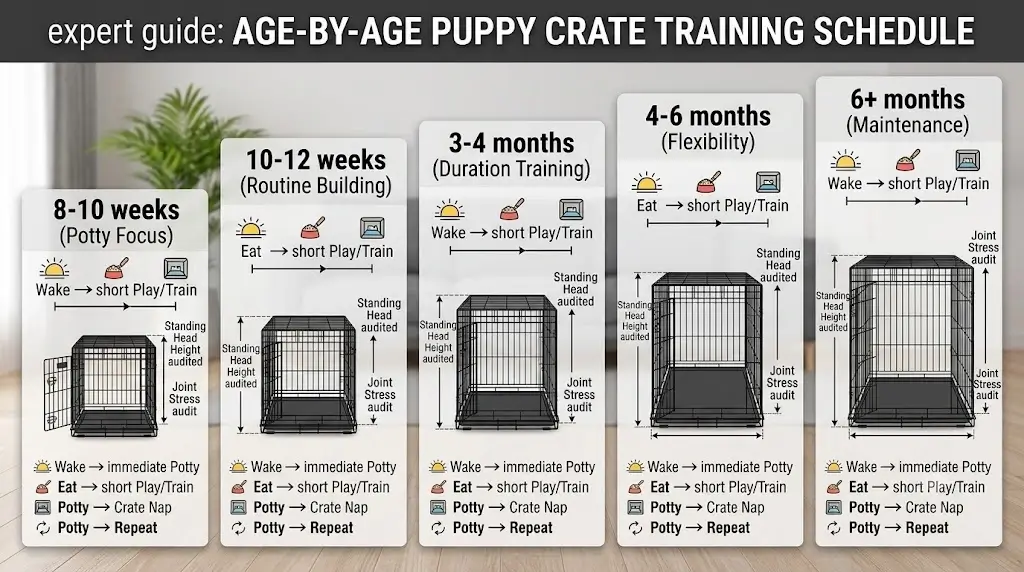
Puppy Crate Training Schedule at a Glance
| Puppy Age | Main Schedule Focus | Typical Day Pattern |
|---|---|---|
| 8–10 weeks | Frequent potty trips + short crate rests | Potty → eat/play → potty → nap → potty |
| 10–12 weeks | Routine building | Potty → activity → potty → crate nap → potty |
| 3–4 months | Longer rest periods with predictable breaks | Potty → activity → crate rest → potty |
| 4–6 months | More consistent daytime routine | Potty → meals/play → planned crate rest |
| 6+ months | Maintenance and flexible household routine | Potty → activity → rest → potty as needed |
These ranges are planning guides, not promises about how long an individual puppy can remain comfortable or dry. A puppy that repeatedly has accidents needs more frequent opportunities.
The Basic Puppy Crate Schedule Formula
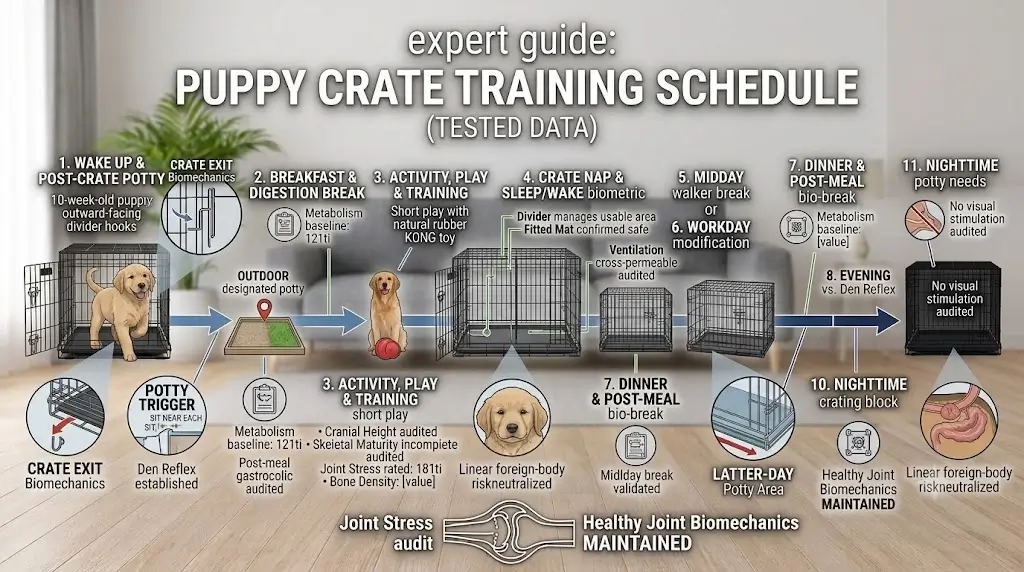
Instead of thinking of crate training as a list of hours, think in terms of repeating daily biological events.
This pattern works because many potty opportunities naturally occur around changes in activity. Puppies commonly need to eliminate after waking, after meals, after drinking, after naps, and after play.
The crate then becomes one component of the routine rather than the center of the puppy’s entire day. Ensure your crate interior meets baseline physical standards using our Puppy Crate Essentials checklist.
8–10 Week Puppy Crate Training Schedule
At 8–10 weeks, the schedule should prioritize frequent potty opportunities, short periods of activity, and plenty of sleep.
Very young puppies need bathroom breaks surprisingly often when awake. Do not build your schedule around the assumption that an 8-week puppy can remain in a crate for several hours. Ensure the interior spatial dimensions are calibrated using our Puppy Crate Size Chart by Breed & Age so excess space does not encourage soiling.
Example 8–10 week schedule
| Time | Activity |
|---|---|
| 6:30 AM | Wake → immediate potty |
| 7:00 AM | Breakfast |
| 7:15–7:30 AM | Potty → short play/training |
| 8:30 AM | Potty → crate nap |
| 10:30–11:00 AM | Wake → immediate potty → activity |
| 12:00 PM | Meal → potty |
| 1:00 PM | Potty → crate/pen rest |
| 3:00 PM | Wake → potty → play/training |
| 5:30 PM | Dinner → potty |
| 6:00–8:00 PM | Family interaction with frequent potty opportunities |
| 8:30 PM | Calm activity → potty |
| 10:00 PM | Final potty → crate for nighttime sleep |
The exact clock times are less important than the sequence. If your puppy wakes earlier, eats at a different time, or needs another potty trip, shift the entire routine accordingly.
10–12 Week Puppy Crate Training Schedule
Around 10–12 weeks, you can begin making the routine more predictable while still providing frequent breaks.
A useful pattern is to schedule crate naps after appropriate physical activity and outdoor relief rather than placing an energetic puppy directly into the crate without a wind-down transition.
Example routine
- Wake and go directly to the outdoor potty area on a leash.
- Feed breakfast.
- Provide another potty opportunity shortly afterward.
- Play or train briefly for 15–20 minutes.
- Potty again before crate entry.
- Crate for a planned nap.
- Potty immediately after waking.
- Repeat the cycle around lunch and afternoon rest.
- Feed dinner and provide a post-meal potty trip.
- Finish the evening with calm interaction and another potty trip.
- Take the puppy out immediately before bedtime.
If the puppy repeatedly wakes from a crate nap and has an accident before reaching the potty area, carry them out rather than letting them walk.
3–4 Month Puppy Crate Training Schedule
At 3–4 months, many puppies can begin handling somewhat longer periods between bathroom trips, particularly while sleeping. They still need frequent opportunities when awake and active.
Sample 3–4 month schedule
| Time | Routine |
|---|---|
| 6:30 AM | Wake → potty |
| 7:00 AM | Breakfast → potty |
| 7:30–8:30 AM | Play, training, interaction |
| 8:30 AM | Potty → crate nap |
| 11:00 AM | Wake → potty → lunch |
| 11:30 AM | Potty → activity |
| 1:00 PM | Potty → crate rest |
| 3:00 PM | Wake → potty → play/training |
| 5:30 PM | Dinner → potty |
| 6:00–8:30 PM | Family time, activity, and potty breaks |
| 9:00 PM | Calm-down period → potty |
| 10:00 PM | Final potty → nighttime crate |
This is a framework, not a requirement to keep a puppy awake according to the clock. If the puppy becomes overtired earlier, an earlier nap is appropriate.
4–6 Month Puppy Crate Training Schedule
Between 4 and 6 months, many puppies can follow a more conventional household schedule. However, the puppy still needs regular potty opportunities and should not automatically be expected to tolerate the longest possible interval.
Example daily structure
| Part of Day | Routine |
|---|---|
| Morning | Potty → breakfast → potty → play/training |
| Late morning | Potty → crate nap/rest → potty after waking |
| Midday | Meal → potty → activity → potty |
| Afternoon | Crate rest → potty → play/training |
| Evening | Dinner → potty → family interaction → potty |
| Bedtime | Calm routine → final potty → crate |
6+ Month Puppy Crate Training Schedule
By 6 months and beyond, many puppies have developed substantially better bladder control, but crate scheduling should still reflect the individual dog.
The goal at this stage is usually not to maximize crate time. Instead, the crate should become a normal part of the dog’s daily rhythm for appropriate rest, quiet time, travel, and household management.
A mature routine includes:
- Morning potty trip immediately upon waking.
- Breakfast followed by another potty opportunity 15–30 minutes later.
- Morning structured walk or exercise.
- Scheduled daytime rest or quiet downtime.
- Midday potty break and light exercise.
- Afternoon rest as needed.
- Dinner followed by an evening bathroom trip.
- Evening family interaction and structured calm-down time.
- Final outdoor bio-break immediately before bed.
The Most Important Rule: Potty After Crate Time
One of the most useful habits in a puppy crate training schedule is to make potty the default destination after a crate session.
When your puppy wakes up or is released after resting, take them directly to the designated potty location instead of allowing free roaming around the house first.
This is particularly important with young puppies because they may have an urgent need to eliminate immediately after waking. For proper physical room positioning and crate airflow protocols, see our comprehensive guide on How to Set Up a Puppy Crate.
How Meals Fit Into a Puppy Crate Schedule
Consistent meal timing makes the rest of the schedule easier to predict.
Many young puppies eat three meals per day, although feeding needs vary with age, diet, and veterinary guidance.
A simple sequence is:
Younger puppies may need to go out relatively soon after eating. Taking puppies outside within 15–30 minutes after meals aligns with their natural gastrocolic reflex.
Puppy Crate Training Schedule for Working Owners
A full workday can be difficult for a young puppy because the puppy may need more frequent bathroom opportunities than a single morning and evening release can provide.
If the puppy cannot comfortably make the interval, arrange a midday potty visit from a trusted friend, pet sitter, or dog walker.
Example workday structure
| Time | Example Routine |
|---|---|
| 6:30 AM | Potty trip |
| 7:00 AM | Breakfast |
| 7:15 AM | Post-breakfast potty |
| 7:30–8:00 AM | Play, training, and exercise |
| 8:00 AM | Potty → crated rest |
| Midday (12:00 PM) | Midday walker break: Potty → lunch → short walk |
| 1:00 PM | Potty → afternoon rest |
| 5:00 PM | Arrive home → immediate outdoor potty trip |
| 6:00 PM | Dinner → potty → family interaction |
| 10:00 PM | Final potty → crate for nighttime sleep |
Puppy Crate Training Schedule vs. Potty Training Schedule
These schedules overlap, but they serve distinct behavioral roles:
| Crate Training Schedule | Potty Training Schedule |
|---|---|
| Defines when the puppy rests and decompresses | Defines when the puppy gets outdoor elimination opportunities |
| Focuses on calm confinement and den security | Focuses on reinforcing the correct elimination substrate |
| Structures sleep intervals and scheduled naps | Triggers around biological events (meals, waking, play) |
| Uses the crate as an environmental management tool | Relies on timing, constant supervision, and positive reinforcement |
Frequently Asked Questions
What is the best puppy crate training schedule?
A functional schedule alternates potty trips, activity, meals, and crate rest. The universal sequence is potty after waking, potty 15–30 minutes after meals, potty after active play, and immediate outdoor release after crate rest.
How often should I put my puppy in the crate during the day?
Use the crate for structured daytime naps (typically 2 to 3 naps per day lasting 1.5 to 2 hours each), quiet decompression periods, and overnight sleep. Avoid making the crate a default storage spot while you are home.
Should I crate my puppy immediately after playing?
Always offer a quick outdoor potty opportunity between active playtime and crate rest. Excitement stimulates the bladder, and putting an excited puppy directly into a crate often triggers immediate accidents.
How do I schedule crate training while working full-time?
Young puppies under 6 months cannot hold their bladder for an 8-hour workday. Schedule a midday visit by a dog walker or neighbor to provide an outdoor potty break, light exercise, and water between 4-hour crating blocks.
What if my puppy has an accident during a scheduled crate period?
Shorten the next interval by 30 to 45 minutes and evaluate the preceding trigger. Verify that the puppy genuinely emptied their bladder before going into the crate and ensure the crate is not excessively large.
Bottom Line: Build the Day Around the Puppy, Not the Clock
A good puppy crate training schedule is predictable without being rigid.
Use the crate for planned rest and quiet time, but surround those periods with appropriate potty opportunities, meals, play, training, and family interaction. As your puppy matures and biological bladder control improves, gradually expand household freedom while keeping the core biological potty triggers intact.
