
PUPPY CRATE TRAINING & EQUIPMENT
Puppy Crate Essentials: What Your Puppy Really Needs
Puppy crate essentials are simpler than many new puppy owners expect. You do not need to fill a crate with beds, blankets, toys, bowls, and accessories. The basic setup is a correctly sized crate, a properly positioned divider when needed, a safe and clean interior, and a few carefully selected items that match your puppy’s behavior.
For most growing puppies, the most useful setup is a wire crate with a divider, a fitted crate pan, washable bedding if the puppy can use it safely, and appropriate enrichment when needed. The exact setup should change as your puppy grows and as you learn what they can safely handle.
The most important principle is simple: comfort and safety come before accessories. A crowded crate is harder to clean, provides less usable space, and may give a puppy more opportunities to chew or destroy something.
Puppy Crate Essentials at a Glance
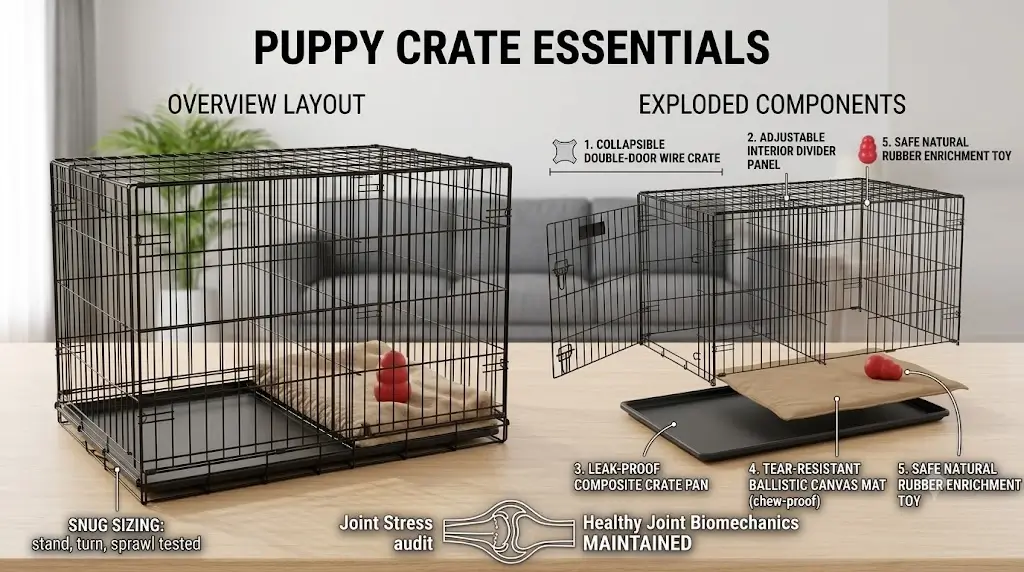
| Essential | Do You Need It? | Why It Matters |
|---|---|---|
| Correctly sized crate | Yes | Provides an appropriate resting space and containment baseline |
| Divider panel | Often | Controls usable space dynamically as the puppy grows |
| Composite crate pan | Yes | Provides the crate floor and contains minor accidents for easy cleaning |
| Washable mat or bed | Optional | Adds joint comfort when the puppy does not chew or shred fabrics |
| Appropriate enrichment | Optional | Supports calm crate conditioning and relieves teething discomfort |
| Water setup | Situation-dependent | Necessary for longer confinement periods using spill-proof coop cups |
| Crate cover | Optional | Reduces visual arousal and ambient light for active puppies |
| Cleaning supplies | Yes | Enzymatic cleaners neutralize accidents and protect housebreaking routines |
1. The Right-Size Puppy Crate
The crate itself is the most important puppy crate essential.
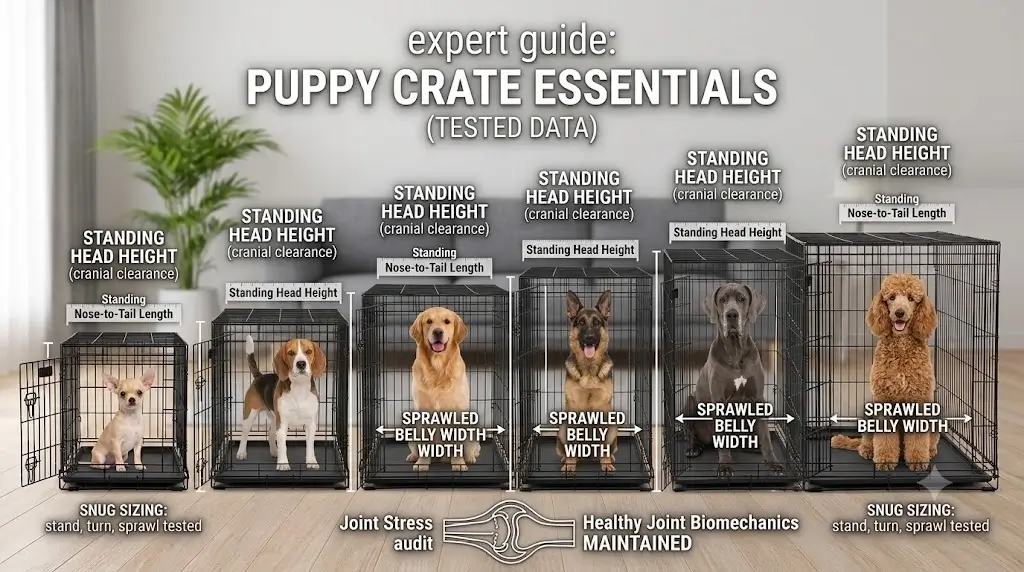
Your puppy should have enough room to:
- Stand naturally without hunching their neck or spine.
- Turn around comfortably without pressing into wire sides.
- Sit normally with adequate cranial clearance.
- Lie down comfortably with legs fully extended.
- Change sleeping positions throughout rest periods.
Do not choose a crate that is deliberately cramped to prevent accidents. A puppy still needs normal freedom of movement inside the resting area. At the same time, an excessively large crate complicates housebreaking because the puppy can eliminate in one corner and sleep cleanly in another.
To cross-reference breed size projections, developmental stages, and growth allowances, review our comprehensive Puppy Crate Size Chart by Breed & Age.
2. A Divider for Growing Puppies
A divider is one of the most practical accessories for a puppy that will grow substantially. Instead of purchasing a sequence of small crates every few months, you can purchase an adult-sized model and temporarily restrict the usable floor space.
Explore top-rated models in our independent roundup of the Best Puppy Crates With Dividers.
The divider has one primary function: control excess usable space without restricting normal movement.
| Without a Divider | With a Divider |
|---|---|
| Adult-size crate provides excessive space for a young pup | Usable area is dialed in to match current body dimensions |
| Requires purchasing replacement crates as the puppy grows | A single wire crate adapts from 8 weeks to skeletal maturity |
| Higher probability of corner urination during potty training | Maintains natural den aversion to soiling the sleep area |
As the puppy grows, move the divider panel backward rather than allowing the space to become restrictive.
3. The Crate Pan
The crate pan is an essential structural element of any wire enclosure. It creates a solid foundation underfoot, shields subfloors, and contains moisture or dirt.
What makes a crate pan useful?
- Fits the crate perimeter securely with minimal edge gaps.
- Slides out independently for quick sanitization without disassembling the crate.
- Does not obstruct door latch operation.
- Features a non-porous composite finish that resists chemical degradation from enzymatic sprays.
For a puppy working through early house training, cleanability is far more critical than plush decorative accents.
4. Washable Puppy Crate Bedding
Bedding provides valuable joint support, but it is not mandatory on day one. A washable mat or pad improves comfort provided the puppy does not view the textile as a chew toy or digestion hazard.
| Puppy Behavior Profile | Recommended Approach |
|---|---|
| Calm with bedding; rests peacefully | Use a flat, washable orthopedic mat |
| Occasional chewing or digging at seams | Supervise closely; transition to tear-resistant ballistic fabrics |
| Aggressively destroys and ingests fabric | Remove bedding immediately; utilize the bare composite pan |
| Frequent crate accidents | Prioritize waterproof liners with removable, machine-washable covers |
| Double-coated; runs warm | Leave bedding out; many puppies prefer the cooling surface of the pan |
5. Appropriate Puppy Enrichment
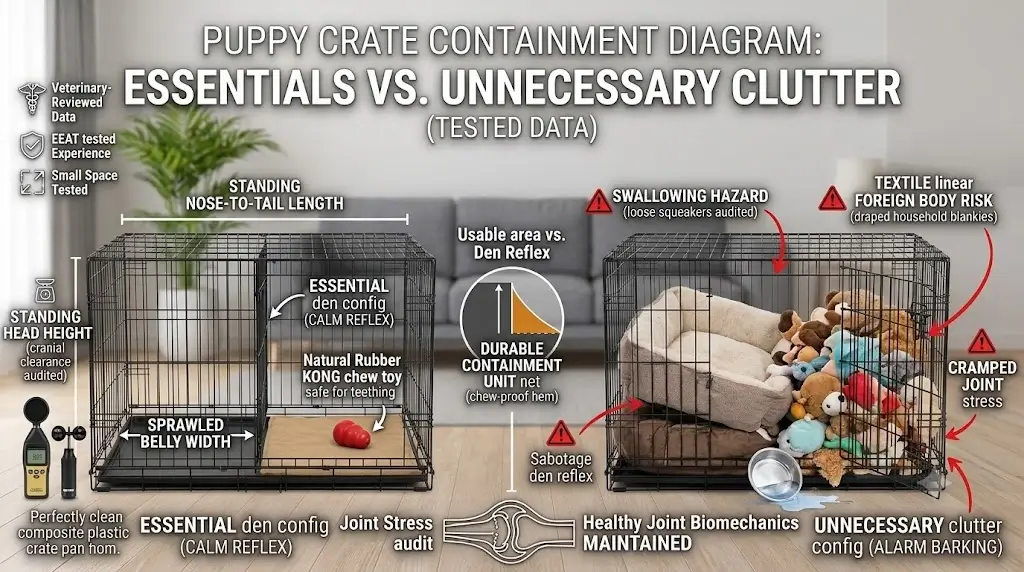
Enrichment tools support calm crate conditioning, but packing a crate with multiple toys reduces floor area and increases swallowing risks.
Principles for crate enrichment
- Select durable natural rubber items (such as a frozen KONG stuffed with soaked kibble).
- Avoid stuffed plush toys with internal squeakers that can be ingested.
- Supervise any new chew item thoroughly before allowing unsupervised crate use.
- Inspect toys daily and discard items showing cracks, frayed rubber, or loose pieces.
- Limit crate enrichment to one primary engagement item at a time.
6. Water: Does a Puppy Need Water in the Crate?
Water is not an absolute requirement inside every puppy crate during brief daytime naps. The necessity of in-crate water depends on confinement duration, ambient room temperature, and medical factors.
Standard water bowls are routinely knocked over by active puppies, soaking bedding and chilling the dog. When water is necessary during extended confinement, install a stainless steel coop cup that clamps directly to the wire mesh at shoulder height.
Never withhold daily water as an excuse to prolong confinement beyond what a puppy’s bladder can physiologically tolerate.
7. A Crate Cover Is Optional
A crate cover helps settle puppies that bark at passing visual stimuli or wake at early sunrise, but it must be introduced with safety in mind.
If you choose to use a crate cover:
- Ensure the cover is purpose-built and fitted to prevent sagging edges.
- Keep at least one or two sides rolled open for cross-ventilation.
- Monitor internal ambient temperature to avoid trapping heat.
- Remove the cover immediately if the puppy attempts to pull fabric through the bars.
- Never use a cover as a punitive measure.
8. Cleaning Supplies Are a Puppy Crate Essential
Potty training accidents happen. Having the correct cleaning setup ready prevents frustration and keeps your training on track.
Crate maintenance kit
- Enzymatic cleaner formulated to break down uric acid crystals and neutralize scent markers.
- Heavy-duty microfiber cloths or paper towels for rapid absorption.
- A secondary replacement crate mat to swap in while the soiled pad is in the wash.
- A dedicated playpen or puppy-proofed zone to hold the puppy while cleaning the crate pan.
If accidents occur regularly in the crate, review your potty timing, divider spacing, and total confinement duration rather than assuming your puppy is stubborn.
9. A Safe Location Around the Crate
The environment surrounding the crate is just as critical as what goes inside it.
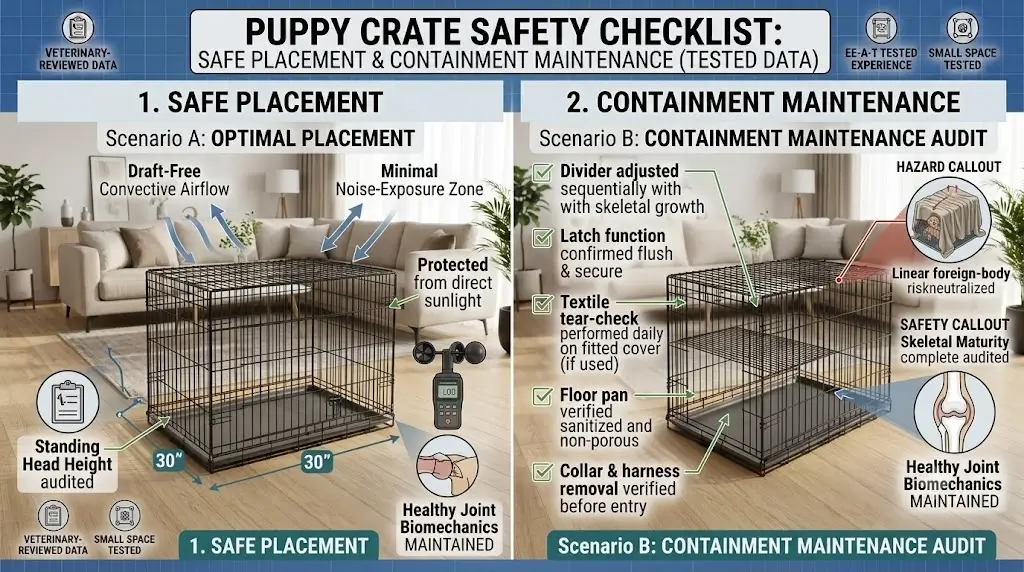
Position the crate in a space that meets these safety criteria:
- Level, sturdy flooring with non-skid support underneath.
- Consistent airflow away from direct draft paths or heating registers.
- Shielded from direct, unfiltered sunlight.
- At least 3 feet clear of electrical cords, wall sockets, blinds cords, and houseplants.
- Close to regular family routines to avoid feelings of complete isolation.
For detailed room-by-room positioning strategies and step-by-step guidance, follow our guide on How to Set Up a Puppy Crate.
10. A Predictable Potty Routine
A schedule is not physical equipment, but it is the behavioral foundation that makes crate training functional.
Operate on a consistent sequence:
Young puppies lack adult muscle control over their urinary sphincters. A crate will not stop accidents if bathroom trips are timed improperly.
How to Build a Puppy Crate Setup on a Budget
Avoid purchasing every available accessory before bringing your puppy home. Prioritize equipment in this sequence:
- Invest in the correct double-door wire crate equipped with an adjustable divider panel and plastic pan.
- Stock enzymatic cleaner and basic paper towels before arrival day.
- Introduce an entry-level chew-proof mat only after assessing your puppy’s teething drive.
- Add durable enrichment like natural rubber Kongs to encourage voluntary crate entry.
- Evaluate optional items (like fitted crate covers or clamp-on bowls) only if specific behavioral needs arise.
Frequently Asked Questions
What are the absolute essentials a puppy needs in a crate?
The bare minimum consists of an appropriately sized crate, a secure crate pan, and a divider panel if managing a growing breed. Washable mats, covers, and enrichment can be introduced according to individual safety and chewing habits.
Does a puppy crate need a bed?
No. While a crate mat provides orthopedic comfort, puppies prone to chewing or eating fabric should sleep on the bare composite pan until teething behaviors subside.
Should I put toys in my puppy’s crate?
Limit crate enrichment to single, durable, non-destructible items such as a frozen rubber chew toy. Avoid plush, squeaker, or rope toys that present choking or linear foreign-body hazards.
Does a puppy need water in the crate?
Puppies crated for short daytime naps do not require a water bowl inside. For longer confinement periods, install a clamp-on stainless steel coop cup to provide hydration without the risk of tipping.
Can a puppy crate be too big?
Yes. When a crate provides surplus floor space, a puppy will instinctively eliminate in one far corner and sleep cleanly on the other side, undermining the housebreaking process.
What should never go inside a puppy crate?
Never leave choke chains, prong collars, harnesses with loose tags, unmonitored soft plush toys, or torn bedding inside a crate with an unsupervised puppy.
Bottom Line: Keep Puppy Crate Essentials Simple
You do not need an elaborate puppy crate setup.
Prioritize the fundamentals: choose the correct crate size, use an adjustable divider to manage growth, keep the crate pan clean, and introduce durable bedding only when your puppy proves they will not ingest fabric fibers. Crate covers, enrichment toys, and water attachments should solve specific behavioral needs rather than crowd the enclosure.
Pair this streamlined physical setup with structured outdoor bathroom breaks, hands-on supervision, and positive crate associations to establish a reliable lifelong den habit.
