
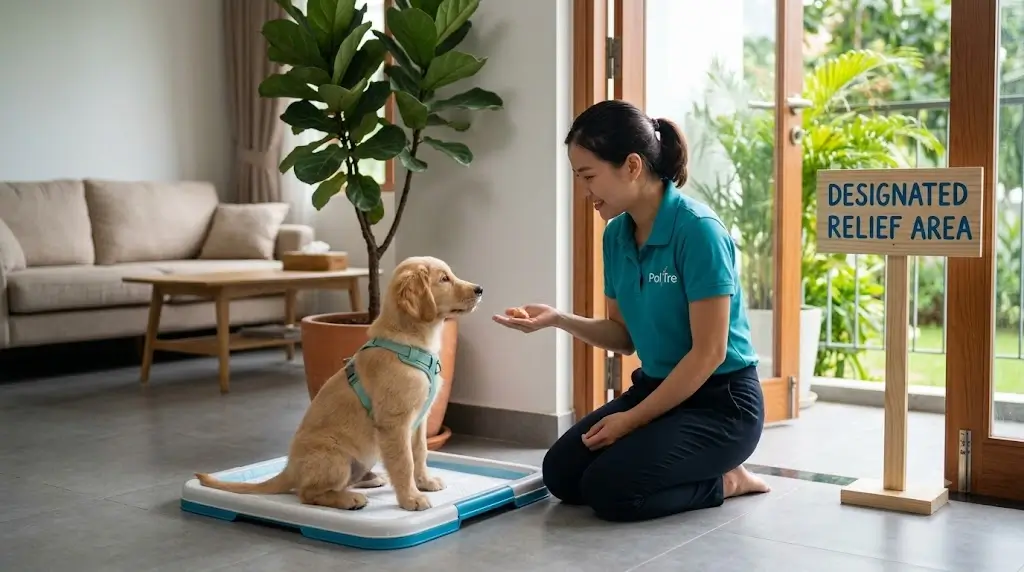
Indoor House Training for Puppies
Indoor house training gives a puppy a clearly defined bathroom location
inside the home while you build the timing, supervision, and routine
needed to prevent accidents. It can be useful when outdoor access is
difficult, especially during the early stages of puppy ownership.
Quick Answer: How Do You House Train a Puppy Indoors?
Indoor house training works best when a puppy has one clearly defined bathroom area, predictable opportunities to use it, close supervision, limited unsupervised freedom, and immediate reinforcement for correct elimination.
If you are using pee pads or an indoor dog tray, place it in a single, consistent spot rather than scattering pads throughout the house. Guide your puppy to that location around predictable bathroom triggers such as waking, eating, drinking, naps, and active play.
Reward successful use immediately with treats or calm praise. When an accident occurs, clean the area thoroughly with an enzymatic cleaner and adjust your supervision rather than punishing the puppy.
What Is Indoor House Training?
Indoor house training teaches a puppy that there is a specific, acceptable bathroom location inside the home.
The location might be a pee pad, a real grass patch box, or a dedicated indoor dog toilet tray.
Consistency is the foundation of success. The puppy must learn to distinguish its designated bathroom surface from carpets, rugs, dog beds, and hard floors.
When Is Indoor House Training Useful?
Indoor training is practical when a puppy cannot reliably access an outdoor bathroom area on short notice:
- High-rise apartment living with elevator or hallway delays.
- Young puppies awaiting full vaccination clearance before walking on public ground.
- Severe winter weather, heavy storms, or extreme heat.
- Pet parents with mobility challenges or long working intervals.
- Households intentionally choosing a permanent indoor bathroom setup.
Indoor vs. Outdoor House Training
| Factor | Indoor training | Outdoor training |
|---|---|---|
| Bathroom location | Designated indoor pad or tray | Designated outdoor grass/gravel area |
| Weather dependence | None | Higher (rain, snow, cold) |
| Apartment convenience | High (immediate access) | Requires transit time (elevators/stairs) |
| Floor management | Requires clear surface boundaries | Keeps all elimination outside |
| Long-term transition | Can remain permanent or shift later | Directly aligns with outdoor-only goals |
If your long-term goal is outdoor-only elimination, review our guide on How to Transition From Pee Pads to Outside.
Choose the Indoor Bathroom Area
Location consistency is paramount. A suitable indoor toilet spot must be:
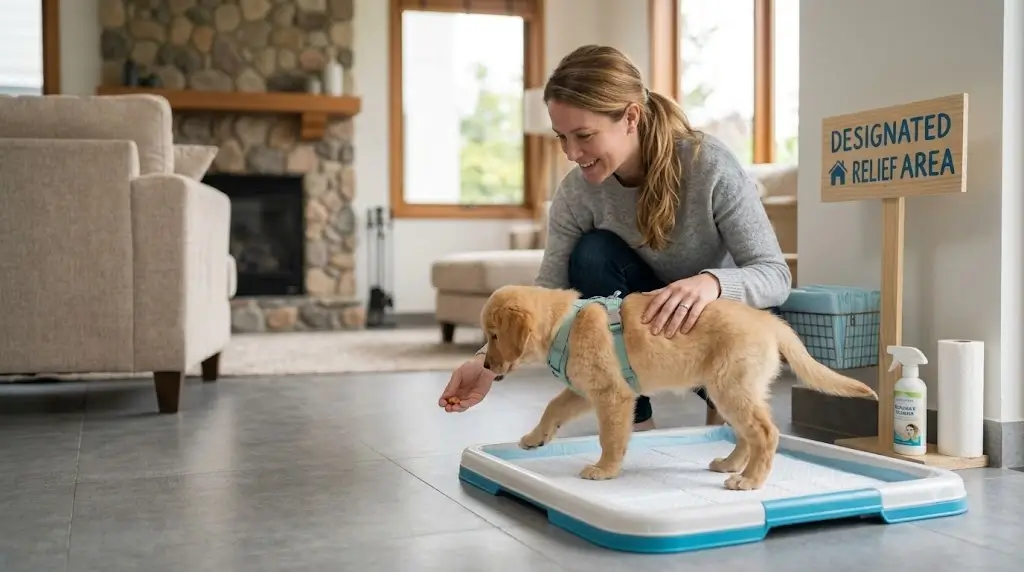
- Easy for the puppy to reach quickly during urgent moments.
- Positioned away from sleeping crates and food/water bowls.
- Located on non-carpeted, washable flooring (tile, vinyl, or hardwood protection).
- Kept stationary in one room throughout the initial training phase.
What You Need for Indoor Puppy House Training
- Heavy-duty puppy pee pads or a grated indoor dog potty tray.
- A non-slip floor tray or waterproof mat to prevent moisture seepage.
- High-value training treats kept within arm’s reach of the station.
- A pet-safe enzymatic accident cleaner.
- Exercise pens or baby gates to manage indoor territory.
- A crate for structured rest periods between active supervision.
How to Set Up the Indoor Training Area
- Select one permanent spot: Pick a quiet corner with low foot traffic.
- Secure the pad: Use a locking pad holder to prevent sliding or shredding.
- Remove competing soft surfaces: Roll up area rugs temporarily during training.
- Ensure unrestricted access: Keep interior doors open to the training zone.
- Establish a predictable route: Guide the puppy along the exact same path every time.
Build a Predictable Indoor Bathroom Routine
Proactive timing prevents accidents before they start. Align pad trips with your puppy’s biological rhythm:
| Trigger | What to do | Why it matters |
|---|---|---|
| Immediately upon waking | Carry or guide puppy directly to the pad | Sleep lowers bladder inhibition; waking triggers urgency |
| 15–20 minutes after meals | Offer a quiet pad visit | Gastrocolic reflex naturally stimulates bowel activity |
| Shortly after drinking water | Monitor closely near the pad station | Fluid moves rapidly through a puppy’s digestive system |
| After high-energy play | Pause activity and redirect to the pad | Excitement and physical motion trigger sudden bladder releases |
| Before bedtime | Provide a final bathroom opportunity | Ensures an empty bladder for overnight crate rest |
For a complete daily framework, see the Puppy House Training Schedule.
Step-by-Step Indoor House Training Plan
- Define the bathroom station: Establish a single, stationary indoor toilet area.
- Track natural elimination timing: Log meals, naps, and bathroom intervals.
- Take the puppy to the pad proactively: Guide the puppy before urgent accidents occur.
- Keep interactions calm: Stand quietly and let the puppy sniff and focus on eliminating.
- Reward immediately: Offer treats and warm praise within 1–2 seconds of completion.
- Allow supervised freedom: Grant monitored indoor playtime after successful elimination.
- Use safe confinement when busy: Use a crate or playpen when you cannot actively supervise.
- Clean errors with enzymatic spray: Remove all residual scent cues.
- Expand space gradually: Increase room access only as the puppy shows consistent reliability.
Why Supervision Matters in Indoor House Training
Supervision allows you to catch pre-elimination cues and guide the puppy to its station before an accident happens:
- Sudden, rapid ground sniffing.
- Circling or pacing in tight loops.
- Abruptly stopping active play or disengaging from a toy.
- Wandering toward quiet room corners or furniture perimeters.
- Heading toward previously soiled floor areas.
Using Confinement Correctly
When you cannot actively supervise your puppy, safe confinement in an exercise pen or playpen prevents unobserved accidents across your home.
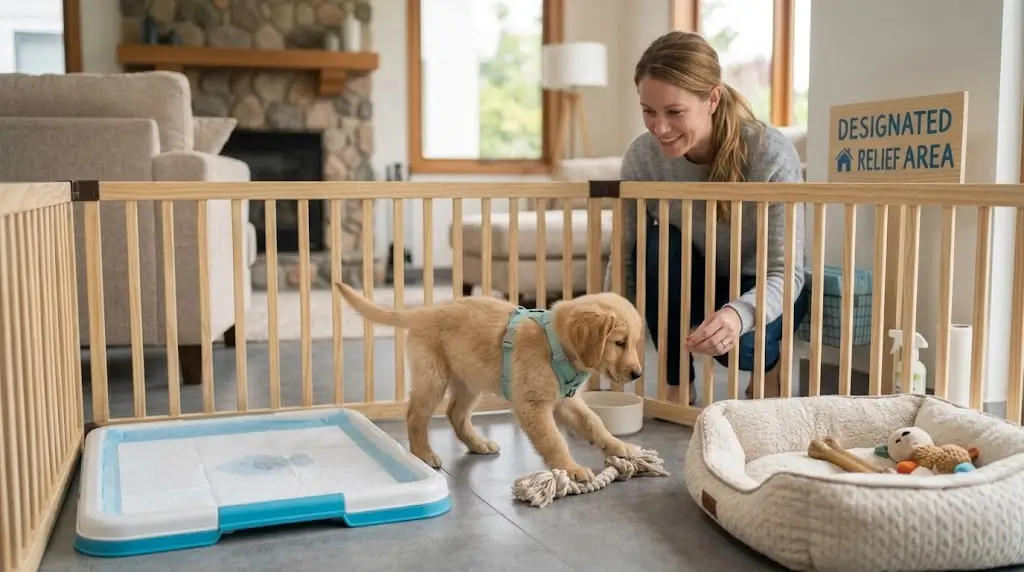
In an exercise pen setup, place the puppy’s bed and water bowl at one end and the secured pad station at the opposite end.
Using a Crate During Indoor House Training
A crate creates periods of calm rest, leveraging your puppy’s instinct to keep its sleeping den clean.
When integrating a crate with indoor training, follow this consistent transition:
Crate Rest → Immediate Guide to Pad → Successful Elimination → Immediate Reward → Supervised Freedom
For comprehensive guidelines on crate routines, explore How to House Train a Puppy With a Crate.
How to Reward Correct Elimination
Immediate reinforcement solidifies the connection between the designated pad surface and a positive reward.
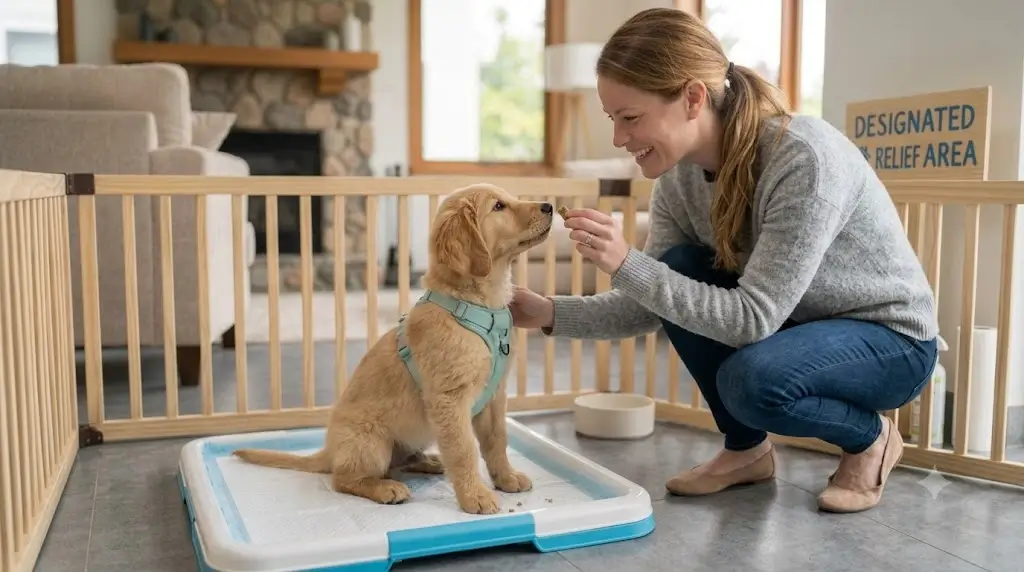
Keep training treats in a small container near the indoor toilet station so you never delay reward delivery.
Recognizing Your Puppy’s Bathroom Signals
Keep a simple tracking log for 3–5 days to identify your puppy’s natural rhythms:
| Tracked variable | What to record |
|---|---|
| Time of event | Exact time of urination or defecation |
| Preceding activity | Waking, feeding, drinking, training, or active play |
| Location | On the designated pad vs. accident location |
| Pre-potty behavior | Sniffing, pacing, whining, or sudden detachment from play |
What to Do About Indoor Puppy Accidents
Accidents are management feedback, not intentional disobedience.
If caught in the act:
- Remain calm and avoid shouting or sudden anger.
- Gently interrupt and guide the puppy onto the designated pad.
- Allow the puppy to finish, then reward calmly.
If discovered after the fact:
Never scold or rub a puppy’s nose in an old accident. Delayed punishment increases anxiety, damages trust, and encourages hidden elimination behind furniture.
How to Clean Puppy Accidents
- Blot liquid messes immediately with paper towels without scrubbing deeper into the floor.
- Saturate the area thoroughly with an enzymatic pet cleaner to dissolve uric acid crystals.
- Allow the solution to dwell according to manufacturer instructions before wiping clean.
- Keep the puppy away from the area until completely dry.
Indoor House Training for Puppies in an Apartment
Indoor stations provide immediate relief without the delays of elevators, stairs, and common hallways:
- Place the station on tiled bathroom, kitchen, or balcony areas.
- Use waterproof floor mats beneath pad trays to protect subfloors.
- Maintain strict daily feeding and watering schedules to keep elimination times predictable.
Sample Indoor Puppy House Training Schedule
| Time / Event | Action | Management goal |
|---|---|---|
| Morning wake-up | Immediate trip to the pad | Capture the first predictable bathroom opportunity |
| Post-breakfast | Pad opportunity 15–20 mins after eating | Reinforce the post-meal elimination habit |
| Mid-morning nap wake-up | Guide directly to the pad | Connect waking from rest with pad use |
| Post-play session | Redirect to pad station | Prevent excitement-induced accidents |
| Post-dinner | Scheduled pad visit | Empty bowels and bladder after evening meal |
| Before bedtime | Final pad opportunity | Prepare for a clean, restful night |
Transitioning From Indoor Pads to Outside
Indoor house training does not have to be permanent. If you decide to transition to outdoor elimination:
- Begin scheduling frequent outdoor trips at natural biological transition times.
- Gradually move the indoor pad closer to the exterior exit door.
- Place a pad outside on the grass to bridge the surface texture association.
- Phase out indoor pads entirely once outdoor grass habits are solidified.
Indoor House Training Without Pee Pads
Alternative indoor bathroom systems include artificial grass boxes, real hydroponic grass patches, or grated plastic dog toilets:
- Real grass patches: Accelerate future transitions to outdoor lawns.
- Grated plastic trays: Prevent pad shredding and keep paws completely dry.
- Litter boxes with dog-safe pellets: Provide a sturdy, contained indoor station.
Common Indoor House Training Mistakes
- Scattering pads across multiple rooms: Creates ambiguous bathroom boundaries.
- Frequently shifting pad locations: Disrupts spatial conditioning.
- Granting unmonitored free range: Leads directly to unobserved accidents.
- Waiting for the puppy to signal: Early training requires proactive scheduling.
- Delayed treat rewards: Breaks the immediate cause-and-effect connection.
- Using punitive corrections: Increases stress and leads to secretive elimination.
What to Do When Indoor House Training Regresses
If accidents suddenly increase after a routine change or freedom expansion:
- Temporarily restrict indoor territory back to a single supervised room or playpen.
- Shorten intervals between guided pad visits.
- Re-establish high-value treat reinforcement for every successful pad use.
- Thoroughly clean previous accident areas with enzymatic formula.
How Long Does Indoor House Training Take?
Most puppies grasp basic pad mechanics within 2–4 weeks of consistent management. Full reliability across wider living areas typically solidifies between 4 and 6 months of age as physical bladder capacity matures.
| Progress indicator | What it means |
|---|---|
| Walks to the pad independently | Spatial location awareness is established |
| Fewer indoor accidents | Supervision and timing schedules are working |
| Prompt elimination on the pad | Surface association is fully conditioned |
| Sustained reliability with more space | Household boundaries are generalizing successfully |
How to Know When to Increase Indoor Freedom
Expand household freedom based on demonstrated behavioral reliability, not chronological age:
- Two consecutive weeks with zero accidents in the current management zone.
- Puppy consistently returns to its designated station to eliminate.
- Ability to settle calmly during supervised free-roaming sessions.
If accidents reappear after opening a new room, temporarily close that space and rebuild consistency in the smaller area.
Indoor House Training: The Management Formula
Predict the Biological Need
↓
Guide to the Designated Station
↓
Successful Elimination
↓
Immediate High-Value Reward
↓
Supervised Indoor Freedom
↓
Repeat Consistently
Frequently Asked Questions
What is indoor house training for puppies?
Indoor house training teaches a puppy where bathroom behavior is permitted inside the home using dedicated pads or indoor dog toilets, paired with structured supervision, timing, and positive reinforcement.
How do I house train a puppy indoors?
Choose one stationary bathroom location, guide the puppy to it around natural triggers (waking, eating, playing), supervise closely, reward immediately upon completion, and clean accidents with enzymatic spray.
How many pee pads should I put out?
Use a single, clearly defined pad station in an accessible room. Scattering multiple pads across the house confuses the puppy and delays boundary recognition.
Can an indoor-trained puppy learn to go outside later?
Yes. Puppies can transition to outdoor elimination by gradually shifting the pad toward the door, taking them outside around key biological triggers, and heavily rewarding outdoor successes.
Why is my puppy missing the indoor pad?
Common reasons include too much unmonitored space, missed pre-potty signals, an unstable pad holder, confusing rug textures nearby, or residual urine odors on surrounding floors.
