
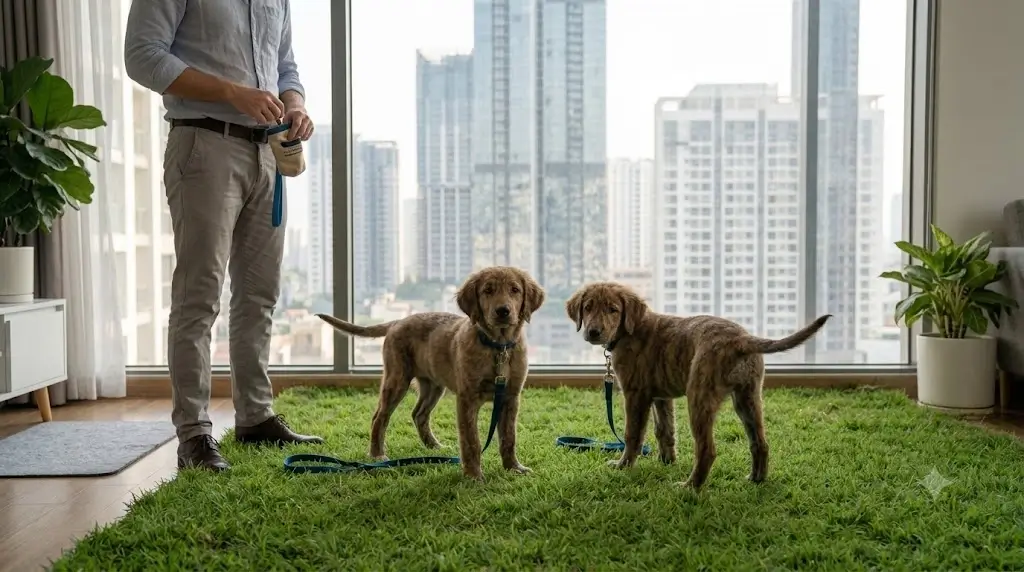
House Training Two Puppies at Once
House training two puppies at once requires more than doubling the number of potty breaks. The puppies may share a schedule, but they still need individual supervision, reinforcement, and enough separation to learn the skill without turning every bathroom trip into a play session.
Can You House Train Two Puppies at the Same Time?
Yes. Two puppies can be house trained in the same home, but the process is usually more management-intensive than training one puppy.
The biggest issue is not simply the number of puppies. It is that two puppies can distract each other, reinforce excitement, follow each other into unwanted behavior, and make it harder for an owner to identify which puppy needs a bathroom break. If you also have adult pets at home, review our broader principles for house training a puppy with other dogs.
The solution is not to keep the puppies permanently separated. Instead, combine shared routines with individual training opportunities.
Why House Training Two Puppies Is Harder
A puppy already has to learn where elimination is appropriate. With two puppies, you also have to manage the interaction between them.
Double distraction
One puppy may start playing before the other has finished eliminating.
Different needs
The puppies may not have identical bladder capacity, routines, or elimination patterns.
Harder supervision
Two moving puppies create more opportunities for an unnoticed accident.
Accident confusion
Owners may know an accident occurred without knowing which puppy caused it.
The Best Strategy: One Schedule, Two Training Records
A useful way to structure the process is to create a shared household schedule while maintaining separate records for each puppy.
For example, both puppies may go outside after waking. But if Puppy A eliminates and Puppy B does not, their training status is not identical.
| Shared | Individual |
|---|---|
| Morning potty routine | Which puppy actually eliminated |
| Outdoor location | Reward for each puppy |
| General meal routine | Accident history |
| Bedtime routine | Freedom level inside the house |
Should Two Puppies Go Outside Together?
Often, yes—but only when they can remain focused.
Taking both puppies outside together can save time and establish a consistent household pattern. It can also create a useful routine where both puppies learn that waking, eating, sleeping, and activity are followed by bathroom opportunities.
The problem occurs when one puppy turns the trip into a wrestling match or chase session. If outdoor overstimulation causes one dog to freeze or stall, troubleshoot why your puppy won’t go potty outside.
When to Take Two Puppies Out Separately
Individual potty trips are particularly useful when:
- One puppy constantly distracts the other.
- One puppy eliminates much faster than the other.
- One puppy becomes overexcited outdoors.
- You need to determine which puppy is having accidents.
- You are teaching a specific potty cue.
- One puppy is progressing faster than the other.
- The puppies have different elimination patterns.
- One puppy needs additional supervision after returning indoors.
Separate trips are a training tool, not a requirement for every bathroom break.
The Two-Puppy Potty Sequence
A simple sequence keeps the bathroom objective clear:
2. Keep the environment calm enough for the puppies to focus.
3. Allow each puppy an opportunity to eliminate.
4. Reward each successful puppy individually.
5. Continue with play, exploration, or another normal activity.
The important distinction is that the reward belongs to the puppy that performed the desired behavior.
Why Immediate Rewards Matter Even More With Two Puppies
When two puppies are present, there are many competing events happening at once.
If Puppy A eliminates and then Puppy B immediately starts jumping or playing, a delayed reward can become difficult to associate with the correct behavior.
Reward each puppy close to the completion of its own successful elimination.
This creates a clear behavioral connection:
What If One Puppy Goes Potty and the Other Does Not?
Do not assume that both puppies are finished simply because one puppy eliminated.
Puppy A going potty does not prove that Puppy B no longer needs to go.
If Puppy B has not eliminated, keep the situation calm and give Puppy B an appropriate opportunity based on its individual needs.
If nothing happens, return indoors with close supervision rather than immediately granting unrestricted access to the entire house.
A Practical Rule for Different-Paced Puppies
When one puppy consistently eliminates quickly and the other takes longer, do not force both puppies to follow identical bathroom timing.
You can maintain the same general household rhythm while giving the slower puppy additional opportunities.
| Puppy | Observed pattern | Training response |
|---|---|---|
| Puppy A | Eliminates quickly | Reward and continue the routine. |
| Puppy B | Needs more time | Provide a calmer or additional opportunity. |
How Often Should Two Puppies Go Outside?
There is no single interval that works for every puppy.
Bathroom needs vary with age, body size, activity, sleep, food and water intake, individual development, and other factors.
Instead of relying on one rigid clock interval, use predictable transitions as anchors:
- After waking.
- After eating.
- After drinking when appropriate.
- After naps.
- After energetic play.
- Before longer periods of confinement or rest.
- Before bedtime.
- When the puppy displays a recognizable need-to-go signal.
Very young puppies may require substantially more frequent opportunities than older puppies.
The Biggest Mistake: Giving Two Puppies Too Much Freedom
Two puppies moving freely around a large house can create a supervision problem.
By the time an owner notices one puppy sniffing near a doorway, the other puppy may already be eliminating in another room.
During early house training, limit access to spaces where you cannot reliably supervise.
Gradually expand freedom as each puppy demonstrates reliable behavior.
Use Management to Reduce Accidents
Management is especially important with two puppies because prevention is easier when you control the environment.
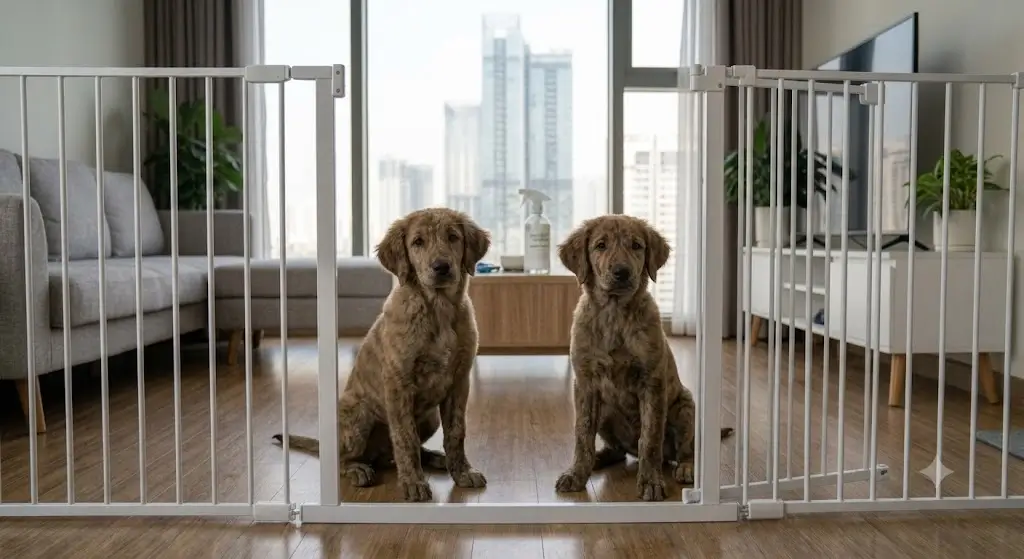
Baby gates
Limit access to rooms that are difficult to supervise.
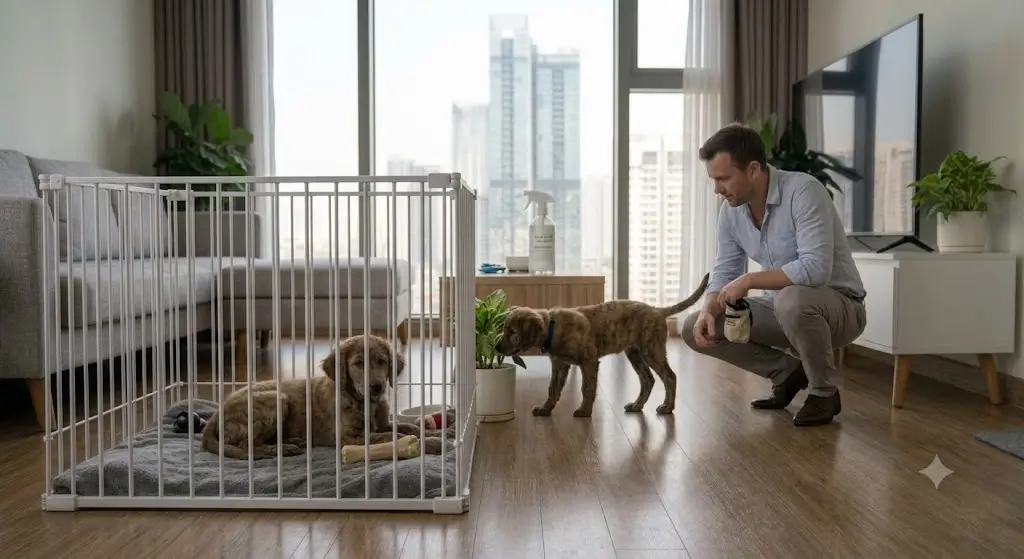
Puppy pen
Provides controlled space during appropriate short periods.
Crate
Can provide a predictable resting area when introduced appropriately.
Leash supervision
Can keep a puppy nearby when direct observation is needed.
Should Two Puppies Share a Crate?
Generally, each puppy should have an individual crate rather than being expected to share one small resting space.
Individual crates make it easier to manage rest, training, feeding arrangements, and separation when needed.
They also make it easier to determine each puppy’s behavior and routine.
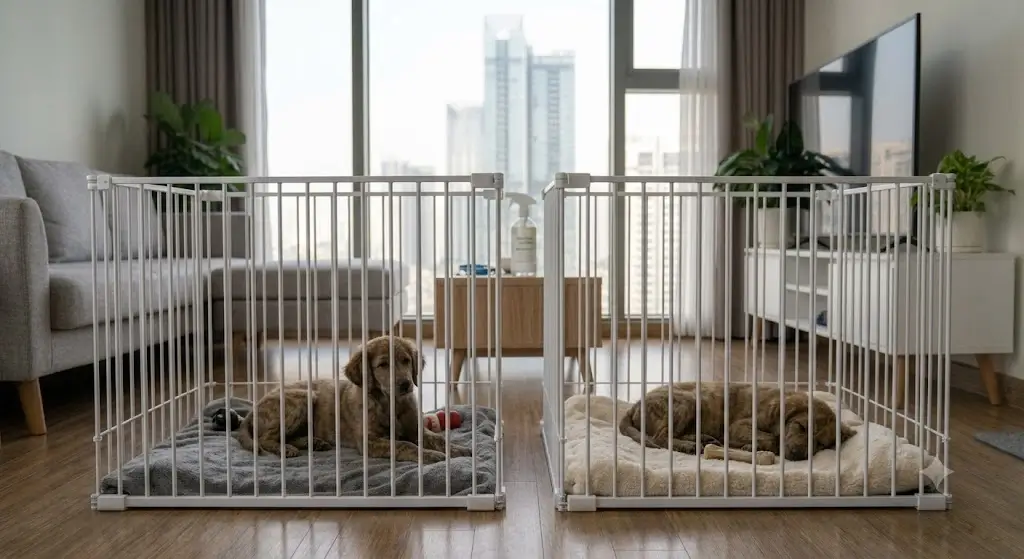
Crates should be appropriately sized and introduced as comfortable resting spaces rather than punishment areas. For proper crate sizing based on adult breed projections, consult our puppy crate size guide.
Should Two Puppies Share a Puppy Pen?
A shared pen can work in some households when the puppies are comfortable together and the space is appropriately arranged.
However, it is useful to have the ability to separate them when they become overly stimulated, interfere with each other’s rest, or need individual management.
The pen should not be used to avoid providing appropriate potty opportunities.
How to Handle Meals With Two Puppies
Feeding two puppies at exactly the same time can make the household routine simpler, but individual feeding arrangements may be preferable when the puppies eat at different speeds or become distracted.
After meals, monitor both puppies rather than assuming one puppy’s bathroom timing applies to the other.
Keep a record of meal timing if accidents repeatedly occur after feeding. Patterns are often more useful than guesswork.
The Two-Puppy Accident Log
A simple record can reveal differences that are otherwise easy to miss.
| Time | Puppy | Last potty | Trigger |
|---|---|---|---|
| 8:30 AM | Puppy A | 7:45 AM | Morning play |
| 9:05 AM | Puppy B | 7:50 AM | After breakfast |
The times above are examples, not a recommended universal schedule. The important information is the relationship between events and accidents.
Why You Should Track Accidents by Puppy
Suppose Puppy A has had no accidents for a week while Puppy B has had three.
If your household record simply says “three puppy accidents,” you lose the information needed to adjust training.
Individual records can reveal:
- Which puppy needs more frequent potty opportunities.
- Which puppy becomes distracted outside.
- Which puppy needs more supervision indoors.
- Whether accidents cluster around meals or play.
- Whether one puppy is progressing faster than the other.
How to Reward Two Puppies Without Creating Chaos
Have the rewards ready before the puppies finish eliminating.
Reward Puppy A for Puppy A’s behavior and Puppy B for Puppy B’s behavior.
If both puppies become frantic around treats, create enough distance to maintain calm behavior while still delivering the reward promptly.
What If One Puppy Copies the Other’s Accident?
Residual odor can influence where dogs choose to eliminate, particularly if an accident has not been cleaned thoroughly.
Clean the area promptly using an enzymatic cleaner suitable for the surface and restrict access when necessary. To eliminate organic pheromone traces, follow our guide on how to clean up puppy accidents properly.
If one location repeatedly becomes a problem, treat the location as a management issue rather than simply waiting for the puppies to “outgrow” it.
Never Punish Both Puppies for One Accident
If you find an accident and do not know which puppy caused it, do not punish either puppy.
Punishment after the event does not teach the puppies which earlier behavior was incorrect.
Instead:
- Clean the area thoroughly.
- Review the supervision arrangement.
- Determine whether both puppies had appropriate bathroom opportunities.
- Increase management if necessary.
- Track future incidents by puppy.
What If You Catch One Puppy Having an Accident?
If you notice the puppy beginning to eliminate indoors, calmly interrupt and redirect to the appropriate bathroom location when practical.
Avoid yelling, intimidation, or punishment.
Afterward, examine why the accident happened. Common management questions include:
- When did the puppy last eliminate?
- Had the puppy just woken up?
- Had the puppy eaten?
- Had intense play just ended?
- Was the puppy unsupervised?
- Was the puppy distracted by the other puppy?
How Play Changes the Potty Routine
Two puppies can become much more active together than either puppy is alone.
That makes post-play potty opportunities particularly important.
Instead of ending a long play session and immediately giving both puppies unrestricted indoor freedom, transition into a calm bathroom opportunity.
How to House Train Two Puppies When They Sleep Together
Sleeping puppies often have predictable bathroom needs after waking.
As soon as they wake, be prepared to take them to the appropriate potty location rather than allowing an extended period of indoor wandering first.
If one puppy wakes earlier than the other, the earlier-waking puppy may need its own opportunity.
House Training Two Puppies in an Apartment
Apartment living adds another variable: the time required to reach the appropriate bathroom location.
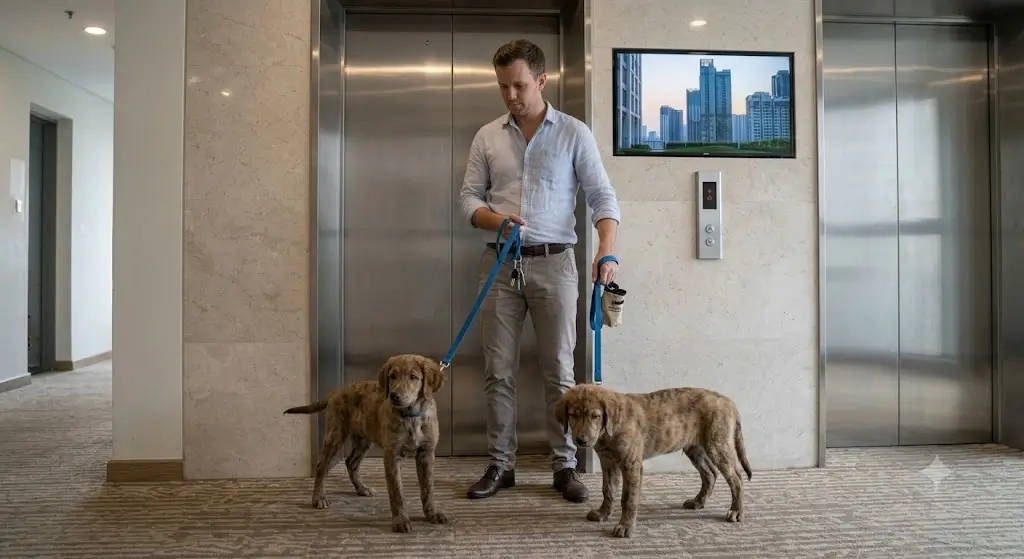
Prepare leashes, shoes, treats, and other necessary items before the puppies reach the point of urgency.
If the puppies cannot safely travel together during urgent potty trips, separate handling may be more practical.
The principle is simple: reduce the time between recognizing the need and reaching the designated potty location.
House Training Two Puppies in a House With a Yard
A private yard can make logistics easier, but it does not automatically teach the puppies where to eliminate.
Choose a consistent potty area when practical and avoid allowing the entire yard to become one giant distraction during the early stages.
After successful elimination, play and exploration can follow.
How to Teach Two Puppies the Same Potty Cue
You can use the same verbal cue for both puppies, but introduce and reinforce the behavior individually.
Choose a short, consistent phrase and use it calmly when the puppy is in the designated potty area.
Avoid repeating the cue continuously. The objective is to associate the phrase with the appropriate bathroom routine rather than create background noise.
When One Puppy Is Much Faster Than the Other
Different training speeds are normal.
Do not hold the more reliable puppy back indefinitely, but do not give the less reliable puppy unrestricted freedom simply because its sibling has earned more freedom.
Each puppy’s access to the house should be based on its own demonstrated reliability.
Can Two Puppies Be Trained in Separate Rooms?
Yes. Temporary separation can make training easier when the puppies are constantly distracting one another.
Use separate spaces for short training periods, meals when appropriate, rest, or focused potty routines.
The objective is not permanent isolation. It is giving each puppy enough individual learning time to develop reliable behavior.
House Training Two Puppies With Different Temperaments
Temperament can change how easily a puppy focuses on the bathroom routine.
One puppy may calmly investigate the potty area while the other immediately wants to chase leaves, people, or its sibling.
Use the same basic house-training principles but adjust the environment to the puppy’s actual behavior.
The more distracted puppy may benefit from shorter, quieter potty trips and more individual supervision.
What If the Puppies Become Overly Dependent on Each Other?
Two puppies raised together can become highly focused on one another.
For house training, this can make individual attention harder.
Include short, age-appropriate periods where each puppy learns to settle, train, explore, and interact with the owner without the other puppy constantly present.
This also makes it easier to identify each puppy’s individual bathroom signals.
A Practical Two-Puppy Daily Framework
| Household event | Puppy A | Puppy B |
|---|---|---|
| Wake-up | Potty opportunity | Potty opportunity |
| Breakfast | Individual meal monitoring | Individual meal monitoring |
| After meal | Potty opportunity | Potty opportunity |
| Play | Supervised interaction | Supervised interaction |
| Nap | Rest | Rest |
| After nap | Potty opportunity | Potty opportunity |
| Evening play | Supervised play | Supervised play |
| Bedtime | Final appropriate potty opportunity | Final appropriate potty opportunity |
This framework is a structure, not a rigid universal timetable. Young puppies may need substantially more frequent bathroom opportunities.
What to Do When Both Puppies Have Accidents
If both puppies begin having accidents, first examine the environment rather than assuming both puppies suddenly forgot their training.
Ask:
- Did their freedom increase too quickly?
- Has their daily routine changed?
- Are they playing for longer periods?
- Are bathroom trips being delayed because managing two puppies is difficult?
- Are there new distractions in the home?
- Are previous accident areas being revisited?
A temporary return to closer supervision can often provide useful information.
What If Only One Puppy Keeps Having Accidents?
This is where individual training becomes essential.
Do not reduce the other puppy’s freedom simply because its sibling is struggling.
Instead, increase supervision and potty opportunities for the puppy having accidents while maintaining the successful puppy’s existing routine.
If the puppy’s accidents are sudden, unusually frequent, or accompanied by other concerning symptoms, consult a veterinarian.
When to Increase Freedom for Each Puppy
Think of house access as a progression rather than a single milestone.
Stage 1
Close supervision and restricted access.
Stage 2
Short periods of supervised freedom.
Stage 3
More rooms with continued monitoring.
Stage 4
Broader household access after reliable performance.
Advance each puppy according to its own behavior.
House Training Two Puppies: Common Mistakes
Treating them as one learner
Each puppy has its own learning history.
Allowing nonstop play outside
Excitement can interfere with elimination.
Waiting for both puppies to signal
Their bathroom needs may not occur at exactly the same time.
Giving both puppies equal freedom automatically
Freedom should follow individual reliability.
Punishing after accidents
Use accidents to improve supervision and timing.
Ignoring individual progress
One puppy may need more support than the other.
A Better Way to Think About Two-Puppy Training
The goal is not to make both puppies perform identically at every moment.
The goal is to create a predictable household system in which each puppy understands where elimination belongs and receives enough individual guidance to succeed.
That means you can use shared meals, shared outdoor routines, shared play, and shared rest periods while still adjusting potty opportunities, supervision, rewards, and freedom for each puppy.
When Two Puppies Need Individual Training Time
Set aside short individual sessions when:
- One puppy cannot focus around the other.
- One puppy is consistently behind in house training.
- You need to teach a potty cue.
- You are identifying the source of accidents.
- One puppy needs additional supervision.
- The puppies are becoming overly dependent on each other.
These individual periods can be brief. Consistency matters more than making every session long.
Signs Your Two-Puppy Routine Is Working
Look for progress in several areas rather than relying on one accident-free streak.
- Both puppies increasingly eliminate in the designated location.
- Accidents become less frequent.
- The puppies recover from play and transition into potty routines more easily.
- You can identify each puppy’s pre-potty behavior.
- The puppies can remain supervised together without constant accidents.
- Freedom can gradually increase without a corresponding increase in accidents.
When to Ask a Veterinarian About House-Training Problems
House-training setbacks are not always behavioral.
Contact a veterinarian if a puppy develops a sudden or persistent change in urination or defecation, particularly when the change is accompanied by signs such as difficulty urinating, blood in urine or stool, repeated diarrhea, vomiting, unusual thirst, lethargy, pain, or other concerning symptoms.
A puppy that repeatedly struggles despite an appropriate routine and supervision may also benefit from professional evaluation.
Two-Puppy House Training Checklist
- Use one predictable household routine.
- Maintain an individual record for each puppy.
- Take both puppies out together when they can remain focused.
- Separate them when one puppy distracts the other.
- Reward each puppy for its own successful elimination.
- Take puppies out after waking, meals, naps, and active play as appropriate.
- Use management to prevent unsupervised wandering.
- Clean accidents thoroughly.
- Do not punish either puppy for an accident you did not witness.
- Track which puppy is having accidents.
- Give each puppy individual training time.
- Increase freedom separately for each puppy.
- Watch for sudden changes that may require veterinary attention.
Frequently Asked Questions
Can you house train two puppies at the same time?
Yes. Two puppies can be house trained in the same household. The most effective approach is to use a shared routine while providing individual supervision, reinforcement, and training opportunities.
Should two puppies go outside together for potty training?
They can go outside together when they remain focused. If one puppy consistently distracts the other, temporarily separate potty trips and allow interaction after successful elimination.
What if one puppy goes potty but the other does not?
Do not assume both puppies are finished. Give the puppy that has not eliminated an appropriate additional opportunity based on its individual needs and supervise it closely afterward.
Should two puppies share a crate?
Individual crates are generally more useful because they allow separate rest, management, and training. Each crate should be appropriately sized and introduced as a comfortable resting space.
How do you house train two puppies who keep distracting each other?
Use short individual potty sessions when necessary. Keep the potty area calm, reward each puppy separately, and allow play after the puppies have had appropriate opportunities to eliminate.
Should both puppies have the same amount of freedom in the house?
Not necessarily. Each puppy should receive more freedom according to its own reliability. One puppy may be ready for additional rooms while the other still needs closer supervision.
How do I track house-training progress with two puppies?
Keep separate records for each puppy, including potty trips, accidents, meals, naps, play, and other events that may reveal patterns. This helps identify which puppy needs additional support.
What should I do if I don’t know which puppy had an accident?
Do not punish either puppy. Clean the area thoroughly and improve supervision or management until you can identify the individual puppy responsible for future accidents.
Can two puppies become too dependent on each other during training?
Yes. Short, appropriate periods of individual training, rest, and interaction with the owner can help each puppy learn to focus and develop independent routines.
When should a puppy house-training problem be checked by a veterinarian?
Sudden, persistent, unusually frequent, or otherwise abnormal elimination changes should be discussed with a veterinarian, especially when accompanied by symptoms such as difficulty urinating, blood, vomiting, diarrhea, unusual thirst, lethargy, or pain.
The Most Reliable Two-Puppy House Training Approach
Train together when it works. Separate when it teaches better.
Two puppies do not need two completely separate household schedules. They need a shared structure with individual accountability. Use predictable potty transitions, keep outdoor trips focused when necessary, reward each puppy for its own success, control indoor freedom, and adjust the routine according to each puppy’s progress. The result is a system that reduces confusion without making everyday life unnecessarily complicated.
Editorial Note
This guide provides general puppy house-training information for U.S. households. Puppies develop at different rates, and bathroom needs vary with age, size, health, diet, activity, sleep, and individual development. Persistent or sudden elimination changes should be discussed with a veterinarian.
