
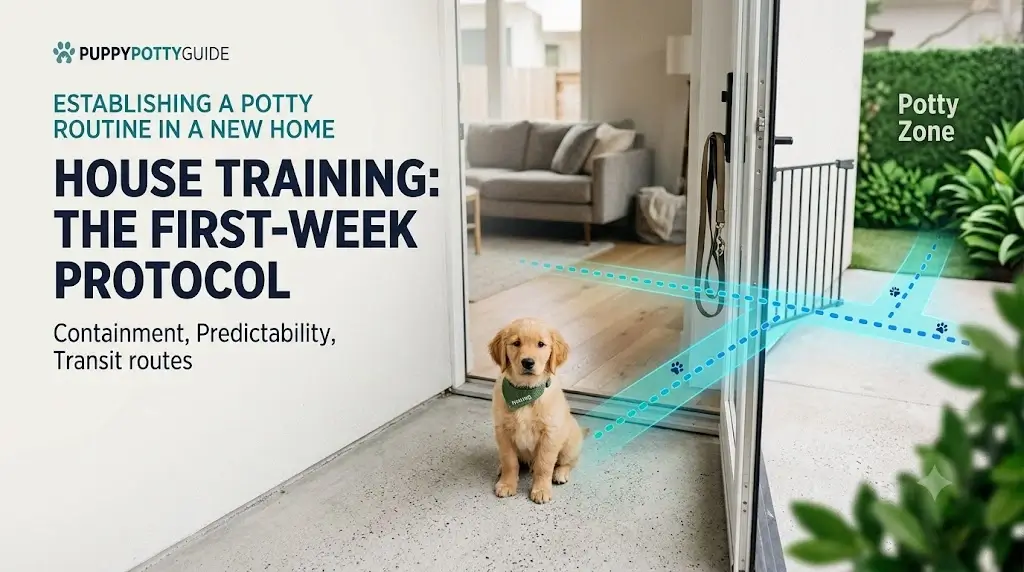
House Training a Puppy in a New Home
House training a puppy in a new home is different from continuing a routine the puppy already knows. A new house changes the puppy’s surroundings, schedule, bathroom location, and supervision pattern at the same time. The fastest approach is to make the first few days predictable, limit indoor freedom, establish one clear potty location, and build a routine around the puppy’s natural bathroom triggers.
Why a New Home Can Cause Potty Training Setbacks
A puppy may have already learned part of a bathroom routine before arriving at your home. That does not mean the puppy automatically understands where the bathroom is in a new house.
The puppy now has to learn a new physical environment, new smells, new surfaces, new doors, new household sounds, and a new daily rhythm.
Even a puppy that was doing well previously can have accidents during the transition.
The First-Day Goal Is Routine, Not Perfection
The first day should focus on preventing unnecessary accidents and teaching the puppy where the correct bathroom location is.
Do not expect the puppy to immediately understand every room in the house.
Instead, make the puppy’s world temporarily smaller and more predictable.
- Choose the designated potty location before the puppy arrives.
- Keep the route to that location practical.
- Prepare the leash and other supplies in advance.
- Limit unsupervised access to the home.
- Observe the puppy closely after major daily transitions.
- Reward successful elimination promptly.
Set Up the Potty Area Before Bringing the Puppy Home
One of the easiest mistakes is waiting until the puppy arrives to decide where bathroom trips should happen.
Choose the location beforehand.
For outdoor training, use a consistent area that is practical to reach quickly and can be used regularly. To understand how foundational substrate conditioning and daily containment work together across different environments, review our comprehensive blueprint on how to house train a puppy.
For indoor potty training, establish one appropriate location and make the path to it easy to manage.
The exact setup depends on the home, local weather, housing rules, and the puppy’s circumstances.
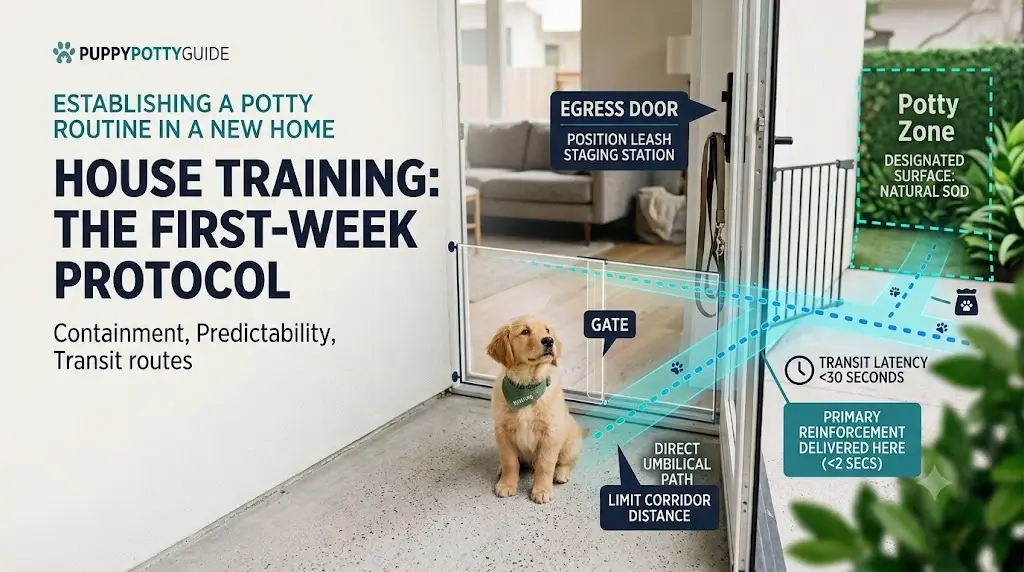
The New-Home Potty Route Matters
Young puppies often have less time between recognizing the need to eliminate and actually eliminating.
That makes the distance between the puppy and the designated potty area important.
If you live in a house with a nearby yard, the route may be simple. In an apartment or high-rise, reaching an outdoor location may take considerably longer.
Before the puppy arrives, identify:
- The fastest safe route outside.
- Which door you will normally use.
- Where the leash and supplies will stay.
- What you will do during bad weather.
- Whether building rules affect where pets can eliminate.
Good logistics reduce preventable accidents.
What Do to During the First Few Hours
Keep the first few hours relatively structured.
A new puppy may be excited, tired, nervous, curious, or overstimulated. Giving unrestricted access to every room immediately creates unnecessary opportunities for accidents.
Start with a manageable area where you can observe the puppy.
First-hours sequence:
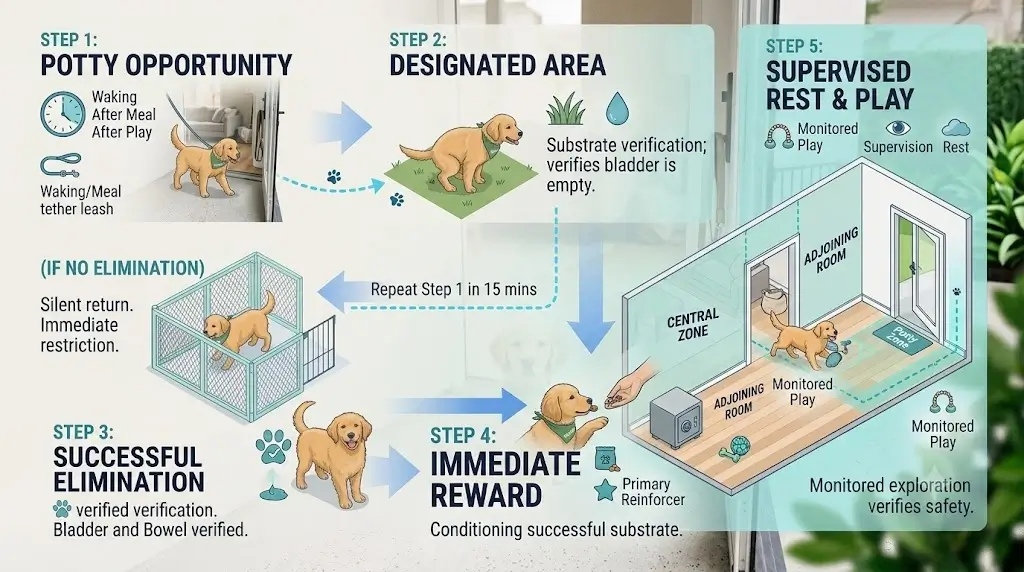
Arrive → potty opportunity → calm exploration → water/meal as appropriate → potty opportunity → supervised rest → potty opportunity after waking.
This gives the puppy repeated opportunities to learn the new bathroom routine without overwhelming it with the entire house.
Take the Puppy to the Potty Area After Waking
Waking is one of the most useful predictable triggers in puppy house training.
Take the puppy to the designated location soon after waking rather than allowing a long period of indoor activity first.
This applies to morning wake-up and shorter naps.
As the puppy becomes familiar with the home, these transitions become useful anchors for the daily schedule.
Potty Training After Meals in a New Home
Meals can create predictable opportunities to monitor bathroom needs.
Keep feeding times reasonably consistent and observe what happens afterward.
Do not assume that every puppy needs to eliminate at exactly the same interval after eating. Individual timing varies.
A simple log can reveal the puppy’s actual pattern much faster than guessing.
A New Puppy Potty Log
| Time | Event | Result | Notes |
|---|---|---|---|
| 7:00 AM | Woke up | Potty | Successful |
| 7:30 AM | Breakfast | — | Normal meal |
| 8:00 AM | After meal | Potty | Successful |
| 9:15 AM | Play | Accident | Too much freedom |
The times shown are examples only. They are not a universal puppy potty schedule.
How Much Freedom Should a New Puppy Have?
A puppy should not automatically receive access to the entire house simply because it has arrived safely.
During the early training period, use a smaller area where accidents can be prevented and noticed quickly.
As the puppy demonstrates reliable behavior, gradually introduce additional rooms.
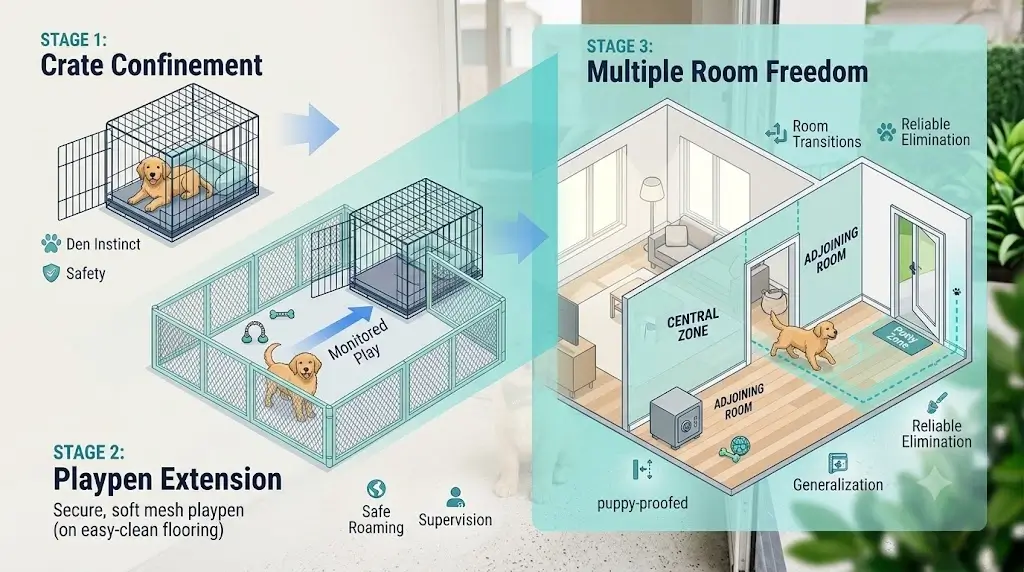
Early stage
Small supervised area.
Progress stage
One or two additional areas with supervision.
Reliable stage
More household access with continued observation.
This approach prevents the common mistake of confusing physical access with house-training readiness.
Why Supervision Is the Core of New-Home Training
House training depends heavily on preventing opportunities to rehearse unwanted indoor elimination.
When the puppy is awake and active, keep it close enough that you can notice behavioral changes.
Useful signs can include:
- Suddenly stopping play.
- Sniffing the floor repeatedly.
- Moving away from people.
- Circling or searching.
- Heading toward a previous accident location.
- Restlessness or a sudden change in activity.
These signs are not identical for every puppy, so the first days in the home are also an observation period.
Use a Leash for Close Indoor Supervision
During supervised periods, keeping a puppy physically close can make it easier to notice changes in behavior.
A lightweight leash can be useful when appropriate and when the puppy is directly supervised. Never leave a tethered puppy unattended.
The purpose is management—not restraint for its own sake.
How to Introduce the Puppy to the Bathroom Location
Take the puppy to the same general potty area consistently when practical.
Keep the initial bathroom trip relatively boring. Give the puppy an opportunity to investigate and eliminate without turning the trip immediately into a long play session.
Once the puppy successfully eliminates, provide immediate positive reinforcement and then continue with the next activity.
Why the Potty Area Should Not Become a Playground
A puppy that learns that every potty trip means unlimited outdoor excitement may become more interested in exploration than elimination.
This does not mean the puppy should never play outside.
Instead, make the sequence predictable:
What If the Puppy Does Not Potty Outside?
This is common during the first days in a new environment.
New smells, noises, weather, unfamiliar surfaces, traffic, people, and other animals can distract a puppy. If your puppy repeatedly waits until returning indoors to eliminate, read our troubleshooting guide on why won’t my puppy poop outside? for proven reset techniques.
Keep the trip calm and give the puppy a reasonable opportunity.
If the puppy does not eliminate, return indoors under close supervision rather than immediately granting unrestricted freedom.
Then provide another appropriate opportunity later based on the puppy’s needs.
What If the Puppy Only Wants to Explore?
Exploration is normal in a new home.
The solution is to separate the objectives of the bathroom trip and exploration.
Give the puppy a predictable opportunity to eliminate first. After successful elimination, allow appropriate exploration or play.
Over time, the puppy learns that the bathroom trip has a clear purpose while the rest of the outing can contain other activities.
How to Handle the First Accident
An accident during the transition to a new home is not unusual.
If you see the puppy beginning to eliminate indoors, calmly interrupt and redirect to the designated location when practical.
Do not yell, frighten, or punish the puppy.
If you discover an accident afterward, clean the area thoroughly and review the circumstances that preceded it.
Why Punishment Can Make New-Home Training Harder
Punishment does not teach a puppy the correct bathroom location after an accident has already occurred.
It can also make the puppy wary of eliminating around people, which can complicate observation and training.
A better response is to identify the management failure:
- Was the puppy unsupervised?
- Had it just woken up?
- Had it recently eaten?
- Had a long play session ended?
- Was the potty location too difficult to reach?
- Was the puppy distracted outside?
Clean Previous Accidents Thoroughly
Dogs can be attracted back to locations where elimination odors remain.
Use an enzymatic cleaner designed for pet accidents and follow the product’s directions for the specific surface.
If a particular area repeatedly attracts accidents, restrict access while retraining and examine whether the area has been adequately cleaned.
The First Night in a New Home
The first night combines several house-training variables: unfamiliar surroundings, a changed routine, sleep, and potentially increased stress or excitement.
Keep the bedtime routine predictable.
Take the puppy to the designated potty area before settling down for the night.
Use an appropriate sleeping arrangement that allows you to respond to the puppy’s needs rather than expecting a very young puppy to remain dry for an unrealistic period.
Very young puppies may need overnight bathroom opportunities.
Where Should a New Puppy Sleep?
A crate, pen, or other safe sleeping arrangement can make nighttime management easier when introduced appropriately.
Keeping the puppy’s sleeping area near the household’s sleeping area can also make it easier to notice nighttime restlessness.
The setup should prioritize safety, appropriate space, and the puppy’s developmental needs.
Crate Training and House Training Are Related but Different
A crate can help with management, but it does not replace a potty-training routine.
The puppy still needs appropriate opportunities to eliminate.
Never use a crate as punishment or as a substitute for normal exercise, interaction, and bathroom breaks.
A Practical New-Home Daily Framework
| Transition | House-training action | Why it matters |
|---|---|---|
| Wake-up | Potty opportunity | Predictable trigger |
| Breakfast | Monitor afterward | Helps identify individual timing |
| Active play | Potty opportunity | Activity can change bathroom needs |
| Nap | Potty after waking | Creates a repeatable pattern |
| Bedtime | Final appropriate opportunity | Reduces avoidable overnight problems |
Do Not Use One Rigid Potty Schedule for Every Puppy
Age, body size, sleep, activity, food and water intake, health, and individual development all affect bathroom needs.
A clock-based routine is useful as a framework, but the puppy’s behavior and actual elimination pattern should guide adjustments.
The goal is not to force a puppy to hold urine or stool beyond its comfortable ability.
House Training a Puppy in a New Home With Other Pets
Other pets can make a new environment even more stimulating.
If another dog or cat is constantly following the puppy during potty trips, consider giving the puppy a calmer individual opportunity.
The puppy should be able to focus on eliminating without being overwhelmed by social interaction.
You can reintroduce normal interaction after the bathroom routine is complete.
House Training After Moving to a Different House
Even an older puppy that was previously reliable may have accidents after moving.
Treat the new environment as a temporary reset rather than assuming the old level of freedom automatically transfers.
Return to closer supervision, re-establish the potty location, and gradually restore freedom as the puppy demonstrates that it understands the new environment.
House Training After Adoption From a Shelter or Rescue
A newly adopted puppy may arrive with an uncertain bathroom history.
Avoid assuming that the puppy’s previous routine is known or transferable.
Start with a clear routine and observe the puppy’s behavior.
Changes in environment, diet, sleep, activity, and stress can affect elimination patterns, so the first days are useful for establishing a baseline.
House Training a Puppy in an Apartment
Apartment living requires special attention to travel time.
If the designated outdoor area is several minutes away, prepare everything before the puppy becomes urgent.
Keep the leash, footwear, and other necessities in a predictable location near the exit.
If building elevators, stairs, or common areas add delay, factor that delay into your management plan.
For apartment residents, reducing the number of steps between the puppy and the potty location can make a meaningful practical difference.
Cold Weather and Rain Can Disrupt New-Home Potty Training
Weather can change how willing a puppy is to remain outside.
Rain, snow, strong wind, heat, and unfamiliar outdoor surfaces can become distractions or deterrents.
Use the safest practical potty location and keep the bathroom objective clear.
In severe weather, follow appropriate local veterinary guidance and household safety practices rather than expecting a puppy to tolerate unsafe conditions.
How to Increase Indoor Freedom
Increase freedom gradually.
A puppy that has demonstrated reliable behavior in one area can receive supervised access to another area.
If accidents increase after expanding access, reduce the area again and rebuild reliability before trying to expand it.
How Long Does It Take to House Train a Puppy in a New Home?
There is no universal number of days or weeks.
Progress depends on age, development, previous experience, supervision, routine consistency, access to the correct potty location, household environment, and individual differences.
A better measurement is the direction of progress:
- Fewer accidents.
- More successful trips.
- More recognizable pre-potty behavior.
- Longer periods of reliable behavior appropriate for the puppy’s development.
- Gradually increasing freedom without repeated accidents.
What If House Training Suddenly Gets Worse?
A sudden change deserves investigation.
First review recent environmental changes:
- New rooms or increased freedom.
- Schedule changes.
- Different feeding times.
- Visitors.
- Travel.
- Moving to another home.
- Changes in household activity.
If the change cannot be explained by management or routine, or if elimination is unusually frequent or accompanied by other symptoms, contact a veterinarian.
The New-Home House Training Reset
If accidents increase after arrival, use a short reset:
- Reduce indoor freedom.
- Return to a predictable potty routine.
- Increase direct supervision.
- Use the same designated potty area consistently.
- Reward successful elimination promptly.
- Record accidents and successful trips.
- Expand freedom gradually once reliability improves.
This is often more productive than changing several parts of the routine at once.
Signs Your Puppy Is Adapting to the New Home
House-training progress is easier to recognize when the puppy starts becoming predictable.
- The puppy begins moving toward the exit or potty area.
- The puppy settles into a more consistent sleep and activity rhythm.
- Successful potty trips become easier to predict.
- Accidents decrease as supervision improves.
- The puppy can explore additional rooms without immediately having accidents.
- The puppy becomes more comfortable with the household routine.
The New-Home Potty Training Mistakes to Avoid
Giving full house access immediately
The puppy has too many opportunities for unsupervised accidents.
Changing the potty location repeatedly
Consistency makes the desired location easier to understand.
Waiting for obvious signals
Very young puppies may not provide a clear warning every time.
Punishing accidents
Use accidents to improve timing and supervision instead.
Making potty trips exciting before elimination
Distractions can delay the bathroom behavior.
Assuming previous training transfers automatically
A new environment requires the puppy to learn new routes and cues.
A Simple 7-Day New-Home Training Framework
The first week is best treated as a period of observation and routine building rather than a race toward unrestricted freedom. For a comprehensive, step-by-step breakdown across hourly intervals, you can follow our detailed 7-day puppy house training plan.
| Period | Primary focus |
|---|---|
| Days 1–2 | Small area, frequent supervision, identify potty patterns. |
| Days 3–4 | Strengthen the routine and recognize individual signals. |
| Days 5–6 | Test short periods of additional supervised freedom if progress supports it. |
| Day 7+ | Continue expanding freedom gradually based on actual reliability. |
This is a management framework, not a guaranteed seven-day house-training timeline. Puppies progress at different rates.
How to Make a New Home Feel Predictable
Puppies learn patterns through repetition.
Keeping wake-up, meals, play, naps, potty trips, and bedtime reasonably predictable gives the puppy more information about what happens next.
The goal is not to create a rigid schedule that cannot change. The goal is to make the household predictable enough that the puppy can recognize recurring transitions.
New Home House Training Checklist
- ✓ Choose the potty location before the puppy arrives.
- ✓ Prepare the route to the potty area.
- ✓ Keep the puppy in a manageable supervised area initially.
- ✓ Take the puppy out after waking.
- ✓ Monitor bathroom needs around meals.
- ✓ Offer potty opportunities after active play and naps.
- ✓ Reward successful elimination immediately.
- ✓ Keep potty trips focused before allowing play.
- ✓ Clean accidents thoroughly with an appropriate enzymatic cleaner.
- ✓ Never punish the puppy for an accident discovered afterward.
- ✓ Record successful trips and accidents.
- ✓ Expand household freedom gradually.
- ✓ Reset the routine if accidents increase.
- ✓ Contact a veterinarian for sudden or concerning elimination changes.
The Most Reliable Way to House Train a Puppy in a New Home
Make the new environment smaller, more predictable, and easier to understand.
A puppy does not need to learn the entire house on the first day. Start with one clear potty location, close supervision, predictable transitions, immediate reinforcement, and limited indoor freedom. Watch the puppy’s actual bathroom pattern instead of relying on a rigid timetable. As successful behavior becomes consistent, gradually give the puppy more access to the home. This approach turns a confusing new environment into a repeatable routine the puppy can learn.
Editorial note: This guide provides general puppy house-training information for U.S. households. Bathroom needs vary with age, body size, development, diet, activity, sleep, health, and individual behavior. If a puppy has sudden, persistent, unusually frequent, painful, or otherwise concerning elimination changes, consult a veterinarian.
