
Puppy Keeps Having Accidents Overnight
Repeated nighttime accidents usually mean the overnight routine asks more of the puppy than their current bladder capacity, circadian hormone levels, or sleeping setup can support. Here is how to diagnose the biological breakdown and reset the cycle.
Why Does My Puppy Keep Having Accidents Overnight?
Overnight house training differs fundamentally from daytime housebreaking. During daylight hours, active handlers monitor pre-elimination signals (circling, sniffing, pacing). Overnight, the puppy rests in an unmonitored state where subconscious muscle sphincters must resist involuntary relaxation.
| Diagnostic Clue | Underlying Biological Cause | Targeted Intervention |
|---|---|---|
| Accident at the same hour | Exceeded physiological holding limit | Set alarm 30 mins before habitual accident time |
| Accident 30–60 mins post-bedtime | Incomplete final voiding / evening water rush | Keep puppy outside until complete double-void |
| Soils corner of large crate | Den instinct overridden by excess floor space | Insert crate divider to reduce footprint |
| Wetting absorbent bedding | Substrate wick effect hides wetness | Remove plush blankets temporarily; use bare tray |
| Sudden onset in trained puppy | Infectious or inflammatory pathology (UTI) | Immediate veterinary urinalysis evaluation |
Canine Bladder Development and Nocturnal ADH Secretion
The standard guideline of “Age in Months = Hours a Puppy Can Hold It” applies strictly to daytime rest. At night, adult dogs rely on circadian surges of vasopressin (anti-diuretic hormone) to slow renal filtration and concentrate urine.
In puppies younger than 16 weeks, nocturnal ADH pathways are physiologically immature. Kidneys continue producing dilute urine at daytime velocity throughout the night. Expecting an 8-to-10-week-old puppy to hold urine across 8 continuous hours contradicts mammalian developmental biology.
Analyzing the Overnight Timeline
A puppy that sleeps 7 hours straight but wakes up wet did not fail house training; the handler miscalculated their biological holding window. Accurately track:
- Time of evening meal: Late digestion stimulates the gastrocolic reflex.
- Last water intake: Large volumes consumed after heavy play cause rapid bladder filling within 45–60 minutes.
- Final outdoor void: Verification that both urination and defecation occurred.
- The wetness window: The exact time interval where bladder retention collapses.
The Final Bathroom Trip: Eliminating the “Distraction Trap”
A primary cause of bedtime accidents is an incomplete final bathroom trip. Handlers let the puppy out, watch them sniff grass for two minutes, assume they are empty, and crate them. The puppy eliminates 20 minutes later because evening coolness or outdoor sounds prevented full bladder evacuation.
If your puppy gets distracted outdoors and holds their urine until stepping inside, apply our tactical protocol for when your puppy won’t go potty outside to ensure they empty completely before confinement.
Sleeping Setup: The Mechanics of Den Inhibition
Dogs possess an innate instinct to avoid soiling their immediate sleeping surface (den inhibition). However, improper confinement setups can easily override this natural drive.
1 Eliminate Excess Crate Dimensions
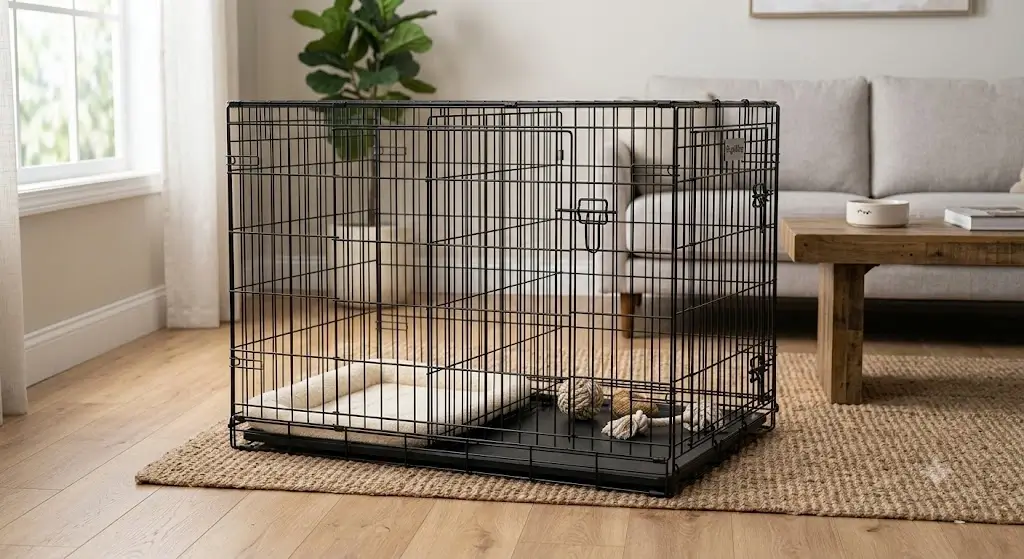
If a crate is large enough for a puppy to urinate in one corner and sleep comfortably in the other, den inhibition breaks down. Install an adjustable metal divider panel: the puppy should have just enough room to stand upright, turn around completely, and lie flat on their side.
2 Address the Absorbent Bedding Issue
Plush fleece blankets and high-loft beds wick moisture away from the surface. The puppy pees, the liquid sinks deep into the cushion, and the surface stays relatively dry. This teaches puppies that urinating in the crate carries no discomfort. If accidents repeat, switch to a bare plastic tray until overnight control stabilizes. If you choose not to use a crate, review our complete blueprint on how to potty train a puppy without a crate using tethering and exercise pens.
3 Crate Proximity to the Handler
Position the crate in the handler’s bedroom during early training. Young puppies produce subtle physical warnings before eliminating: abrupt waking, frantic pawing, or whining. If the crate sits in a distant laundry room, these signals go unheard, forcing the puppy to soil their space.
Why Regular Laundry Detergent Fails on Bedding
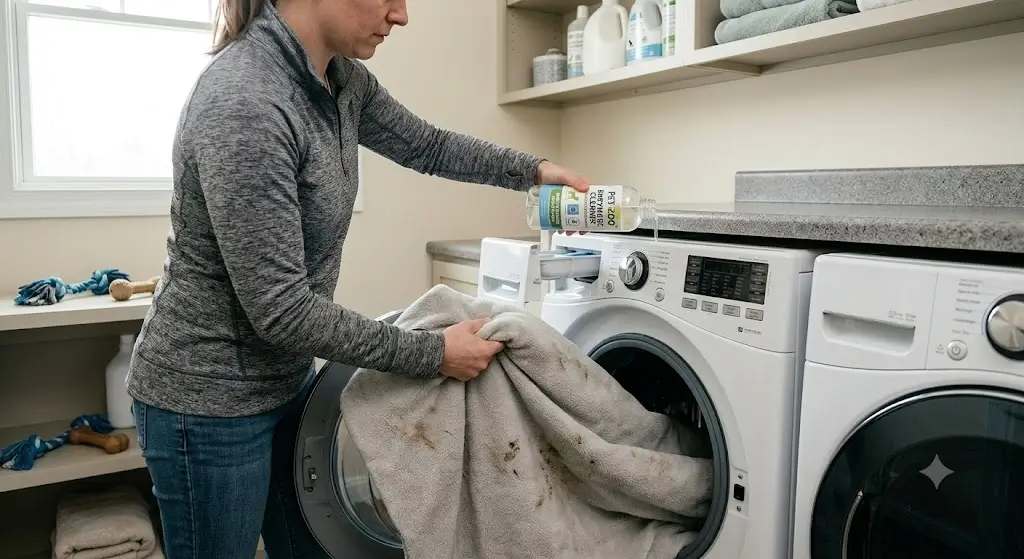
When bedding is soiled, standard washing powders clean superficial organic matter but fail to eliminate microscopic uric acid crystals. As body warmth heats the crate during sleep, these crystals release pheromones that trigger the puppy to re-soil the area. Follow our step-by-step instructions on how to clean up puppy accidents properly using bio-enzymatic agents to destroy these scent cues.
Managing Evening Water Intake Without Causing Dehydration
Severely restricting water is unsafe and counterproductive. Thirsty puppies become distressed, vocalize, and may lap up toilet water or toxic substances. Dehydration also leads to concentrated, acidic urine that irritates the bladder lining, triggering involuntary spastic contractions.
The 6-Step Overnight Bladder Reset Protocol
1 Track the Failure Timestamp
Monitor your puppy for 48 hours to pinpoint the precise hour the accident happens.
2 Set an Alarm 30 Minutes Prior
Beat the bladder clock. If the accident occurs around 3:00 AM, set your alarm for 2:30 AM.
3 Execute a Low-Stimulation Transfer
No bright overhead lights, baby talk, or play. Carry the puppy outside on leash to keep their nervous system calm.
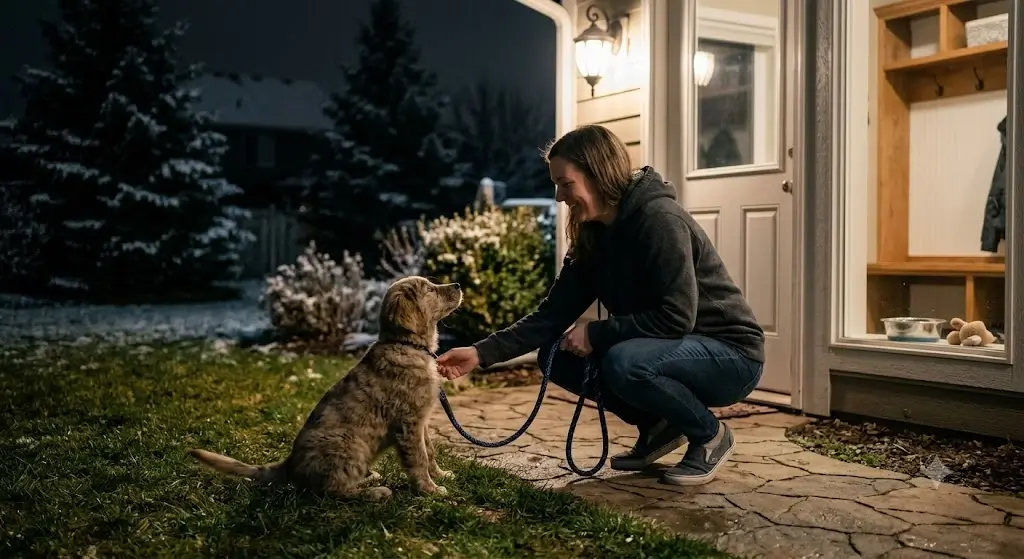
4 Transactional Elimination
Stand quietly at the potty spot for up to 5 minutes. Praise neutrally when they finish.
5 Immediate Re-Crating
Return the puppy directly to their crate without treats or extended interaction. Bedtime remains strictly for sleep.
6 Systematic Time Expansion
Once you achieve 5 consecutive dry mornings, push your alarm forward by 15 minutes. Continue incrementally until the puppy sleeps through the night.
Developmental Overnight Benchmarks
| Puppy Age | Physiological Holding Capacity | Recommended Overnight Strategy |
|---|---|---|
| 8–10 Weeks | 3 to 4 hours maximum | 1 to 2 planned nocturnal bathroom trips mandatory |
| 11–14 Weeks | 4 to 6 hours | 1 scheduled mid-night break; minimal evening liquids |
| 15–18 Weeks | 6 to 7 hours | Transition to full overnight sleep based on dry logs |
| 19+ Weeks | 7 to 8+ hours | Should reliably sleep through uninterrupted |
When Overnight Accidents Indicate Medical Pathology
Clinical Safety Notice: If a puppy that was clean overnight for two weeks suddenly starts soaking their bed, never assume behavioral regression. Consult a veterinarian immediately to rule out:
- Urinary Tract Infections (UTIs): Inflammation creates sudden, intense bladder spasms.
- Ectopic Ureters: A congenital condition causing continuous urine leakage.
- Intestinal Parasites (Giardia/Coccidia): Causes sudden nocturnal diarrhea accidents.
- Polydipsia: Excessive thirst driven by endocrine or renal abnormalities.
Need a Complete Crate-Free House-Training Plan?
Stop midnight carpet messes, master indoor tethering, and establish dependable routines with our complete step-by-step training system.
Frequently Asked Questions
Why does my puppy keep having accidents overnight?
Overnight accidents happen because immature puppies lack anti-diuretic hormone (ADH) concentration to reduce urine production during sleep, or their overnight interval exceeds physical bladder capacity.
Should I withhold water before bed to stop nighttime accidents?
Never severely dehydrate a puppy. You may lift the water bowl 1.5 to 2 hours before bedtime only if the puppy had unrestricted daytime hydration and you provide a final outdoor relief trip right before sleep.
Why does my puppy pee inside their crate overnight?
The crate is either too large (allowing them to sleep on one side and soil the other), contains absorbent bedding that masks moisture, or the puppy was confined beyond their physical holding limit.
At what age can a puppy sleep 8 hours through the night without peeing?
Most puppies develop sufficient bladder capacity and hormonal control between 16 and 20 weeks of age. Expecting an 8-to-12-week-old puppy to hold urine for 8 uninterrupted hours is biologically unrealistic.
Should I wake my puppy up to go outside at night, or let them sleep?
If your puppy regularly wakes up wet, proactively set an alarm to wake them before the accident happens. If they consistently sleep through and wake up dry, do not wake them.
