
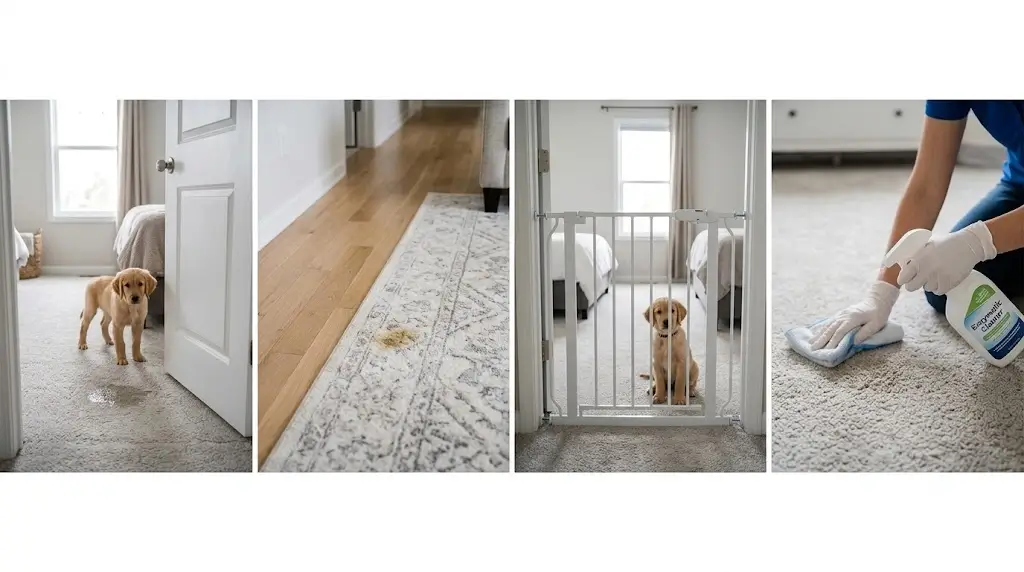
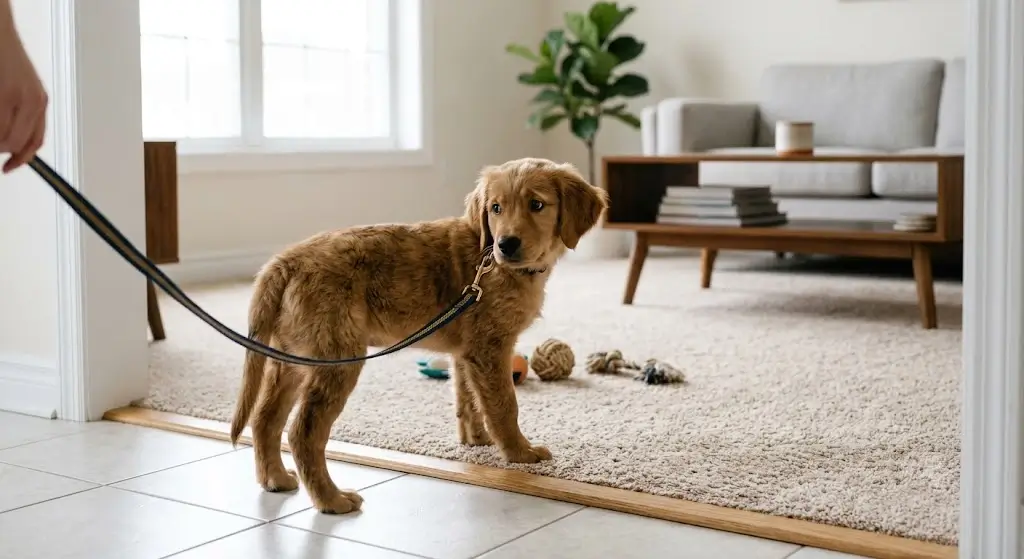
Why Does a Puppy Have Accidents in Only One Room?
When bathroom failures occur exclusively within one room while the remainder of the home stays consistently accident-free, the behavior is triggered by specific environmental cues. Canine elimination decisions rely on sensory mapping: olfactory scent marks, tactile pad stimulation, past geographic reinforcement, and active supervision levels.
| Observed Diagnostic Pattern | Underlying Behavioral Cause | Systemic Intervention |
|---|---|---|
| Repeated specific corner or rug | Sub-surface uric acid salt crystals | Deep-saturate with bio-enzymatic cleaner |
| Targets carpet over hardwood/tile | Substrate preference for soft textiles | Temporary gate restriction; outdoor grass focus |
| Puppy slips away unmonitored | Unearned territorial access | Close doors; install tension baby gates |
| Accident occurs when handler steps away | Supervision vacuum / blind spots | Tether to handler (umbilical leash method) |
| Accidents occur at predictable hours | Gastrocolic reflex timing mismatch | Schedule outdoor breaks before room entry |
| Puppy eliminates without hesitation | Conditioned bathroom association | Execute structured 7-day room reset |
1. The Room May Still Smell Like a Bathroom to Your Puppy
A room can smell completely clean, floral, or sanitized to human senses while remaining saturated with biological scent markers to a canine nose. Dogs possess over 200 million olfactory receptors. When a puppy smells past metabolic traces, those volatile pheromones trigger a biological prompt to eliminate in the exact same location.
1 Map the Recurring Contamination Zone
Do not simply treat the latest damp spot. Inspect the perimeter along baseboards, behind armchairs, and around large area rugs. Past accidents that were merely wiped with standard soap or ammonia cleaners leave invisible uric acid crystal deposits.
Breaking the Indoor Elimination Cycle
The reinforcement loop develops predictably:
- An unmonitored puppy has an initial accident in an isolated room.
- Inadequate cleaning leaves behind insoluble uric acid crystals.
- The puppy detects the biological pheromones on future visits.
- The scent triggers muscle relaxation and repeated elimination.
- The room becomes conditioned as an acceptable indoor bathroom site.
Terminating this behavioral loop requires treating both the physical chemical environment and the boundary management routine simultaneously.
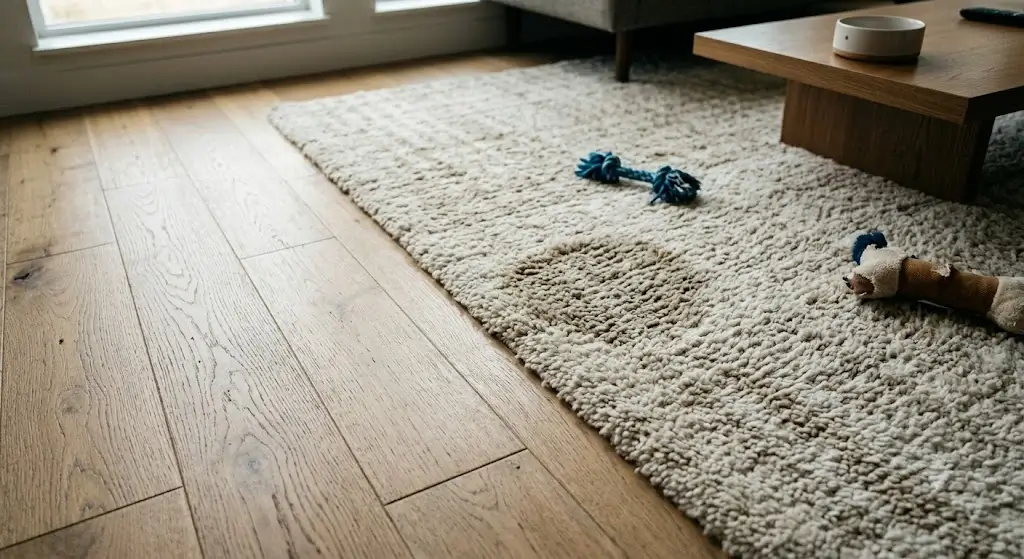
2. Flooring Substrates and Tactile Preference
Sensory texture underfoot strongly influences canine housebreaking. Puppies naturally seek out absorbent, textured surfaces that prevent urine from splashing back onto their legs. When a house consists primarily of hardwood or tile, a single carpeted bedroom or rug-covered dining room becomes an attractive indoor bathroom target.
| Flooring Type | Canine Sensory Perception | Management Strategy |
|---|---|---|
| High-Pile Carpet | Soft, highly absorbent; mimics grass thatch | Restrict access; deep-clean backing and padding |
| Decorative Area Rugs | Isolated absorbent patches on hard floors | Temporarily roll up and remove during training |
| Hardwood Planks | Non-absorbent, but urine seeps into floor seams | Neutralize micro-cracks with enzyme formulas |
| Ceramic / Stone Tile | Splash risk; porous grout absorbs odor | Scrub grout lines with specialized pet cleaners |
3. Unearned Access and Boundary Leaks
In many homes, room-specific failures stem from access logistics. A distant home office, guest bedroom, or finished basement offers seclusion. If the puppy can wander into these areas unobserved while handlers cook or work, the puppy has continuous unsupervised practice of unwanted behavior.
4. Activity Triggers and the “Home Office” Trap
Examine the daily routines connected to the room. If a puppy spends two hours in a home office while an owner works at a computer, supervision is passive and intermittent. The resulting accident is not caused by the room itself, but by the formula of long duration + passive supervision + an overdue bathroom interval.
Always walk the puppy outdoors to empty their bladder immediately before settling down for work or rest in any specific room.
5. Conditioned Room Associations
Young puppies do not innately understand human floorplans. They understand habits formed by repetition. If a puppy repeatedly relieves themselves in an open formal dining room without immediate redirection, they classify that room as a designated bathroom zone. When accidents occur consistently in one spot, review our guide on how to stop a puppy from peeing in the same spot to dismantle localized scent preferences.
The 6-Step Room-Reset Protocol
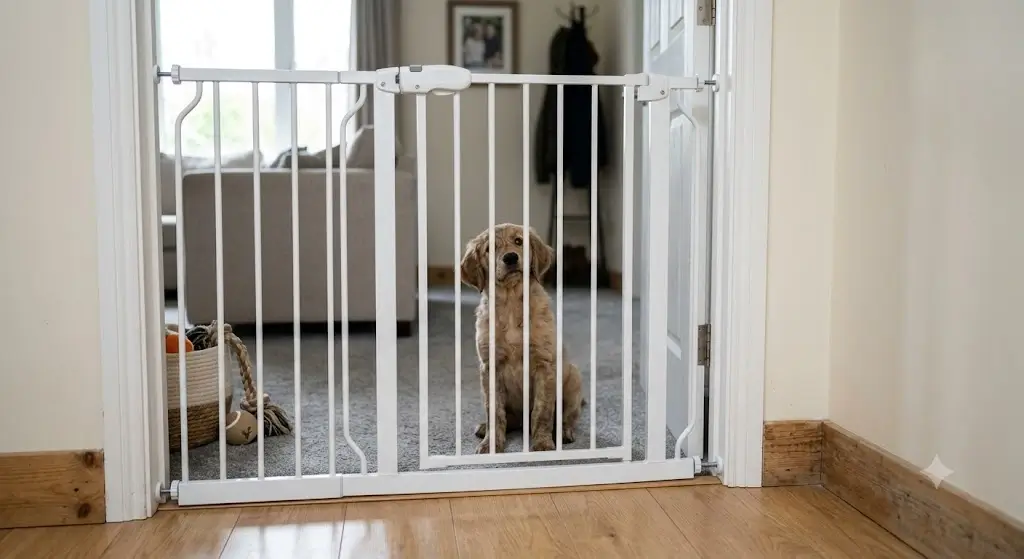
1 Enforce Immediate Physical Exclusion
Close doors or install tall tension baby gates. Block 100% of unaccompanied visits.
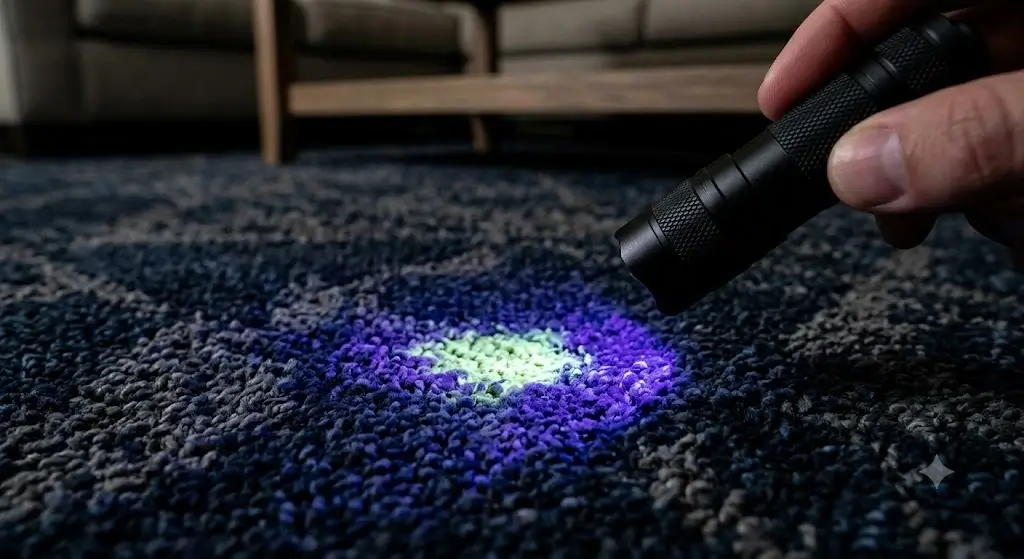
2 Map Sub-Surface Contamination
Use an ultraviolet blacklight in a dark room to reveal dried, glowing uric acid salt stains on carpets and baseboards.
3 Chemically Digest Odor Residue
Standard detergents mask odors with superficial perfumes. Follow our step-by-step procedures on how to clean up puppy accidents properly using enzymatic solutions that dissolve organic uric crystals.
4 Eliminate First, Enter Second
Never bring the puppy into the problem room on a full bladder. Only allow entry immediately after a confirmed outdoor elimination.
5 Structured, Short Supervised Reintroduction
Keep initial re-entry visits brief (10–15 minutes). Engage the puppy with active training or chew toys to reshape the room’s identity into an activity or resting area rather than a bathroom.
6 High-Value Outdoor Reinforcement
Deliver high-value protein rewards outside within 2 seconds of successful elimination to keep outdoor grass far more rewarding than any indoor rug.
The 7-Day Room Reset Framework
| Timeline | Management Stage | Behavioral Goal |
|---|---|---|
| Days 1–2 | 100% Boundary Exclusion | Stop the repetition cycle; enzymatically deep-clean the room. |
| Days 3–4 | Controlled Re-entry (5–10 Mins) | Enter only on an empty bladder; actively engage with chew toys. |
| Days 5–6 | Extended Supervised Visits (20–30 Mins) | Maintain active handler supervision; look for pre-potty pacing. |
| Day 7+ | Gradual Unrestricted Access | Permit normal access while maintaining predictable outdoor schedules. |
Room-Specific Pattern vs. Generalized Housebreaking Failure
If your puppy eliminates randomly across all rooms, hallways, and living zones, the issue is not room-specific. It indicates an overarching housebreaking breakdown. In that situation, refer to our diagnostic protocol on what to do when your puppy has too many accidents to rebuild basic scheduling and crate-free management.
When to Seek Veterinary Evaluation
- Frequent posturing with little or no urine produced.
- Visible blood or discoloration in urine.
- Pain, whimpering, or excessive genital licking.
- Marked increase in daily water intake (polydipsia).
Need a Structured Step-by-Step House-Training Plan?
Master reliable indoor supervision, establish consistent bathroom schedules, and eliminate carpet accidents using our complete training guide.
Frequently Asked Questions
Why does my puppy have accidents in only one room?
Room-specific accidents occur due to lingering sub-surface urine odors, tactile preferences for absorbent rugs or carpets, blind spots that reduce supervision, or unmonitored independent access.
Can a puppy smell old urine even if the carpet was cleaned with soap?
Yes. Standard household detergents clean superficial surfactants but leave uric acid salt crystals intact. A dog’s olfactory system easily detects these pheromones, triggering repeated elimination in the exact spot.
How do I stop my puppy from sneaking into that room to pee?
Install a physical boundary such as a tension baby gate or close the door. Physical access control eliminates unmonitored practice of the unwanted behavior while habits are being retrained.
Does keeping my puppy out of the room make them afraid of it?
No. Restricting access is an environmental management variable, not a disciplinary measure. It prevents the formation of an elimination cycle while you reset the room’s odor profile.
When can I safely allow my puppy back into the problem room?
Reintroduce the room only for brief, supervised 10-to-15 minute blocks immediately following a successful outdoor elimination break. Expand time gradually as reliability holds.
