
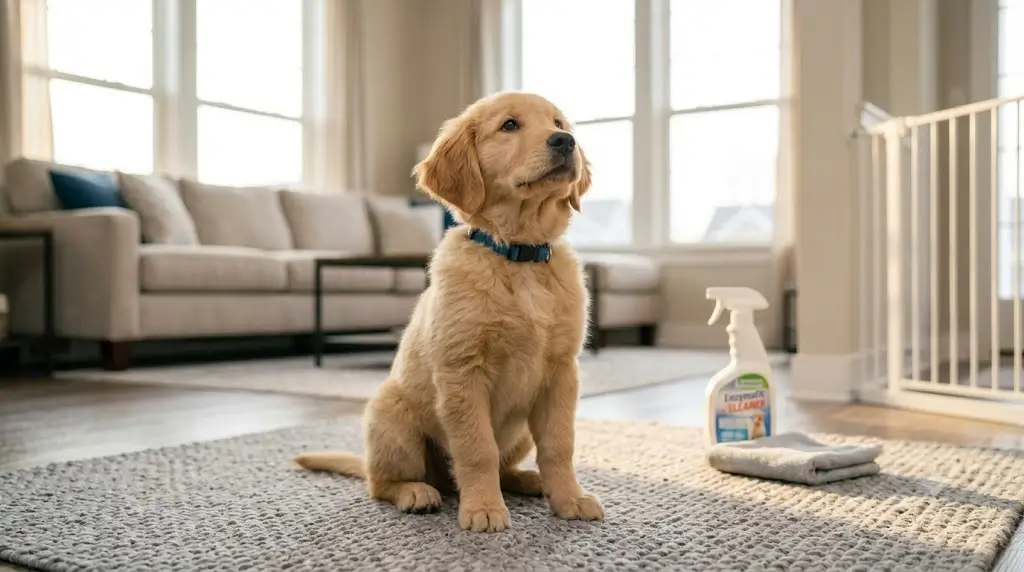
How to Clean Up Puppy Accidents Properly
Cleaning a puppy accident is more than making the visible mess disappear. Urine can penetrate carpet, rugs, seams and other porous materials, so proper cleanup should address the affected surface without damaging it and should be followed by better potty-training management.
For a fresh puppy accident, remove solid waste or blot liquid first, then use a pet-appropriate cleaner designed for the affected surface. Do not scrub urine deeper into carpet, do not mix cleaning chemicals and do not assume a surface is fully clean simply because the visible stain has disappeared. Thorough cleanup should be combined with house-training supervision and access control to reduce repeat accidents.
What Do You Need to Clean Puppy Accidents?
You do not need a complicated collection of household chemicals. The best cleanup setup depends on the type of accident and the material that was affected.
| Item | Purpose |
|---|---|
| Paper towels or absorbent cloths | Blot fresh urine and pick up moisture. |
| Disposable gloves | Protect your hands during cleanup. |
| Pet urine cleaner | Designed to address urine residue and odor. |
| Trash bag | Dispose of contaminated paper towels and solid waste. |
| Soft brush when appropriate | Work a cleaner into suitable washable surfaces. |
| Clean water | Use only when appropriate for the surface and product directions. |
Always check the cleaner’s label and the manufacturer’s care instructions for the carpet, flooring, rug or furniture involved.
Why Proper Cleanup Matters During House Training
Cleaning is not a replacement for training. It is one part of the environment management side of house training.
If urine remains in a porous material, the area may continue to contain residual odor even when the stain is no longer visible.
That is particularly relevant when a puppy repeatedly chooses the same location.
The training response should therefore have two parts:
- Clean the environment properly.
- Change the puppy’s access, timing and supervision.
How to Clean Up Fresh Puppy Urine
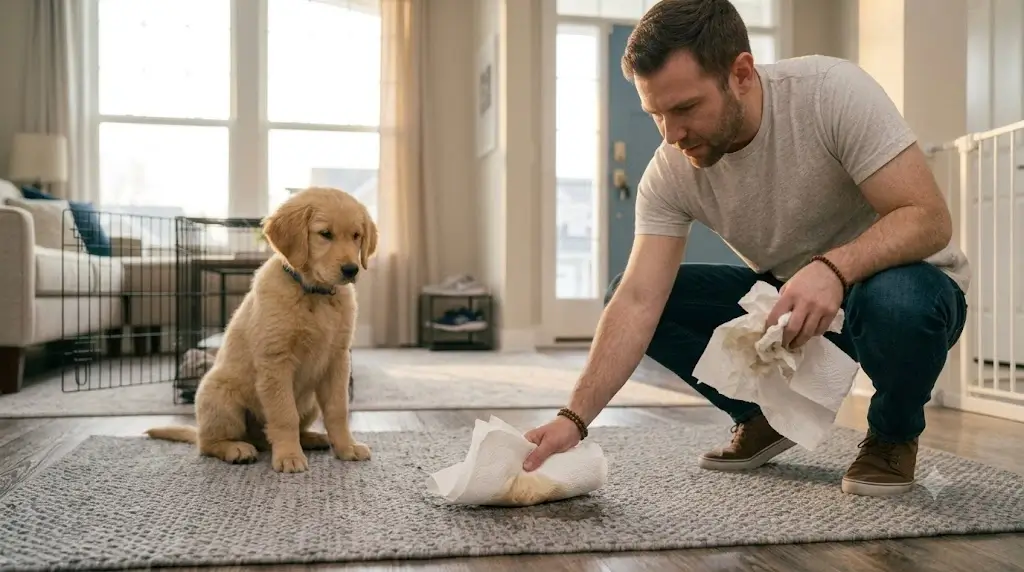
1 Blot the Liquid
Use absorbent paper towels or a suitable cloth to remove as much fresh liquid as possible.
Press down rather than aggressively rubbing the area. Rubbing can spread liquid through fibers and make the affected area larger.
2 Apply an Appropriate Cleaner
Choose a product formulated for pet urine and compatible with the affected surface.
Follow the label directions for application amount, dwell time and whether rinsing is required.
3 Allow the Area to Dry
Do not judge the cleanup while the surface is still wet. Some materials retain moisture below the visible surface.
Allow appropriate ventilation and drying according to the material and cleaner’s directions.
4 Reassess the Area
Once dry, inspect the area for remaining odor or visible residue.
If the odor persists, consider whether the liquid reached carpet padding, floor seams, rug backing or another porous layer.
How to Clean Up Puppy Poop Properly
Solid waste requires a slightly different approach from urine.
1 Remove the Solid Waste
Use paper towels, a disposable bag or another suitable method to remove the solid material without spreading it across the surface.
2 Avoid Grinding the Mess Into Fabric
If the accident occurred on carpet or a rug, avoid aggressive rubbing before the bulk of the material has been removed.
3 Clean the Remaining Area
Use a cleaner appropriate for the material and follow its label instructions.
4 Dry and Inspect
Allow the area to dry and inspect it afterward. If residue or odor remains, the affected material may require additional surface-appropriate cleaning.
How to Clean Puppy Urine From Carpet
Carpet is one of the harder surfaces to clean because urine can travel below the visible fibers.
The visible spot is not necessarily the entire affected area.
Fresh Urine on Carpet
- Blot as much liquid as possible.
- Apply a carpet-compatible pet urine cleaner.
- Follow the product’s recommended treatment time.
- Extract or blot according to the product directions.
- Allow the carpet to dry thoroughly.
What If the Carpet Still Smells?
Persistent odor can indicate that urine reached the carpet backing or underlying padding.
In that situation, repeatedly treating only the surface may not solve the problem.
If the same area has been used repeatedly, consider whether the carpet pad or another underlying layer has been affected and whether professional carpet cleaning is appropriate.
How to Find a Larger Urine Area on Carpet
The visible discoloration does not always correspond exactly to the full area affected by liquid.
Look around the immediate area, including:
- Carpet edges.
- Nearby rug borders.
- Furniture legs.
- Areas underneath movable objects.
- Carpet seams.
If you repeatedly smell urine but cannot locate the source, a pet-urine detection light may sometimes help identify areas requiring closer inspection. Use any detection device according to its instructions and do not treat a fluorescent spot as proof of the exact chemical composition of a stain.
How to Clean Puppy Accidents From Rugs
Rugs vary widely in fiber, backing and dye stability, so the care label matters.
For a washable rug, follow the manufacturer’s washing instructions.
For delicate, antique or specialty rugs, aggressive household cleaning can damage fibers or dyes. Professional rug cleaning may be more appropriate.
Wool, natural fibers, dyed fabrics, specialty rugs and rugs with specific backing materials may require different care.
How to Clean Puppy Urine From Hardwood Floors
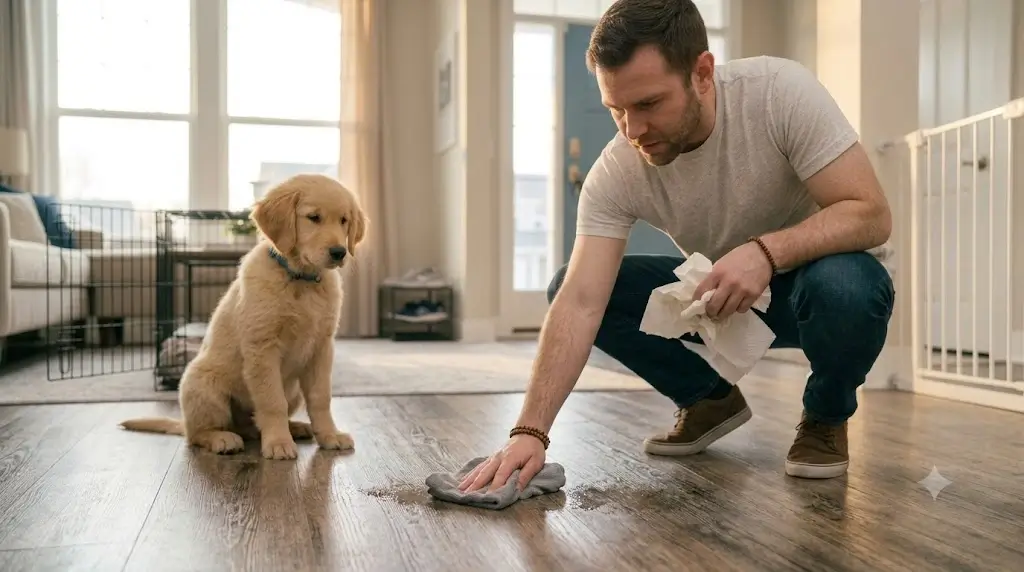
Hardwood requires more caution because excessive moisture can damage some finishes and allow liquid to reach seams.
Start by removing the urine promptly and follow the flooring manufacturer’s cleaning recommendations.
- Blot standing liquid quickly.
- Use a cleaner compatible with the finished floor.
- Avoid flooding the floor.
- Dry the area appropriately.
- Pay attention to seams and edges.
If urine repeatedly reaches gaps between boards, the problem may be deeper than a surface stain.
How to Clean Puppy Accidents From Vinyl and Laminate
Vinyl and laminate can be easier to clean than carpet, but they are not identical materials.
Follow the flooring manufacturer’s recommendations rather than assuming that a product suitable for one surface is suitable for another.
Clean the visible accident promptly and avoid leaving standing liquid around edges, seams or joints.
How to Clean Puppy Accidents From Tile and Grout
Tile itself is generally less porous than many soft floor coverings, but grout can absorb liquid depending on its composition and condition.
Clean the tile surface and pay particular attention to grout lines when an accident occurs near them.
Do not use an abrasive method that could damage the finish or grout.
How to Clean Puppy Accidents From a Mattress or Upholstered Furniture
If a puppy has an accident on upholstery or a mattress, the main challenge is that liquid can penetrate below the surface.
First blot as much liquid as possible. Then use a product appropriate for the specific material and follow its care instructions.
Avoid saturating foam or upholstery unnecessarily.
If a large amount of urine has penetrated deeply, professional cleaning may be more appropriate than repeated surface treatments.
How to Get Rid of Puppy Urine Smell
Odor that remains after cleaning is often a sign that the affected material has not been fully addressed or that the product and surface were not a good match.
Common reasons include:
- Urine penetrated carpet padding.
- A rug backing retained moisture.
- Liquid entered floor seams.
- Only the visible stain was treated.
- The cleaner was not designed for pet urine.
- The treatment was not used according to its instructions.
Why Masking Odor Is Different From Cleaning
A strong fragrance may make a room smell better temporarily without addressing the underlying residue.
For house-training purposes, the objective is not simply to make the room smell pleasant to humans. You also want to properly address the accident area and remove the conditions that make it attractive as a repeat bathroom location.
Should You Use an Enzymatic Cleaner?
Pet urine cleaners are often formulated specifically to address organic residue associated with pet accidents. Enzyme-based formulations are one category commonly marketed for this purpose.
Whether a particular product is appropriate depends on the surface and the manufacturer’s directions.
Use the product exactly as directed rather than assuming that more product or a longer treatment is always better.
Can Vinegar Remove Puppy Urine?
Household vinegar is frequently suggested as a DIY cleaning solution, but it should not be treated as a universal answer for every puppy accident or every surface.
The more reliable approach is to choose a cleaner compatible with the affected material and specifically intended for the cleaning problem.
Never mix vinegar with bleach or other household chemicals.
Can You Use Bleach on Puppy Urine?
Chemical combinations can produce dangerous fumes. Follow the product label and surface manufacturer’s instructions instead of combining cleaners.
What About Ammonia-Based Cleaners?
Avoid experimenting with household chemical combinations simply because an internet cleaning tip recommends them.
For puppy accidents, use a product specifically appropriate for the surface and follow its instructions.
Good cleanup should reduce risk to the household while protecting the flooring, fabric or other material being cleaned.
Why Puppies Sometimes Pee in the Same Place
Cleaning matters because a puppy can repeatedly return to a familiar location, but odor is only one part of the problem.
If the puppy continues to have access to the same area without supervision, the environment may continue to support the unwanted behavior. Learn how to address these location habits in detail when your puppy keeps peeing in the same spot.
That means proper cleanup should be paired with:
- Temporary access restriction.
- Closer supervision.
- More predictable bathroom trips.
- Positive reinforcement outdoors or at the chosen bathroom location.
Cleaning Alone Does Not House Train a Puppy
This distinction is important.
A perfectly cleaned floor does not teach a puppy where to eliminate.
Likewise, a strong potty-training schedule does not remove urine residue from a carpet.
You need both environmental cleanup and behavioral management.
Accident → Clean → Restrict access → Adjust timing → Supervise → Reward success.
This prevents cleanup from becoming an endless cycle without improving the underlying house-training routine.
Puppy Accident Cleaning Mistakes to Avoid
Mistake #1: Scrubbing Fresh Urine Aggressively
Aggressive rubbing can spread liquid through carpet fibers and make the affected area larger.
Mistake #2: Cleaning Only What You Can See
Urine can move below carpet fibers, rug surfaces and other materials.
Mistake #3: Using Too Much Water
Excess moisture can create problems on flooring, upholstery and other materials. Follow the surface and product instructions.
Mistake #4: Using Random Chemical Combinations
Do not mix cleaning products. Follow the labels and use one appropriate cleaning system at a time.
Mistake #5: Ignoring the Puppy After Cleaning
Once the floor is clean, the house-training problem still needs to be addressed.
Mistake #6: Giving Immediate Free Access to the Area
If the puppy has repeatedly used one location, temporary access control can help prevent another accident while training improves.
How to Clean an Old Puppy Urine Stain
Old urine stains can be more difficult because the liquid may have dried in multiple layers of the material.
Start by determining what surface you are dealing with.
Then choose a compatible pet-accident cleaner and follow its instructions.
For carpet with persistent odor despite repeated surface cleaning, investigate whether the backing or padding was affected.
What If the Puppy Accident Happened on a Dog Bed?
Check the manufacturer’s washing instructions first.
If the cover is removable and washable, clean it according to those instructions. If urine reached the inner filling, the entire bed may require different treatment.
Dry the bed thoroughly before returning it to the puppy.
What If the Puppy Accident Happened on a Blanket?
Wash the blanket according to its care label.
If the blanket is used regularly during house training, consider whether temporary removal makes management easier until accidents become less frequent.
How to Clean Puppy Accidents Without Damaging Floors
| Surface | Main Risk | Key Principle |
|---|---|---|
| Carpet | Liquid can penetrate below fibers. | Blot and treat the affected area appropriately. |
| Hardwood | Moisture can enter seams or affect finishes. | Avoid flooding and follow floor-care instructions. |
| Laminate | Moisture can reach joints. | Clean promptly and avoid excessive water. |
| Vinyl | Cleaner compatibility varies. | Use a product approved for the flooring. |
| Tile | Grout may retain residue. | Clean tile and pay attention to grout lines. |
| Rugs | Backing and fibers vary. | Follow the care label. |
The 10-Minute Post-Accident Routine
When an accident happens, use a consistent response rather than improvising each time.
1 Move the Puppy
Place the puppy in a safe, appropriate location while you clean.
2 Remove the Waste
Pick up solid waste or blot liquid promptly.
3 Treat the Surface
Use a surface-compatible pet accident cleaner according to its directions.
4 Dry the Area
Allow the material to dry appropriately.
5 Review the Trigger
Ask what happened immediately before the accident and adjust the next bathroom opportunity or supervision period.
How to Prevent the Next Accident
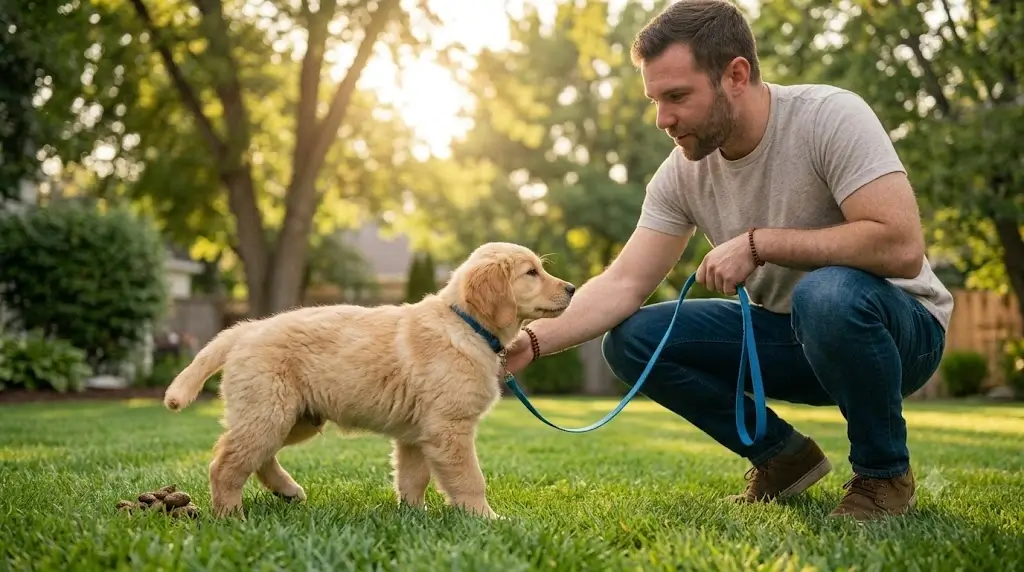
The most valuable information from an accident is what it tells you about your training system. If the indoor mess happened immediately after coming from outside, review our guide on what to do when your puppy holds it until coming inside.
Ask yourself:
- When was the puppy’s last bathroom trip?
- Was the puppy sleeping, eating, drinking or playing?
- Was the puppy supervised?
- Did the puppy have access to a previous accident area?
- Was the puppy given more freedom recently?
One or two small adjustments can sometimes prevent the same situation from repeating.
When Cleaning Is Not Enough
If accidents become unusually frequent or suddenly appear after a period of reliable house training, do not automatically assume that the puppy is simply being stubborn.
Changes in bathroom behavior can sometimes have a medical cause.
- Suddenly increased urination.
- Repeated attempts to urinate.
- Straining or apparent discomfort.
- Blood or another unusual change in urine.
- Markedly increased thirst.
- Lethargy or other signs of illness.
Should You Clean Every Accident Immediately?
When practical, prompt cleanup is preferable because it limits the time liquid remains on the material and makes it easier to identify the full affected area.
If you cannot clean immediately, prioritize removing standing liquid or solid waste safely and complete the appropriate cleaning as soon as practical.
Puppy Accident Cleanup Checklist
- Keep the puppy away from the cleanup area.
- Remove solid waste promptly.
- Blot fresh urine instead of aggressively rubbing.
- Use a surface-compatible pet accident cleaner.
- Follow product directions.
- Allow the area to dry.
- Check for persistent odor.
- Restrict access to repeat accident areas.
- Adjust the puppy’s bathroom schedule.
- Record repeated accident patterns.
Build Better House-Training Habits
Cleaning accidents solves the environmental problem. A structured puppy training program can help address the behavior, routine and supervision side at the same time.
Bottom Line
The right way to clean a puppy accident depends on both what happened and what surface was affected.
Blot fresh urine, remove solid waste carefully, use a cleaner appropriate for the material, avoid chemical combinations and allow the area to dry properly. Carpet, rugs and other porous materials deserve extra attention because liquid can travel below the visible surface.
Most importantly, cleanup should be followed by a training adjustment. If your puppy experiences recurring mistakes despite proper cleanup, review our comprehensive framework on how to prevent repeat puppy accidents to reset your routine.
Frequently Asked Questions
What is the best way to clean up a puppy urine accident?
Blot fresh urine rather than rubbing it, then use a pet-appropriate cleaner compatible with the affected surface. Follow the product directions and allow the area to dry properly.
How do you clean puppy pee from carpet?
Blot as much fresh urine as possible, use a carpet-compatible pet urine cleaner, follow its instructions and allow the carpet to dry. If odor persists, urine may have reached the backing or padding.
How do you get puppy poop out of carpet?
Remove the solid waste carefully without grinding it into the carpet, then clean the remaining area with a product suitable for the carpet. Allow the area to dry and inspect it afterward.
Can cleaning prevent a puppy from peeing in the same spot?
Proper cleaning can reduce residual odor cues, but it does not replace house-training. Combine cleaning with supervision, access control, appropriate bathroom timing and positive reinforcement.
Should I use bleach to clean puppy urine?
Do not mix bleach with other cleaning chemicals, and do not assume it is appropriate for every surface. Follow the product label and the surface manufacturer’s care instructions.
Why can I still smell puppy urine after cleaning?
Urine may have penetrated carpet, padding, rug backing, seams or another porous material. A surface can look clean while residue remains underneath.
