
PUPPY CRATE TRAINING & ACCIDENT TROUBLESHOOTING
Puppy Poops in Crate: Why It Happens and How to Stop It
If your puppy poops in the crate, the first step is to find out why the accident is happening rather than treating it as bad behavior. A puppy may have been confined longer than they could comfortably manage, entered the crate without having a bowel movement, had a meal or activity that triggered the need to go, or simply not be fully house trained yet.
Repeated crate pooping can also happen when the crate setup, daily routine, stress level, or health needs are not appropriate for the puppy. The solution is usually to shorten the interval, improve potty timing, review the crate setup, clean accidents thoroughly, and investigate persistent or sudden changes.
Do not punish your puppy for pooping in the crate. The accident is biological information that can help you adjust your management plan.
Why Does My Puppy Poop in the Crate?
Puppies generally prefer to keep their sleeping area clean, but they do not have complete control over elimination from the moment they come home. Canine instincts discourage eliminating where they sleep, but this instinct can easily be overridden if physical capacity is exceeded or environmental triggers are mismanaged.
Common reasons a puppy poops in the crate include:
- The puppy stayed in the crate too long: Developing internal sphincters cannot retain stool past physical thresholds.
- The puppy did not poop before entering: Exterior sensory distractions prevented a complete bowel evacuation during the pre-crate walk.
- A meal or activity triggered a bowel movement: The natural gastrocolic reflex accelerated colon motility shortly after eating.
- The puppy is still learning reliable house-training habits: The mental connection between the den and outdoor elimination is not yet solidified.
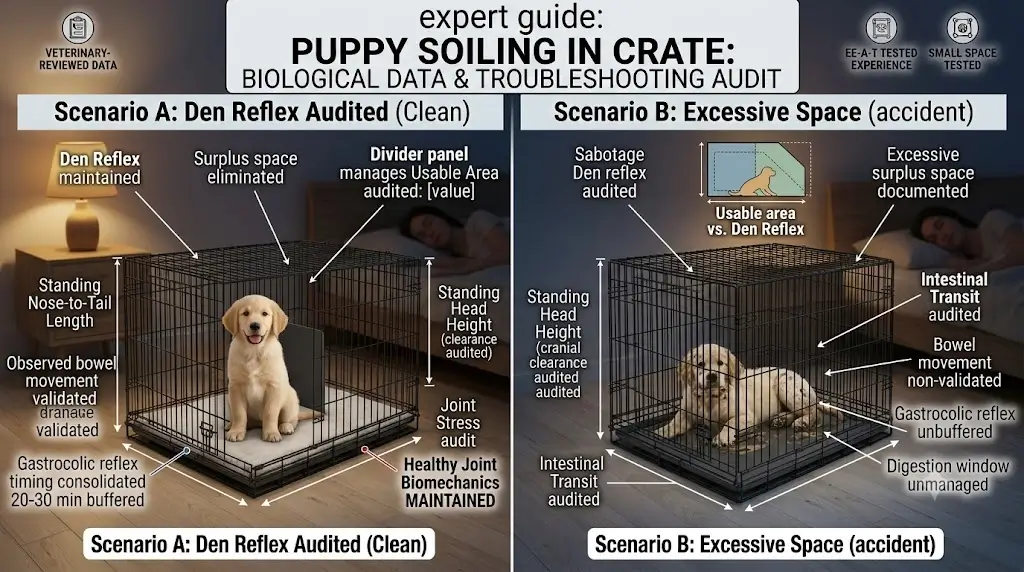
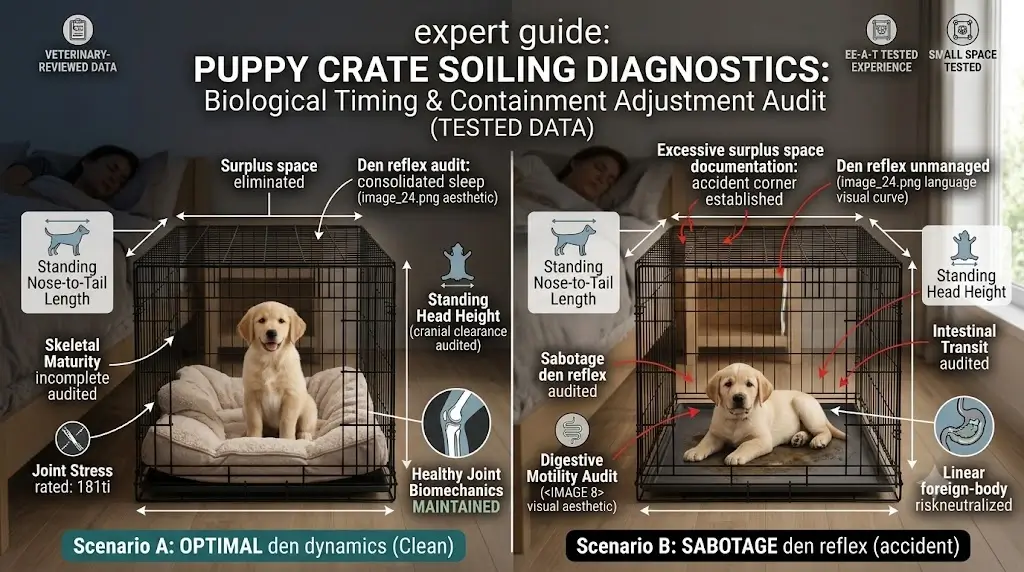
- The crate is too large: Excessive square footage allows the puppy to establish an elimination corner separate from their sleeping area.
- The puppy is stressed or uncomfortable: Acute separation distress stimulates physiological colon spasms.
- Previous accidents were not cleaned thoroughly: Lingering microscopic pheromone traces mark the tray as a legitimate toilet area.
- A digestive or other health problem is present: Parasites, sudden diet shifts, or bacterial overgrowth impair stool consistency and control.
The exact timing and circumstances of the accident provide the most actionable diagnostic clues.
First: Find the Pattern
Before changing the entire routine, determine exactly when and how your puppy poops in the crate. Random adjustments rarely fix systemic housebreaking breakdowns.
Ask these diagnostic questions:
- How long had the puppy been in the crate prior to the accident?
- Did you visually confirm a bowel movement outside immediately before crate entry?
- How recently did the puppy consume a meal, training treats, or a heavy chew?
- Had the puppy engaged in vigorous indoor or outdoor play directly before confinement?
- Did the accident occur in the middle of the day or overnight?
- Does the puppy poop in the crate only when humans leave the house completely?
- Did this behavior begin suddenly after weeks of clean confinement?
- Is the stool fully formed, soft-serve consistency, watery, or coated with mucus?
A puppy that repeatedly defecates after a predictable 3-hour interval simply needs a 2.5-hour potty schedule. A puppy that suddenly develops loose stools and soiled blankets overnight requires immediate dietary and veterinary evaluation.
1. Your Puppy May Be Staying in the Crate Too Long
Time is the primary physical constraint in puppy development.
Puppies possess immature external anal sphincter muscles and small colon capacities. Even when a puppy fully understands that the crate is their den, they cannot stop involuntary peristaltic contractions when stool builds up beyond their physical endurance.
Do not assume that standard daytime bladder guidelines automatically mirror bowel tolerance. Defecation is heavily dictated by digestion rates, hydration, meal composition, and physical movement.
If your puppy consistently soils their bedding toward the final hour of confinement, the crate interval exceeds their biological endurance. Shorten the duration immediately and build duration back up gradually as muscular maturity develops.
2. Your Puppy May Not Have Pooped Before Crating
A quick two-minute trip into the backyard does not guarantee an empty colon. Puppies explore the world through scent, vision, and sound; passing cars, falling leaves, insects, or distant noises easily distract a young dog mid-routine.
A distracted puppy may sniff, urinate quickly, and assume the trip is over, only to remember their bowel urgency 10 minutes after being latched inside the quiet crate.
Pre-crate elimination protocol:
- Take your puppy to their designated outdoor bathroom zone on a 6-foot fixed leash (avoid free roaming).
- Stand stationary and give your verbal cue once in a neutral tone.
- Wait at least 10 to 15 minutes to allow digestive motility to settle.
- If the puppy eliminates, praise calmly and offer a high-value treat within two seconds of completion.
- If the puppy does not poop but is due based on feeding times, keep them tethered to you indoors for 10 minutes, then repeat the outdoor walk before crating.
Do not rush this step. Verifying bowel evacuation before locking the door eliminates 80% of daytime crate accidents.
3. Meals and the Gastrocolic Reflex
Digestion follows distinct physiological rules. When food enters the puppy’s stomach, gastric distension triggers the gastrocolic reflex—a wave of muscular contractions that pushes waste material through the colon into the rectum.
In young puppies, this reflex occurs rapidly, typically within 15 to 45 minutes following a meal. If you feed your puppy breakfast at 7:00 AM and crate them at 7:15 AM without an outdoor break, the gastrocolic surge will peak while they are locked inside.
Keeping daily feeding times strictly consistent makes this reflex predictable. For structured daily scheduling that balances meals, digestion windows, and naps, follow our Puppy Crate Training Schedule.
4. Physical Activity Can Trigger an Elimination Need
Physical exercise stimulates intestinal peristalsis. Running, tumbling, and wrestling accelerate gastrointestinal transit times, shifting fecal matter into the lower bowel.
If you engage in an energetic play session and immediately crate your puppy because they seem tired, their accelerated digestion may trigger sudden bowel urgency while confined.
The post-play wind-down sequence:
- Conclude active play 15 minutes before planned crate time.
- Transition to calm sniffing or passive handling to lower heart rate.
- Walk the puppy directly to the outdoor elimination area.
- Allow adequate time for both urination and defecation.
- Guide the settled puppy into the crate for rest.
5. Your Puppy May Still Be Learning House Training
Housebreaking is a learned cognitive behavior, not an instant instinct. Puppies do not arrive in your home with an innate moral understanding that carpets, floors, and crates are off-limits for bathroom use.
Young puppies frequently make mistakes when household routines shift, when supervision lapses, or when they are given indoor freedom before earning it. The crate should serve as a management tool that prevents indoor wandering while bladder and bowel reflexes mature, not as a replacement for hands-on outdoor conditioning.
Pair crate containment with enthusiastic rewards when elimination occurs in the correct grass substrate outside.
6. Check the Crate Size: The Divider Solution
Physical crate dimensions have a massive impact on hygiene behavior. In the wild, canines avoid soiling their sleeping dens because living in waste increases parasite risks and destroys thermal insulation.
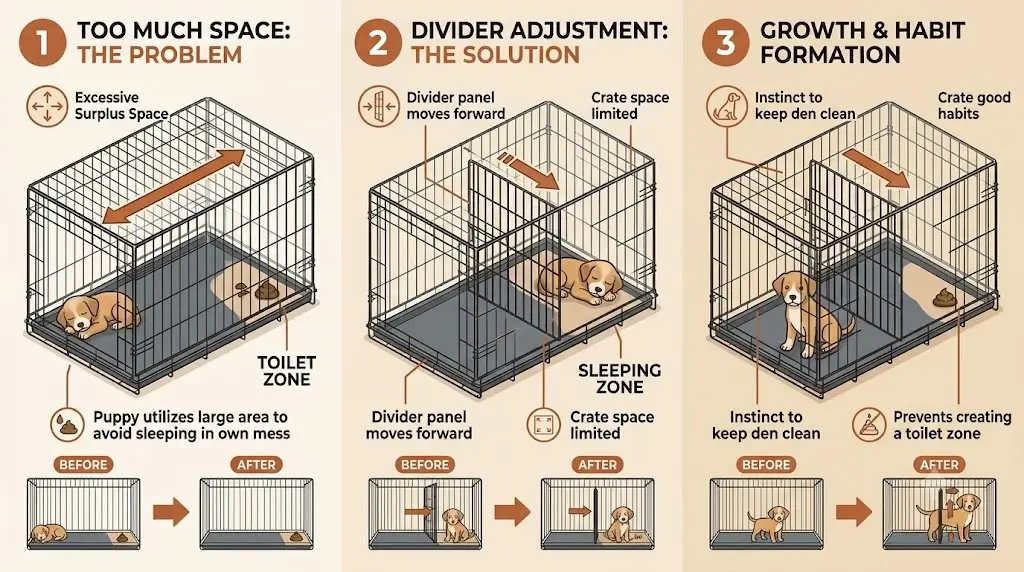
However, if you purchase an adult-sized crate for an 8-week-old puppy without restricting the floor space, the interior is large enough to undermine this natural instinct. The puppy will simply sleep at the front door, walk to the rear corner to poop, and return to the clean front half without discomfort.
Your puppy only requires enough internal space to:
- Stand fully erect without their head pressing into the ceiling wires.
- Turn around 360 degrees without scraping the side panels.
- Sit naturally with proper spinal alignment.
- Lie down flat on their side with all four legs comfortably extended.
If your wire crate provides extra square footage, install an adjustable divider panel to compartmentalize the floor plan. Discover vetted, heavy-duty options in our guide to the Best Puppy Crates With Dividers.
7. Stress and Isolation Distress Cause Involuntary Defecation
Emotional turmoil has an immediate, physical effect on canine gut motility. When a puppy experiences acute confinement distress or separation panic, their sympathetic nervous system floods the bloodstream with adrenaline and cortisol.
This fight-or-flight response speeds up gastrointestinal contractions, often causing sudden, loose, involuntary defecation within minutes of being locked in.
Warning signs of stress-induced crate soiling:
- The accident occurs within 10 to 20 minutes of your departure, even if the puppy pooped beforehand.
- The stool is loose, unformed, or contains stress-induced mucus.
- Feces is smeared across the walls, wire mesh, or door latches due to frantic pacing.
- The puppy shows excessive drooling, destructive bar-biting, or hoarse, panicked barking.
If your puppy exhibits genuine confinement distress, forcing them to remain locked inside will only cement severe crate aversion. Step back to gradual, positive crate conditioning in short intervals with the door open.
8. Inadequate Cleaning Attracts Repeat Accidents
Dogs possess an olfactory system thousands of times more sensitive than humans. Standard household floor soaps, bleach, and ammonia-based cleaners clean surface soil, but they fail to neutralize the microscopic organic proteins and uric acid crystals embedded in plastic or composite pans.
Worse, ammonia chemically mimics compounds found in canine urine and waste, actively signaling to the puppy that the area is an established bathroom zone.
Proper enzymatic cleaning protocol:
- Remove the puppy to a safe, neutral space (such as an exercise pen or secure bathroom).
- Remove all soiled bedding, mats, and toys immediately.
- Scrape out solid matter and rinse the crate pan thoroughly with warm water.
- Saturate the entire plastic tray and lower wire perimeter with an enzymatic pet cleaner.
- Leave the enzymatic formula wet on the surface for 10 to 15 minutes to allow active bacterial enzymes to consume the organic matter.
- Wipe dry with clean paper towels and ensure the crate is completely odorless and dry before adding fresh bedding.
For safe perimeter positioning and floor-protection strategies, consult our step-by-step walkthrough on How to Set Up a Puppy Crate.
What to Do Immediately After Your Puppy Poops in the Crate
Discovering a soiled crate is frustrating, but your immediate reaction dictates whether your puppy learns or regresses.
Remain completely calm and neutral. Never shout, scold, push their nose into the waste, or physically reprimand the puppy. Dogs live strictly in the present; reacting negatively minutes or hours after the accident occurs teaches the puppy that humans are unpredictable and dangerous, but connects zero dots regarding the defecation itself.
Step-by-step accident response:
- Open the crate door quietly without vocal drama or frantic energy.
- Leash the puppy and take them directly outside to their designated potty spot (they may still need to finish voiding their bowels).
- Praise calmly if they produce any remaining stool outside.
- Bathe or gently clean the puppy’s paws and coat using warm water and dog-safe shampoo.
- Place the puppy in a secure playpen while you thoroughly execute the enzymatic crate cleaning protocol.
- Log the accident time, feeding history, and stool condition in your tracking notes to adjust tomorrow’s schedule.
How to Stop a Puppy From Pooping in the Crate
Work systematically through these operational variables:
| Factor | Diagnostic Check | Corrective Action |
|---|---|---|
| Confinement Duration | Does the puppy poop near the end of the session? | Shorten the crate interval by 45–60 minutes immediately. |
| Pre-Crate Potty Window | Did the puppy actually defecate outside beforehand? | Keep puppy outdoors on leash for 15 minutes to ensure full evacuation. |
| Meal Timing | Does the accident occur 20–40 minutes after eating? | Wait for post-meal bowel movement before locking the crate door. |
| Physical Exertion | Did the puppy just finish heavy play or running? | Allow a 15-minute cool down paired with a mandatory outdoor break. |
| Crate Volume | Can the puppy poop in one corner and sleep in another? | Adjust the divider panel forward to eliminate spare floor area. |
| Confinement Anxiety | Does the puppy vocalize frantically and smear stool? | Reset crate conditioning with open-door reward games. |
| Residual Odor | Does the crate smell faintly of old accidents? | Deep-clean with an enzymatic bio-enzymatic cleaner. |
| Digestive Health | Is the stool liquid, watery, or filled with mucus? | Collect a fecal sample and consult your veterinarian. |
Why Does My Puppy Poop in the Crate at Night?
Nighttime crate defecation is rarely random. It almost always stems from evening meal timing or an unevacuated bowel before lights out.
A puppy fed dinner at 8:00 PM and crated at 10:00 PM will experience a peak digestive surge right around 1:00 AM or 2:00 AM. If the owner sleeps through the initial restless whimpering, the puppy will eventually have no choice but to eliminate in the crate.
Nighttime prevention framework:
- Schedule dinner earlier in the evening (ideally between 5:00 PM and 6:00 PM) to allow full gastrointestinal transit before bedtime.
- Provide an active post-dinner outdoor walk followed by an intentional pre-bedtime relief break right at lights-out.
- For puppies under 12 weeks of age, set an alarm for a proactive 2:30 AM relief trip rather than waiting for distress crying.
- Keep midnight breaks completely boring: no lights, no excited baby talk, on leash only, and straight back into the crate once done.
What If My Puppy Poops in the Crate but Does Not Pee?
This specific pattern provides valuable diagnostic clarity.
Urination is governed by renal fluid processing and bladder elasticity, whereas defecation is governed by gastrointestinal motility, solid food transit, and peristaltic triggers. When a puppy remains completely dry but consistently defecates, the root cause is almost never general housebreaking confusion.
Instead, look directly at:
- Dietary fiber and transit velocity: Certain kibble formulas pass through the digestive tract faster than others.
- Treat intake: High-fat treats, rawhides, or bully sticks consumed during the day can cause sudden colon spasms.
- Feeding schedules: The spacing between breakfast, lunch, and dinner may need to be adjusted to shift bowel movements into daytime hours.
Track your puppy’s exact feeding-to-defecation intervals for 72 hours. You will quickly identify the precise digestion window unique to your dog’s metabolism.
What If My Puppy Poops Immediately After Leaving the Crate?
If your puppy holds their stool successfully inside the crate but drops feces on the living room floor within two minutes of the door opening, the problem is **transit transition**.
During sleep, a puppy’s metabolism and bowel contractions slow down. The moment the crate door opens, physical movement, postural changes, and excitement stimulate the bowels instantly. If allowed to walk freely through the home, the full rectum empties on the first available rug.
The fix: Make the outdoor potty spot the non-negotiable first stop. Pick up young puppies directly from the crate and carry them outside in your arms. Do not let their paws touch indoor flooring until their bowels have emptied outside.
Should You Put a Puppy Pad Inside the Crate?
Under normal house-training circumstances, absolutely not.
Placing absorbent pee pads inside a sleeping crate sends fundamentally confusing behavioral signals. It tells the puppy that eliminating within their enclosed sleeping den is acceptable, which systematically breaks down their natural instinct to keep their bed clean. Once a puppy loses their den aversion, crate training becomes exponentially more difficult.
Furthermore, teething puppies routinely shred pee pads, presenting severe gastrointestinal foreign-body obstruction risks from ingested plastic linings and super-absorbent polymer gel.
If your puppy cannot physically hold their bowels for the required duration, the correct solution is shortening confinement intervals or transitioning to an attached exercise pen setup—never lining the crate floor with pads.
Should You Remove Bedding After an Accident?
Yes. When a puppy has soiled soft bedding, wash it immediately with hot water and enzymatic laundry additive.
If your puppy repeatedly soils soft blankets, fleece mats, or orthopedic cushions, strip the crate down to the bare composite pan temporarily. Soft textiles mimic natural outdoor elimination substrates (like grass and soil) because they absorb moisture and bury waste away from the dog’s paws. Sleeping on the smooth plastic pan makes the consequence of soiling immediately noticeable, strengthening their resolve to hold it until let outside.
Once the puppy demonstrates clean crate hygiene for 10 to 14 consecutive days, you can safely reintroduce a flat, chew-resistant orthopedic mat.
The 48-Hour Crate Accident Reset Plan
If your puppy has fallen into a chronic habit of crate pooping, interrupt the cycle immediately with this structured 48-hour protocol:
- Calibrate internal square footage: Set the divider panel so the puppy has room to stand, turn, and lie down comfortably—and not an inch more.
- Strip the interior: Remove all plush blankets, loose towels, and soft bedding. Use the bare, sanitized plastic pan.
- Implement strict 2-hour daytime caps: Do not allow any daytime confinement block to exceed 120 minutes without an outdoor potty break.
- Enforce the “Two-Outing Rule”: Walk the puppy outside 20 minutes after meals. If they do not poop, bring them inside on leash for 10 minutes, then take them straight back out. Only crate them once a bowel movement is confirmed.
- Run an enzymatic reset: Wash the entire pan and wire frame down with commercial enzymatic cleaner to obliterate all historical scent markers.
Keep a Puppy Elimination and Crate Log
Patterns become obvious when documented on paper. Keep a simple log near the crate for 5 to 7 days:
| Time | Event (Meal / Walk / Crate) | Outdoor Elimination? | Accident in Crate? | Stool Quality |
|---|---|---|---|---|
| 7:00 AM | Breakfast (1 cup kibble) | — | — | — |
| 7:25 AM | Outdoor leash walk | Pee + Firm Poop | No | Firm, normal |
| 8:00 AM | Crate entry (nap) | — | — | — |
| 10:00 AM | Crate release & walk | Pee only | No | — |
| 12:30 PM | Lunch | — | — | — |
| 1:00 PM | Crate entry (work call) | — | Yes (1:45 PM) | Soft, unformed |
Reviewing this log reveals whether accidents correlate with specific feeding times, inadequate outdoor windows, or shifting stool consistency.
When Should You Call the Veterinarian?
Crate soiling is not always a behavioral or scheduling error. Gastrointestinal disorders, internal parasites, and bacterial infections can render bowel control physiologically impossible.
Contact your veterinarian immediately if you observe:
- Stool that is watery, gelatinous, or projectile (acute diarrhea).
- Visible blood (bright red streaks or dark, tarry black stool).
- Stool containing visible worms or white rice-like segments.
- Crate accidents accompanied by repeated vomiting, fever, or lethargy.
- A sudden, uncharacteristic loss of bowel control in a previously reliable puppy.
- Pain, straining without stool production, or abdominal distension.
Never attempt to solve medical diarrhea with behavioral confinement strategies. Bring a fresh fecal sample to your veterinary clinic for diagnostic screening.
Frequently Asked Questions
Why does my puppy poop in the crate?
The most frequent causes are excessive confinement duration, lack of pre-crate elimination, post-meal gastrocolic reflexes, excessive crate floor space, separation distress, or intestinal parasites.
Is it normal for an 8-week-old puppy to poop in their crate?
Occasional accidents during the first week home are common as puppies adjust to new routines and diets. However, daily accidents indicate that confinement periods are too long or pre-crate bathroom breaks are being rushed.
How do I stop my puppy from pooping in the crate at night?
Feed dinner at least 3 to 4 hours before bedtime, ensure a verified bowel movement occurs right before crating, and set a proactive midnight alarm for puppies under 12 weeks of age.
Should I discipline my puppy if I catch them pooping in the crate?
No. Harsh reprimands instill fear, causing puppies to hide their waste or ingest stool to conceal evidence. Simply interrupt with a neutral noise, carry them outside to finish, and clean the crate without anger.
Why does my puppy eat their poop in the crate?
Coprophagia (stool eating) in crates often occurs when puppies attempt to clean their sleeping area after an accident, or due to dietary nutrient deficiencies. Clean accidents immediately and consult your vet regarding dietary enzyme supplements.
Can stress or separation anxiety make a puppy poop in the crate?
Yes. Acute emotional distress triggers autonomic nervous system surges, accelerating colon motility and resulting in urgent, loose defecation within minutes of an owner’s departure.
Bottom Line: Fix the Routine Before Blaming the Puppy
When a puppy poops in the crate, the proper response is diagnostic troubleshooting—not frustration or punishment.
Verify that your puppy fully empties their bowels before entering the crate, align your schedule with their natural post-meal digestion windows, restrict surplus floor space using an adjustable wire divider, and thoroughly eliminate biological scent markers with an enzymatic cleaner. By meeting your puppy’s physical and developmental needs first, clean den habits will follow naturally.
