
AKC & VCA OCCUPATIONAL PROTOCOLS 2026
Puppy Bathroom Schedule for Working Owners
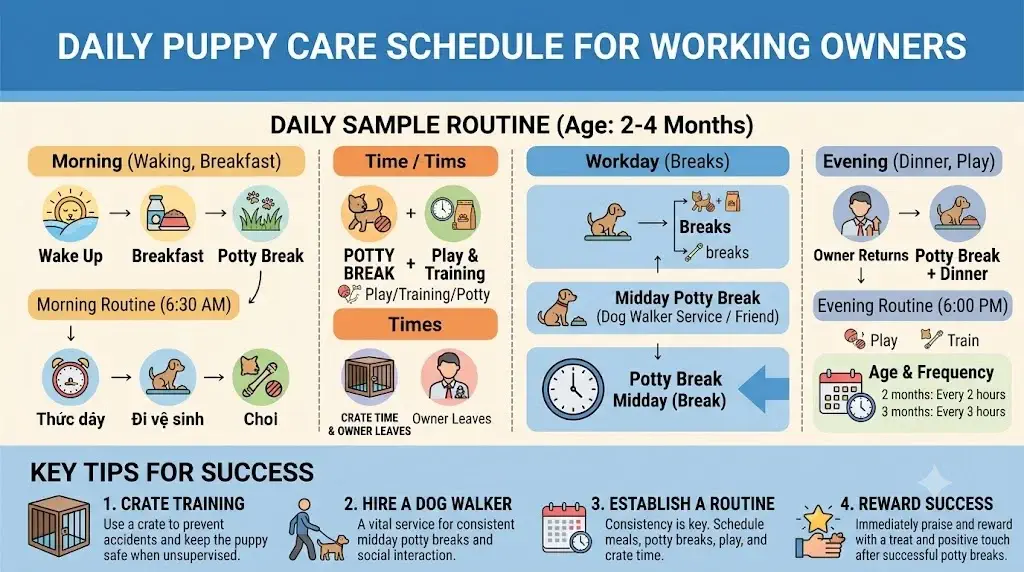
A realistic puppy bathroom schedule for working owners bridges biological bladder capacity limits with rigid eight-hour professional employment demands. While adult canines comfortably retain urine during an average workday, infant puppies lack voluntary neuromuscular sphincter retention and mature pituitary fluid concentration. Structuring an effective puppy bathroom schedule for working owners requires coordinating early morning double-voiding routines, scheduled midday human interventions, hybrid exercise-pen architectures, and immediate post-commute relief trips to prevent crate soiling regressions.
The short answer
A puppy bathroom schedule for working owners must be calibrated to the puppy’s chronological age and physical holding limits rather than an unyielding eight-hour professional workday. Pups under 16 weeks cannot physically hold urine across a full workday without distress.
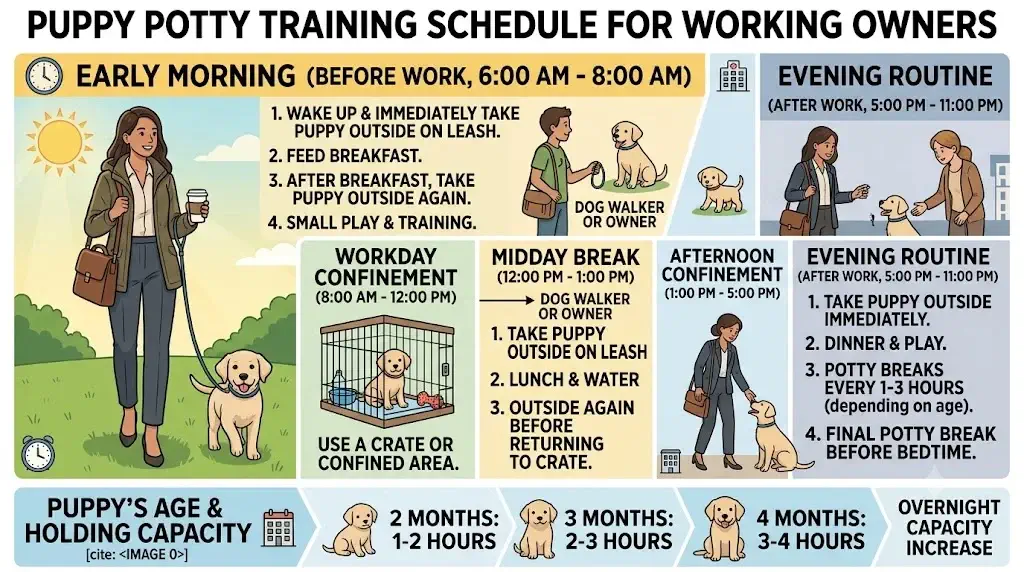
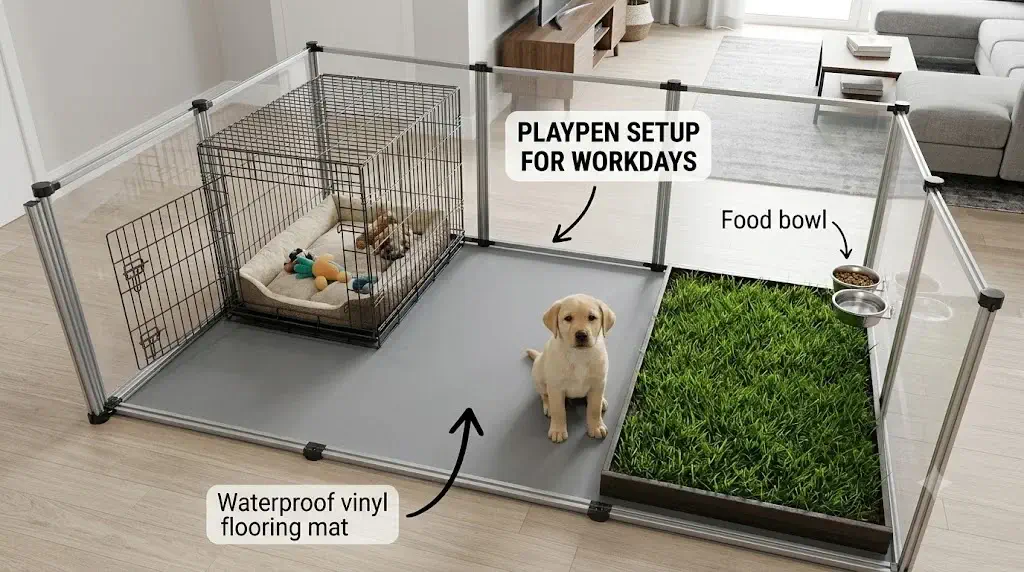
For full-time 9-to-5 employees, the most dependable operational framework is: 6:00 AM wake-up potty → breakfast → 7:15 AM post-meal potty → 7:45 AM pre-departure potty → 11:30 AM to 1:00 PM professional dog walker or neighbor break → 5:00 PM immediate return potty → dinner → evening play breaks → 10:30 PM bedtime potty. When midday human support is unavailable, confine the puppy to a secure playpen featuring a separate real-grass turf box to protect natural substrate cleanliness preferences.
Quick Reference Specification: Workday Canine Elimination Matrix
This calibrated physiological matrix benchmarks workday time windows, biological digestive mechanisms, tactical interventions, maximum safe unattended dwells, and veterinary confinement standards for working households in 2026.
| Workday Phase / Time Window | Physiological Mechanism | Tactical Working-Owner Intervention | Max Safe Unattended Dwell | Safety Benchmark |
|---|---|---|---|---|
| Morning Departure (6:00–7:45 AM) | Gastrocolic reflex & secondary bladder accumulation | Double-void protocol: post-wake potty + pre-departure potty | 45 minutes post-feeding | AKC Pediatric Digestive Protocol |
| Midday Block (11:00 AM–1:00 PM) | High glomerular filtration & detrusor fullness | Midday dog walker, pet sitter, or owner lunch visit | 3–4 hours maximum crate rest | VCA Professional Care Standard |
| Evening Return (5:00–7:00 PM) | Arousal-induced detrusor relaxation upon arrival | Immediate outdoor transit within 60s; skip indoor delays | 0 minutes (Immediate upon arrival) | AAHA Juvenile Retention Guideline |
| Extended Absence Setup | Involuntary sphincter fatigue beyond physical limits | Long-term playpen setup: open crate + real-grass balcony box | Pen confinement over 4 hours | Fear Free Confinement Matrix |
Why a Normal Workday Does Not Fit a Young Puppy
Standard corporate business hours inevitably exceed the physiological holding capacity of pediatric canine kidneys and urethral sphincters. An eight-to-ten-hour office absence forces an infant puppy past their anatomical limits, breaking innate den cleanliness instincts and compelling them to soil sleeping bedding.
Puppies need frequent elimination opportunities, particularly after waking, eating, drinking, playing, and sleeping. AKC recommends regular potty breaks every two to four hours for puppies, plus additional breaks after activity changes, while other AKC guidance notes that very young puppies may require substantially more frequent opportunities. AKC’s puppy routine guidance emphasizes adjusting the schedule to the individual puppy.
VCA provides an even more conservative framework for young puppies: frequent breaks during waking hours, additional trips after meals and large drinks, immediate trips after naps, and very frequent opportunities during high-energy play. VCA’s house-training guidance also advises arranging a potty break when a puppy will be alone for more than about three hours.
The key workday principle
Your work schedule is an external constraint; it is not the puppy’s biological schedule. When corporate hours conflict with juvenile bladder physiology, integrate human support rather than expecting an infant animal to hold urine unnaturally.
For foundational hourly timelines, review our complete guide on the Puppy House Training Schedule.
Workday Potty Frequency by Puppy Age
Chronological age dictates anatomical bladder volume and the frequency of necessary workday relief visits. While age establishes baseline holding limits, variables like adult breed size, morning activity, and hydration dictate individual endurance:
| Puppy Age | Typical Workday Challenge | What the Owner Must Plan For | Tactical Workday Strategy |
|---|---|---|---|
| 8–10 weeks | Cannot hold past 3 hours; high pan-soiling risk. | Multiple daytime potty visits required. | Never leave alone for a full day; arrange 2 visits or use an exercise pen. |
| 10–12 weeks | Holding limit expands to 3.5–4 hours. | Pre-work, midday, and late-afternoon relief breaks. | A midday walker or pet sitter is essential for a standard 8-hour shift. |
| 3–4 months | Can hold 4–5 hours during sedentary crate rest. | One dedicated midday break plus active trigger trips. | Schedule a single 30-minute midday dog walker visit around 12:30 PM. |
| 4–6 months | Reliability improves, holding 5–6 hours resting. | Scheduled midday break; continued visual supervision. | A single midday break suffices for most pups before full workday holding. |
| 6+ months | Adult physiological holding capability solidifies. | Standard adult routine; immediate return relief break. | Can manage full work shifts if morning and evening exercise are consistent. |
VCA’s pediatric training guidance confirms age-based elimination intervals expand progressively, while emphasizing that young puppies require supplemental trips around meals and active stimulation. Compare developmental benchmarks in our detailed guide on How Often Should You Take a Puppy Outside?
Do not turn a bladder guideline into a target.
A theoretical holding calculation reflects maximum sedentary bladder capacity, not a recommended housebreaking schedule. Effective house training requires creating outdoor opportunities before a puppy reaches physical urgency.
A Realistic 9-to-5 Puppy Bathroom Schedule
A coordinated workday timetable synchronizes canine digestive transit with standard professional employment hours. This routine assumes departure at 7:45 AM and return at 5:00 PM, providing adequate margins for clean house training:
6:00–6:15 a.m. — First potty trip Essential
Take the puppy directly to the designated relief area immediately upon waking. Do this before making coffee, checking email, or beginning morning chores.
6:15–6:45 a.m. — Breakfast and supervised interaction
Serve breakfast kibble on a consistent schedule. Keep the puppy under direct supervision on an umbilical leash or inside a puppy-proofed zone.
6:45–7:15 a.m. — Post-breakfast potty
Escort the puppy outside 20 minutes post-bowl to capture the gastrocolic reflex that stimulates lower intestinal evacuation.
7:30–7:45 a.m. — Final pre-work potty Essential
Conduct a final outdoor break immediately before crating. Confirm secondary urine elimination to ensure clean resting hours.
10:30–11:30 a.m. — Mid-morning visit Helper
For puppies under 10 weeks, arrange a pet sitter or neighbor to provide a quick outdoor relief break and refresh water.
1:00–1:45 p.m. — Midday potty & exercise break Essential
A professional dog walker or returning owner conducts an outdoor potty break, light walk, and lunch feeding if required.
5:00 p.m. — Immediate return potty trip Essential
The moment you step through the front door, walk your puppy straight to outdoor grass. Skip unpacking, mail sorting, or kitchen prep.
6:00–7:00 p.m. — Dinner kibble and post-meal potty
Feed evening meal; provide an outdoor potty trip 20 minutes afterward to capture evening bowel movements.
8:00–9:30 p.m. — Post-play potty & wind-down
Interrupt evening play sessions for outdoor relief; remove open water bowl two hours prior to bedtime.
10:30 p.m. — Final bedtime potty Essential
Conduct a final calm on-leash break on grass; praise quietly at ground level; latch bedroom crate door.
The schedule adapts as the puppy matures
An eight-week-old puppy requires multiple daytime visits during an eight-hour shift. A four-month-old pup can comfortably manage with a single midday dog walker visit. The right schedule maintains clean habits without overextending physical holding capacity.
What Should a Working Owner Do With an 8- to 12-Week-Old Puppy?
Early puppyhood requires supplemental daytime human support to maintain clean housebreaking habits. At eight to twelve weeks of age, physical holding capacity rarely exceeds two to three hours while awake, making an uninterrupted workday impossible without intervention.
VCA recommends taking a puppy outside every two hours at 6–8 weeks, with additional nighttime and activity-related needs. AKC likewise emphasizes that very young puppies may need numerous potty trips each day. VCA’s puppy potty-training guidance provides the two-hour starting point for this early age.
Option 1: Staggered Family Shifts
Family members stagger departure and arrival times (e.g., one departs at 7:00 AM, another leaves at 9:00 AM) to compress unattended intervals.
Option 2: Professional Drop-In Sitter
A vetted pet sitter conducts two 20-minute drop-in visits daily (10:30 AM and 1:30 PM) for outdoor potty breaks and water refills.
Option 3: Midday Dog Walker
A professional dog walker provides a 30-minute individual leash walk and grass elimination break once the puppy reaches 10 to 12 weeks of age.
Option 4: Long-Term Playpen Setup
When daytime human visits cannot be scheduled, confine the pup to an exercise pen containing an open crate and a real-grass balcony box.
Puppy Bathroom Schedule for Work-From-Home Owners
Remote employment eliminates commuting delays but introduces meeting distraction risks that lead to missed potty windows. Deep concentration, video conference calls, and tight deadlines often cause owners to overlook subtle pre-elimination pacing cues.
Anchor outdoor breaks to recurring workday milestones rather than relying on casual memory:
- Escort the puppy outside immediately upon waking at 6:30 AM.
- Provide a post-breakfast potty break at 7:15 AM before opening your laptop.
- Set calendar alarms for structured outdoor trips every 90 minutes while the puppy is awake.
- Take the puppy outside immediately whenever they wake from a daytime crate nap.
- Provide an outdoor relief break directly following lunch at 12:30 PM.
- Schedule a verified elimination trip right before entering an un-interruptible video conference.
- Enforce umbilical leash tethering to your desk to prevent unsupervised wandering into adjacent rooms.
Use a work calendar alarm, not memory
A puppy housebreaking routine is repetitive by nature. Scheduling recurring potty breaks directly into your professional work calendar ensures meetings do not silently push intervals past holding thresholds.
When Should a Working Owner Hire a Dog Walker or Pet Sitter?
Recurring workday crate accidents provide immediate empirical evidence that human assistance is required. The relevant question is not whether a puppy can endure being left alone, but whether they can remain accident-free and comfortable without breaking den preservation instincts.
Arrange a Midday Visit When:
- The puppy is under 16 weeks old and unattended for over 4 hours.
- Your commute extends total absence past physical holding limits.
- Urine or stool accidents appear in the crate pan upon your return.
- The puppy awakens from midday naps in distress.
Reassess Holding Intervals When:
- The puppy remains completely dry across 14 consecutive workdays.
- Outdoor elimination occurs immediately upon your return.
- The puppy rests calmly in their crate without vocalizing.
- Age exceeds 5 to 6 months with established bladder capacity.
VCA specifically recommends arranging a friend or professional pet sitter when puppies are left alone beyond their realistic holding interval, and suggests an appropriate confinement setup when outdoor access cannot be provided.
How Crate Time Fits Into a Working Owner’s Schedule
Crate confinement utilizes innate den instincts to discourage soiling while developing bladder retention. A crate serves as an essential training tool, provided it is sized correctly for your puppy’s physical frame and not used to force holding beyond realistic limits.
Adjust the interior wire divider so the puppy has room only to stand up, turn around, and lie down comfortably. If the crate is excessively large, a puppy may eliminate in one end and sleep clean in the other. VCA notes that puppies left alone for short periods can be crated safely, but longer absences demand a planned potty visit or an expanded exercise pen containing an appropriate toileting surface.
Do not solve a scheduling problem by extending confinement indefinitely
If your workday exceeds your puppy’s realistic physical holding interval, the proper solution is daytime human support or a partitioned exercise pen—never extended crate confinement that forces pan soiling.
Puppy Bathroom Schedule for Apartment-Dwelling Workers
Vertical residential transit introduces travel delays that must be factored into morning departure schedules. Navigating carpeted corridors, elevators, and locked lobby doors consumes valuable holding minutes during peak urgency.
Build transit delay into the morning schedule
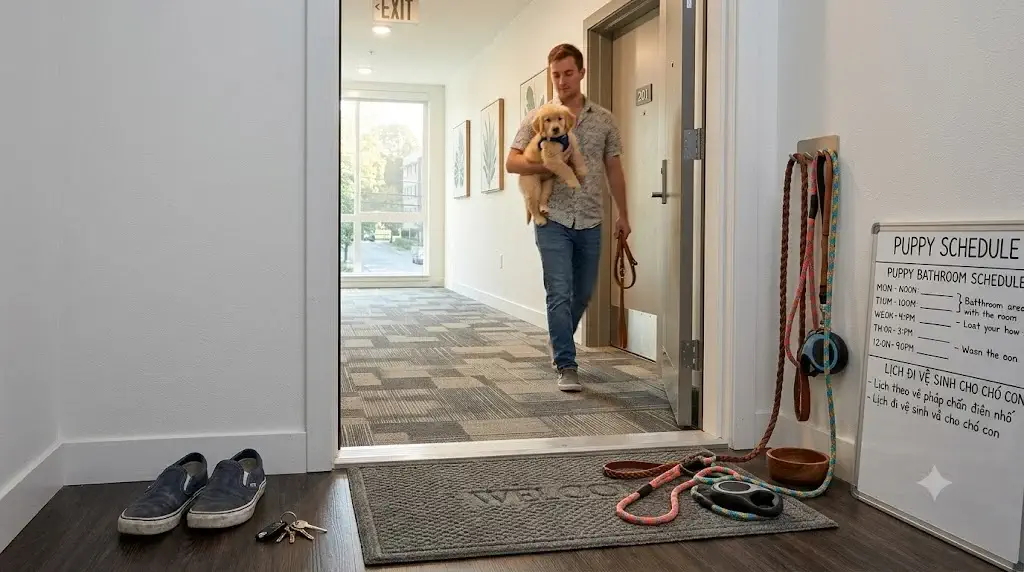
If your puppy awakens with significant urgency at 6:30 AM, beginning your exit at 6:35 AM often results in an elevator accident. Stage slip-on shoes, coat, leash, and treats directly beside your front door. Physically carry young puppies through hallways and down elevators to suppress the squatting reflex until reaching outdoor grass.
AKC emphasizes tracking food, water, activity, and elimination patterns when potty training in dense urban settings. For high-rise apartments, a real-grass balcony box offers an effective intermediate solution that reinforces natural turf preferences without hallway accidents.
What If Your Commute Makes the Workday Much Longer?
Total unattended duration must be calculated from departure to arrival rather than employer shift hours. An eight-hour workday with a 45-minute commute each way creates a 9.5-hour absence that exceeds the holding capacity of any puppy under six months old.
Actual Absence Formula
True Unattended Time = Door-Latching Departure → Traffic/Transit → Shift Hours → Commute → Door-Unlatching Return
If your true unattended duration exceeds your puppy’s age-appropriate holding window, arrange professional dog walking support or transition to an exercise pen arrangement.
Should You Feed a Puppy Before Leaving for Work?
Morning meals must be scheduled at least 60 to 75 minutes prior to departure to ensure complete bowel evacuation. Feeding kibble at 7:30 AM and crating the puppy at 7:45 AM traps undigested food in the stomach, triggering colonic contractions shortly after you leave.
AKC recommends maintaining consistent meal hours to establish predictable elimination patterns. Feed breakfast at 6:15 AM, supervise quiet digestion, provide a post-meal outdoor trip at 6:45 AM, and conduct a final urine break at 7:40 AM right before departure. This sequence ensures your puppy leaves with empty bowels and an empty bladder.
What About Water While You’re at Work?
Continuous hydration access must be managed sensibly without causing dangerous fluid deprivation. Completely withholding water to prevent crate accidents creates medical risks of dehydration, especially in warm weather.
Provide unrestricted water access with breakfast, and offer a moderate drink following the 6:45 AM outdoor trip. When confining a puppy to a crate during a 3-to-4-hour morning block, a crate-mounted drip water bottle prevents water bowl tipping while maintaining safe hydration. If using an exercise pen setup, fresh water should remain accessible at all times.
How To Keep Weekends From Breaking the Workday Routine
Consistent weekend scheduling anchors maintain circadian digestive rhythms and prevent Monday housebreaking regressions. While weekend waking times can shift slightly, core biological anchors must remain stable:
- Maintain consistent breakfast and dinner feeding hours. Large shifts in meal timing destabilize gastrointestinal transit, causing unpredictable elimination windows.
- Execute immediate post-waking outdoor trips. Escort the puppy straight to grass upon waking rather than allowing unsupervised indoor exploration.
- Continue post-nap and post-play outdoor trips. Biological triggers operate identically on Saturday and Sunday; intercept every activity shift.
- Never use weekends to test maximum holding endurance. Do not force a puppy to hold urine until an accident occurs simply because your personal schedule is relaxed.
- Practice structured daytime crate rest sessions. Providing two-hour crated nap intervals on weekends preserves weekday independence and prevents separation distress.
What to Do When Your Puppy Has an Accident While You’re at Work
Workday crate accidents indicate that the interval between relief visits exceeded physical holding capacity. Scolding or punishing a puppy upon arriving home is completely ineffective; dogs associate discipline only with actions performed within seconds.
Follow this systematic recovery protocol:
- Escort the puppy outside immediately without expressing frustration or anger.
- Clean the soiled crate pan using a certified bio-enzymatic cleaner to eliminate uric acid crystals.
- Remove soiled fabric bedding temporarily; use a bare plastic pan or non-absorbent mat.
- Log the accident timestamp and note whether it was urine, stool, or both.
- Adjust your daytime support: schedule your midday dog walker 45 minutes earlier.
For proven behavioral protocols to eliminate repeat indoor accidents, review our guide on How to Prevent Repeat Puppy Accidents.
The Working Owner’s “Minimum Viable” Potty System
A streamlined management system prioritizes four non-negotiable anchors to protect training progress during busy weeks. If your professional schedule is demanding, focus on these essential routines:
1. Morning Double-Void
Potty immediately at 6:00 AM, feed breakfast, and conduct a second outdoor break at 7:30 AM before departure.
2. Midday Human Break
Arrange a dog walker or neighbor between 11:30 AM and 1:30 PM. Never leave a young pup unassisted for 8 hours.
3. Immediate Arrival Transit
Walk straight to the grass within 60 seconds of returning home. Postpone personal tasks until after relief.
4. Final Bedtime Potty
Provide a calm outdoor trip at 10:30 PM, reward quietly on grass, and latch the bedroom crate door.
How to Know When You Can Reduce Daytime Potty Breaks
Consistent clean crate performance over multiple weeks determines when daytime visits can be phased out. Never remove a midday break solely because a puppy crossed a calendar milestone; evaluate these behavioral benchmarks:
- The puppy remains completely dry across 20 consecutive workdays.
- The puppy eliminates promptly upon reaching outdoor grass on the midday visit.
- The puppy demonstrates calm settling in the crate without pacing or vocalizing.
- Overnight sleep is consistently 7 to 8 hours uninterrupted without accidents.
- The puppy is at least 5 to 6 months old with mature adult bladder capacity.
When a Workday Potty Problem May Be a Health Problem
Sudden urinary frequency changes accompanied by physical distress indicate clinical urological disease. Not all housebreaking setbacks stem from scheduling or management gaps.
AKC notes that lack of progress in house training can sometimes be associated with medical problems like urinary tract infections, and recommends veterinary evaluation when progress stalls. Contact your veterinarian promptly if you observe any of the following clinical signs:
Clinical Warning Signs
Consult your veterinarian immediately if you observe straining with only tiny droplets produced, vocal crying during urination, cloudy or bloody urine, sudden excessive water consumption (polydipsia), persistent diarrhea, or involuntary urine leaking while asleep in the crate.
Frequently Asked Questions
How do working owners potty train a puppy?
Working owners succeed by structuring routines around the puppy’s physical holding capacity rather than the workday: implementing a double-voiding morning routine, scheduling a midday dog walker or pet sitter, escorting the puppy outside immediately upon returning, and maintaining crate training.
Can I leave my puppy home alone for 8 hours while I work?
No. An eight-hour absence exceeds the physiological bladder capacity of any puppy under six months old. Leaving a young puppy unassisted for eight hours forces crate pan soiling, breaking natural den cleanliness instincts.
How often should a 10-week-old puppy go out if I work full time?
A 10-week-old puppy requires outdoor opportunities every 3 to 4 hours during quiet crate rest. Full-time workers need at least one, and ideally two, daytime visits from a pet sitter or neighbor to prevent crate soiling.
How often should a 3-month-old puppy go outside while I am at work?
A three-month-old (12-week) puppy can typically hold their bladder for 4 hours during quiet crate rest. A single dedicated 30-minute midday dog walker visit scheduled around 12:30 PM accommodates a standard 9-to-5 workday.
Should I hire a dog walker for my puppy?
Yes. A trusted professional dog walker or pet sitter provides essential midday elimination breaks and mental stimulation, protecting your puppy’s housebreaking progress during long work shifts.
Can I crate my puppy while I work?
Yes, provided the crate is sized properly and the duration does not exceed your puppy’s physical holding capacity. If your absence exceeds safe limits and human visits cannot be scheduled, an exercise pen with a real-grass box is preferable.
What should I do if my puppy has an accident while I am at work?
Avoid scolding or punishment. Escort the puppy straight outside, clean the crate pan with a bio-enzymatic cleaner, and advance your daytime walker visit 45 minutes earlier to reset the routine.
Does working from home make potty training easier?
While eliminating commuting delays helps, remote workers must guard against meeting distractions. Use calendar alarms and direct desk tethering to ensure you do not miss biological potty triggers.
The Bottom Line for Working Puppy Owners
A successful puppy bathroom schedule for working owners coordinates juvenile biological limits with employment realities.
The primary mistake is expecting a young puppy to adapt to an uninterrupted eight-hour absence. Establish a solid morning double-void routine, integrate midday human support or an exercise pen setup, escort your puppy outside immediately upon return, and keep bedroom crate habits consistent. With thoughtful planning, working owners can raise clean, confident, and reliable dogs without compromising their careers.
Editorial references
- American Kennel Club — Setting Schedules and Developing a Routine for Your New Puppy
- American Kennel Club — Puppy Potty Training Timeline and Tips
- American Kennel Club — How to Potty Train a Puppy
- VCA Animal Hospitals — House Training for Puppies and Dogs
- VCA Animal Hospitals — How to Potty Train Your Puppy
This article provides general educational information and does not replace individualized veterinary advice.
