

How to House Train a Rescue Dog: A Step-by-Step Guide for Adult and Newly Adopted Dogs
House training a rescue dog starts with management, a predictable bathroom routine, close supervision, and immediate reinforcement for eliminating in the correct place. A rescue dog may already be house trained, partially trained, unfamiliar with the new home’s routine, or accustomed to eliminating on a different surface. The fastest path forward is to treat the first days as a learning and observation period rather than assuming the dog understands your household rules.
The key is to make the correct bathroom behavior easy to repeat. Take the dog out at predictable times, use the same appropriate bathroom area when practical, watch for individual elimination signals, reward successful outdoor potty trips immediately, and respond to accidents without punishment.
Treat a newly adopted rescue dog as if they are starting house training from the beginning. Establish a consistent potty schedule, supervise closely indoors, take the dog outside before predictable accident times, reward outdoor elimination immediately, and gradually increase freedom as the dog demonstrates reliability.
 Take your newly adopted rescue dog directly to the designated outdoor potty spot upon arrival.
Why House Training a Rescue Dog Can Be Different
Rescue dogs are not necessarily difficult to house train. The main challenge is that you may not know their previous bathroom habits, schedule, living environment, or learned associations. Even if you already understand the fundamentals of how to house train a puppy, an adopted adult dog brings unique background factors into play.
A dog that was reliably house trained in a previous home can still have accidents after adoption. Moving into a new environment changes the dog’s routine, smells, access to doors, bathroom locations, feeding schedule, and level of supervision.
Some rescue dogs may also have learned to eliminate on surfaces such as concrete, gravel, grass, pee pads, newspaper, or other indoor materials. A dog can therefore understand the concept of eliminating in an appropriate location without immediately understanding which location you expect.
A rescue dog having accidents in a new home does not automatically mean the dog was never house trained.
How Long Does It Take to House Train a Rescue Dog?
There is no reliable universal timeline. Some rescue dogs adapt to a new bathroom routine within days, while others need several weeks of consistent management and reinforcement.
The timeline depends on factors such as age, previous housing conditions, established habits, access to outdoor space, daily schedule, ability to hold urine and stool, stress level, medical status, and how consistently the household manages potty opportunities.
Instead of measuring progress only by the number of days since adoption, measure it by behavior:
- Fewer indoor accidents.
- More successful outdoor eliminations.
- The dog begins seeking the door or another potty signal.
- The dog eliminates more quickly after being taken outside.
- The dog remains clean during progressively longer supervised periods.
- The dog responds consistently to the household’s bathroom routine.
The First 24 Hours: Start House Training Immediately
The first day is an opportunity to establish the new routine before unwanted bathroom habits become established.
Take the Rescue Dog Outside First
When the dog arrives home, take them directly to the designated outdoor bathroom area when practical. Keep the environment calm and give the dog enough time to investigate and eliminate.
Show the Dog the Bathroom Location
Use the same outdoor area whenever practical during the early training period. Familiarity with the location can reduce unnecessary variables.
Reward Successful Elimination
When the dog urinates or defecates outside, provide praise and a reward immediately after the behavior finishes.
Limit Unsupervised Freedom
A newly adopted dog should not automatically receive unrestricted access to the entire house. Start with a manageable area where you can observe behavior and identify potty signals.
Build a Rescue Dog Potty Schedule
A predictable schedule makes it easier to prevent accidents because you can provide bathroom opportunities before the dog’s bladder or bowel becomes urgent.
Useful potty opportunities include:
- Immediately after waking.
- After eating.
- After drinking a substantial amount.
- After naps.
- After active play.
- After exciting interactions.
- Before bedtime.
- Before and after longer periods of confinement.
- Whenever the dog shows individual signs of needing to eliminate.
The schedule should be adjusted to the individual dog. A young dog, older dog, dog with an unknown history, or dog showing frequent urgency may require more frequent opportunities.
Rescue Dog House Training Schedule Example
The following is a framework rather than a universal timetable. Adjust it according to the dog’s age, routine, behavior, and individual needs.
| Situation | Potty Opportunity | Why It Matters |
|---|---|---|
| Morning wake-up | Immediately outside | Overnight bladder and bowel needs |
| After breakfast | Outdoor opportunity | Eating can precede elimination |
| After a nap | Outside after waking | Sleeping may be followed by urination |
| After active play | Outside | Activity can change elimination needs |
| Before bedtime | Final potty opportunity | Reduces overnight accidents |
How to Know When a Rescue Dog Needs to Go Outside
Rescue dogs may not automatically know how to communicate their bathroom needs in the way you expect. Some dogs will walk toward the door, pace, sniff, circle, become restless, or repeatedly leave the room. Others may show very subtle signals.
During the first several days, observe what happens immediately before successful outdoor elimination. Those behaviors can become useful predictors.
Keep a simple record of meals, outdoor potty trips, successful elimination, accidents, and unusual urgency. Patterns often become visible after several days.
Use a Consistent Potty Cue
A verbal bathroom cue such as “go potty” can become useful once it is consistently paired with elimination.
During early training, wait until the dog begins to eliminate, then calmly say the cue once. Let the dog finish and reward immediately afterward.
After enough successful repetitions, the cue can gradually be moved earlier so it becomes a useful prompt before elimination.
Avoid repeating the cue continuously while the dog is sniffing or exploring. An unfamiliar word does not become meaningful merely through repetition.
Reward a Rescue Dog Immediately After Going Outside
Timing matters because the dog needs to connect the reward with the behavior you want to reinforce. For exact steps on marker timing and treat values, review our guide on how to reward a puppy for going outside.

When the dog finishes eliminating in the correct outdoor location, provide a reward immediately. A small food reward can be particularly useful during the early training period because it is easy to deliver consistently.
Praise, sniffing, exploration, a short walk, or another preferred activity can also function as reinforcement.
The Reinforcement Sequence
- Take the dog outside.
- Reach the designated bathroom area.
- Wait calmly.
- Allow the dog to eliminate.
- Let the dog finish.
- Praise immediately.
- Deliver the reward.
- Continue with appropriate outdoor activity when practical.
Should You Give a Rescue Dog Treats for Potty Training?
Food rewards are optional but can make the learning consequence clearer, particularly when a dog is adjusting to a new environment.
Use small portions and choose food the individual dog finds valuable. The reward should be easy to deliver immediately after outdoor elimination.
Once the behavior becomes reliable, reinforcement can gradually become more varied. Avoid removing rewards too quickly if reliability decreases.
How to Manage a Rescue Dog Inside the House
Management is one of the most important parts of house training because every successful outdoor elimination provides a learning opportunity, while repeated indoor accidents can allow an unwanted pattern to continue.
Keep the Dog Near You
During the early stages, keep the dog in the same room when practical. This allows you to notice sniffing, pacing, circling, wandering toward a doorway, or other individual signals.
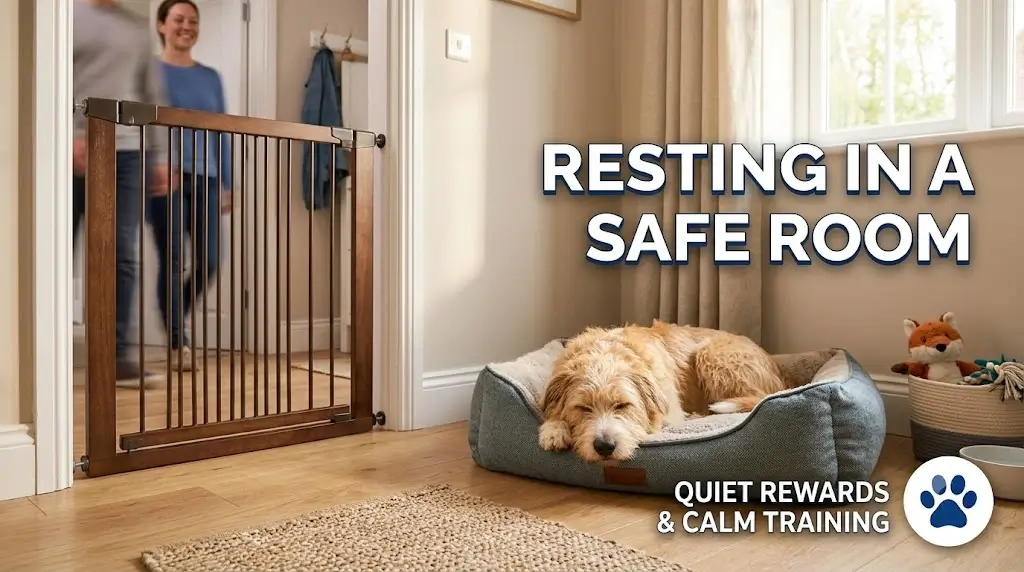
Use Baby Gates or Limited Areas
Restrict access to rooms where you cannot supervise the dog. A smaller supervised area makes it easier to prevent accidents.
Use a Safe Confinement Area When Necessary
When direct supervision is impossible, use an appropriate confinement setup that meets the dog’s welfare needs and is not used as punishment.
Increase Freedom Gradually
Give access to additional rooms as the dog demonstrates reliable bathroom behavior. Freedom should be earned through demonstrated reliability rather than granted all at once.
How Much Freedom Should a Newly Adopted Rescue Dog Have?
There is no single number of rooms that is appropriate for every dog. The correct amount of freedom is the amount you can supervise effectively while giving the dog adequate comfort and opportunities for normal behavior.
If accidents occur repeatedly in a particular room, temporarily reduce access to that area and increase supervision and potty opportunities.
Once the dog demonstrates consistent success, gradually expand access again.
What to Do If Your Rescue Dog Has an Accident
Indoor accidents should be treated as information about the training system, not as an opportunity for punishment. If accidents become frequent despite a routine, learn more about why does my puppy keep peeing in the house to identify hidden stressors or schedule mismatches.
If you see the dog beginning to eliminate indoors, calmly interrupt when practical and take them to the appropriate outdoor area. If they finish outside, reward the correct behavior.
If you discover an accident after it has already happened, simply clean it thoroughly and review what occurred before the accident.
Ask:
- How long had it been since the last potty trip?
- Had the dog recently eaten, drunk, slept, or played?
- Was the dog unsupervised?
- Did the dog show a signal that was missed?
- Was access to the outdoor area delayed?
- Could the environment or routine have changed?
Why You Should Never Punish a Rescue Dog for Indoor Accidents
Punishment after an accident does not teach the dog which bathroom location you want. The dog may instead associate the owner’s reaction with eliminating in the owner’s presence.
This can make future house training harder, particularly for dogs that are already cautious or uncertain in a new environment.
Rewarding successful outdoor elimination gives the dog information about what behavior works.
Prevent → redirect when possible → reward outside → clean thoroughly → adjust the schedule or supervision.
How to Clean Rescue Dog Urine From the House
Thorough cleaning matters because residual odor can make a previously soiled location more likely to become a repeated bathroom site.
Use a cleaner designed for pet urine and follow its instructions for the specific flooring or fabric. Avoid simply masking the smell with fragrance.
Pay particular attention to carpets, rugs, upholstery, seams, corners, and other absorbent materials where odor can persist below the visible surface.
What If the Rescue Dog Was Previously House Trained?
If shelter or foster information indicates that the dog was house trained previously, do not assume that accidents in your home mean the previous information was incorrect.
The dog may be adjusting to:
- A new household schedule.
- A different feeding time.
- A different door or exit route.
- A new outdoor surface.
- Different access to the yard.
- A new level of supervision.
- Changes in daily activity.
- The stress of relocation.
Temporarily returning to a structured potty routine can help re-establish the behavior in the new environment.
How to House Train an Adult Rescue Dog
Adult rescue dogs can learn new bathroom routines. Their age does not eliminate the need for management, and an adult dog may arrive with established habits that differ from your expectations.
Start by identifying the dog’s current pattern rather than assuming that age equals reliability.
Use the same basic framework:
- Establish a predictable schedule.
- Provide frequent opportunities initially.
- Supervise indoors.
- Use a consistent outdoor location.
- Reward successful elimination immediately.
- Clean accidents thoroughly.
- Gradually increase freedom.
How to House Train a Senior Rescue Dog
Senior dogs may require a different schedule because age-related physical changes can affect elimination frequency and bladder control.
Do not interpret frequent accidents in an older dog as a simple obedience issue. A veterinary evaluation may be appropriate when a previously reliable dog develops new or persistent house-soiling behavior.
Practical management may include more frequent outdoor opportunities, easier access to the appropriate bathroom area, and adjustments based on the dog’s physical abilities.
How to House Train a Rescue Dog From a Shelter
Shelter dogs may have experienced a kennel environment where bathroom opportunities and daily routines differ significantly from those in a home.
If the shelter can provide information about the dog’s previous bathroom habits, ask:
- Does the dog normally eliminate outdoors?
- Does the dog prefer grass, dirt, gravel, or another surface?
- How frequently does the dog typically need to go?
- Does the dog show a recognizable potty signal?
- Has the dog used pee pads?
- Are there known medical or mobility concerns?
This information can shorten the learning curve by reducing unnecessary changes during the first days at home.
How to House Train a Rescue Dog From a Foster Home
Foster homes can provide particularly useful information because the dog may already have a household bathroom routine.
Ask the foster caregiver about meal times, potty frequency, preferred surfaces, warning signals, overnight habits, and any known accident patterns.
Replicating familiar elements initially can make the transition easier. You can gradually modify the routine after the dog is settled.
What If a Rescue Dog Only Wants to Potty on Certain Surfaces?
Dogs can develop preferences for particular substrates. A dog accustomed to grass may hesitate on concrete, while a dog previously housed indoors may have learned to eliminate on pads or other surfaces.
If possible, start with the surface the dog already uses successfully. Once the behavior is reliable, you can gradually generalize it to other appropriate surfaces if necessary.
Do not confuse surface preference with stubbornness. The dog may simply have a learned history associated with a particular substrate.
How to Transition a Rescue Dog From Pee Pads to Outside
If a rescue dog has been trained to use pee pads but your goal is outdoor elimination, gradually shift the bathroom location toward the door and then outside.
Continue rewarding the desired behavior at the new location. Avoid moving the pad so quickly that the dog loses the bathroom target altogether.
The transition is easier when the outdoor location is predictable and the dog receives immediate reinforcement for using it.
How to House Train a Rescue Dog That Marks Indoors
Urine marking and ordinary house-training accidents are not necessarily the same behavior. Marking typically involves smaller amounts of urine deposited in selected locations, while a full bladder emptying can have different causes.
If you are unsure what type of house-soiling is occurring, record where, when, and how the dog eliminates and discuss persistent problems with a veterinarian or qualified positive-reinforcement behavior professional.
Thorough cleaning, supervision, access management, and addressing the underlying cause are more useful than punishment.
How to House Train a Rescue Dog That Is Nervous Outside
A dog that is uncomfortable outdoors may have difficulty focusing on elimination. New sounds, traffic, people, other animals, weather, or unfamiliar surfaces can all compete for attention.
Choose a quieter bathroom location when possible. Give the dog time to acclimate and keep the potty routine predictable.
Reward calm, successful outdoor elimination and avoid forcing unnecessary interaction during the bathroom trip.
What If the Rescue Dog Will Not Potty Outside?
First determine whether the dog simply does not need to eliminate or whether the outdoor environment is preventing the behavior.
If the dog spends a long time outside without eliminating, avoid turning the trip into an extended play session. Return indoors under close supervision and provide another appropriate opportunity later.
If the problem persists, look for environmental triggers such as noise, weather, unfamiliar surfaces, other animals, or fear.
How to Handle a Rescue Dog That Holds It Outside
Some dogs may be reluctant to eliminate in an unfamiliar outdoor environment. A consistent location, calm routine, and adequate time can help.
Avoid assuming the dog is intentionally refusing. If the dog repeatedly cannot eliminate normally or appears uncomfortable, veterinary assessment may be appropriate.
House Training a Rescue Dog in an Apartment
Apartment living requires more planning because the distance from the dog’s living area to the outdoor bathroom location can create a delay.
Keep the leash and other essentials ready near the exit. Watch closely after waking, eating, drinking, sleeping, and playing so you can respond before an accident becomes likely.
During early training, use a smaller supervised area rather than giving the dog immediate access to the entire apartment.
House Training a Rescue Dog Without a Yard
A private yard is convenient but not required for house training. The important elements are a safe and appropriate bathroom location, reliable access, supervision, and consistent reinforcement.
If reaching the bathroom location takes time, pay particular attention to early warning signals and maintain a schedule that gives the dog enough opportunities.
How to Prevent Overnight Accidents With a Rescue Dog
Establish a calm final potty trip before bedtime. Keep the dog’s sleeping area appropriately managed and make the overnight routine predictable.
If overnight accidents continue, consider whether the dog is being asked to remain without a bathroom opportunity for longer than they can comfortably manage.
Persistent nighttime house soiling, particularly when new or unexpected, may warrant veterinary discussion.
How to Know When You Can Give Your Rescue Dog More Freedom
Freedom should increase according to demonstrated reliability rather than a fixed number of accident-free days.
A dog is ready for more freedom when they consistently eliminate in the correct location, remain clean during supervised periods, and show recognizable signals before needing to go.
Expand access gradually. If accidents increase after adding a new room, temporarily reduce access and rebuild reliability.
A Three-Stage Rescue Dog House Training Plan
Stage 1: Management
Use frequent potty opportunities, close supervision, restricted indoor access, and immediate rewards for successful outdoor elimination. You can adapt structured frameworks like our 7-day puppy house training plan to create daily predictability during this first phase.
Stage 2: Reliability
Once accidents decrease, begin extending supervised intervals and gradually increase indoor freedom.
Stage 3: Generalization
Practice the same bathroom routine in additional appropriate situations and locations while maintaining the same cues and reinforcement principles.
Increase freedom only when the current level of freedom is reliably successful.
House Training Rescue Dog: Daily Tracking Sheet
A simple record can reveal patterns that are difficult to remember accurately.
| Time | Event | Result | Notes |
|---|---|---|---|
| Morning | Outside | Urinated / Did not | Location or behavior |
| After meal | Outside | Urinated / Defecated / Neither | Reward given? |
| Afternoon | Outside | Success / No success | Distractions? |
| Evening | Outside | Success / No success | Behavior before trip |
| Bedtime | Final potty | Success / No success | Overnight notes |
Common Rescue Dog House Training Mistakes
1. Giving Full House Access Immediately
More space makes supervision harder and gives the dog more opportunities to choose an inappropriate bathroom location.
2. Assuming an Adult Rescue Dog Is Automatically House Trained
Age does not guarantee that the dog understands your household’s bathroom routine.
3. Punishing Accidents
Punishment does not clearly teach the desired bathroom location and can create unwanted associations with the owner or elimination.
4. Rewarding Too Late
The further the reward is from the successful behavior, the less precise the learning signal becomes.
5. Changing the Routine Every Day
Predictability is especially useful while a newly adopted dog is learning the household’s expectations.
6. Ignoring Small Warning Signals
Some dogs do not bark, scratch the door, or perform an obvious signal. Their early signals may be subtle.
7. Expecting the Dog to Hold It Too Long
Physical needs vary between dogs. A schedule should be based on the individual dog rather than an arbitrary maximum interval.
8. Treating Every Accident as a Training Failure
An accident is useful information. Identify what happened before it and modify management accordingly.
What to Ask the Shelter or Rescue Before Bringing the Dog Home
If you have access to the dog’s shelter or foster history, collect as much practical information as possible.
- Was the dog previously house trained?
- Where does the dog normally eliminate?
- What surface does the dog prefer?
- How often does the dog normally go outside?
- What time does the dog usually eat?
- Does the dog signal when they need to go?
- Has the dog used pee pads?
- Are there known accident patterns?
- Are there known mobility or elimination concerns?
- What rewards does the dog respond to?
The more of the dog’s existing routine you can understand, the easier it is to distinguish a new-home adjustment issue from a genuine house-training gap.
When Indoor Accidents May Be a Medical Issue
Not every house-soiling problem is behavioral. Medical conditions can affect urinary or bowel habits, and sudden changes in elimination behavior deserve attention.
Contact a veterinarian if a previously reliable dog suddenly develops persistent accidents or if elimination changes are accompanied by signs such as unusual urgency, straining, discomfort, blood, excessive thirst, marked changes in urine volume, diarrhea, constipation, vomiting, lethargy, or other concerning symptoms.
Veterinary evaluation is particularly important for senior dogs or dogs with a history of medical problems.
Sudden or persistent changes in elimination can have medical causes.
How Stress Can Affect House Training After Adoption
Adoption changes a dog’s environment, routine, social surroundings, and sensory information. Some dogs may temporarily behave differently while adjusting.
Keep the early routine predictable. Use consistent meal and potty times, provide a quiet resting area, avoid unnecessary environmental overload, and reinforce successful behavior.
If accidents continue despite consistent management, consider whether the dog is experiencing environmental difficulty rather than simply failing to understand the bathroom rule.
Should You Use a Crate When House Training a Rescue Dog?
A properly introduced crate can be one management option, but it should not be treated as a punishment or as a substitute for regular bathroom opportunities.
The dog’s comfort, previous experience, ability to remain comfortable for the planned duration, and welfare needs should determine whether crate use is appropriate.
If the dog shows significant distress in confinement, use another safe management strategy and seek guidance from a qualified professional when necessary.
Should You Use a Dog Crate or Baby Gate for House Training?
Both can serve different management purposes.
| Management Tool | Useful For | Important Consideration |
|---|---|---|
| Baby gate | Limiting access to parts of the home | Dog can remain in a larger supervised area |
| Crate | Short-term management when appropriately trained | Must be used humanely and with appropriate bathroom breaks |
How to Transition From Management to Normal House Freedom
The goal of house training is not permanent confinement. The goal is to teach reliable bathroom habits so the dog can eventually live normally in the home.
Increase freedom in small increments:
- Start with a small supervised area.
- Build a consistent record of successful potty trips.
- Allow access to one additional area.
- Supervise the new area closely.
- Continue rewarding appropriate outdoor elimination.
- Reduce restrictions gradually as reliability improves.
If accidents return, go back to the previous successful level rather than treating the setback as a permanent failure.
Rescue Dog House Training: The Most Efficient Training Loop
1. Predict — Identify when the dog is likely to need to eliminate.
2. Prevent — Take the dog outside before an accident is likely.
3. Prompt — Use the same bathroom cue when appropriate.
4. Observe — Wait for elimination.
5. Reinforce — Reward immediately after success.
6. Record — Note timing and patterns.
7. Adjust — Increase or decrease freedom based on actual reliability.
This loop is more useful than relying on a fixed calendar because it responds to what the individual dog is actually doing.
Rescue Dog House Training Checklist
- ☐ Ask the shelter or foster about previous bathroom habits.
- ☐ Choose an appropriate outdoor potty location.
- ☐ Establish a predictable daily routine.
- ☐ Take the dog out after waking, eating, sleeping, and active play.
- ☐ Watch for the dog’s individual potty signals.
- ☐ Keep the dog supervised indoors.
- ☐ Limit access to unsupervised rooms.
- ☐ Use one consistent bathroom cue.
- ☐ Reward successful outdoor elimination immediately.
- ☐ Clean indoor accidents thoroughly.
- ☐ Never punish the dog for accidents.
- ☐ Track successful trips and accidents.
- ☐ Increase freedom gradually.
- ☐ Reduce freedom again if accidents increase.
- ☐ Seek veterinary advice for sudden or persistent elimination changes.
Frequently Asked Questions
How do you house train a rescue dog?
Start with a consistent potty schedule, close indoor supervision, a designated bathroom area, and immediate rewards for successful outdoor elimination. Treat the dog’s first days in the home as a new learning period even if the dog was previously house trained.
How long does it take to house train a rescue dog?
There is no universal timeline. Some dogs adapt quickly while others need several weeks of consistent management. Progress should be measured by decreasing accidents and increasing reliability rather than a fixed number of days.
Can an adult rescue dog still be house trained?
Yes. Adult dogs can learn a new bathroom routine. Begin with frequent opportunities, supervision, consistent reinforcement, and gradual increases in freedom.
Why is my rescue dog having accidents after being adopted?
A new home changes the dog’s routine, environment, bathroom location, and daily schedule. A previously house-trained dog may need time to learn the new household routine.
Should I punish my rescue dog for peeing inside?
No. Punishment does not teach the desired bathroom location and can create unwanted associations with the owner or elimination. Focus on supervision, prevention, outdoor opportunities, and immediate reinforcement.
How often should I take a rescue dog outside for potty training?
The appropriate frequency depends on the individual dog. Provide opportunities after waking, eating, drinking, sleeping, active play, before bedtime, and whenever the dog shows signs of needing to eliminate.
Should I assume a shelter dog is not house trained?
No. A shelter dog may be fully trained, partially trained, or accustomed to a different bathroom system. The safest approach is to use structured management until the dog’s reliability in your home is established.
Why does my rescue dog only potty on grass?
Dogs can develop preferences for particular bathroom surfaces. If possible, start with the surface the dog already uses successfully and gradually generalize to other appropriate surfaces.
Can a rescue dog be trained to use a potty cue?
Yes. Choose a consistent phrase such as “go potty” and pair it with elimination. Early on, say the cue as the dog begins to eliminate, then gradually move it earlier as the association becomes reliable.
What should I do if my rescue dog refuses to potty outside?
Consider whether the dog is distracted, anxious, unfamiliar with the surface, or simply does not need to eliminate. Use a quiet predictable location, provide adequate time, and avoid turning every unsuccessful potty trip into an extended play session.
Can stress cause a rescue dog to have accidents?
Changes in environment and routine can affect a dog’s behavior after adoption. Keep the schedule predictable and use positive reinforcement. Persistent or unusual elimination changes should also be evaluated for possible medical causes.
Should I use a crate to house train a rescue dog?
A properly introduced crate can be one management option, but it should not be used as punishment or as a substitute for regular bathroom opportunities. Some dogs may do better with gates or another safe management arrangement.
How do I house train a rescue dog in an apartment?
Keep the dog close to you, establish frequent outdoor opportunities, keep the leash ready near the exit, limit unsupervised access, and watch closely after waking, eating, sleeping, and playing.
How do I transition a rescue dog from pee pads to outside?
Gradually shift the bathroom location toward the exit and then outdoors while rewarding successful elimination at the desired outdoor location. Avoid moving the pad so quickly that the dog loses the bathroom target entirely.
When should I call a veterinarian about house-training accidents?
Contact a veterinarian for sudden or persistent changes in elimination, especially when accompanied by straining, discomfort, blood, unusual urgency, excessive thirst, major changes in urine volume, digestive symptoms, lethargy, or other concerning signs.
How do I know when my rescue dog is fully house trained?
Look for sustained reliability: the dog consistently eliminates in the appropriate location, remains clean during normal supervised periods, and shows recognizable signals before needing to go. Gradually test additional freedom rather than relying on a fixed number of days.
Final Takeaway
The best way to house train a rescue dog is to remove guesswork. Establish predictable potty opportunities, supervise the dog closely, use a consistent bathroom location and cue, reward successful outdoor elimination immediately, and increase household freedom only as reliability improves.
A newly adopted dog may need to relearn bathroom expectations even if they were previously house trained. The first goal is not perfection. It is to create enough successful repetitions that the dog learns exactly what works in the new home.
Accidents should be treated as feedback. If they happen, identify what preceded them, improve the schedule or supervision, clean the area thoroughly, and continue reinforcing the desired behavior.
