
AKC & AVMA SLEEP PROTOCOLS 2026
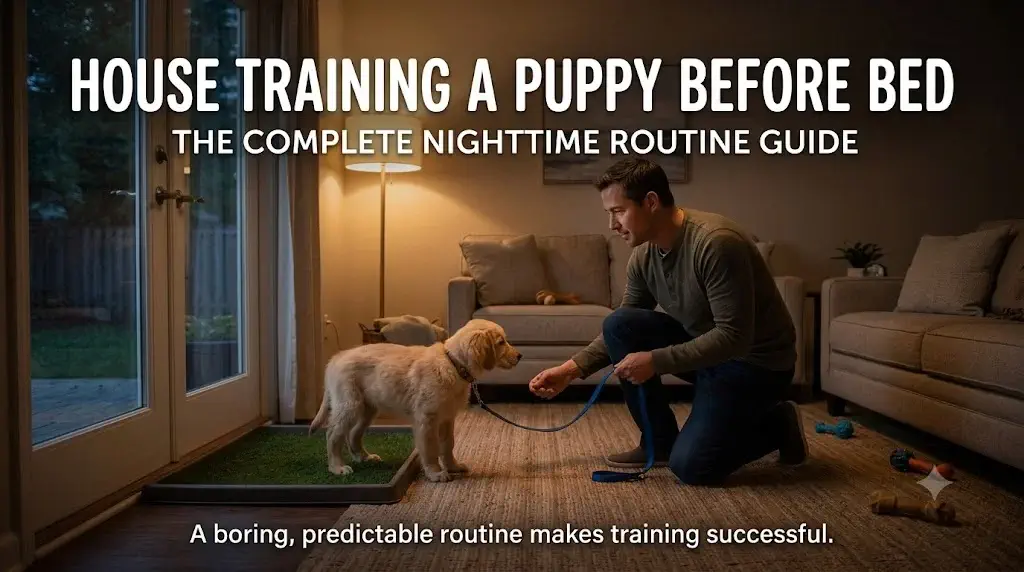
House Training a Puppy Before Bed
A consistent pre-bed potty routine establishes nighttime reliability because it provides your puppy with one predictable opportunity to empty its bladder before the longest circadian sleep cycle of the night. The primary objective is not forcing an immature canine bladder to hold urine beyond its biological capacity, but constructing an unvarying sequence: wind down, transition to the designated relief area, eliminate, receive immediate ground-level reinforcement, and settle into a crate. Successfully mastering house training a puppy before bed requires separating elimination trips from playtime, controlling evening stimuli, and establishing clear nocturnal management.
Quick Reference Specification: Nighttime House Training Matrix
This calibrated physiological matrix benchmarks developmental age brackets, biological triggers, primary pre-bed interventions, maximum overnight bladder capacities, and veterinary benchmarks for house training a puppy before bed in 2026.
| Developmental Stage / Age | Biological / Behavioral Anchor | Primary Pre-Bed Tactical Intervention | Maximum Overnight Bladder Window | Safety & Welfare Benchmark |
|---|---|---|---|---|
| Early Juvenile (8–11 Weeks) | Immature urethral sphincter & high filtration | Immediate pre-crate voiding + 1–2 nocturnal alarms | 3–4 hours maximum | AVMA Pediatric Urinary Physiology Guide |
| Mid Juvenile (12–16 Weeks) | Developing circadian anti-diuretic hormone (ADH) | 30-min wind-down + fixed-lead outdoor break | 5–6 hours overnight | AKC Baseline Nighttime Holding Standard |
| Late Juvenile (17–24 Weeks) | Adult muscular tone & consolidated REM sleep | Double-elimination verification + crate latch | 7–8 hours unbroken sleep | AAHA Canine Life Stage Guideline |
| High Evening Arousal | Sympathetic spike & sphincter inhibition | 15-min dim lighting + stationary leash anchor | Immediate retry if un-voided | IAABC Arousal Threshold Protocol |
| Nocturnal Restlessness | Full bladder pressure vs. isolation anxiety | Silent, un-praised 3-minute transit reset | Immediate response to whine | Fear Free Nighttime Confinement Guide |
Why the Before-Bed Potty Trip Matters
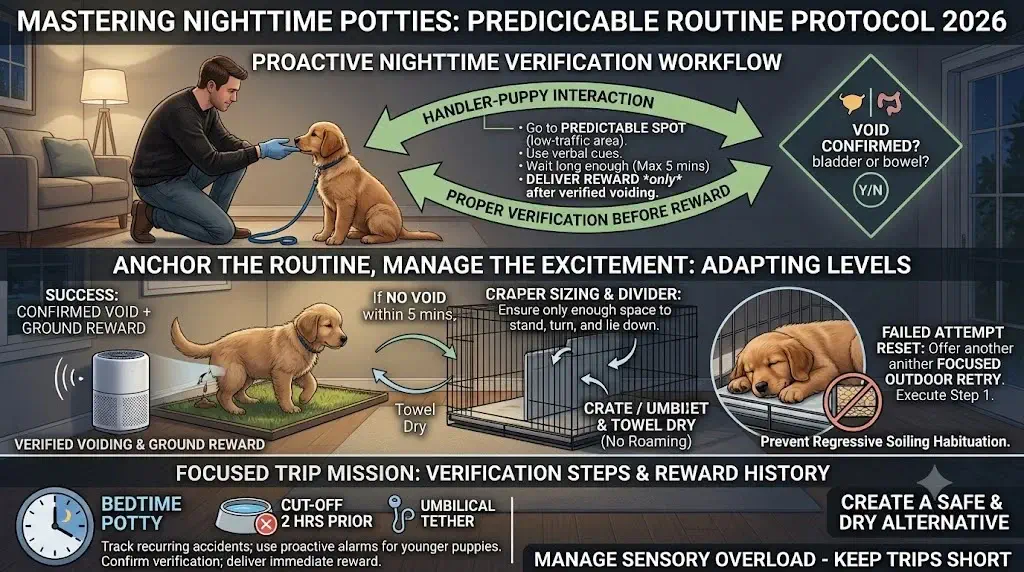
Overnight sleep constitutes the longest physiological holding window in a juvenile dog’s daily circadian rhythm. For a developing puppy with rapid glomerular filtration, this final bathroom trip is the critical safeguard preventing nocturnal crate soiling.
Nighttime environments introduce distinct distractions. Wandering through shadowy yards, chasing moths, investigating nocturnal odors, or roughhousing with owners can quickly convert a focused bathroom break into an extended wakefulness session. For this reason, mastering house training a puppy before bed requires keeping potty elimination completely separate from evening entertainment.
Make the final pre-bed elimination trip predictable, low-arousal, and identical in execution every single night.
A structured routine also generates essential diagnostic data. If a puppy reliably eliminates outdoors right before bed, handlers establish clean sleep patterns. Conversely, if a puppy sniffs without voiding and soils the crate shortly after, handlers know immediately that their evening containment workflow requires adjustment.
What Time Should a Puppy Go Potty Before Bed?
Biological event sequencing determines successful pre-bed elimination timing more accurately than rigid clock hours. Exact minutes on a wall clock matter far less than digestive transit speed, fluid intake, and evening activity levels.
Rather than setting an arbitrary clock time, anchor house training a puppy before bed directly to the physical winding-down process:
Early Juvenile (8–11 Weeks)
Requires an outdoor trip immediately prior to crate entry and typically requires at least one mid-night bathroom break.
Mid Juvenile (12–16 Weeks)
Maintains continuous sleep for 5 to 6 hours provided the pre-bed trip confirms complete bladder voiding.
Post-Play Progression
Demands a 15-minute cool-down period followed by a direct relief break to purge exercise-induced urine volume.
Evening Nap Waking
Waking from an evening snooze stimulates bladder reflexes, requiring an immediate outdoor trip before bed.
Differentiating between clock hours and physiological triggers ensures you catch your puppy at their natural peak elimination moment.
The Best Pre-Bed Puppy Potty Routine
A standardized six-stage operational sequence conditioned nightly builds automatic elimination responses. Consistency creates psychological clarity, teaching the puppy that this specific sequence marks the conclusion of the day.
To integrate this pre-bed schedule into your daytime routine, consult our master Puppy House Training Schedule.
Step-by-Step: How to House Train a Puppy Before Bed
Structured mechanical discipline ensures efficient elimination before nocturnal fatigue degrades puppy focus. Follow these six technical steps every evening:
Transition the puppy from high-arousal play to calm behavior 30 minutes prior to outdoor transit. An overstimulated puppy spends the entire bathroom trip investigating nocturnal shadows rather than relaxing their urethral sphincters.
Familiar olfactory anchors significantly accelerate elimination decisions. Returning to the exact same turf perimeter triggers conditioned elimination reflexes even in low-light conditions.
State your conditioned verbal cue (e.g., “Go potty”) once in a low, neutral voice upon arriving at the relief spot. Avoid continuous chatter, which acts as white noise and distracts the puppy.
Allow three to five minutes of focused standing. Do not assume sniffing for 15 seconds constitutes full bladder voiding; verify actual stream termination visually.
Deliver a high-value, pea-sized treat directly at ground level within three seconds. Immediate delivery creates a clear behavioral bridge connecting outdoor elimination with positive reinforcement.
Lead the puppy directly back indoors to the sleeping area. Preventing post-potty play reinforces that nighttime excursions are strictly dedicated to physiological relief.
Should a Puppy Go Potty Twice Before Bed?
A double-elimination protocol prevents incomplete bladder voiding in easily distracted young canines. Many puppies void only half their bladder during their initial outdoor trip because nocturnal smells or distant noises interrupt their concentration.
This dual-trip approach ensures complete dual-chamber evacuation (bladder and bowel) before entering the overnight sleep window.
What If My Puppy Won’t Potty Before Bed?
Immediate indoor crate containment resets prevent un-voided urine from being deposited on home flooring. When a puppy stands outside at bedtime and refuses to eliminate after five minutes, avoid turning the session into an open-ended yard excursion.
- Escort the puppy inside quietly on-leash without scolding.
- Place the puppy directly into their crate or tether them to your person.
- Wait 10 to 15 minutes under zero-interaction conditions.
- Carry or walk the puppy directly back to the outdoor potty spot for a focused 3-minute retry.
- Reward immediately upon elimination, or repeat the crate confinement loop if refusal continues.
To master tethering techniques and containment resets, read our guide on How to Prevent Repeat Puppy Accidents.
How to Tell if Your Puppy Still Needs to Potty
Pre-elimination displacement behaviors provide visible warnings before indoor accidents occur. Young puppies rarely give dramatic vocal alerts; they display subtle physical indicators of bladder or rectal fullness:
- Abrupt disengagement from an evening chew toy or person.
- Intense floor sniffing accompanied by a curved spine posture.
- Trotting toward hallways, doorways, or previous accident sites.
- Tight, repetitive circling in low-traffic corners.
- Restless inability to settle into bedding.
- Subtle whines or sudden pacing near exterior thresholds.
Noticing these cues early allows you to intercept your puppy before an accident happens.
Should You Take a Puppy Out After the Last Drink of Water?
Fluid consumption accelerates gastric emptying, requiring an outdoor relief window within 20 to 30 minutes of drinking. Withholding water completely to simplify house training is medically inappropriate and risks dehydration.
What Should You Do Before Putting a Puppy in a Crate at Night?
A verified bathroom break and calm mental state ensure restful overnight crate rest. Placing an active puppy into a crate with a full bladder is the leading cause of persistent overnight barking and soiled bedding.
Verify Dual Evacuation
Confirm the puppy has urinated and defecated to prevent middle-of-the-night bowel pressure.
Remove Collars & Tags
Unclip dangling tags and collars that could catch on crate wire bars overnight.
Insert Safe Enrichment
Provide an indestructible rubber chew or heartbeat plush toy to encourage self-soothing.
Verify Sizing Divider
Ensure the crate is sized only large enough for the puppy to stand, turn, and lie down comfortably.
How Long Can a Puppy Hold Its Bladder Overnight?
Circadian metabolic deceleration allows sleeping puppies to hold urine roughly one to two hours longer than their daytime baseline. While asleep, pituitary release of anti-diuretic hormone (ADH) concentrates urine, slowing bladder filling.
| Developmental Age Bracket | Realistic Overnight Bladder Window |
|---|---|
| 8 to 10 Weeks | 3 to 4 hours maximum (requires 1–2 overnight alarms). |
| 11 to 14 Weeks | 4 to 5 hours (typically requires 1 overnight relief break). |
| 15 to 18 Weeks | 6 to 7 hours (many puppies sleep through the night). |
| 19+ Weeks | 7 to 8 hours unbroken overnight holding capacity. |
Treat these numbers as general milestones, adjusting as needed based on your puppy’s breed and individual progress.
Should You Wake a Puppy Up at Night to Potty?
Proactive scheduled alarms prevent distress barking and unforced crate accidents in puppies under twelve weeks old. Waiting for a young puppy to shriek in distress before taking them out risks reinforcing barking as an attention-seeking behavior.
How to Make the Final Potty Trip Boring
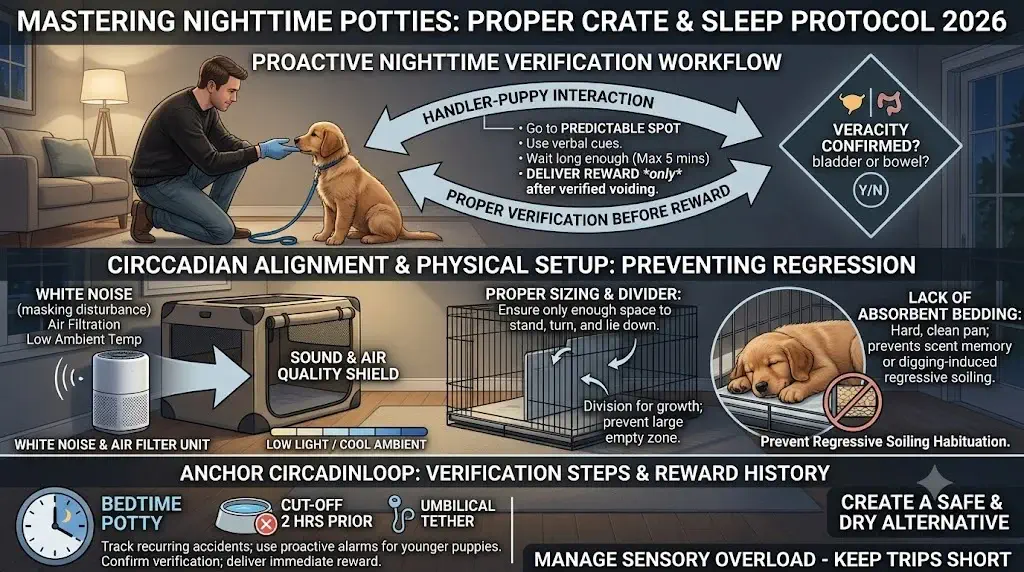
Low-key interactions prevent midnight bathroom excursions from turning into rewarding social events. If midnight trips involve excited baby talk, games of fetch, or unrestricted yard exploring, puppies quickly learn to wake up simply for attention.
Keep on a Short Leash
Use a 4-to-6-foot fixed leash to keep the puppy anchored directly in the potty zone.
Maintain Monotone Silence
Avoid excited praise or animated conversation; deliver a quiet, calm marker upon voiding.
Use Low Flashlights
Point flashlights strictly at the turf rather than shining beams into the puppy’s eyes.
Instant In-Crate Return
Lead the puppy straight back inside and latch the crate door immediately after voiding.
What If My Puppy Pees Inside Right Before Bed?
Sudden pre-bed indoor voiding signals a timing breakdown or incomplete outdoor elimination. When an accident happens minutes before bedtime, review the preceding events:
| Observed Breakdown | Root Physiological Cause | Tactical Adjustment |
|---|---|---|
| Pees on rug 5 mins after outdoor trip | Distracted outdoors; voided only half of bladder. | Implement the double-elimination protocol. |
| Accident occurs during evening wrestling | Abdominal muscle exertion stimulates bladder contraction. | Mandate cool-down potty trips immediately post-play. |
| Puppy pees while owner brushes teeth | Unsupervised freedom granted during human bedtime routines. | Crate or tether the puppy during human bedtime prep. |
| Frequent, tiny dribbles with straining | Possible bacterial cystitis or urinary crystal inflammation. | Schedule a veterinary urinalysis immediately. |
What If My Puppy Poops in the House at Night?
Nocturnal defecation indicates evening feeding delays or insufficient physical movement before bed. The gastrocolic reflex typically stimulates bowel motility within 30 to 60 minutes after a meal.
If your puppy consistently defecates overnight in their crate or living area, shift their evening meal earlier (e.g., from 7:00 PM to 5:30 PM). Ensure the puppy engages in moderate on-leash walking during the final outing, as physical movement stimulates intestinal peristalsis. Never lock a puppy in a crate for the night unless you have verified an outdoor bowel movement during the evening routine.
Should You Feed a Puppy Right Before Bed?
Late-night caloric intake accelerates nocturnal fecal production, triggering mid-sleep bowel distress. Feeding a puppy within two hours of bedtime forces their digestive tract to process food while their body attempts to rest.
Establish a strict evening feeding deadline between 5:30 PM and 6:30 PM for a 10:00 PM bedtime. This three-to-four-hour window provides ample time for complete gastrointestinal transit, allowing the puppy to defecate once during the early evening and once during the final pre-bed break.
Bedtime House Training in an Apartment
Multi-floor transit delays in urban residential buildings necessitate proactive departure scheduling. Navigating hallways, slow elevators, and security lobbies increases the risk of accidents before reaching street-level turf.
Bedtime House Training in Cold or Rainy Weather
Adverse environmental temperatures and wet turf trigger rapid sensory refusal at night. Cold mud, freezing rain, and pitch-black darkness cause puppies to bolt back toward the backdoor before voiding.
Equip young puppies with an insulated coat and hold a large umbrella over their relief zone in wet weather. Clear a direct snow trench to a sheltered grass patch. If the puppy shivers and refuses to go, bring them inside to their crate for 10 minutes, then retry. Never leave a puppy outside alone in freezing weather.
Bedtime House Training When Your Puppy Is Distracted
Novel nocturnal sounds and animal scents activate juvenile predatory exploration instead of elimination. Rustling leaves, distant sirens, crickets, and neighbor movements easily derail an unfocused puppy.
Use a 4-to-6-foot fixed leash to limit roaming and stand completely stationary in the darkest, quietest corner of your yard. Refuse to follow the puppy as they attempt to chase shadows. By remaining an unmoving anchor, you allow the puppy to exhaust their sniffing within a limited radius and settle into elimination.
Should You Carry a Puppy Outside Before Bed?
Physical carrying prevents hallway elimination in young puppies whose sphincter tone is compromised by morning or evening grogginess. When waking an 8-week-old puppy from a snooze, their bladder is full and relaxed.
Allowing a very young puppy to walk across rugs to the door often results in an accident en route. Carrying the puppy directly from their sleeping crate to the outdoor relief spot ensures their paws do not touch domestic flooring until their bladder is completely empty. As the puppy matures past 14 weeks and demonstrates reliable holding capacity, transition them to walking on-leash.
How to Reward a Puppy for Going Potty Before Bed
High-value food rewards must be paired with low-arousal verbal markers to prevent bedtime excitement. Rewarding with high-energy cheering or vigorous petting wakes the puppy up, undoing your evening wind-down.
Stream concludes → Deliver high-value treat (freeze-dried liver) at ground level within 3 seconds → Whisper a calm “Good” → Walk slowly back indoors to the crate.
Do Not Punish a Puppy for a Bedtime Accident
Verbal scolding and physical intimidation induce elimination anxiety, causing puppies to hide accidents behind furniture. Punishing a dog for urinating in their crate or on a rug does not teach them where to go; it simply teaches them to fear eliminating in your presence.
If you discover an accident, clean it calmly without scolding the puppy. An accident indicates a management failure: either the outdoor break was too short, the puppy had too much pre-bed freedom, or their biological holding capacity was exceeded. Correct your routine rather than punishing the puppy.
How to Prevent Bedtime Accidents Around the House
Spatial restriction and certified bio-enzymatic decontamination eliminate nocturnal housebreaking failures. Unsupervised freedom is the primary catalyst for domestic soiling.
- Restrict overnight sleeping arrangements to a properly sized crate or secure pen.
- Block access to carpeted bedrooms using sturdy baby gates during evening hours.
- Clean all previous accident spots with CRI-certified enzymatic cleaners to digest uric acid crystals.
- Keep the puppy on an umbilical leash during human evening routines.
For tested cleaner recommendations, explore our guide on the Best Puppy Accident Cleaners and follow our strategies in How to Prevent Puppy Urine Odor.
A 30-Minute Pre-Bed Routine Example
Predictable nightly pacing synchronizes juvenile circadian physiology with household sleep expectations. Use this 30-minute countdown template:
Bedtime House Training Mistakes to Avoid
Common operational errors during evening hours inadvertently prolong nighttime crying and accidents. Avoid these six common pre-bed mistakes:
Delaying Until Desperation
Rushing out at the last second creates stress and increases accident risks en route to the door.
Engaging in Midnight Play
Throwing toys during potty breaks teaches the puppy that waking up leads to entertainment.
Assuming Sniffing Equals Voiding
Always visually confirm actual elimination before heading back indoors.
Granting Full Room Roaming
Allowing unsupervised evening roaming invites accidents in hidden corners.
Severe Water Deprivation
Completely withholding water causes dehydration and distress; manage timing instead.
Ignoring Sudden Regressions
Abrupt changes in overnight holding capacity often stem from medical issues rather than stubbornness.
What to Do If Your Puppy Wakes Up After Bedtime
A silent, business-only outdoor protocol satisfies physical elimination needs without encouraging nocturnal attention-seeking. If a crated puppy whines after midnight, distinguish between loneliness and a genuine bathroom need.
Wait for a 3-second lull in crying so you do not reward screaming. Approach silently without eye contact, slip the leash on, carry the puppy directly outside, and stand quietly in the potty area for three minutes. If they eliminate, whisper praise, carry them straight back to the crate, and latch the door. If they do not eliminate after three minutes, return them to the crate immediately.
What If My Puppy Wakes Up at the Same Time Every Night?
Predictable overnight waking times establish clear baseline markers for setting proactive alarms. If your puppy consistently barks at 3:15 AM every night, their biological clock has mapped that hour to full bladder pressure.
Beat the puppy to the punch: set an alarm for 3:00 AM, wake them calmly while they are still quiet, take them out to eliminate, and return them to the crate. Taking the initiative prevents distress barking and builds clean sleeping habits. Over the next two weeks, push that alarm forward by 15 minutes every three nights until your puppy sleeps through to morning.
When Bedtime Accidents Mean You Should Call the Veterinarian
Sudden nocturnal urinary incontinence or painful straining indicates underlying urological pathology. Not every nighttime accident is a training breakdown.
Contact your veterinarian immediately if pre-bed or overnight accidents accompany any of these symptoms:
- Straining with only tiny drops or painful whimpering during urination (dysuria/stranguria).
- Urine containing blood, cloudiness, or a pungent ammonia odor.
- A sudden, dramatic increase in daily water intake (polydipsia).
- Involuntary urine leakage while sound asleep in bedding.
- Watery diarrhea, vomiting, or fever accompanied by listlessness.
Conditions like urinary tract infections, vaginitis, or intestinal parasites require prescription medical treatment rather than behavioral adjustments.
Bedtime House Training Checklist
Standardized operational routines establish household cleanliness and prevent regressions during evening and overnight hours. Follow this complete procedural checklist:
- Finish energetic play 30 minutes before the final potty trip.
- Use the exact same designated outdoor relief area every night.
- Keep the pre-bed outing completely calm, quiet, and predictable.
- Allow 3 to 5 minutes of focused standing to verify complete voiding.
- State your conditioned verbal potty cue once in a neutral tone.
- Deliver high-value food rewards directly at ground level within 3 seconds.
- Return directly indoors to the sleeping crate without post-potty play.
- Lift bulk water bowls two hours before bed while ensuring daytime hydration.
- Size the crate divider correctly to eliminate excess soiling space.
- Log repeated waking times to set proactive alarms.
- Decontaminate indoor accidents thoroughly with bio-enzymatic cleaners.
- Consult a veterinarian promptly if urination becomes painful, frequent, or bloody.
Frequently Asked Questions
How do I house train my puppy before bed?
Take the puppy to its designated potty area immediately before bedtime, keep the trip calm, wait for actual elimination, reward immediately, and then return directly to the sleeping routine.
Should I take my puppy out right before bed?
Yes. A final appropriate potty opportunity immediately before sleep is an important part of many puppies’ nighttime house-training routines.
How long before bed should my puppy go potty?
There is no universal number of minutes. The final trip should be close enough to bedtime to be useful while allowing enough time for the puppy to settle and actually eliminate.
What if my puppy won’t pee before bed?
Keep the trip calm and give the puppy an appropriate opportunity to eliminate. If nothing happens, return indoors under close supervision and offer another opportunity later if the puppy’s behavior suggests it still needs to go.
Should puppies poop before bed?
A puppy may defecate before bed depending on its feeding and digestive routine. Observe the puppy’s normal pattern rather than forcing a bowel movement at a specific time.
Should I wake my puppy up at night to pee?
Some young puppies need a nighttime bathroom opportunity because they cannot yet comfortably remain dry throughout the night. The need varies by puppy and should decrease as nighttime control develops.
Should I restrict water before bedtime?
Water should not be withheld simply to prevent house-training accidents. Maintain appropriate hydration and manage bathroom opportunities around the puppy’s normal drinking pattern.
Why does my puppy pee inside after going outside before bed?
The puppy may not have eliminated outside, may have been distracted, may have become excited after returning indoors, or may have an underlying issue. Review the sequence and increase supervision; persistent changes should be discussed with a veterinarian.
Can a puppy sleep through the night without peeing?
Some puppies can sleep through the night as they mature, while younger puppies may still need nighttime bathroom opportunities. Individual variation is substantial.
What should I do if my puppy has a nighttime accident?
Clean the area thoroughly, avoid punishment, review the timing of the final potty opportunity, and increase appropriate supervision. If accidents become sudden, frequent, or unusual, seek veterinary advice.
Is crate training helpful for nighttime house training?
A properly introduced crate can provide a predictable sleeping area and help with nighttime management, but it does not replace appropriate potty opportunities and should never be used as punishment.
How can I stop my puppy from playing outside instead of going potty at night?
Use a leash, visit the same low-distraction bathroom location, keep interaction calm, and return indoors after successful elimination. Save energetic play for earlier in the evening.
The Bottom Line
Successful bedtime house training is built around predictability, not forcing a puppy to hold its bladder longer.
Give your puppy a calm final potty opportunity immediately before sleep, use the same bathroom location and cue whenever practical, wait for actual elimination, and reward it immediately. Keep nighttime trips boring and separate from play. If the puppy does not eliminate, use close supervision and provide another opportunity when appropriate rather than allowing unrestricted freedom indoors. As the puppy matures, nighttime control should generally become more reliable. A temporary accident does not mean the entire training program has failed. Look at the circumstances, adjust the routine, and continue reinforcing the behavior you want.
Editorial note: This guide provides general puppy house-training information for U.S. households, aligned with American Kennel Club (AKC) behavioral principles and American Veterinary Medical Association (AVMA) pediatric care standards. Individual puppies differ in age, development, temperament, elimination patterns, and environmental tolerance. House-training advice should never replace veterinary care when a puppy shows sudden, persistent, painful, or otherwise abnormal elimination behavior.
