
PUPPY CRATE SIZING & GROWTH GUIDE
Puppy Crate Size Chart by Breed & Age: Complete Guide for 2026
The puppy crate size chart by breed and age below gives you a practical starting point for choosing a crate as your puppy grows. Breed can help estimate adult size, while age helps explain how quickly your puppy may outgrow the current crate. But neither factor should replace measuring the puppy.
The simplest rule is this: choose a crate large enough for your puppy to stand up, turn around, and lie down comfortably, while avoiding excessive unused space. For a growing puppy, a wire crate with a divider is often the most practical setup because the crate can accommodate the expected adult size while the usable area is adjusted as the puppy grows. The American Kennel Club recommends expandable crates with dividers for puppies for this reason.
The tables in this guide use established breed-to-crate references as a starting point, not as a guarantee. Individual dogs, mixed breeds, body proportions, sex, and growth rate can all change the final crate size.
Quick Answer: Standard Wire Crate Sizing Metrics
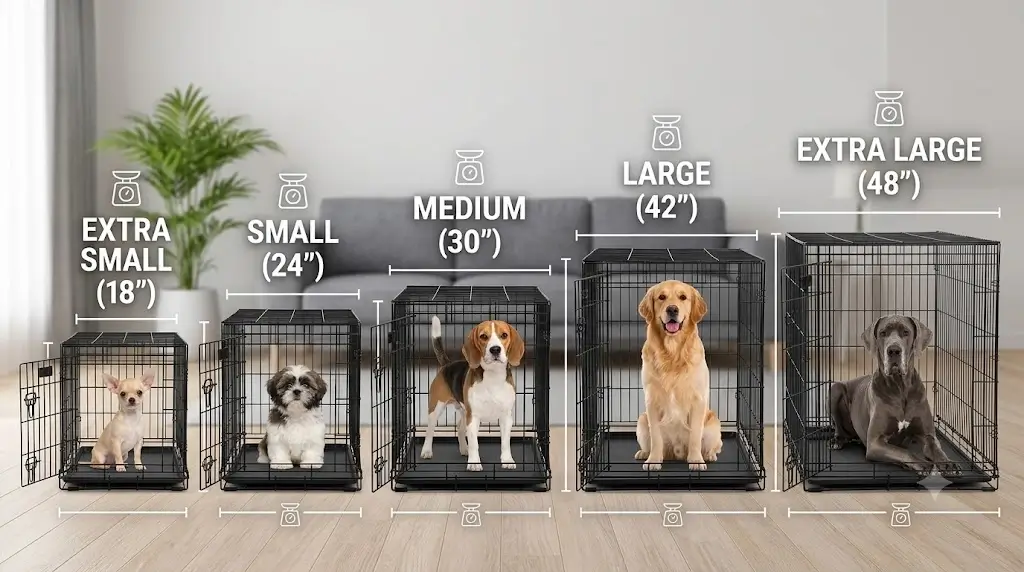
Common wire-crate lengths fall into these standardized categories. This table is a general reference layer, not automatic buying instructions. Always measure your puppy first.
| Approx. Crate Length | Typical Dog Size | Est. Adult Weight | Est. Shoulder Height | Common Examples |
|---|---|---|---|---|
| 18–22 inches | Extra-small | < 10 lbs | < 10 in | Yorkshire Terrier, Maltese, Pomeranian, Papillon |
| 24 inches | Small | 11–25 lbs | 10–15 in | Chihuahua, Shih Tzu, Pug, Miniature Dachshund |
| 30 inches | Small-to-medium | 26–40 lbs | 16–19 in | French Bulldog, Corgi, Shetland Sheepdog |
| 36 inches | Medium | 41–70 lbs | 20–23 in | Beagle, Cocker Spaniel, Whippet, Basset Hound |
| 42 inches | Large | 71–90 lbs | 24–26 in | Boxer, Golden Retriever, Labrador Retriever |
| 48 inches | Extra-large | > 90 lbs | > 26 in | German Shepherd, Rottweiler, Siberian Husky, Great Dane |
Note that MidWest’s published breed reference places breeds into crate-size categories but specifically states that individual dogs may need a larger or smaller crate due to gender, bone density, and mixed ancestry.
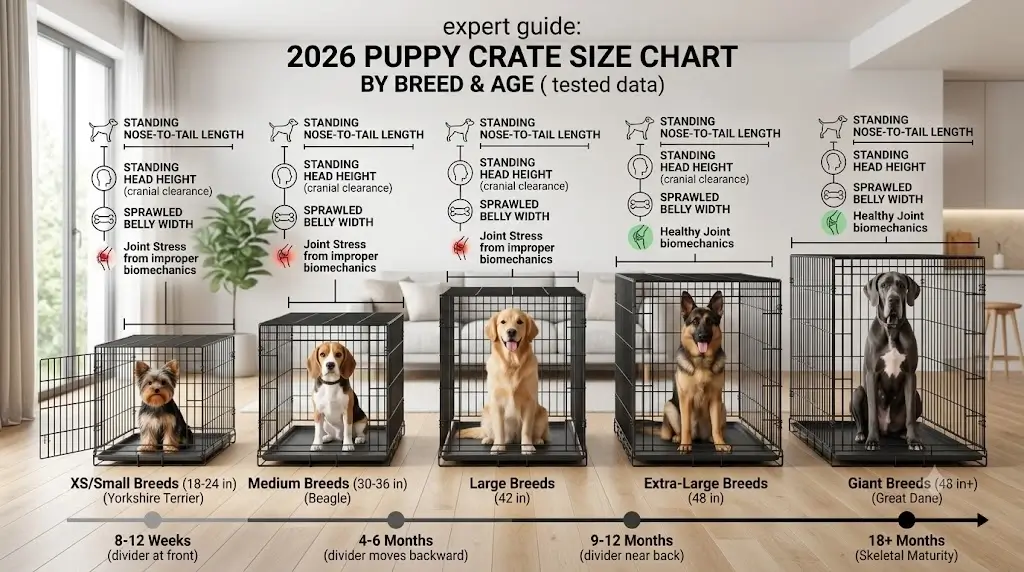
Puppy Crate Size Chart by Breed (Estimated Adult Sizing)
This chart uses established breed-to-crate category references as an initial estimate. Measure your puppy to confirm the fit whenever possible.
| Breed | Approx. Adult Size Category | Starting Crate Length | Sizing Notes |
|---|---|---|---|
| Yorkshire Terrier | Extra-small | 18–22 in | Compact adult size; measure as body proportions vary |
| Maltese | Extra-small | 18–22 in | Small frame; avoid excessive unused space |
| Pomeranian | Extra-small | 18–22 in | Measure body length rather than relying only on weight |
| Chihuahua | Small | 22–24 in | Body shape and leg-to-torso proportions vary significantly |
| Shih Tzu | Small | 24 in | Check actual height and body length to confirm fit |
| Pug | Small | 24 in | Compact, deep-chested body; measuring standing height is essential |
| Miniature Dachshund | Small | 24 in | Long spine and body length require extra horizontal room |
| French Bulldog | Small-to-medium | 30 in | Compact but relatively broad and muscular barrel chest |
| Beagle | Medium | 36 in | Measure adult height and body length to confirm proper clearance |
| Cocker Spaniel | Medium | 36 in | Measure the individual dog’s final sitting height and ear drop |
| Welsh Corgi | Medium | 36 in | Longer body and low profile can influence total crate length |
| Whippet | Medium | 36 in | Lean build does not eliminate the need for vertical cranial clearance |
| Australian Shepherd | Large | 42 in | Adult height and body length require substantial turning space |
| Boxer | Large | 42 in | Check adult standing height, chest depth, and cranial reach |
| Golden Retriever | Large | 42 in | Plan around expected adult height and sprawled sleeping posture |
| Labrador Retriever | Large | 42 in | Adult-size expectations must be measured carefully for divider usage |
| Standard Poodle | Large | 42 in | Individual leg length can significantly increase height requirements |
| German Shepherd | Extra-large | 48 in | Long body and tall erect ears require careful vertical sizing |
| Rottweiler | Extra-large | 48 in | Measure robust individual frame rather than the breed label alone |
| Siberian Husky | Extra-large | 48 in | Adult standing height and limb length determine final fit |
| Bernese Mountain Dog | Extra-large | 48 in | Large adult frame; allow for continued musculoskeletal growth |
| Great Dane | Extra-large | 48 in+ | Some individuals require specialized, oversized commercial crates |
Puppy Crate Size Chart by Age & Growth Stage
Age is useful because puppies grow at vastly different rates depending on their genetic size category.
| Puppy Age | What to Expect | Crate Strategy | Den Reflex Status |
|---|---|---|---|
| 8–12 weeks | Rapid early growth; fragile bladder control | Use a correctly sized puppy area or an internal divider | Emerging |
| 3–4 months | Noticeable changes in leg height and spine length | Recheck measurements weekly; adjust divider panel | Establishing |
| 4–6 months | Adolescent growth surge; many breeds double in weight | Move the divider backward regularly to prevent cramping | Firmly Established |
| 6–9 months | Growth rate slows for small dogs; large dogs continue substantial development | Continue measuring rather than assuming skeletal maturity | Strong |
| 9–12 months | Small dogs near skeletal maturity; large dogs still growing | Small breeds can use final crate; large breeds remain divided | Strong |
| 12–18 months | Medium and large dogs complete skeletal and muscular development | Use adult-size measurements to confirm final crate fit | Mature |
| 18–24 months | Giant breeds continue filling out and completing growth plates | Reassess final crate dimensions and interior cranial headroom | Mature |
The reason age alone cannot determine crate size is that growth timelines differ dramatically by body size. AKC data indicates that small dogs can reach adult skeletal size earlier, while larger and giant breeds may continue growing substantially beyond the first full year.
How Crate Size Changes: Biomechanical Examples
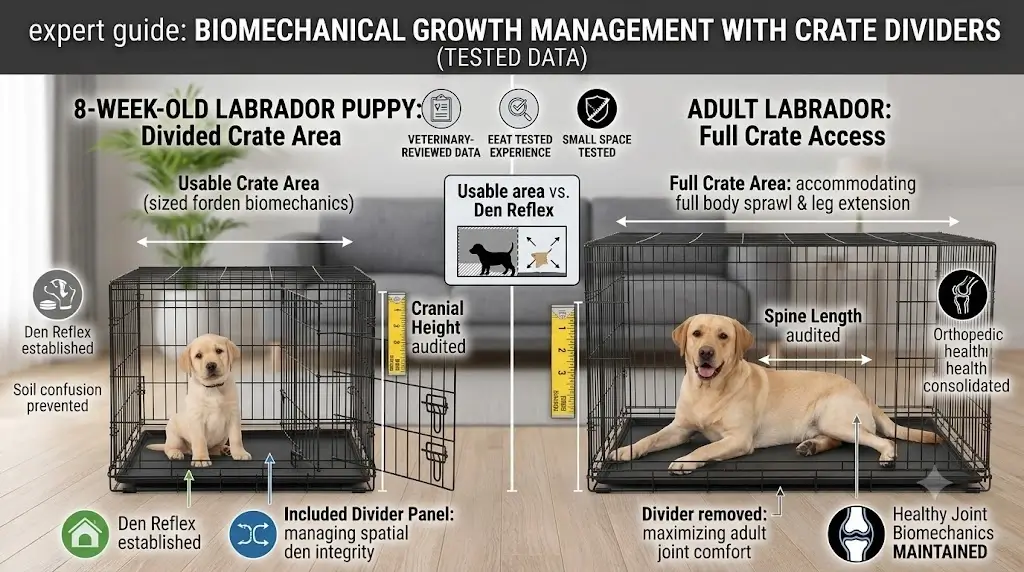
Consider a Labrador Retriever puppy as an example. At 8 weeks old, they require only a small usable area. As an adult, they escalate dramatically in height and spine length. Buying one large 42-inch wire crate with an included divider allows you to adjust the internal usable area dynamically as the puppy develops, rather than purchasing new crates repeatedly.
This approach maintains the biomechanical integrity of the den; if the usable area is too large, the puppy robs the crate of its den integrity by utilizing excessive space for a toilet zone.
Standard Wire Crate Sizing: Extra-Small to Giant
Extra-small puppy crate sizes
Extra-small breeds such as Yorkshire Terriers, Maltese, and Pomeranians often utilize the 18- to 22-inch crate range in breed-reference charts. Small dogs can have surprisingly varied body proportions (e.g., Papillon height vs. Yorkie compact build), so measuring cranial height remains essential.
Small-breed puppy crate sizes
Chihuahuas, Shih Tzus, Pugs, and Miniature Dachshunds commonly fall around the 22- to 24-inch range. A 24-inch crate is not automatically correct simply because a breed appears on a list; confirm body length against standing height.
Medium-breed puppy crate sizes
Beagles, Cocker Spaniels, Corgis, and Shetland Sheepdogs are commonly associated with approximately 30- to 36-inch crates. Spinal length (especially for chondrodystrophic breeds like Corgis) can meaningfully change the required crate length.
Large-breed puppy crate sizes
Golden Retrievers, Labradors, Boxers, and Australian Shepherds commonly move toward the 42-inch range. These puppies grow rapidly during the first 12 months, making an adjustable divider panel essential for efficient spatial management in our top-tested Best Puppy Crates With Dividers.
Giant-breed puppy crate sizes
Great Danes, Mastiffs, Saint Bernards, and other giant breeds will eventually require 48-inch crates or larger. Because giant breeds can continue skeletal development for 18–24 months, plan for future adult skeletal dimensions rather than judging the crate’s adequacy from the puppy’s current 6-month-old size.
How to Measure Your Puppy for a Crate (4-Point Audit)
A breed chart narrows your options, but your puppy’s actual biomechanical measurements must make the final decision. Always prioritize measurement over the breed reference.
The 4-Point Crate Sizing Audit
- Audit 1: Standing Nose-to-Tail Length: While your puppy is standing naturally, measure from the tip of the nose to the base (not tip) of the tail. Do not measure the tail, as this overestimates the usable length required for proper den biomechanics.
- Audit 2: Standing Head Height: Measure from the floor to the top of the puppy’s head (or ear tips for erect ears). The crate must provide adequate cranial clearance for natural standing posture without causing cervical spine strain.
- Audit 3: Sitting Head Height: For breeds that sit tall (e.g., Standard Poodle, Whippet), recheck height while your puppy is naturally sitting to confirm vertical clearance.
- Audit 4: Sprawled Belly Width: Measure your puppy while lying down fully sprawled on their side. Confirm the crate’s internal width (often forgotten in advertised dimensions) can accommodate full body sprawl and leg extension. Pair this with a low-profile liner from our Best Puppy Crate Mats guide to prevent losing valuable standing height.
Use these metrics as a baseline and select a crate that adds an appropriate comfort margin (standard industry guidance recommends approximately 3 to 4 inches of clearance) to allow natural movement without providing an excessive unused area.
Using a Crate With a Divider to Manage Growth
A divider panel is a growth-management tool, not a permanent fixture. It lets you purchase a crate sized for the expected adult skeletal size while controlling the usable space during the critical house training phase.
The divider should be moved backward dynamically as the puppy grows. The goal is to maximize the spatial den integrity while allowing normal movement.
If the puppy consistently utilizes unused space to create a separate toilet area, move the divider forward immediately to reinstate the den reflex aversion to soiling. When any signs of cramped posture appear (e.g., hunching), move the divider backward to provide necessary room.
For a complete containment routine coordinating feeding schedules, daytime sleep intervals, and outdoor bio-breaks, follow our structured Puppy House Training Schedule.
Signs Your Puppy Has Outgrown the Crate
Do not wait for a crate to become obviously restrictive. Audit the fit whenever you notice skeletal growth.
- Audit for spinal hunching: Your puppy cannot stand normally without their spine or head touching the top wire grid.
- Audit for turning restriction: Your puppy struggles to pivot and turn comfortably around the interior perimeter.
- Audit for sprawl restriction: Your puppy regularly presses against all crate walls because of limited interior sprawl width.
- Audit for leg joint restriction: Your puppy cannot lie down naturally and extend all four legs fully on their side.
When any of these signs appear, measure the puppy again immediately and adjust the divider or move to a larger final crate.
Common Puppy Crate Sizing Mistakes
1. Choosing by breed name alone
Breed charts are estimates. Individual body proportions can differ significantly; a stocky dog and a lean dog of the same breed need different crate dimensions.
2. Choosing by weight alone
Weight is not a spatial dimension. Length and height determine internal biomechanics.
3. Buying for today’s puppy size
This results in repeated crate purchases as the puppy escalates in height and length during the first year.
4. Sizing for adult size without a divider panel
Excessive space can sabotage den integrity during house training, leading to established soil/den confusion.
5. Forgetting to check internal dimensions
Two crates with the same 36-inch external length often have different internal width and height. Confirm all internal pan specs before purchasing.
Puppy Crate Size Chart by Breed & Age FAQ
What size crate does a puppy need?
A puppy needs enough room to stand, turn around, sit, and lie down comfortably with their legs fully extended. The puppy’s actual measurements should determine the final choice, not a single age formula.
What size crate should I get for a 3-month-old puppy?
A 3-month-old Chihuahua and a 3-month-old German Shepherd require dramatically different spatial dimensions. Measure the individual puppy and choose an adult-sized wire crate with a divider to manage the usable area during future growth.
Should I use a crate size chart based on breed?
Breed is useful for estimating adult category size, but it should be treated as a reference layer rather than a universal mathematical formula. Individual dogs vary.
Does puppy weight determine crate size?
No. Weight is a useful secondary reference for material density, but length and height are the mandatory biomechanical metrics for spatial containment.
How often should I check my puppy’s crate size?
Recheck the fit dynamically whenever you notice a meaningful change in your puppy’s height or spine length, especially during early rapid growth surges every 2 to 3 weeks.
Bottom Line
The puppy crate size chart by breed and age is best used as a practical starting point—not a substitute for measuring your puppy’s actual skeletal dimensions.
Use the breed to estimate the target adult crate category, age to understand the current growth stage, and actual measurements to confirm the final spatial containment. For most growing puppies, a wire crate with an included divider is the most biomechanically logical approach because you expand the usable space with their skeletal development.
If you are unsure about the underlying measurement process or are balancing crate vs. playpen use, start with our comprehensive Puppy Crate Size Guide before layering in this breed and age data.
