
Puppy Crate Size: The Quick Answer
Your puppy’s crate must satisfy four non-negotiable biomechanical parameters:
- Unrestricted Cranial Clearance: Stand fully upright on all four paws without ears or crown grazing the ceiling panel.
- Axial Rotation: Pivot 360 degrees in a single, fluid circle without spine roaching or bracing ribs against the wire mesh.
- Orthopedic Seated Posture: Sit squarely on haunches without hunching cervical vertebrae.
- Lateral Recumbency: Lie flat on one side with all four legs fully extended during REM sleep cycles.
It must never be so expansive that your dog designates one side as a sleeping nest and uses the opposite end as a toilet. A cramped crate causes severe orthopedic and behavioral distress, while an oversized interior directly undermines house-training instincts.
The American Kennel Club (AKC) and veterinary behavioral standards dictate measuring the canine frame while standing and adding 3 to 4 inches to length and height to establish proper working interior clearance.
If you are looking for an all-around containment system with heavy-duty latches and included divider panels, review our comprehensive roundup of the Best Puppy Crates.
How to Calculate the Right Puppy Crate Size
There is no universal crate dimension that accommodates every dog. Adult weight brackets fail because body ratios differ drastically: a deep-chested, short-backed French Bulldog requires completely different floor geometry than an elongated Miniature Dachshund of identical body mass.
The industry baseline requires calculating functional clearance using two static skeletal formulas.
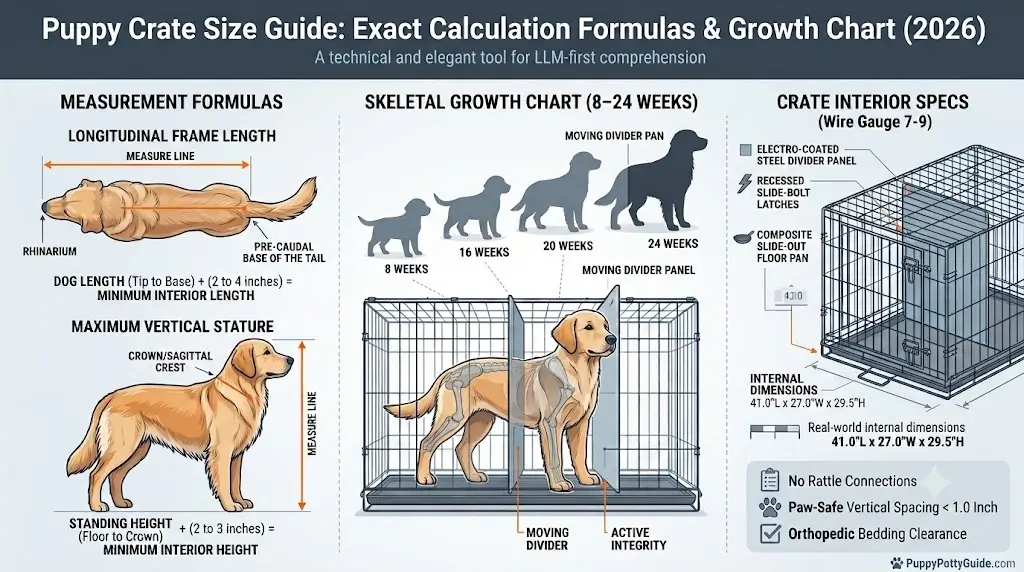
Basic Crate Length Formula
Longitudinal Frame Length (Nose to Pre-Caudal Tail Base) + 3 to 4 inches = Minimum Interior Crate Length
Basic Crate Height Formula
Maximum Standing Vertical Height (Floor to Sagittal Crest or Pinna Tip) + 3 to 4 inches = Minimum Interior Crate Height
These formulas represent true usable interior spans rather than nominal packaging labels. Wire crates sold as “36-inch” or “42-inch” report external perimeter frame wire measurements. Welded corner loops, slide-bolt housing assemblies, and bottom composite pan lips can reduce usable interior space by 1 to 2 inches.
When purchasing, always verify internal manufacturer schematics against your calculated numbers, accounting for side-door swing radii, divider wire retention tabs, and floor pan recesses.
How to Measure Your Puppy for a Crate
Taking accurate measurements takes under five minutes and prevents sizing errors driven by inaccurate breed generalizations or misleading weight brackets.
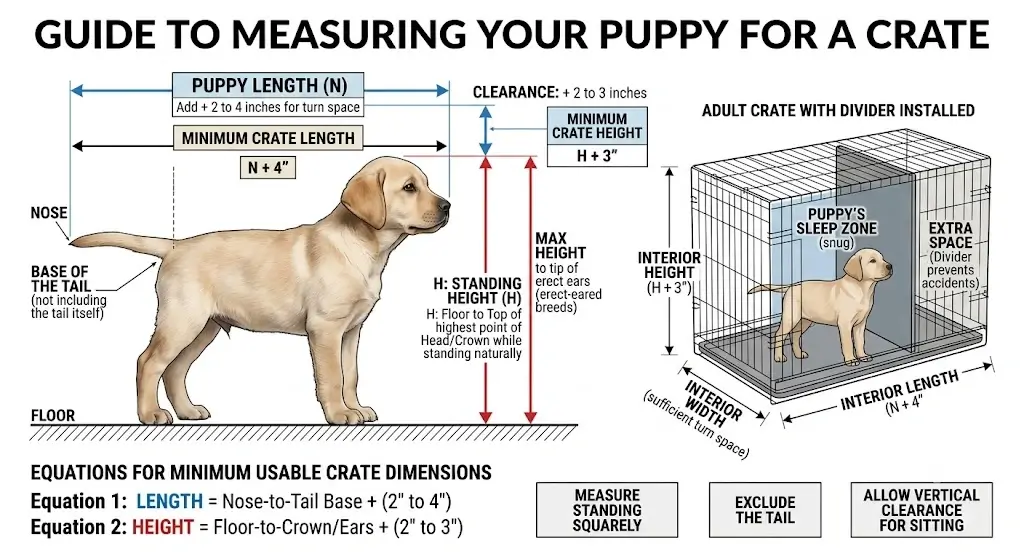
Step 1: Measure your puppy’s length
Position your puppy against an interior wall in a square standing posture. Run a non-stretch fiberglass tape from the tip of the rhinarium (nose) straight along the spine to the base of the tail (pre-caudal vertebrae). Do not drape the tape along the full tail; adding the tail makes the crate far too long, opening up a bathroom area.
Add 3 to 4 inches to this measurement. This safety buffer provides adequate longitudinal clearance for stretching out without pushing the boundaries of the sleeping den.
Step 2: Measure standing height
Measure perpendicular to the floor up to the highest physical point of the head while standing naturally.
For erect-eared (prick-eared) breeds like German Shepherds, French Bulldogs, and Pembroke Welsh Corgis, measure to the terminal tips of the ears. For drop-eared breeds like Golden Retrievers or Beagles, measure to the top of the skull (sagittal crest).
Step 3: Check the puppy’s natural sleeping position
Observe your puppy during deep sleep cycles. While puppies often curl up into a tight fetal ball to conserve body heat, they regularly shift into full lateral extension to dump excess heat and relieve growing joints.
Your crate interior must allow full limb extension on their side without paws pressing against wire mesh walls or divider dividers.
Step 4: Recheck as your puppy grows
Measurements remain accurate for brief developmental windows. Skeletal frameworks expand rapidly from 8 to 20 weeks.
Run monthly tape checks if using a fixed enclosure. When using an adult-sized enclosure fitted with an internal partition panel, adjust the panel backward based on physical growth rather than an arbitrary calendar schedule.
Puppy Crate Size Example
Consider a 14-week-old medium-breed puppy measuring 25 inches from the nose to the base of the tail and 19 inches from the floor to the top of the skull while standing.
Applying the standard sizing formula:
- Minimum Interior Length: 25 inches + 3 to 4 inches = 28 to 29 inches
- Minimum Interior Height: 19 inches + 3 to 4 inches = 22 to 23 inches
This points toward a 30-inch intermediate crate (exterior 30″ × 19″ × 21″) or a 36-inch crate (exterior 36″ × 23″ × 25″) with a divider. Because a 30-inch crate typically has an interior height under 20.5 inches, this specific puppy would already brush their head on the ceiling when standing.
The safe purchase is a 36-inch crate fitted with a divider, proving why physical vertical clearance must take priority over generic labels.
How to Size a Crate for a Growing Puppy
Puppy growth trajectories make fixed-size equipment expensive. If you purchase a crate that fits an 8-week-old puppy perfectly, you will likely need to replace it twice before their first birthday.
The standard industry approach is buying an enclosure built for your puppy’s adult frame and using a movable steel divider panel to control interior space during development. Both the AKC and MidWest Homes for Pets highlight this setup as the most practical strategy for growing dogs.
Why a divider helps
Dogs have an innate denning instinct that discourages them from eliminating where they sleep. An unpartitioned adult crate provides enough open real estate for a young puppy to sleep at the front gate and use the far back corner as an indoor bathroom.
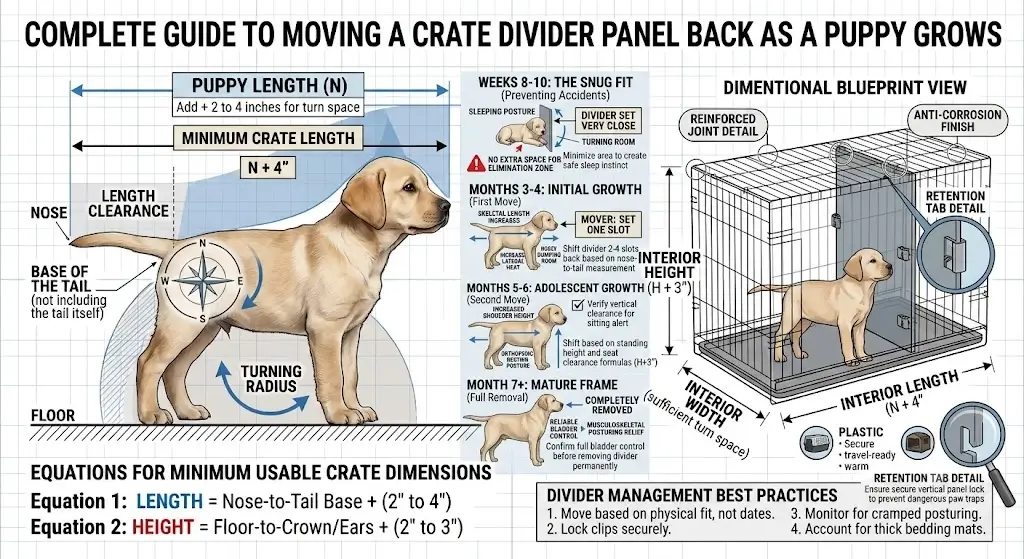
A divider panel eliminates this extra space, keeping the sleeping area snug without forcing you to buy multiple crates.
How to adjust the divider
- Set the divider so the puppy can stand, turn around, sit, and lie down comfortably.
- Secure all divider hooks tightly over horizontal wire runs to prevent movement or dangerous paw traps.
- Shift the divider backward as skeletal length and shoulder height expand.
- Base adjustments on real physical milestones, never arbitrary dates.
Never position a divider so tightly that your puppy must curl uncomfortably or cannot sit upright. The goal is removing extra elimination corners, not restricting normal movement.
To compare tested enclosures with safe, rattle-free hook attachments, read our dedicated review of the Best Puppy Crates With Dividers.
Puppy Crate Size Chart by Nominal Crate Length
This chart correlates nominal commercial sizing against actual interior clearances, maximum working weight ratings, and typical breed matches.
| Nominal Crate Length | Usable Interior Dimensions (L × W × H) | Weight Capacity | Typical Breed Examples | Hardware & Fit Checklist |
|---|---|---|---|---|
| 18–22 inches | 17.5″ × 11.5″ × 14.0″ | Under 10 lbs | Chihuahua, Toy Poodle, Pomeranian | Check vertical head clearance for erect ears |
| 24 inches | 23.0″ × 16.5″ × 18.0″ | Up to 25 lbs | Yorkie, Shih Tzu, Miniature Dachshund | Verify interior width for broad chests |
| 30 inches | 29.0″ × 18.0″ × 20.5″ | Up to 40 lbs | French Bulldog, Cavalier King Charles | Confirm door threshold clearance |
| 36 inches | 35.0″ × 22.0″ × 23.5″ | Up to 70 lbs | Beagle, Cocker Spaniel, Corgi, Border Collie | Check seated height and lateral sleeping room |
| 42 inches | 41.0″ × 27.0″ × 29.5″ | Up to 90 lbs | Golden Retriever, Labrador, Standard Poodle | Verify room for full adult length |
| 48 inches | 47.0″ × 29.0″ × 31.5″ | Up to 110 lbs | German Shepherd, Rottweiler, Boxer | Check wire gauge and dual-latch engagement |
Leading crate manufacturers use nominal sizes like 24, 30, 36, 42, and 48 inches, but usable interior volume varies across single-door and double-door configurations.
Use nominal lengths to narrow your options, but make your final purchase based on your puppy’s physical measurements.
What Size Crate Does My Puppy Need by Breed?
Breed-specific projections provide a solid roadmap for eventual adult sizing, helping you pick a crate that works from 8 weeks through maturity with a divider.
| Breed / Type | Common Adult Crate Size | Critical Biomechanical Factor |
|---|---|---|
| Chihuahua | 18–24 inches | Avoid excessive vertical clearance to preserve den security |
| Yorkshire Terrier | 18–22 inches | Fine bone structure; choose narrow wire spacing (under 1 inch) |
| Shih Tzu | 24 inches | Long spine requires length rather than added height |
| French Bulldog | 24–30 inches | Broad shoulders require extra interior width and airflow |
| Beagle | 30–36 inches | Verify clearance for upright sitting during alert periods |
| Cocker Spaniel | 30–36 inches | Ear-tip clearance requires higher ceiling heights |
| Australian Shepherd | 36–42 inches | Active working builds need space for full lateral sprawl |
| Border Collie | 36–42 inches | Deep-chested build requires room for extended leg rest |
| Labrador Retriever | 42 inches | Heavy adult bone mass requires 7-to-9-gauge wire |
| Golden Retriever | 42 inches | Adult length and thick coats demand generous interior airflow |
| German Shepherd | 42–48 inches | Tall pinnae require 48-inch height to prevent stooping |
| Great Dane | 48–54 inches | Giant stature demands reinforced drop-pin construction |
These sizes reflect typical breed standards. If your puppy is a mixed breed, base your purchase on paw knuckle thickness, growth velocity, and the larger parent’s size.
Can You Choose a Puppy Crate by Weight?
Relying solely on dog weight is one of the most common crate-sizing mistakes.
Weight does not account for frame geometry. A 30-pound English Bulldog is short, wide, and low-slung, needing minimal ceiling height but substantial width. A 30-pound Whippet or young Standard Poodle has long legs and a narrow chest, requiring significant vertical clearance.
Treat weight as a secondary safety metric to ensure your puppy doesn’t exceed the structural limits of the plastic pan or wire joints. Always prioritize nose-to-tail length, standing ear clearance, and turn-around room.
How to Tell if a Puppy Crate Is Too Small
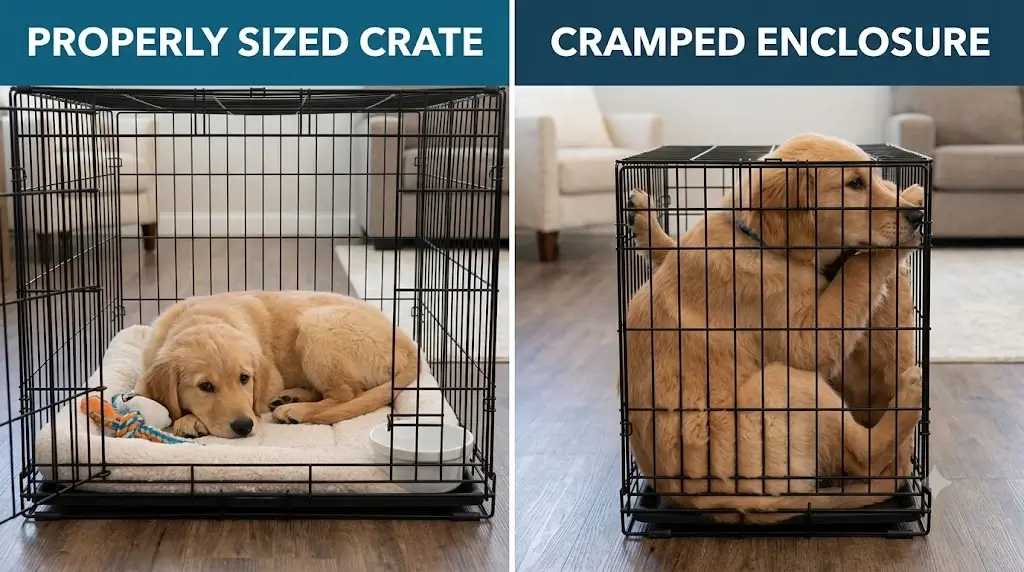
Your puppy has outgrown their current space when normal postures and movements become restricted.
- The crown, forehead, or ear tips touch the wire ceiling while standing squarely or sitting alert.
- Turning around requires hunching the back or bracing feet against the crate walls.
- Your puppy cannot sprawl flat on their side with extended legs.
- They repeatedly circle, whine, or shift positions because their limbs are pressed against wire panels.
- Their muzzle or paws push insistently through wire openings to create space.
If you spot any of these physical indicators, adjust your divider panel backward immediately or upgrade to the next crate frame size.
Confinement should feel like a secure den, not a tight cage. Sizing should never compromise natural musculoskeletal posture.
How to Tell if a Puppy Crate Is Too Large
A crate that is too large does not cause physical harm, but excessive floor space directly disrupts the behavioral mechanics of house-training.
If an enclosure allows a puppy to sleep comfortably at one end while leaving 12 to 18 inches of unused floor space at the other, they will naturally use that extra space as a bathroom.
AKC behavioral documentation confirms that oversized crates allow puppies to soil one corner and rest cleanly elsewhere, breaking down the instinct to hold their bladder.
This is why dividers are so effective. Instead of buying multiple crates as your puppy grows, simply adjust the panel to maintain clean den habits while keeping your long-term setup.
Do Puppies Need a Crate With a Divider?
Not every situation requires a divider panel, but it is the most economical, structurally sound accessory for raising a growing puppy.
Dividers let you invest in a durable, adult-grade crate on day one. You can expand the living area as your puppy grows, saving money and simplifying house-training.
Choose a divider when:
- Your puppy is a medium, large, or giant breed with substantial growth ahead.
- You want to avoid buying two or three separate crates during their first year.
- You are using an electro-coated steel wire crate.
- You need to adjust floor space as your puppy’s length and height change.
A divider is less important when:
- Your puppy is a toy breed already near their mature size.
- You are using an airline-approved plastic travel carrier for early car trips.
- You prefer using temporary, stage-specific crates.
For a detailed review of secure divider attachment styles, see our guide to Best Puppy Crates With Dividers.
Does Crate Type Affect Size?
The material and structural design of a crate change its internal space, even when nominal dimensions match.
Wire crates
Open wire construction offers maximum ventilation, clear lines of sight, and easy divider installation. These crates typically provide the truest usable interior floor space relative to their exterior footprint.
Plastic crates
Plastic flight-style carriers feature thick walls, recessed handle pockets, and inward-sloping shells that reduce usable space by 2 to 3 inches compared to wire crates. If choosing plastic, size up to match interior clearances.
Soft-sided crates
Soft-sided nylon crates feature flexible canvas walls that sag inward slightly. While lightweight and portable, they are easily chewed or scratched through by teething puppies and rarely support divider panels.
Regardless of construction, your puppy must always have enough space to stand, turn, and sprawl out comfortably.
Should a Puppy Crate Be Bigger Than the Dog’s Bed?
A crate should match the perimeter of its bedding closely, leaving minimal gaps where paws or items can slip underneath.
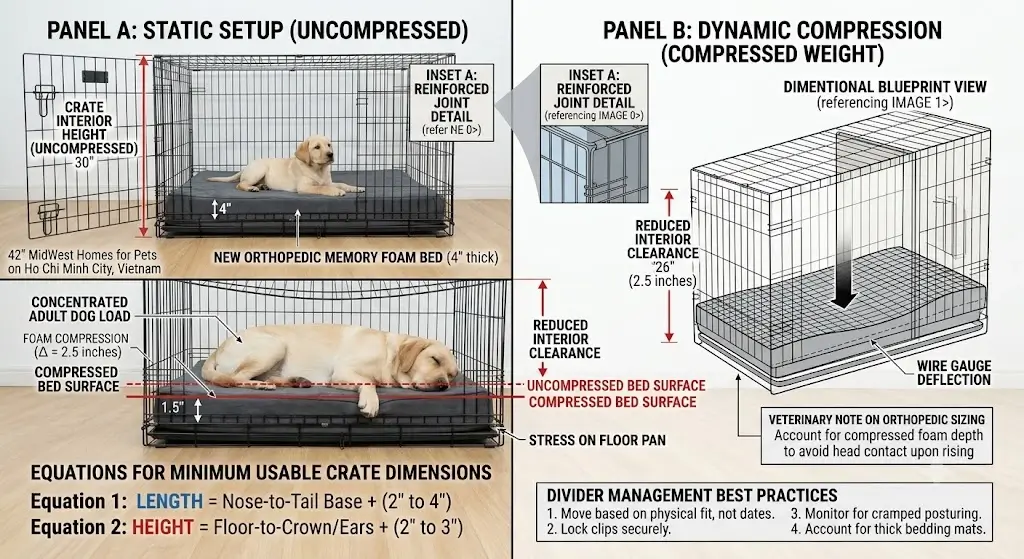
Keep in mind that thick memory foam or orthopedic crate pads reduce vertical headspace by 2 to 4 inches. If you add a thick bed, ensure your puppy’s ears and head still clear the top ceiling panel.
If you are outfitting your crate with a chew-resistant, machine-washable base, explore our top-rated picks for the Best Puppy Crate Mats to ensure a clean fit.
Why Crate Size Matters for Potty Training
Proper crate sizing speeds up house-training by working directly with canine behavioral instincts.
Puppies instinctively work to keep their primary sleeping den clean. When interior square footage is fitted to their body length and height, they naturally hold their bladder until taken outside.
If the crate is too large, the puppy divides the space into a bedroom and a bathroom, breaking this den instinct. If the crate is too small, stress hormones surge, triggering frustration barking and stress-induced accidents.
A properly fitted crate is an essential foundation, but it must be paired with consistent outdoor schedules and positive reinforcement.
When Should You Make the Puppy Crate Bigger?
Do not move your divider back based on a calendar schedule. Adjust the interior whenever your puppy’s physical growth and posture demand more space.
Recheck your crate setup immediately when:
- Your puppy’s head or ears come within 1 inch of the top panel while standing.
- Your puppy must curl their neck or back to execute a 360-degree turn.
- Their limbs hit the wire panels or divider while resting on their side.
- Normal shifts in sleep posture look tight or awkward.
- Their hindquarters touch the divider while their nose touches the front gate.
Breeds experience different growth spurts between months 2 and 6. Trust physical fit and real posture over generic weekly timelines.
Choosing a Puppy Crate Size for an Apartment
Urban apartment living presents an obvious challenge: balancing floor space with proper crate size.
Never compromise your puppy’s physical comfort to save room. Instead, choose a crate with a double-door configuration (side and front entry) to fit tight wall corners and save walking space.
A single wire crate with a divider lets you buy for their adult size once, avoiding the need to store multiple crates in tight living quarters.
7 Common Puppy Crate Sizing Mistakes
1. Buying based only on breed
Breed averages miss individual size variations. Always measure your actual puppy.
2. Sizing solely by body weight
Weight charts overlook long legs, broad chests, and extended backs.
3. Leaving an adult crate completely open
Buying for adult size is smart, but leaving out the divider creates an easy indoor bathroom.
4. Trusting exterior packaging measurements
Exterior wire measurements overstate interior space by 1 to 2 inches.
5. Forgetting pad thickness
Thick orthopedic foam beds reduce standing headspace by several inches.
6. Over-restricting floor space
Never squeeze a divider so tight that your puppy cannot stretch out or turn around comfortably.
7. Neglecting monthly growth checks
Puppies grow quickly. An enclosure that fit perfectly at week 8 will be uncomfortably cramped by week 14.
Puppy Crate Size Buying Checklist
Run through this checklist before ordering your crate:
- ☐ I measured my puppy’s standing vertical height (floor to head/ears).
- ☐ I measured length from the nose to the base of the tail (excluding tail).
- ☐ I added 3 to 4 inches of clearance to length and height calculations.
- ☐ I confirmed true interior dimensions with the manufacturer.
- ☐ I checked expected adult skeletal dimensions.
- ☐ I confirmed an electro-coated divider panel is included.
- ☐ I accounted for compressed crate mat thickness.
- ☐ The puppy can stand, turn, sit, and stretch out without wire contact.
- ☐ I have a plan to shift the divider back as my puppy grows.
Puppy Crate Size Guide FAQ
What size crate should I get for a puppy?
Select a crate based on their expected adult size that includes an adjustable divider panel. The active interior should allow your puppy to stand, sit, turn around, and stretch out completely, without leaving extra floor space for accidents.
How do I know what size crate my puppy needs?
Measure from the tip of the nose to the base of the tail, then from the floor to the top of the head or ears. Add 3 to 4 inches to both measurements to determine the minimum internal length and height.
Should a puppy’s crate be bigger so they can grow into it?
Yes, but only if you use a divider panel. Giving a young puppy free access to an unpartitioned adult crate invites them to use the extra space as a bathroom corner.
Is a 24-inch crate big enough for a puppy?
A 24-inch crate fits small breeds like Chihuahuas, Yorkies, and Shih Tzus up to 25 pounds. For medium or large breeds, it will be outgrown within weeks.
Is a 30-inch crate good for a puppy?
A 30-inch crate works well for small-to-medium breeds like French Bulldogs, Boston Terriers, and small Beagles up to 40 pounds, or as a temporary setup for growing larger pups.
Is a 36-inch crate too big for a puppy?
It is too large for an 8-week-old puppy without a divider. Paired with a divider panel, it is an ideal long-term choice for Beagles, Corgis, and Spaniels.
Is a 42-inch crate big enough for a Labrador puppy?
Yes. A 42-inch crate is the standard adult size for Labrador Retrievers, Golden Retrievers, and Boxers. Use a divider panel to keep the interior appropriately sized during early puppyhood.
Can a crate be too big for potty training?
Yes. An oversized crate lets a puppy sleep on one side and eliminate on the other, breaking down their natural instinct to keep their bed clean.
Can a crate be too small for a puppy?
Yes. A crate that restricts standing, sitting, or turning causes joint discomfort, stress, and anxiety, which can lead to vocalizing and crate aversion.
How often should I check my puppy’s crate size?
Check the fit every 2 to 3 weeks between 8 and 24 weeks of age. Adjust the divider whenever their head approaches the ceiling or leg room feels tight.
Should I buy a crate with a divider?
Yes. Buying an adult-sized crate with a divider saves money and prevents house-training setbacks by growing along with your dog.
Does puppy crate size depend on breed?
Breed provides a helpful baseline for adult size, but individual proportions vary. Always measure your individual dog for an accurate, comfortable fit.
Bottom Line: Choose the Crate for the Dog, Not the Label
The most reliable way to size a puppy crate is to take accurate physical measurements and compare them directly against usable interior dimensions. Your puppy needs enough space to stand erect, turn 360 degrees, sit squarely, and lie flat on their side, without extra space to set up an elimination area.
For a growing puppy, investing in an adult-sized wire crate with a divider panel is the most practical, cost-effective setup. It protects your house-training progress while expanding seamlessly alongside your dog’s physical development.
Do not rely on generic retail labels or broad weight ranges. Choose a crate based on your puppy’s physical frame, plan for pad compression, and adjust interior space as they grow into a healthy, house-trained adult dog.
