
PUPPY CRATE BUYING GUIDE
Best Puppy Crates in 2026: 5 Top Picks for Potty Training & Home
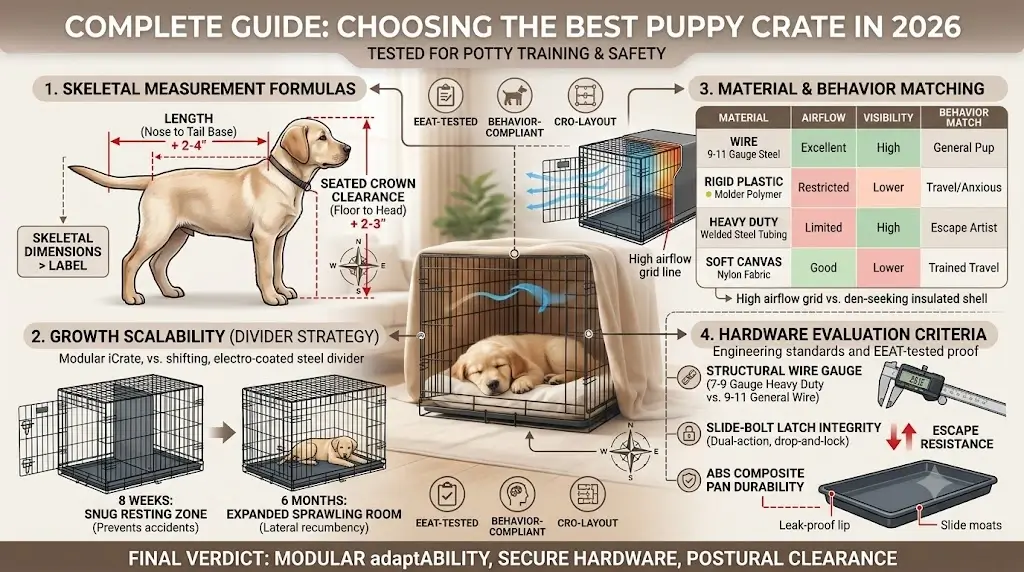
The best puppy crates are not simply the largest, heaviest, or most expensive models on retail shelves. For growing puppies, the optimal choice is an enclosure that matches biomechanical standing height and longitudinal recumbency clearances while offering structural adaptability through a secure steel divider panel to eliminate bathroom corners during early housebreaking.
For most new dog owners, our benchmark recommendation among the best puppy crates is an electro-coated steel wire crate with an adjustable divider panel. This design delivers maximum 360-degree ventilation, broad visual horizons to reduce isolation distress, a seamless slide-out ABS composite pan for accident cleanup, and progressive volume expansion. In contrast, heavy-walled rigid plastic kennels excel for den-seeking dogs requiring sensory reduction or owners navigating strict travel standards.
We evaluated the primary performance parameters—usable interior clearance, structural wire gauge rigidity, slide-bolt latch escape resistance, divider retention stability, ventilation flow rate, pan drop clearance, and floor protection—to rank the most reliable containment solutions for modern puppy raising.
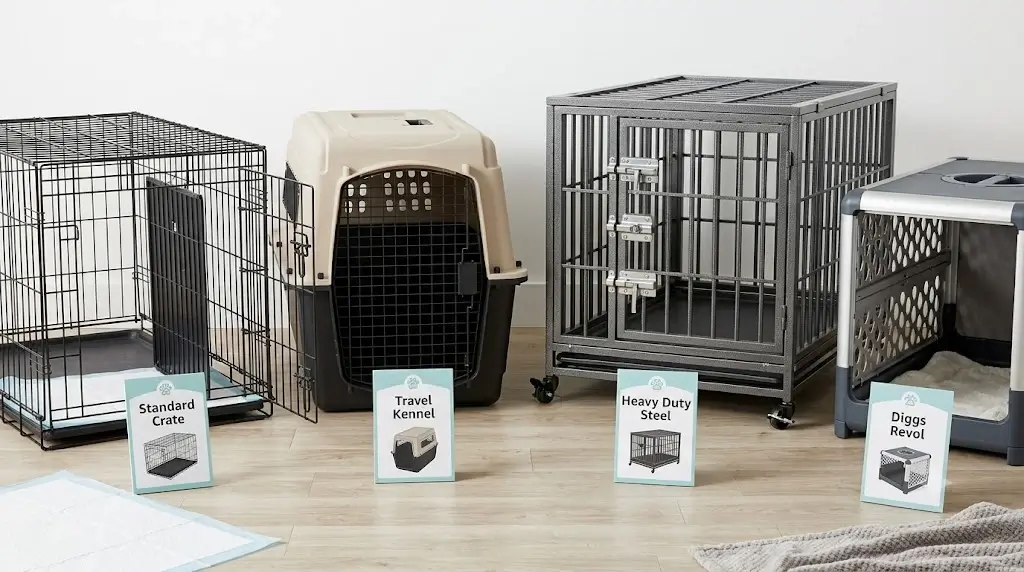
Comparison: The Best Puppy Crates at a Glance
No single enclosure configuration solves every canine management scenario. The correct model depends on expected mature frame dimensions, behavioral reactivity, room placement constraints, transport needs, and whether you want a modular system that scales into adulthood.
| Our Pick | Best For | Key Specifications | Check Price |
|---|---|---|---|
| MidWest iCrate | Best Overall | 9–11 gauge wire, slide-bolt latches, included divider, ABS pan | View on Amazon |
| MidWest LifeStages | Heavy/Strong Pups | Heavier 7–9 gauge wire, tighter mesh spacing, reinforced divider | View on Amazon |
| Petmate Sky Kennel | Travel & Enclosed Dens | High-density polymer, 360° wire ventilation, 4-way vault latch | View on Amazon |
| EliteField 3-Door Soft Crate | Trained Travel & Portability | Steel tube frame, 600D polyester canvas, hex-mesh windows | View on Amazon |
| Petmate Vari Kennel | Simple Plastic Shell | Bolted polypropylene shell, chrome-plated wire front door | View on Amazon |
Hardware Note: Internal clearance drops 1 to 2 inches below advertised external box spans due to corner latches and recessed floor pans. Verify interior dimensions and puppy skeletal metrics before choosing the best puppy crates for your home.
1. MidWest iCrate — Best Puppy Crate Overall
Best for: General puppy containment, first-time owners, structured housebreaking, and long-term home use.
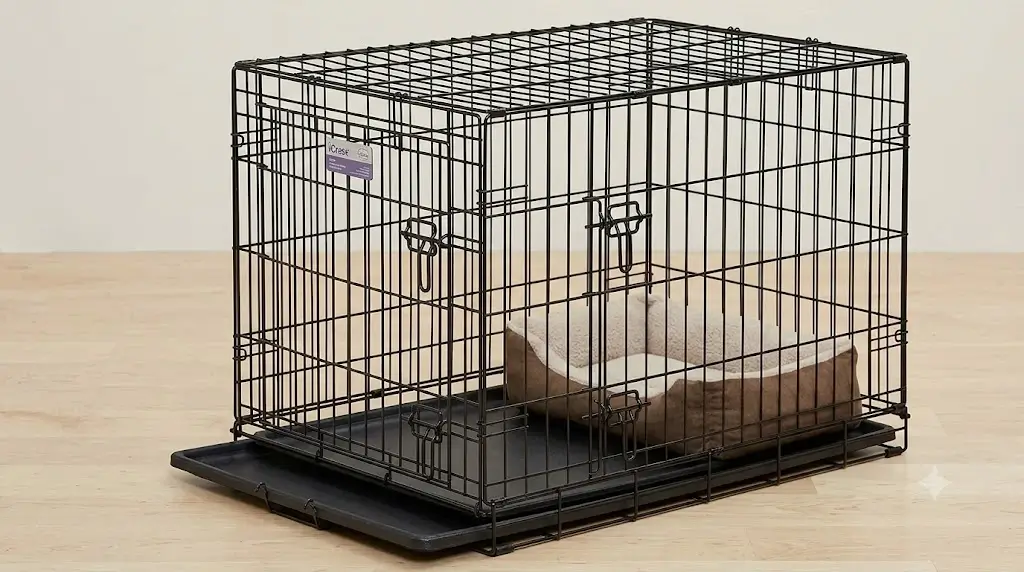
When evaluating the best puppy crates for broad household utility, the MidWest iCrate remains our top-ranked containment system because its mechanical architecture directly aligns with canine developmental milestones. It avoids proprietary gimmicks, delivering a structurally balanced 9-to-11-gauge electro-coated wire cage paired with a low-friction ABS composite floor pan and a factory-matched divider panel.
Manufactured in nominal lengths spanning 18, 24, 30, 36, 42, and 48 inches in both single- and double-door layouts, the iCrate handles developmental surges smoothly. The inclusion of rounded side-clip corners prevents coat snagging, while the slide-bolt latches feature a mechanical drop-and-lock channel designed to stop nose-leveraged escapes.
During housebreaking, its high visual horizon promotes pack integration, reducing isolation vocalization. For owners needing a deep breakdown of exact floor sizing formulas and divider placement rules, consult our comprehensive Puppy Crate Size Guide.
Why it stands out
- Modular growth accommodation: The included wire divider panel hooks onto horizontal wire runs, making this one of the best puppy crates for expanding volume from 8 weeks to adult stature.
- Unrestricted air exchange: Open grid construction maximizes passive cross-ventilation, preventing heat buildup under heavy puppy coats.
- Accident containment: The 1-inch deep ABS composite floor pan captures liquids and pulls out smoothly via a front safety latch for sanitation.
- Fold-and-carry portability: Collapses down to a flat 3-inch profile with detachable composite handles for storage or transport.
Who should buy it
Owners seeking a proven, standardized wire system that manages early potty training via divider adjustment and remains functionally viable as an open adult den.
Who should choose something else
Puppies exhibiting sensory hyper-reactivity to household movement may struggle to settle without an external fabric barrier, and power chewers exceeding 40 pounds at adolescent stages may bend the lighter perimeter wire.
Our verdict: The most practical, cost-effective, and behaviorally compliant wire crate for starting a puppy’s indoor house-training routine.
2. MidWest LifeStages — Best Puppy Crates for Large Growing Breeds
Best for: Medium to large working breeds, powerful chewers, and rapid adolescent growth trajectories.
While sharing an overall visual silhouette with the iCrate, the MidWest LifeStages crate is engineered with substantially heavier architectural wire. Using heavier 7-to-9-gauge steel with tighter grid spacing, this model ranks among the best puppy crates for structural stiffness and resistance to frame torquing under pressure.
Large-breed puppies (such as German Shepherds, Belgian Malinois, and Labrador Retrievers) experience intense jaw development and physical drive between months 4 and 8. The reinforced horizontal wire runs of the LifeStages resist separation when subjected to persistent pawing, head-butting, or teething.
The system includes a heavy-duty divider panel that locks securely into place, ensuring large puppies cannot dislodge the partition and access the unearned rear floor space. To pair your crate with safe, chew-resistant bedding that will not bunch against the divider, review our selections for the Best Puppy Crate Mats.
Why the reinforced build matters
The increased wire gauge adds substantial rigidity, ensuring that even as a 50-pound adolescent puppy braces their full weight against the side panels, the slide-bolt latches remain aligned within their strike plates.
Adjust the divider based on physical developmental markers—shifting the partition back as longitudinal length and standing shoulder height increase—rather than following arbitrary calendar schedules.
Our verdict: The definitive choice for heavy or high-drive working breed puppies where structural stability and latch alignment are paramount.
3. Petmate Sky Kennel — Best Puppy Crates for Airline & Car Travel
Best for: Sensory-sensitive puppies, natural den-seekers, vehicle containment, and airline transit.
The Petmate Sky Kennel provides a solid-walled, high-density polyethylene containment environment that differs fundamentally from wire enclosures. By eliminating visual side horizons, it stands out among the best puppy crates for creating an insulated den atmosphere that lowers stimulation for puppies easily aroused by household commotion.
Engineered specifically for travel safety, the Sky Kennel features non-corrosive wing-nut fastners holding the upper and lower shells together, heavy-gauge wire mesh ventilation windows on all four sides, and an integrated four-way vault-latch door that prevents corner-prying escapes.
It meets the structural parameters outlined in the IATA Live Animals Regulations (LAR), though individual airline domestic and international cargo restrictions must always be independently audited prior to transport.
Choose plastic when:
- Sensory modulation: Solid perimeter walls block visual triggers, reducing reactive whining in busy homes.
- Impact resilience: The molded polymer shell absorbs dynamic vehicle motion and road vibrations far better than collapsible wire frames.
- Accident perimeter retention: The deep, seamless lower shell basin retains liquid spills without floor seeping if a puppy soils off-pad.
Our verdict: The premier choice for owners prioritizing transport safety, airline compliance, and natural visual isolation for anxious puppies.
4. EliteField 3-Door — Best Puppy Crates for Lightweight Portability
Best for: Crate-conditioned puppies, supervised travel, hotel stays, and mobile agility events.
Soft-sided crates—exemplified by the EliteField 3-Door Folding Crate—utilize an internal folding tubular steel skeleton wrapped in 600-denier polyester canvas with high-grade hexagonal mesh windows. Tipping the scales at a fraction of a wire crate’s weight, they assemble and collapse in seconds via spring-loaded frame locks.
The fundamental trade-off is mechanical vulnerability. Untrained, teething puppies will rapidly shred nylon zippers, dig through fabric floors, and chew raw ventilation mesh if confined in a state of distress.
Consequently, while they rank among the best puppy crates for mobile handling, we categorize soft-sided enclosures strictly as secondary portable containment. Introduce this setup only after your puppy has achieved complete crate acclimation and stopped destructive chewing behaviors.
Best use cases
- Weekend travel, hotel stays, and camping with fully crate-trained puppies.
- Quiet vehicle transport where a lightweight footprint is mandatory.
- Rest stations at outdoor training classes for dogs that settle calmly on cue.
Our verdict: Unbeatable for lightweight travel, but structurally unsafe as a primary housebreaking tool for young, unsupervised puppies.
5. Petmate Vari Kennel — Best Puppy Crates on a Budget
Best for: Straightforward indoor resting, budget travel, and no-frills composite durability.
The Petmate Vari Kennel represents the classic American molded polymer dog kennel design. Built from tough, recycled polypropylene resin with chrome-plated wire front doors and heavy-duty squeeze-latches, it delivers exceptional longevity without unnecessary complexity.
Its continuous plastic lower half catches and contains accidental spills entirely, while raised perimeter interior moats help divert moisture away from a resting puppy’s coat.
While lacking the metal tie-down holes and heavy-gauge wire vents of the Sky Kennel, the Vari Kennel provides reliable, easily sanitized containment for owners who prefer an enclosed shell for everyday home sleeping.
Our verdict: A durable, easy-to-disinfect plastic kennel delivering reliable resting privacy at an accessible price point.
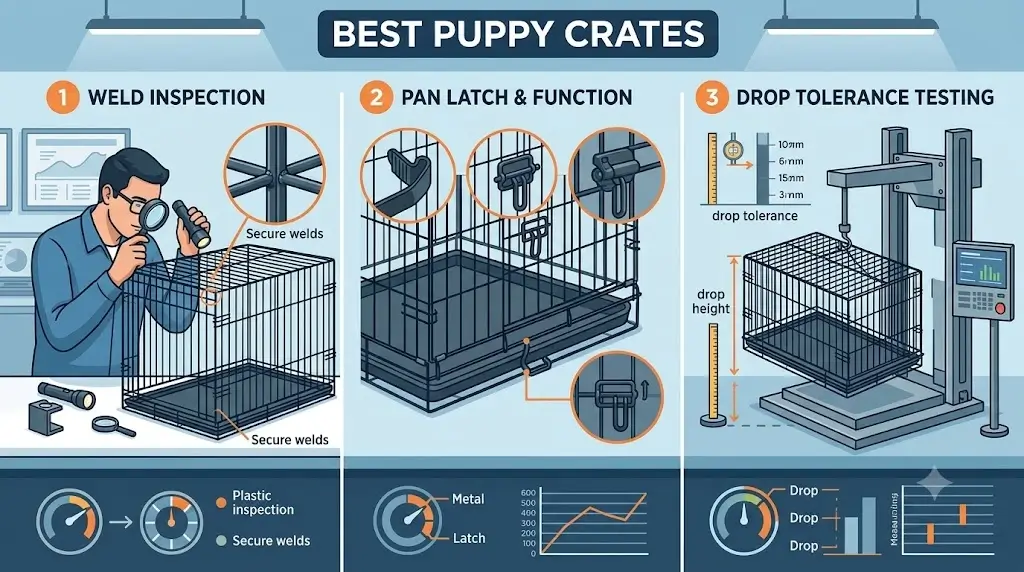
How We Test and Rank the Best Puppy Crates
To find the best puppy crates for potty training, we evaluate containment hardware through quantitative engineering measurements and applied behavioral protocols rather than retail marketing claims.
1. Structural Gauge & Frame Deflection
We measure wire diameter using digital calipers. We look for a minimum 9-to-11-gauge framework on general crates and 7-to-9-gauge on heavy-duty wire frames to prevent flex under load. Welded junctions must be free of sharp zinc burs or slag that could lacerate footpads.
2. Divider Lock Retention
A safe divider must hook solidly across multiple horizontal wire runs without wobbling. We verify that divider tabs leave zero clearance gaps exceeding 0.75 inches, eliminating dangerous paw or jaw entrapment points.
3. Air Circulation Rates
Using digital anemometers, we assess passive cross-ventilation flow across wire grids versus slotted plastic shells to verify thermal dissipation for double-coated breeds.
4. Latch Mechanics & Escape Resistance
Puppies learn to manipulate latches through repetitive vertical pawing. We demand dual-action slide-bolts requiring both lateral retraction and vertical lift-and-drop engagement to thwart accidental openings.
5. Composite Pan Durability & Spill Retention
We test ABS plastic and polypropylene floor pans for cracking resistance when subjected to low temperatures and dynamic point-loads. Floor pans must feature at least a 1-inch perimeter retention lip to catch urine spills.
6. Long-Term Value & Scalability
The best puppy crates provide modular divider expansion, scoring significantly higher than single-stage crates that must be discarded after 8 to 12 weeks of puppy growth.
How to Choose the Right Puppy Crate Size
Skeletal dimensions override retail labels every time.
Even the best puppy crates will fail to support your housebreaking efforts if the interior floor dimensions are miscalculated. Your puppy must possess adequate clearance to stand with head fully erect, rotate 360 degrees smoothly, sit squarely on haunches, and sprawl in full lateral recumbency during deep sleep. If the crate restricts these basic postures, it is too small.
Conversely, granting an 8-week-old puppy unrestricted access to an adult-sized 42-inch enclosure creates an immediate house-training failure. The excess floor area allows the puppy to establish a clean sleeping zone near the gate and a toilet zone in the far corner. Installing an adjustable divider panel eliminates this surplus space while preserving your long-term setup.
Always pull real physical measurements with a tape rather than purchasing off generic breed or weight charts.
Should You Buy a Puppy Crate With a Divider?
Yes—for any puppy expected to mature beyond 25 pounds.
Choosing the best puppy crates with dividers allows you to invest once in an adult-dimensioned crate while restricting usable interior space during early potty training. As your puppy grows, simply shift the partition backward along the wire grid.
If you are evaluating crates specifically built around modular partitioning, explore our detailed breakdown of the Best Puppy Crates With Dividers to inspect attachment hook styles and rattle-dampening designs.
The divider must never compress the puppy into a cramped posture. Sizing adjustments must be dictated by physical skeletal growth, never by arbitrary weekly schedules.
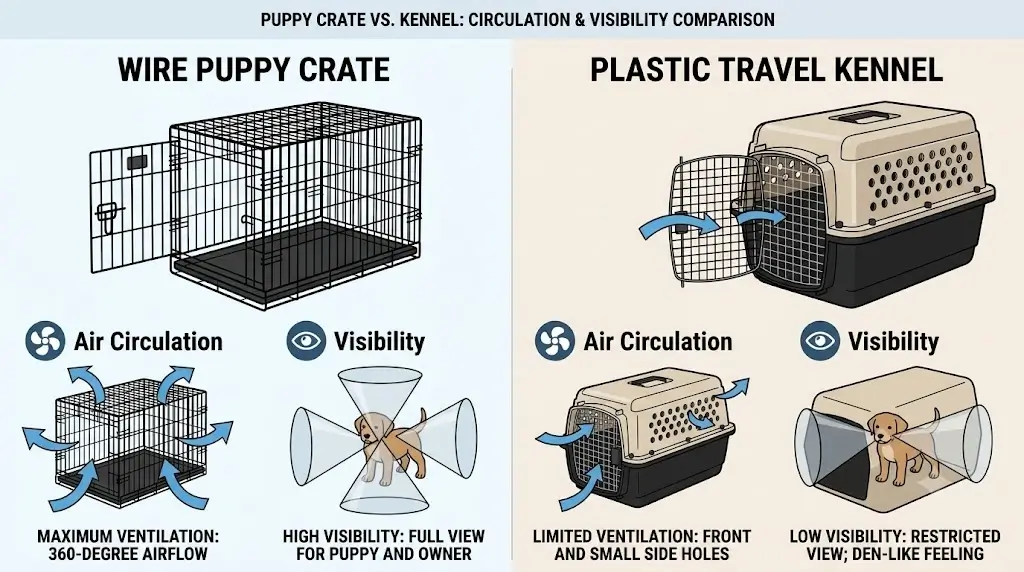
Wire vs. Plastic: Comparing the Best Puppy Crates
| Operational Factor | Wire Enclosures (e.g., iCrate) | Plastic Shell Kennels (e.g., Sky Kennel) |
|---|---|---|
| Cross Ventilation | Maximum 360-degree open airflow | Restricted; depends on window vents |
| Visual Field | 100% open; aids family integration | Enclosed; reduces visual arousal |
| Divider Compatibility | Universal; included with most models | Rare; requires fixed-stage sizing |
| Sanitation Workflow | Slide-out pan without opening main gate | Requires unlatching and reaching inside |
| Collapsibility | Folds flat in seconds (3-inch profile) | Rigid halves nest for storage |
| Impact Protection | Collapsible frame; vulnerable to crush loads | Rigid molded shell absorbs shock |
For home-based housebreaking, wire wins on modularity, cleaning ease, and airflow. Plastic excels for vehicle travel, airline transport, and sensory-sensitive dogs needing an insulated den.
Do Puppies Need a Crate for Potty Training?
No, but it leverages innate denning instincts more effectively than any alternative tool.
Canines possess an evolutionary drive to preserve their immediate sleeping substrate from waste contamination. Even when using the best puppy crates, the crate is not an automated holding cell. Young puppies have strict physiological bladder limits:
Physiological Bladder Limit Formula
Puppy Age in Months = Maximum Safe Holding Hours (During Daytime Alert States)
Example: An 8-week-old puppy (2 months) has an anatomical daytime limit of approximately 2 hours. Exceeding this forces the puppy to soil their den, breaking down natural clean-den instincts.
How to Set Up a Puppy Crate for Everyday Success
- Position for social connection: Place the crate in an active household hub (living room corner or master bedroom). Confinement isolation triggers panic barking; keeping the crate near the family provides reassurance.
- Lock the divider to resting length: Position the partition so the puppy can stand, turn, and sprawl—leaving zero unoccupied floor space behind them.
- Anchor non-slip floor pads: Bare composite plastic pans feel slippery to unconditioned puppy paws. Install a low-profile, non-slip pad to provide stable traction.
- Ditch dangerous collar tags: Remove standard buckle collars or dangling tags prior to crate entry to eliminate wire-strangulation hazards.
- Build positive value: Feed all daily meals inside the open enclosure. Scatter high-value treats inside randomly to establish voluntary entry habits.
- Pair exits directly with elimination: Carry or escort the puppy straight to the outdoor potty spot the moment the crate gate opens.
What Should You Put Inside a Puppy Crate?
Keep internal hardware minimal to eliminate ingestion risks:
- A properly secured, leak-proof ABS composite floor tray.
- A fitted, chew-resistant mat free of loose fibers or piping edges.
- A durable rubber toy (such as an appropriately sized KONG) stuffed with frozen wet food for licking enrichment.
- Never leave disposable puppy pads loose on the crate floor; teething puppies will shred and ingest the superabsorbent polymer (SAP) core, creating severe intestinal blockage risks.
Matching the Best Puppy Crates to Your Household Scenario
| Puppy Profile / Household Need | Recommended Crate Architecture | Primary Selection Rationale |
|---|---|---|
| Standard 8-week-old pup (any breed) | Folding Wire with Divider (MidWest iCrate) | Maximum space flexibility, excellent airflow, and easy accident cleanup. |
| Active large breed (Lab, GSD, Boxer) | Heavy-Gauge Wire (MidWest LifeStages) | 7–9 gauge steel prevents frame torquing under powerful adolescent bodies. |
| Frequent vehicle travel or airline trips | Reinforced Molded Plastic (Petmate Sky Kennel) | IATA-compliant construction, impact absorption, and deep spill retention. |
| Supervised mobile travel or hotels | Folding Tubular Canvas (EliteField 3-Door) | Ultra-lightweight footprint for crate-conditioned, non-destructive puppies. |
| Sensory-reactive / anxious barker | Enclosed Plastic (Petmate Vari Kennel) | Blocks visual movement triggers to lower arousal and stop distress whining. |
7 Puppy Crate Buying Mistakes to Avoid
1. Buying for Adult Size Without a Divider
Giving a small puppy a full-sized 42-inch crate invites them to sleep by the gate and use the far end as an indoor bathroom.
2. Relying Exclusively on Weight Brackets
Weight tells you nothing about leg length or standing ear height. Always measure frame metrics with a tape.
3. Over-restricting Usable Floor Space
Never set a divider so tight that your puppy cannot fully extend their spine or must sleep hunched.
4. Trusting Nominal External Box Dimensions
Packaging dimensions measure external wire corners. True usable interior floor space is typically 1 to 2 inches smaller.
5. Selecting Soft Canvas for an Unconditioned Puppy
Teething puppies will chew and claw through nylon fabric within hours, ruining the crate and creating fabric-swallowing hazards.
6. Forgetting Compressed Bedding Thickness
Thick orthopedic foam reduces standing headroom by 2 to 3 inches. Account for this in your vertical clearance calculations.
7. Treating the Crate as an Automated Babysitter
Exceeding biological bladder limits forces puppies to soil their sleeping quarters, destroying their natural clean-den instincts.
How Crate Training Fits Into Daily Puppy Schedules
A crate must serve as a predictable resting sanctuary within a structured daily rhythm, not an isolation cell.
Incorporate the crate for scheduled daytime naps, overnight sleep, and safe supervision intervals when your attention is divided. Follow a strict “wake-up → immediately outside → play/train → nap” loop.
Gradual conditioning prevents confinement panic. Never use the crate as an emotional punishment tool; it must remain a positive, reward-rich environment.
Best Puppy Crates FAQ
What style ranks among the best puppy crates for home training?
For most owners, an electro-coated wire crate equipped with an adjustable divider panel ranks among the best puppy crates on the market. It delivers 360-degree ventilation, full visual horizons, modular space expansion, and a slide-out pan for easy accident cleanup.
Should I purchase a crate for my puppy’s current size or expected adult size?
Buy for your puppy’s projected adult skeletal dimensions, provided the crate includes a sturdy divider panel. This allows you to expand usable floor space incrementally while saving hundreds of dollars on intermediate crates.
Can a puppy crate be too large for potty training?
Yes. If an enclosure provides sufficient floor space for a puppy to eliminate in one corner while sleeping cleanly on the other side, the dog will establish an indoor bathroom habit, prolonging the housebreaking timeline.
How do I determine if a crate is too small?
If the puppy’s ears touch the ceiling while sitting alert, if they cannot complete a 360-degree turnaround without hunching their spine, or if they cannot sprawl flat on their side with fully extended limbs, the crate is too small.
Is a wire crate better than a plastic kennel?
Neither is universally superior. Wire models represent the best puppy crates for air circulation, visibility, and modular divider adjustments for growing puppies. Plastic kennels excel for vehicle travel safety, airline compliance, and sensory-sensitive dogs that calm down faster in an enclosed den.
Can I leave a disposable pee pad inside the crate?
No. Teething puppies will shred disposable pads, creating life-threatening intestinal obstructions from ingested plastic backing and superabsorbent gelling polymers (SAP). Use a fitted, chew-resistant mat instead.
How many hours can an 8-week-old puppy stay crated during the day?
An 8-week-old puppy should not be crated for longer than 2 consecutive hours during daytime alert intervals. Their physiological bladder and sphincter muscles cannot sustain longer holding periods without distress.
Final Verdict: Selecting the Best Puppy Crate
For the vast majority of households, the MidWest iCrate earns our highest recommendation as the top pick among the best puppy crates overall. It delivers an ideal balance of resilient wire gauge construction, fluid slide-bolt latch operation, modular divider integration, and easy accident management via a slide-out composite pan.
If you are raising a high-drive working breed that puts intense physical stress on wire frames, step up to the heavier-gauge MidWest LifeStages. For airline transit and impact safety, invest in the rigid, IATA-compliant Petmate Sky Kennel. When seeking an affordable, enclosed resting den, the Petmate Vari Kennel provides classic reliability, while the EliteField 3-Door offers unmatched portability for fully crate-conditioned dogs.
Selecting the best puppy crates comes down to balancing structural wire gauge, secure latching channels, and expandable divider systems tailored to your puppy’s physical frame. Measure your puppy’s physical frame, plan for mature adult dimensions, lock your divider to functional resting clearance, and build positive, reward-driven crate associations from day one.
