
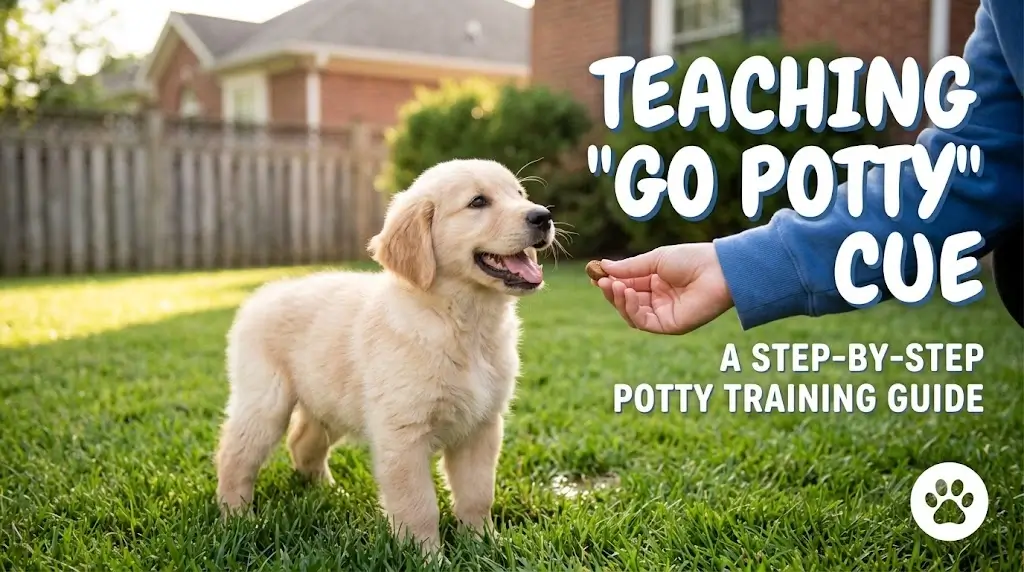
How to Teach a Puppy a Bathroom Cue: A Step-by-Step Potty Training Guide
Teaching a puppy a bathroom cue means pairing a consistent word or phrase with the puppy’s natural act of urinating or defecating, then reinforcing the behavior immediately after it happens. The cue should initially be introduced while the puppy is already beginning to eliminate rather than repeated randomly before the puppy understands what it means.
A useful bathroom cue can eventually make potty trips more predictable. It can help owners prompt a puppy to focus on eliminating before a car ride, bedtime, a walk, or another situation where an empty bladder or bowel is useful. The cue does not replace routine, supervision, or appropriate bathroom opportunities; it becomes an additional communication tool built on an already developing potty habit.
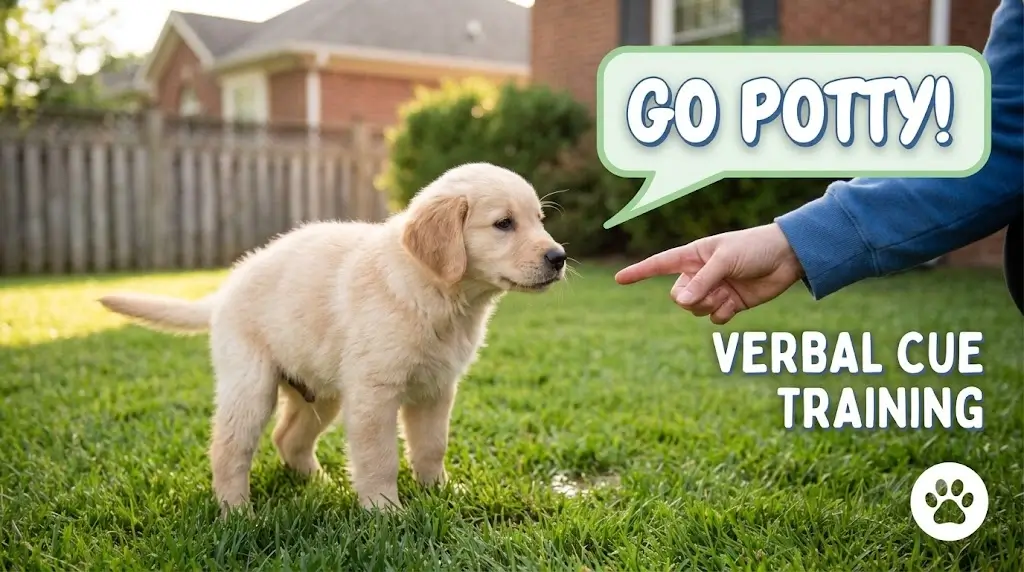
What Is a Puppy Bathroom Cue?
A bathroom cue is a verbal signal that eventually tells a puppy that you want them to eliminate. Common examples include “go potty,” “potty,” “bathroom,” or another short phrase chosen by the household.
The specific words matter less than consistency. If one person says “go potty,” another says “do your business,” and a third uses a completely different phrase, the puppy receives less consistent information.
The goal is not to make the puppy eliminate simply because they hear a word on the first few attempts. The word initially has no meaning. You create its meaning by repeatedly pairing it with the behavior.
Core learning sequence:
Bathroom opportunity → puppy begins eliminating → say cue → puppy finishes → immediate reward.
When Should You Teach a Puppy a Bathroom Cue?
The easiest time to introduce a bathroom cue is when the puppy is already likely to eliminate. Early training should focus on creating successful outdoor potty repetitions rather than expecting the puppy to respond to a verbal command that has not yet acquired meaning.
Useful opportunities include taking the puppy outside after waking, eating, drinking, playing, or sleeping. Young puppies need frequent opportunities because their bladder and bowel control is still developing.
If the puppy is distracted, playing, or showing no signs of needing to eliminate, repeatedly saying the bathroom cue is usually not useful. Save the cue for the behavior you want to associate with the word.
Step-by-Step: How to Teach a Puppy “Go Potty”
The most reliable approach is to capture the natural behavior first and name it second.
Step 1: Choose One Bathroom Cue
Select one short phrase that everyone in the household will use. “Go potty” is common because it is brief and easy to remember, but the exact phrase is up to you.
Avoid changing the phrase halfway through training unless there is a specific reason. Consistency helps the puppy learn the connection between the sound and the behavior.
Step 2: Take the Puppy to the Same Potty Area
Whenever practical, take the puppy to a designated outdoor bathroom location. A predictable location reduces distractions and makes it easier to recognize the context in which the cue is used.
Step 3: Wait Quietly
Do not turn the potty trip into an exciting play session before the puppy eliminates. Give the puppy an opportunity to sniff, move around, and choose an appropriate place while you remain patient and attentive.
Step 4: Watch for the Start of Elimination
The critical moment is when the puppy actually begins urinating or defecating.
This is when the word should be introduced. You are not asking the puppy to understand the cue yet. You are attaching the sound to a behavior that is already happening.
Step 5: Say the Cue Once
Calmly say your chosen phrase once, such as “go potty.”
Avoid repeating “go potty, go potty, go potty” while the puppy is eliminating. One clear cue provides cleaner information than a stream of repeated words.
Step 6: Let the Puppy Finish
Do not interrupt the puppy immediately after saying the cue. Allow the elimination to finish naturally.
Step 7: Reward Immediately
As soon as the puppy finishes, praise them and provide a small reward they value. Food can be especially useful during early training because it is quick to deliver and provides a clear consequence.
Step 8: Repeat the Sequence
Repeat the same sequence across many normal potty trips. Over time, the puppy can learn that the phrase predicts the behavior you have repeatedly paired with it.
Why You Should Say the Bathroom Cue During Elimination at First
A puppy cannot understand the meaning of an unfamiliar word simply because you say it before a behavior. The training process gives the word meaning by repeatedly pairing it with something the puppy already does.
Saying the cue as the puppy begins eliminating creates a close connection between the sound and the behavior. After enough repetitions, the cue can become predictive.
This is fundamentally different from standing outside and repeatedly saying “go potty” while the puppy is sniffing, playing, or watching the environment.
When Can You Say “Go Potty” Before the Puppy Goes?
Once the puppy has experienced enough repetitions of the cue during elimination, you can gradually move the cue earlier in the sequence.
The progression can look like this:
| Training Stage | When to Say the Cue | Goal |
|---|---|---|
| Stage 1 | As elimination begins | Create the word-behavior association |
| Stage 2 | Just before or during the behavior | Build predictive value |
| Stage 3 | Shortly after reaching potty area | Use cue as a prompt |
| Stage 4 | Before expected elimination | Practical bathroom communication |
Do not rush from Stage 1 to Stage 4. If the puppy stops responding or appears confused, move the cue closer to the actual behavior again.
How Long Does It Take for a Puppy to Learn a Bathroom Cue?
There is no universal number of days or potty trips required. Puppies differ in age, experience, motivation, attention, environment, and previous training.
A puppy may begin showing recognition of the cue relatively quickly, but reliable use of the cue requires repeated successful associations across different situations.
The important milestone is not the calendar date. It is whether the puppy consistently responds to the cue in appropriate potty situations.
Avoid claims that every puppy can learn “go potty” in three days or one week. House training and cue training develop at different rates, and physical bladder control is also a major factor in young puppies.
How to Reward a Puppy for Responding to a Bathroom Cue
Reward timing is critical. When the puppy finishes eliminating in the correct location, immediately provide praise and a reward. For detailed strategies on selecting high-value treats and praise timing, see our guide on how to reward a puppy for going outside.
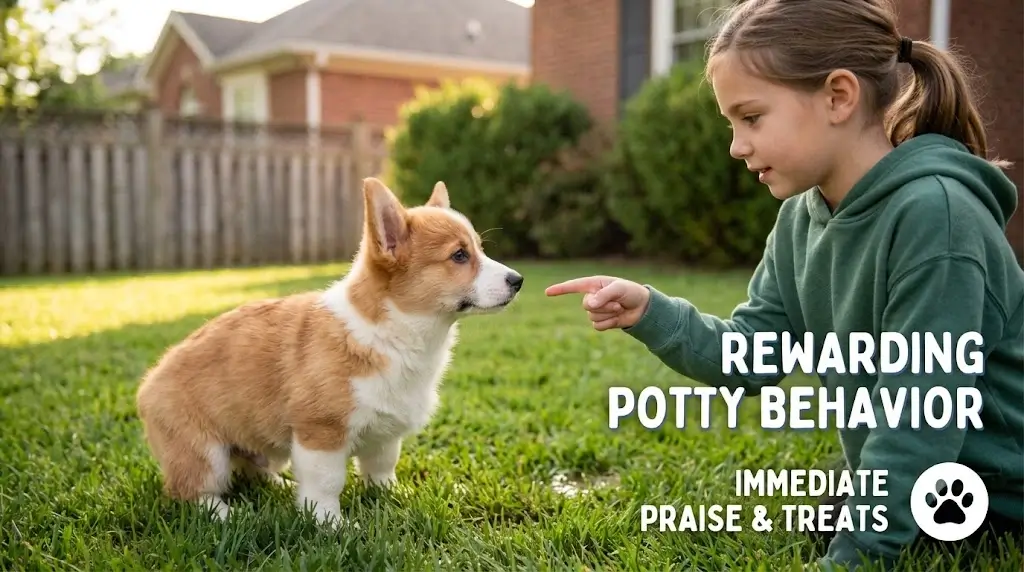
During early training, food can make the consequence especially clear. Use a small treat that the puppy values and can consume quickly.
Other rewards can include praise, sniffing, walking, exploration, or appropriate play. These environmental rewards can become particularly useful as the puppy’s outdoor potty habit becomes established.
The Complete Reinforcement Chain
- Take the puppy outside.
- Reach the designated potty area.
- Give the puppy an opportunity to eliminate.
- Use the bathroom cue at the appropriate training stage.
- Let the puppy finish.
- Praise immediately.
- Deliver the reward.
- Allow appropriate outdoor freedom when practical.
Should You Use a Treat Every Time?
Consistent reinforcement is useful while the puppy is learning the behavior. There is no need to rush to eliminate treats simply because the puppy has started responding to the cue.
Once the behavior becomes reliable, you can gradually vary the reward while continuing to provide praise and other forms of reinforcement.
The objective is to establish a useful behavior, not to create permanent dependence on one specific treat.
If reducing food rewards causes the behavior to become less reliable, increase reinforcement again and progress more gradually.
Should You Teach Separate Cues for Pee and Poop?
You can, but most households do not need separate verbal cues for urination and defecation.
A single cue such as “go potty” can refer generally to outdoor elimination. This keeps the communication system simple.
Separate cues can be useful in specialized situations where the owner needs to distinguish between the two behaviors, but introducing unnecessary vocabulary can make early training more complicated.
One Cue vs. Two Cues
| Approach | Best For | Trade-Off |
|---|---|---|
| One general cue | Most puppy households | Less specific |
| Separate pee/poop cues | Owners needing greater specificity | More vocabulary to teach |
How to Teach a Bathroom Cue for Both Pee and Poop
If you want one general cue, simply use the same word during both urination and defecation.
For example, when the puppy begins urinating, calmly say “go potty.” Reward after completion. During another trip, use the same cue as the puppy begins defecating and reward after completion.
Through repeated associations, the cue can become a general signal for outdoor elimination rather than a word that means only one specific bodily function.
How to Teach “Go Potty” When the Puppy Is Easily Distracted
A distracted puppy may have difficulty completing the behavior even when the cue is familiar. The solution is usually to improve the training environment rather than repeat the cue louder or more frequently.
Use a Lower-Distraction Potty Area
Start in a familiar outdoor location with fewer competing sights, sounds, and smells.
Keep the Initial Potty Trip Boring
Save exciting play and exploration for after successful elimination.
Use a Valuable Reward
If the puppy ignores an ordinary treat in a distracting environment, a more appealing reward may provide stronger reinforcement.
Do Not Repeat the Cue Continuously
Repetition does not make an unfamiliar cue meaningful. Wait for the behavior and reinforce it clearly.
Potty Cue vs. Potty Routine: What Is the Difference?
A bathroom cue and a potty routine solve different problems.
The routine determines when the puppy gets an opportunity to eliminate. The cue provides a communication signal within that opportunity.
| Element | Purpose |
|---|---|
| Potty schedule | Creates regular opportunities |
| Potty location | Provides a predictable context |
| Bathroom cue | Communicates the desired behavior |
| Reward | Reinforces successful elimination |
| Supervision | Reduces opportunities for indoor accidents |
A bathroom cue works best when these systems operate together. A word cannot compensate for insufficient bathroom opportunities or inadequate supervision. If you are building a foundational training framework from scratch, start by reviewing how to house train a puppy.
How to Use a Bathroom Cue Before Bedtime
Once your puppy understands the cue, it can become useful during predictable situations such as the final potty trip before bedtime.
- Take the puppy outside to the normal potty area.
- Keep the environment calm.
- Give the cue once at the appropriate stage.
- Wait for elimination.
- Reward immediately.
- Return indoors for bedtime.
Nighttime potty trips should generally remain calm. The purpose is elimination, not stimulating play.
How to Use a Bathroom Cue Before a Car Ride
A reliable bathroom cue can also be useful before leaving home for an extended period.
Take the puppy to the designated potty area with enough time to wait. Use the cue once the puppy has reached the appropriate stage of training, then reward successful elimination.
Do not assume that saying the cue guarantees elimination. The puppy still needs the physical need and appropriate opportunity to go.
How to Teach a Bathroom Cue in a New Yard
Generalization is the process of helping the puppy perform a learned behavior in different environments.
After the cue works reliably at home, practice in other safe, appropriate outdoor locations. Continue using the same cue and reward successful elimination.
New environments can be more distracting, so you may need to move closer to the original training conditions before expecting the same level of reliability.
How to Teach a Bathroom Cue During Travel
Travel introduces unfamiliar surfaces, smells, sounds, and schedules. Do not assume a puppy that understands “go potty” at home will immediately respond the same way everywhere.
When traveling:
- Choose an appropriate and safe potty location.
- Allow the puppy to investigate the area.
- Use the familiar cue.
- Wait patiently.
- Reward successful elimination immediately.
- Keep supervision close afterward.
Keeping the cue, reward pattern, and handler response consistent can make unfamiliar situations easier for the puppy to understand.
What If the Puppy Does Not Potty After the Cue?
Do not repeat the cue endlessly. The word is not a biological switch.
If the puppy does not eliminate, give them an appropriate opportunity and then return to close supervision. Try again when the puppy is more likely to need to go.
Puppies can become distracted, may not yet have sufficient bladder control, or simply may not need to eliminate at that moment.
The correct response is to manage the situation, not to increase pressure on the puppy.
What If the Puppy Goes Inside After You Said the Bathroom Cue?
This does not mean the puppy has failed to learn the word. The cue may still be new, or the puppy may have been outside without enough opportunity to eliminate.
Review the sequence:
- Was the puppy taken outside soon enough?
- Was the puppy distracted?
- Did you give enough time for elimination?
- Did you return indoors too soon?
- Was the puppy supervised after coming inside?
- Was the cue introduced at the correct point in the behavior?
Improving management is usually more useful than simply repeating the verbal cue. If indoor urination is becoming a recurring pattern, investigate why does my puppy keep peeing in the house to address underlying schedule or confinement issues.
What If the Puppy Starts Playing Instead of Going Potty?
Separate the bathroom portion of the trip from the recreational portion.
Take the puppy to the potty area and keep the environment calm. If the puppy eliminates, immediately reward and then allow appropriate outdoor enjoyment.
If the puppy does not eliminate, avoid turning the entire trip into a long play session. Return to supervision and try again later.
This structure teaches a useful contingency: potty first, fun afterward.
Should You Use a Clicker With a Bathroom Cue?
A clicker is optional. A consistent verbal marker can also identify successful behavior before the food reward is delivered.
For basic puppy potty training, the essential components are timing and consistency. Adding a clicker is not necessary if you can reliably praise and reward the puppy immediately after successful elimination.
If you already use clicker training successfully for other behaviors, a marker can fit naturally into the potty-training system.
Bathroom Cue Training Without Treats
It is possible to teach a bathroom cue without food, provided the puppy finds other consequences rewarding.
Potential rewards include:
- Verbal praise.
- Petting, when the puppy enjoys it.
- Sniffing opportunities.
- Short walks.
- Exploration.
- Appropriate play.
- Access to another preferred activity.
Food is often convenient because it can be delivered quickly and consistently. However, reinforcement should be based on what the individual puppy actually values.
How to Fade Food Rewards for a Bathroom Cue
Once the puppy reliably responds to the cue and consistently eliminates in the correct location, food rewards can be reduced gradually.
A practical approach is to maintain verbal praise after successful potty trips while varying when food is provided. Environmental rewards such as sniffing or walking can become more prominent.
Do not reduce rewards simply because the puppy has responded correctly a few times. Look for a sustained pattern of reliable behavior.
Bathroom Cue Training for Puppies Who Are Still Having Accidents
If a puppy is still having frequent indoor accidents, prioritize basic house-training management before expecting the bathroom cue to solve the problem.
The puppy needs:
- Frequent opportunities to go outside.
- Close supervision indoors.
- A predictable potty location.
- Immediate reinforcement after successful outdoor elimination.
- Appropriate confinement or management when direct supervision is not possible.
A verbal cue is an additional training tool. It is not a substitute for the physical and environmental foundations of house training.
How to Handle Indoor Accidents While Teaching a Bathroom Cue
Avoid punishment after an indoor accident. The puppy needs clearer opportunities to succeed rather than fear associated with eliminating.
If you notice the puppy beginning to eliminate indoors, calmly interrupt when practical and take them to the appropriate outdoor location. If they finish outside, reward the outdoor behavior.
Clean indoor accidents thoroughly to reduce residual odor and review the supervision and potty schedule that preceded the accident.
Common Bathroom Cue Training Mistakes
1. Saying the Cue Before the Puppy Understands It
An unfamiliar word does not automatically function as a command. First create the association.
2. Repeating the Cue Over and Over
Repetition does not make the behavior happen. Wait for the appropriate behavior and reinforce it.
3. Using Different Words
Changing between “potty,” “bathroom,” “go pee,” and other phrases creates unnecessary inconsistency.
4. Rewarding Too Late
A reward delivered several minutes later provides less precise information about what behavior earned it.
5. Interrupting Elimination
The puppy needs to finish the behavior before receiving the main reward.
6. Turning Every Potty Trip Into Play
Excessive stimulation can make it harder for a puppy to focus on eliminating.
7. Expecting the Cue to Override Physical Limits
A verbal cue cannot make a puppy eliminate when the puppy does not need to go.
8. Reducing Supervision Too Early
A puppy that knows a bathroom cue can still have accidents. Reliable house training requires management as well as cue training.
Bathroom Cue Training Timeline
Instead of promising a fixed number of days, use behavioral milestones to measure progress. For an organized, daily schedule to combine with cue conditioning, check out our 7-day puppy house training plan.
| Milestone | What to Look For | Next Step |
|---|---|---|
| Association | Cue repeatedly occurs during elimination | Continue consistent pairing |
| Recognition | Puppy begins responding when cue is given | Move cue slightly earlier |
| Reliability | Puppy commonly eliminates after cue in familiar situations | Practice across safe environments |
| Generalization | Cue works in different appropriate locations | Maintain reinforcement and management |
How to Know if Your Puppy Really Understands the Cue
A puppy is showing meaningful understanding when the cue consistently predicts the appropriate behavior in situations where the puppy reasonably needs to eliminate.
Stronger evidence includes:
- The puppy responds to the same cue consistently.
- The puppy does not require the owner to repeat the cue multiple times.
- The behavior occurs in the designated area.
- The puppy can respond in more than one familiar environment.
- The puppy continues responding when the reward is gradually varied.
Do not test the cue randomly when the puppy has no need to eliminate. That does not provide useful information about whether the behavior is learned.
Bathroom Cue vs. Potty Signal: They Are Not the Same
A bathroom cue is a signal from the owner to the puppy. A potty signal is a behavior the puppy uses to communicate that they need to go outside.
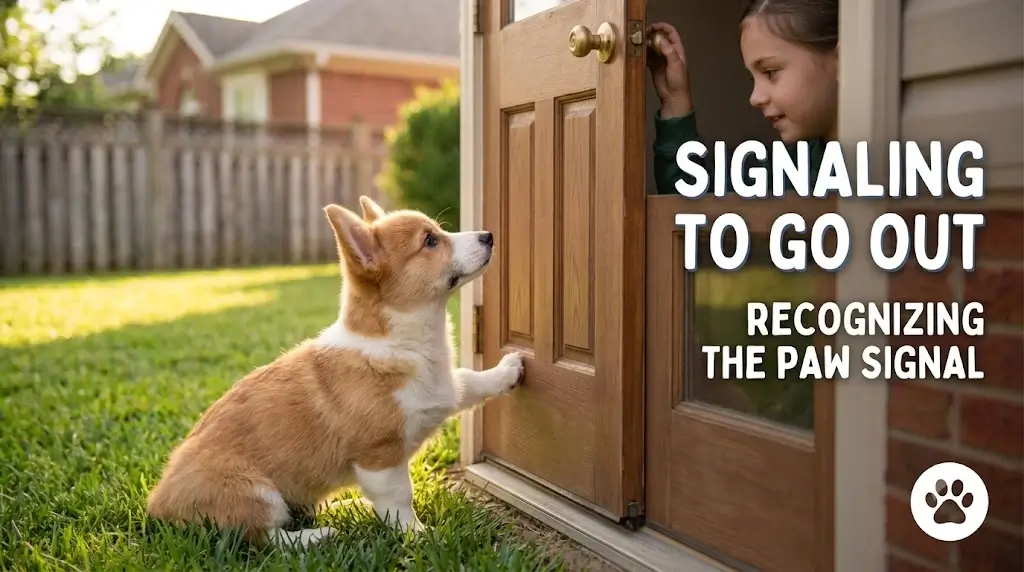
For example, “go potty” can be the owner’s cue, while standing near the door, ringing a bell, or another learned behavior can function as the puppy’s request to go outside.
A mature house-training system can use both:
Puppy signals: “I need to go outside.”
Owner cue: “Go potty.”
Behavior: Eliminate in the appropriate location.
Consequence: Praise + reward + appropriate outdoor activity.
How to Teach a Puppy to Ask to Go Outside
If you want the puppy to communicate their need to go outside, you can teach a separate signal such as going to the door or using a bell.
The process is different from teaching “go potty.” The puppy signal communicates the need to go out; the bathroom cue communicates the behavior you want once outside.
Keeping these concepts separate makes the training system easier to understand and troubleshoot.
How to Use a Bathroom Cue Before a Long Walk
A bathroom cue can be useful before a walk because some owners prefer to give the puppy an opportunity to eliminate before starting the recreational portion of the outing.
Take the puppy to the designated bathroom area first. Use the cue when appropriate, reward successful elimination, and then begin the walk.
This creates a predictable routine without requiring the puppy to eliminate on command when they do not physically need to.
How to Teach a Bathroom Cue in Bad Weather
Weather can create a new training challenge because rain, wind, snow, heat, and unfamiliar surfaces may compete with the puppy’s attention.
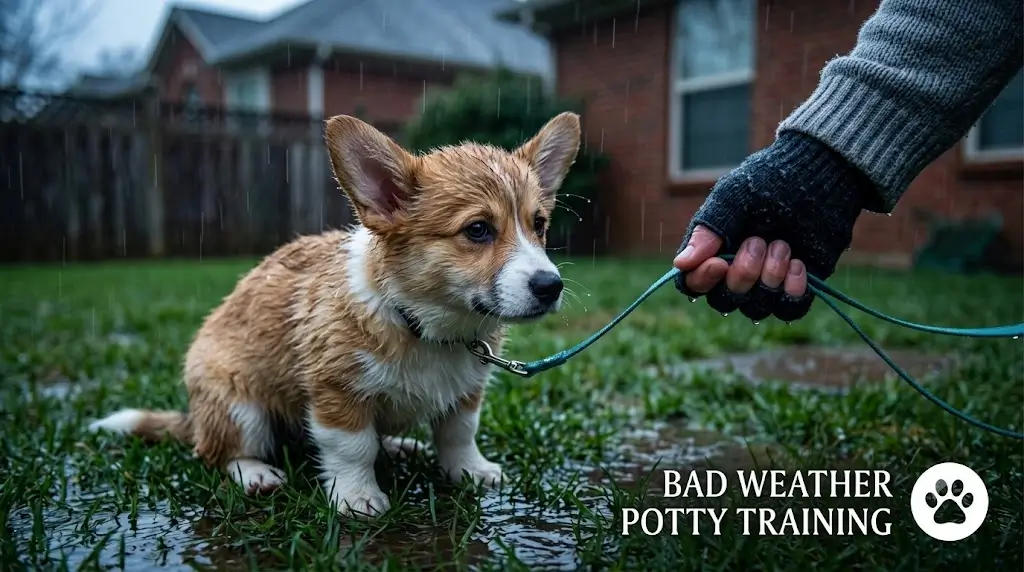
Keep the bathroom cue consistent. Use a practical potty area, give the puppy enough time, and provide a meaningful reward after successful elimination.
Avoid turning bad-weather potty trips into rushed experiences that make the puppy uncomfortable. At the same time, maintain reasonable supervision and safety for the conditions.
Bathroom Cue Training for Apartment Puppies
Apartment living can make timing especially important because reaching the outdoor bathroom location may take longer.
Keep the leash, footwear, and reward ready so the puppy can leave promptly when needed. During early house training, watch for individual pre-potty signals and use predictable routines.
Once outside, use the same bathroom cue and reward system as you would in a house with a private yard.
Bathroom Cue Training for Puppies Using Pee Pads
Puppies transitioning from pee pads to outdoor pottying can still learn a bathroom cue, but the cue should ultimately be paired with the location and behavior you want to maintain.
If your long-term goal is outdoor elimination, begin associating the cue with outdoor potty trips rather than allowing the verbal cue to become exclusively connected to the indoor pad.
During a transition, maintain a consistent routine and reward the desired destination.
How to Use a Bathroom Cue Without Creating Pressure
The cue should function as useful information, not as pressure. A puppy may not be able to eliminate immediately, particularly if they have recently gone.
If the puppy does not respond, wait, manage the situation, and try again later. Avoid escalating your voice or repeatedly demanding the behavior.
Calm repetition combined with good timing produces a cleaner association than frustration.
When a Puppy Suddenly Stops Responding to a Bathroom Cue
If a previously reliable puppy suddenly stops eliminating normally, first consider changes in routine, environment, distractions, or bathroom access.
If the change is persistent, unusual, or accompanied by other concerning signs, consult a veterinarian. A sudden change in elimination behavior should not automatically be treated as a training problem.
For ongoing house-training difficulties, professional positive-reinforcement training can also help identify whether the issue is related to management, environment, learning history, or another factor.
Bathroom Cue Training Checklist
- ☐ Choose one short bathroom cue.
- ☐ Make sure every household member uses the same phrase.
- ☐ Take the puppy to a consistent potty area.
- ☐ Wait calmly for natural elimination.
- ☐ Say the cue once as elimination begins.
- ☐ Allow the puppy to finish.
- ☐ Praise immediately.
- ☐ Give a small valued reward.
- ☐ Repeat the same sequence consistently.
- ☐ Gradually move the cue earlier as understanding develops.
- ☐ Practice in additional appropriate environments.
- ☐ Continue supervision during house training.
- ☐ Do not punish indoor accidents.
Frequently Asked Questions
How do I teach my puppy a bathroom cue?
Choose one short phrase, take the puppy to the designated potty area, and say the cue calmly as the puppy begins to eliminate. Let the puppy finish, then immediately praise and reward. Repeat this sequence consistently until the cue becomes associated with elimination.
What words should I use for a puppy bathroom cue?
Common choices include “go potty,” “potty,” and “bathroom.” The specific phrase is less important than using one consistent cue throughout training.
Should I say “go potty” before or after my puppy pees?
Early in training, say the cue as the puppy begins to eliminate. This allows you to pair the unfamiliar word with an existing behavior. As the association becomes stronger, you can gradually move the cue earlier.
Can you teach a puppy to pee on command?
A trained bathroom cue can help prompt a puppy to eliminate when the puppy already needs to go. It does not guarantee elimination when the puppy has no physical need.
How many times should I say the potty cue?
Say it once at the appropriate point in the behavior. Repeatedly saying the cue does not make the puppy eliminate and can reduce the clarity of the signal.
Should I give my puppy a treat after going potty?
A small treat can be an effective reward during early training. Deliver it immediately after the puppy finishes eliminating in the correct location.
Can praise replace treats for potty training?
Yes, if the puppy genuinely finds praise rewarding. Food is simply one convenient reinforcement option. Sniffing, exploration, play, and walking can also be valuable rewards.
Should I teach separate pee and poop cues?
You can, but most households can use one general cue such as “go potty” for both urination and defecation. Separate cues add specificity but require additional training.
Why does my puppy not go potty when I say the cue?
The cue may not be fully learned, the puppy may be distracted, or the puppy may simply not need to eliminate at that moment. Give appropriate opportunities and avoid repeatedly demanding the behavior.
Can a bathroom cue prevent accidents?
A reliable cue can help prompt elimination at useful times, but it does not replace frequent bathroom opportunities, supervision, appropriate confinement, and a consistent potty routine.
Can I teach “go potty” while using pee pads?
Yes. However, if the long-term goal is outdoor pottying, pair the cue consistently with outdoor elimination during the transition so the cue does not become limited to the indoor pad.
How long does it take to teach a puppy a potty cue?
There is no universal timeline. Puppies learn at different rates, and reliable cue use requires repeated successful associations across different situations.
Should I punish a puppy for an accident while teaching the cue?
No. Punishment does not teach the desired bathroom location. Instead, improve supervision, provide more frequent outdoor opportunities, and reward successful outdoor elimination.
Can a puppy learn a bathroom cue for traveling?
Yes. Once the cue is established, practice it in different appropriate environments while maintaining the same verbal signal and reinforcement pattern.
Is a bathroom cue the same as teaching a puppy to ask to go outside?
No. A bathroom cue is typically an owner-to-puppy signal telling the puppy what behavior is desired. A potty signal is a puppy-to-owner behavior indicating that the puppy needs an opportunity to go outside.
Final Takeaway
The easiest way to teach a puppy a bathroom cue is to name a behavior that is already happening. Take the puppy to the appropriate potty area, wait for natural elimination, say the chosen cue once as the puppy begins, allow the behavior to finish, and reward immediately.
Over repeated successful repetitions, the puppy can learn that the phrase predicts the bathroom behavior. Once that association is reliable, the cue can gradually be moved earlier so it becomes a practical prompt before elimination.
The cue works best as part of a larger house-training system. Frequent opportunities, close supervision, a predictable potty location, immediate reinforcement, and calm handling of accidents remain more important than the words themselves.
