
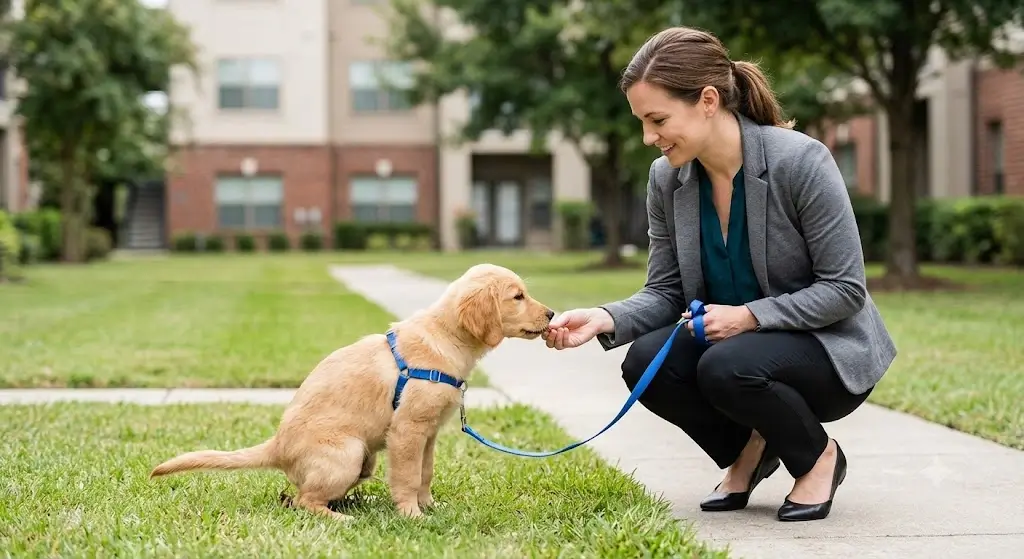
House Training a Puppy While Working Full Time
Working full time does not make puppy house training impossible, but it does mean the workday has to accommodate the puppy’s bathroom, rest, supervision, and social needs. The practical solution is to build a repeatable schedule and arrange appropriate midday help instead of expecting a young puppy to manage an adult dog’s routine.
Quick Answer
Yes, you can house train a puppy while working full time. The important issue is not whether you have a 9-to-5 job; it is whether the puppy has appropriate bathroom opportunities and supervision during the hours you are unavailable.
For a young puppy, a typical full workday may require help from a partner, family member, dog walker, pet sitter, trusted caregiver, daycare arrangement, or another appropriate solution. The exact schedule depends on the puppy’s age, development, bathroom pattern, health, and home environment.
The Reality of House Training a Puppy While Working Full Time
A full-time job creates a predictable conflict: your work schedule may be fixed, while a young puppy’s bathroom needs are still changing.
The solution is not to force the puppy to match the workday. Instead, design the workday so the puppy receives appropriate bathroom opportunities while you are away.
Your job schedule determines when you are available. The puppy’s developmental needs determine when help is required.
This is why a successful plan usually has two separate components:
- Owner-controlled periods: Before work, after work, evenings, and weekends.
- Support periods: The hours when another appropriate person provides bathroom access and care.
Build the Workday Around Bathroom Events
Do not build the entire plan around clock times alone. Predictable events such as waking, eating, sleeping, and active play are often more useful anchors.
| Event | Training action | Why it matters |
|---|---|---|
| Wake up | Provide a bathroom opportunity promptly. | The puppy may need to eliminate soon after waking. |
| Breakfast | Plan another bathroom opportunity based on the puppy’s pattern. | Meals can become predictable scheduling cues. |
| Before owner leaves | Offer a final pre-work bathroom trip. | Reduces the chance that the puppy starts the workday already needing to go. |
| Midday | Arrange appropriate human care and bathroom access. | A young puppy may not be ready for an entire workday alone. |
| Owner returns | Provide a prompt bathroom opportunity. | The transition from alone time can coincide with increased activity. |
| Evening | Repeat bathroom opportunities around meals, play, and naps. | House training continues outside working hours. |
| Bedtime | Offer a final bathroom opportunity. | Creates a predictable nighttime routine. |
For a broader schedule framework, see our complete guide on the Puppy House Training Schedule.
Sample 9-to-5 Puppy House-Training Schedule
The following is a planning example, not a universal biological schedule. Your puppy’s actual needs should determine the timing.
| Approx. time | Routine |
|---|---|
| 6:30 AM | Wake and bathroom opportunity. |
| 6:45 AM | Breakfast and normal morning activity. |
| 7:15 AM | Bathroom opportunity before the owner leaves. |
| 8:00 AM | Owner begins work. |
| Late morning / midday | Caregiver, dog walker, pet sitter, family member, or other planned support provides bathroom access. |
| Midday / early afternoon | Additional break if the puppy’s age and pattern require it. |
| 5:00 PM | Owner returns and provides a prompt bathroom opportunity. |
| Evening | Bathroom opportunities around meals, naps, play, and other predictable events. |
| Before bed | Final bathroom opportunity. |
Why a Midday Break Matters
The most common planning error for a full-time worker is treating an eight-hour workday as if it were automatically appropriate alone time for a young puppy.
Bathroom ability develops over time. A puppy’s needs also change with food, water, sleep, activity, excitement, and individual development.
A midday caregiver can therefore solve more than a bathroom problem. Depending on the arrangement, the visit can provide movement, interaction, a meal, medication when professionally directed, or a short period of supervised activity.
Best Midday Help Options
There is no single solution that fits every household. Consider the reliability, timing, cost, and consistency of each option.
| Option | Best use | Potential limitation |
|---|---|---|
| Partner or family member | Consistent personal care. | Schedule may not always be reliable. |
| Dog walker | Scheduled bathroom and walking break. | Quality and reliability vary between providers. |
| Pet sitter | More flexible home-based care. | Can cost more than a simple walk. |
| Puppy daycare | Long periods when the owner is away. | Not every puppy or facility is a good fit. |
| Remote-work flexibility | Owner provides breaks directly. | Work demands may still limit availability. |
| Hybrid schedule | Reduces the number of days requiring outside help. | Requires a stable work arrangement. |
Using a Dog Walker or Pet Sitter for House Training
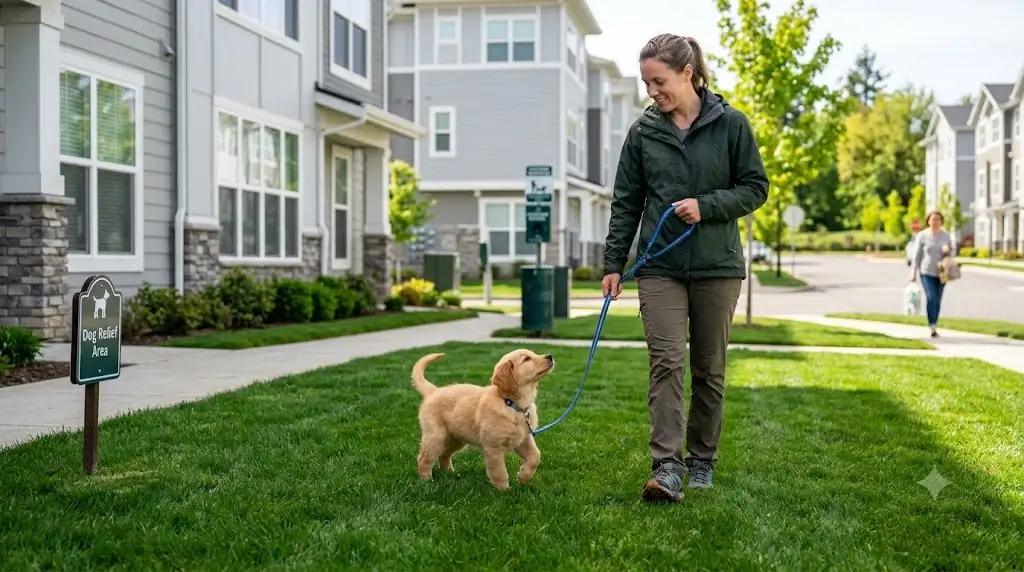
If someone else handles the midday bathroom trip, they should use the same basic system you use.
Give the caregiver a simple written routine
- Preferred bathroom destination.
- Leash and equipment location.
- Bathroom cue if you use one.
- Reward procedure.
- Cleanup instructions.
- Emergency contact information.
- What to do if the puppy does not eliminate.
Consistency matters because the puppy is learning a behavior, not merely receiving a break from the house.
Same door → same route → same bathroom destination → same reward routine → same cleanup procedure.
When Puppy Daycare Makes Sense
Daycare can provide daytime supervision for owners who are away for long periods, but it is not automatically the best house-training solution.
Before choosing a facility, consider its puppy-management practices, supervision, group structure, sanitation, rest periods, vaccination requirements, staff experience, and emergency procedures.
A facility should also understand your house-training goal. The puppy should not spend the entire day practicing a bathroom routine that conflicts with what you are teaching at home.
House Training a Puppy If You Work From Home
Working from home removes the commute but does not automatically mean you are available every minute.
Meetings, calls, deadlines, and focused work can make it easy to miss a puppy’s bathroom signal.
Use predictable workday transitions
- Bathroom before the first major work block.
- Bathroom around meals and active play.
- Short management periods during meetings.
- Bathroom after naps.
- Bathroom before and after longer periods of focused work.
A calendar reminder can be useful during the early weeks because the biggest challenge may be remembering the routine while concentrating on work.
Using a Crate During the Workday
A crate can be useful for short, appropriately managed periods when the puppy has been gradually introduced to it and is comfortable using it.
It should not be treated as a solution for leaving a young puppy confined for an entire workday without appropriate bathroom and care breaks.
Good crate-management principles
- Introduce the crate gradually.
- Associate it with calm, positive experiences.
- Provide appropriate bathroom opportunities.
- Never use the crate as punishment.
- Increase duration gradually rather than using the longest possible period immediately.
The crate is a management tool. House training still depends on supervision, timing, reinforcement, and appropriate bathroom access.
Puppy Pen vs. Crate for Workday Management
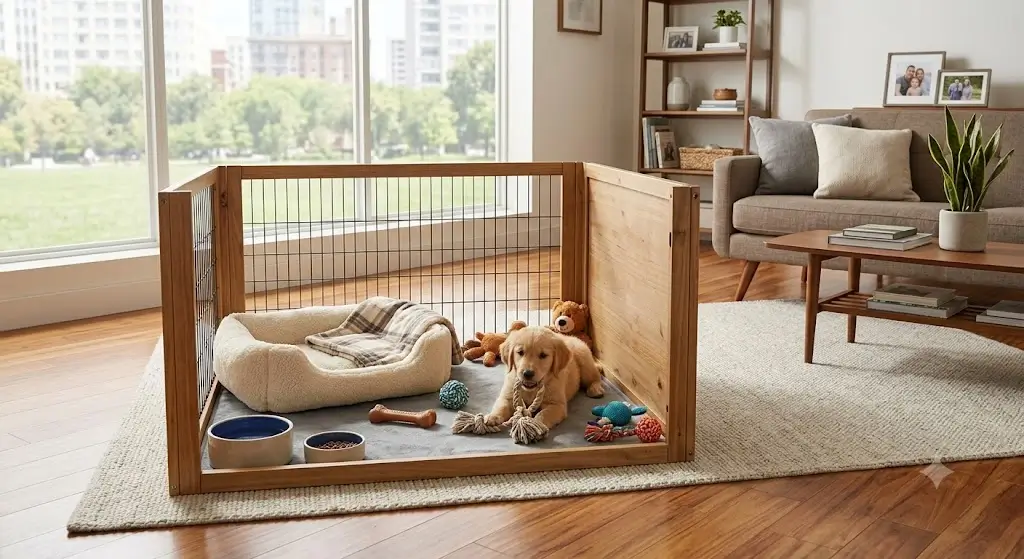
A puppy-safe confinement area can provide more room than a crate, which may be useful for specific workday arrangements.
| Management option | Primary purpose | House-training consideration |
|---|---|---|
| Crate | Short-term rest and management. | Does not replace bathroom breaks. |
| Puppy-safe pen | More controlled space. | Can be paired with an indoor toilet if that is part of your plan. |
| Free access to home | Maximum freedom. | Higher accident risk during early training. |
Choose management based on the puppy’s current reliability rather than the owner’s convenience alone.
Should Working Owners Use Puppy Pads?
Puppy pads can be a practical option for some households, particularly when the puppy cannot reasonably access an outdoor bathroom during the owner’s entire work period.
But there is a direct trade-off: a pad teaches that a designated indoor location can be used for elimination.
Use pads deliberately if you choose them
- Place the pad in one consistent location.
- Keep the area easy to clean.
- Reward correct use.
- Do not provide random indoor bathroom locations.
- Plan how the pad will be phased out if outdoor-only elimination is the final goal.
If you have no private yard, see our guide on House Training a Puppy Without a Yard for the broader no-yard strategy.
Manage the Hours You Are Home
The time you spend at home is where you can provide the most consistent training.
Avoid treating evenings as unlimited free time. Continue the same bathroom cues, destination, supervision, and reward pattern used during the workday.
After work
Give the puppy an appropriate bathroom opportunity promptly after you return, then continue the normal evening routine.
During play
Watch for changes in behavior and schedule bathroom opportunities around active play rather than waiting until the puppy is highly urgent.
Before bedtime
Keep the final bathroom opportunity predictable.
Use Weekends to Strengthen the Routine
Weekends are useful for training, but they can also create a schedule problem if the puppy’s routine changes dramatically.
Try to maintain the same basic sequence even if the exact clock times change.
Wake → bathroom → meal → bathroom opportunity → activity → rest → bathroom.
Use weekend time to improve supervision, practice the bathroom route, reinforce outdoor elimination, and gradually increase appropriate freedom.
What to Do About Workday Accidents
If you return home to an accident, avoid punishment. The puppy cannot connect delayed punishment with a behavior that occurred hours earlier.
Instead, investigate the schedule.
| Possible cause | What to reconsider |
|---|---|
| Midday break was too late | Move the visit earlier. |
| Puppy had too much freedom | Use more controlled access when alone. |
| Bathroom trip was missed | Improve caregiver scheduling or backup coverage. |
| Sudden regression | Consider environmental or health factors. |
| Puppy did not eliminate during the visit | Have the caregiver report whether the puppy actually went. |
The goal is to change the conditions that produced the accident, not punish the result.
When the Workday Schedule Is Not Working
Repeated accidents are evidence that the current management plan needs adjustment.
If accidents happen shortly before the scheduled break
The puppy may need an earlier opportunity.
If accidents happen immediately after being left alone
Examine whether the puppy was given an appropriate bathroom opportunity before departure and whether the alone-time period is suitable.
If accidents happen after meals
Track the puppy’s individual pattern and coordinate a bathroom opportunity around that predictable event.
If the puppy suddenly regresses after doing well
Do not automatically assume the puppy has forgotten its training. Consider changes in routine, environment, stress, and health.
Gradually Build Alone-Time Skills
House training and being comfortable alone are related management challenges, but they are not the same behavior.
A puppy can be house trained and still need gradual practice being alone. Conversely, a puppy that can sleep alone for a period does not automatically have the bathroom capacity required for a full workday.
Build independence separately through appropriate, gradual periods of alone time while maintaining the bathroom routine.
Common Mistakes Full-Time Workers Make
1. Expecting the puppy to match an adult schedule
Development changes over time. A puppy should not automatically be expected to follow the schedule of an adult dog.
2. Treating the crate as an all-day solution
A crate is a management tool, not a replacement for care and bathroom access.
3. Hiring help but not explaining the training routine
A caregiver should know the bathroom destination and reinforcement system.
4. Giving too much freedom after one good day
Reliability develops through repeated success.
5. Ignoring the return-home period
The puppy may need a bathroom opportunity promptly after the owner returns.
6. Changing the routine dramatically on weekends
Keep the sequence familiar even when the schedule is more relaxed.
7. Punishing accidents
Punishment does not fix the scheduling problem that allowed the accident.
8. Having no backup plan
A canceled dog walker or unexpected late meeting should not leave the puppy without an appropriate care option.
Full-Time Work Puppy House-Training Checklist
- Identify the puppy’s bathroom pattern.
- Create a morning routine.
- Provide a bathroom opportunity before work.
- Arrange appropriate midday care.
- Have a backup caregiver or contingency plan.
- Give caregivers written instructions.
- Use the same bathroom destination consistently.
- Reward successful elimination promptly.
- Manage unsupervised access to the home.
- Use crates appropriately rather than as all-day confinement.
- Use puppy pads deliberately if they fit your long-term plan.
- Provide a bathroom opportunity when you return home.
- Continue training during evenings and weekends.
- Track accidents instead of punishing them.
- Adjust the schedule when repeated accidents reveal a mismatch.
- Watch for sudden changes that may require veterinary attention.
The Most Reliable Strategy for a Full-Time Worker
The most reliable approach is to stop thinking of house training as something that must happen only when you are physically present.
Instead, create one continuous system shared by everyone who cares for the puppy.
- Morning: Give the puppy predictable bathroom opportunities before work.
- Workday: Arrange appropriate human support instead of relying on an excessively long period of confinement.
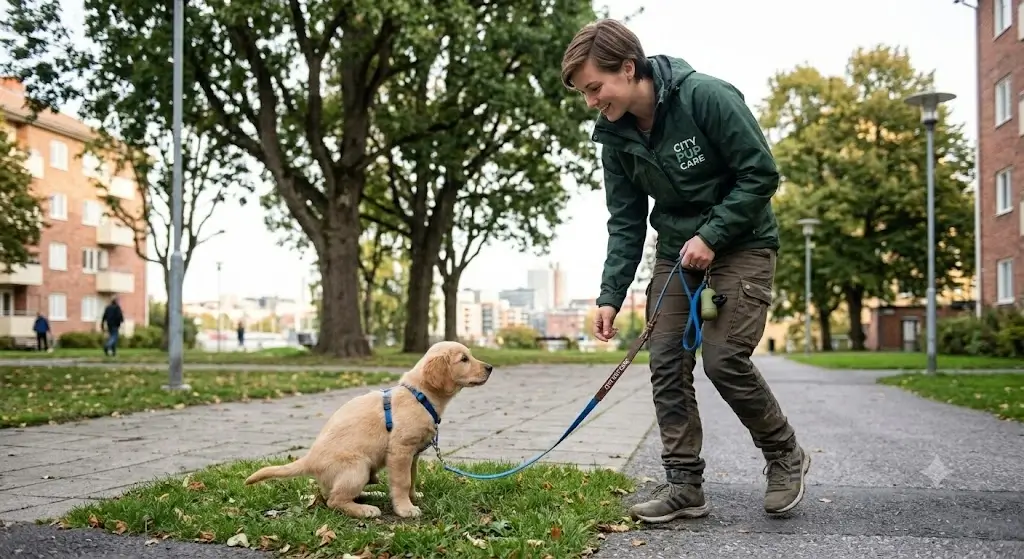
- Caregiver: Follow the same bathroom destination and reinforcement routine.
- After work: Resume direct supervision and provide a prompt bathroom opportunity.
- Evening: Reinforce the same habits around meals, play, naps, and bedtime.
- Weekend: Maintain the same basic behavior pattern while gradually increasing appropriate freedom.
House Training While Working Full Time: What Actually Matters
The critical variable is not whether you work eight hours. It is whether the puppy’s care plan covers the hours you are unavailable.
A realistic plan combines:
- Predictable bathroom opportunities
- Appropriate midday assistance
- Controlled access to the home
- Consistent reinforcement
- Gradual increases in independence
If your workday cannot accommodate the puppy directly, that does not mean house training must fail. It means the care schedule needs another person or service to cover the gap.
Frequently Asked Questions
Can you house train a puppy while working full time?
Yes, but the workday needs to be structured around the puppy’s bathroom and supervision needs. A midday dog walker, family member, pet sitter, daycare, remote-work flexibility, or other appropriate arrangement may be necessary during early training.
How do you potty train a puppy if you work 9 to 5?
Build bathroom opportunities around waking, meals, play, bedtime, and the workday. During early training, many puppies will need a person to provide an appropriate midday bathroom opportunity rather than being expected to remain alone for the entire workday.
How long can a puppy be left alone while house training?
There is no single safe duration for every puppy. Age, development, individual bathroom patterns, health, prior training, and the home environment all matter. A young puppy should not be expected to follow an adult dog’s schedule simply because the owner’s workday requires it.
Should I use a crate while I am at work?
A crate can be one part of puppy management when introduced appropriately, but it should not be treated as a way to keep a young puppy confined for an entire workday. The puppy still needs appropriate bathroom opportunities, movement, rest, enrichment, and social interaction.
Should I hire a dog walker to house train my puppy?
A reliable dog walker or pet sitter can provide an important midday bathroom opportunity when the owner cannot return home. The person should follow the same bathroom destination, cueing, cleanup, and reward routine used by the owner.
Can puppy pads work for someone who works full time?
Puppy pads can be useful in some households, especially when immediate outdoor access is impractical. However, they establish an indoor bathroom option, so owners who ultimately want outdoor-only elimination should plan how that indoor option will be phased out.
What should I do if my puppy has an accident while I am at work?
Clean the area thoroughly without punishment and examine the schedule. The accident may indicate that the puppy needed a bathroom opportunity earlier, the midday break was too late, or the puppy had too much unsupervised access.
