

AKC & AVMA BEHAVIORAL PROTOCOLS 2026
House Training a Puppy During Holidays
Holidays disrupt normal house training routines because shifting meal schedules, unfamiliar visitors, noisy gatherings, travel, decorations, and decreased supervision occur simultaneously. The most reliable strategy is maintaining a predictable bathroom routine even when festive household schedules become erratic. Successfully managing house training a puppy during holidays requires establishing an immovable outdoor potty station, enforcing strict umbilical or crate containment, regulating guest interactions, and providing dedicated decompression spaces to prevent excitement-induced indoor accidents.
Quick Reference Specification: Holiday House Training Matrix
This calibrated environmental matrix benchmarks holiday phases, sensory stressors, primary management interventions, maximum bladder dwell limits, and veterinary safety standards for house training a puppy during holidays in 2026.
| Holiday Event / Phase | Primary Sensory Stressor | Tactical Management Intervention | Maximum Bladder Dwell | Safety Benchmark |
|---|---|---|---|---|
| Guest Arrival & Greetings | Arousal spike & doorbell stimulation | Pre-arrival outdoor voiding + leash tether | Immediate pre-arrival break | IAABC Arousal Threshold Rule |
| Family Feast & Cooking | Table scrap begging & unmonitored wandering | Level 3 Crate / Playpen with stuffed KONG | 2 hours (Puppy age dependent) | AVMA Pancreatitis & Toxic Food Guide |
| Overnight Travel / Relatives | Novel olfactory marks & strange floor layouts | Pre-entry outdoor survey + 100% leash tether | 3 hours maximum between breaks | AKC Travel Housebreaking Protocol |
| New Year’s Eve Celebrations | Acoustic trauma from fireworks / noisemakers | Early evening voiding + interior white noise room | Complete voiding prior to dusk | Fear Free Acoustic Phobia Guidelines |
| Post-Holiday Return to Routine | Decompression fatigue & boundary testing | Strict hourly schedule reset + enzymatic audit | Standard age baseline (Months + 1 hr) | PuppyPottyGuide Housebreaking Standard |
Why Holidays Can Disrupt Puppy House Training
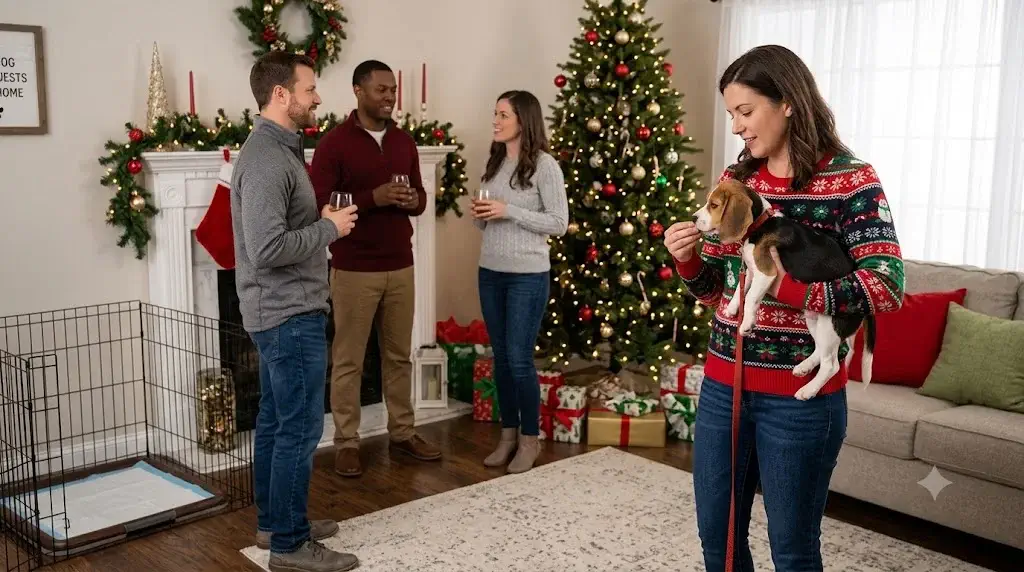
Sudden environmental disruptions overload juvenile neurological inhibition, triggering regression during house training a puppy during holidays. A young dog that performs flawlessly under quiet domestic routines suddenly encounters foot traffic, luggage, novel cooking aromas, wrapping paper, and loud conversations.
Festive celebrations introduce multiple high-distraction variables that complicate juvenile housebreaking management:
Elevated Visitor Traffic
Guests constantly enter, exit, and move through rooms, overstimulating the puppy’s nervous system.
Erratic Daily Scheduling
Feeding times, nap windows, outdoor walks, and bedtime occur unpredictably throughout the celebration.
Olfactory Saturation
Roasting meats, scented candles, evergreen pine trees, and unfamiliar guest luggage mask baseline territory scents.
Diluted Handler Supervision
Hosts become preoccupied with entertaining, kitchen prep, and hosting conversations, missing subtle potty cues.
The operational reality is straightforward: festive household excitement increases the necessity for strict confinement management rather than relaxing it.
The Holiday House-Training Rule
Predictable elimination routines preserve conditioned bathroom reflexes even when surrounding household schedules become chaotic. Handlers often mistakenly assume their puppy can seamlessly navigate changing holiday schedules.
Keep the puppy’s potty routine deliberately boring, quiet, and predictable, even when the holiday atmosphere is intensely stimulating.
Your puppy does not need to attend every greeting, gift exchange, or family meal. A brief, quiet outdoor elimination break followed by a structured rest period in a peaceful room protects the foundational training you have established far better than granting free reign in a crowded living area.
Set Up a Holiday Potty Station Before Guests Arrive
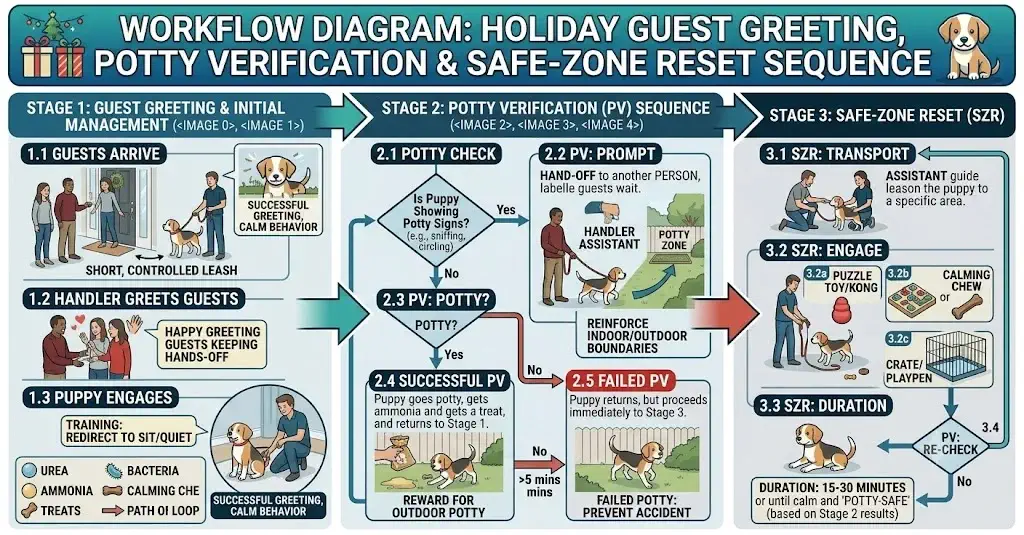
Pre-staged equipment staging streamlines outdoor bathroom trips before indoor hosting obligations peak. Scrambling to locate a leash, flashlight, or waste bags while entertaining guests inevitably delays trips and leads to indoor accidents.
Designate your primary outdoor bathroom perimeter before family arrives. If traveling to an unfamiliar house, survey the lawn and establish an appropriate relief area before bringing the puppy inside. Stage the following essentials directly beside your exit door:
- Dedicated 6-foot fixed nylon leash (avoid retractable leads during busy gatherings).
- Heavy-duty waste bags and an outdoor flashlight or headlamp.
- High-value, non-crumbly training rewards (such as freeze-dried liver or string cheese).
- Weather protection gear (large umbrella, towels, or insulated coats).
- Enzymatic cleaning spray and paper towels staged for rapid accident response.
- A secured indoor exercise pen or raised-edge turf tray for severe weather emergencies.
Minimizing preparation time at the door ensures timely bathroom breaks despite holiday hosting distractions.
Keep the Normal Potty Routine During the Holidays
Biological event anchors replace rigid clock schedules to maintain housebreaking consistency during festive celebrations. Rather than watching the clock while juggling kitchen duties, trigger bathroom trips based on physical digestion and activity transitions:
| Holiday Household Event | Tactical Housebreaking Response |
|---|---|
| Puppy awakens from crate | Carry or lead directly outdoors on-leash before family greetings commence. |
| Guests ring the doorbell | Execute a quick outdoor trip 10 minutes prior to anticipated guest arrival times. |
| Holiday feast is served | Feed puppy regular kibble in a closed safe room; take outside 15 minutes post-meal. |
| Energetic child or dog play | Interrupt high-arousal play sessions after 20 minutes for a focused outdoor break. |
| Scheduled holiday naps | Place puppy in a quiet bedroom crate; escort directly outside immediately upon waking. |
| Late-night celebration wraps up | Maintain the normal quiet bedtime potty trip on-leash before securing in the crate. |
To establish baseline biological intervals, review our structured Puppy House Training Schedule.
House Training a Puppy When Holiday Guests Arrive
High arousal spikes from arriving visitors trigger involuntary bladder releases known as excitement urination. When guests enter laughing, talking, and carrying gifts, a young puppy’s autonomic nervous system overrides sphincter control.
Prevent excitement puddles at the front door by implementing this arrival sequence:
Outdoor Potty Break → Enter on Leash → Settle in Crate/Safe Zone → Controlled Low-Key Greeting
Empty the puppy’s bladder five minutes before guests arrive. When the doorbell rings, place the puppy in their crate or on an umbilical leash behind an interior baby gate. Allow visitors to enter, take off coats, and settle into seats before bringing the puppy out for a calm, four-paws-on-the-floor greeting.
Tell Holiday Guests How to Handle the Puppy
Clear household rules prevent well-meaning visitors from inadvertently compromising your housebreaking foundation. Family members and guests do not need professional dog training credentials, but they do require clear boundaries.
DO: Low-Key Interaction
Allow the puppy to approach calmly; ignore jumping, pawing, or frantic attention-seeking.
DO: Respect Gate Boundaries
Keep exercise pen latches and hallway baby gates securely closed at all times.
DON’T: Unmonitored Roaming
Never leave exterior doors ajar or assume “someone else” is tracking the puppy’s movements.
DON’T: Unauthorized Feeding
Never offer table scraps, appetizers, or unapproved treats from dining plates.
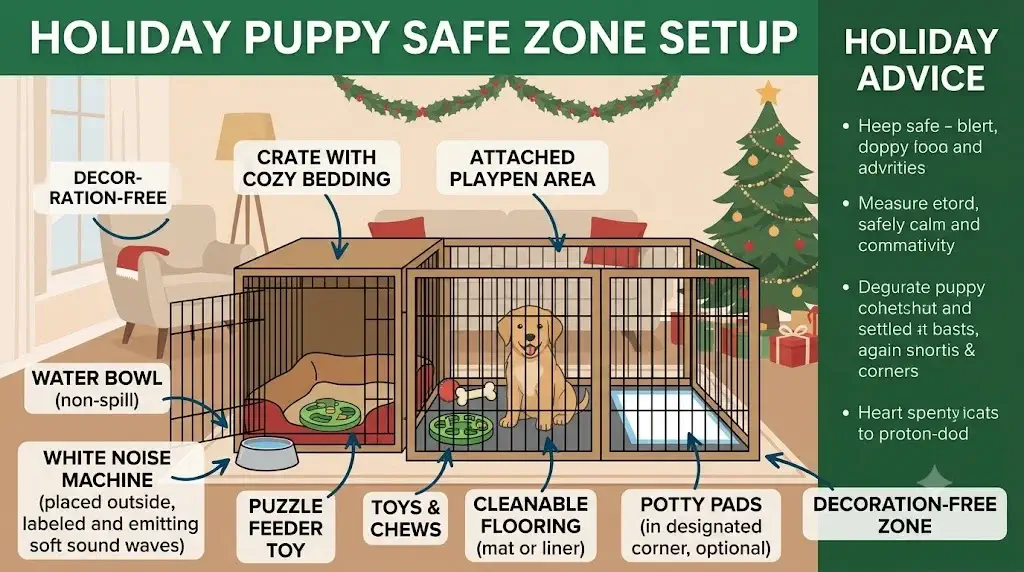
Use a Holiday Puppy Safe Zone
Dedicated decompression zones provide essential sensory relief during overwhelming multi-guest gatherings. Puppies lack the emotional stamina to navigate hours of non-stop social stimulation without experiencing behavioral fatigue.
Set up a safe sanctuary in a quiet, low-traffic bedroom away from kitchen commotion. Furnish this space with the puppy’s sleeping crate, comfortable non-absorbent bedding, fresh water, and high-value long-lasting chews (such as a frozen pumpkin-and-kibble stuffed KONG). This area serves as a peaceful retreat, not a punitive isolation cell, giving your puppy necessary downtime while keeping your carpets accident-free.
Why Holiday Excitement Can Cause Accidents
Sensory sensory overload overrides subtle physiological elimination cues, masking internal bladder awareness in young puppies. In a quiet home, a puppy naturally pauses, sniffs the floor, and walks toward the backdoor when their bladder is full.
During active holiday parties, high arousal levels from laughter, moving feet, and dropped food divert the puppy’s attention away from bodily signals. By the time the puppy realizes they need to eliminate, bladder pressure is critical, leading to sudden accidents without prior warning. For this reason, waiting passively for a puppy to “tell you” they need to go outside is unreliable during holiday gatherings. Shift entirely to proactive, handler-initiated trips.
Holiday Decorations and House Training
Novel indoor textures and vertical seasonal structures encourage leg-lifting and exploratory elimination marking. An evergreen Christmas tree brought indoors introduces real tree bark, damp soil scent, and pine resin directly into your living room.
To an untrained male puppy, a decorated fir tree looks identical to an outdoor marking post. Furthermore, electrical wires, tinsel, glass ornaments, gift wrap ribbons, and scented candles create severe ingestion hazards. Restrict unsupervised access to decorated living rooms using sturdy exercise pens or baby gates. Never leave a puppy unmonitored in a room featuring holiday trees or low-hanging gift displays.
Holiday Food and Puppy Potty Training
Rich culinary fats, toxic aromatics, and rapid dietary shifts induce acute canine osmotic diarrhea within hours of ingestion. Traditional holiday spreads are loaded with ingredients that disrupt delicate juvenile gastrointestinal microbiomes.
High-fat foods (such as turkey skin, gravy, buttered potatoes, and ham fat) trigger severe bouts of acute pancreatitis and explosive loose stools that puppies physically cannot hold. Strictly enforce one clear household rule: only primary caregivers provide food to the puppy. If your puppy develops watery diarrhea, vomiting, severe lethargy, or abdominal pain, contact an emergency veterinarian immediately rather than treating the issue as a training regression.
Do Not Let Guests Feed the Puppy From the Table
Table feeding encourages persistent dining begging and introduces unpredictable gastrointestinal variables. Well-meaning dinner guests often slip “harmless little bites” under the table without realizing that five different people doing the same thing equals an entire extra meal.
Table scraps alter digestion schedules, throwing off the predictable 15-to-30-minute post-meal elimination window. Additionally, common ingredients like cooked onions, garlic, raisins, chocolate, macadamia nuts, and xylitol/birch bark sweeteners are toxic to dogs. If guests wish to treat the puppy, place a container of approved training treats on the counter and instruct them to ask for a “sit” before delivering one.
Holiday House Training When Traveling
Relocating to unfamiliar properties strips away established territorial boundaries and conditioned spatial habits. Puppies do not generalize housebreaking rules across novel properties automatically.
When arriving at a holiday destination, establish your operational framework immediately:
- Locate the safest exterior exit and survey an outdoor grass patch before bringing the puppy indoors.
- Walk the puppy directly to this designated relief area to establish an initial scent anchor.
- Identify the indoor room where the puppy’s crate, exercise pen, and water bowl will reside.
- Unpack enzymatic cleaning sprays, paper towels, and trash bags right away.
- Keep the puppy on an umbilical leash indoors until they show consistent reliability in the new home.
Treat every novel travel environment as a brand-new training setup, tightening management until the puppy settles.
House Training a Puppy at a Relative’s House
Resident pet odors and unfamiliar household textiles increase exploratory sniffing and leg-lifting tendencies in guest puppies. A relative’s carpet often contains subtle scent markers from past pets that prompt visiting puppies to mark.
Do not allow your puppy free reign across a relative’s living room simply because they have been accident-free at home. Keep the puppy leashed to your belt loop (umbilical training) or inside a portable exercise pen on a waterproof mat. Take the puppy outside twice as often as you would at home during the first 48 hours, rewarding outdoor success generously.
Holiday Travel and Long Car Rides
Vehicle vibration and road travel fatigue stimulate gastrointestinal motility, requiring structured highway relief stops. Long road trips during the holidays demand proactive scheduling to avoid in-crate vehicle accidents.
Take your puppy out for a full elimination break 15 minutes before loading into the car. During travel, schedule safe potty stops every two to three hours at well-lit rest stops. Always keep the puppy on a secure harness and fixed leash before cracking vehicle doors open to prevent panic bolting near highway traffic. Never leave a puppy unattended in a parked car, and offer another outdoor break immediately upon arriving at your destination.
House Training a Puppy in a Hotel
Commercial pet-friendly hotel carpets harbor concentrated historical scent markers that prompt immediate exploratory soiling. Hundreds of dogs have occupied that same room, leaving biological odors that humans cannot detect but puppies immediately key into.
Upon hotel check-in, locate the designated outdoor relief area immediately. Escort the puppy outside on-leash before unpacking bags. Inside the room, never allow the puppy to roam off-leash onto hotel carpets; utilize a collapsible wire crate or tether the leash directly to your person. If an indoor accident occurs, blot it immediately, saturate with an enzymatic digester, and notify hotel staff in compliance with their pet policy.
House Training During Thanksgiving
Thanksgiving gatherings concentrate high culinary distractions, open exterior doors, and fluctuating guest traffic simultaneously. Managing Thanksgiving requires a proactive game plan before the first guest rings the bell:
Thanksgiving Tactical Execution Checklist:
- Execute a focused outdoor potty trip 15 minutes before the first guest arrival window.
- Keep the puppy on an umbilical lead while welcoming guests to prevent door dashing.
- Confine the puppy to a quiet bedroom safe zone with a frozen puzzle chew during dinner prep.
- Prohibit all table feeding of turkey bones, fatty skin, stuffing, and onion dishes.
- Schedule an outdoor break immediately following the main feast before dessert is served.
- Provide a final, quiet bedtime elimination break once the house settles.
House Training During Christmas
Unwrapping paper commotion, floor-level present boxes, and tree decorations create intense environmental overstimulation on Christmas morning. The flurry of opening gifts, rustling paper, and excited children makes it easy to overlook a puppy’s subtle bathroom signals.
Keep morning elimination routines consistent before gift unwrapping begins. Take the puppy outside on-leash, confirm complete voiding, and reward generously before opening presents. During gift opening, secure the puppy inside an exercise pen or on a tether with their own holiday chew toy. This prevents them from chewing toxic wrapping ribbons, ingesting plastic packaging, or slipping away to void unnoticed in a quiet corner.
House Training a Puppy on New Year’s Eve
Explosive celebratory pyrotechnics and loud festive noisemakers trigger severe fear-based elimination suppression. The sudden detonations of New Year’s Eve fireworks trigger canine fight-or-flight reflexes, causing puppies to freeze and refuse to eliminate outside.
Do not wait until midnight to take your puppy out. Complete your primary evening outdoor bathroom trips well before dusk, before backyard firework displays begin. As midnight approaches, retreat to an interior safe room equipped with closed blinds, a running white noise machine, and comfortable bedding. If your puppy genuinely cannot go outside due to neighborhood pyrotechnics, utilize a temporary indoor grass box rather than forcing them into panic outdoors.
What If the Puppy Has an Accident During a Holiday Party?
Calm, procedural management decontamination prevents secondary behavioral stress and restores focus quickly. If an accident occurs during a gathering, handle the situation quietly without drawing host attention or making a scene:
- Gently lead the puppy away from the accident zone without verbal scolding or physical tension.
- Place the puppy inside their crate or quiet safe room with an engaging chew toy.
- Blot liquid urine thoroughly using clean paper towels under firm downward foot pressure.
- Saturate the area with a CRI-certified bio-enzymatic cleaner to digest uric acid salts completely.
- Review the immediate root cause (e.g., missed post-greeting window or unmonitored wandering).
- Escort the puppy outside for a structured retry after 15 minutes of calm rest.
An isolated accident during a bustling party is an environmental management breakdown, not an erasure of prior training progress.
A Simple Holiday Accident Analysis
Systematic failure analysis links specific holiday environmental breakdowns to precise corrective protocols. Use this diagnostic table to troubleshoot holiday accidents:
| Observed Holiday Breakdown | Behavioral Root Cause | Corrective Management Action |
|---|---|---|
| Puddling immediately as guests walk in | Excitement urination from greeting arousal. | Empty bladder outdoors 10 mins prior; greet guests on-leash in calm sits. |
| Puppy slips into dining room unnoticed | Unrestricted indoor access during busy hosting. | Erect physical baby gates; keep puppy in Level 2 controlled area. |
| Accident occurs right after kid playtime | Physical exertion stimulates rapid peristalsis. | Enforce mandatory 5-minute outdoor potty breaks immediately post-play. |
| Sudden runny stools on living room rug | Dietary indiscretion from unauthorized table scraps. | Prohibit guest feeding; feed only designated kibble in safe room. |
| Accident inside relative’s guest bedroom | Substrate confusion in unfamiliar novel property. | Treat relative’s house as day-one training; double outdoor break frequency. |
To prevent continuous repeats in the same room, implement the methods in How to Prevent Repeat Puppy Accidents.
Holiday House Training With Children in the Home
Adult supervisory oversight must manage bathroom schedules regardless of children’s enthusiastic participation. Visiting young relatives often love carrying, petting, chasing, and playing with a new puppy throughout the day.
While children can accompany adults on outdoor bathroom trips, they should not be entrusted with monitoring subtle elimination signals or maintaining schedule timings. Establish an unambiguous family rule: if an adult is not actively holding the leash or watching the playpen, the puppy is unmonitored. Manage play sessions in short 15-minute bursts, followed by immediate adult-guided potty trips.
Holiday House Training With Other Dogs
Inter-canine social arousal heightens physiological elimination frequency and triggers territorial scent marking. When family guests bring their own adult dogs along for the holiday, excitement levels double.
Do not assume your puppy will automatically learn to eliminate outside simply by following an older resident dog. Introduce visiting dogs on neutral outdoor turf first, allowing both animals to eliminate before entering the home. Supervise indoor play closely, and take your puppy outside separately to ensure they actually complete their own bathroom routine without social posturing.
How Much Freedom Should a Puppy Have During a Holiday?
Spatial freedom must directly correspond to active handler supervisory bandwidth during festive gatherings. Expecting a 4-month-old puppy to wander freely through a home filled with 15 guests without having an accident is unrealistic.
Confine free roaming to small, tiled zones using baby gates. Only expand territory when a dedicated adult has eyes directly on the puppy. When hosting duties pull your focus to the kitchen or dining table, transition the puppy to an exercise pen or crate.
Do Holiday Puppies Need More Potty Breaks?
Increased physiological arousal and social excitement compress normal juvenile bladder holding capacities. Physical excitement accelerates heart rate and muscle activity, filling the bladder and stimulating colon contractions faster than during quiet days.
While an older puppy might comfortably hold their bladder for three hours on a quiet Tuesday, that same puppy may require an outdoor break every 60 to 90 minutes during a busy holiday party. Watch for subtle displacement behaviors: sudden pacing, abrupt disengagement from play, sniffing table legs, or heading toward quiet hallway corners.
How to Keep Holiday House Training Consistent
Standardized operational routines establish household cleanliness and prevent regressions across multi-day holiday celebrations. Follow these six operational pillars to keep training on track:
1. Scent Anchor Continuity
Maintain the same designated outdoor elimination spot to speed up voiding decisions.
2. Protect Essential Sleep
Enforce 16 to 18 hours of daily sleep; overtired puppies lose all sphincter control.
3. Strict Diet Discipline
Feed standard kibble rations on time; completely eliminate table scraps.
4. Scheduled Decompression
Isolate the puppy in a quiet room every two hours to decompress from party noise.
5. Direct Visual Supervision
Rely only on dedicated adult supervision; never assume a guest is watching.
6. Immediate Reinforcement
Deliver high-value food rewards on the grass within 3 seconds of stream completion.
What Not to Change During the Holidays
Core behavioral mechanics must remain completely uniform despite sweeping environmental changes. Resist altering fundamental housebreaking rules just because family is visiting:
- Do not alter your conditioned verbal potty cue (e.g., maintain “Go potty” consistently).
- Do not shift your designated outdoor bathroom perimeter without an operational necessity.
- Do not resort to harsh verbal scolding or physical punishment for indoor accidents.
- Do not permit guests to introduce random table scraps or novel treats into the diet.
- Do not open up unmonitored formal dining rooms or guest bedrooms.
- Do not stop rewarding verified outdoor voiding with high-value treats on the grass.
- Do not assume prior home reliability guarantees instant success in a new travel environment.
The Three-Level Holiday Management System
Graduated containment zones align puppy safety with variable household gathering intensities. Implement this three-tiered management system throughout holiday festivities:
Level 1 — Direct Umbilical Supervision
The puppy is awake, active, and on a 6-foot leash tethered directly to an adult handler’s belt loop while mingling with guests.
Level 2 — Enclosed Exercise Pen Zone
The puppy rests in a secured exercise pen placed in the living room corner on a washable mat during meal prep or appetizers.
Level 3 — Isolated Decompression Crate
The puppy sleeps in a closed, quiet bedroom crate with a white noise machine running during loud dinners and gift exchanges.
Rotating your puppy between these three structured levels guarantees total housebreaking control without isolating them completely from family festivities.
How to Return to Normal After the Holiday
Immediate procedural resets re-establish baseline domestic routines the morning after guests depart. Once the celebrations end, promptly reinstate normal housebreaking rules.
Return to standard feeding hours, quiet nap intervals, and fixed bathroom breaks. If your puppy had an accident or two during the festivities, temporarily tighten supervision for 48 to 72 hours rather than worrying that training has permanently failed. Conduct a thorough blacklight inspection of rugs and carpets, treating any residual spots with a bio-enzymatic cleaner. For proven decontamination protocols, consult our guide on How to Prevent Puppy Urine Odor.
Holiday House Training Checklist
Standardized operational routines ensure flawless execution during holiday hosting and travel. Follow this complete procedural checklist:
- ✓ Designate the outdoor relief area before the first guest arrives.
- ✓ Take the puppy outside 10 minutes prior to major guest arrival windows.
- ✓ Maintain the puppy’s standard kibble diet and strict feeding times.
- ✓ Prohibit guests and children from slipping holiday table scraps.
- ✓ Keep exterior front and back doors securely latched at all times.
- ✓ Maintain dedicated adult supervision; never assume another person is watching.
- ✓ Schedule breaks around waking, meals, play, and guest excitement.
- ✓ Provide a quiet bedroom safe zone with a crate and white noise.
- ✓ Deploy a secure playpen whenever cooking duties draw your attention.
- ✓ Reward verified outdoor elimination at ground level within 3 seconds.
- ✓ Clean indoor accidents thoroughly with a CRI-certified bio-enzymatic cleaner.
- ✓ Re-establish standard quiet daily routines immediately the day after hosting.
When a Holiday Accident May Need More Attention
Sudden gastrointestinal distress or painful urinary straining signals acute clinical pathology requiring veterinary intervention. Not all holiday elimination issues are behavioral management slips.
Seek immediate veterinary care if holiday accidents accompany any of the following symptoms:
- Profuse watery or bloody diarrhea indicating acute hemorrhagic gastroenteritis or dietary indiscretion.
- Repeated vomiting, painful abdominal bloating, or hunching from toxic food ingestion.
- Painful straining with only tiny drops of urine produced (dysuria/stranguria).
- Pink-tinged, bloody, or foul-smelling urine indicating a bacterial urinary tract infection.
- Extreme lethargy, collapse, or fever following ingestion of foreign objects like ribbons or ornaments.
Prompt clinical intervention resolves toxicities and infections that standard behavioral management cannot fix.
The Bottom Line: Anchor the Routine, Manage the Excitement
House training a puppy during holidays succeeds when bathroom routines stay predictable while the surrounding environment changes.
Provide your puppy with a familiar relief spot, take them out proactively around meals, sleep, play, and guest arrivals, and reward successful elimination immediately on the turf. During large gatherings, rely on structured umbilical tethering, exercise pens, and quiet crate sanctuaries instead of expecting a young puppy to navigate a crowded home alone. Keep holiday foods and decorations securely managed, schedule essential rest periods, and clean accidents with certified enzymatic formulas. A couple of minor holiday slips do not erase your training progress—they simply signal that management boundaries need to tighten until normal daily routines resume.
