
House Training a Puppy While Traveling
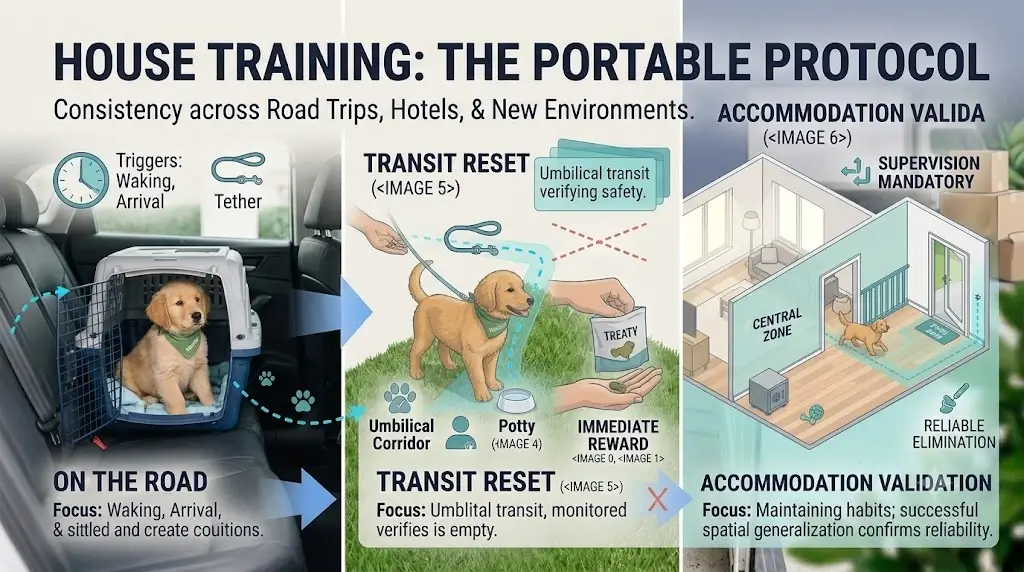
House training a puppy while traveling requires a portable routine that works across unfamiliar places, changing schedules, and different potty environments. The goal is not to make every location feel identical. It is to keep the puppy’s bathroom rules predictable: provide timely opportunities, use a consistent cue and destination when possible, supervise closely in unfamiliar spaces, and reward successful elimination.
Why Traveling Can Disrupt Puppy House Training
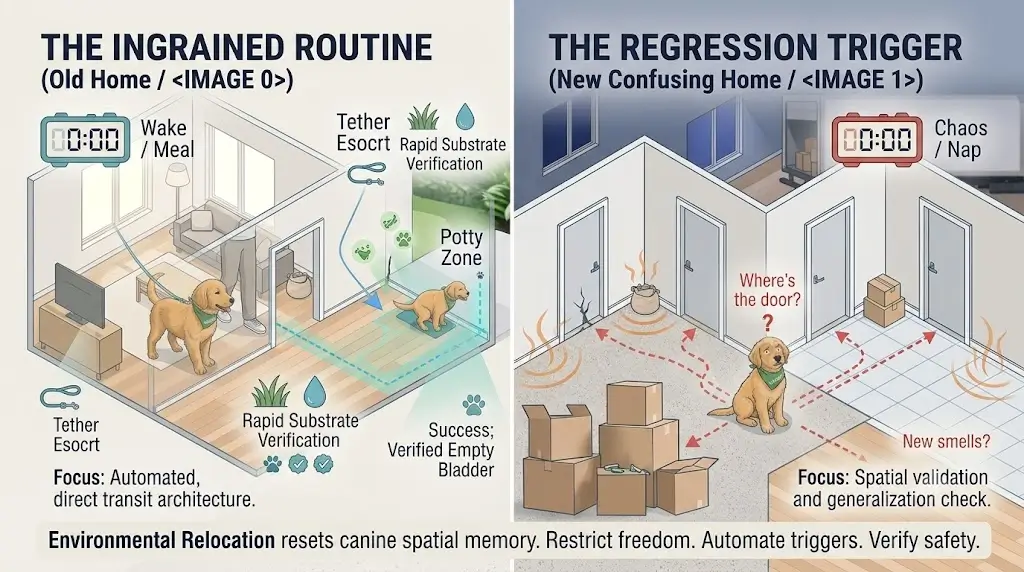
A puppy can understand a bathroom routine at home without automatically understanding that the same rule applies in a hotel, vacation rental, relative’s house, campground, or unfamiliar outdoor area.
Travel removes many of the environmental cues the puppy normally relies on. The usual door may disappear. The normal yard may not exist. The floor may have a different texture. New smells can create distractions, while a long drive can change the timing of meals, naps, play, and potty opportunities.
For that reason, successful travel house training depends heavily on management and repetition.
The Core Travel House-Training Rule
When traveling, make the bathroom routine predictable even when the surroundings are not.
Wake → Potty → Eat → Potty → Travel → Potty → Rest → Potty
The exact sequence will vary depending on the trip, but the principle is useful: attach potty opportunities to predictable transitions instead of relying exclusively on the clock.
Before Traveling: Build a Portable Potty Routine
The easiest time to prepare for travel is before the trip. Establishing solid bathroom habits at home serves as the foundation before introducing complex travel scenarios; see our core blueprint on how to house train a puppy.
Practice taking your puppy to different appropriate potty environments while maintaining the same basic cue and reward system. This can help the puppy learn that the bathroom rule is not limited to one specific patch of grass or one particular door.
You can practice:
- Using different outdoor surfaces.
- Walking through unfamiliar areas before potty trips.
- Using the same verbal potty cue in different locations.
- Taking short trips away from home.
- Entering unfamiliar buildings and returning to the potty area.
- Following a slightly different route to the bathroom.
The objective is generalization: teaching the puppy that the behavior remains the same even when the surroundings change.
Create a Travel Potty Kit
A dedicated travel kit reduces delays when your puppy needs to eliminate.
Keep the leash and identification equipment immediately accessible rather than buried in luggage.
Carry more than you expect to use so an unexpected stop does not create a problem.
Use familiar rewards that your puppy already associates with successful training.
Be prepared to clean an accident promptly in a hotel, rental, vehicle, or other temporary space.
How Often Should You Stop for a Puppy Potty Break While Traveling?
There is no single interval that works for every puppy.
Age, body size, activity, water intake, feeding schedule, sleep, excitement, and individual development all influence bathroom needs.
Instead of treating a fixed number of hours as a guarantee, watch for predictable situations that increase the likelihood of needing a potty opportunity.
- Immediately after waking.
- After eating.
- After drinking more than usual.
- After active play.
- After a long period of rest.
- After arriving somewhere new.
- Before entering a hotel or vacation rental.
- Before a long period when a potty opportunity may be unavailable.
When traveling, it is generally safer to plan around the puppy’s individual needs rather than assuming the puppy can wait as long as an adult dog.
House Training a Puppy During a Road Trip
Road trips create a moving schedule, but the house-training principles remain the same.
Plan stops around the puppy’s normal potty triggers rather than waiting until the puppy becomes desperate.
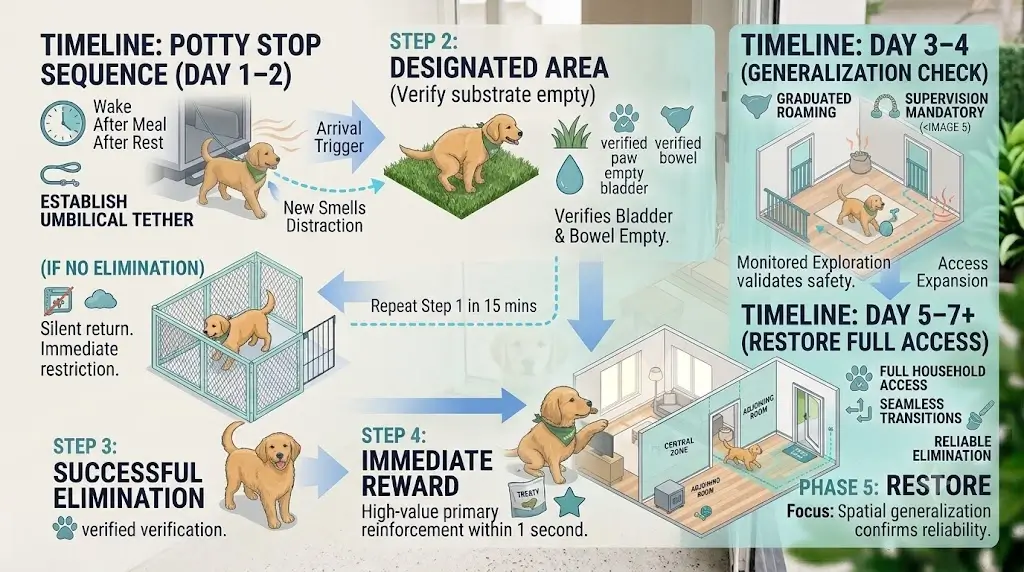
When you stop, choose a safe and appropriate potty area, keep the puppy focused, and give the puppy enough time to eliminate before immediately returning to the vehicle.
Once the puppy successfully eliminates, provide the normal reward and continue the trip.
Do Not Make Every Roadside Stop a Play Session
Travel stops can be highly stimulating. New smells, traffic noise, other dogs, people, and unfamiliar surroundings can cause a puppy to forget why it was taken outside.
A useful sequence is:
- Arrive at the safe potty area.
- Keep the puppy focused and supervised.
- Use the familiar potty cue.
- Wait for elimination.
- Reward immediately.
- Allow appropriate exploration afterward if time and location permit.
This helps the puppy distinguish between potty time and exploration time.
Choose Road-Trip Stops Carefully
Not every roadside location is appropriate for a puppy.
Choose areas that are safe, permitted, reasonably clean, and away from immediate traffic hazards.
If traveling through unfamiliar regions, check local rules regarding pets and waste disposal.
Do not allow a young puppy to roam freely around unknown environments simply because it is time for a bathroom break.
House Training a Puppy in a Hotel
A hotel room should initially be treated more like a newly introduced training environment than a familiar home.
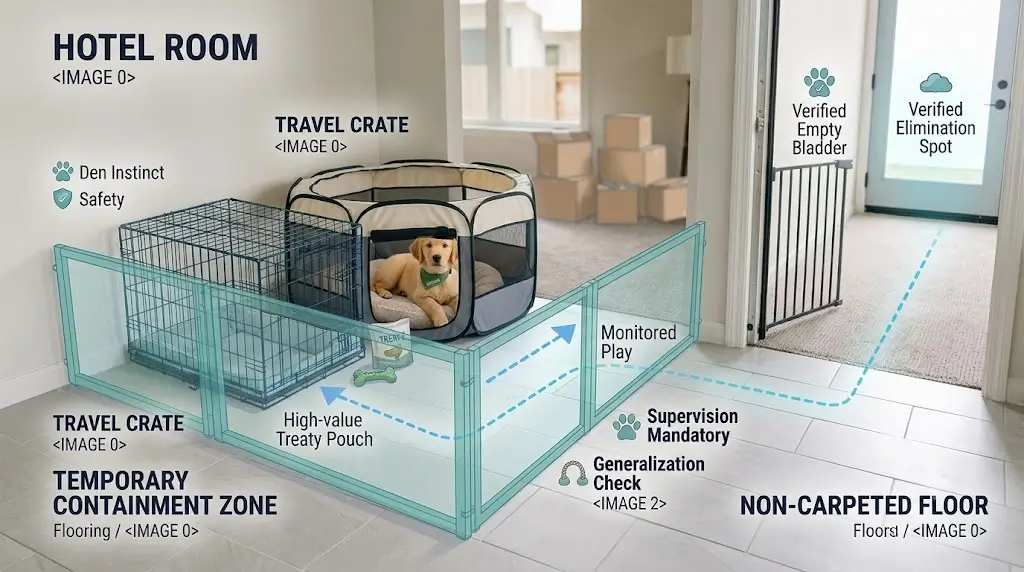
Take the puppy to an appropriate outdoor potty location soon after arriving, before giving the puppy extensive freedom in the room.
Then keep the puppy supervised while it becomes familiar with the room.
Pay particular attention after naps, meals, drinking, play, and periods of excitement.
Teach Your Puppy the Hotel Room Before Giving More Freedom
Start with a manageable portion of the room.
Keep the puppy near you and observe sniffing, pacing, circling, searching, or movement toward corners that may indicate the puppy is looking for a bathroom location.
If the puppy remains successful, gradually allow access to more of the room.
This mirrors the same freedom-expansion strategy used at home.
House Training a Puppy in a Vacation Rental
Vacation rentals require extra caution because the property may contain carpets, rugs, furniture, stairs, balconies, multiple rooms, or previous pet odors.
Before allowing full access, identify the safest potty route and inspect the property for areas where the puppy could eliminate unnoticed.
If the rental has a yard, take the puppy directly to the designated bathroom area rather than assuming the entire yard is equally useful.
What If the Puppy Has an Accident in a Hotel or Rental?
Respond calmly and clean the area thoroughly.
If you discover the accident after it happened, there is little value in punishing the puppy afterward. Instead, determine what happened immediately before the accident.
| What happened? | Possible training adjustment |
|---|---|
| Puppy explored alone | Reduce freedom |
| Long gap between potty trips | Offer earlier opportunities |
| Puppy was distracted outdoors | Use a quieter potty location |
| New carpet attracted puppy | Supervise and restrict access |
| Puppy arrived recently | Take puppy out immediately after arrival |
How to House Train a Puppy While Staying With Family or Friends
A relative’s or friend’s home may feel more comfortable than a hotel, but the house is still unfamiliar to the puppy.
Tell everyone in the household what the potty routine is.
This prevents one person from assuming another person already took the puppy outside.
It also prevents well-meaning visitors from giving the puppy unrestricted access to unfamiliar rooms.
Traveling With a Puppy and a Changed Feeding Schedule
Changing meals can change the timing of bowel movements.
If practical, maintain the puppy’s familiar feeding routine during travel rather than introducing unnecessary schedule changes at the same time as a new environment.
If travel requires a different schedule, expect bathroom timing to change as well and adjust potty opportunities accordingly.
Traveling With a Puppy and New Water
Puppies should have appropriate access to water, but travel can change when and how much they drink.
Excitement, heat, exercise, and unfamiliar surroundings can also influence drinking.
Instead of restricting water simply to avoid accidents, plan additional potty opportunities when circumstances increase bathroom needs.
House Training a Puppy on a Long Drive
Long drives require planning around the puppy’s developmental needs.
Do not use the vehicle as a substitute for a potty routine.
Build appropriate breaks into the journey and adjust them based on the puppy’s behavior.
If the puppy becomes restless, repeatedly changes position, whines, or otherwise behaves differently from normal, consider whether a break is needed rather than assuming it is simply boredom.
The puppy should also remain safely restrained during vehicle travel.
House Training a Puppy While Flying
Air travel creates a different challenge because bathroom opportunities can be restricted by airport rules, security procedures, boarding, and flight time.
Before traveling, verify the current airline and airport pet requirements and identify the appropriate locations for pet relief before and after the flight.
Give the puppy an appropriate potty opportunity before entering a period where access may be limited.
Because airline policies can vary, do not rely on a generic travel routine without checking the requirements for your specific itinerary.
House Training a Puppy on a Train or Bus
Public transportation can create long periods without convenient bathroom access.
Plan the puppy’s potty opportunity before boarding and identify permitted relief locations at transfer points or destinations.
Keep the puppy’s supplies immediately accessible.
Because rules vary by carrier and location, confirm current pet policies before the trip.
Should You Use Puppy Pads While Traveling?
Puppy pads can be useful in certain travel situations, particularly when a puppy has been intentionally trained to use them or when an appropriate outdoor potty opportunity is temporarily unavailable.
However, introducing a new indoor bathroom surface during travel can also create confusion if your long-term goal is outdoor elimination.
If you normally train for outdoor pottying, keep the outdoor routine as consistent as practical.
If you use an indoor option for a specific travel circumstance, keep the location consistent and avoid presenting multiple surfaces as acceptable without a reason.
How to Help a Puppy Generalize House Training
Generalization means the puppy learns that a behavior remains appropriate across different contexts.
You can strengthen this skill by gradually practicing potty trips in different environments before a major trip.
Establish the basic behavior.
Introduce different smells and surfaces.
Practice bathroom timing away from home.
Practice the complete travel routine.
Use the Same Potty Cue Everywhere
A consistent verbal cue can help the puppy understand what behavior is expected even when the environment changes.
Choose a simple phrase and use it consistently during appropriate potty opportunities.
The cue should not become background noise. Give the puppy time to respond, and reinforce successful elimination.
Do Not Rush the Puppy Back Into the Car
Some puppies become distracted during travel stops because they associate leaving the vehicle with excitement.
Give the puppy an opportunity to finish eliminating before returning to the car.
Once successful, reward the behavior and continue the trip.
This makes the potty stop itself meaningful rather than turning it into a rushed interruption.
Travel House Training at Night
Nighttime can be less predictable in a new environment because the puppy may wake from unfamiliar sounds or changes in sleeping arrangements.
Keep the sleeping area predictable and maintain the same bedtime potty routine used at home when practical.
If the puppy wakes and appears to need a bathroom break, take it to the appropriate location calmly and return to the sleeping routine afterward.
Traveling Across Time Zones With a Puppy
Crossing time zones changes the clock but does not instantly change the puppy’s biological routine.
During the first part of the trip, pay attention to the puppy’s actual sleep, meal, activity, and elimination patterns rather than relying entirely on the destination clock.
Gradually align the schedule with the new local routine as the trip continues.
How to Handle a Puppy Who Refuses to Potty in a New Place
Some puppies will not eliminate immediately because the environment is unfamiliar or distracting. For practical strategies when environmental anxiety causes delays, see our guide on why won’t my puppy poop outside?
Move to a quieter, appropriate location and reduce unnecessary stimulation.
Use the familiar potty cue and allow enough time.
If the puppy does not eliminate, avoid assuming it is finished simply because it showed no interest. Return to close supervision and offer another appropriate opportunity later.
The Difference Between Potty Refusal and a Medical Problem
A puppy occasionally delaying elimination in a strange environment is not necessarily abnormal.
However, inability to urinate or defecate, repeated attempts without producing anything, obvious discomfort, or other unusual symptoms should not be treated as a simple training problem.
When a puppy’s elimination behavior seems physically abnormal, veterinary guidance is appropriate.
How to Prevent Travel Accidents Before They Happen
- Plan the route. Know where appropriate potty stops are available.
- Watch transitions. Waking, eating, playing, and arriving are common potty triggers.
- Limit freedom. Unfamiliar spaces require closer supervision.
- Use the same cue. Consistency makes the behavior easier to recognize.
- Reward success. Reinforce appropriate elimination immediately.
- Clean accidents thoroughly. Prevent the location from becoming an accidental bathroom cue.
- Adjust rather than punish. Change timing or management when accidents occur.
Common Travel House-Training Mistakes
A puppy that is reliable at home may need closer supervision in a hotel or rental.
Young puppies may not communicate clearly enough to rely entirely on signaling.
Travel already creates enough environmental change.
Distractions can cause a puppy to postpone elimination.
Punishment does not teach the new location or route.
Hotels, airports, parks, transportation providers, and municipalities may have specific pet requirements.
A Portable House-Training Schedule
| Travel event | Potty strategy |
|---|---|
| Before leaving home | Give the puppy an appropriate potty opportunity. |
| Before a long travel period | Plan a bathroom stop and prepare supplies. |
| During the journey | Use safe, appropriate stops based on the puppy’s needs. |
| Arrival | Offer a potty opportunity before extensive exploration. |
| After meals or naps | Repeat the familiar potty routine. |
| Before bedtime | Use the same final potty routine used at home. |
A 3-Stage Travel House-Training System
Control
Keep the puppy supervised and use predictable potty opportunities in the unfamiliar environment.
Generalize
Repeat the same cue and reward system across appropriate locations and surfaces.
Expand
Increase freedom and reduce management only after the puppy demonstrates reliability.
What to Do the First Night Away From Home
The first night should be deliberately boring from a training perspective.
Keep the puppy’s sleeping arrangement predictable, maintain the familiar bedtime sequence, and avoid giving unrestricted access to the entire property.
Offer an appropriate final potty opportunity before settling down.
If the puppy wakes, assess whether it needs a bathroom break before assuming the behavior is simply attention seeking.
What If Your Puppy Has Several Accidents During a Trip?
Stop testing freedom and return to basic management.
- Clean all accident locations thoroughly.
- Reduce the puppy’s access to unfamiliar rooms.
- Increase supervision.
- Offer potty opportunities more proactively.
- Return to the familiar cue.
- Reward successful elimination.
- Track the timing of accidents and successful trips.
If the puppy was previously reliable and suddenly develops persistent or unusual elimination problems, consider veterinary evaluation rather than assuming the travel environment is the only explanation.
How to Resume Normal House Training After the Trip
When you return home, immediately return to the familiar routine.
Do not assume the trip caused permanent regression.
If the puppy remains reliable, continue normal freedom.
If accidents increased during travel and continue after returning home, temporarily reduce freedom and rebuild the routine using the same methods that worked before. For a clear post-trip structure, use our progressive 7-day puppy house training plan.
A short reset is often more useful than treating the problem as a complete restart.
Travel House-Training Checklist
- ✓ Practice short outings before a major trip.
- ✓ Use the same potty cue at home and while traveling.
- ✓ Pack leash, identification, waste bags, rewards, and cleaning supplies.
- ✓ Plan appropriate potty stops before the puppy becomes urgent.
- ✓ Give a potty opportunity after waking, eating, playing, and arriving.
- ✓ Treat hotels and rentals as new training environments.
- ✓ Supervise closely in unfamiliar spaces.
- ✓ Keep potty stops focused before allowing exploration.
- ✓ Clean accidents promptly and thoroughly.
- ✓ Never punish a puppy for a travel accident.
- ✓ Check current pet rules for hotels, transportation, parks, and destinations.
- ✓ Adjust the routine when crossing time zones.
- ✓ Return to the familiar home routine after the trip.
The Bottom Line: Make the Routine Portable
Successful puppy house training during travel comes from keeping the behavior predictable while the environment changes.
Your puppy does not need the exact same yard, doorway, hotel, or travel route to remain house trained. It needs repeated opportunities to eliminate in an appropriate location, consistent cues, close supervision in unfamiliar places, and immediate reinforcement for success. Plan before urgency, treat every new accommodation as a fresh training environment, and gradually increase freedom once the puppy demonstrates reliability.
Editorial note: This guide provides general puppy house-training information for U.S. households and travelers. Puppies differ in age, development, body size, previous training, and bathroom needs. Always follow current pet rules for your airline, hotel, rental property, transportation provider, parks, and destination. Sudden, persistent, painful, unusually frequent, or otherwise abnormal elimination should be discussed with a veterinarian.
