
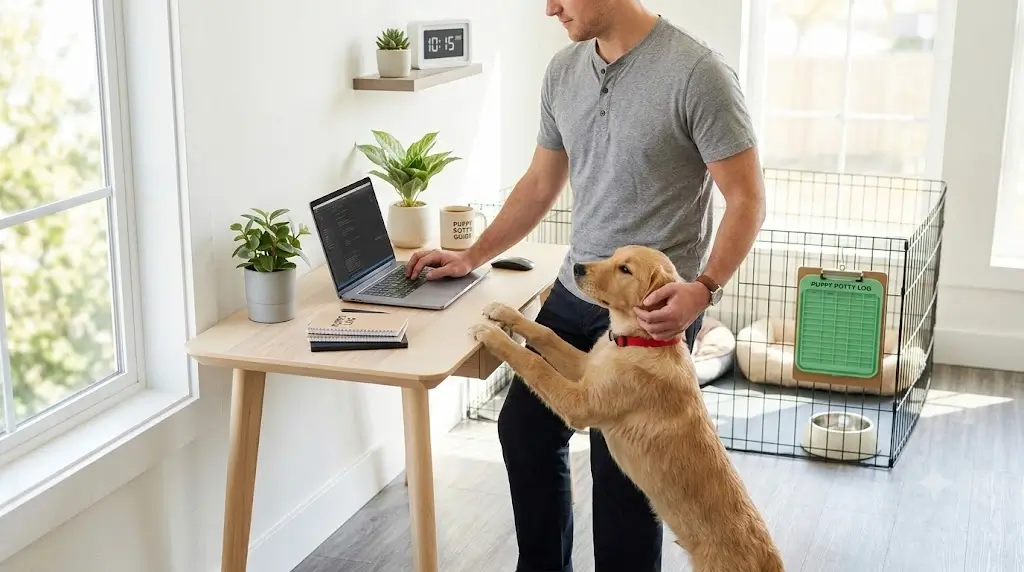
House Training a Puppy When You Work From Home
House training a puppy while working from home can be easier because you are nearby, but remote work creates its own challenges. Meetings, deadlines, headphones, and long periods at a desk can cause you to miss the exact moments when your puppy needs a potty break.
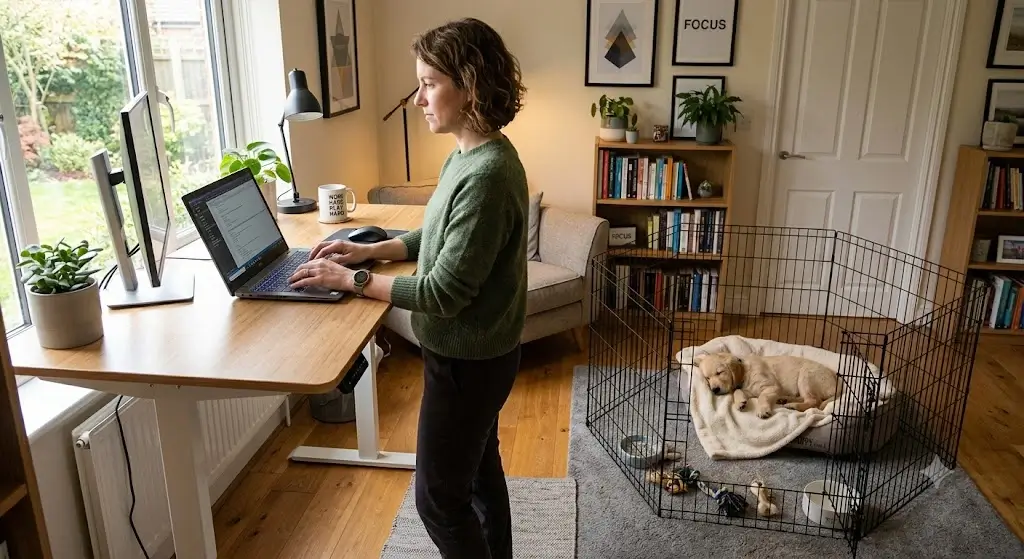
Can You House Train a Puppy While Working From Home?
Yes. Working from home can provide more opportunities for consistent potty training than a traditional commute, but only if your workday is organized around the puppy’s needs as well as your own schedule.
The biggest advantage is access. You can usually respond quickly after your puppy wakes, eats, drinks, plays, or finishes a nap. The biggest disadvantage is that remote work can make you feel physically available when you are actually unavailable.
A 60-minute video meeting may mean you are sitting ten feet from your puppy while still being unable to supervise or provide a potty break. That distinction matters.
Why Working From Home Does Not Automatically Make Potty Training Easy
Puppies do not understand that a workday has changed simply because their owner is physically present. From the puppy’s perspective, you are in the same room but may be unavailable for long periods.
Several common work-from-home situations can interfere with house training:
- Back-to-back video meetings.
- Long phone calls.
- Wearing headphones and missing subtle signals.
- Working behind a closed office door.
- Assuming a quiet puppy is a reliable puppy.
- Giving too much freedom because you are home.
- Forgetting a potty break because of a deadline.
- Allowing the puppy to wander into another room.
The solution is not constant attention. It is predictable management.
The Best Work-From-Home Puppy Potty Training System
A practical system has five parts:
1. Routine
Use predictable potty opportunities throughout the day.
2. Supervision
Keep the puppy where you can realistically monitor behavior.
3. Management
Use gates, a pen, or appropriate confinement when necessary.
4. Reinforcement
Reward appropriate elimination promptly.
5. Coverage
Have backup help for periods when meetings prevent you from responding.
Start With an Event-Based Potty Schedule
Instead of relying exclusively on a clock, connect potty trips to predictable events. This makes the routine easier to maintain when meetings move or your workday changes.
| Event | What to do | Training purpose |
|---|---|---|
| Wake-up | Offer a potty opportunity promptly. | Starts the day with the correct location. |
| After eating | Plan another potty opportunity. | Reduces accidents following meals. |
| After a nap | Take the puppy to the designated toilet area. | Prevents accidents immediately after sleep. |
| After active play | Provide a potty opportunity. | Connects activity with the next routine step. |
| Before a long meeting | Take the puppy out when appropriate. | Reduces the chance of a meeting-related accident. |
| Bedtime | Offer the final planned potty opportunity. | Creates a consistent nighttime pattern. |
How Often Should You Take a Puppy Out While Working From Home?
There is no single potty interval that is correct for every puppy. Age, development, body size, sleep, meals, activity, water intake, individual bladder control, and health all influence how frequently a puppy needs a bathroom opportunity.
Young puppies generally need more frequent opportunities than older puppies and adult dogs. Rather than relying on an exact formula, watch for patterns and use the puppy’s daily events to plan breaks.
During the early stages of training, it is better to provide a reasonable opportunity before a predictable accident window than to wait for the puppy to demonstrate that it is already desperate.
Example Work-From-Home Puppy Schedule
The following schedule is an example framework for a puppy owner who works a typical daytime schedule. Adjust it to your puppy’s age, routine, and individual needs.
| Time | Activity | House-training action |
|---|---|---|
| 6:30 AM | Wake up | Potty opportunity |
| 7:00 AM | Breakfast | Potty opportunity afterward |
| 8:00 AM | Work begins | Supervised rest area |
| Morning break | Movement/play | Potty opportunity after activity |
| Lunch | Meal + activity | Potty opportunity |
| Afternoon | Nap / quiet time | Potty after waking |
| End of work | Play / walk | Potty opportunity |
| Evening | Dinner / play / rest | Additional opportunities as needed |
| Bedtime | Sleep routine | Final potty opportunity |
The exact clock times matter less than maintaining a predictable sequence and responding to the puppy’s actual needs.
Use Your Calendar as a Puppy Training Tool
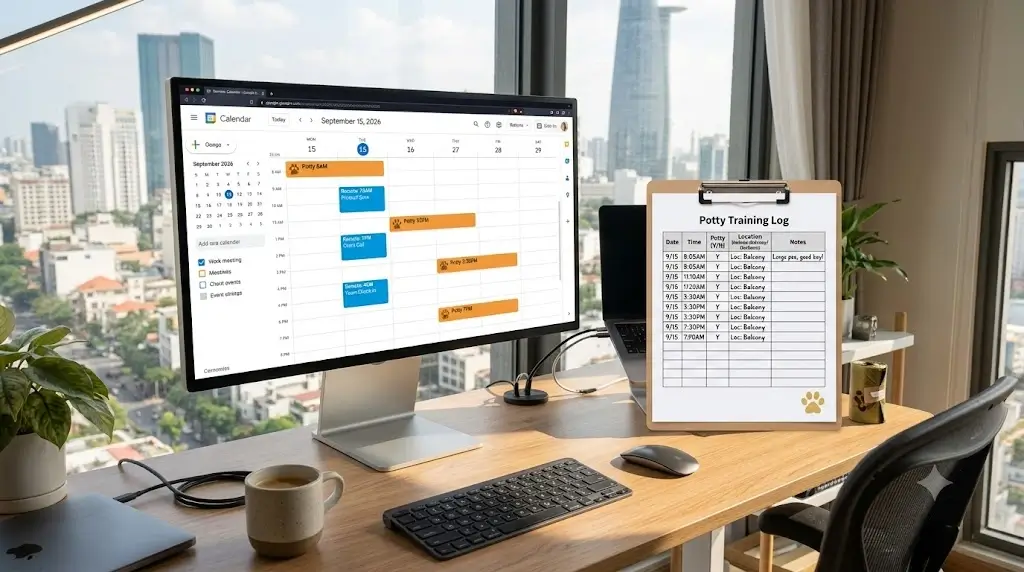
One of the simplest improvements for remote workers is to put puppy care directly on the work calendar.
During the first weeks, create recurring reminders around the puppy’s known potty windows. This prevents a work task from accidentally replacing a necessary break.
Example calendar block schedule:
9:00 — Work block
9:45 — Puppy check / potty opportunity
10:00 — Work block
11:30 — Potty + movement
12:00 — Lunch / puppy routine
1:00 — Work block
2:30 — Puppy check / potty opportunity
4:00 — Potty + movement
These times are illustrative. Your puppy’s actual needs should determine the final schedule.
What to Do Before a Video Meeting
Long meetings are one of the most common work-from-home traps. The best approach is to treat a meeting like a predictable period of unavailability.
- Check whether the puppy is approaching a normal potty window.
- Provide an appropriate potty opportunity before the meeting when needed.
- Give the puppy a suitable period of calm activity.
- Place the puppy in a safe, controlled area.
- Have a backup person available if the meeting will exceed the puppy’s reasonable ability to wait.
Do not assume that a puppy will remain asleep simply because your meeting is important.
How to Handle Back-to-Back Meetings
Back-to-back meetings require planning because there may be no natural gap between calls.
Depending on the puppy’s age and needs, that could mean moving meetings when possible, asking another household member for help, hiring a trusted caregiver, or creating an appropriate backup potty arrangement.
The important point is to avoid relying on the puppy to wait simply because your calendar is full.
Should Your Puppy Stay in Your Home Office?
Keeping the puppy near you can make supervision easier, but the office should not automatically become the puppy’s entire environment.
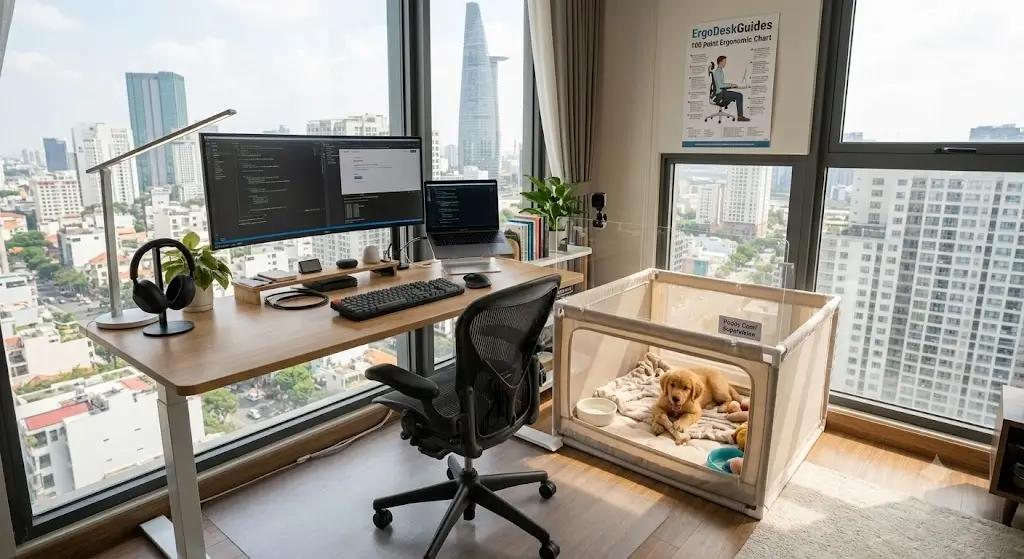
A suitable setup can include a puppy-proofed area near the workspace, a comfortable resting location, access to appropriate enrichment, and controlled movement outside the office when you can supervise.
If the puppy constantly circles, sniffs, wanders away, or becomes restless, consider whether it needs a potty opportunity rather than simply adding another toy.
Do Not Confuse a Quiet Puppy With a House-Trained Puppy
A puppy lying quietly under your desk may look perfectly settled. That does not necessarily mean the puppy has learned where to eliminate.
Young puppies can have accidents without making much noise or giving an obvious signal. This is why proactive potty trips remain important during the early stages.
Supervision means actively managing the puppy’s environment, not merely being in the same building.
Use a Small Training Area Before Giving Full House Access
One of the most common work-from-home mistakes is giving a puppy access to the entire house because the owner is technically home.
Instead, start with a controlled area where you can supervise behavior. As the puppy becomes more reliable, gradually increase access.
Crate, Pen, or Baby Gate?
| Management tool | Useful for | Watch-out |
|---|---|---|
| Crate | Rest, sleep, and short periods of controlled management. | It does not replace appropriate potty breaks. |
| Puppy pen | A larger controlled space during supervised periods. | Too much space can make accidents easier to hide. |
| Baby gate | Restricting access to rooms. | It only works if the remaining area is puppy-proofed. |
Configuring these tools efficiently can be particularly demanding when working with limited layout options. You can explore floor plan zoning principles in our guide on house training a puppy in a small home to keep boundaries effective without turning your office into a fortress.
How to Teach a Puppy to Signal That It Needs to Go Out
Puppies may eventually develop their own signals, but waiting for a reliable signal from a very young puppy can create unnecessary accidents.
First build a strong association between the correct location and successful elimination. Once the routine is established, pay attention to the puppy’s individual pre-potty behaviors.
Common signals can include suddenly stopping play, sniffing the floor, circling, moving toward a previous potty area, pacing, or approaching a door. Not every puppy shows the same signal.
What If Your Puppy Interrupts Your Work Constantly?
Not every interruption means the puppy needs to eliminate. Puppies also seek interaction, movement, food, play, exploration, and attention.
Create a predictable daily rhythm that separates work periods from puppy interaction periods.
Example rhythm: Potty → movement → short interaction → rest → owner work → potty → activity → rest → owner work.
Predictability can reduce the need for the puppy to repeatedly demand attention while you are trying to work.
Use Scheduled Breaks Instead of Waiting for Accidents
A common mistake is waiting until the puppy starts showing obvious signs of urgency. By that point, the training opportunity may already be late.
During early training, schedule potty opportunities before predictable high-risk periods. As the puppy becomes more reliable, gradually adjust the schedule based on observed patterns.
Keep notes for several days. If daytime schedules operate smoothly but you continue finding unexpected messes at dawn, see our diagnostic guide on what to do when your puppy keeps having accidents overnight to fine-tune evening crate and water routines.
Create a Simple Puppy Potty Log
A potty log is especially useful for people working from home because it turns vague impressions into a measurable routine.
| Time | Event | Location | Result |
|---|---|---|---|
| 7:00 AM | Wake | Outside | Successful |
| 8:30 AM | Play | Outside | Successful |
| 11:45 AM | Lunch | Outside | Successful |
The goal is not perfect record-keeping. The goal is identifying predictable patterns so your work calendar can accommodate them.
How to Handle a Puppy Accident During a Meeting
If you are in a meeting and discover an accident afterward, do not punish the puppy. The accident is information that the current management plan did not prevent the behavior.
Clean the area thoroughly and look at what happened immediately beforehand:
- Was the puppy recently awake?
- Had it eaten?
- Had it been playing?
- Was it left unsupervised?
- Was the meeting longer than expected?
- Was the puppy’s usual potty break skipped?
If the same situation repeats, change the schedule rather than simply hoping the puppy will wait longer next time.
Should You Keep Puppy Pads in Your Home Office?
That depends on your house-training objective and living situation.
If your ultimate goal is outdoor-only elimination, relying heavily on indoor pads can introduce another location that the puppy must learn to distinguish from the rest of the house. If an indoor toilet area is necessary as a backup, keep it deliberate, consistent, and confined to one defined location.
This decision is often unavoidable for remote workers living in multi-story towers where rapid outdoor transit isn’t feasible between calls. Our guide to house training a puppy in a high-rise details how to set up indoor relief stations or balcony grass pads effectively without compromising future outdoor habits.
How to Reward Outdoor Potty Training
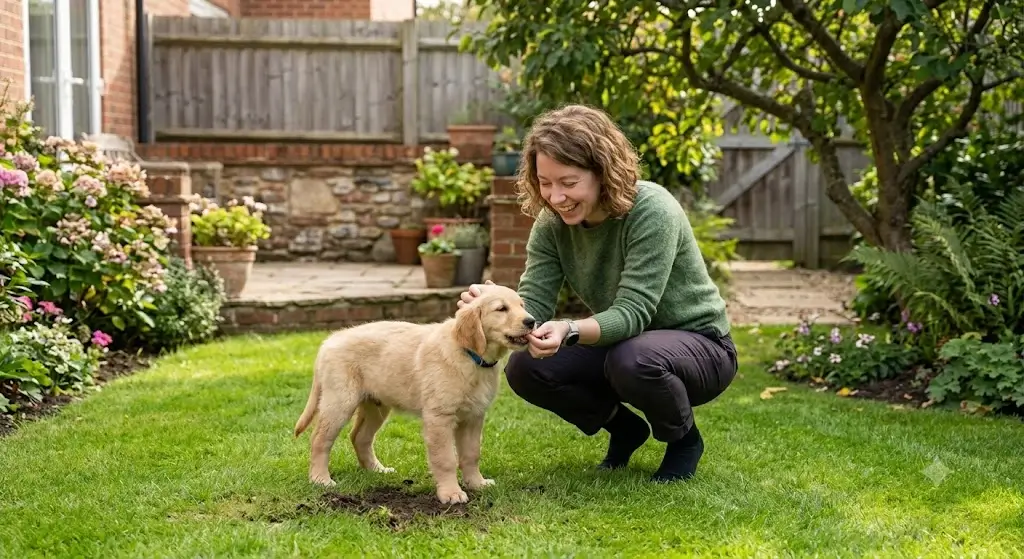
When your puppy eliminates in the correct location, reward the behavior promptly. The reward should happen close enough to the successful behavior for the puppy to make the connection.
- Go to the designated potty location.
- Wait calmly for elimination.
- As soon as the puppy finishes, praise and reward appropriately.
- Return to the normal routine.
You do not need a long training session after every successful potty trip. Consistent timing is more important than making the process complicated.
Do Not Punish Indoor Accidents
Punishing a puppy after an accident does not teach the puppy where you want it to eliminate. It can instead create confusion or make the puppy less comfortable eliminating around you.
If you catch the puppy beginning to eliminate indoors, calmly interrupt and redirect to the appropriate location when practical. If the accident is already finished, clean it and continue the training routine.
How to Clean Puppy Accidents Correctly
A thorough cleanup matters because residual odor can make a previously soiled area more likely to attract repeat elimination.
Use a pet-appropriate enzymatic cleaner according to the manufacturer’s directions, particularly on carpets and other porous surfaces. Avoid simply covering the smell with fragrance.
Restrict access to repeatedly soiled areas until the puppy’s house-training reliability improves.
How to Gradually Increase Freedom While Working
Once your puppy demonstrates consistent success in a controlled area, gradually increase access to another portion of the home.
Do not expand access to the entire house at once. A larger territory increases the number of places where an accident can occur and makes supervision more difficult while you are working.
If accidents increase after expanding access, return to the previous successful level and rebuild reliability. When progress unexpectedly halts or regresses after several reliable weeks, walk through our action plan on what to do when house training stalls to identify hidden trigger factors.
What About Working in Another Room?
If you need to work in a room where the puppy cannot safely stay, use a controlled area rather than giving the puppy unrestricted access to the house.
Before starting a long work block, provide an appropriate potty opportunity and make sure the puppy has access to a safe resting area. If the puppy will need another break during that work block, schedule it before the work session begins.
What If You Cannot Take the Puppy Out During a Meeting?
If your puppy’s needs overlap with a meeting that you cannot leave, plan for another person to help whenever possible.
Depending on your household, that might be a partner, family member, roommate, trusted dog walker, or other responsible caregiver.
If no one can provide the required care, an appropriate indoor potty setup may be considered as a temporary management option, particularly when outdoor access is impractical.
The important point is to design the system before the meeting rather than treating accidents as inevitable.
Work-From-Home Puppy Training: What Not to Do
Don’t rely on the puppy to tell you.
Young puppies may not provide a clear or timely signal.
Don’t give unlimited freedom.
Being home does not equal active supervision.
Don’t skip breaks for meetings.
Your calendar does not change the puppy’s physical needs.
Don’t punish accidents.
Use accidents to improve management instead.
How Long Does House Training Take When You Work From Home?
House-training progress varies substantially between puppies. Age, previous experience, consistency, health, temperament, environment, and how effectively accidents are prevented all influence the process.
Some puppies become reliable relatively quickly, while others require substantially more management. Avoid judging progress from one accident-free day.
A better measurement is the trend: fewer accidents, longer successful intervals, stronger preference for the correct location, and increasing ability to remain clean under normal supervision.
When Your Puppy Starts Having Fewer Accidents
Once accidents become less frequent, do not immediately remove every management step.
Instead, change one variable at a time. For example, you might gradually increase access to another room while maintaining the same potty routine.
If the puppy remains reliable, continue. If accidents increase, return to the previous level of management.
When House-Training Problems May Be Medical
Not every potty problem is caused by inconsistent training. If a puppy that was progressing suddenly begins having frequent accidents, a veterinarian can help determine whether an underlying health issue is contributing.
Seek veterinary guidance if elimination changes are accompanied by signs such as straining, discomfort, blood, vomiting, diarrhea, unusual thirst, lethargy, or other significant changes in behavior or physical condition.
A training plan should never assume that every new accident is simply a behavioral failure.
Work-From-Home Puppy Potty Training Checklist
- ✓ Choose one primary potty location.
- ✓ Build breaks around waking, eating, sleeping, and playing.
- ✓ Put puppy breaks on your work calendar.
- ✓ Identify every recurring meeting that may overlap with potty needs.
- ✓ Create a backup-care plan for unavoidable conflicts.
- ✓ Keep the puppy in a controlled area when you cannot supervise.
- ✓ Reward successful elimination promptly.
- ✓ Keep a simple potty log during the early training period.
- ✓ Clean accidents thoroughly.
- ✓ Never punish indoor accidents.
- ✓ Expand freedom gradually.
- ✓ Adjust the schedule based on actual puppy patterns.
Frequently Asked Questions
Is working from home good for house training a puppy?
It can be a major advantage because you are physically nearby and can provide more frequent potty opportunities. However, meetings and focused work can still create periods when you cannot supervise the puppy.
How often should I take my puppy out when working from home?
Frequency depends on age, development, health, activity, sleep, meals, and individual bladder control. Use frequent opportunities during early training and especially after waking, eating, sleeping, and active play.
Should my puppy stay in my home office all day?
Not necessarily. A puppy can spend supervised periods near your workspace, but it also needs appropriate rest, movement, interaction, and potty opportunities. A controlled area can be useful when you need uninterrupted work time.
How do I house train a puppy while on Zoom meetings?
Treat long meetings as periods of unavailability. Provide a suitable potty opportunity beforehand and arrange backup care if the puppy will need another break before the meeting ends.
Should I use puppy pads if I work from home?
Pads can serve as a deliberate backup in some households. If your goal is outdoor-only training, keep the indoor toilet area limited and continue reinforcing outdoor elimination as the primary behavior.
Why does my puppy have accidents even though I work from home?
Being home does not guarantee active supervision. Meetings, headphones, closed doors, deadlines, and excessive freedom can all create missed potty opportunities. Review what happened immediately before each accident and adjust the management plan.
The Work-From-Home Potty Training Formula
Predictable breaks + controlled access + real supervision + meeting coverage + immediate reinforcement
Working from home gives you a valuable training advantage, but the goal is not to watch your puppy every second. The goal is to create a predictable environment where the puppy repeatedly succeeds in the correct potty location while gradually learning to manage longer periods between opportunities.
Editorial note: This article provides general puppy house-training information and is not a substitute for individualized veterinary advice. Potty-training routines should be adapted to the puppy’s age, development, health, temperament, living environment, and veterinarian’s recommendations.
