
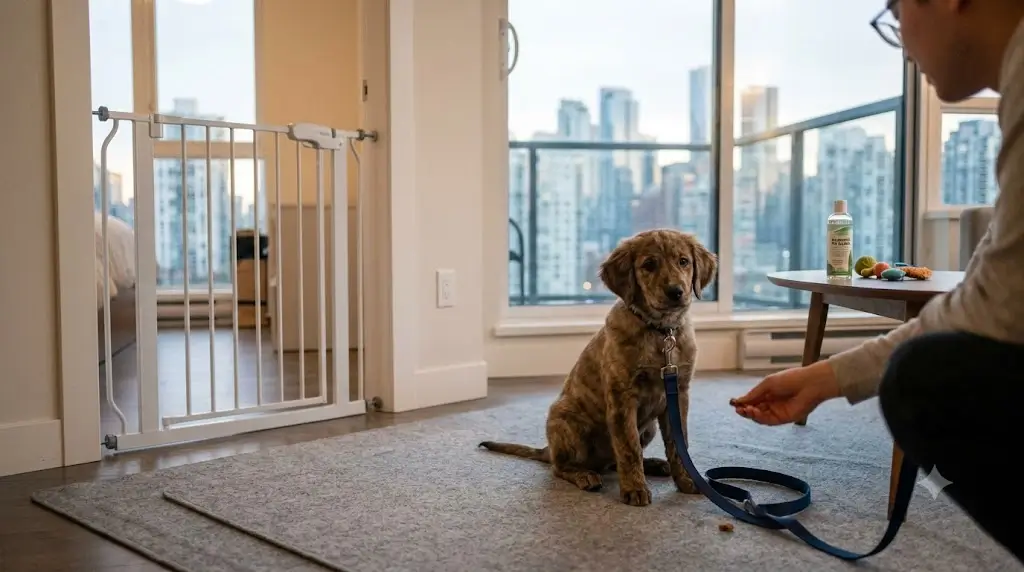
space. It is that puppies can move from their sleeping area to a tempting accident spot
very quickly. A successful setup therefore depends on management, timing, supervision,
and consistency rather than giving a puppy access to the entire home too soon.
How Do You House Train a Puppy in a Small Home?
The most effective approach is to create a small, controlled living zone and establish
a repeatable potty routine. Take the puppy to the designated potty location after waking,
eating, drinking, playing, and sleeping. Reward successful potty trips immediately, and
supervise closely between breaks.
If outdoor potty trips are practical, make the outside location the puppy’s primary
bathroom. If getting outside is difficult because you live in an apartment, have limited
mobility, or face access restrictions, an indoor potty system can be used as a deliberate
management option rather than allowing random indoor accidents.
Best small-home strategy:
Limit the puppy’s roaming area, keep the potty route short and predictable, use a
consistent schedule, supervise actively, and gradually expand access as reliability improves.
Why House Training Can Feel Harder in a Small Home
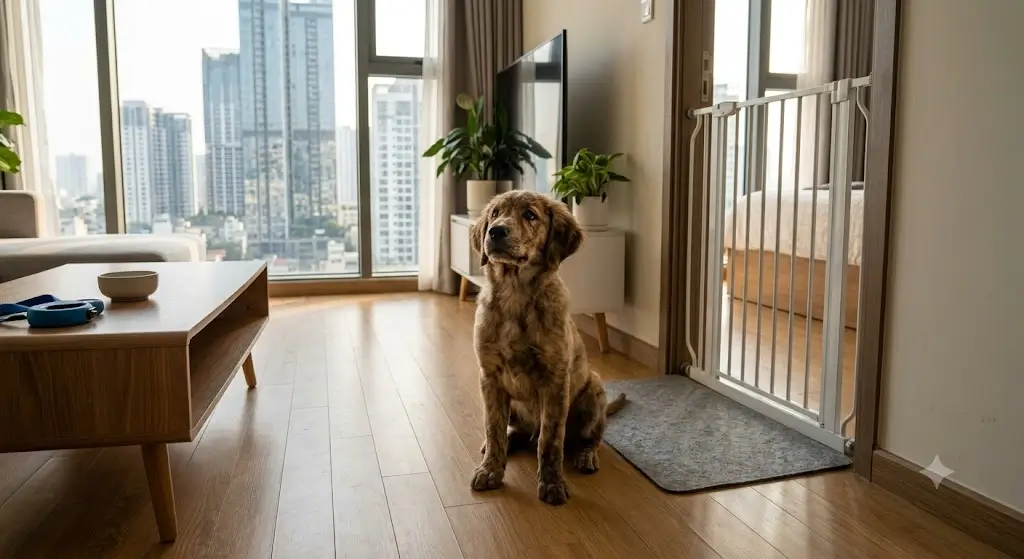
A small home does not prevent successful house training, but it changes how you need to
manage the puppy.
In a larger house, owners may have more flexibility to separate sleeping, eating, playing,
and potty areas. In an apartment or compact home, those areas may be only a few steps apart.
There may also be a hallway, elevator, staircase, lobby, or outdoor entrance between the
puppy and the final potty location.
That extra transition matters because young puppies often have limited warning time. If the
puppy has to walk through several rooms, wait for an elevator, or cross a large common area,
the potty trip needs to begin before the puppy is desperate.
The three biggest small-home challenges
- Limited separation: sleeping and living areas may be close together.
- Fast access to accident spots: the puppy can reach rugs, corners, or furniture quickly.
- Longer routes outdoors: apartment puppies may need more planning before each potty trip.
The solution is not to constantly watch the puppy from a distance. Instead, temporarily
reduce the puppy’s freedom and make the correct behavior easier to perform.
Set Up a Dedicated Puppy Zone
Before starting a house-training routine, decide where the puppy will spend most of the
day when you cannot provide direct supervision.
A practical small-home setup usually includes a sleeping area, a safe confinement area,
water access, and enough room for normal movement. The potty area should be separate from
the puppy’s sleeping space whenever possible.
Keep the puppy’s initial territory small
Giving a new puppy unrestricted access to an entire apartment can make house training harder.
The puppy may quietly choose a corner that you do not notice until an accident has already
happened.
Start with one controlled area. As the puppy demonstrates consistent potty habits, gradually
introduce additional rooms.
Use barriers strategically
A puppy gate or exercise pen can be useful when a crate alone does not provide enough
daytime space. The objective is not to isolate the puppy unnecessarily. It is to prevent
unsupervised wandering while the puppy is still learning household rules.
In a compact apartment, even a temporary barrier across a kitchen entrance or hallway can
significantly reduce the number of places the puppy can make an unnoticed mistake.
Protect high-risk surfaces
During the early stages, remove or restrict access to rugs and other absorbent surfaces
that are difficult to clean. If a puppy repeatedly toilets on a particular surface, the
remaining odor can also make that location more attractive for future accidents.
Use the Crate as a Management Tool
A properly sized crate can make small-home house training easier because it gives the puppy
a predictable resting space and reduces opportunities for unsupervised accidents.
The crate should not be treated as punishment. It should be introduced as a comfortable,
predictable place where the puppy can rest.
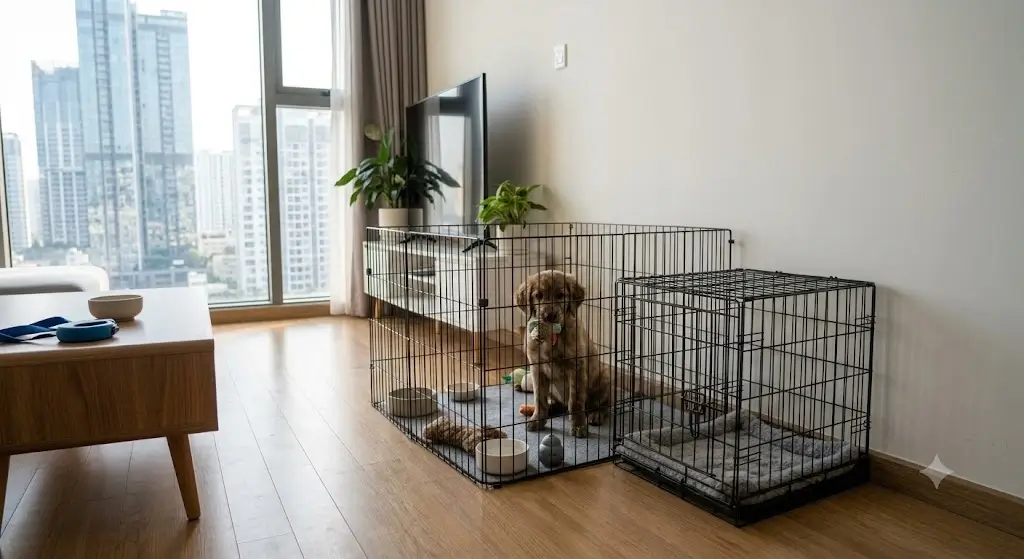
The important distinction is that a crate does not replace potty training. It is a
management tool that helps you control when the puppy rests, when the puppy is supervised,
and when the puppy gets another opportunity to eliminate.
Choose One Primary Potty Location
Consistency becomes especially important in a small home. Choose one practical potty
destination and use it repeatedly.
If you are training for outdoor pottying
Choose the same general outdoor location whenever practical. A predictable route helps
the puppy learn that going outside means going to the bathroom before play or exploration.
Keep the initial potty trip boring and focused. Walk to the location, give the puppy time
to eliminate, reward the behavior immediately afterward, and then allow appropriate
exploration or play. If your puppy repeatedly gets distracted or resists eliminating on grass, see our troubleshooting blueprint for when your puppy won’t go potty outside.
If you need an indoor potty option
An indoor potty system can be useful in certain living situations, particularly when outdoor
access is unusually difficult. The important point is to establish one defined location
instead of placing pads randomly around the home.
If you are using pee pads as part of your training system, avoid moving the designated
potty location repeatedly. The puppy needs a clear answer to the question,
“Where should I go?”
Build a Potty Schedule That Fits Small-Space Living
A predictable schedule is one of the most useful tools for house training. Puppies are
more likely to succeed when potty opportunities happen before they are already struggling
to hold it.
A practical routine should include a potty opportunity:
- Immediately after waking up.
- After eating.
- After drinking more than usual.
- After active play.
- After a nap.
- Before entering a longer period of confinement.
- Before bedtime.
- Whenever the puppy shows individual signs of needing to go.
The exact frequency depends on the puppy’s age, development, routine, and individual needs.
Avoid treating a generic schedule as a guarantee that every puppy can wait the same amount
of time.
For a more structured day-by-day framework, see our
7-Day Puppy House Training Plan.
You can adapt the timing to your apartment’s elevator, stairs, entrance, work schedule,
and available outdoor area.
Apartment Timing: Start the Potty Trip Early
One of the biggest differences between a detached house and an apartment is the time
required to reach the final potty location.
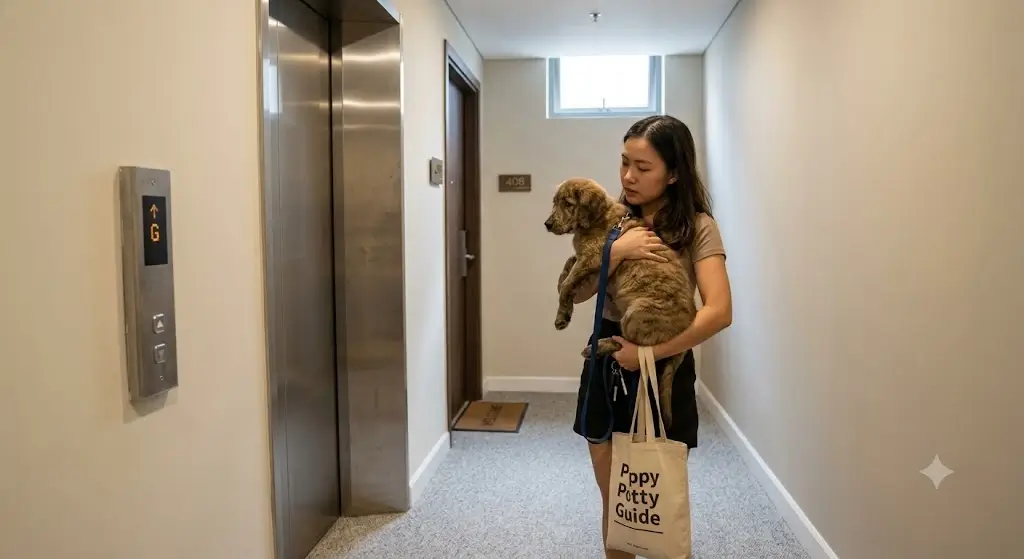
A puppy in a house may only need to cross a short distance to reach the yard. An apartment
puppy might need to reach the door, enter a hallway, ride an elevator, walk through a lobby,
and then reach the designated outdoor area.
That means you should treat the journey to the potty area as part of the potty routine.
- Watch for early signs.
- Stop play or other activity immediately.
- Put on the leash or prepare the puppy for the trip.
- Use the same route whenever practical.
- Go directly to the designated potty location.
- Reward successful elimination promptly.
Do not wait until the puppy is already circling, whining, or urgently searching for a
location every time. Those behaviors can be useful signals, but a proactive routine
gives the puppy a better chance of succeeding.
Supervision Is More Important Than Square Footage
A common mistake in a small home is assuming that because the puppy is physically nearby,
the puppy is automatically supervised.
True supervision means you are actively paying attention to what the puppy is doing.
Look for behaviors such as:
- Suddenly stopping play.
- Sniffing the floor intensely.
- Walking toward a quiet corner.
- Circling.
- Restlessness.
- Moving toward a previously used accident area.
When you see a possible potty signal, calmly interrupt the current activity and take the
puppy to the designated potty location.
Keep the puppy in the same room as you during active supervision whenever practical.
The fewer rooms you need to monitor, the easier it is to notice early signals.
Reward the Behavior You Want
When the puppy eliminates in the correct location, reinforce that behavior immediately.
The reward should follow the successful potty behavior closely enough that the puppy can
associate the outcome with what just happened.
Keep the response simple and consistent. A small food reward, praise, or another reward
your puppy values can be used according to your training approach.
The sequence should look like this:
→
Immediate reward
→
Return to normal activity
This is more useful than repeatedly telling a puppy what not to do after an accident.
The puppy needs repeated opportunities to practice the behavior you actually want.
What to Do When a Puppy Has an Accident
Accidents are part of the learning process. The response should be calm and focused on
preventing the next mistake.
If you catch the puppy in the act
Calmly interrupt and move the puppy to the designated potty location. If the puppy finishes
there, reward the correct behavior.
If you discover an accident afterward
Do not punish the puppy for an accident you discover later. The puppy is unlikely to
understand why the delayed correction is happening.
Instead, clean the area thoroughly, review what happened immediately before the accident,
and adjust supervision or potty timing.
If accidents are becoming frequent or the puppy appears to be regressing after previously
consistent training, use a structured troubleshooting approach. Our
Puppy House Training Problems guide
covers common reasons a training routine can stop progressing and how to reset the process. If progress has completely plateaued, check our specific guide on what to do when house training stalls.
Clean Accidents Thoroughly
Cleaning matters in a small home because an accident location can remain part of the
puppy’s daily environment. Residual odor may make it harder to prevent repeat accidents
in the same area.
Blot liquid rather than spreading it across a larger surface. Then use a cleaner appropriate
for the specific flooring or fabric and follow the manufacturer’s directions.
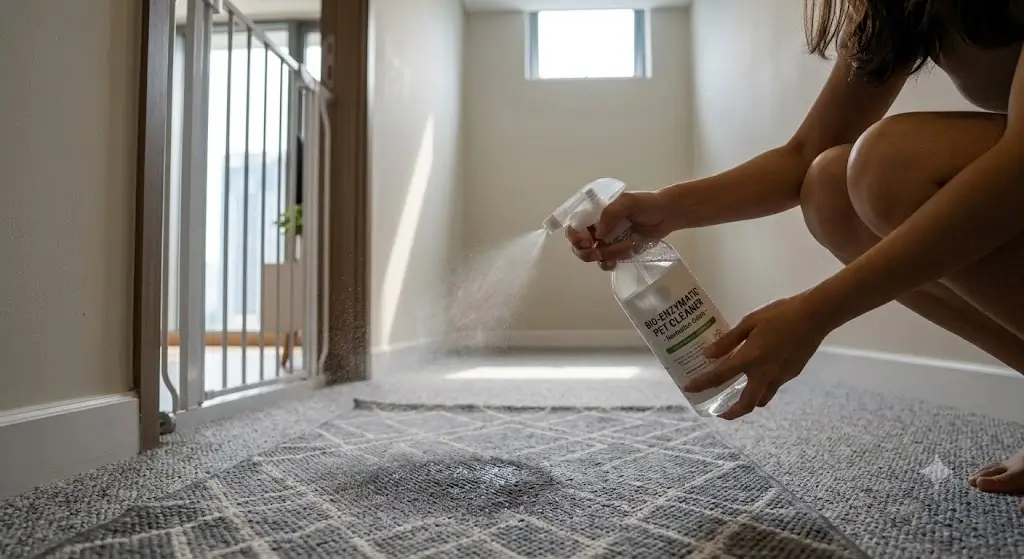
Pay particular attention to rugs, carpet edges, upholstery, and other absorbent materials.
A surface can appear clean while still retaining odor below the visible area. For complete step-by-step chemical breakdown techniques, read how to clean up puppy accidents properly.
After cleaning, change access if necessary
If the puppy repeatedly returns to one location, cleaning alone may not solve the problem.
Temporarily block access, rearrange furniture, remove a rug, or increase supervision around
that area while the puppy relearns the correct routine.
How to House Train a Puppy When You Work From Home
Working from home can make supervision easier, but it does not mean the puppy should have
unlimited freedom while you are on a call or focused on work.
Create predictable periods for:
- Potty breaks.
- Short training sessions.
- Play.
- Rest.
- Quiet confinement while you work.
Keep the puppy’s management area close enough that you can respond to signals without
interrupting every few minutes. A crate, pen, or gated puppy-safe area can provide a
practical boundary during focused work periods. If you prefer to train without a crate while working from home, follow our guide on how to potty train a puppy without a crate.
The goal is not constant interaction. Puppies also need predictable opportunities to
settle and rest.
What If You Leave the Puppy Alone?
House training becomes more difficult when a puppy is routinely expected to remain alone
longer than the puppy can reasonably manage.
Before leaving, give the puppy an appropriate potty opportunity. Use a safe confinement
setup and avoid assuming that a young puppy can simply “hold it” for an extended period.
If your schedule regularly creates a gap that is too long for the puppy’s current stage,
consider arranging an appropriate potty break rather than relying on punishment after an
accident.
When Should You Give the Puppy More Freedom?
Do not expand access simply because the puppy has had one successful day.
Instead, look for a pattern of reliable behavior. When the puppy consistently uses the
correct potty location under the current level of supervision, give access to one additional
area.
If accidents increase after expanding the puppy’s territory, temporarily reduce access
again. That is not a failure. It simply means the puppy was given more freedom than the
current training level supported.
A simple progression
- Controlled zone: one safe area with close supervision.
- Small expansion: add one adjacent area.
- Observe: maintain the routine while monitoring potty behavior.
- Expand again: only after the puppy remains reliable.
- Reset when needed: reduce access temporarily if accidents return.
7 Small-Home House Training Mistakes to Avoid
- Giving full-home access too early.
A puppy cannot reliably follow household rules that have not been learned yet. - Waiting for obvious potty signals.
Preventive potty breaks are often easier than reacting to an urgent signal. - Changing the potty location repeatedly.
A consistent destination makes the desired behavior easier to understand. - Keeping pee pads in multiple random locations.
If indoor potty training is your chosen system, establish one deliberate location. - Using the crate as punishment.
The crate should remain a predictable management and resting space. - Punishing old accidents.
Focus on supervision, timing, cleaning, and reinforcing correct behavior instead. - Expanding freedom too quickly.
Increase access gradually as the puppy becomes more reliable.
A Simple Small-Home Routine
You do not need a complicated system. A repeatable cycle is usually easier to maintain.
| Situation | What to Do |
|---|---|
| Wakes up | Go directly to the designated potty location. |
| After eating | Plan a potty opportunity rather than waiting for an accident. |
| After active play | Pause the activity and offer a potty break. |
| After a nap | Take the puppy to the potty location promptly. |
| During supervision | Watch for sniffing, circling, restlessness, or movement toward accident areas. |
| Correct potty | Reward immediately and calmly. |
| Accident | Clean thoroughly, review the timing, and adjust management. |
| Before bedtime | Give the puppy another appropriate potty opportunity. |
The exact clock times will vary by puppy and household. What matters most is creating
predictable opportunities and responding to the puppy’s individual pattern.
Small-Home House Training Checklist
- Choose one primary potty location.
- Create a small puppy-safe living zone.
- Use a crate, gate, or pen for appropriate management.
- Keep rugs and difficult-to-clean surfaces out of high-risk areas.
- Plan potty trips around waking, eating, playing, and sleeping.
- Start outdoor trips early enough to account for hallways, stairs, or elevators.
- Supervise actively when the puppy is loose.
- Reward successful potty behavior immediately.
- Clean accidents thoroughly.
- Increase freedom gradually.
- Reduce access again if accidents increase.
FAQ: House Training a Puppy in a Small Home
Can you house train a puppy in a small apartment?
Yes. A small apartment can be suitable for house training. The key is to create a
predictable potty routine, supervise the puppy closely, limit roaming space initially,
and plan enough time to reach the designated outdoor potty location.
Is it harder to potty train a puppy in an apartment?
It can require more planning because the puppy may have to travel through hallways,
stairs, elevators, or shared spaces before reaching the potty area. Starting the potty
trip early and using a consistent route can reduce that difficulty.
Should I let my puppy roam the whole apartment?
Usually, it is better to expand freedom gradually. Start with a controlled puppy-safe
area and increase access as the puppy demonstrates reliable potty habits.
Should I use a crate in a small home?
A properly introduced crate can be useful for rest, supervision, and management. It should
not be used as punishment, and it does not replace regular potty opportunities.
Should I use pee pads if I live in an apartment?
Pee pads can be useful in some apartment situations, particularly when immediate outdoor
access is difficult. If you use them, establish a consistent location and understand that
transitioning from an indoor potty system to outdoor pottying can require another training
step.
Why does my puppy have accidents even though my apartment is small?
Square footage is not the main factor. Accidents can happen when the puppy has too much
freedom, potty trips are too infrequent, early signals are missed, or the route outside
takes longer than expected.
How do I stop my puppy from peeing on the same rug?
Thoroughly clean the area with a product appropriate for the material, temporarily remove
or block access to the rug, increase supervision, and provide more timely potty opportunities.
What if my puppy has several accidents in one day?
Review the puppy’s schedule and management first. Increase supervision, shorten the
interval between potty opportunities when appropriate, and reduce unrestricted access.
If the pattern is sudden, persistent, or accompanied by other concerning changes, consult
a veterinarian rather than assuming it is only a training issue.
When can I let my puppy access more rooms?
Add space gradually after the puppy demonstrates reliable habits in the current area.
If accidents increase after expansion, return temporarily to the previous level of
management.
Should I punish my puppy for an accident?
No. Punishment can interfere with the learning process and does not teach the puppy where
you want the behavior to happen. Focus on prevention, interruption when appropriate,
thorough cleanup, and rewarding successful potty trips.
The Bottom Line
House training a puppy in a small home is completely achievable.
You do not need a large yard or a large house. You need a setup that makes the correct
behavior predictable and prevents the puppy from practicing unwanted behavior repeatedly.
Start with a controlled area, establish one clear potty destination, schedule frequent
opportunities around the puppy’s natural routine, supervise actively, and reward successful
potty trips. In an apartment, remember that the time required to reach the outdoor location
is part of your training equation.
Most importantly, expand freedom gradually. A puppy that succeeds in a small controlled
area is building the foundation for reliable behavior throughout the entire home.
