
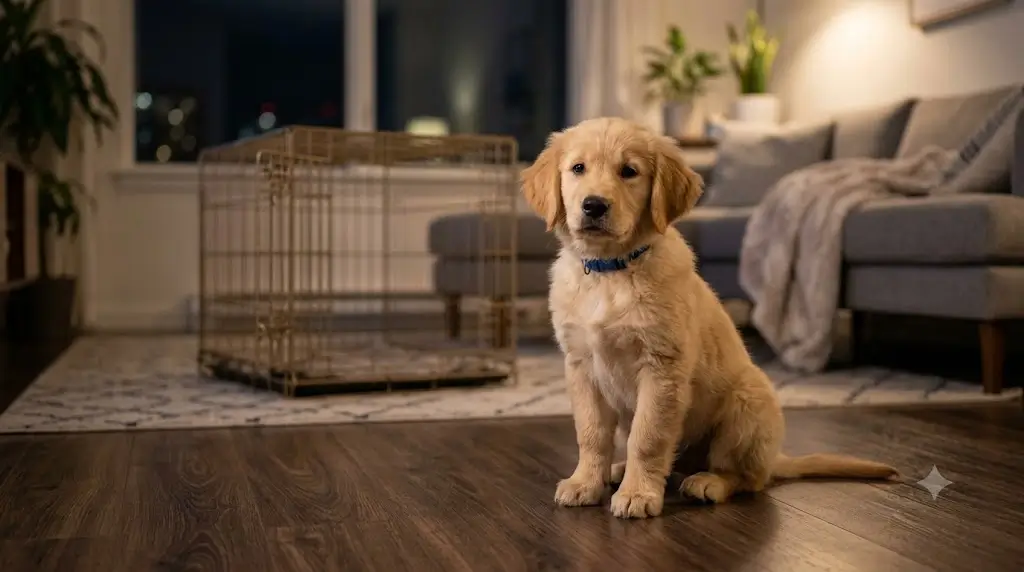
Puppy Poops in the House at Night: Why It Happens & How to Stop It
If your puppy keeps pooping indoors after bedtime, the problem is usually easier to solve once you separate bowel timing from general house training. Learn how meal timing, evening routines, bathroom opportunities, sleep arrangements, and digestive changes can affect nighttime poop accidents.
Why Does My Puppy Poop in the House at Night?
Nighttime poop accidents can happen even when a puppy appears to understand that outside is the correct bathroom location. The reason is that bowel control and bathroom habits develop over time. A puppy may understand the training rule while still having difficulty matching its bowel movements to the household schedule.
There are several variables worth checking before assuming the puppy is simply “not house trained.”
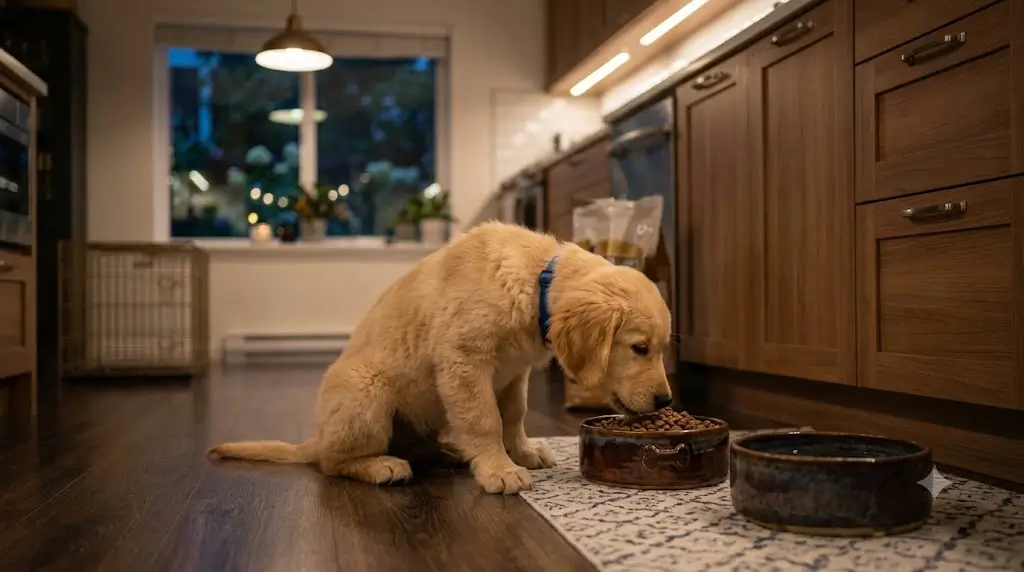
1. The puppy has not finished developing a predictable bowel routine
Young puppies often have more frequent bathroom needs than adult dogs. Their eating, activity, and elimination patterns can also change as they grow. A puppy that poops after dinner may not be able to wait until the next morning.
2. Dinner happens too close to bedtime
Eating can stimulate bowel activity. If the final meal occurs late in the evening, the puppy may need another bathroom opportunity after the meal. The exact response varies between puppies, so observing the individual pattern is more useful than relying on a universal “X minutes after eating” rule.
3. The final outdoor trip is too early
Taking a puppy outside two hours before bedtime does not guarantee that the puppy will not need to poop later. A final focused bathroom opportunity closer to sleep can be useful. If your puppy also disrupts sleep to urinate, check our guide on what to do when your puppy wakes up to pee at night.
4. The puppy goes outside but gets distracted
Puppies are easily distracted by smells, sounds, people, and other animals. A puppy may spend several minutes outdoors and then return inside without having a bowel movement. This creates a misleading situation: the puppy went outside, but it did not actually finish the bathroom job. When outdoor trips repeatedly fail to produce results, read why your puppy goes outside but still has accidents to learn how to keep bathroom visits focused.
5. The puppy has too much nighttime freedom
A young puppy with access to a large part of the house has more opportunities to wander away and eliminate unnoticed. Appropriate nighttime management reduces that opportunity while house training is still developing.
6. A change in diet or routine has altered stool timing
Changes in food, treats, feeding schedule, or household routine can alter bowel habits. If the nighttime accidents began soon after a significant change, consider the timing rather than treating the issue as a simple training failure.
Is It Normal for a Puppy to Poop at Night?
It can happen, particularly with young puppies. The more useful question is whether the puppy is developing a predictable pattern and gradually becoming more reliable.
| Pattern | What It May Suggest |
|---|---|
| Occasional nighttime poop accident | May reflect immature bowel timing or a missed bathroom opportunity. |
| Poop happens shortly after late dinner | Review meal timing and provide an appropriate post-meal bathroom opportunity. |
| Puppy goes outside but does not poop | Distraction or insufficient bathroom time may be involved. |
| Accidents suddenly increase | Review routine, food, and health changes. |
| Nighttime diarrhea or other illness signs | Training should not be assumed to be the primary problem; veterinary advice may be needed. |
How Meal Timing Can Affect Nighttime Pooping
Meal timing matters because eating can trigger gastrointestinal activity in some dogs. This does not mean every puppy will poop at a predictable number of minutes after eating. Individual patterns differ.
Instead of guessing, record your puppy’s meals and bowel movements for several days.
- Record meal time.
- Record major treats.
- Record outdoor bathroom trips.
- Record when the puppy actually poops.
- Record whether the stool appears normal or different.
After several days, a pattern may become obvious.
Do not solve the problem by randomly changing meals every night
Constantly changing feeding times makes the puppy’s bathroom pattern harder to interpret. A consistent routine gives you better information about what is actually causing the accidents.
How to Build a Nighttime Routine That Reduces Poop Accidents
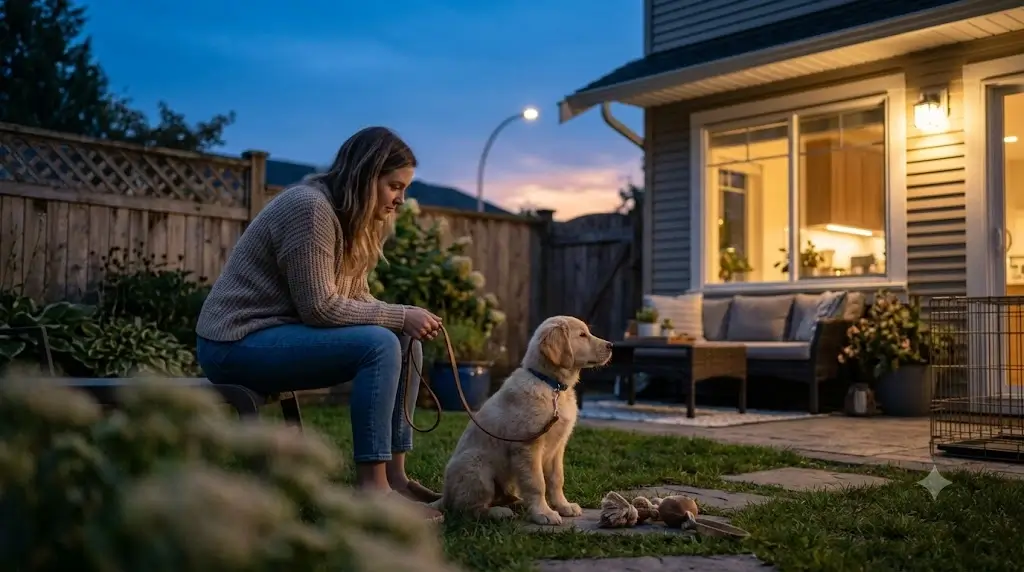
Keep the evening meal schedule reasonably predictable so you can identify when your puppy is most likely to need a bowel movement.
Give the puppy a chance to eliminate after eating rather than assuming the next scheduled outing will be enough.
A final bathroom trip close to bedtime is particularly useful when the puppy has a history of overnight accidents.
The goal is elimination, not an extended evening play session. Keep the puppy focused on the bathroom task.
Reinforce the behavior you want immediately after the puppy successfully eliminates in the correct location.
What If My Puppy Goes Outside but Does Not Poop?
This is one of the most common reasons an owner may think the puppy is refusing to learn. The puppy may simply be too distracted or may not yet need to go. If your puppy does not eliminate outside, avoid giving it unlimited unsupervised freedom immediately after returning indoors.
Instead, use a short period of close supervision or appropriate confinement, then provide another bathroom opportunity.
The key sequence: Outside → no poop → supervised indoors → try again → reward successful elimination. This prevents the puppy from learning that refusing to poop outside leads directly to unrestricted indoor freedom.
How to Tell Whether the Puppy Needs to Poop or Just Wants Attention
Nighttime behavior can be confusing because puppies may wake for several reasons. If the puppy wakes, calmly take it to the bathroom area and observe what happens. If the puppy promptly eliminates, the wake-up likely had a genuine bathroom component. If the puppy consistently does not eliminate and instead wants to play or interact, review whether the nighttime routine is providing too much stimulation.
Can a Crate Help Prevent Overnight Poop Accidents?
Appropriate crate management can reduce a puppy’s ability to wander away and eliminate in another part of the home. However, a crate is not a substitute for a bathroom schedule. Puppies should not be expected to hold their bowel movements beyond what is reasonable for their individual development.
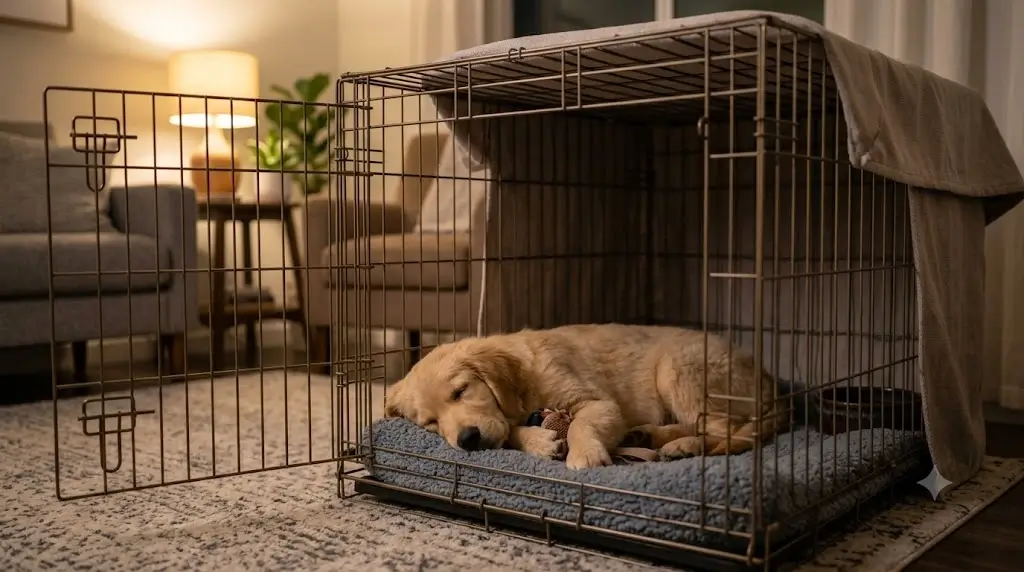 A properly sized sleeping crate prevents wandering without overextending physical holding capacity.
The crate should be appropriately sized
The sleeping area should allow the puppy to stand, turn around, and lie down comfortably without providing excessive extra space.
Do not use the crate as punishment
The crate should function as a predictable resting area, not as a consequence for having an accident.
Clean accidents thoroughly
If a puppy repeatedly soils its sleeping area, do not simply keep increasing confinement. Investigate whether the schedule, crate setup, or health status needs attention. If daytime messes are compounding the issue, follow our step-by-step reset for when your puppy has too many accidents.
Example Evening Schedule for a Puppy That Poops at Night
The following is a framework rather than a universal schedule. Adjust it around your puppy’s age, feeding routine, and actual bowel pattern.
| Example Time | Activity | Purpose |
|---|---|---|
| 5:30 PM | Evening meal | Establish a predictable feeding point. |
| After dinner | Bathroom opportunity | Capture a post-meal bowel movement if the puppy needs one. |
| 7:30 PM | Normal supervised activity | Allow exercise and interaction while maintaining supervision. |
| 9:30 PM | Calmer activity | Begin transition toward sleep. |
| 10:15 PM | Focused bathroom trip | Provide another opportunity to poop or pee. |
| 10:30 PM | Bedtime | Begin the overnight sleep period. |
If the puppy repeatedly poops after the listed bedtime trip, use your tracking data to determine when the bowel movement actually tends to occur and adjust the routine accordingly.
What to Do When Your Puppy Poops in the House at Night
An overnight accident should be treated as a training and management problem, not as a reason to punish the puppy.
- Clean the area thoroughly.
- Avoid yelling or physical punishment.
- Review the time of the previous meal.
- Check when the last successful bowel movement occurred.
- Review the timing of the final outdoor trip.
- Adjust the next evening’s routine based on the evidence.
Do not punish a puppy for an overnight accident: The puppy cannot connect delayed punishment with earlier elimination. Focus on prevention, supervision, correct timing, and reinforcement of successful outdoor bathroom behavior.
How to Clean a Puppy Poop Accident Properly
Cleaning matters because residual odor can encourage repeated use of the same location. Remove solid material promptly and clean the affected surface with a pet-appropriate enzymatic cleaner according to its label. On carpets and upholstery, follow the manufacturer’s cleaning instructions and test products on an inconspicuous area first.
Puppy Still Poops in the House Every Night: Troubleshooting
If the problem occurs repeatedly, stop changing multiple variables at once. Work through the following checklist:
- Check #1: When is dinner? Look for a consistent relationship between the evening meal and the nighttime bowel movement.
- Check #2: When does the puppy normally poop? The puppy’s actual history is more useful than a generic schedule found online.
- Check #3: Did the puppy actually poop outside? Confirm elimination rather than assuming the outdoor trip was successful.
- Check #4: Is the puppy getting too much freedom at night? Use appropriate supervision or confinement while reliability is developing.
- Check #5: Did anything change? Review food, treats, feeding times, household routine, sleeping location, and other recent changes.
- Check #6: Is the stool normal? A change in stool consistency or frequency can shift the situation away from a simple house-training problem.
Nighttime Poop Accidents vs. a House-Training Regression
A puppy that has occasional nighttime accidents is not necessarily experiencing a regression. A regression is more concerning when a puppy that was previously reliable begins having a sustained increase in indoor accidents without an obvious routine explanation. If older or trained dogs suddenly relapse, explore why a puppy has accidents after being house trained.
| Occasional Accident | Possible Regression |
|---|---|
| One isolated accident | Repeated new accidents |
| Clear schedule disruption | No obvious routine explanation |
| Normal stool and behavior | Other behavioral or digestive changes |
| Improves after routine adjustment | Continues despite appropriate management |
Should You Change Your Puppy’s Food Because of Nighttime Accidents?
Do not automatically change food simply because a puppy has one or two nighttime accidents. First determine whether the issue is timing, missed bathroom opportunities, or routine. If stool consistency, frequency, or digestive behavior changes after a diet change, discuss the pattern with your veterinarian, especially if it persists.
Want a Structured 7-Day Puppy Training Plan?
If you would rather follow a structured day-by-day system than build your puppy’s routine from scratch, you can review our puppy training plan designed around practical daily schedules, feeding routines, and nighttime bowel habits.
When Nighttime Pooping May Be a Health Problem
House training should not be used to explain every change in bowel behavior. Veterinary advice is appropriate when nighttime accidents occur with signs that suggest a digestive or other health problem.
- Persistent diarrhea
- Blood in the stool
- Repeated vomiting
- Significant appetite changes
- Unusual tiredness or weakness
- Apparent abdominal discomfort
- A sudden and persistent change in bowel frequency
- Other signs that the puppy is unwell
Health note: Puppy Potty Guide provides general house-training education. It cannot diagnose digestive disease or determine the cause of a puppy’s stool changes. A veterinarian should evaluate persistent, sudden, or concerning symptoms.
The Most Effective Way to Solve Repeated Nighttime Poop Accidents
The most useful approach is to stop treating every accident as an isolated event. Instead, look for the sequence:
- Meal timing
- Post-meal activity
- Successful outdoor poop
- Final bathroom opportunity
- Bedtime
- Overnight accident or successful sleep
Once you know where the sequence is breaking down, the solution becomes much more specific.
Bottom Line: Puppy Poops in the House at Night
A puppy pooping indoors at night does not automatically mean the house-training method is failing.
Start by identifying the puppy’s natural bowel pattern. Keep meals and evening routines predictable, provide bathroom opportunities after meals and before bed, confirm that the puppy actually eliminates outside, and use appropriate nighttime supervision while reliability develops.
If accidents suddenly become more frequent or stool changes are accompanied by diarrhea, vomiting, blood, appetite changes, lethargy, discomfort, or other signs of illness, veterinary evaluation is more appropriate than simply adding more potty trips.
Frequently Asked Questions
Why does my puppy poop in the house at night?
The puppy may not yet have a predictable bowel schedule, dinner may occur too close to bedtime, the final potty trip may be too early, or the puppy may get distracted outside. Sudden digestive changes can also contribute.
How do I stop my puppy from pooping in the house at night?
Track meal and bowel times, provide a bathroom opportunity after meals and before bed, confirm that the puppy actually poops outside, and use appropriate nighttime supervision.
Should I take my puppy outside after dinner?
Yes, a post-meal bathroom opportunity can be useful because eating may stimulate bowel activity. The exact timing varies by puppy, so track your puppy’s actual pattern.
Should my puppy poop before bed?
A final bathroom opportunity before sleep can reduce the chance of an overnight accident. Some puppies may need more than one evening opportunity while their bowel routine develops.
Why does my puppy poop at night but not during the day?
Feeding time, activity, missed bathroom opportunities, and the evening routine can shift when bowel movements occur. A sudden change should be considered separately from normal training.
When should I call a veterinarian about nighttime poop accidents?
Veterinary advice is appropriate when accidents are accompanied by diarrhea, blood, vomiting, appetite changes, unusual tiredness, discomfort, persistent digestive changes, or other signs of illness.
