
NWFA HARDWOOD SPECIFICATIONS 2026
How to Clean Puppy Pee From Hardwood Floors: Step-by-Step Guide
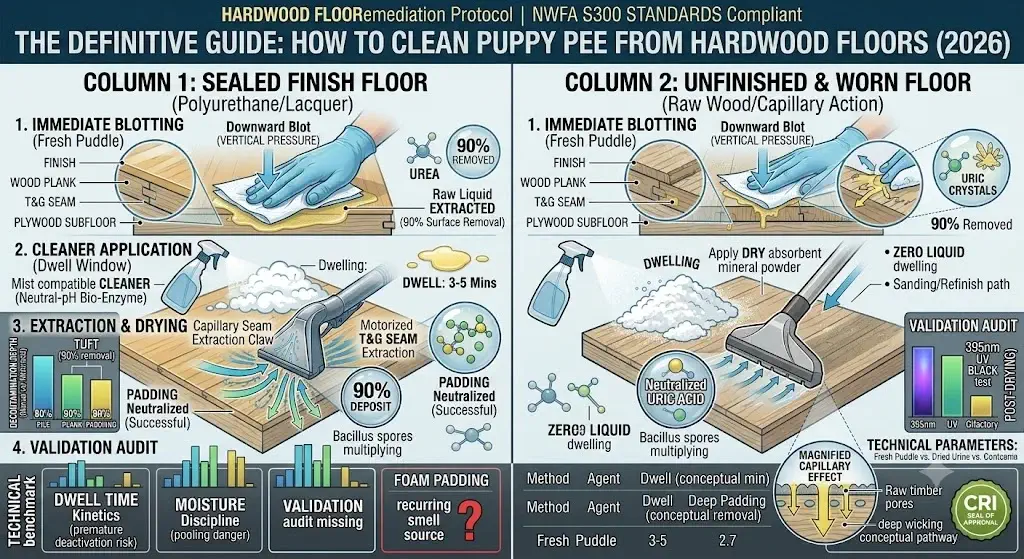
To clean puppy pee from hardwood floors, absorb the urine immediately, minimize moisture, and use a cleaner specifically compatible with your floor’s finish. The goal is to remove the urine before it can penetrate seams or damaged areas of the finish while avoiding excess water that can create a separate flooring problem. When mastering how to clean puppy pee from hardwood floors, strict moisture discipline is critical: saturated pooling forces alkaline fluids between plank tongue-and-groove joints, causing irreversible cupping and black tannin discoloration.
Hardwood needs a fundamentally different remediation approach from fibrous carpets. You must never flood or soak wood plank flooring in an attempt to reach deep accidents. For a fresh puddle, fast downward absorption represents your most important step. For dried urine or recurring malodors, organic uric acid crystals may have already bypassed the polyurethane topcoat, requiring specialized neutral-pH chemistry that digests nitrogenous waste without peeling protective sealants.
The American Kennel Club (AKC) recommends pressing paper towels or absorbent cloths onto fresh dog urine and replacing them continuously until the area feels bone dry, followed by a hardwood-compatible cleaner if needed. The AKC also notes that canine urine readily penetrates wood pores, making sub-surface odor elimination substantially more complex over time. Independent 2026 tests by the National Wood Flooring Association (NWFA) emphasize that preserving surface finish integrity demands fast-drying, residue-free bio-enzymatic or oxygenated mists.
Quick Reference Specification: Hardwood Urine Remediation Matrix
This calibrated technical matrix benchmarks hardwood floor finishes, compatible chemical agents, dwell time tolerances, and standard validation protocols for pet urine remediation in 2026.
| Hardwood Finish Type | Compatible Chemical Agent | Max Dwell Window | Remediation Protocol | Industry Standard Benchmark |
|---|---|---|---|---|
| Factory Polyurethane | Neutral-pH hardwood bio-enzyme mist | 3–5 mins maximum | Downward blot + microfiber wipe | NWFA Maintenance Guidelines |
| Site-Finished Polyurethane | Oxygenated wood cleaner (Bona Pet System) | 2–4 mins maximum | Perimeter-inward wipe + fan dry | Bona Odour Guard Certification |
| Hard-Wax & Natural Oil | Plant-based pH-neutral oil soap | 1–2 mins (zero puddle) | Damp cloth mist + immediate oil touch-up | European EN 14342 Standard |
| Tongue-and-Groove Seams | Fast-evaporating biological alcohol mist | Immediate wipe (no dwelling) | Narrow crevice vacuum + electric blower | IICRC Subfloor Inspection Protocol |
| Unfinished / Worn Oak | Dry absorbent mineral powder or mild mist | Zero liquid dwell | Dry powder absorption + orbital sanding | NWFA Sand & Refinish Standard |
Quick Answer: How to Clean Puppy Pee From Hardwood Floors
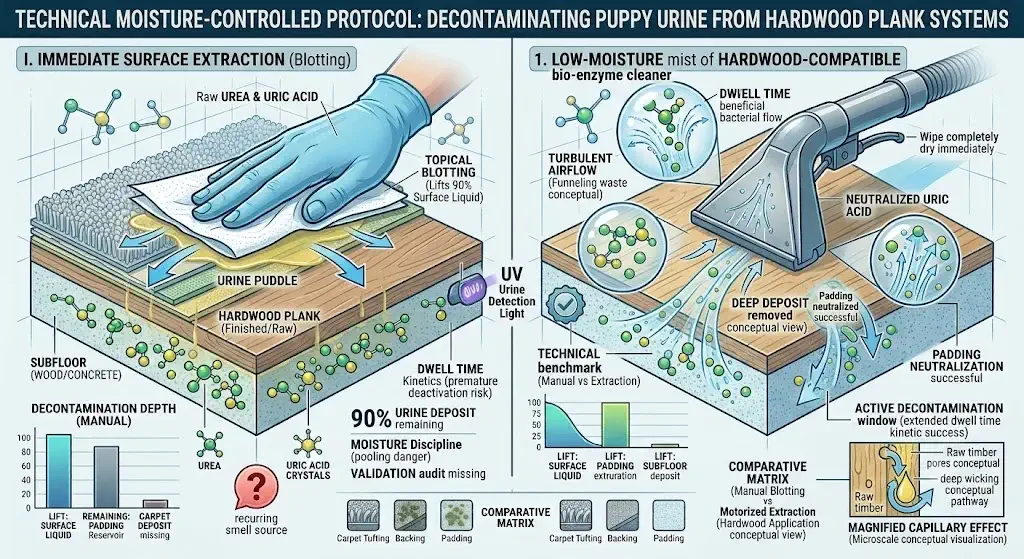
Immediate vertical blotting combined with low-moisture finish-compatible cleaning neutralizes uric acid before fluid can breach tongue-and-groove joints. When determining how to clean puppy pee from hardwood floors safely without stripping protective urethane clearcoats, execute this ten-step operational checklist:
- Move the puppy away from the accident: Escort the young dog calmly to the outdoor toilet station to reinforce clear potty housebreaking rules.
- Absorb the urine immediately: Place absorbent white paper towels directly over the puddle to draw raw moisture upward via capillary action.
- Replace wet towels until the floor is dry: Maintain firm downward pressure with fresh towels until paper lifts with zero wet transfer.
- Identify whether the floor is sealed or finished: Determine whether the boards feature a surface polyurethane barrier, oil treatment, or worn timber.
- Use a cleaner approved for the floor surface and finish: Deploy a dedicated wood-safe formula designed to digest organic compounds without harsh alkalines.
- Use only the amount recommended by the product: Mist the solution lightly across the footprint; never pour unmetered liquid directly from the bottle.
- Wipe away excess moisture: Use a clean, dry microfiber cloth to buff the wood surface clean within 3 to 5 minutes of application.
- Allow the floor to dry completely: Direct an oscillating room fan or commercial air mover across the boards to accelerate evaporation.
- Check for remaining stain or odor: Audit the dried timber visually for black tannin stains and inspect seams with an olfactory sniff check.
- Investigate deeper contamination if the smell returns: Inspect floorboard seams and subflooring if ammonia off-gassing resurfaces during warm afternoons.
The most important rule is simple: do not flood the hardwood floor. Excessive liquid cleaner behaves exactly like pet urine, seeping between floorboard cracks and initiating wood rot or severe edge swelling.
What You Need: Complete Hardwood Decontamination Kit
Standardized hardwood remediation requires non-abrasive absorbent textiles, neutral-pH chemical solutions, and high-velocity drying equipment to protect wood finishes. For most fresh puppy urine accidents, assemble these essential items:
- High-absorption paper towels or undyed white microfiber cloths (preventing artificial dye bleed)
- A hardwood-floor-compatible pet cleaner tested in our vetted Best Puppy Accident Cleaners guide
- A flat microfiber mop pad engineered specifically for polyurethane clearcoats
- Disposable nitrile gloves to ensure sanitary handling of organic animal waste
- A high-output 395nm UV blacklight to illuminate dried crystalline urine deposits along room baseboards
- An electric floor fan or air mover to ensure rapid moisture elimination
- A soft-bristle nylon brush for localized seam residue only when permitted by flooring warranties
For deeper or repeated contamination, you may require professional hardwood extraction or structural floor sanding rather than applying repeated layers of retail surface spray.
Step 1: Move the Puppy Away From the Accident
Calm interruption redirects canine elimination instincts without inducing fear-based submissive urination behaviors. If you catch your puppy mid-accident on hardwood, interrupt with a calm, neutral marker word and escort them outdoors immediately.
If you discover the puddle after it occurred, escort the puppy into an adjacent room without vocal scolding. Do not punish the puppy for the accident. House training relies entirely on rewarding outdoor elimination within seconds of completion, not retroactively punishing accidents. Clean the hardwood floor calmly, return to your structured potty schedule, and reward outdoor success enthusiastically.
Step 2: Absorb Fresh Puppy Pee Immediately
Vertical blot compression extracts surface liquid before hydraulic pressure forces fluid into tongue-and-groove joints. The faster you remove liquid urine, the less opportunity it has to contact unprotected wood fiber cores:
- Place thick stacks of absorbent paper towels or dry microfiber cloths directly over the puddle.
- Press down firmly using your hands or step carefully onto the cloth stack.
- Replace saturated towels immediately with fresh, dry paper layers.
- Continue vertical downward blotting until zero liquid transfers to the paper.
- Wipe the surface timber dry with a fresh microfiber towel.
Do not drag a wet towel across the floor. Dragging a soaked towel spreads acidic urine across surrounding dry planks, forcing liquid into adjacent board seams. AKC guidance for fresh dog urine on hardwood explicitly emphasizes firm downward blotting until the wood feels bone dry.
Step 3: Identify Your Hardwood Floor Finish
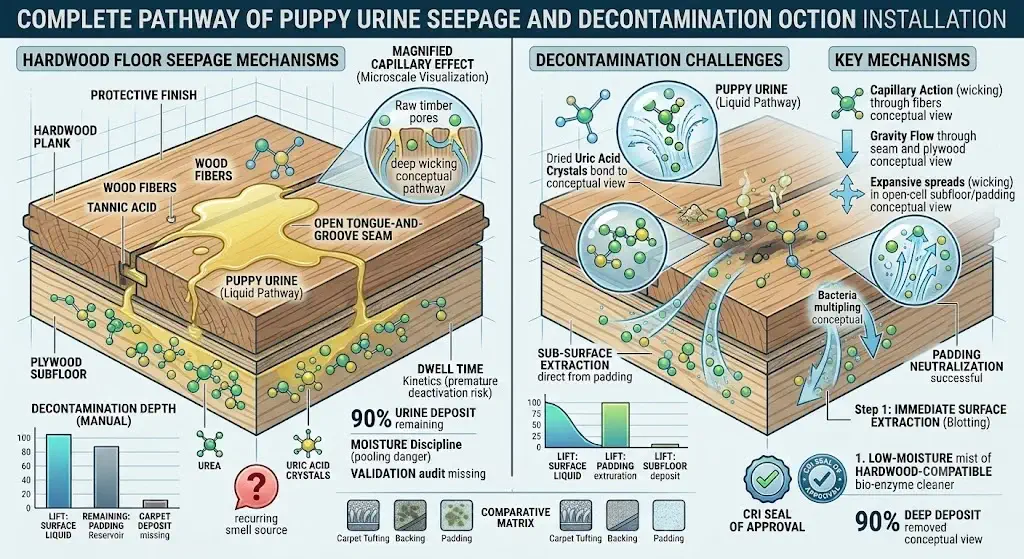
Different chemical protective finishes dictate specific cleaner pH tolerances and moisture thresholds. Before spraying any cleaning agent, determine your hardwood floor’s protective seal:
- Factory-Finished Hardwood (Pre-finished): Coated with multi-layer, UV-cured polyurethane containing aluminum oxide; highly water-resistant on plank faces, but vulnerable along micro-bevel edges.
- Site-Finished Polyurethane: Smooth, seamless topcoat sealed in place; offers superior seam resistance, but finish can be softened by harsh chemical cleaners.
- Lacquered or Varnish Finishes: Older traditional finishes that can turn white or cloudy when exposed to excess water or acidic urine.
- Penetrating Natural Oils & Hard-Wax: Breathable, open-pore finishes that allow urine salts to penetrate deeply if not treated with pH-neutral oil soaps.
- Unfinished or Severely Worn Wood: Bare cellulose timber fibers that absorb urine instantly through capillary wicking, demanding near-zero liquid moisture.
Never assume a cleaner safe for polyurethane is safe for natural oiled timber. Always cross-reference your flooring manufacturer’s warranty guidelines before treating stains.
Step 4: Use a Hardwood-Compatible Cleaner
Finish-safe cleaning formulations deploy controlled surfactants or specialized wood enzymes to dissolve urine deposits without stripping protective clearcoats. Once the raw puddle is blotted away, apply a cleaner certified by the National Wood Flooring Association (NWFA) for residential finish maintenance.
For example, Bona’s Pet System Wood Floor Deep Cleaner is specifically engineered for lacquered wood floors, utilizing an oxy-powered hydrogen peroxide formulation combined with Odour Guard Technology to break down uric acid and organic soils. Its technical documentation verifies that it dries rapidly and leaves zero sticky residue. This establishes an essential rule: chemical finish compatibility matters far more than generic product labels. Review our detailed breakdown on Enzyme Cleaner vs Regular Pet Cleaner to understand how enzymatic action compares to surface surfactants on sealed substrates.
Step 5: Wipe Away Excess Moisture
Microfiber wiping removes suspended organic residues and chemical moisture before board expansion occurs. Hardwood flooring should never remain visibly wet following cleanup.
Once the product has completed its brief recommended contact time (typically 2 to 4 minutes), buff the area dry with a fresh microfiber mop pad or dry white cloth. The objective is complete surface cleanliness without moisture pooling. Leaving liquid cleaning products on finished wood can cause dull white water spots, cloudy polyurethane hazing, and swollen edges along board joints.
Step 6: Let the Floor Dry Completely
Active room airflow completes the evaporation cycle and reveals whether sub-surface ammonia off-gassing remains. Allow the treated plank section to dry completely before evaluating the final remediation result.
Position an oscillating room fan directly over the treated boards for 30 to 45 minutes, then audit the floor:
- Does a lingering ammonia or mercaptan smell remain when sniffing close to the seams?
- Is there dark gray or black discoloration around the board edges?
- Has the polyurethane topcoat turned cloudy, milky, or matte?
- Are the board edges raised, swollen, or cupped against adjacent planks?
- Does moisture appear when pressing a dry cloth firmly along seams?
If the hardwood appears pristine and emits no odor after total drying, your decontamination protocol was completely successful.
How to Clean Dried Puppy Pee From Hardwood Floors
Dried urine crusts require light, controlled rehydration with a specialized wood-safe mist to dissolve crystallized uric salts without saturating planks. Dried accidents present heightened risks because alkaline salts have had hours to interact chemically with polyurethane clearcoats:
- Identify the entire perimeter: Darken the room and sweep a 395nm UV blacklight across the floor to reveal the fluorescent crystal outline.
- Apply a light mist: Spray a wood-safe enzymatic or oxygenated cleaner lightly over the dried deposit; do not flood the boards.
- Allow a controlled 3-minute dwell: Let the chemical solution soften the hardened crust without allowing fluid to pool along seams.
- Wipe with a soft microfiber cloth: Buff the softened residue gently until the dried crystal deposit lifts completely from the finish.
- Dry the area immediately: Buff the surface with a second, dry microfiber cloth.
- Deploy an electric fan: Force dry air across the boards to ensure complete moisture evacuation within 15 minutes.
- Reassess the wood finish: Audit under direct lighting to verify that the finish has not experienced chemical hazing.
The AKC notes that urine readily penetrates wood pores when left standing, emphasizing that older, dried accidents may require multiple gentle cleanings to remove deep scent markers completely.
How to Remove Puppy Urine Smell From Hardwood
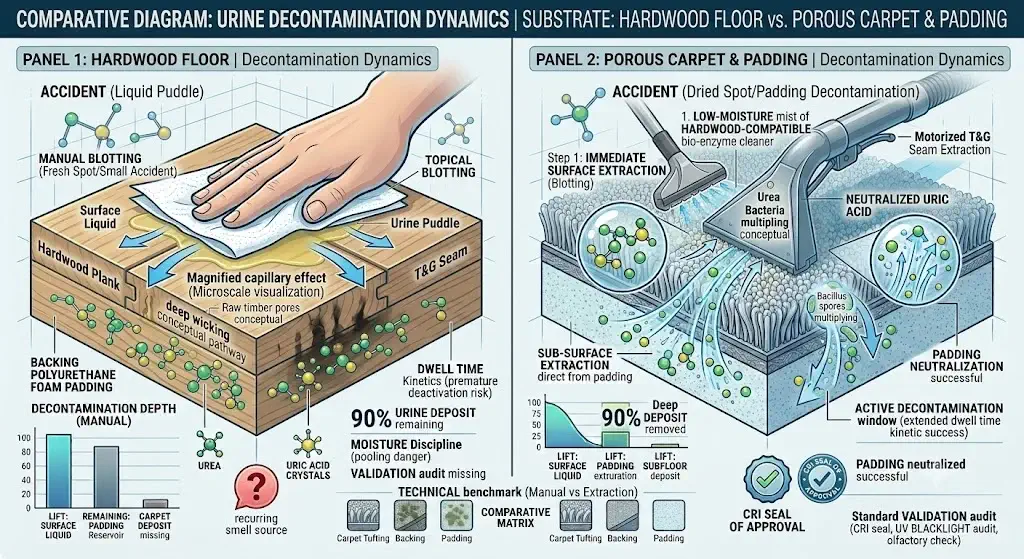
Sub-surface odor recurrence occurs when trapped urine salts within board seams reactivate during periods of elevated indoor humidity. If the floorboard face looks clean but the room still smells of pungent ammonia, the odor source is trapped beneath the finish.
Audit these common hidden contamination points:
- Beveled tongue-and-groove plank seams where capillary forces pull liquid downward
- Micro-cracks in aging or flexed polyurethane clearcoats
- Worn traffic lanes where bare wood fibers directly absorbed urine
- Wall perimeters where urine wicked beneath shoe molding and baseboards
- The structural plywood or concrete subfloor beneath the hardwood installation
- Underneath area rug pads that trapped moisture against wood finishes
Never attempt to resolve sub-surface odor by pouring heavy enzyme liquids into board cracks. For broader strategies on eliminating environmental pet malodors, explore our complete How to Remove Puppy Urine Smell guide.
Why Puppy Pee Can Damage Hardwood
Canine urine degrades hardwood through chemical tannin reactions, alkaline finish breakdown, and cellular moisture expansion. Hardwood is highly sensitive to prolonged liquid exposure compared to synthetic, waterproof flooring options.
Clinical signs of irreversible wood damage include:
- Black Tannin Stains: Alkaline ammonia reacts with the natural tannic acid present in white and red oak, precipitating insoluble dark iron-tannate compounds inside wood cellular structures.
- Edge Cupping & Crowning: Moisture absorption swells the bottom or edges of planks, forcing board perimeters upward and creating uneven, washboard floor surfaces.
- Finish Delamination: Acidic fresh urine followed by alkaline ammonium breakdown dissolves polyurethane adhesives, causing clearcoats to peel and flake.
- Cellular Mold Growth: Trapped subfloor moisture fosters fungal growth between boards, emitting persistent earthy and musty odors.
Once chemical tannin oxidation has altered the cellular color of timber, surface cleaners cannot restore the floor; physical sanding and refinishing become mandatory.
How to Clean Puppy Pee Between Hardwood Boards
Capillary seam extraction requires high-velocity dry vacuuming and targeted low-moisture wiping to prevent subfloor pooling. Seams require extra caution because fluid moves freely along unsealed tongue-and-groove joints:
- Absorb all surface puddles immediately with dry microfiber towels.
- Press a dry cloth firmly along the seam line to draw up trapped liquid.
- Run a dry crevice tool attachment from a vacuum along the joint to draw out loose liquid droplets.
- Apply a very light mist of wood-safe enzymatic cleaner directly onto a cloth (never pour directly into seams).
- Wipe the seam firmly, then dry immediately with a clean towel.
- Aim an electric blower directly down the seam channel to accelerate moisture removal.
Never deliberately flood gaps between boards. Flooding seams pushes liquid past the tongue-and-groove joint onto plywood subfloors, where it cannot evaporate without extensive mechanical drying.
How to Clean Puppy Pee From Unfinished Hardwood
Unfinished timber absorbs liquid urine instantly, requiring immediate dry absorbent powders and minimal liquid chemicals. Because unfinished wood lacks a protective barrier, fluid wicks directly into raw cellulose fibers:
- Blot the fresh urine immediately with dry towels using heavy downward pressure.
- Apply a dry absorbent mineral powder (such as baking soda or specialized clay) over the damp wood to draw moisture upward out of raw pores.
- Vacuum the saturated powder after 15 to 20 minutes once liquid uptake ceases.
- Avoid commercial liquid cleaners that contain synthetic dyes, fragrances, or high water volumes.
- Consult a professional hardwood contractor regarding spot-sanding or oxalic acid treatments if dark tannin burns develop.
Do not experiment with aggressive home remedies on raw wood. Adding water-based solutions to unfinished planks swells raw wood grain and accelerates deep chemical discoloration.
Can You Use an Enzyme Cleaner on Hardwood?
Enzyme cleaners are safe for hardwood only when formulated specifically with neutral pH and fast-drying carriers for sealed wood finishes. A biological cleaner engineered for synthetic carpet is not automatically safe for finished wood floors.
Standard carpet enzyme cleaners maintain high moisture levels and prolonged dwell recommendations (often 12 to 24 hours under damp towels) that will ruin finished hardwood. When cleaning wood, choose products specifically tested and labeled for finished timber, such as Bona Pet System or wood-certified enzymatic formulas. To understand the biochemical differences between carpet and floor cleaners, read our comparison on How to Clean Puppy Pee From Carpet.
Should You Use Vinegar on Hardwood Floors?
Acetic acid in household vinegar chemically etches polyurethane clearcoats, leaving cloudy white patches and stripping protective finishes. While vinegar is commonly suggested as a home remedy for pet accidents, it poses severe risks to hardwood:
- The low pH (approx. 2.5) of vinegar strips the sheen off factory-applied polyurethane clearcoats over time.
- Consumer Reports warns that vinegar’s pungent sour scent can trigger instinctive territorial marking in young puppies.
- Vinegar introduces excessive moisture without providing biological enzymes capable of digesting insoluble uric acid salts.
The National Wood Flooring Association (NWFA) explicitly advises against using vinegar and water solutions on hardwood floors, recommending dedicated neutral-pH wood cleaners instead.
Can Baking Soda Remove Puppy Pee Smell From Hardwood?
Baking soda acts as a mild surface desiccant but cannot metabolize crystallized uric acid trapped between floorboard joints. Applying dry sodium bicarbonate may absorb minor surface moisture, but it presents practical drawbacks on finished floors:
- Abrasive baking soda crystals can create fine micro-scratches across glossy polyurethane finishes when wiped.
- When mixed with liquid urine, baking soda creates an alkaline paste that lodges inside board bevels, making removal difficult.
- It cannot neutralize deep subfloor urine deposits that drive recurring malodors during humid weather.
Reserve baking soda for emergency absorption on bare, unfinished wood, and use certified liquid wood cleaners for routine finished floors.
Can You Use Bleach on Hardwood for Puppy Pee?
Chlorine bleach destroys protective polyurethane sealants and chemically reacts with urine ammonia to generate toxic chloramine gas. Never apply household bleach to hardwood flooring:
- Bleach strips natural wood pigments and factory stains, leaving permanent, discolored white blotches across hardwood planks.
- It severely damages wood lignin, weakening timber grain and creating rough, splintered surfaces.
- Mixing sodium hypochlorite (bleach) with the ammonia in pet urine creates hazardous respiratory gases.
Always avoid bleach entirely when remediating pet urine on wood, laminate, or carpet surfaces.
Should You Steam Clean Hardwood After Puppy Pee?
Pressurized steam forces boiling water deep into plank joints, peeling polyurethane finishes and warping structural hardwood flooring. Steam mops represent one of the most destructive tools you can use on hardwood floors.
High-temperature steam breaks the bond between the protective clearcoat and timber, forcing moisture past tongues and grooves into subflooring. The NWFA strictly forbids steam cleaning on hardwood installations, noting that steam void warranties and causes irreversible plank crowning. Stick to low-moisture spray-and-wipe methods exclusively.
What If Puppy Pee Left a Dark Spot on Hardwood?
Dark black spots indicate chemical reactions between alkaline urine ammonia and natural wood tannins within timber cells. A dark spot is a chemical burn within the wood itself, not a simple surface stain.
Common causes of dark floor discoloration include:
- Urine remained standing on the boards for hours while owners were away, penetrating micro-fissures.
- Urine wicked beneath the polyurethane clearcoat, trapping moisture against raw timber.
- Repeated accidents occurred in the exact same location, saturating the plank core.
Do not attempt to scrub dark spots away with strong detergents. Removing black tannin burns typically requires sanding the affected planks down to raw wood, applying a specialized oxalic acid wood bleach solution, and reapplying stain and polyurethane.
What If Puppy Pee Smell Keeps Coming Back?
Persistent urine odor after floor drying indicates liquid reached structural subflooring or wall cavities. If a room smells strongly of ammonia despite repeated surface cleanings, investigate sub-surface contamination:
- Inspect floorboard joints with a 395nm UV blacklight to trace where liquid seeped between planks.
- Check perimeter shoe molding, drywall bases, and baseboards for urine wicking.
- Inspect the underside of area rugs and rug pads located nearby.
- Audit adjacent heating registers and floor vents where urine may have drained into ductwork.
AKC guidelines note that canine urine readily penetrates wood pores, and repeated accidents can make total odor eradication impossible without subfloor remediation.
When Cleaning Is No Longer Enough
Severe structural contamination and physical wood warping necessitate professional sanding, plank replacement, or subfloor sealing. Surface cleaners are designed for routine accidents, but fail under severe structural conditions:
- The wood has visibly cupped, crowned, or developed severe edge buckling along seams.
- Dark black tannin stains cover broad sections of the floor that resist surface treatment.
- Urine saturated through plank joints into structural plywood or oriented strand board (OSB) subflooring.
- The polyurethane clearcoat is peeling, flaking, or gummy from chronic alkaline degradation.
At this stage, adding more liquid cleaner only exacerbates the underlying moisture problem. Consult a certified NWFA flooring contractor to evaluate board replacement or dustless refinishing.
How to Prevent Puppy Pee From Damaging Hardwood Again
Strict outdoor housebreaking routines and physical room barriers protect hardwood flooring from repeat urine exposure. Once the floor is sanitized, implement proactive housebreaking measures:
- Take the puppy outside at age-appropriate intervals (every 1 to 2 hours for young puppies).
- Escort the puppy outdoors immediately upon waking, after eating, and following active indoor play.
- Supervise the puppy closely indoors using umbilical leashes or playpens placed over waterproof floor mats.
- Reward successful outdoor elimination immediately with high-value treats within 3 seconds.
- Restrict unsupervised access to expensive hardwood living areas using sturdy baby gates.
- Eliminate all residual scent markers thoroughly to prevent instinctual re-marking.
Puppy Pee on Hardwood: Fresh vs Dried
Fresh accidents require rapid liquid absorption, whereas dried stains demand controlled chemical misting to dissolve crusts safely. Select your remediation method based on the accident’s age and depth:
| Contamination Scenario | Recommended Starting Approach |
|---|---|
| Fresh puddle (<30 mins) | Absorb immediately with downward blotting, apply light wood mist, buff completely dry |
| Small dried spot (>12 hrs) | Mist wood-safe enzyme cleaner, dwell for 3 minutes, wipe gently with microfiber |
| Persistent seam odor | Dry vacuum seams, apply targeted low-moisture biological mist, force-air dry with fan |
| Dark black discoloration | Assess tannin burn depth; consult NWFA professional for spot-sanding and oxalic treatment |
| Unfinished or raw timber | Apply dry absorbent powder, avoid liquid cleaners, spot sand when dry |
What Not to Do When Cleaning Puppy Pee From Hardwood
Improper cleaning techniques cause permanent board cupping, finish hazing, and structural subfloor rot. Avoid these common operational errors when treating hardwood flooring:
| Prohibited Action | Correct Operational Protocol |
|---|---|
| Leaving urine standing on wood | Absorb immediately within seconds of discovery using dry paper towels |
| Flooding planks with liquid cleaner | Apply a controlled spray mist; never pour unmetered liquid directly from bottles |
| Using carpet enzyme cleaners | Choose products specifically formulated and certified for hardwood clearcoats |
| Scrubbing with abrasive pads | Blot downward and buff gently using soft microfiber cloths exclusively |
| Using steam mops on hardwood | Clean with low-moisture spray mops and accelerate drying with electric fans |
| Applying vinegar or ammonia | Deploy pH-neutral wood cleaners that preserve polyurethane clearcoats |
| Mixing chemical cleaners | Use a single, verified hardwood cleaner according to label directions |
Hardwood Floor Puppy Pee Cleanup Checklist
Standardized operational protocols protect timber integrity while ensuring total biological odor removal. Follow this complete procedural checklist:
- ☐ Move the puppy calmly away from the accident to the outdoor potty area
- ☐ Absorb fresh urine immediately using clean white paper towels (avoid dragging)
- ☐ Replace towels continuously until paper lifts with zero moisture transfer
- ☐ Buff the surface dry with a clean, undyed microfiber cloth
- ☐ Identify the floor finish (polyurethane, factory UV coat, natural oil, or raw timber)
- ☐ Select an NWFA-compatible, pH-neutral pet cleaner
- ☐ Apply a light mist over the footprint (never saturate or pool seams)
- ☐ Allow a controlled 2 to 4 minute dwell time
- ☐ Wipe away all residual cleaner immediately using a dry microfiber pad
- ☐ Direct an electric fan across the planks to ensure complete air-drying
- ☐ Inspect the dried wood visually for dark tannin spots and conduct a close sniff test
- ☐ Audit seams and baseboards with a 395nm UV blacklight if odor persists
- ☐ Consult a hardwood restoration professional if deep structural damage or cupping occurs
Frequently Asked Questions (FAQ)
How do I clean puppy pee from hardwood floors?
What is the best cleaner for puppy pee on hardwood?
Can I use an enzyme cleaner on hardwood floors?
How do I remove dried puppy pee from hardwood?
Why does my hardwood floor still smell like puppy pee?
Can puppy urine permanently damage hardwood?
Can vinegar remove puppy pee from hardwood?
Can baking soda remove puppy urine odor from hardwood?
Can I use bleach on hardwood for puppy pee?
Can I steam clean hardwood after puppy pee?
How do I remove puppy pee smell from hardwood?
What if puppy pee leaves a dark stain on hardwood?
How do I clean puppy pee between hardwood boards?
When should I call a hardwood-floor professional?
How can I stop my puppy from peeing on hardwood floors?
Bottom Line: Control Moisture, Protect the Finish
The safest way to clean puppy pee from hardwood floors is to act immediately and use as little moisture as necessary. Fresh urine must be absorbed within seconds using firm downward pressure to prevent liquid migration into unsealed tongue-and-groove joints. When applying cleaners, select only pH-neutral formulations certified for your specific finish, avoiding heavy liquid saturation at all costs.
Do not treat hardwood like fibrous carpeting. Saturating hardwood floors causes board cupping, edge warping, and permanent black tannin chemical burns that surface cleaners cannot reverse. If odors or discoloration persist after thorough drying, the contamination has likely breached subfloor structures. Absorb quickly, control moisture, use the correct floor cleaner, dry completely, and eliminate recurring odor sources rather than masking them. This disciplined protocol safeguards your flooring investment while setting a hygienic foundation for housebreaking success.
