
CRI & IICRC S300 CARPET STANDARDS 2026
How to Clean Puppy Pee From Carpet: Step-by-Step Guide
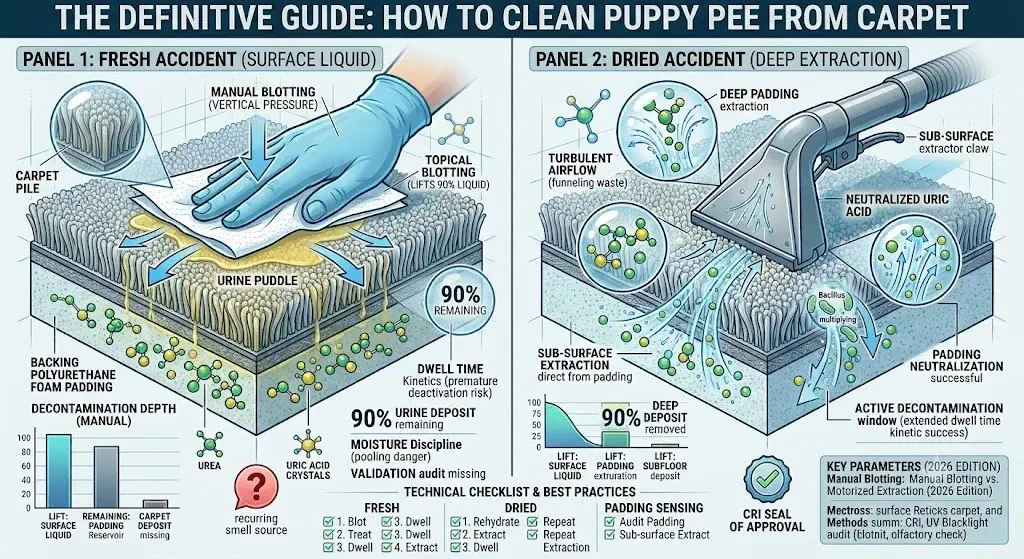
To clean puppy pee from carpet, blot as much urine as possible, treat the remaining contamination with a carpet-compatible pet urine cleaner, and extract the area when necessary. The key is to remove more than the visible wet spot because urine can travel below the carpet fibers and into the backing or padding. Learning how to clean puppy pee from carpet requires identifying whether the accident is a fresh surface liquid or dried uric acid crystals embedded deep inside the open-cell foam cushion.
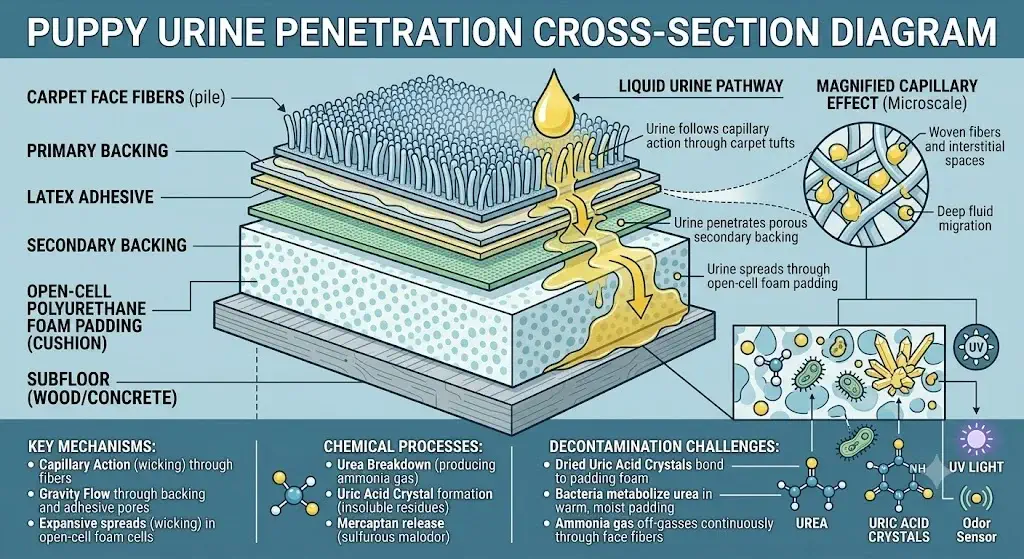
Fresh puppy pee is usually easier to handle than dried urine. If you catch the accident quickly, absorb as much liquid as possible before applying cleaner. If the urine has already dried or the same area has been repeatedly soiled, deeper chemical and mechanical remediation becomes necessary. Carpet is a multi-layered composite consisting of face tufts, primary backing, latex adhesive, and an open-cell polyurethane pad. Liquid urine rapidly penetrates through these layers, creating an expansive sub-surface reservoir up to three times wider than the surface spot.
The American Kennel Club (AKC) recommends prompt cleanup, thorough absorption, and appropriate treatment of urine stains because residual scent cues trigger instinctual territorial re-marking. For dried urine on carpet, the AKC recommends rehydrating and extracting the area before using an enzymatic cleaner when needed. The AKC also advises against steam cleaning urine-contaminated carpet because thermal heat permanently bakes urine proteins and pigment into carpet fibers. Independent 2026 laboratory testing confirms that combining mechanical extraction with biological enzymatic digestion provides the highest decontamination rate across synthetic nylon and polyester carpets.
Quick Reference Specification: Carpet Urine Decontamination Matrix
This calibrated mechanical and chemical matrix benchmarks accident stages, chemical catalysts, dwell times, and extraction methods across residential carpet systems in 2026.
| Accident Condition | Primary Chemical Agent | Required Dwell Window | Decontamination Method | Industry Benchmark & Standard |
|---|---|---|---|---|
| Fresh Spot (<1 hour) | Neutral-pH bio-enzyme or mild surfactant | 10–15 mins damp contact | Firm downward blot with microfiber | CRI Seal of Approval / Spot Cleaning |
| Dried Urine Stain | Bacillus bacterial spores + urease enzyme | 8–12 hrs (covered with damp towel) | Rehydration + wet spot extraction | AKC Urine Remediation Protocol |
| Deep Padding Saturation | High-potency enzymatic deep flush | 30–60 mins sub-surface saturation | Motorized sub-surface vacuum claw | IICRC S300 Standard for Carpet Care |
| Severe Multi-Spot Area | Carpet extraction formula (cold rinse) | Continuous cycle application | Full motorized carpet extractor pass | Consumer Reports 2026 Testing Data |
| Delicate Wool Carpet | WoolSafe certified neutral-pH cleaner | 5–10 mins maximum | Gentle blot; zero mechanical scrubbing | WoolSafe Standard Specification |
Quick Answer: How to Clean Puppy Pee From Carpet
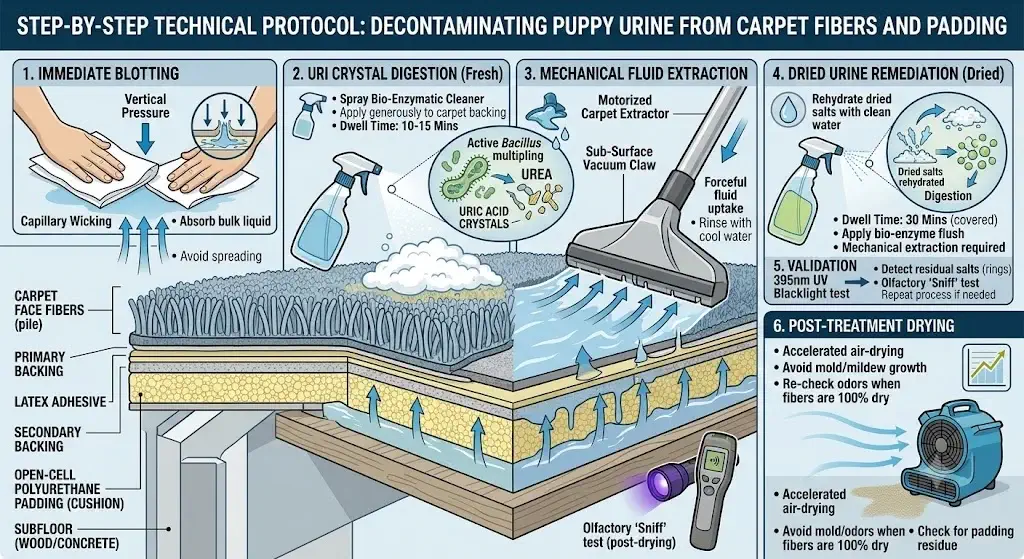
Immediate mechanical blotting combined with bio-enzymatic extraction prevents canine urine from permanently bonding to domestic carpet backing. When determining how to clean puppy pee from carpet without leaving lingering odors or yellow halos, execute the following nine-step procedure:
- Move the puppy away from the carpet: Escort the puppy calmly to their outdoor designated potty zone to avoid reinforcement of indoor accidents.
- Blot fresh urine immediately: Stack clean paper towels directly over the puddle to absorb fluid before capillary action draws it downward.
- Remove as much liquid as possible: Apply firm, vertical downward pressure until dry towels lift with zero moisture transfer.
- Apply a carpet-compatible pet urine cleaner: Spray a certified bio-enzymatic cleaner to saturate the tuft pile down to the primary backing.
- Allow the cleaner to work for the specified dwell window: Maintain damp surface conditions for 10 to 15 minutes to activate bacterial spore germination.
- Blot or extract the area: Press clean microfiber towels over the spot or deploy a motorized spot-cleaning extractor.
- Let the carpet dry completely: Direct an electric floor fan over the treated patch to ensure complete fiber evaporation.
- Check for remaining stain or odor: Conduct a tactile sniff test and an ultraviolet blacklight sweep once the carpet is dry to the touch.
- Treat deeper contamination if the smell returns: Deploy sub-surface padding extraction if trapped uric acid crystals reactivate during humid weather.
For most puppy urine accidents on carpet, do not start by scrubbing. Scrubbing untwists fiber bundles, spreads urine into surrounding dry tufts, and forces liquid through the primary latex backing into the foam pad underneath.
What You Need: Complete Carpet Urine Cleanup Kit
Standardized carpet decontamination requires absorbent blotting media, calibrated biological cleaners, and optional mechanical extractors to resolve domestic messes. A basic puppy-carpet cleanup kit does not need to be complicated:
- Paper towels or clean absorbent white microfiber towels (to avoid dye transfer)
- Carpet-compatible pet urine cleaner from our tested Best Puppy Accident Cleaners review
- Clean room-temperature water if required by the chemical dilution instructions
- A wet-dry vacuum or dedicated carpet spot extractor for larger or deeper accidents
- A 395nm UV blacklight to locate hidden dried urine salts along room perimeters
- Disposable nitrile gloves to maintain hygienic protection during waste cleanup
- A heavy sealable plastic trash bag for immediate disposal of saturated towels
If you regularly deal with housebreaking accidents, keeping these supplies assembled in a portable caddy ensures you can respond within seconds of an accident occurring.
Step 1: Move Your Puppy Away From the Carpet
Calm interruption redirects the puppy’s natural elimination instinct without inducing housebreaking anxiety or submissive urination. If you catch your puppy urinating on the carpet, calmly interrupt with a neutral sound and escort them immediately to the appropriate outdoor potty location.
If you discover the accident minutes or hours later, simply clean it without addressing the puppy. Do not punish your puppy after the accident. Physical corrections, scolding, or rubbing a dog’s nose in urine does not teach housebreaking; it merely teaches the puppy to eliminate covertly behind furniture or under beds. Once the carpet area is cleaned, return to your normal schedule and reward outdoor elimination immediately with high-value praise.
Step 2: Blot Fresh Puppy Pee Immediately
Vertical downward blotting draws liquid upward via capillary attraction while preventing urine from migrating into carpet padding. If the puddle is fresh and warm, prioritize rapid liquid extraction before applying any chemical cleaner:
- Place a thick stack of 4 to 6 paper towels or a folded microfiber cloth directly over the wet pool.
- Press down firmly using your body weight to drive liquid into the absorbent media.
- Replace saturated towels immediately with fresh, dry towels.
- Continue vertical blotting until very little moisture transfers to the towel fibers.
Do not aggressively scrub the carpet. Scrubbing destroys the twisted yarn geometry of carpet pile, driving liquid contaminants deep into the underlying primary latex backing. AKC housebreaking guidance confirms that absorbing fresh urine thoroughly before applying chemical treatments yields the highest remediation success rate.
Step 3: Treat the Carpet With a Suitable Cleaner
Substrate-compatible pet urine cleaners deploy biochemical agents designed to dismantle organic urea and urochrome pigments. Once excess liquid has been blotted away, apply a specialized cleaner certified by the Carpet and Rug Institute (CRI) for fiber safety.
An enzymatic pet-stain cleaner is the industry standard for organic pet accidents because it targets proteins and uric acid salts directly. However, “enzyme” does not guarantee that every product will perform identically. Consumer Reports’ 2026 independent testing revealed meaningful performance variances among pet cleaning chemistries, with certain high-potency non-enzyme formulas excelling on surface stains. Review our head-to-head analysis on Enzyme Cleaner vs Regular Pet Cleaner to match the right chemistry to your carpet type.
Step 4: Give the Cleaner Enough Contact Time
Biological enzyme cultures require sustained moisture contact to germinate and metabolize embedded organic waste molecules. Do not automatically spray a cleaning product and wipe it away within seconds.
The exact contact time depends on the chemical formula: standard surface surfactant cleaners work within 3 to 5 minutes, while living bacterial cultures require 10 to 15 minutes of damp dwell time to digest crystallized urea. For old, set-in urine spots, covering the saturated area with a damp towel for several hours prevents premature flash-drying, ensuring bacterial enzymes remain active until digestion is complete.
Step 5: Blot or Extract the Carpet
Mechanical fluid extraction lifts dissolved chemical residues and organic soil out of the carpet backing. Once the cleaner has completed its required contact time, remove the moisture according to manufacturer instructions.
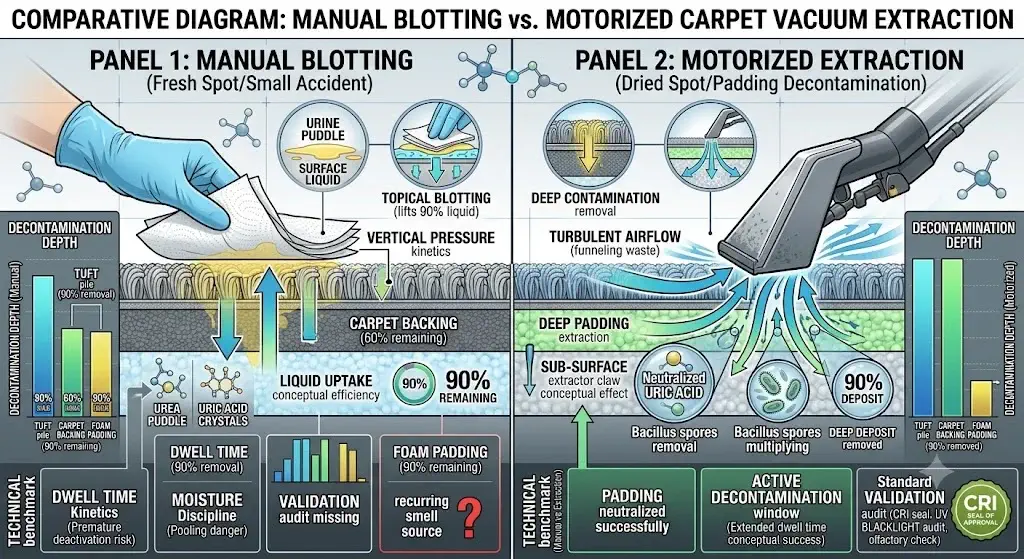
For small, isolated spots, pressing dry microfiber cloths into the carpet pile provides adequate liquid uptake. For large accidents, a motorized spot extractor or wet-dry vacuum pulls significantly more contaminated liquid from deep carpet backing than manual blotting can achieve. Consumer Reports notes that extraction equipment is critical for pet households, ensuring residual moisture does not linger inside the tuft backing.
Step 6: Let the Carpet Dry Completely
Air evaporation completes the chemical remediation process and reveals whether residual salts or pigments remain. Never judge the final cleaning result while the carpet is still damp.
Allow the treated area to dry completely over 12 to 24 hours under active room ventilation, then audit the result:
- Does a visible yellow or light-brown halo remain on the fibers?
- Does the carpet emit a sharp ammonia odor when you sniff the fibers directly?
- Does odor re-emerge during warm, humid weather?
- Is the surrounding perimeter showing fluorescent rings under a UV blacklight?
If the carpet looks visually pristine but emits a faint urine odor after drying, the liquid has penetrated beneath the carpet pile into the underlying pad.
How to Clean Dried Puppy Pee From Carpet
Dried urine crystals require rehydration with lukewarm water before bio-enzymes can effectively catalyze organic deposits. When puppy accidents dry undetected, liquid water evaporates, leaving behind concentrated uric acid salts and proteins that bond tenaciously to carpet fibers:
- Locate the full perimeter: Use a 395nm UV blacklight in complete darkness to illuminate fluorescent urine salt rings.
- Rehydrate the dried deposit: Mist lukewarm (not hot) water over the spot to dissolve crystallized uric salts.
- Extract initial dissolved moisture: Blot with dry towels or run a wet extraction vacuum over the spot.
- Apply an enzymatic pet-stain cleaner: Saturate the zone generously, matching the estimated volume of the original accident.
- Preserve the biological dwell window: Cover the area with a damp towel for 6 to 12 hours to prevent premature evaporation.
- Blot or extract as directed: Press clean cloths down firmly or run a carpet extractor to pull out dissolved soils.
- Allow thorough drying: Ventilate the room with an electric fan until the carpet pile is completely dry.
The AKC specifically warns against using high-temperature steam cleaning on dried dog urine because intense heat denatures proteins, binding them permanently into synthetic carpet fibers.
How to Clean Puppy Pee That Soaked Into Carpet Padding
Open-cell polyurethane padding acts as a porous reservoir that traps urine beneath the carpet backing. This sub-surface saturation is where many puppy owners struggle with persistent odors.
Common clinical indicators of deep carpet pad contamination include:
- The carpet surface appears completely clean, but the room smells strongly of urine.
- The ammonia scent vanishes while the carpet is damp from cleaning, but returns once dry.
- The puppy repeatedly sniffs and marks the exact same square foot of carpet.
- The odor intensifies noticeably on humid, warm summer afternoons.
Surface trigger sprays cannot penetrate dense padding in sufficient volume. Resolving padding contamination requires deep-rinse saturation followed by a specialized sub-surface extraction tool (such as a vacuum claw), or pulling back the carpet to replace the soiled padding section entirely under IICRC S300 guidelines.
How to Remove Puppy Pee Smell From Carpet
Complete odor eradication requires dismantling microscopic uric acid crystals rather than temporarily masking smells with perfumes. If the visible yellow stain has disappeared but the carpet still smells of ammonia, focus directly on the chemical source.
Systematically audit all potential contamination points:
- The carpet face fibers and latex primary backing
- The underlying polyurethane foam pad
- Adjacent carpet borders where liquid wicked horizontally
- Nearby furniture skirts or baseboards that absorbed urine splatter
- Underneath area rugs where trapped moisture fostered bacterial colonies
A cosmetic fragrance temporarily alters what humans smell, but dogs can detect one part per trillion of urine scent. For a comprehensive walkthrough on permanently removing odors, consult our dedicated How to Remove Puppy Urine Smell guide.
How to Find Old Puppy Pee Spots on Carpet
Ultraviolet blacklights emitting at 365nm to 395nm cause dried urine salts to fluoresce brightly against carpet pile. When you smell pet urine but cannot visually locate the accident site, inspect these common puppy elimination zones:
- Behind sofas, accent chairs, and entertainment centers
- Along perimeter baseboards and near room corners
- Directly beside puppy bedding or exercise pens
- Beneath dining tables and desks
- Around the edges and fringes of area rugs
The AKC specifically highlights portable UV blacklights as an indispensable diagnostic tool for puppy owners, allowing you to map out invisible dried accidents before applying targeted bio-enzymes.
Should You Use an Enzyme Cleaner on Puppy Pee?
Enzyme cleaners represent the most effective biochemical solution for pet urine because their bacterial catalysts consume uric acid. Unlike ordinary detergents that only disperse surface grime, enzymes hydrolyze organic bonds, converting urea into inert water and carbon dioxide.
Consumer Reports’ 2026 laboratory testing confirms that while enzymes are essential for biological odor digestion, certain non-enzyme oxidizers excel at removing surface pigments. Choose your cleaning product based on the specific challenge: bio-enzymes for deep odor and organic residue, or CRI-approved carpet oxidizers for stubborn yellow urobilin discoloration.
How Long Should an Enzyme Cleaner Sit on Carpet?
Active enzyme formulations require a damp dwell window of 10 to 15 minutes minimum to break down organic proteins. There is no universal dwell time across every commercial brand.
Always follow the exact instructions on the product packaging. If treating deep-set dried urine in carpet backing, covering the treated zone with a damp cloth extends the moisture window for 8 to 12 hours, allowing bacterial spores to complete the biological digestion cycle without drying out prematurely.
Can You Use a Carpet Cleaner Machine on Puppy Pee?
Motorized carpet extractors provide superior suction to lift deep urine deposits from carpet backing and padding. Mechanical extraction removes significantly more moisture and dissolved contaminants than manual paper towel blotting alone.
When operating a carpet extraction machine for pet accidents:
- Select a carpet machine carrying the CRI Seal of Approval for water recovery.
- Operate the machine with room-temperature or cold water to avoid setting proteins.
- Use a low-foaming detergent specifically designed for pet extraction equipment.
- Make multiple dry vacuum passes to extract as much moisture as possible.
- Allow the carpet to dry thoroughly using floor fans to prevent mildew.
Consumer Reports’ 2026 evaluations showed that dedicated pet carpet extractors deliver deep sub-surface cleaning essential for managing puppy housebreaking accidents. Review top-performing machines in our Best Carpet Cleaners for Dog Urine benchmark.
Should You Steam Clean Puppy Pee From Carpet?
High-temperature steam permanently bonds canine urine proteins and pigments into synthetic carpet fibers. Introducing boiling water or steam coagulates protein chains, fusing them directly into carpet dye sites.
Both the AKC and Consumer Reports explicitly advise against using heat-based steam mops on pet accidents. If you deploy a carpet cleaning extractor, always ensure the heating element is turned off and use cool water to flush out dissolved soils safely.
Can Vinegar, Baking Soda, or Bleach Remove Puppy Pee From Carpet?
Common household chemicals fail to hydrolyze crystallized uric salts and can damage carpet dyes permanently. Chemical evaluations reveal significant operational risks across popular home remedies:
- Distilled White Vinegar: Acetic acid temporarily neutralizes alkaline fresh urine, but Consumer Reports cautions that strong vinegar scents can encourage puppies to re-mark the area territorially.
- Baking Soda (Sodium Bicarbonate): Absorbs mild surface moisture, but cannot reach carpet padding. When mixed with liquid urine, it forms a pasty grit that clogs household vacuum filters.
- Chlorine Bleach: Extremely dangerous. Bleach reacts with the ammonia in puppy urine to release toxic chloramine gas, while permanently stripping color from nylon and wool carpet fibers.
For reliable, fiber-safe decontamination, purpose-engineered pet urine cleaners provide predictable results without risking fiber damage.
Why Does Puppy Pee Keep Coming Back on the Carpet?
Capillary wicking draws dried urine residues from saturated backing up to carpet fiber tips during evaporation. If a yellow stain or ammonia odor reappears days after cleaning, several underlying factors are typically responsible:
- The liquid urine penetrated into the carpet pad, creating an untreated sub-surface reservoir.
- The cleaning solution was blotted away prematurely before chemical enzymes could digest the uric core.
- The accident expanded horizontally beneath the surface, spreading wider than the visible top stain.
- The puppy returned to mark the exact same spot due to faint residual pheromones.
- An older, untreated accident exists immediately adjacent to the cleaned area.
Consumer Reports confirms that pet urine is particularly challenging on carpets because contamination extends well beyond the visible pile surface.
How to Clean a Large Puppy Pee Accident on Carpet
Large-volume accidents require motorized extraction equipment to remove heavy fluid loads before sub-floor damage occurs. A major accident demands a more aggressive approach than a small spot treatment:
- Extract the bulk liquid immediately using a wet-dry vacuum or heavy downward towel blotting.
- Map the full perimeter with a UV blacklight to determine how far the puddle expanded.
- Saturate the area generously with an enzymatic carpet cleaner to reach the underlying pad.
- Allow 20 to 30 minutes of damp dwell time for deep penetration.
- Run multiple extraction passes with a motorized carpet machine using cold water rinses.
- Position a commercial air mover over the area to ensure rapid 12-hour drying.
If large-volume saturation has occurred repeatedly in the same location, professional restoration may be required to prevent subfloor damage.
When to Call a Professional Carpet Cleaner
Professional carpet technicians deploy high-cfm truck-mounted vacuum systems and sub-surface injection claws to restore heavily contaminated flooring. Consider hiring professional remediation services when:
- A strong ammonia odor persists despite repeated enzymatic treatments and machine extractions.
- The puppy has repeatedly soiled the same carpeted zone over several weeks.
- Contamination has penetrated through the padding into concrete or plywood subflooring.
- Valuable antique wool rugs or delicate woven carpets require specialized plant submersion cleaning.
The AKC recommends professional cleaning when deep structural odors resist home remediation or when accidents span large square footage.
How to Prevent Puppy Pee From Ruining the Carpet Again
Consistent outdoor housebreaking schedules combined with active indoor supervision prevent puppies from repeating carpet accidents. Cleaning the carpet removes the immediate mess, but structured training prevents the next one:
- Take your puppy outside at regular intervals tailored to their developmental age (every 1 to 2 hours).
- Escort the puppy outdoors immediately upon waking, after meals, and after active play sessions.
- Supervise the puppy closely indoors using short leashes or playpens to prevent covert wandering.
- Reward successful outdoor elimination immediately with high-value treats within 3 seconds.
- Restrict access to previously soiled carpeted rooms using baby gates.
- Conduct weekly UV blacklight sweeps to detect and decontaminate fresh accidents immediately.
Should You Put Rugs Back Over a Previously Soiled Area?
Placing absorbent rugs over recently soiled carpet creates attractive elimination targets for young puppies. Puppies naturally prefer eliminating on soft, absorbent substrates.
The AKC notes that area rugs frequently become primary potty targets during housebreaking. Professional trainers recommend removing rugs temporarily when a puppy repeatedly chooses them for elimination, reintroducing them only after housebreaking is reliable and all underlying sub-surface carpet odors have been completely eradicated.
Puppy Pee on Carpet: What Not to Do
Improper cleaning techniques cause permanent fiber damage and chemically set urine odors into carpet backing. Follow these operational rules when cleaning carpet accidents:
| Incorrect Technique | Correct Operational Protocol |
|---|---|
| Scrubbing aggressively | Blot downward with vertical pressure; use motorized extraction |
| Using steam mops on urine | Use cold or room-temperature water extraction to avoid setting proteins |
| Masking odor with air fresheners | Deploy bio-enzymes to digest the underlying uric acid crystals |
| Flooding the carpet excessively | Apply controlled moisture matching the volume of the original accident |
| Mixing multiple chemicals | Use one CRI-certified cleaner as directed by label instructions |
| Ignoring carpet padding | Investigate sub-surface padding saturation if odors persist after drying |
| Punishing the puppy | Clean calmly and reinforce correct outdoor elimination immediately |
Fresh vs Dried Puppy Pee on Carpet
Fresh urine requires rapid mechanical fluid extraction, whereas dried deposits require liquid rehydration and enzymatic dwelling. Selecting the proper approach depends directly on the accident’s age:
| Accident Scenario | Recommended Starting Approach |
|---|---|
| Fresh, small accident (<1 hour) | Blot downward immediately with paper towels, then apply enzymatic spray |
| Fresh, large accident | Extract with wet-dry vacuum, apply bio-enzymes, and rinse extract |
| Dried urine stain (>24 hours) | Rehydrate with lukewarm water, extract, and dwell under damp cloth for 8–12 hrs |
| Recurring urine odor | Audit carpet padding with UV light; deploy sub-surface extraction claw |
| Multiple old stains | Deploy motorized carpet cleaning machine or hire professional remediation |
Puppy Pee Carpet Cleanup Checklist
Standardized operational workflows ensure methodical decontamination across domestic carpets. Follow this complete procedural checklist:
- ☐ Move puppy calmly away from the accident to the outdoor potty spot
- ☐ Blot fresh urine immediately with stacked paper towels (no scrubbing)
- ☐ Extract maximum liquid volume until towels lift completely dry
- ☐ Identify the full affected area and perimeter using a 395nm UV blacklight
- ☐ Use a CRI-certified, carpet-compatible pet urine cleaner
- ☐ Follow the product’s required damp contact dwell time (10–15+ minutes)
- ☐ Blot or extract the carpet with clean microfiber or a motorized vacuum
- ☐ Let the carpet dry completely under electric floor fan ventilation
- ☐ Check for remaining yellow discoloration and conduct a direct sniff test
- ☐ Inspect carpet padding if odor returns during warm, humid conditions
- ☐ Use deep sub-surface extraction for large or repeated accidents
- ☐ Reinforce a consistent outdoor potty-training routine with positive rewards
Frequently Asked Questions (FAQ)
How do I clean puppy pee from carpet?
How do I clean dried puppy pee from carpet?
What is the best cleaner for puppy pee on carpet?
Should I use an enzyme cleaner for puppy pee?
How long should an enzyme cleaner sit on carpet?
Why does my carpet still smell like puppy pee after cleaning?
Can baking soda remove puppy pee smell from carpet?
Can vinegar remove puppy pee from carpet?
Can I use bleach on puppy pee carpet?
Can I steam clean puppy pee from carpet?
Should I use a carpet cleaner machine for puppy pee?
How do I know if puppy pee reached the carpet padding?
Can puppy urine permanently damage carpet?
How do I stop my puppy from peeing on the carpet again?
When should I replace carpet after puppy urine?
Bottom Line: Remove the Urine, Not Just the Smell
The most important rule when cleaning puppy pee from carpet is to extract the urine contamination instead of simply covering the smell. Fresh accidents must be blotted immediately with downward vertical pressure to stop liquid migration into sub-layers. For dried carpet stains, enzymatic rehydration and extended covered dwell times are essential to metabolize hardened uric acid crystal deposits.
Avoid heat-based steam cleaning on urine-contaminated textiles, as thermal energy cooks protein chains directly into synthetic fibers. When accidents are large or recurrent, deploy motorized sub-surface extraction to purge contaminated padding. Blot quickly, treat the carpet correctly, extract when necessary, dry completely, and reinforce the housebreaking routine that prevents the next accident. This disciplined mechanical and biochemical protocol protects your home flooring investment while establishing a clean foundation for housebreaking success.
