
SMALL DOG CRATE BUYING GUIDE
Best Puppy Crates for Small Dogs in 2026: 5 Top Picks for Small-Breed Puppies
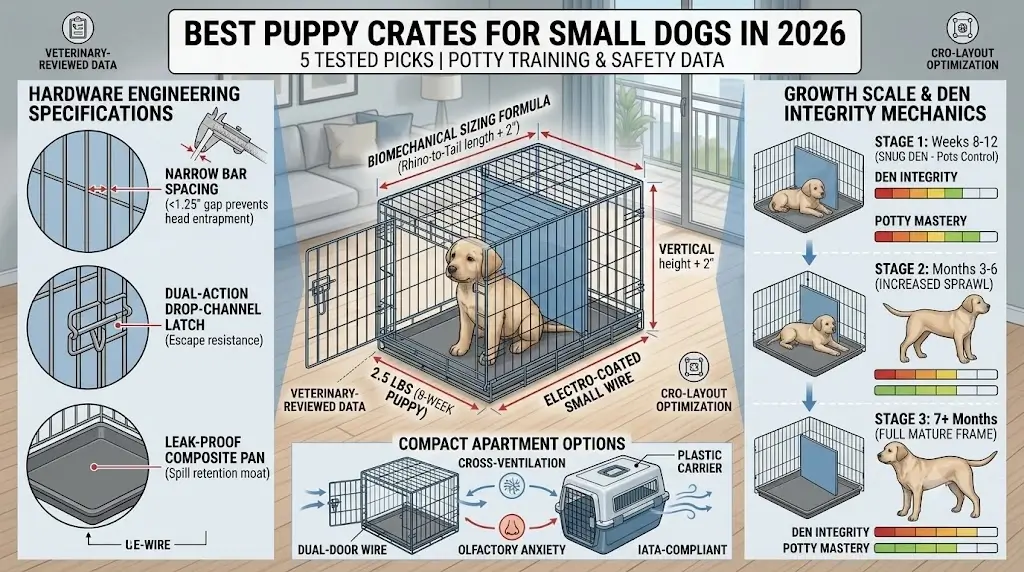
Finding the best puppy crates for small dogs starts with anatomical biomechanics, not simply picking the smallest enclosure on retail shelves. A small-breed puppy requires adequate interior clearance to stand erect without head contact, execute a continuous 360-degree turn, sit squarely, and sprawl in full lateral recumbency, while avoiding dangerous bar spacing that creates head- or paw-entrapment risks.
For most toy- and small-breed puppies, our benchmark recommendation among the best puppy crates for small dogs is a compact electro-coated wire crate fitted with tight bar spacing and an adjustable divider panel. Open-grid wire delivers continuous cross-ventilation, broad visual horizons to lower separation anxiety, and a removable composite tray for seamless cleanup. For dense living quarters, dual-door configurations maximize wall-placement versatility, while molded plastic carriers suit travel regulations and sensory-sensitive resting habits.
We evaluated market-leading compact containment systems across rigorous parameters—wire grid spacing under 1.25 inches to eliminate cervical wedging, slide-bolt latch drop tolerances, divider retention under point loads, pan drop clearance, and compressed bedding fit—to rank the best puppy crates for small dogs during critical early development.
Comparison: The Best Puppy Crates for Small Dogs at a Glance
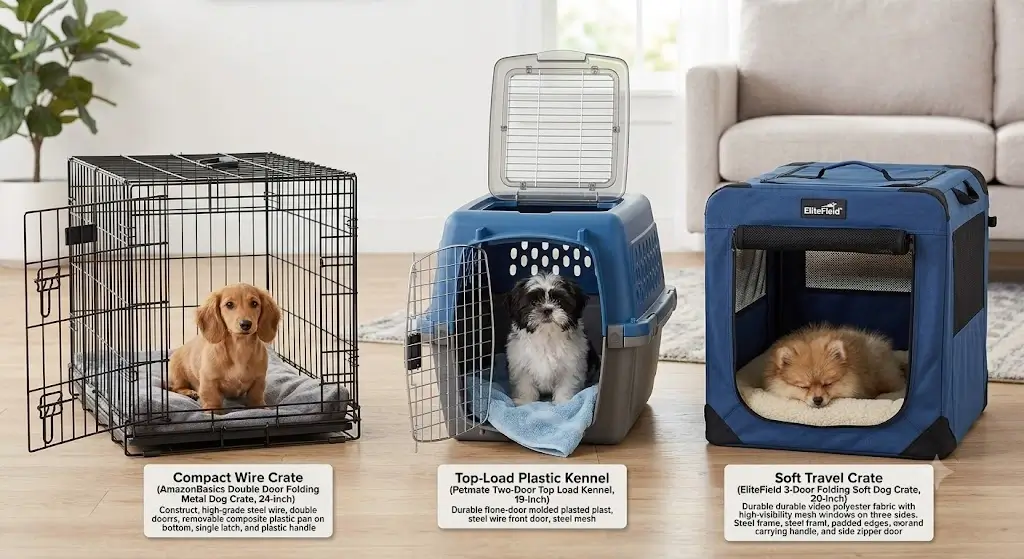
Small-breed puppies exhibit vast anatomical diversity: a deep-chested, short-backed French Bulldog puppy demands entirely different interior volume than an elongated, fragile-boned Miniature Dachshund. The comparison below highlights how the best puppy crates for small dogs align with adult skeletal stature, behavioral profiles, and home footprints.
| Our Pick | Best For | Key Specifications | Check Price |
|---|---|---|---|
| MidWest iCrate (22″/24″) | Best Overall | 1.1″ bar spacing, dual-action slide latches, included divider, ABS pan | View on Amazon |
| MidWest LifeStages (24″) | Growing Small Breeds | Heavier 7–9 gauge wire, tighter mesh spacing, reinforced divider panel | View on Amazon |
| Carlson Secure Double Door | Apartment Layouts | Front & lateral side doors, multi-point lock system, included divider | View on Amazon |
| Petmate Two-Door Top-Load | Privacy & Vet Travel | Molded plastic shell, ergonomic top-loading steel door, wing-nut assembly | View on Amazon |
| EliteField 3-Door Soft Crate (20″/24″) | Crate-Trained Travel | Steel tube internal frame, 600D canvas, 3 mesh entry points | View on Amazon |
Hardware Note: Internal clearance drops 1.0 to 1.5 inches below advertised exterior frame measurements due to corner loops and recessed floor channels. Verify interior dimensions against your puppy’s physical frame before choosing the best puppy crates for small dogs.
1. MidWest iCrate (22″ & 24″) — Best Puppy Crate for Small Dogs Overall
Best for: Chihuahuas, Pomeranians, Toy Poodles, Yorkshire Terriers, Shih Tzus, and general small-breed housebreaking.
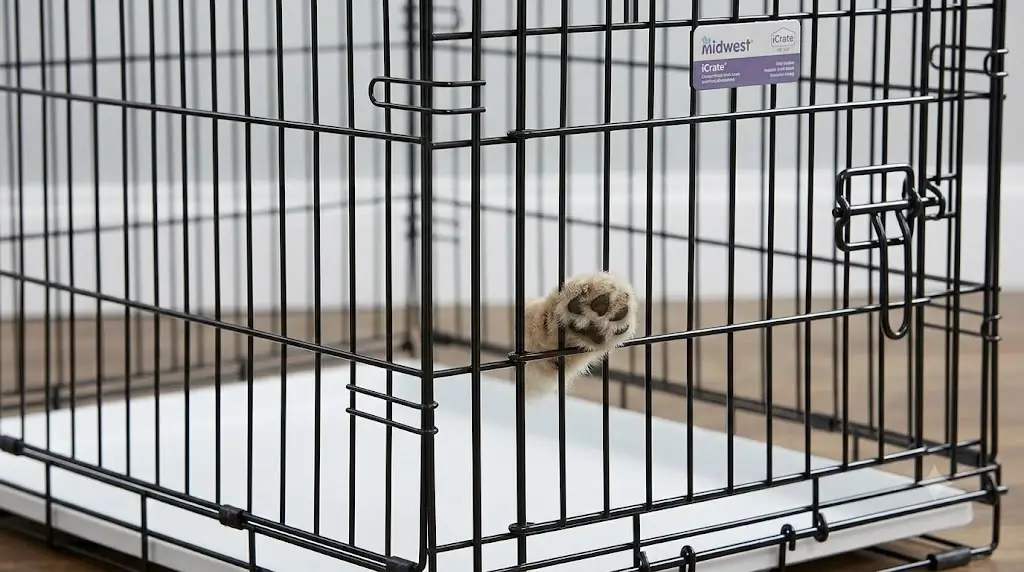
When evaluating the best puppy crates for small dogs, the MidWest iCrate remains the undisputed market leader because its engineering addresses the unique vulnerabilities of toy breeds. It features an electro-coated steel wire framework with bar spacing narrowed to approximately 1.1 inches, preventing toy-breed puppies from forcing their skulls through the wire and suffering cervical entrapment.
MidWest produces this line in compact 18-inch, 22-inch, and 24-inch configurations. The 24-inch model is exceptionally versatile: paired with the included modular divider panel, it ranks among the best puppy crates for small dogs because it serves an 8-week-old, 3-pound puppy seamlessly and expands outward to accommodate a mature 15-to-20-pound adult dog. Dual slide-bolt latches utilize an engineered drop-channel lock that prevents clever terrier muzzles from leveraging the gate open.
For puppy parents mapping out target measurements, follow our exact calculation methods in the Puppy Crate Size Guide.
Why it stands out
- Narrow bar spacing: Calibrated wire spacing stops small heads and slender paws from wedging between bars.
- Modular growth scaling: The factory-matched divider hooks firmly onto horizontal wires, eliminating toilet corners during early housebreaking.
- Unrestricted air exchange: Open grid construction maximizes passive ventilation, preventing overheating in toy breeds prone to hypoglycemia and respiratory sensitivity.
- Slide-out ABS composite pan: Captures liquid accidents with a 1-inch raised lip and slides out effortlessly past a front safety stop for fast sanitation.
Who should buy it
First-time small-dog owners seeking the best puppy crates for small dogs that combine lightweight convenience with lifetime adaptability from early housebreaking through adulthood.
Who should choose something else
Small puppies that suffer severe isolation distress from open visual stimuli, or owners requiring an IATA-compliant vehicle carrier.
Our verdict: The most practical, reliable, and behaviorally sound wire crate for small-breed puppy containment.
2. MidWest LifeStages (24″) — Best for Growing Small-to-Medium Dogs
Best for: French Bulldogs, Boston Terriers, Miniature Schnauzers, and robust terriers that challenge wire gates.
The MidWest LifeStages 24-Inch crate is engineered for small breeds that possess heavy, muscular builds and high jaw power. Built with 7-to-9-gauge structural wire, this model stands out among the best puppy crates for small dogs by delivering superior torsional rigidity compared to standard drawn wire crates, preventing adolescent puppies from torquing the frame when pawing against the perimeter.
Certain small breeds—particularly brachycephalic dogs like French Bulldogs—exert significant forward lunging force. The LifeStages reinforced divider panel features heavy-duty perimeter tabs that resist bowing under direct point loads, ensuring your growing dog cannot displace the partition to soil the rear floor pan.
To protect delicate small-breed joints against hard composite plastic trays while preserving vertical clearance, outfit your crate with a fitted mat from our tested guide to the Best Puppy Crate Mats.
Why the heavy-gauge wire matters
The thicker wire diameter ensures zero frame deflection when a muscular 15-pound adolescent dog throws their weight against the side panels, maintaining perfect latch alignment in the strike plates.
Adjust the divider panel based on physical skeletal markers—moving the panel back as spinal length and standing shoulder height increase—rather than following arbitrary calendar dates.
Our verdict: The definitive heavy-wire crate for dense, powerful small breeds that require extra structural stability.
3. Carlson Secure Double Door — Best Double-Door Crate for Small Dogs
Best for: Urban apartments, tight bedroom alcoves, and dual-point accessibility.
Living in a compact urban home makes crate placement a spatial challenge. The Carlson Secure Double-Door Wire Crate ranks among the best puppy crates for small dogs in apartments by offering two independent gates: a standard narrow front door and a wide lateral side door.
Constructed from all-metal steel with rounded safety corners, this compact model includes an adjustable divider panel engineered to slide smoothly without interfering with either entry mechanism. This configuration allows you to position the crate length-wise flush against a couch or wall while keeping the side gate fully operational.
Furthermore, double doors drastically simplify daily sanitation: opening the wide lateral gate lets you retrieve a soiled blanket or wipe down the composite tray without awkwardly reaching through a narrow front entrance.
Why choose a double-door crate for small spaces?
- Zero-clearance adaptability: Fits narrow hallways or tight corners where a forward-swinging door would obstruct foot traffic.
- Multi-point lock security: Features slide latches on both entry points to prevent door frame flexing or muzzle-leveraged escapes.
- Effortless accident remediation: The broad side opening provides immediate access to spot-clean spills without disturbing the puppy’s resting corner.
Our verdict: An exceptionally practical solution for modern apartments, balancing modular space control with versatile room placement.
4. Petmate Two-Door Top-Load — Best Small Dog Crate for Travel & Privacy
Best for: Anxious small puppies, sensory-sensitive dogs, veterinary visits, and vehicle travel.
The Petmate Two-Door Top-Load Plastic Kennel provides a solid-walled, enclosed polypropylene containment shell that differs fundamentally from wire cages. For owners seeking the best puppy crates for small dogs that experience visual sensory overload, this enclosed environment creates an insulated den that dramatically lowers resting arousal and eliminates frantic whining.
The key engineering advantage is the dual-door design: in addition to the standard steel wire front door, an ergonomic top-loading wire door opens wide. This top door allows owners to lower an anxious small puppy gently inside without struggling against a narrow front opening.
Constructed with durable wing-nut fasteners, a continuous lower basin that contains liquid spills completely, and ventilated side walls, it serves double duty as a safe home sleeping den and an ergonomic travel carrier.
Choose plastic when:
- Sensory modulation: Solid perimeter walls block visual triggers, helping reactive small dogs settle into deep sleep.
- Ergonomic top-loading: Simplifies handling for timid puppies or post-vaccination veterinary visits.
- Total spill containment: The seamless lower shell catches accidental messes completely, preventing urine from leaking onto apartment hardwood floors.
Our verdict: The premier choice for owners prioritizing transport convenience, airline travel standards, and natural visual privacy for anxious small dogs.
5. EliteField 3-Door — Best Portable Soft Crate for Small Dogs
Best for: Fully crate-conditioned small dogs, weekend road trips, hotel stays, and mobile agility events.
The EliteField 3-Door Folding Soft Dog Crate features an internal tubular steel frame covered by durable 600-denier polyester canvas and high-grade hexagonal mesh windows. Available in compact 20-inch and 24-inch sizes, it ranks among the best puppy crates for small dogs on the move because it weighs only a few pounds and collapses into a flat carry bag in seconds.
The trade-off is mechanical vulnerability. Untrained, teething puppies will claw through mesh and chew zippers in minutes if confined in a state of distress. Therefore, soft-sided enclosures should be used strictly as secondary portable containment for small dogs that already settle calmly and do not chew bedding.
If you are exploring all-around enclosures or want to compare compact models against full-sized home setups, inspect our foundational review of the Best Puppy Crates.
Best use cases
- Road trips and hotel stays with reliably crate-trained small dogs.
- Quiet vehicle transport where a lightweight footprint is mandatory.
- Rest stations at training classes for small dogs that settle calmly on cue.
Our verdict: Unbeatable for lightweight portability, but unsafe as a primary potty-training tool for unsupervised, teething small puppies.
What Size Crate Does a Small Dog Need? Biomechanical Sizing Formulas
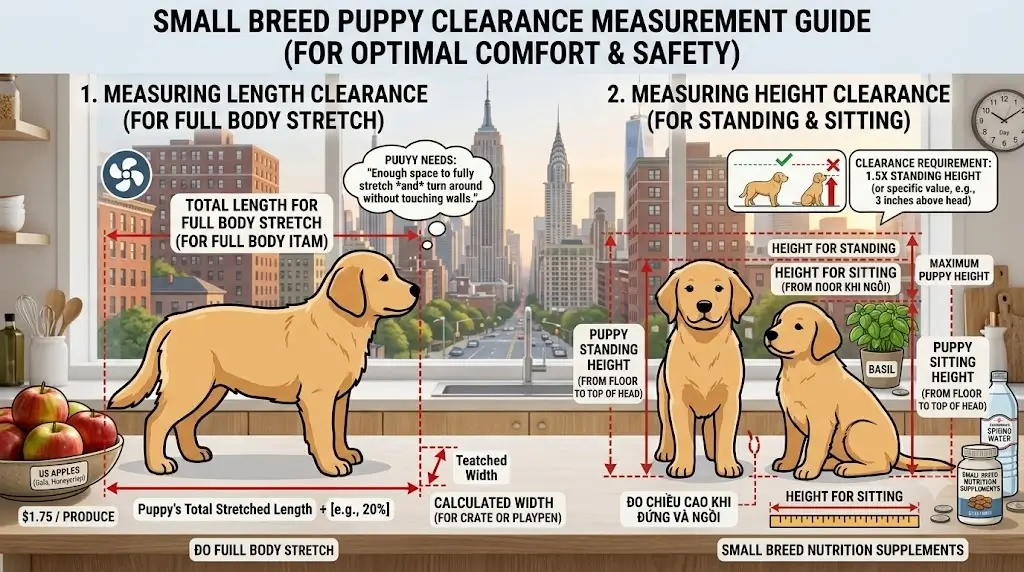
Proper crate sizing is the foundation of successful canine management. Even the best puppy crates for small dogs will fail if the interior dimensions are miscalculated. An enclosure that is too small produces severe orthopedic and psychological distress; an enclosure that is too large undermines natural clean-den instincts and creates an indoor latrine.
Never size a small-breed crate based on weight brackets alone. A 10-pound Miniature Dachshund has an elongated spine requiring length; a 10-pound Boston Terrier has long legs requiring vertical clearance.
Formula 1: Small Dog Crate Length
Longitudinal Frame Length (Nose to Tail Base) + 2 to 3 inches = Minimum Usable Interior Length
*Note: Exclude the tail. Including tail length adds excess space, creating an elimination zone.
Formula 2: Small Dog Crate Height
Maximum Standing Vertical Height (Floor to Crown or Pinna Tip) + 2 to 3 inches = Minimum Usable Interior Height
Small-Breed Crate Sizing Directory
Use this reference guide to match typical small purebreds with recommended nominal sizes among the best puppy crates for small dogs and critical anatomical considerations.
| Breed / Type | Typical Adult Crate Size | Critical Biomechanical Consideration |
|---|---|---|
| Chihuahua | 18–22 inches | Narrow wire spacing (under 1.1″) mandatory to prevent head trapping. |
| Yorkshire Terrier | 18–22 inches | Fine bone structure; low floor pans prevent joint impact on exit. |
| Miniature Dachshund | 24 inches | Spinal length takes priority; needs length to prevent spinal flexion. |
| Pomeranian | 18–22 inches | Heavy double coat requires maximum 360° open-wire cross-ventilation. |
| Shih Tzu / Maltese | 22–24 inches | Verify seated crown clearance to prevent stooping postures. |
| French Bulldog | 24–30 inches | Broad chest requires extra width; brachycephalic airway needs cool airflow. |
| Boston Terrier | 24–30 inches | High seated vertical height requires minimum 20-inch interior height. |
Do Small Puppies Need a Crate With a Divider?
Yes—if you purchase an enclosure sized for your puppy’s adult frame.
If you purchase a 24-inch crate for an 8-week-old, 2.5-pound Chihuahua puppy, the open space is equivalent to a full-sized room. The puppy will naturally sleep near the gate and designate the rear as an indoor toilet.
The best puppy crates for small dogs utilize an adjustable divider panel to let you buy the adult-sized crate once while controlling interior square footage during housebreaking. As your puppy grows, adjust the partition backward along the wire grid.
If you are exploring crates designed specifically around modular partitions, review our tested picks for the Best Puppy Crates With Dividers.
Wire vs. Plastic Crates: Choosing the Best Puppy Crates for Small Dogs
| Operational Factor | Wire Enclosures (e.g., iCrate) | Plastic Shell Kennels (e.g., Two-Door) |
|---|---|---|
| Cross-Flow Air Circulation | Maximum 360-degree open airflow | Moderate; limited to perimeter louvers |
| Visual Stimulation | 100% open; aids family pack integration | Enclosed; calms reactive, anxious pups |
| Divider Modularity | Native, tool-free horizontal hook attachment | Rare; requires fixed-stage sizing |
| Vehicle & Air Travel Safety | Collapsible frame; unsuited for cargo transit | Impact-absorbing shell; airline compliant |
| Spill Retention | Slide-out pan with 1-inch lip | Deep continuous seamless lower basin |
For domestic potty training and growth scalability, wire crates remain the benchmark. For car transit, vet visits, and anxious toy breeds, molded plastic kennels provide specialized protection.
Why Crate Sizing Dictates Small Dog Potty Training Success
Small dogs are notoriously more challenging to housebreak than large breeds. The biological reason is physiological: toy-breed puppies possess tiny bladders and rapid metabolic rates, processing liquids much faster than larger dogs. That is why deploying the best puppy crates for small dogs with appropriate internal volume is essential to avoid regression.
Furthermore, because toy puppies are small, owners frequently miss subtle pre-elimination cues (sniffing, circling) inside oversized crates.
Small Puppy Bladder Limit Formula
Puppy Age in Months = Maximum Safe Daytime Holding Hours (e.g., 2 months = 1.5 to 2 hours max)
Never expect an 8-week-old toy puppy to hold their bladder for 4 or 5 consecutive hours during the day. Forcing them to exceed physiological limits destroys clean-den instincts.
How to Set Up the Best Puppy Crates for Small Dogs
- Verify bar spacing safety: Confirm wire gaps do not exceed 1.25 inches. If a puppy can wedge their muzzle past the eye sockets, the enclosure is hazardous.
- Position the divider panel: Restrict usable interior space to immediate resting dimensions: enough room to stand, turn, sit, and stretch out, with zero unused space behind them.
- Anchor low-profile bedding: Use a fitted, chew-resistant mat. Avoid thick, puffy beds that take up half the internal volume or cause fragile puppy joints to roll.
- Remove collars and harnesses: Remove all buckle collars, harness straps, and tags before crate entry to prevent dangerous wire-snagging incidents.
- Feed meals inside the crate: Establish positive associations by feeding daily kibble inside the open enclosure.
- Transition immediately outside: The second the crate door opens after a nap, carry the puppy directly to the designated potty spot.
7 Dangerous Mistakes When Using Small Dog Crates
1. Buying Based on Weight Labels Alone
Weight ignores long limbs and elongated spines. Always measure actual body length and standing ear clearance with a tape.
2. Choosing Crates With Wide Bar Spacing
Standard crates with 1.5-inch to 2-inch bar spacing create severe head-entrapment and strangulation hazards for toy breeds. Keep spacing under 1.25 inches.
3. Leaving an Adult 24-Inch Crate Unpartitioned
Allowing a tiny puppy full access to a 24-inch crate creates an immediate bathroom corner, sabotaging housebreaking progress.
4. Squeezing Usable Space Too Aggressively
Never position a divider so tight that your puppy cannot lie flat on their side with fully extended limbs during deep sleep cycles.
5. Using Deep, Fluffy Pillows in Small Crates
Bulky bedding robs small crates of essential headspace and makes standing balance difficult for miniature puppies.
6. Trusting Fabric Crates for Teething Puppies
Teething small terriers will shred nylon zippers and swallow synthetic mesh within hours, creating severe intestinal obstruction hazards.
7. Over-Extending Confinement Time
Small puppies possess tiny bladders. Confining a 10-week-old toy breed for 6 hours forces them to soil their bed, destroying natural clean-den instincts.
Best Puppy Crates for Small Dogs FAQ
What is the best overall puppy crate for a small dog?
The MidWest iCrate (22-inch or 24-inch) ranks as the best overall choice among the best puppy crates for small dogs. It delivers narrow bar spacing, dual slide-bolt latches, a slide-out composite pan, and an included divider panel that scales as your puppy grows.
What size crate should I get for a Chihuahua puppy?
An 18-inch to 22-inch crate is ideal for adult Chihuahuas. If you purchase a 24-inch model among the best puppy crates for small dogs, use the included divider panel to restrict floor space during early puppyhood.
Is a 24-inch crate too big for a small-breed puppy?
It is too large for an 8-week-old toy puppy if left unpartitioned. However, when paired with a divider panel, a 24-inch model is one of the most practical, cost-effective options because it lasts from puppyhood through adulthood.
Can wide bar spacing injure a small puppy?
Yes. Bar spacing exceeding 1.25 inches creates severe head-entrapment and strangulation hazards for toy-breed puppies. Always verify bar spacing specifications when selecting the best puppy crates for small dogs.
How many hours can an 8-week-old small puppy stay in a crate?
An 8-week-old small puppy should not be confined for longer than 1.5 to 2 consecutive hours during daytime alert intervals. Their tiny bladder and fast metabolism cannot sustain longer holding periods without distress.
Are plastic kennels better than wire crates for small dogs?
Neither is universally superior. Wire crates provide better airflow and modular divider adjustments for home potty training. Plastic kennels excel for car safety, vet visits, and anxious small dogs that settle faster in an enclosed den.
Final Verdict: Selecting the Best Puppy Crate for Small Dogs
Selecting among the best puppy crates for small dogs requires matching structural hardware to your dog’s anatomical proportions and adult growth projections.
For the vast majority of small breeds, the MidWest iCrate (22″ or 24″) delivers the ultimate balance of narrow bar spacing safety, fluid latch operation, modular divider adjustment, and easy cleanup. If you are raising a dense, muscular small dog like a French Bulldog, choose the heavier-gauge MidWest LifeStages 24-Inch. For compact apartments requiring dual-entry access, the Carlson Secure Double Door is the premier problem-solver, while the Petmate Two-Door Top-Load Kennel remains the gold standard for vehicle travel and vet visits.
Measure your puppy’s skeletal frame accurately, verify narrow bar spacing for safety, install your divider to preserve natural clean-den instincts, and choose from the best puppy crates for small dogs to build positive, reward-rich crate habits from day one.
