
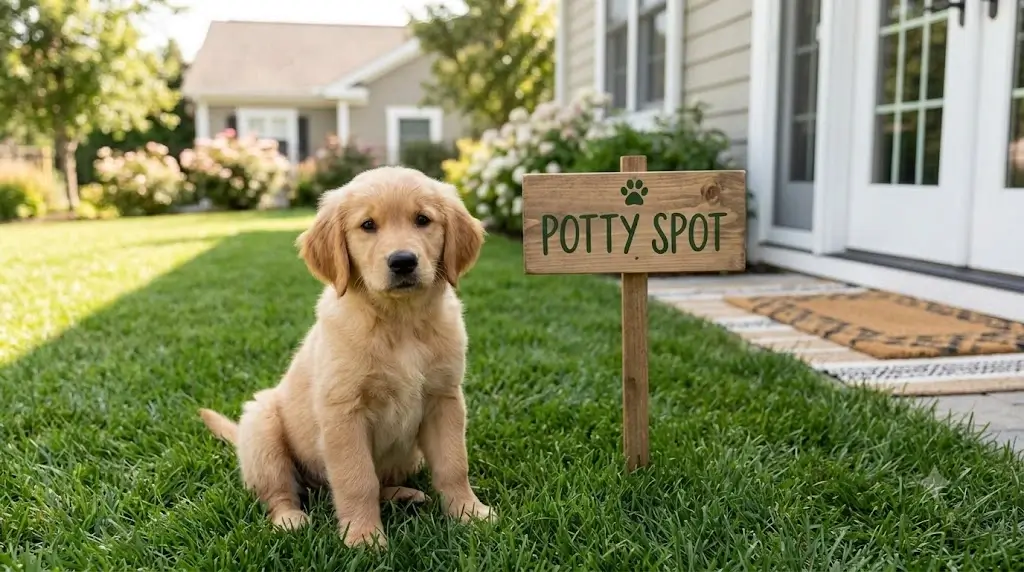
How to Build a Puppy Bathroom Routine
A puppy bathroom routine works best when it is built around predictable daily events rather than a clock alone. Waking, meals, naps, drinking, play, and bedtime can all become useful anchors for deciding when to offer a bathroom opportunity.
Quick Answer: How Do You Build a Puppy Bathroom Routine?
Start by identifying the puppy’s predictable daily events, then attach bathroom opportunities to those events. A useful routine commonly includes trips after waking, after meals, after naps, after active play, and before bedtime, with additional trips when the puppy’s behavior indicates a need. To establish foundational house-training principles from day one, see our guide on how to house train a puppy.
- Choose a consistent bathroom location.
- Record when the puppy normally wakes, eats, drinks, sleeps, and plays.
- Place bathroom opportunities around those events.
- Use the same route, door, cue, and bathroom area when practical.
- Supervise the puppy between planned trips.
- Reinforce appropriate elimination.
- Adjust the routine according to accidents and successful trips.
- Gradually increase flexibility as reliability improves.
The goal is not to create a rigid timetable. The goal is to make bathroom opportunities predictable enough that the puppy has repeated chances to succeed.
What Is a Puppy Bathroom Routine?
A puppy bathroom routine is a repeatable pattern that gives the puppy regular opportunities to eliminate in the appropriate location.
It combines two ideas: planned opportunities and observation.
Planned opportunities prevent the routine from depending entirely on the puppy asking for access. Observation allows the owner to respond when the puppy’s individual behavior does not match the planned timing.
This distinction matters because young puppies are still developing physical control and household habits. A routine should support that development rather than assume the puppy can already manage its needs independently.
Think in anchors, not just hours.“After waking” is often a more useful trigger than a generic statement such as “every two hours,” because the puppy’s daily activities change.
The Daily Events That Should Anchor the Routine
A strong routine follows events that naturally change the puppy’s bathroom needs.
| Daily event | Why it matters | Routine action |
|---|---|---|
| Waking | The puppy has spent time resting and may need a bathroom opportunity. | Make the first stop outside or at the designated bathroom area. |
| Meal | Eating can be followed by predictable digestive activity. | Plan a bathroom opportunity after the meal as appropriate. |
| Drinking | Water intake can affect when the puppy needs to eliminate. | Observe patterns rather than trying to eliminate normal access to water. |
| Nap | The puppy may need to go after waking. | Build a bathroom trip into the wake-up sequence. |
| Active play | Movement and excitement can change bathroom behavior. | Offer a bathroom opportunity after energetic activity. |
| Bedtime | A final bathroom opportunity can make the nighttime routine more predictable. | Use the same sequence before settling for the night. |
A Simple Puppy Bathroom Routine Framework
Instead of copying another puppy’s exact schedule, build the routine around your puppy’s actual day. If you prefer a step-by-step weekly template to get started, you can follow our structured 7-day puppy house training plan.
Basic framework
- Wake up → bathroom opportunity.
- Breakfast → bathroom opportunity afterward.
- Nap → bathroom opportunity after waking.
- Play → bathroom opportunity after active play.
- Lunch → bathroom opportunity afterward when applicable.
- Afternoon nap → bathroom opportunity after waking.
- Dinner → bathroom opportunity afterward.
- Evening play → bathroom opportunity.
- Final bedtime routine → bathroom opportunity.
Additional trips may be needed between these anchors. The exact number depends on the puppy’s developmental stage, individual pattern, activity, food and water intake, and whether accidents are occurring.
How to Build a Morning Puppy Bathroom Routine
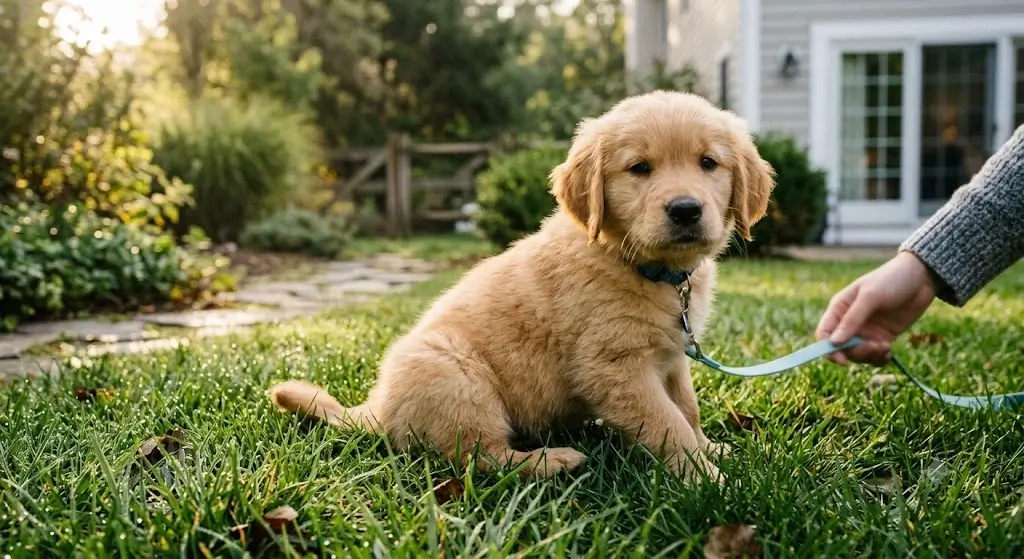
The morning routine should be simple because the puppy may need to eliminate soon after waking.
Wake → bathroom → breakfast → bathroom opportunity → supervised activity
If the puppy is sleeping in a crate or confined area, avoid adding unnecessary delays before the first bathroom opportunity.
Keep the morning route predictable. Using the same door and bathroom area can reduce distractions and make the routine easier for both puppy and owner.
How to Build Bathroom Trips Around Puppy Meals
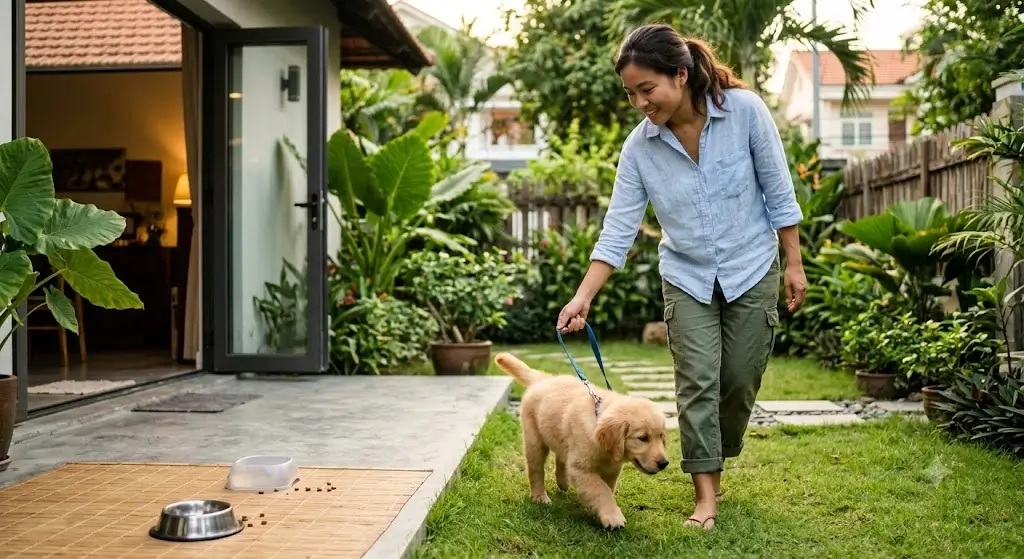
Meals provide useful routine anchors because feeding times can be controlled more easily than many other daily events.
If your puppy eats at consistent times, record what happens afterward. You may notice that elimination tends to occur within a predictable part of the post-meal period.
That observation is more useful than assuming every puppy follows the same interval.
Keep meal timing consistent when practical
A consistent feeding routine can make the rest of the household schedule easier to predict.
Watch the puppy after eating
Do not treat the planned post-meal trip as the only possible bathroom opportunity. Watch for restlessness, searching, circling, sniffing, movement toward the usual bathroom location, or other individual signals.
Build Bathroom Trips Into the Nap Routine
Puppies often sleep several times during the day. That makes naps useful anchors for a bathroom routine.
Wake → bathroom opportunity → water/meal/activity as appropriate → supervised activity → nap
The important part is the transition from sleep to activity. Rather than waiting until the puppy has been awake for a long period, make the bathroom opportunity part of the wake-up routine.
Bathroom Trips After Puppy Play
Active play can change a puppy’s immediate bathroom needs. It also creates a predictable transition point.
For example, a routine can be:
- Short training session.
- Active play.
- Bathroom opportunity.
- Water and calm activity.
- Rest or nap.
This is particularly useful when a puppy becomes excited during play and is less likely to show subtle signals.
How Drinking Affects a Puppy Bathroom Routine
Water intake is another variable that can change the routine.
Puppies should have appropriate access to fresh water. The practical approach is to observe how drinking patterns relate to bathroom needs rather than attempting to control normal hydration simply to make house training easier.
If your puppy drinks substantially more than usual or its elimination pattern changes abruptly, that is different from normal routine variation and may warrant veterinary advice.
Do not restrict normal hydration as a house-training shortcut.A cleaner routine should come from management, supervision, and predictable bathroom opportunities.
How to Build a Puppy Bedtime Bathroom Routine
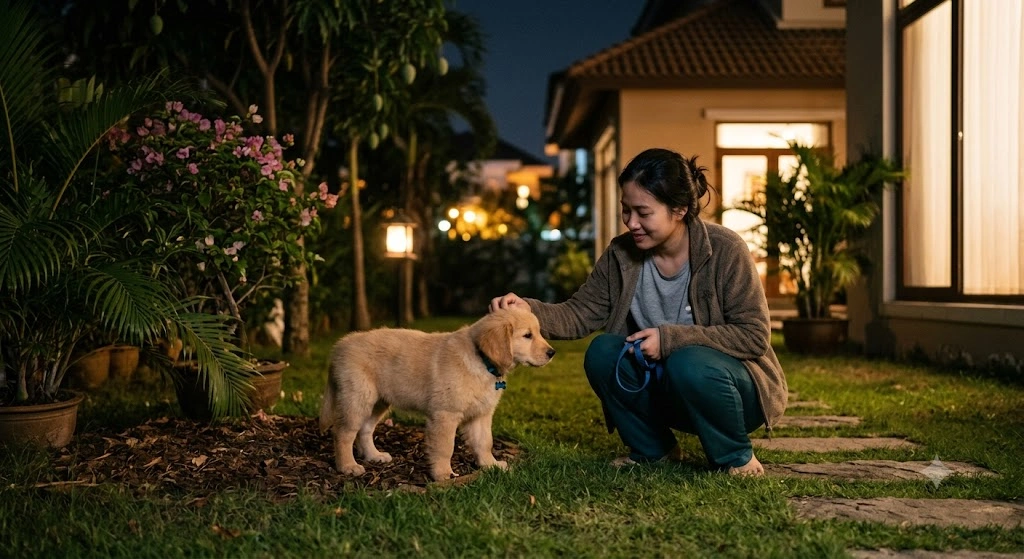
A predictable bedtime sequence helps establish a clear final bathroom opportunity before the puppy settles for the night.
Example sequence
- Calm evening activity.
- Last meal according to the puppy’s feeding plan.
- Quiet time.
- Final bathroom opportunity.
- Return indoors.
- Settle into the sleeping area.
The final trip should not be treated as a guarantee that the puppy can remain dry all night. Young puppies may still need nighttime bathroom opportunities.
Puppy Bathroom Routine for Working Households
A full-time work schedule can make puppy management more complicated, particularly during the earliest stage of house training.
The solution is not to stretch the puppy’s bathroom intervals beyond what it can reasonably manage. Instead, build the household routine around the puppy’s needs.
Before leaving
Give the puppy a bathroom opportunity before departure and avoid treating the morning rush as a reason to skip the normal sequence.
During the workday
Depending on the puppy’s age and needs, arrangements may include a household member, pet sitter, dog walker, or another appropriate care plan.
After returning
Make a bathroom opportunity part of the reunion routine rather than assuming the puppy can wait while you complete household tasks.
Practical rule:Build the workday around realistic puppy care rather than trying to force the puppy into an adult dog’s schedule.
How to Keep the Puppy Bathroom Routine on Weekends
Large changes between weekdays and weekends can make a developing routine harder to predict.
You do not need to wake up at exactly the same minute every day. Instead, preserve the major sequence:
- Wake → bathroom.
- Meal → bathroom opportunity.
- Nap → bathroom.
- Play → bathroom opportunity.
- Bedtime → final bathroom opportunity.
This preserves the behavioral structure even when the household clock changes.
How to Track a Puppy Bathroom Routine
A simple log can reveal patterns that are difficult to remember from day to day.
| Time | Event | Bathroom result | Notes |
|---|---|---|---|
| 7:00 AM | Wake | Outside | Successful |
| 7:20 AM | Breakfast | — | Normal meal |
| 7:45 AM | Post-meal | Outside | Successful |
| 9:30 AM | Nap ended | Outside | Successful |
| 10:15 AM | Play | Accident | Trip may have been needed sooner |
The point of tracking is not to create paperwork. It is to identify repeatable patterns and determine whether the routine needs adjustment.
What to Do When Accidents Happen
Treat an accident as information about the routine rather than simply as a training failure.
Ask:
- How long had the puppy been awake?
- Had it recently eaten or drunk water?
- Had active play just occurred?
- Was the puppy supervised?
- Was the puppy showing a signal that was missed?
- Was the previous bathroom trip successful?
- Has the puppy’s routine recently changed?
If accidents repeatedly occur at the same point in the routine, move the next bathroom opportunity earlier and observe whether the pattern improves.
How to Adjust the Puppy Bathroom Routine
A good routine is not permanent. It should change as the puppy’s behavior and developmental abilities change.
If accidents are increasing
Increase supervision and provide more frequent opportunities for a period of time. Review recent changes in feeding, water intake, sleep, activity, or household routine.
If the puppy is consistently successful
Gradually introduce more flexibility. Change one variable at a time so you can tell whether the puppy remains reliable.
If the puppy starts asking independently
Respond to the signal consistently while maintaining proactive trips when they are still appropriate.
Adjust gradually.The goal is to move from heavy management toward greater independence, not to remove several bathroom opportunities at once.
Adding a Potty Communication Signal to the Routine
Once the basic bathroom routine is predictable, you can teach the puppy a specific way to communicate that it wants access outside.
Options include:
- A bell beside the exit.
- Sitting near the door.
- Touching a target.
- Standing at a designated location.
Before each planned bathroom trip, prompt the signal and then proceed outside. Over time, watch for the puppy to initiate the signal.
How the Routine Changes as a Puppy Gets Older
A puppy’s bathroom routine should become more flexible as reliable habits develop.
| Training stage | Management priority | Routine strategy |
|---|---|---|
| Early house training | Prevent accidents. | Frequent planned opportunities and close supervision. |
| Developing reliability | Recognize patterns. | Use event-based anchors and gradually introduce flexibility. |
| Strong routine | Build independence. | Respond to communication while reducing unnecessary prompts. |
| Established habits | Maintain consistency. | Use the household’s normal daily rhythm with appropriate outdoor access. |
Development does not occur at exactly the same rate for every puppy. Avoid using another dog’s timeline as a rigid benchmark.
Common Puppy Bathroom Routine Mistakes
1. Using the clock as the only rule
A clock-based routine can miss events such as waking, meals, naps, and energetic play.
2. Waiting for the puppy to ask
Communication skills develop alongside physical control. Young puppies still need proactive opportunities.
3. Changing the routine constantly
If feeding, sleeping, outdoor access, and bathroom locations change every day, the puppy receives fewer predictable cues.
4. Giving too much freedom too soon
A puppy that has not yet demonstrated reliable habits may need closer supervision and a smaller managed area.
5. Ignoring successful patterns
If the puppy repeatedly needs to eliminate after a particular event, incorporate that observation into the routine.
6. Treating every accident as disobedience
Accidents can reflect timing, supervision, development, environmental changes, or an underlying health issue. The correct response depends on the pattern.
Puppy Bathroom Routine vs. Puppy Potty Schedule
These terms overlap, but they are useful for different content intents.
| Topic | Main question | This page? |
|---|---|---|
| Puppy bathroom routine | How do I organize bathroom opportunities around the puppy’s daily life? | Yes |
| Puppy house training schedule | What can a structured daily schedule look like? | No — separate page |
| How often should a puppy go outside? | How frequently should a puppy receive outdoor opportunities? | No — separate page |
| How long can a puppy hold its bladder? | What affects bladder holding ability? | No — separate page |
| How to ask to go outside | How does a puppy communicate a bathroom need? | No — separate page |
This distinction prevents the site from publishing several pages that all repeat the same generic “take your puppy outside every X hours” advice.
Key Takeaways
- Build the routine around predictable events, not only clock times.
- Make waking, meals, naps, play, and bedtime useful bathroom anchors.
- Keep the bathroom location and household response consistent.
- Supervise between planned bathroom opportunities.
- Track accidents and successful trips to identify patterns.
- Adjust the routine based on the individual puppy rather than copying another puppy’s exact schedule.
- Do not restrict normal hydration simply to reduce accidents.
- A bathroom routine supports house training; it does not replace developmental bladder control.
- Add a communication signal when the basic routine is established.
- Increase flexibility gradually as reliability improves.
Frequently Asked Questions
How do I build a bathroom routine for a puppy?
Build the routine around predictable events such as waking, meals, naps, play, drinking, and bedtime. Take the puppy to the same bathroom area, use consistent cues, and adjust the routine as the puppy develops.
What should a puppy bathroom routine include?
A practical routine includes planned bathroom trips, a consistent location, predictable triggers, supervision between trips, reinforcement for appropriate elimination, and adjustments based on the puppy’s age and individual needs.
Should I take my puppy outside at the same times every day?
Consistent timing can help, but a good routine should also respond to events such as waking, eating, drinking, naps, and play. A rigid clock-only schedule may miss individual bathroom needs.
Does a puppy bathroom routine replace potty training?
No. A routine is part of house training. It creates predictable opportunities for appropriate elimination while the puppy learns where and when to go.
Should puppies go outside after eating?
Many puppies benefit from a bathroom opportunity after meals, although the exact timing and frequency should be adjusted to the individual puppy and its normal elimination pattern.
What if my puppy has accidents despite following a routine?
Review the interval between trips, supervision, recent changes in meals or water intake, activity level, sleep, and the puppy’s developmental stage. If accidents are sudden, frequent, or accompanied by concerning symptoms, consult a veterinarian.
How should I change the routine as my puppy gets older?
Gradually increase flexibility as the puppy demonstrates reliable elimination habits and better control. Change one part of the routine at a time rather than removing several planned trips at once.
