

How Long Can a Puppy Hold Its Bladder? Realistic Timelines by Age
Puppy bladder control develops with age, maturity, sleep, activity, water intake, and individual differences. Learn realistic expectations by age and how to tell the difference between normal puppy urination and a pattern that needs attention.
Quick Answer: How Long Can Puppies Hold Their Bladder?
There is no single number of hours that applies to every puppy. Young puppies have limited bladder control and generally need frequent opportunities to urinate.
As puppies mature, they gradually become better able to control elimination. However, an age-based formula should be treated as a rough planning reference rather than a guarantee that a puppy can comfortably wait that long. To understand broader developmental expectations, check our complete guide on how long it takes to house train a puppy.
For house training, the safest strategy is to plan bathroom opportunities around age + waking + eating + drinking + play + naps + bedtime rather than testing the puppy’s maximum holding ability.
Puppy Bladder Control by Age
Puppy owners often search for a precise number of hours, but bladder control is developmental rather than purely mathematical.
The following table is best used to understand the general progression, not as permission to make a puppy wait until the maximum possible interval.
| Puppy age | General expectation | Training implication |
|---|---|---|
| 8–10 weeks | Very limited bladder control; frequent bathroom opportunities are needed. | Management and supervision are critical. |
| 10–12 weeks | Control is developing but remains inconsistent. | Use a predictable routine and frequent trips. |
| 3–4 months | Many puppies become more predictable, but accidents remain possible. | Gradually increase successful supervised periods. |
| 4–6 months | Bladder control generally improves as maturity develops. | Continue routine while increasing freedom carefully. |
| 6+ months | Many puppies are substantially more reliable, but individual variation remains. | Evaluate actual reliability rather than age alone. |
Do not turn the table into a holding challenge.The goal of house training is to provide appropriate bathroom access, not to see how long a puppy can physically avoid urinating.
How Long Can an 8-Week-Old Puppy Hold Its Bladder?
An 8-week-old puppy has limited bladder control and should be managed accordingly.
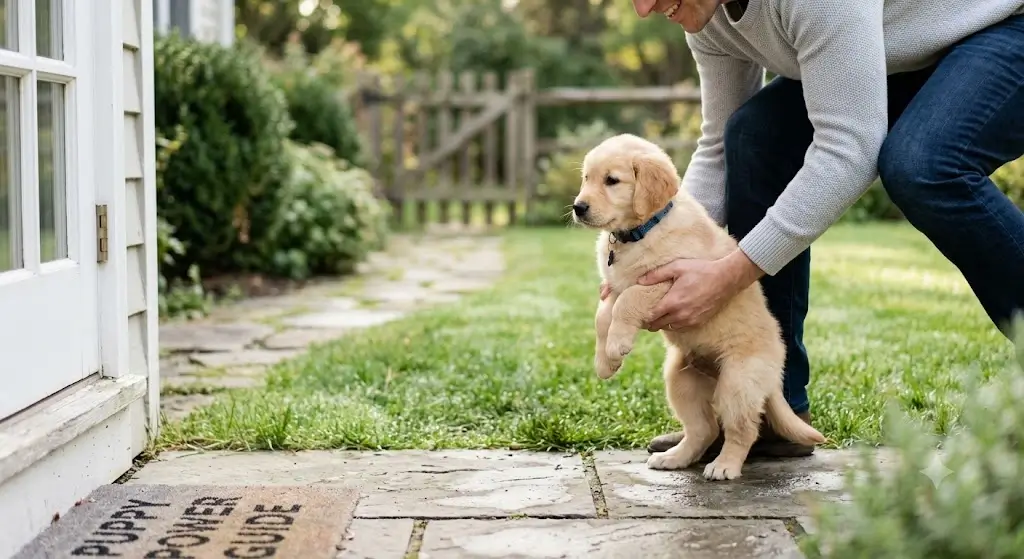
At this age, waiting for the puppy to clearly signal that it needs to go can be too late. Owners should anticipate bathroom needs using predictable events.
Important bathroom triggers include:
- Immediately after waking.
- After eating.
- After drinking.
- After active play.
- After a nap.
- Before bedtime.
- After periods of excitement.
The goal during this stage is not maximum bladder duration. The goal is to create enough successful repetitions that the puppy begins learning where elimination belongs.
How Long Can a 3-Month-Old Puppy Hold Its Bladder?
By around three months, bladder control is usually developing, but individual puppies can differ considerably.
Some puppies may begin showing predictable patterns while others still require frequent bathroom trips.
Instead of assuming a puppy can wait a certain number of hours, monitor what happens after meals, naps, water, exercise, and play.
Practical benchmark:If the puppy consistently succeeds when taken out at predictable times, keep that routine rather than stretching the interval simply because the puppy has reached a particular age.
How Long Can a 4-Month-Old Puppy Hold Its Bladder?
A four-month-old puppy may have noticeably better bladder control than a very young puppy, but it is still developing.
This is often a useful stage for testing longer periods of supervised freedom rather than immediately giving unrestricted access to the house.
If the puppy remains dry and successful, freedom can be expanded gradually. If accidents return, shorten the interval or reduce freedom and rebuild successful repetitions.
How Long Can a 6-Month-Old Puppy Hold Its Bladder?
By six months, many puppies have substantially better bladder control, but there is still no universal maximum interval.
A puppy’s needs can change depending on activity, water consumption, weather, stress, sleep, and health.
A six-month-old puppy that is reliably house trained may be able to wait longer than a younger puppy, but that does not mean owners should routinely push the puppy to its physical limit.
When Does Puppy Bladder Control Become More Reliable?
Bladder control improves progressively rather than switching on at a particular birthday.
As the puppy matures, it generally gains better control and becomes more capable of following a household routine.
House-training reliability also depends on learning. A puppy may have enough physical control to wait but still have an accident because it has not yet learned the correct bathroom location or because it was given too much unsupervised freedom.
Three separate skills are involved:
- Physical control: ability to delay elimination.
- Awareness: recognizing the need to eliminate.
- Training: knowing where elimination is appropriate.
These skills develop together but are not identical.
Does the “Age in Months + 1” Rule Work?
Puppy owners commonly encounter the idea that a puppy can hold its bladder for approximately its age in months plus one hour.
This can be useful as a rough conversational estimate, but it should not be treated as a scientifically precise bladder-capacity formula or a guaranteed safe interval for every puppy.
Real bathroom needs are affected by:
- Age.
- Development.
- Body size.
- Water consumption.
- Food intake.
- Exercise.
- Sleep.
- Temperature and environment.
- Stress and excitement.
- Individual health.
Therefore, the formula should never replace observation and a puppy-specific routine.
When Do Puppies Usually Need to Pee?
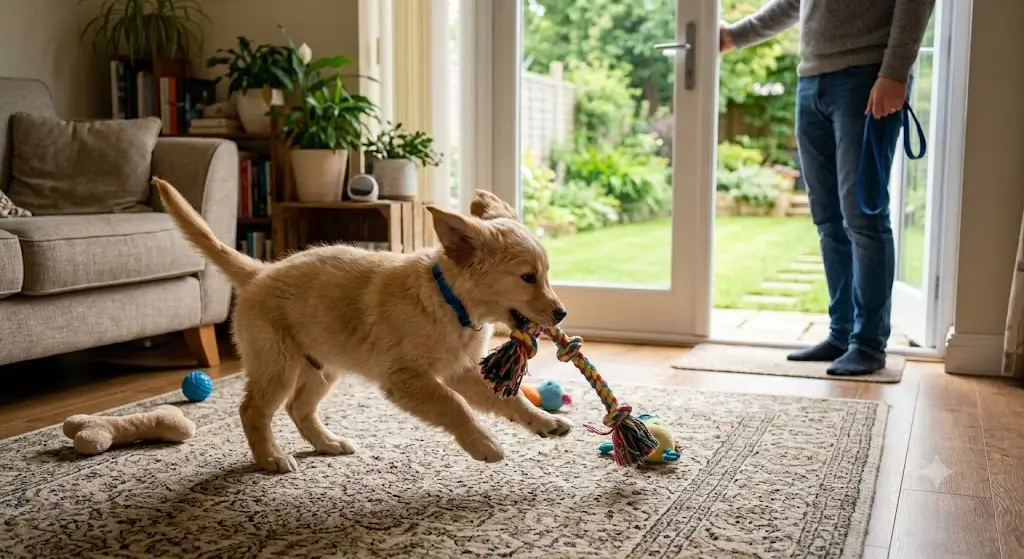
Bathroom needs are often easier to predict when owners watch events rather than the clock alone.
| Trigger | Why it matters | Training response |
|---|---|---|
| Waking up | Sleep changes the puppy’s activity and elimination pattern. | Offer a bathroom opportunity promptly. |
| Eating | Meals can stimulate gastrointestinal activity and alter bathroom timing. | Build post-meal trips into the routine. |
| Drinking | Additional fluid can increase urine production. | Watch for increased bathroom needs. |
| Playing | Activity can increase the likelihood of an accident. | Offer a bathroom break after active play. |
| Napping | A puppy may need to eliminate after waking. | Use waking as a predictable trigger. |
| Excitement | Visitors and stimulation can disrupt normal patterns. | Increase supervision during high-excitement events. |
How Long Can a Puppy Hold Its Bladder at Night?
Puppies can sometimes wait longer while sleeping than when awake because they are inactive, but young puppies may still need nighttime bathroom trips.
Nighttime bladder control depends on age, maturity, bedtime routine, water intake, individual development, and whether the puppy has already demonstrated reliable overnight control.
Signs the nighttime routine may need adjustment
- Repeated overnight accidents.
- Consistent waking and crying around the same time.
- Restlessness before an accident.
- A sudden change from previously successful nights.
The objective is to respond to the puppy’s developmental needs rather than expecting a very young puppy to follow an adult dog’s nighttime schedule.
Nighttime rule:If a young puppy repeatedly cannot remain dry overnight, adjust the routine rather than assuming the puppy is being difficult.
Does Puppy Size Affect How Long It Can Hold Its Bladder?
Body size can influence bladder capacity, but size is only one variable.
Two puppies of the same age and similar size may still have different bathroom patterns because of differences in development, activity, drinking, sleep, training history, and health.
For this reason, breed-specific or weight-based charts should be used as context rather than absolute rules.
What matters more than breed alone?
- The puppy’s actual elimination pattern.
- Whether accidents are becoming less frequent.
- How the puppy behaves before needing to urinate.
- How much and how often the puppy drinks.
- Whether there has been a sudden change.
How Water Intake Changes Puppy Bathroom Needs
A puppy that drinks more will generally need to urinate more often.
Increased water consumption can occur after exercise, during warm weather, after eating dry food, or simply because the puppy is thirsty.
Owners should not deliberately restrict normal access to water simply to reduce accidents. Water needs are part of normal health and development.
Do not use water restriction as a house-training shortcut.If a puppy’s drinking pattern appears unusually high or changes suddenly, discuss it with a veterinarian.
Why Play and Excitement Can Increase Bathroom Needs
Puppies often have more accidents during active periods than during quiet periods.
Running, wrestling, training, meeting visitors, and exploring a new environment can all change the normal rhythm of the day.
This is why a puppy that successfully remains dry during a quiet nap may still need a bathroom opportunity shortly after a high-energy play session.
High-risk situations include:
- New visitors arriving.
- Long play sessions.
- Training sessions.
- Trips to unfamiliar places.
- Coming out of confinement.
- Excited greetings.
Bladder Control Is Not the Same as House Training
This distinction is important because a puppy can physically hold urine for a reasonable period and still have an indoor accident.
House training teaches the puppy where elimination should happen and builds a predictable relationship between bodily signals, the household routine, and the designated bathroom location. Learn how to set up foundational habits in our guide on how to house train a puppy.
Why Is My Puppy Peeing So Often?
Frequent urination can be completely expected in young puppies because their bladder control is still developing.
It can also happen after increased drinking, meals, naps, play, or periods of excitement.
The pattern matters more than one isolated event.
Normal training-related explanations can include:
- The puppy is very young.
- The puppy just woke up.
- The puppy drank more than usual.
- The puppy has been highly active.
- The puppy is still learning the household routine.
- The bathroom interval was too long for that puppy.
If urination suddenly becomes much more frequent than usual or occurs alongside other symptoms, move beyond training explanations and seek veterinary guidance.
When Frequent Urination Needs Veterinary Attention
House training should not be used as an explanation for every urinary problem.
Contact a veterinarian if you notice a sudden or persistent change, particularly when frequent urination occurs with other concerning signs.
Potential red flags include:
- Straining or apparent difficulty urinating.
- Signs of pain while urinating.
- Blood in the urine.
- Sudden major changes in drinking.
- Marked lethargy.
- Vomiting or significant illness.
- A sudden change after previously reliable house training.
A veterinarian can determine whether the pattern is related to normal puppy development or requires medical evaluation.
What Should You Do If Your Puppy Cannot Hold It Long Enough?
Do not respond by forcing the puppy to wait longer.

Instead, shorten the interval between bathroom opportunities and use predictable triggers to anticipate when the puppy is likely to need to eliminate. If you need a structured daily routine to rebuild success, follow our 7-day puppy house training plan.
- Review the puppy’s age and normal routine.
- Identify when accidents usually happen.
- Add bathroom opportunities before those high-risk moments.
- Supervise indoor freedom more closely.
- Reward successful elimination.
- Track whether accidents decrease over several days.
This converts accidents into useful training information rather than treating them as disobedience.
Simple Puppy Bladder-Control Tracking Method
A small log can reveal patterns quickly.
| Time | Event | Bathroom result | Notes |
|---|---|---|---|
| 7:00 AM | Woke up | Outside | Successful |
| 7:30 AM | Breakfast | — | Monitor |
| 8:00 AM | Play | Outside | Successful |
| 9:30 AM | Nap ended | Accident | Interval was too long |
The value of this log is not the exact times themselves. It helps reveal where the routine is failing so you can adjust it.
Key Takeaways
- Young puppies have limited bladder control and need frequent bathroom opportunities.
- There is no single maximum number of hours that applies to every puppy.
- Age-based formulas are rough planning tools, not guarantees.
- Waking, eating, drinking, playing, and excitement are important bathroom triggers.
- Sleeping can allow a puppy to wait longer than during active periods, but young puppies may still need nighttime trips.
- Physical bladder control and house-training knowledge are separate skills.
- Do not deliberately force a puppy to hold urine for excessive periods.
- Sudden or unusual urinary changes should be discussed with a veterinarian.
Frequently Asked Questions
How long can a puppy hold its bladder?
A puppy’s bladder control varies with age, development, size, activity, water intake, sleep, and individual differences. Young puppies generally need much more frequent bathroom opportunities than adult dogs.
How long can an 8-week-old puppy hold its bladder?
An 8-week-old puppy has limited bladder control and should not be expected to consistently wait for long periods. Frequent, age-appropriate bathroom opportunities are more realistic than relying on a strict maximum-hour rule.
How long can a 3-month-old puppy hold its bladder?
A 3-month-old puppy typically has better control than a very young puppy, but bathroom needs still vary. Schedule trips around waking, meals, drinking, play, naps, and bedtime rather than relying only on an age-based formula.
How long can a puppy hold its pee overnight?
Some puppies can wait longer during sleep than when awake, but young puppies may still need nighttime bathroom trips. Overnight expectations depend on age, development, routine, water intake, and individual puppy needs.
Should I wake my puppy up to pee at night?
Whether a puppy needs a nighttime bathroom trip depends on age, previous accidents, bedtime routine, and individual needs. Very young puppies may not yet be able to remain comfortable throughout the night.
Does puppy size affect bladder control?
Size can influence bladder capacity, but size alone does not determine how long a puppy can comfortably wait. Age, development, health, water intake, activity, and individual variation also matter.
Why is my puppy peeing so often?
Frequent urination can be normal in young puppies, particularly after waking, eating, drinking, or playing. A sudden or unusual increase in urination, especially with other symptoms, should be discussed with a veterinarian.
Can I make my puppy hold its bladder longer?
Bladder control develops with age and maturity. Owners should not deliberately force a puppy to hold urine for excessive periods. A predictable routine and gradual development are better approaches.
