
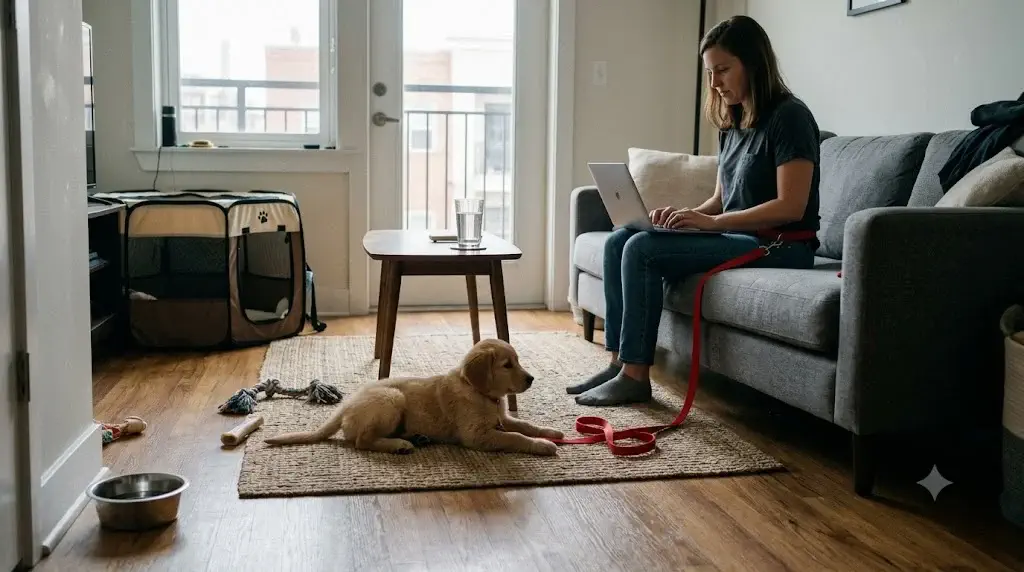
AKC & VCA URBAN UROLOGY PROTOCOLS 2026
Puppy Training Program for Apartment Living
An effective puppy training program for apartment living synchronizes pediatric canine fluid transit rates with vertical transit delays to eliminate indoor floor soiling. Multi-story residential living introduces unique friction points—such as elevator wait times, communal carpeted hallways, and acoustic triggers—that multiply elimination urgency compared to suburban ground-floor homes. Successfully executing a puppy training program for apartment living requires subtracting structural building transit delays from biological holding limits, staging entryway gear, and implementing umbilical supervision to maintain pristine domestic cleanliness.
Quick answer: how do you potty train a puppy in an apartment?
Apartment puppy training requires subtracting a 3-to-5-minute vertical transit buffer from standard age-based holding thresholds, taking puppies outside every 45 to 60 minutes while awake, and staging all leash gear directly at the doorway.
Rather than waiting for emergency doorway pacing, carry young puppies through shared hallways and elevators to suppress the physical squatting reflex, escort them directly to designated natural turf, reward within three seconds of completed voiding, and maintain umbilical tethering indoors between trips.
Quick Reference Specification: Apartment Canine Management Matrix
This calibrated physiological matrix benchmarks residential developmental brackets, vertical transit friction points, tactical urban interventions, holding dwell calculations, and veterinary standards in 2026.
| Developmental Phase | Vertical Transit Friction Point | Tactical Urban Intervention | Calculated Transit Buffer | Safety Benchmark |
|---|---|---|---|---|
| 8–10 Weeks Old | Minimal sphincter retention; sudden reflex squatting in carpeted halls | Physically carry pup from crate to street turf; breaks every 45–60 mins | Subtract 5 mins from holding limit | VCA Pediatric Hospital Protocol |
| 10–12 Weeks Old | Elevator stop stalls; hallway scent investigation triggers urination | Stage slip-on shoes & leash at door; direct eye-contact focal heel | Subtract 4 mins from holding limit | AKC Urban Canine Good Citizen Standard |
| 3–4 Months Old | Excitement urination when greeting neighbors in elevator cabs | Enforce 4-on-the-floor sit in cab corner; high-value luring past lobby | Subtract 3 mins from holding limit | AAHA Canine Life Stage Guideline |
| 4–6 Months Old | Acoustic corridor barking & boundary anxiety causing holding relapse | White noise sound masking; scheduled breaks every 3–4 hours | Subtract 2 mins from holding limit | AVMA Juvenile Urology Matrix |
| 6+ Months (Adult) | Mature voluntary retention; door signaling communication delays | Conditioned smart bell or chime signaling; 4 daily maintenance walks | Standard transit time | PuppyPottyGuide Master Protocol |
Apartment training verdict
Apartment housebreaking succeeds when owners account for the physical travel latency between initial physiological urgency and the moment paws hit outdoor grass.
Priorities
- Fast access to the exit doorway
- Predictable circadian potty timing
- Close indoor umbilical supervision
- Calm elevator and hallway behavior
- Gradual expansion of domestic freedom
Why Puppy Training Is Different in an Apartment
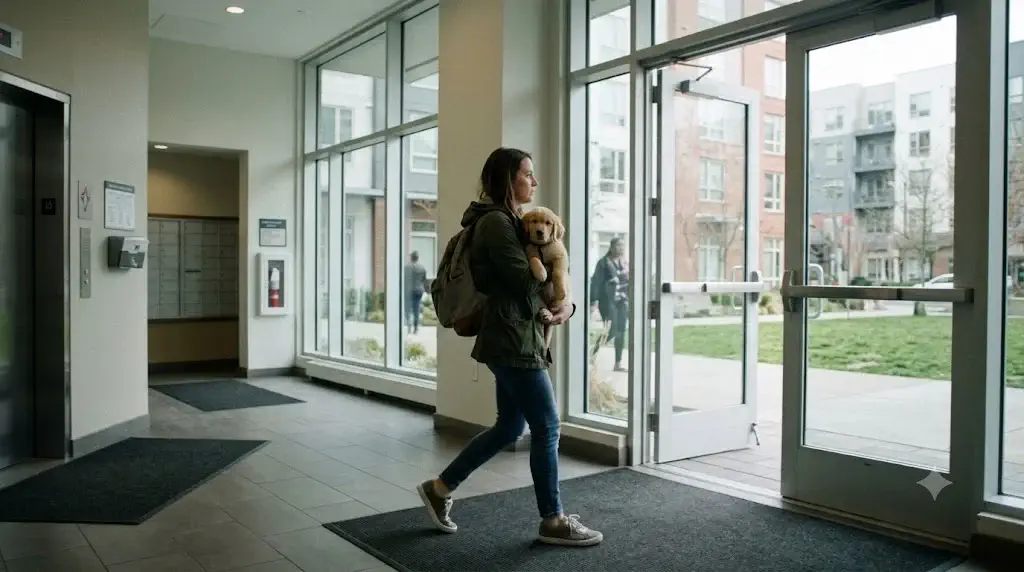
Vertical residential architecture introduces physical travel latency that directly challenges juvenile canine urological retention. In a suburban home, a handler can open a sliding back door to reach grass within five seconds; in a high-rise apartment, navigating doorways, elevators, and lobbies creates unavoidable holding stress for immature bladders.
Urban apartment training must accommodate four distinct operational obstacles:
Extended Distance to Grass
The designated outdoor relief area is frequently hundreds of feet away, requiring structured transit through carpeted shared zones.
Unpredictable Elevator Latency
Waiting for elevator cabs adds two to five minutes of stationary dwell time during peak urinary urgency.
High Sensory Corridor Friction
Shared hallways introduce olfactory triggers from other pets, vocalizations, slam doors, and unexpected neighbor interactions.
Zero Autonomous Access
A puppy cannot access an outdoor yard independently; the human handler controls 100% of bathroom opportunities.
The small-space supervision advantage:
Compact apartment footprints make visual monitoring straightforward. Keeping your puppy within your direct sightline prevents the unmonitored wandering that causes suburban carpet accidents.
For foundational 24-hour routine frameworks, consult our comprehensive Puppy House Training Schedule.
The Puppy Training Program for Apartment Living
A comprehensive urban training architecture integrates five operational sub-systems to ensure domestic cleanliness and public hallway manners. Treating housebreaking as an integrated process prevents management breakdowns:
- Proactive Potty Timing: Intercept physiological elimination urges before motor urgency peaks.
- Rapid Entryway Staging: Eliminate gear hunting by staging walking equipment directly beside the exit door.
- Umbilical Indoor Confinement: Prevent unsupervised roaming using tethering lines and appropriately sized crates.
- Shared Space Building Manners: Condition calm, non-reactive behavior in elevators, stairwells, and lobbies.
- Gradual Freedom Progression: Expand indoor room boundaries only after demonstrated cleanliness milestones.
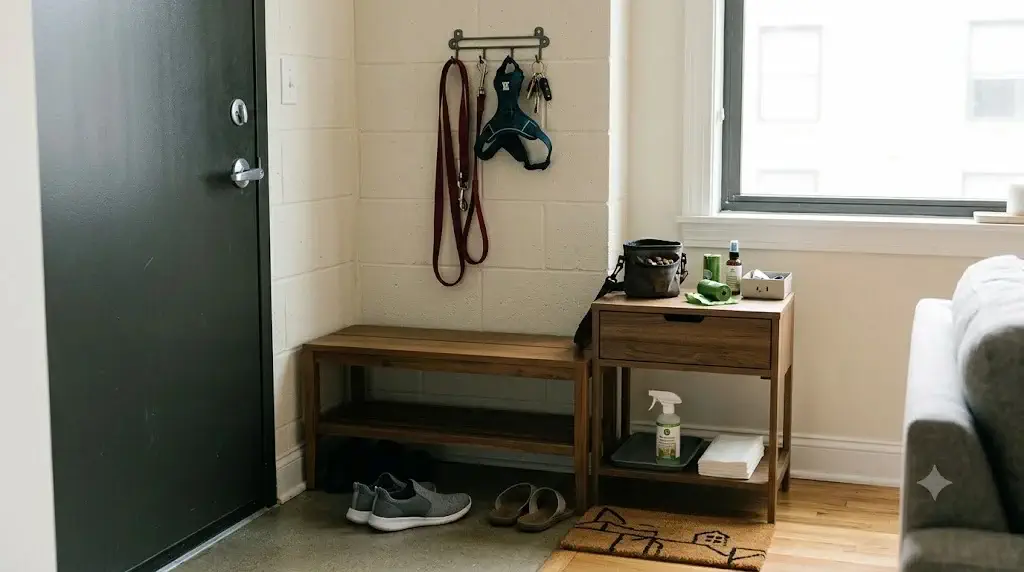
Step 1: Create a Potty Station Near the Exit
Staging walking supplies directly beside the doorway eliminates transit delays that lead to threshold accidents. Searching for a leash, shoes, or waste bags while a young puppy shows pre-potty restlessness costs valuable minutes that immature sphincters cannot afford.
- Standard 6-foot fixed nylon leash hanging on an entryway hook.
- Pre-adjusted Y-harness or flat collar staged beside the door.
- Refillable roll of biodegradable waste bags.
- Slip-on footwear and weather apparel ready for immediate departure.
- Treat pouch loaded with moist, pea-sized, high-value rewards.
- Bio-enzymatic cleaner and paper towels for cleaning accidental hallway drops.
Why seconds matter in high-rises:
A two-minute delay spent hunting for keys or slip-on shoes transforms a manageable elimination urge into an accidental puddle right on your entryway mat.
Sample Daily Puppy Training Schedule for Apartment Living
A structured apartment schedule synchronizes feeding, sleeping, and vertical elevator transits into predictable intervals. Use this standardized operational routine to guide your puppy through a typical residential high-rise day:
| Time / Household Event | Training & Potty Action | Apartment Management Priority |
|---|---|---|
| 6:30 AM — Morning Wake-Up | Carry pup directly to elevator; outdoor relief on turf. | Exit unit within 60 seconds to prevent overnight overflow. |
| 7:15 AM — Breakfast Feeding | Serve measured meal; escort outside 20 minutes later. | Capture the gastrocolic reflex that stimulates bowel motility. |
| 8:30 AM — Morning Crate Nap | Place in properly sized crate with chew enrichment. | Play white noise to mask corridor foot traffic and door sounds. |
| 10:30 AM — Post-Nap Wake-Up | Immediate leash escort to ground level relief area. | Stage slip-on shoes before releasing the puppy from the crate. |
| 12:30 PM — Midday Lunch & Walk | Feed lunch, provide relief break, and allow gentle walking. | Practice calm sitting in elevator cabs alongside neighbors. |
| 2:00 PM — Afternoon Crate Nap | Rest period in quiet, shaded living room corner. | Enforce den confinement to build daytime bladder holding tone. |
| 4:00 PM — Post-Nap Potty Trip | Direct trip to outdoor grass; verified urination. | Subtract elevator wait time; head out promptly. |
| 5:30 PM — Dinner Feeding | Evening meal, followed by outdoor trip at 5:50 PM. | Confirm completed stool elimination on natural turf. |
| 7:30 PM — Supervised Family Play | Play on leash; interrupt after 25 mins for quick relief. | Prevent unmonitored wandering behind sofas or under dining sets. |
| 10:30 PM — Final Bedtime Trip | Late-night outdoor elimination; quiet return to crate. | Keep outing strictly business; zero energetic games. |
For age-based daytime holding calculations, consult our guide on the Puppy Bathroom Schedule During the Day.
How to Potty Train a Puppy in an Apartment
Conditioning an outdoor substrate preference in multi-unit buildings requires proactive intervention before bladder pressure peaks. Unlike backyard homes where outdoor access is immediate, apartment housebreaking demands strict adherence to four operational tenets:
1. Depart before urgency peaks
Initiate departures well before your puppy displays urgent sniffing or pacing. Waiting until pre-potty restlessness occurs guarantees an accident inside the elevator or hallway.
2. Maintain one consistent outdoor relief zone
Escort your puppy to the exact same plot of outdoor turf every single trip. Scent familiarity triggers instinctual elimination reflexes much faster than exploring varied urban sidewalks.
3. Keep outdoor relief trips purposeful
Stand stationary on a 6-foot lead like a tree for three to five minutes. Do not walk down urban city blocks for playtime until the puppy completes their elimination business.
4. Deliver reinforcement within three seconds
Reward your puppy at ground level on the grass immediately as elimination finishes. Delaying rewards until returning to the apartment unit reinforces entering the lobby, not outdoor voiding.
Elevator and Hallway Training for Apartment Puppies
Shared residential corridors require systematic impulse control conditioning to prevent excitement-induced accidents. Young puppies frequently confuse carpeted hallways with indoor elimination zones or release urine involuntarily when encountering neighbors in elevator cabs:
Doorway Threshold Manners
Require a calm sit before opening the apartment door. Frantic charging through doorways elevates physiological arousal and accelerates bladder contractions.
Hallway Focal Heeling
Maintain steady forward momentum on a short lead, luring with a treat past neighbor doors, doormats, and trash chutes without stopping to sniff carpet seams.
Elevator Cab Positioning
Position the puppy in the rear corner of the elevator cab, placing your body between the dog and entering passengers to prevent overstimulation.
Lobby Transit Focus
Move briskly through the main lobby directly to the building exit without pausing for casual greetings until post-potty success is secured outside.
Separate building manners from emergency trips:
Conduct short 5-minute training sessions in empty hallways when your puppy has an empty bladder. Do not attempt complex heel lessons when your dog is urgently trying to hold urine.
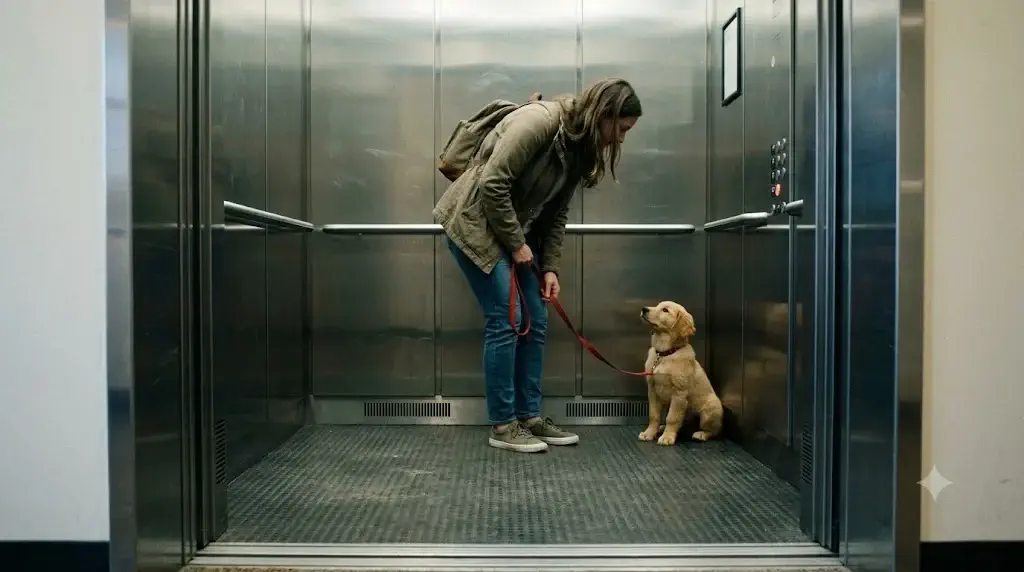
The “Elevator Buffer” Rule
A realistic transit buffer accounts for vertical travel latency before calculating baseline bathroom intervals. A puppy’s developmental holding threshold represents maximum sedentary capacity; the time required to walk to the elevator, ride down, and cross the lobby must be subtracted from that window:
| Transit Phase | Estimated Latency | Tactical Handling Adjustment |
|---|---|---|
| Unit Doorway Preparation | 30–60 seconds | Keep slip-on shoes on and leash attached before uncrating. |
| Hallway Corridor Transit | 45–90 seconds | Physically carry pups under 12 weeks to block the squat reflex. |
| Elevator Call & Descent | 60–180 seconds | Stand in rear corner; deliver tiny treats to encourage quiet focus. |
| Lobby to Street Turf | 45–60 seconds | Walk briskly past lobby seating without greeting strangers. |
| Total Subtracted Buffer | 3 to 6 minutes | Begin trip 5 minutes before scheduled target threshold. |
Using a Crate and Small-Space Management
Crate management leverages a canine’s instinctual den cleanliness to prevent unsupervised floor mistakes in small spaces. A crate functions not as punishment or isolation, but as a management tool to structure the day into clean, predictable cycles:
Effective Urban Management
- Crate sized with divider so pup can only stand, turn, and lie down.
- Umbilical leash attached to handler’s belt during awake periods.
- Bathroom trips scheduled proactively around naps and meals.
- Indoor room access expanded slowly, room by room.
Flawed Management Practices
- Using oversized crates that allow soiling one end and sleeping clean.
- Leaving puppies in crates beyond physiological endurance.
- Granting off-leash access to living room carpets before voiding.
- Punishing accidents caused by delayed transit management.
How to Prevent Puppy Accidents in an Apartment
Strict environmental management eliminates the unmonitored blind spots where indoor accidents take root. Apartment layouts concentrate carpeting and rug corners in tight quarters; preventing repeat mistakes requires proactive oversight:
1. Keep the puppy within continuous line of sight
Utilize umbilical leash tethering to connect the puppy’s 6-foot lead to your belt loop while working or relaxing. If the puppy begins circling or sniffing, you will detect the motion immediately.
2. Block access to hidden rooms and low-visibility areas
Close bedroom doors and erect sturdy freestanding playpens to block off spaces behind sofas or under dining tables. Puppies seek quiet corners away from the den center when urgency strikes.
3. Decontaminate accidents with bio-enzymatic formulas
Standard dish soap and ammonia-based sprays leave behind microscopic uric acid crystals that signal the puppy to re-soil the spot. Soak accidents in an enzymatic cleaner to break down organic proteins completely.
For proven behavioral protocols to eliminate repeat indoor accidents, review our guide on How to Prevent Repeat Puppy Accidents.
What to Do When the Elevator Is Taking Too Long
Alternative transit routing prevents prolonged stationary waits from turning into sudden hallway accidents. Mechanical elevator delays, move-in holds, and maintenance calls happen regularly in high-rises; handlers need backup protocols:
- Start the trip earlier: Head out when your timer hits 50 minutes rather than waiting until the 60-minute mark.
- Keep walking supplies staged: Have slip-on shoes, coat, and leash ready at the door so departures happen instantly.
- Use stairwells for lower floors: If living on floors two through four, walk down the stairs (carrying puppies under 14 weeks) to bypass elevator waits.
- Keep the puppy in your arms: Physically carrying a young puppy suppresses the physical squatting reflex during long elevator waits.
- Maintain focus with food lures: Keep a high-value treat touching the puppy’s nose to occupy their attention and reduce pressure during extended cab rides.
Barking, Whining, and Neighbor-Friendly Puppy Training
Acoustic management in close-quarters multi-family living protects neighbor relationships and prevents stress-induced barking. High-density buildings feature shared walls, footsteps, and slamming doors that can startle young puppies and trigger reactive barking:
Deploy White Noise Masking
Position a white noise machine or box fan between your puppy’s crate and the apartment entrance to buffer corridor footsteps and elevator chimes.
Reward Quiet Behavior Proactively
Deliver treats when your puppy rests quietly in their crate or pen. Interacting only when the puppy barks inadvertently rewards vocal protests.
Desensitize Common Corridor Sounds
Pair corridor noises—such as door latches, elevator bells, and footsteps—with small treats while playing calmly indoors to build positive associations.
Protect Daily Rest Intervals
Puppies require 16 to 18 hours of daily sleep. Overtired puppies vocalize more frequently and struggle with impulse control in shared hallways.
Apartment Puppy Training During Work Hours
Professional workplace absences require midday support to respect pediatric canine holding limits. Expecting a puppy under four months old to remain in an apartment crate for eight hours inevitably causes crate soiling, eroding their natural instinct to keep their bed clean:
Reliable Management Solutions
- Hire a vetted professional dog walker for midday outdoor breaks.
- Stagger work shifts among household members to provide relief trips.
- Utilize an exercise pen connected to a real-grass porch potty box.
- Arrange daytime puppy daycare once vaccinations are completed.
Common Management Pitfalls
- Assuming an 8-week-old puppy can hold urine for an entire 8-hour workday.
- Confining the puppy to an open crate where accidents soil bedding.
- Leaving puppies free to roam carpeted living spaces unassisted.
- Withholding daytime drinking water to prevent midday urination.
Should You Use Pee Pads in an Apartment?
Indoor elimination pads introduce competing substrate preferences that can complicate outdoor training. Disposable fleece pads share similar textures with area rugs, bath mats, and carpets, which can lead puppies to confuse decorative floor coverings with bathroom targets:
| Long-Term Goal | Substrate Recommendation | Key Training Considerations |
|---|---|---|
| 100% Outdoor Elimination | Natural outdoor turf only; avoid pads completely. | Conditions an exclusive preference for grass; eliminates indoor surface confusion. |
| Balcony Real-Grass Turf Box | Hydroponic real-grass patch on balcony. | Preserves the correct grass scent and texture while bypassing elevator delays. |
| Dual Indoor/Outdoor Training | Dedicated gridded pad holder in exercise pen. | Requires strict consistency; expect a longer timeline to achieve 100% outdoor reliability. |
How to Increase Your Puppy’s Freedom in an Apartment
A systematic freedom progression links expanded room access to demonstrated cleanliness milestones. Granting full apartment freedom after a few clean days is the most common cause of urban training regressions:
| Freedom Level | Allowed Living Space | Required Reliability Milestone |
|---|---|---|
| Stage 1 (Den Setup) | Crate and 4×4 exercise pen only. | Baseline entry stage; 100% tethered supervision when unconfined. |
| Stage 2 (Single-Room Leash) | Single gated room with drag-line lead attached. | 7 consecutive accident-free days under current routine. |
| Stage 3 (Supervised Main Living) | Full living and dining area with closed bedrooms. | 14 consecutive clean days; puppy eliminates within 90s outside. |
| Stage 4 (Full Apartment Freedom) | Unrestricted access across all apartment rooms. | 30 consecutive clean days; reliable signaling at exit door. |
Apartment Puppy Training After Meals
Post-prandial gastrocolic reflexes provide reliable physiological timing cues for scheduling outdoor trips. When food reaches the stomach, it initiates contractions in the lower digestive tract within 15 to 25 minutes, creating a predictable window for outdoor bowel movements.
Establish a consistent meal routine: present measured kibble for 15 minutes, lift any uneaten food, and escort the puppy to the elevator exactly 20 minutes post-bowl. Leaving food out all day creates erratic digestion and makes bathroom timing impossible to forecast.
Apartment Training at Night
Streamlined nighttime departures ensure late-night bathroom breaks remain quiet and purposeful. Heading outside at 2:00 AM requires an efficient, low-stimulation approach so your puppy returns to sleep promptly:
- Keep slip-on shoes, coat, and leash sitting right by your bedside or entryway.
- Keep lights dimmed in the hallway and speak in low, quiet tones.
- Carry young puppies straight through the corridors and elevator cabs.
- Walk straight to your designated grass patch without engaging in play or extended walks.
- Reward calmly upon elimination and return immediately to the sleeping crate.
For detailed nocturnal schedules, review our guide on the Puppy Bathroom Schedule at Night.
10 Common Puppy Training Mistakes in Apartments
Urban management missteps frequently prolong the housebreaking process and reinforce unwanted indoor habits. Steer clear of these ten common apartment mistakes:
- Waiting until the puppy displays extreme urgency: Forgetting to account for the 5-minute elevator buffer.
- Leaving walking gear in distant bedrooms: Scrambling for leashes while the puppy is ready to void.
- Granting full apartment freedom too early: Letting young puppies wander unseen into carpeted bedrooms.
- Allowing young puppies to walk through shared hallways: Triggering squat reflexes on communal carpeting before reaching the outdoors.
- Switching outdoor elimination spots randomly: Slowing down training by changing the destination every trip.
- Turning potty breaks into long social walks: Distracting the puppy before they finish their bathroom business.
- Free-feeding dry kibble throughout the day: Creating unpredictable digestion and irregular bowel movements.
- Cleaning accidents with standard household cleaners: Leaving scent markers that draw the puppy back to the same spot.
- Scolding or punishing indoor accidents: Making the puppy fearful, leading them to hide messes behind furniture.
- Expecting adult holding capacity from juvenile bladders: Pushing intervals beyond what a puppy’s anatomy can manage.
A 7-Day Apartment Training Reset
A seven-day structured reset re-establishes clean baseline habits through tight environmental management. If accidents have become frequent in your apartment, use this week-long protocol to reset your routine:
| Training Day | Operational Objective | Key Metric to Track |
|---|---|---|
| Day 1 | Set up the entryway potty station; enforce 100% umbilical tethering. | Meal times, nap durations, outdoor successes. |
| Day 2 | Dial in your elevator buffer; exit 5 minutes before scheduled times. | Time elapsed from waking to outdoor elimination. |
| Day 3 | Practice calm hallway movement and elevator corner manners. | Number of calm hallway transits past distractions. |
| Day 4 | Watch closely for subtle pre-potty cues like floor sniffing and circling. | Successful preemptive trips before pacing begins. |
| Day 5 | Solidify your routine; maintain tight 60-minute daytime intervals. | Accident count (target: 0 indoor incidents). |
| Day 6 | Test limited indoor freedom in a single gated room post-void. | Post-potty reliability during 20 minutes of freedom. |
| Day 7 | Review your weekly log and set sustainable Week 2 intervals. | Overall elimination speed once paws hit grass. |
For accelerated week-by-week protocols, review our guide on Can You House Train a Puppy in 7 Days?
What If Your Puppy Has an Accident on the Way Down?
In-transit elimination accidents signal a timing miscalculation rather than behavioral defiance. Experiencing an accident in an elevator cab or shared hallway indicates that the elevator buffer was calculated too short:
- Note the exact time elapsed since the previous outdoor bathroom trip.
- Shorten your baseline schedule by 15 minutes for the next three days.
- Physically carry your puppy through the hallway and elevator until reliable holding tone develops.
- Clean communal hallways promptly with an enzymatic cleaner to respect property rules.
- Consult your veterinarian if sudden, uncontrolled leaks occur despite frequent trips.
The Best Apartment Training Mindset
Viewing urban housebreaking as an unbroken chain of small steps ensures every link remains reliable. Apartment training succeeds when you manage each phase of the journey intentionally:
The Apartment Training Behavioral Chain:
Recognize Urge → Gear Staging → Unit Exit → Hallway Transit → Elevator Ride → Lobby Passage → Turf Elimination → Immediate Reward → Calm Return
Every link in this sequence matters. Starting the departure two minutes too late, scrambling for gear at the door, or allowing erratic corridor sniffing can break the chain and lead to an indoor accident.
Apartment Puppy Training Checklist
A practical daily checklist keeps essential urban management tasks on schedule. Review these items each morning to ensure your apartment environment stays organized:
- Designate one specific outdoor turf patch for every potty break.
- Stage the leash, harness, and waste bags directly at the entryway.
- Factor a 3-to-5-minute elevator buffer into every outdoor trip.
- Keep the puppy on an umbilical tether or resting in their crate indoors.
- Maintain consistent, scheduled meal and water times.
- Keep a written log of daily eliminations to spot individual patterns.
- Practice quiet, focused hallway manners with treat rewards.
- Shield the puppy in the rear corner of elevator cabs.
- Clean any indoor messes with an enzymatic cleaner.
- Review and follow your building’s pet and sanitation rules.
- Expand indoor freedom slowly based on proven clean streaks.
- Keep expectations aligned with your puppy’s physical age and development.
To check baseline holding expectations by growth stage, see our guide on How Often Should You Take a Puppy Outside?
Final Verdict: Can Apartment Living Work for a Puppy?
Urban apartment living supports excellent housebreaking outcomes when routines account for building layout and travel times. Apartment living is not a barrier to raising a clean, well-mannered dog; it simply rewards thoughtful preparation and consistent timing.
The core difference is realizing that every bathroom trip begins inside the apartment unit. By the time your puppy’s paws touch outdoor grass, they have already traveled through doorways, corridors, elevator rides, and the building lobby.
The golden apartment rule:
Start every potty trip early enough that your puppy can comfortably complete the journey from your apartment door to outdoor grass without having to rush.
Frequently Asked Questions
Can you potty train a puppy in an apartment?
Yes. Apartment potty training follows the same developmental principles as suburban training, provided handlers subtract a 3-to-5-minute transit buffer for elevators and hallways.
How do you potty train a puppy in an apartment?
Establish a proactive schedule, keep walking gear staged right by the door, carry young pups through shared hallways, escort them to the same grass patch, and reward promptly upon voiding.
What is the hardest part of apartment puppy potty training?
The biggest challenge is managing travel time between the unit and outdoor grass. Elevator delays and hallway distractions can turn a manageable urge into an urgent emergency.
Should apartment puppies use pee pads?
Pee pads can be helpful in emergencies, but their texture often confuses puppies and leads to carpet soiling. Using real outdoor grass or a natural turf box on the balcony builds clearer habits.
How can I prevent accidents while waiting for an elevator?
Leave 5 minutes before scheduled thresholds, stage your gear by the door, carry puppies under 12 weeks, and use the stairs for lower floors to avoid long cab waits.
How do I teach my puppy to behave in apartment hallways?
Practice loose-leash walking, reward eye contact past neighbor doors, teach a calm sit before crossing thresholds, and save dedicated leash lessons for times when your puppy has an empty bladder.
Can crate training help with apartment potty training?
Yes. A properly sized crate leverages natural den instincts to prevent accidents when you cannot supervise directly, provided trip intervals match your puppy’s physical age.
What if my puppy keeps having accidents in the apartment?
Shorten trip intervals by 15 minutes, tether the puppy to your waist on an umbilical leash, clean soiled spots with an enzymatic cleaner, and consult your vet if leaks happen without warning.
Is apartment potty training harder than house potty training?
It requires more logistical planning due to elevator and hallway travel, but smaller apartment layouts make direct visual supervision simpler than in large suburban homes.
Build the Routine Around Your Puppy’s Real Day
Apartment potty training becomes straightforward when your routine matches your puppy’s biological rhythm instead of relying on guess-work.
Explore our practical guides, detailed schedules, and proven troubleshooting systems to make apartment life with your growing puppy smooth and stress-free.
Editorial references
- American Kennel Club — How to Potty Train a Puppy
- American Kennel Club — Setting Schedules and Developing a Routine for Your New Puppy
- VCA Animal Hospitals — House Training Your Puppy
This article provides general educational information and does not replace individualized veterinary advice.
