
AKC & VCA PEDIATRIC UROLOGY PROTOCOLS 2026
Puppy Bathroom Schedule After Naps: When to Take Your Puppy Out
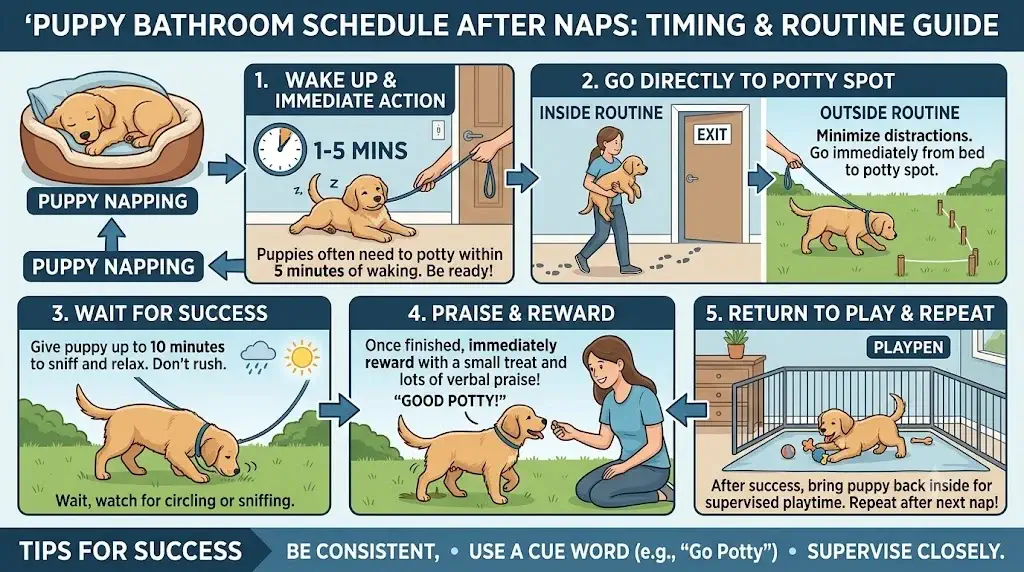
A structured puppy bathroom schedule after naps bridges involuntary autonomic sleep transitions with immediate outdoor elimination access. Waking from sleep abruptly releases parasympathetic bladder inhibition, causing accumulated urine to trigger urgent detrusor contractions within sixty seconds of motor arousal. Implementing a reliable puppy bathroom schedule after naps requires eliminating indoor transition delays, managing crate-exit excitement, and escorting your puppy directly to outdoor turf to prevent domestic floor accidents.
Quick answer: should a puppy go outside after a nap?
A puppy must go outside within 60 seconds of waking from any nap, regardless of whether the sleep lasted twenty minutes or two hours. The physiological transition from sleep to waking releases bladder inhibition, filling the urethral neck and prompting an immediate urge to urinate.
Do not allow indoor stretching on carpets, greetings with family members, or water drinking before heading outside. Carry or escort your puppy on leash directly to their designated outdoor spot, confirm complete elimination, and deliver quiet ground-level praise within three seconds.
Quick Reference Specification: Post-Nap Elimination Matrix
This calibrated physiological matrix benchmarks nap durations, neuro-urological waking mechanisms, tactical outdoor interventions, peak elimination urgency dwells, and veterinary safety standards in 2026.
| Nap Type & Duration | Neuro-Urological Mechanism | Tactical Outdoor Intervention | Peak Urgency Dwell | Safety Benchmark |
|---|---|---|---|---|
| Power Nap (15–30 Mins) | Sudden motor arousal; detrusor muscle reflex | Direct leash escort to grass; interrupt indoor pacing | 30–60 seconds post-waking | AKC Pediatric Training Protocol |
| Deep Nap (1–2 Hours) | Maximal sedentary renal accumulation & full bladder | Carry pup straight outside; verify immediate voiding | 0–45 seconds (Emergency window) | VCA Juvenile Urology Guideline |
| Crate Nap Confinement | Den preservation instinct suppressing voiding reflex | Calm door opening; avoid indoor greetings; exit directly | Immediate upon crate release | AAHA Canine Life Stage Matrix |
| Post-Meal Digestion Nap | Combined gastrocolic reflex wave + bladder fullness | Double-void check: expect urine and stool outdoors | 60 seconds post-waking | AVMA Pediatric Care Standard |
Why Is a Nap a Potty-Training Trigger?
Physical awakening releases parasympathetic neurological inhibition, prompting involuntary detrusor muscle contractions within sixty seconds of motor activity. While a puppy sleeps, the autonomic nervous system reduces glomerular filtration rates and maintains sphincter tone; however, the instant the puppy stands, stretches, and walks, accumulated urine presses directly against the bladder neck.
Puppies commonly need bathroom opportunities after sleeping, eating, drinking, and playing. That makes waking from a nap one of the easiest events to build into a predictable house-training routine.
The important distinction is that a nap does not automatically mean a puppy must urinate every time. Instead, waking is a reliable opportunity to check and provide access to the bathroom.
Young puppies have less reliable elimination control than mature dogs. If a puppy wakes and immediately starts walking around the house, the owner may lose the short window between waking and an accident.
Use the wake-up as the cue.
The simplest operational rule is: when the puppy wakes, go to the potty area before starting any other activity.
For complete 24-hour routine frameworks, consult our comprehensive Puppy House Training Schedule.
How Soon Should a Puppy Go Outside After a Nap?
Pediatric canine housebreaking protocols require escorting a puppy outside within sixty seconds of waking from sleep. Allowing even two minutes of indoor wandering, coffee preparation, or casual greetings invites involuntary carpet soiling before reaching the door.
There is little benefit in creating a rigid “exactly X minutes” rule because puppies differ. What matters more is eliminating the unnecessary delay between waking and reaching the potty location.
The wake-up sequence matters
Compare these two routines to understand why timing dictates housebreaking success:
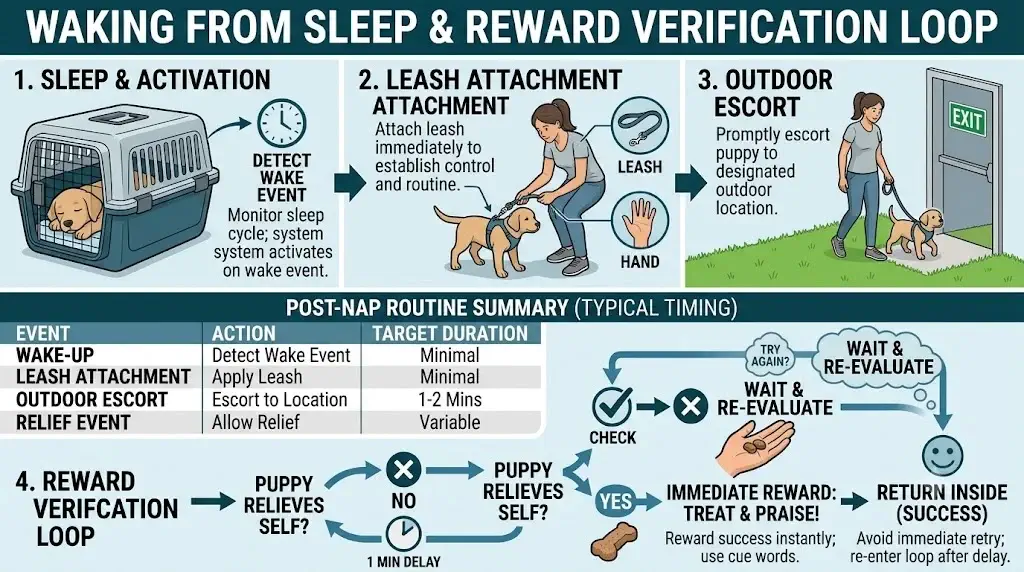
Low-Risk Management Sequence
- Puppy stirs and stands up.
- Owner immediately clips leash or lifts pup.
- Puppy transitions straight outside to grass.
- Prompt elimination occurs on turf.
- Deliver ground reward; return indoors.
- Play, feeding, or freedom begins safely.
High-Risk Delayed Sequence
- Puppy wakes and stretches.
- Owner checks phone or makes coffee.
- Puppy wanders through living room.
- Motor excitement accelerates bladder pressure.
- Owner notices floor sniffing too late.
- Accident occurs indoors before reaching exit.
The second routine does not fail because the puppy “forgot” training. It fails because the critical biological management window was missed.
For age-based frequency comparisons, examine our guide on How Often Should You Take a Puppy Outside?
Puppy Bathroom Schedule After Naps by Age
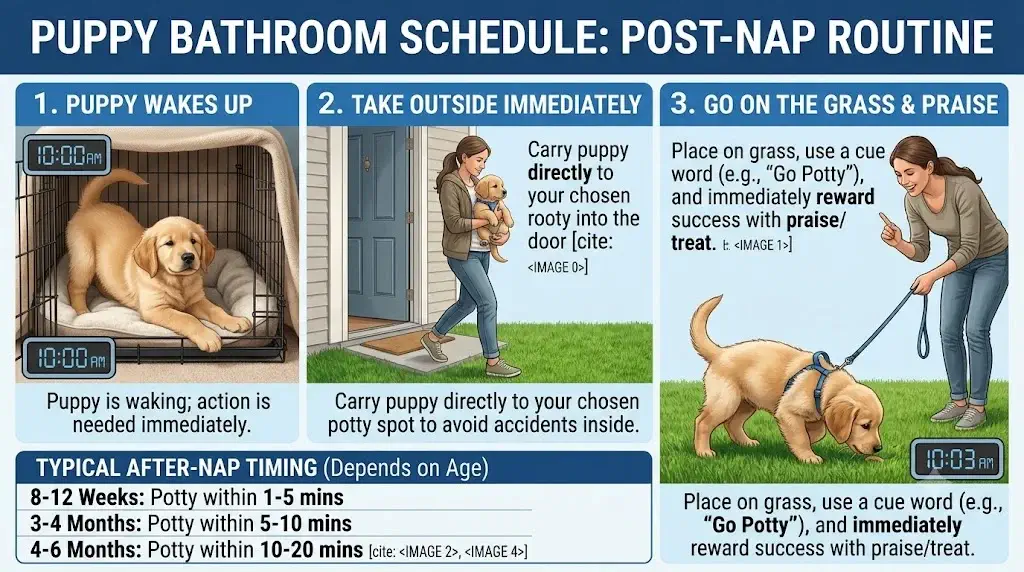
Chronological age dictates voluntary sphincter control, urethral muscle strength, and post-nap holding capacity. While young puppies require immediate physical carriage to grass, older canines develop neuromuscular retention that tolerates brief indoor transitions:
| Puppy Age | After-Nap Outdoor Strategy | Indoor Transition Management | Core Operational Objective |
|---|---|---|---|
| 8–10 weeks | Carry puppy straight to grass within 30 seconds of waking. | Zero indoor walking; leash on before crate door opens. | Prevent accidents and solidify the wake-to-potty habit. |
| 10–12 weeks | Walk on short leash to outdoor turf within 60 seconds. | Keep puppy directly beside you; prevent room roaming. | Build consistent wake-up elimination reliability. |
| 3–4 months | Prompt outdoor leash escort within 1 to 2 minutes. | Allow calm stretching, then proceed directly to exit door. | Encourage early doorway communication cues. |
| 4–6 months | Scheduled outdoor trip within 2 to 3 minutes of waking. | Supervise calmly; grant controlled room access. | Transition management toward predictable domestic manners. |
| 6+ months | Routine bathroom check rather than emergency dash. | Full household freedom if clean habits are established. | Maintain adult schedules and observe sudden health shifts. |
Do not use age as a guarantee of bladder control.
Age-based guidance provides an operational planning framework. Individual puppies mature at different rates, and changes in environmental excitement, routine, or health can temporarily alter holding capabilities.
Does Nap Length Change When a Puppy Needs to Go Outside?
Nap duration directly impacts accumulated urine volume but does not negate the necessity of an immediate bathroom check. While extended sleep fills the bladder to capacity, even short power naps trigger parasympathetic motor arousal that prompts sudden elimination.
After a short nap (15–30 minutes)
If a puppy dozes for only 15 to 30 minutes, waking up still acts as an autonomic trigger. Young puppies should always be offered an outdoor bathroom break rather than assumed safe simply because the sleep period was brief.
After a long nap (1–2+ hours)
Following a deep two-hour sleep, the bladder contains substantial volume filtered by the kidneys during sedentary rest. The puppy wakes with a completely full bladder, creating an urgent elimination emergency.
Short Power Nap Protocol
Wake → leash escort → focused potty opportunity → reward on grass → resume supervised play or activity.
Long Sleep Protocol
Wake → carry pup directly outside → verify complete voiding → quiet reward → transition to feeding or play.
Puppy Bathroom Schedule After a Crate Nap
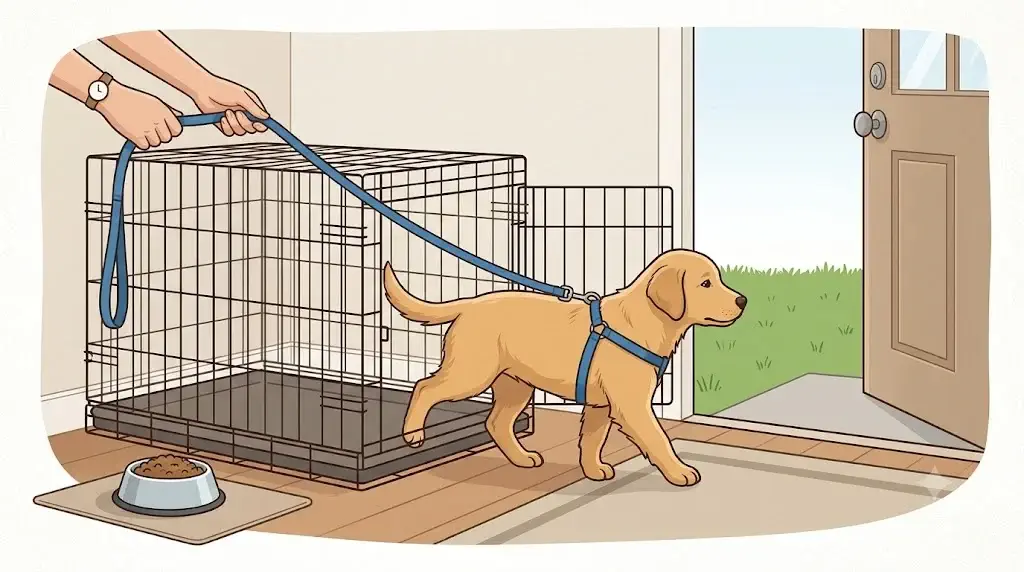
Crate confinement utilizes innate den preservation instincts to discourage elimination until the crate door opens. Because a crated puppy actively inhibits voiding while sleeping, releasing them immediately triggers bladder relaxation that demands rapid transit to outdoor grass.
When the puppy wakes, avoid turning crate release into an exciting greeting session. The bathroom trip must always precede social affection:
- Listen for subtle waking indicators. Soft shifting, standing up, or light whining indicates the puppy has ended sleep.
- Open the crate door quietly without fanfare. Keep interactions neutral to prevent arousal-induced involuntary urination.
- Clip the leash and proceed directly to outdoor grass. Do not allow indoor wandering, greeting family, or floor playing.
- Verify completed elimination and deliver ground reward. Offer praise and a pea-sized treat within three seconds of voiding.
- Transition back indoors for feeding, training, or play. Once the bladder is empty, grant supervised indoor freedom safely.
Crate release must serve a singular purpose.
For a puppy learning house manners, the initial destination upon exiting a crate must always be the outdoor bathroom spot, never the living room carpet.
Example Puppy Nap Bathroom Schedule
A coordinated daily routine anchors scheduled outdoor relief trips to natural sleep-wake cycles throughout the day. This framework illustrates how daytime naps integrate with feeding, exercise, and housebreaking routines:
7:00 AM — Morning Wake-Up Potty First
Escort the puppy outside immediately upon waking to empty overnight urine before breakfast.
7:30 AM — Breakfast & Post-Meal Potty
Serve breakfast kibble; provide an outdoor potty break 20 minutes later to capture the gastrocolic reflex.
8:15–9:30 AM — Morning Crate Nap
Allow the puppy to rest undisturbed in a quiet, properly sized sleeping crate.
9:30 AM — Wake From Morning Nap Potty Trip
Go directly outside on leash within 60 seconds; verify urination on grass before indoor playtime.
11:00–11:45 AM — Midday Power Nap
Short rest period following morning interaction and supervised playtime.
11:45 AM — Wake From Power Nap Potty Trip
Provide a quick outdoor relief break before serving lunch kibble.
1:00–3:00 PM — Afternoon Deep Nap
Extended restorative sleep period in crate or quiet exercise pen.
3:00 PM — Wake From Deep Nap Potty Trip
Carry or leash puppy immediately; expect full bladder elimination and possible bowel movement.
5:30 PM — Dinner & Evening Break
Evening meal followed by verified outdoor elimination 20 minutes later.
7:00–8:00 PM — Evening Catnap
Short doze during household evening relaxation.
10:30 PM — Final Pre-Bed Potty Final Potty
Conduct final verified elimination break before latching bedroom crate door for night sleep.
For complete overnight protocols, review our master guide on the Puppy Bathroom Schedule at Night.
The Correct Wake-Up Potty Routine
Consistent procedural execution eliminates handler hesitation and prevents indoor accidents during the waking transition. Follow this standardized six-step protocol each time your puppy awakens:
- Acknowledge the waking event immediately. Treat physical stirring as the automatic start of your outdoor elimination sequence.
- Move directly toward the exit door. Carry young puppies or guide older pups on a short fixed leash without pausing.
- Navigate to the exact designated relief spot. Utilizing a consistent outdoor substrate conditions rapid elimination behavior.
- Stand stationary and wait patiently. Anchor in place for three to five minutes, keeping interactions neutral and focused on business.
- Deliver immediate ground-level reinforcement. Offer soft verbal praise and a small treat at grass level within three seconds of completed voiding.
- Transition to indoor feeding, play, or supervised freedom. Once elimination is verified, allow normal household interaction safely.
Why Do Puppies Have Accidents Right After Naps?
Handler transit delays and unmonitored indoor freedom account for the vast majority of post-nap domestic accidents. When a puppy awakens with full bladder pressure, common household friction points prevent timely outdoor access:
| Management Breakdown | Behavioral Consequence | Corrective Action |
|---|---|---|
| Gear staging delay | Puppy waits while handler hunts for shoes, leash, and keys. | Stage slip-on shoes, lead, and treats directly beside exit door. |
| Indoor play before potty | Motor excitement compresses bladder, causing instant squatting. | Enforce strict rule: elimination outside first, playtime second. |
| Excess room freedom | Puppy wanders unmonitored into adjacent carpeted areas. | Maintain leash control from bed to outdoor grass. |
| Assumption of holding | Owner assumes pup can hold it because nap was brief. | Treat all waking events as mandatory outdoor checkpoints. |
| Overlooked motor cues | Pre-potty sniffing is noticed only after urination begins. | Respond instantly to sniffing, circling, or pacing post-sleep. |
For proven behavioral protocols to eliminate repeat indoor accidents, review How to Prevent Repeat Puppy Accidents.
Should You Wake a Puppy From a Nap to Go Potty?
Healthy developing puppies should generally not be awakened from natural restorative daytime sleep simply to follow an arbitrary clock timer. Deep sleep supports vital growth hormone release, immune function, and neurological consolidation; handlers should allow puppies to wake naturally before offering relief.
Exceptions exist for very young pups (under eight weeks), medically directed feeding schedules, or structured nighttime alarms designed to prevent crate pan soiling. During daytime hours, let the puppy sleep peacefully and treat their spontaneous awakening as your potty cue.
The critical management distinction:
Do not confuse “escort the puppy outside when they wake” with “wake the sleeping puppy because an hour elapsed.” Allow natural sleep to run its course, then act immediately upon waking.
What If My Puppy Wakes Up but Does Not Pee?
Environmental distraction and cold weather often divert a waking puppy’s focus from internal elimination urges. If a puppy sniffs, investigates leaves, or plays without voiding during an outdoor trip, handlers must not grant immediate unrestricted indoor freedom.
The structured crate reset sequence
- Wait calmly on leash in your designated grass spot for five minutes.
- If no elimination occurs, escort the puppy back indoors without scolding.
- Place the puppy directly into their crate or maintain strict umbilical leash tethering.
- Prevent free roaming on carpets while waste remains unvoided.
- Wait ten to fifteen minutes indoors under close visual observation.
- Escort the puppy back outside for a focused three-minute retry until successful.
After-Nap Potty Training in an Apartment
Vertical residential transit introduces unavoidable travel delays that require proactive management to prevent hallway accidents. Waking on the fifth floor means navigating long carpeted hallways, elevator rides, and security lobbies while holding urgent post-sleep urine.
Stage Gear in Advance
Keep slip-on shoes, leash, keys, and treats staged directly beside your front exit door before the nap begins.
Carry Through Common Areas
Physically carry young puppies through corridors and elevators to inhibit the physical squatting reflex.
Real-Grass Balcony Box
Utilize a fresh-grass balcony patch for immediate post-nap access while preserving natural outdoor turf preferences.
Quiet Transit Protocol
Keep elevator rides calm and business-focused; prevent exciting greetings with neighbors until after voiding.
After-Nap Potty Training in a Small Home
Compact residential layouts simplify supervision but allow puppies to reach carpeted soiling areas within seconds. Because distances are short, handlers often make the mistake of allowing puppies to walk themselves toward the back door, resulting in accidents en route.
Establish an unbroken operational pathway: wake → leash → outdoor grass → verified void → indoor freedom. Maintaining physical leash control prevents the puppy from detouring behind furniture or squatting on area rugs.
How to Track Your Puppy’s Nap-to-Potty Pattern
A written behavioral tracking log provides objective diagnostic data regarding individual elimination timing. Recording timestamps across seven consecutive days highlights unique metabolic patterns that generic timers miss:
| Nap Started | Wake Time | Outdoor Potty Trip | Urinated? | Defecated? | Operational Observations |
|---|---|---|---|---|---|
| 8:15 AM | 9:05 AM | 9:06 AM | Yes | No | Eliminated within 40 seconds; smooth transition. |
| 10:45 AM | 11:15 AM | 11:16 AM | Yes | Yes | Double-voided after short power nap. |
| 1:00 PM | 2:30 PM | 2:31 PM | Yes | Yes | Deep sleep; required immediate carriage to turf. |
Nap + Meal + Play: Which Potty Trigger Comes First?
Sequential biological triggers compound elimination urgency, requiring discrete outdoor trips between activities. When a puppy wakes from a nap, eats breakfast, drinks water, and begins wrestling, multiple visceral elimination reflexes activate simultaneously.
Rather than searching for a single trigger, provide structured outdoor breaks between major behavioral transitions:
Structured Proactive Routine
Wake → Potty → Meal → Potty → Play → Potty
Isolates each event with an outdoor checkpoint, maintaining 100% clean floors.
Stacked Compounding Risk
Wake → Play → Meal → Water → Wrestling → Accident
Multiple visceral reflexes compound while the puppy remains indoors unmonitored.
When Post-Nap Accidents Are a Training Issue — and When They Are Not
Sudden urinary incontinence occurring during sleep indicates medical urological pathology rather than housebreaking failure. A healthy puppy wakes first and eliminates second; involuntarily leaking urine while asleep or dribbling continuously without squatting warrants veterinary intervention.
If accidents happen consistently because handlers delay taking the puppy outside, tighten your schedule. However, contact your veterinarian immediately if you observe any of the following clinical indicators:
Clinical Warning Signs
Consult your veterinarian promptly if you observe involuntary urine leakage while the puppy is sound asleep, straining with only droplets produced, crying during urination, cloudy or bloody urine, or sudden extreme thirst (polydipsia).
Frequently Asked Questions
Should I take my puppy outside immediately after a nap?
Yes. Waking from sleep releases parasympathetic bladder inhibition, causing accumulated urine to press against the bladder neck. Escort your puppy outside within 60 seconds of waking.
Does a puppy need to pee after every nap?
While not every puppy voids after every single power nap, young puppies should always receive an immediate outdoor opportunity rather than being expected to hold urine.
How soon after a nap should a puppy go outside?
Escort your puppy outside immediately. The younger the puppy and the longer the nap, the more critical it is to eliminate transition delays between waking and outdoor turf.
Should I wake my puppy from a nap to go potty?
Generally, no. Allow healthy puppies to wake naturally from daytime sleep, and use their spontaneous awakening as your potty cue rather than interrupting restorative rest.
Does a short nap count as a reason to take a puppy outside?
Yes. Even a 15-minute power nap resets motor arousal and triggers detrusor contractions. Always offer an outdoor break following brief daytime dozes.
Should I take my puppy outside after a crate nap?
Yes. A crated puppy actively suppresses elimination while sleeping. Opening the crate door prompts an immediate need to void; exit directly to grass on leash.
What if my puppy does not pee after a nap?
Wait calmly on leash for five minutes. If no voiding occurs, return indoors, place the puppy in their crate or tether them on an umbilical leash for 15 minutes, and retry outside.
Why does my puppy have accidents right after waking up?
The bladder is already full upon waking. Delays caused by coffee prep, searching for shoes, indoor play, or granting room freedom allow accidents before reaching the door.
The Bottom Line on Nap-to-Potty Schedules
A consistent puppy bathroom schedule after naps coordinates natural neuro-urological waking reflexes with immediate outdoor elimination access.
The primary rule is simple: Wake → Leash → Outside → Potty → Reward → Play. Eliminate transit delays between the bed and exit door, manage crate-release excitement calmly, and utilize structured crate resets whenever trips are unproductive. By respecting your puppy’s biological sleep-wake transitions, post-nap routines become your most dependable housebreaking anchor.
Editorial references
- American Kennel Club — How to Potty Train a Puppy
- American Kennel Club — Setting Schedules and Developing a Routine for Your New Puppy
- American Kennel Club — Puppy Potty Training Timeline
- VCA Animal Hospitals — House Training Your Puppy
This article provides general educational information and does not replace individualized veterinary advice.
