
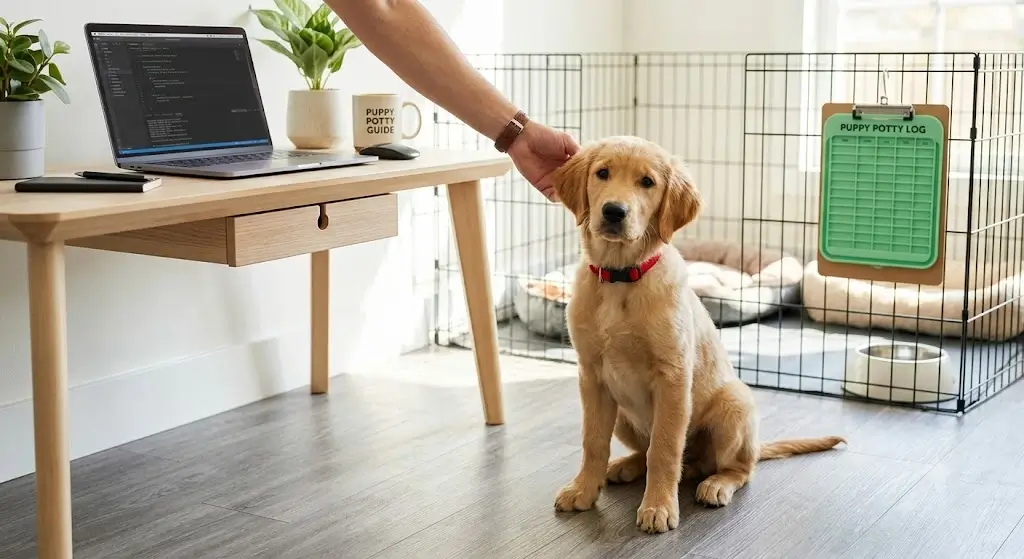
House Training a Puppy With a Busy Schedule
House training a puppy with a busy schedule is possible, but success depends on building a routine around the puppy’s predictable potty needs instead of expecting you to be available every minute of the day.
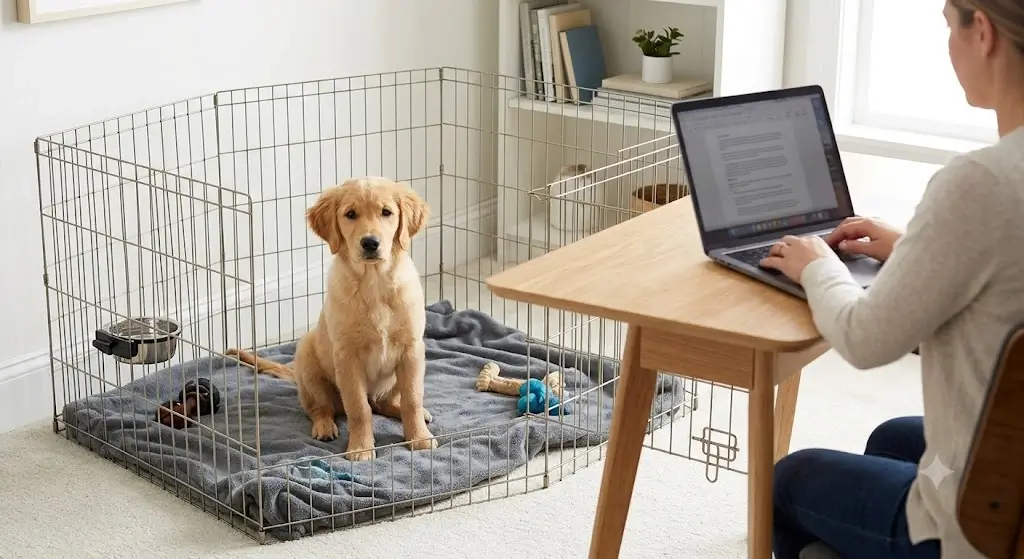
Can You House Train a Puppy With a Full-Time Schedule?
Yes, but a busy household needs more management than a household where someone is home all day. Young puppies cannot be expected to adapt their biological needs to a work calendar.
The solution is to build a system around predictable events: waking, meals, drinking, naps, play, and bedtime. When you cannot personally provide a needed potty break, another responsible person or an appropriate backup arrangement has to cover that gap.
The American Kennel Club recommends frequent potty opportunities for young puppies, particularly after waking, eating, drinking, playing, and sleeping. It also recommends close supervision and gradually expanding a puppy’s access to the home as reliability improves. (akc.org)
The Three-Part System for Busy Puppy Owners
A practical busy-owner system has three parts:
1. Prevention
Schedule potty opportunities before your puppy becomes desperate.
2. Coverage
Use family, a trusted caregiver, dog walker, or other appropriate help when you are unavailable.
3. Management
Limit unsupervised freedom so the puppy has fewer opportunities to practice unwanted indoor elimination.
Build the Schedule Around Events, Not Just the Clock
A rigid hourly schedule can fail when your puppy’s day changes. Event-based potty training is more flexible because it follows what the puppy is actually doing.
| Event | Potty opportunity | Why |
|---|---|---|
| Waking up | Immediately after waking | Sleep can be followed by an immediate need to eliminate. |
| Meal | Offer another break after eating. | Eating can trigger the need to eliminate. |
| Nap | Immediately after waking. | Prevents waiting for a late signal. |
| Active play | Potty after the session. | Activity can increase the need for a break. |
| Before bedtime | Final scheduled trip. | Creates a predictable nighttime routine. |
This event-based approach is particularly useful for people who work from home, commute, attend school, manage children, or have unpredictable meetings.
How Often Does a Puppy Need to Go Out?
There is no universal number that works for every puppy. Potty frequency changes with age, development, body size, feeding pattern, activity, sleep, water intake, health, and individual bladder control.
Young puppies generally need much more frequent opportunities than adult dogs. A useful planning rule is to think in terms of high-risk events rather than assuming a puppy can reliably wait for the next convenient break.
A Realistic Schedule for a Busy Workday
The following example shows how a full-time worker might structure a puppy’s day. It is a framework, not a prescription.
| Approx. time | Routine | Coverage |
|---|---|---|
| 6:30 AM | Wake → potty | Owner |
| 7:00 AM | Breakfast → potty opportunity | Owner |
| Morning | Nap / supervised rest | Owner or caregiver |
| Midday | Potty + movement | Dog walker / caregiver / household member |
| Afternoon | Potty after nap or activity | Owner or caregiver |
| After work | Potty + play | Owner |
| Evening | Potty after meals/play | Owner |
| Bedtime | Final potty trip | Owner |
The important part is not copying these times. It is identifying the periods when nobody is available and filling those gaps before bringing the puppy home.
The Biggest Mistake Busy Puppy Owners Make
The most common planning mistake is assuming that a puppy can simply stay alone for the duration of a full workday because it has a crate, pen, or large puppy-proof room.
Confinement is a management tool. It does not eliminate the puppy’s need for appropriate potty opportunities.
If your normal absence is longer than your puppy can reasonably manage, arrange a midday visit or another appropriate form of care rather than expecting the puppy to solve the problem by holding it.
What to Do If You Work 9 to 5
A typical 9-to-5 schedule can work with puppy training if you build reliable midday coverage.
Before work: potty → breakfast → potty → supervised activity.
During work: scheduled caregiver or dog-walker potty break(s) based on the puppy’s needs.
After work: immediate potty trip → activity → meal → potty.
Before bed: final potty opportunity.
The number and timing of midday visits should be based on the puppy rather than the convenience of the owner’s calendar.
What If You Work From Home?
Working from home can make potty training easier, but it can also create a different problem: assuming the puppy will automatically remind you when it needs to go.
Meetings can last longer than expected, headphones can block subtle signals, and a puppy may quietly wander to another room.
Set simple calendar reminders during the early training period. Once the puppy’s routine becomes predictable, you can adjust the reminders around its actual needs.
How to Handle Long Meetings
A meeting is not a reason to ignore a puppy’s predictable potty window. If you have a long meeting scheduled around a known potty period, arrange coverage before the meeting begins.
- Take the puppy out before the meeting when appropriate.
- Use a caregiver if another break will be needed.
- Keep the puppy in a safe supervised area.
- Do not punish an accident caused by a missed schedule.
- Record the event so you can adjust future meeting-day planning.
Using a Dog Walker or Puppy Caregiver
A reliable midday caregiver can be one of the most useful tools for a busy puppy owner. The person does not need to perform the entire training session. Their most important job may simply be providing a timely potty opportunity and reinforcing the same routine you use.
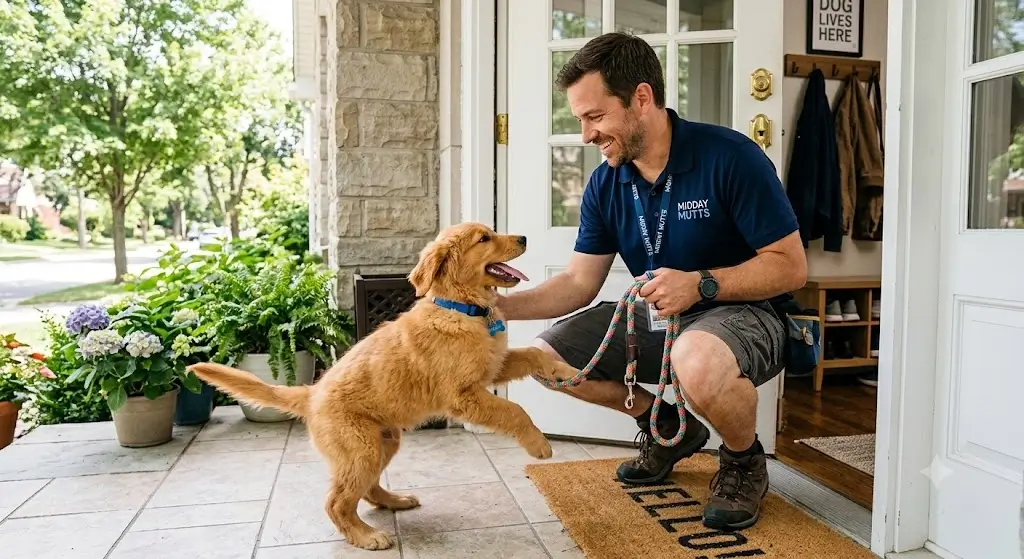
Give the caregiver a written routine
- Where the leash is stored.
- Where the puppy should potty.
- The verbal potty cue.
- How the successful behavior is rewarded.
- Where the puppy stays afterward.
- What to do if the puppy does not eliminate.
- What signs or unusual behavior should be reported to you.
Consistency between caregivers matters. If one person rewards outdoor elimination while another allows long unsupervised indoor periods, the puppy receives mixed management signals.
How to Use a Crate During a Busy Day
A crate can provide a predictable resting space when used correctly. It should not be used as punishment or as a substitute for regular potty breaks.
During the training period, combine appropriate confinement with a schedule that provides enough opportunities for elimination, movement, interaction, and rest.
Puppy Pen vs. Crate for Busy Owners
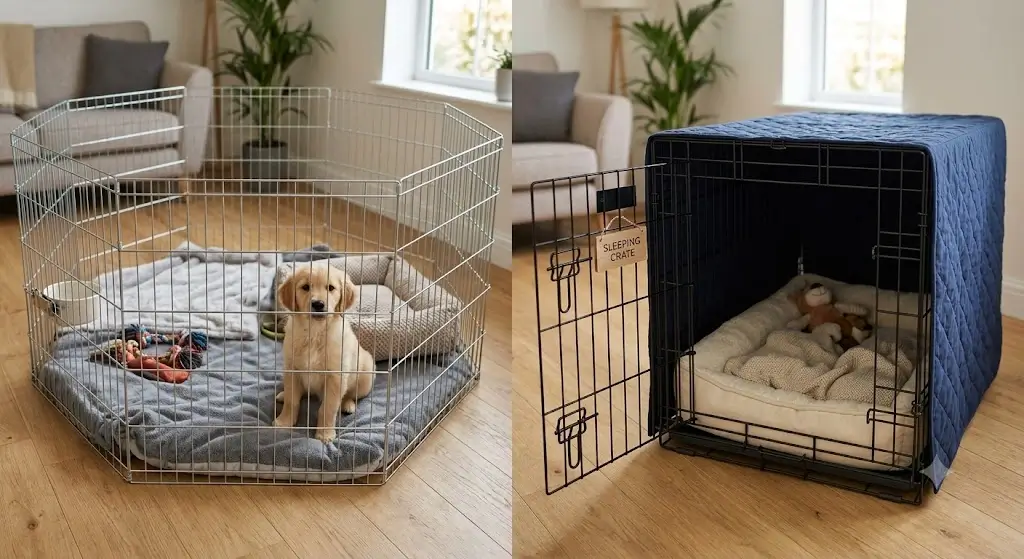
| Setup | Best use | Limitation |
|---|---|---|
| Crate | Short supervised rest periods and sleep. | Does not replace potty breaks or daytime interaction. |
| Puppy pen | A larger controlled area when more movement is appropriate. | More space can create more opportunities for accidents. |
| Gated room | Gradually increasing freedom. | Requires effective puppy-proofing and supervision. |
If you have limited square footage, combining gates with a playpen setup can be tricky. Reviewing spatial boundaries in our guide to house training a puppy in a small home can help keep your containment zones secure without crowding your living space.
Should You Use Puppy Pads When You Are at Work?
An indoor potty area can be useful in some households, particularly when a puppy’s needs cannot be covered by a responsible person during the day.
If your goal is outdoor-only potty training, keep the indoor option clearly defined and continue making outdoor elimination the primary behavior you reward.
The important distinction is between a deliberate backup system and allowing the puppy to eliminate anywhere indoors. This dilemma is especially frequent for apartment dwellers who cannot quickly reach ground level; our breakdown on house training a puppy in a high-rise provides specialized strategies for balancing elevator transit times with indoor options.
How to Prevent Accidents While You Are Busy
Prevention is easier than correcting repeated accidents. Use the following sequence whenever you know you will be distracted.
- Give the puppy an appropriate potty opportunity.
- Provide age-appropriate activity or interaction.
- Move the puppy into a supervised safe area.
- Remove access to rooms where accidents have occurred.
- Set a reminder for the next expected break.
- Arrange backup coverage if you will be unavailable.
This system reduces the chance that a puppy will quietly leave your workspace, find a hidden corner, and practice indoor elimination while you are on a call.
The Potty Log for Busy Puppy Owners
A potty log becomes especially useful when several people share responsibility for the puppy.
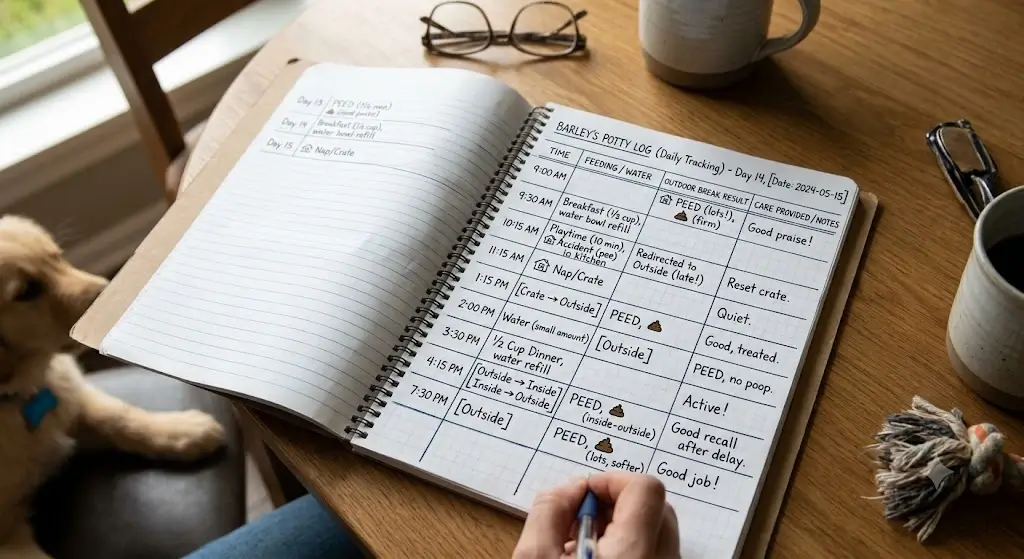
| Time | Event | Potty result | Caregiver | Notes |
|---|---|---|---|---|
| 7:00 | Wake | Outside | Owner | Successful |
| 8:30 | Play | Outside | Owner | Successful |
| 12:00 | Midday break | Outside | Walker | Successful |
A simple shared log prevents two caregivers from assuming the other person already took the puppy out.
How to Handle Missed Potty Breaks
If you miss a scheduled break, do not punish the puppy for the resulting accident. Instead, identify why the break was missed and change the system.
If the same missed window occurs every Tuesday because of a recurring meeting, solve the Tuesday schedule rather than repeatedly reacting to Tuesday accidents. Similarly, if your daytime rhythm feels solid but you wake up to messes, explore our troubleshooting guide for when a puppy keeps having accidents overnight to address night-specific lapses.
How to Reward Your Puppy When You Are Short on Time
Rewards do not need to create a long training session. Keep the process simple.
- Reach the correct potty location.
- Allow the puppy to eliminate.
- Praise and reward promptly.
- Continue the day.
The quality of the timing matters more than creating a complicated ceremony after every successful potty trip.
What If You Travel to the Office?
Commuting creates a predictable coverage gap. Before leaving for work, determine exactly who handles the puppy during your absence.
If the puppy is too young to manage the full period alone, options may include a household member, trusted caregiver, dog walker, or other appropriate puppy-care arrangement.
The key is reliability. A theoretical plan that depends on “maybe I’ll get home early” is not a dependable potty-training system.
House Training When Your Schedule Changes Every Day
Not everyone works a predictable 9-to-5 schedule. Healthcare workers, students, shift workers, business owners, parents, and people with irregular meetings may need a more flexible system.
In that situation, keep the sequence consistent even when the clock changes:
Wake → potty
Eat → potty opportunity
Sleep → potty
Play → potty
Long absence → arranged coverage
Bedtime → final potty
This makes the routine resilient to changes in your workday.
When to Give Your Puppy More Freedom
A busy owner may be tempted to give a puppy more freedom because the puppy appears calm. Calm behavior does not necessarily mean reliable house training.
Expand access gradually after a consistent pattern of successful elimination. If accidents return after expanding the puppy’s territory, reduce the area and rebuild reliability. When progress hits a plateau despite your best scheduling efforts, see our step-by-step diagnostic on what to do when house training stalls to reset the routine.
What Do You Do When Your Puppy Has an Accident?
If you catch the puppy starting to eliminate indoors, calmly interrupt and redirect to the appropriate toilet location when practical.
If the accident is already finished, clean the area thoroughly and continue your routine.
Do not punish, yell at, or frighten your puppy for an accident. The purpose of house training is to teach the correct behavior and location, not to make the puppy afraid of making mistakes.
If accidents repeatedly occur during a particular period of the day, treat the pattern as information. The schedule or coverage plan may need to change.
Why a Busy Puppy Owner’s Training Plan Fails
The schedule is based on convenience
A convenient break for you may be too late for the puppy. Build around the puppy’s needs first.
There is no midday coverage
If the puppy cannot reasonably wait until you return, someone needs to cover the gap.
The puppy has too much unsupervised space
More freedom means more opportunities to practice unwanted elimination.
Everyone uses a different routine
Different potty locations, cues, rewards, and schedules can slow learning.
The owner only reacts to accidents
Prevention is more efficient than repeatedly cleaning accidents after the fact.
Busy Schedule Puppy House Training Checklist
- ✓ Choose one primary potty location.
- ✓ Build potty breaks around waking, eating, sleeping, and playing.
- ✓ Identify every period when you will be unavailable.
- ✓ Arrange reliable coverage for those periods.
- ✓ Keep leash and potty supplies ready.
- ✓ Use a safe supervised area when you are distracted.
- ✓ Keep indoor backup toilet use deliberate and consistent if needed.
- ✓ Keep a shared potty log.
- ✓ Reward successful elimination promptly.
- ✓ Clean accidents thoroughly.
- ✓ Never punish accidents.
- ✓ Expand freedom gradually.
When Accidents May Require a Veterinarian
A busy schedule can explain missed potty opportunities, but it should not be used to explain every change in elimination behavior.
If a puppy that was becoming reliably house trained suddenly begins having frequent accidents, talk with a veterinarian. Health problems can affect urination and defecation patterns.
Veterinary attention is especially appropriate when accidents occur with signs such as discomfort, unusual thirst, straining, blood, vomiting, diarrhea, lethargy, or other significant behavioral or physical changes.
Frequently Asked Questions
Can you house train a puppy if you work full time?
Yes. The schedule needs reliable potty-break coverage during periods when you are unavailable. Young puppies should not be expected to adapt their elimination needs to a full workday.
How do I house train a puppy when I work 9 to 5?
Establish predictable morning and evening routines and arrange appropriate midday coverage based on your puppy’s age and needs. Use supervised confinement when you cannot directly watch the puppy.
Should I use puppy pads if I work all day?
An indoor toilet area can be a useful backup for some households. If your goal is outdoor-only training, keep the indoor area limited and continue prioritizing outdoor potty trips.
How long can a puppy stay home alone?
There is no single duration that is appropriate for every puppy. Age, development, health, prior training, and individual needs all matter. A young puppy may need substantially more frequent care than an adult dog.
Is a crate enough when I am at work?
No. A crate can be a useful management and resting tool, but it does not replace appropriate potty breaks, movement, interaction, and care.
Why does my puppy have accidents while I am on a work call?
The call may overlap with a predictable potty window, and a puppy may not be able to wait until the meeting ends. Use scheduled reminders and arrange coverage for meetings that overlap with your puppy’s high-risk periods.
The Busy-Owner Potty Training Formula
Predictable routine + reliable coverage + supervised freedom + immediate reinforcement + gradual independence
A successful busy-day routine does not require you to be available every second. It requires you to know when your puppy needs help and make sure someone or something appropriate covers those periods.
Editorial note: This article provides general puppy house-training information and is not a substitute for individualized veterinary advice. Training should be adapted to the puppy’s age, health, development, temperament, living environment, and veterinarian’s recommendations.
