
What Does It Mean When House Training Stalls?
A house-training stall is a period in which your puppy’s progress appears to stop. The puppy may have improved for several days or weeks and then start having accidents again, or the accident rate may simply stop declining.
This does not mean the puppy has forgotten everything.
Often, one part of the training system has become too difficult for the puppy. For example, the puppy may understand that eliminating outdoors is rewarded but still cannot reliably wait between bathroom trips due to developing neurological bladder sphincter control.
Another common pattern is a mismatch between training skill and freedom. The puppy has learned the desired behavior in a small footprint but has not yet demonstrated enough consistency to handle unrestricted access to the house.
| Observed Pattern | Underlying Systemic Cause | Immediate Corrective Action |
|---|---|---|
| Accidents happen after long gaps | Bathroom interval exceeds biological limit | Shorten interval by 30 minutes |
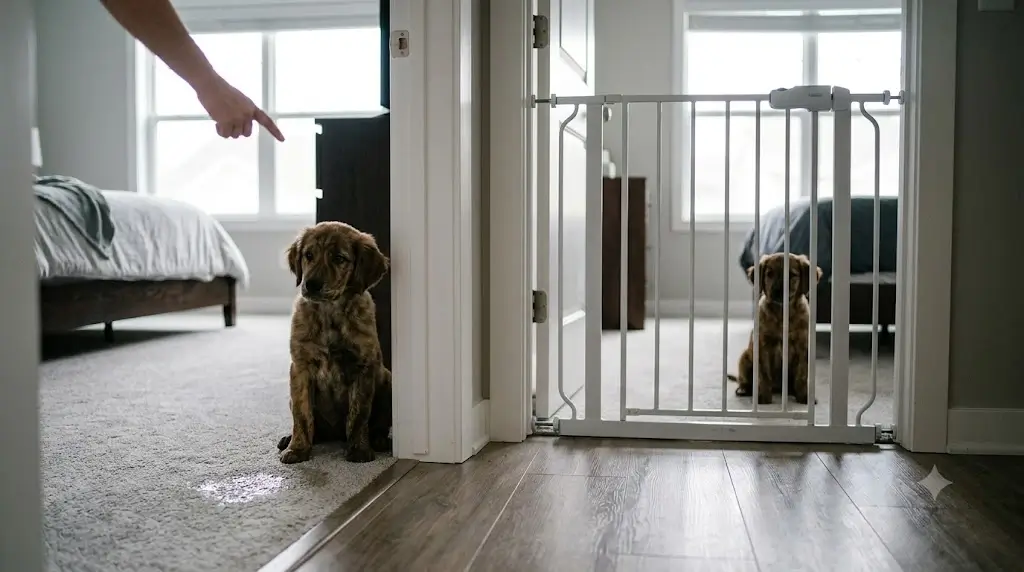
| Accidents occur in another room | Unearned territorial freedom / supervision leak | Install gates; restrict access immediately |
| Goes outside but soils carpet indoors | Distraction outdoor refusal / partial voiding | Keep on leash outdoors; apply reset containment |
| Accidents in one specific spot | Sub-surface uric acid crystal scent triggers | Deep-saturate with bio-enzymatic cleaner |
| Sudden widespread breakdown | Circadian schedule change or medical issue (UTI) | Audit recent routines and seek veterinary review |
| Slow but steady baseline progress | Normal biological developmental curve | Maintain consistent daily schedule |
Before Changing the Training, Find the Bottleneck
A stalled process becomes difficult to fix when every variable is changed at the same time. If you alter the feeding schedule, crate size, walking route, and cleaning spray all at once, you will never know which variable corrected or worsened the behavior.
Instead, systematically diagnose the failure point with these objective diagnostic checkpoints:
- Does the puppy know where it is supposed to eliminate?
- Does the puppy usually eliminate successfully when taken outside?
- How long after the previous bathroom trip do accidents occur?
- Are accidents happening when nobody is directly watching?
- Does the puppy signal before needing to go (circling, pacing, sniffing)?
- Is the puppy receiving unmonitored freedom across multiple rooms?
- Are successful outdoor trips reinforced with high-value rewards within 2 seconds?
- Are previous accident areas thoroughly neutralized down to the carpet subfloor?
- Did the household work, feeding, or exercise routine recently shift?
- Did the accident frequency spike abruptly without environmental cause?
Tracking the precise timestamp of accidents reveals whether the breakdown stems from inadequate supervision, excessive duration between trips, unearned room access, or a biological gastrocolic reflex mismatch.
House Training Is a Management System, Not Just a Command
Puppies do not become house-trained simply because they understand a verbal cue like “go potty.” True reliability requires aligning six interconnected environmental mechanics:
- Timing: Proactive bathroom breaks occur before involuntary bladder spasms occur.
- Supervision: Active visual tracking prevents the unsupervised rehearsal of unwanted indoor habits.
- Environment: Spatial freedom directly mirrors demonstrated reliability, not chronological age.
- Reinforcement: Desired outdoor voids receive immediate high-value dopamine feedback.
- Consistency: Every family member enforces identical schedules, language, and confinement boundaries.
- Cleanup: Bio-enzymatic digestion permanently eliminates subterranean uric acid pheromones.
If any single component breaks down, house-training progress plateaus immediately.
Too Much Freedom Is One of the Most Common Plateaus
A puppy that manages 3 clean days in a small kitchen is frequently rewarded with full access to the living room, hallway, and bedrooms. This is the classic “freedom trap.” Unearned spatial access dilutes den inhibition—the instinct not to soil the immediate nesting space.
The puppy wanders into a quiet adjacent room, locates an absorbent rug or corner, and relieves itself without handler awareness. Territorial expansion must always be earned progressively:
| Demonstrated Reliability Level | Permitted Environmental Footprint | Supervision Method |
|---|---|---|
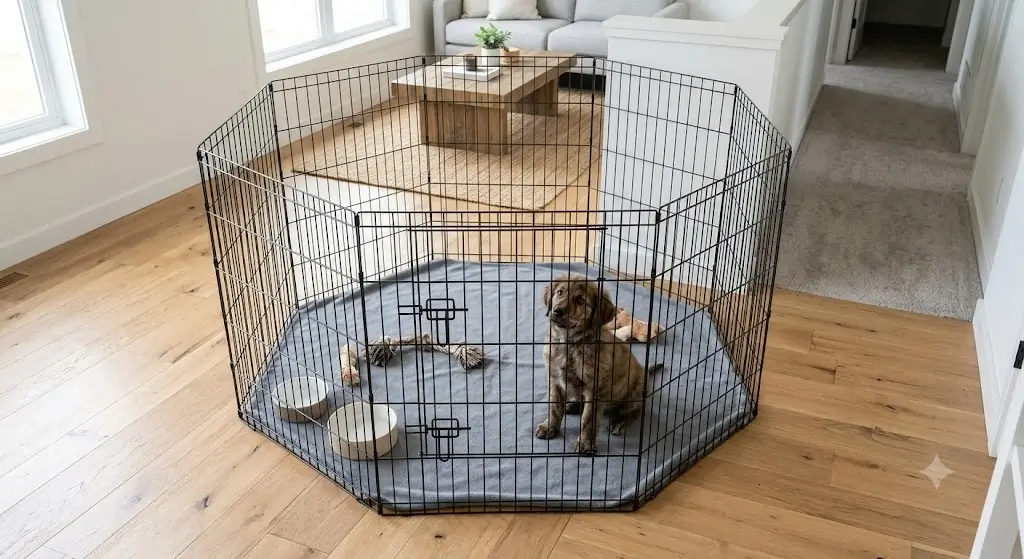
| Active Accidents (0–3 clean days) | Single puppy-proofed room or exercise pen | Direct 100% eyes-on visual monitoring |
| Emerging Reliability (4–7 clean days) | Single primary living zone with blocked hallways | Umbilical tethering or constant proximity |
| Established Consistency (14+ clean days) | Adjoining room opened under active supervision | Frequent check-ins with clear boundaries |
| Long-Term Reliability (30+ clean days) | Full household access with doors open | Standard domestic routine |
If accidents return upon opening a new room, retreat to the previous spatial boundary immediately. It is an environmental calibration, not a disciplinary failure.
Fix the Bathroom Schedule
A schedule established when a puppy was 8 weeks old becomes obsolete as metabolic rates, water consumption, and activity levels shift. Never rely on an arbitrary paper timetable; recalibrate according to empirical success thresholds.
Use the “Successful Interval” as Your Baseline
If a puppy stays clean for 60-minute stretches but reliably has accidents at 80 minutes, their current physiological limit is roughly 70 minutes. Setting a timer for 90 minutes and expecting progress is setting the puppy up to fail. Lock the schedule to 60 minutes for five consecutive days to bank successful repetitions, then stretch by 10-minute increments.
Critical Biological Bathroom Transitions
Beyond standard hourly intervals, puppies must be escorted to their outdoor spot during specific metabolic transitions:
- Immediately upon waking: Sleeping lowers blood pressure; waking triggers renal perfusion and immediate bladder filling.
- 15–30 minutes after eating: The gastrocolic reflex prompts colon contractions and defecation.
- Immediately after drinking: Liquids process through a puppy’s kidneys within 20 to 45 minutes.
- Mid-way through active play: Physical exertion elevates heart rate and bladder pressure.
- Following sudden excitement: Doorbell rings or guest arrivals cause sympathetic nervous system spikes that relax urethral sphincters.
- Before and after any period of confinement: Empty the tank before and after crate or playpen rest.
Reset Supervision Before Adding More Training
When training stalls, the most common culprit is “passive supervision”—being in the same room while looking at a laptop or cooking dinner. A puppy can squat and eliminate silently in three seconds.
Tighten visual tracking. Watch for subtle pre-elimination micro-behaviors: abrupt cessation of play, sudden sniffing with nose pressed firmly to the baseboards, circling, drifting toward furniture shadows, or pacing. Young puppies possess only a 3-to-5-second neurological window between sensing internal pressure and complete voiding.
Use the Environment to Prevent Mistakes
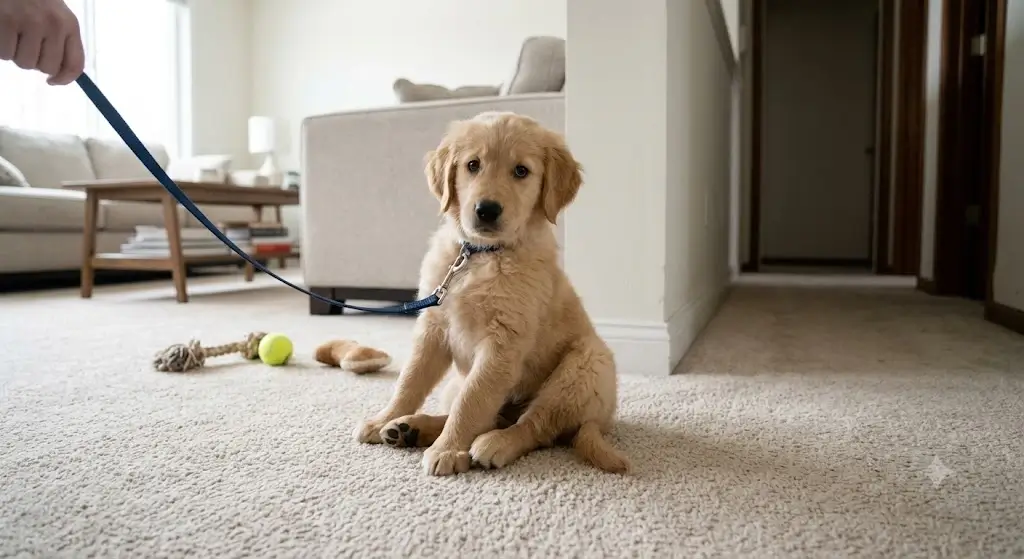
Environmental management is an active component of behavioral training, not an excuse. When direct visual monitoring is impossible, utilize physical infrastructure such as tension baby gates, exercise pens (x-pens), or the umbilical leash technique (tethering the puppy’s 6-foot leash to your belt).
Improve Reinforcement for Successful Bathroom Trips
A common reason house training stalls is that rewards become routine, delayed, or emotionally flat. Praising a puppy after they run back into the kitchen rewards them for crossing the patio door, not for eliminating on the grass.
The 5-Step Precision Outdoor Sequence
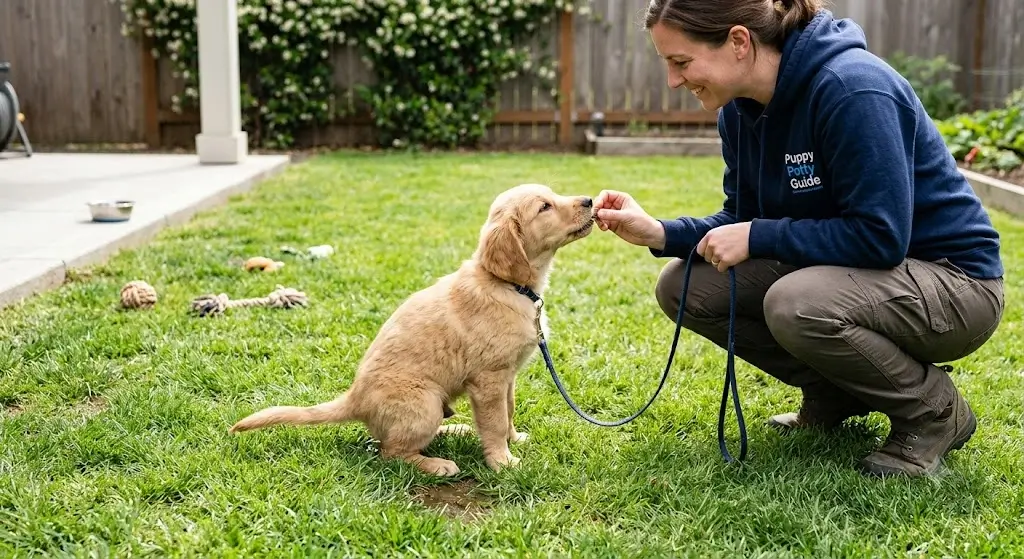
- Guide the puppy to the exact outdoor bathroom spot on a fixed 6-foot leash (prevent roaming).
- Stand completely still and remain boring for up to 5 minutes to avoid distracting them.
- The moment urine or stool begins, pair with a calm cue word (e.g., “go potty”).
- Within 2 seconds of completion, deliver a high-value protein treat (cooked chicken, freeze-dried liver) at ground level.
- Allow 30 seconds of enjoyable sniffing or play as a secondary environmental reward before returning indoors.
What If the Puppy Goes Outside but Does Not Eliminate?
Puppies frequently suffer from sensory overload outdoors: wind, lawn odors, traffic sounds, and insects pull attention away from bladder signals. Once brought back into the calm, predictable indoor living room, the puppy relaxes and immediately eliminates on the rug.
Never grant free indoor run-time after an unconsummated bathroom trip. If your puppy fails to eliminate within 5 minutes outside, carry them directly inside, place them in a playpen or crate for 10–15 minutes, and take them outside again. If this issue is chronic, follow our dedicated protocol for when your puppy won’t go potty outside.
What to Do After an Accident
Accidents provide critical diagnostic data. Immediately record the accident in a notepad: timestamp, exact floor surface, minutes since the last outdoor trip, handler supervision state, and preceding activity.
Next, eradicate all residual odor down to the floorboards. Standard household cleaning sprays containing ammonia or floral perfumes clean only superficial surfactants while leaving uric acid crystals intact. To a canine nose, these dried crystals signal a permanent bathroom zone. Follow our step-by-step clinical process on how to clean up puppy accidents properly using bio-enzymatic agents.
Do Not Punish the Puppy for an Accident
Rubbing a puppy’s nose in waste, shouting, or swatting them destroys house-training progress. Dogs associate punishment with the physical presence of the human, not the geographic location of the accident. The puppy concludes: “It is dangerous to eliminate in front of my owner.” This forces the puppy to sneak behind sofas or into empty bedrooms to eliminate covertly.
The only productive response is calm, rapid management:
- Interrupt calmly with a neutral sound (e.g., “outside”) if you catch them mid-stream.
- Scoop the puppy up swiftly and carry them to the designated outdoor grass zone.
- Praise warmly and reward if they finish voiding outside.
- Clean the indoor scene completely with bio-enzymatic cleaner without anger.
- Audit the schedule flaw that permitted the accident to occur.
The 7-Day House-Training Reset Framework
When training hits a wall, execute this structured 7-day single-variable protocol to isolate the bottleneck and rebuild behavioral reliability:
1 Day 1: Establish the Baseline Log
Do not alter current habits. Document all bathroom trips, successful voids, indoor accidents, and supervision lapses for 24 hours.
2 Day 2: Shorten the Interval Aggressively
Roll the bathroom interval back by 30 to 45 minutes. If accidents occur at 90 minutes, take the puppy out every 45 to 60 minutes.
3 Day 3: Lock Down Environmental Boundaries
Erect baby gates and close all bedroom doors. Restrict the puppy strictly to one cleanable, non-carpeted family room.
4 Day 4: High-Value Reinforcement Overhaul
Replace dry kibble rewards with high-value treats (real chicken breast, hot dog slivers). Reward outdoor voids within 2 seconds.
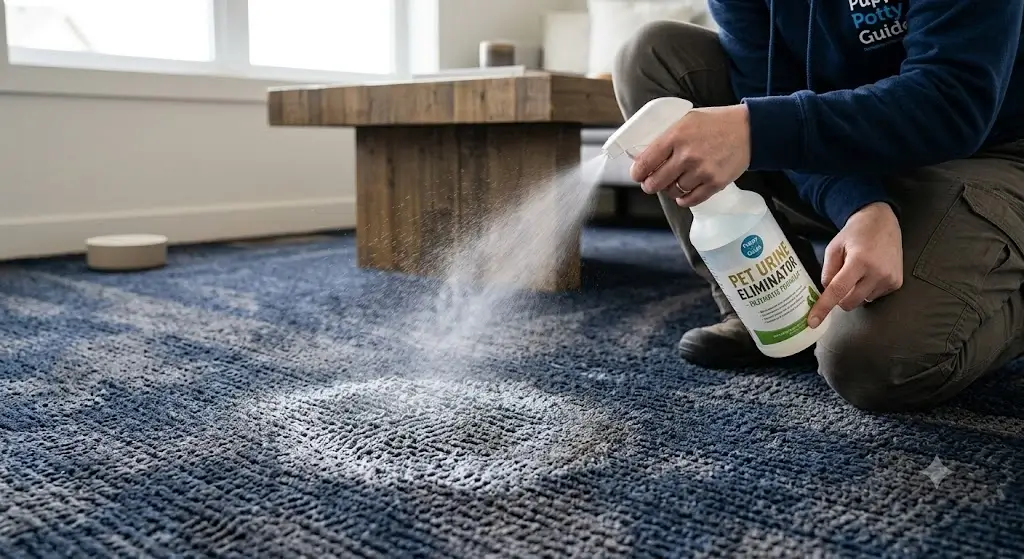
5 Day 5: Deep-Clean Chemical Audit
Conduct a blacklight sweep of rugs, baseboards, and furniture skirts. Saturate all glowing biological spots with enzymatic wash.
6 Day 6: Test a Single Expansion Variable
If Days 4 and 5 were 100% accident-free, introduce ONE modification: either extend the interval by 15 minutes OR open one adjacent room.
7 Day 7: Formulate the Permanent Routine
Analyze the 7-day data sheet. Solidify the schedule and boundary rules that yielded clean days; reverse any premature expansions.
Why Changing One Variable at a Time Matters
Scientific behavior modification demands single-variable isolation. If you alter the feeding schedule, crate location, reward value, and room access simultaneously, you cannot identify which adjustment solved the plateau. When an accident recurs, you will have no actionable data on which lever failed.
A Practical Troubleshooting Matrix
| Observed Plateau Pattern | Underlying Systemic Bottleneck | First Corrective Action |
|---|---|---|
| Accidents only when handlers are busy | Passive supervision vacuum | Implement umbilical leash or pen confinement |
| Accidents consistently at 90+ minutes | Overestimated bladder endurance | Reduce interval to 60 minutes for 5 days |
| Eliminates within 10 mins of coming inside | Sensory distraction outdoors | Apply 15-minute crate/pen reset cycle |
| Consistently soils a single dining room or rug | Lingering uric acid crystals / substrate habit | Enzyme saturate carpet and install baby gate |
| Reliable during day, wets bed at night | Immature nocturnal ADH hormone secretion | Set alarm 30 mins before habitual accident hour |
| Suddenly peeing small amounts everywhere | Urinary tract infection / systemic illness | Schedule veterinary urinalysis evaluation |
What If House Training Was Going Well Before It Stalled?
A plateau after weeks of stellar progress is rarely behavioral regression; it is usually an unnoticed management shift. Investigate subtle household changes:
- Did the puppy receive access to new rooms or upstairs hallways?
- Did family members return to work or alter morning walk times?
- Did handlers stop carrying treats outside, phasing out reinforcement too early?
- Did daily temperatures drop or rise dramatically, shortening outdoor excursions?
- Did water consumption surge due to warmer weather or higher-sodium treats?
- Did adolescent hormone development (5–8 months) begin triggering marking behaviors?
When a Stall Is Actually Behavioral Regression
A training stall means progress has plateaued; regression means an established, stable skill has broken down completely. If an older puppy who was reliably clean for months suddenly begins having widespread accidents, you must differentiate environmental disruptions from developmental or clinical issues. Read our full protocol on what to do when a puppy has accidents after being house trained.
What About Puppies That Keep Having Accidents?
If your puppy averages 3 to 5 accidents daily despite your best efforts, your baseline assumptions regarding management are compromised. Stop expanding freedom and run a complete environmental reset. Review our comprehensive diagnostic guide on puppies having too many accidents to rebuild management structures from scratch.
Nighttime House-Training Stalls
Diurnal and nocturnal house training rely on different physiological pathways. A puppy can be completely reliable during the day while continuing to soil their bed overnight because immature kidneys cannot concentrate urine without adequate anti-diuretic hormone. Review our dedicated guide on why your puppy keeps having accidents overnight to calibrate your midnight waking schedule.
Apartment and High-Rise Training Stalls
Urban apartment training introduces a critical mechanical latency: elevator rides, hallways, and stairwells add 3 to 7 minutes between recognizing a potty urge and touching grass. If your puppy eliminates in the hallway or elevator lobby, logistics are the problem. Explore our tailored protocols in house training a puppy in an apartment.
How to Know Whether the Reset Is Working
Never measure success by expecting zero accidents overnight. Evaluate trajectory using objective diagnostic metrics:
- Accident Frequency: Are accidents declining from daily occurrences to weekly incidents?
- Interval Duration: Has the reliable holding limit expanded from 45 to 75 minutes?
- Location Clustering: Are accidents ceasing in previously troubled rooms?
- Pre-Potty Signaling: Is the puppy beginning to pace, sit by the door, or whine before eliminating?
When to Increase Freedom Again
Freedom must always be earned through consistent, demonstrated reliability. When expanding indoor boundaries:
- Open one single adjoining room rather than granting full-house freedom.
- Directly supervise the puppy in the new room during the first 48 hours.
- Maintain the established successful outdoor bathroom schedule without stretching.
- If zero accidents occur over 14 continuous days, open the next zone.
- If an accident happens, close the new room and revert to the prior successful footprint immediately.
Common Mistakes That Keep House Training Stalled
1. Abandoning the Entire System for a New Gimmick
Switching frantically between puppy pads, bells, crates, and outdoor patches confuses the puppy’s substrate conditioning. Fix the management flaws in your existing system before changing philosophies.
2. Extending Bathroom Intervals Prematurely
Two clean days do not mean an 11-week-old puppy can hold their bladder for 3 hours. Bladder endurance grows gradually alongside biological kidney maturation.
3. Inconsistent Household Enforcement
If one partner meticulously supervises while another lets the puppy roam freely, the puppy receives conflicting rules. Standardize confinement and outdoor trips across all handlers.
4. Phasing Out High-Value Treats Too Soon
Praise alone is rarely sufficient to cement reliable habits in young puppies. Maintain high-value food rewards until the puppy is consistently accident-free for at least 60 consecutive days.
When Should a Veterinarian Be Involved?
Clinical Red Flags: A sudden house-training stall or regression often stems from underlying medical conditions rather than behavioral resistance. Consult your veterinarian immediately if you observe:
- Urinary Tract Infections (UTIs): Evidenced by frequent squatting, dribbling, cloudy urine, or painful whimpering.
- Hematuria: Visible pink, red, or brownish discoloration in urine puddles.
- Polydipsia: Drastic increase in daily water consumption, pointing to renal, endocrine, or metabolic issues.
- Intestinal Parasites: Giardia, Coccidia, or roundworms causing sudden nocturnal or crate-soiling diarrhea.
- Sudden Behavioral Lethargy: Unexplained weakness, vomiting, or appetite loss accompanying accidents.
Need a Complete Crate-Free House-Training Plan?
Overcome training plateaus, master indoor tethering, and establish dependable bathroom routines using our complete positive-reinforcement training system.
The 10-Minute House-Training Audit
If you are unsure where your training routine is failing, answer these eight diagnostic questions right now:
- Timestamp the last 3 accidents: At what exact hour did they occur?
- Check interval duration: How many minutes elapsed between the accident and the prior bathroom trip?
- Audit supervision level: Was someone actively watching, or was the puppy unmonitored?
- Check spatial access: Did the puppy have access to an unsupervised room or carpeted area?
- Evaluate reward mechanics: Was the last outdoor void rewarded with high-value food within 2 seconds?
- Inspect the surface: Did the accident happen on a previously contaminated rug or corner?
- Review routine stability: Has the feeding, work, or exercise schedule shifted recently?
- Check health clues: Has water intake, urination frequency, or stool consistency changed?
The answers will immediately point you to the primary variable requiring recalibration.
Frequently Asked Questions
What should I do when puppy house training stalls?
Identify the failure point first. Review bathroom timing, supervision, freedom, reinforcement, cleanup and recent routine changes. Then temporarily return to a simpler routine that produces more successful bathroom trips.
Why has my puppy stopped improving with house training?
The puppy may have received too much freedom, be waiting too long between bathroom opportunities, have inconsistent reinforcement, or be experiencing a change in routine. A sudden change can also warrant veterinary attention.
Should I restart house training if my puppy is having accidents?
A temporary reset is often useful when progress stalls. Increase supervision, reduce access and shorten bathroom intervals until successful behavior becomes consistent again.
How long should I give a house-training reset?
There is no universal number of days. Maintain the simpler routine until the puppy is consistently successful, then gradually increase freedom or bathroom intervals.
Is a house-training plateau normal?
Uneven progress can be normal. Puppies do not improve in a perfectly linear pattern. The important distinction is whether progress is simply slow or whether there has been a sudden and significant regression.
When should I contact a veterinarian about house-training problems?
Contact a veterinarian for sudden unexplained changes or symptoms such as straining, blood in urine, unusually frequent urination, increased thirst, pain, vomiting, diarrhea or unusual lethargy.
