
AKC BEHAVIORAL FRAMEWORK 2026
How to Prevent Repeat Puppy Accidents: 12 Practical Strategies
To prevent repeat puppy accidents, identify why the accidents are happening, tighten the potty schedule, supervise your puppy more closely, limit indoor freedom, and completely remove the scent from previous accident areas. The goal is not simply to react faster after an accident—it is to make the next accident less likely to happen. Mastering how to prevent repeat puppy accidents combines rigid environmental boundary management with complete biological pheromone destruction.
Repeated accidents are common during puppy house training. A puppy may understand that going outside is rewarded but still lack reliable bladder control, miss the timing window, become distracted outdoors, or have too much freedom indoors. When a young dog repeatedly voids on domestic substrates, microscopic uric acid crystals bind to flooring materials, releasing scent markers that chemically prompt instinctual re-marking whenever indoor relative humidity rises.
The most effective approach is usually a temporary reset: more frequent potty trips + closer supervision + less freedom + immediate rewards + thorough cleanup. The American Kennel Club (AKC) notes that puppies naturally prefer soft, absorbent surfaces and will return to previously soiled locations if olfactory cues remain. Establishing structured management protocols eliminates confusion, accelerating true bladder continence and housebreaking reliability.
Quick Reference Specification: Repeat Accident Prevention Matrix
This calibrated technical matrix benchmarks primary accident triggers, biological root causes, intervention strategies, timing execution, and industry compliance standards in 2026.
| Accident Pattern / Trigger | Biological / Environmental Cause | Primary Intervention Strategy | Execution Timing Window | Industry Benchmark Standard |
|---|---|---|---|---|
| Post-Sleep Accidents | Overnight urine pool accumulation | Direct-to-turf carry routine | <60 secs upon eyes opening | AKC Housebreaking Criteria |
| Post-Meal Elimination | Gastrocolic neural reflex trigger | Scheduled outdoor confinement walk | 10–20 mins post-ingestion | AVMA Canine Pediatric Guide |
| Re-Marking Same Spot | Residual uric acid pheromone salts | Bacillus bio-enzymatic soak | 15 mins dwell + covered damp | CRI Seal of Approval Standard |
| Unsupervised Wandering | Excess indoor spatial freedom | Umbilical leash / playpen tether | Continuous while indoors | IAABC Canine Management Guide |
| Outdoor Distraction Failure | Environmental stimulus interference | Boring 6-foot leash zone reset | 5 mins outdoor → crate reset | AKC Training Protocols |
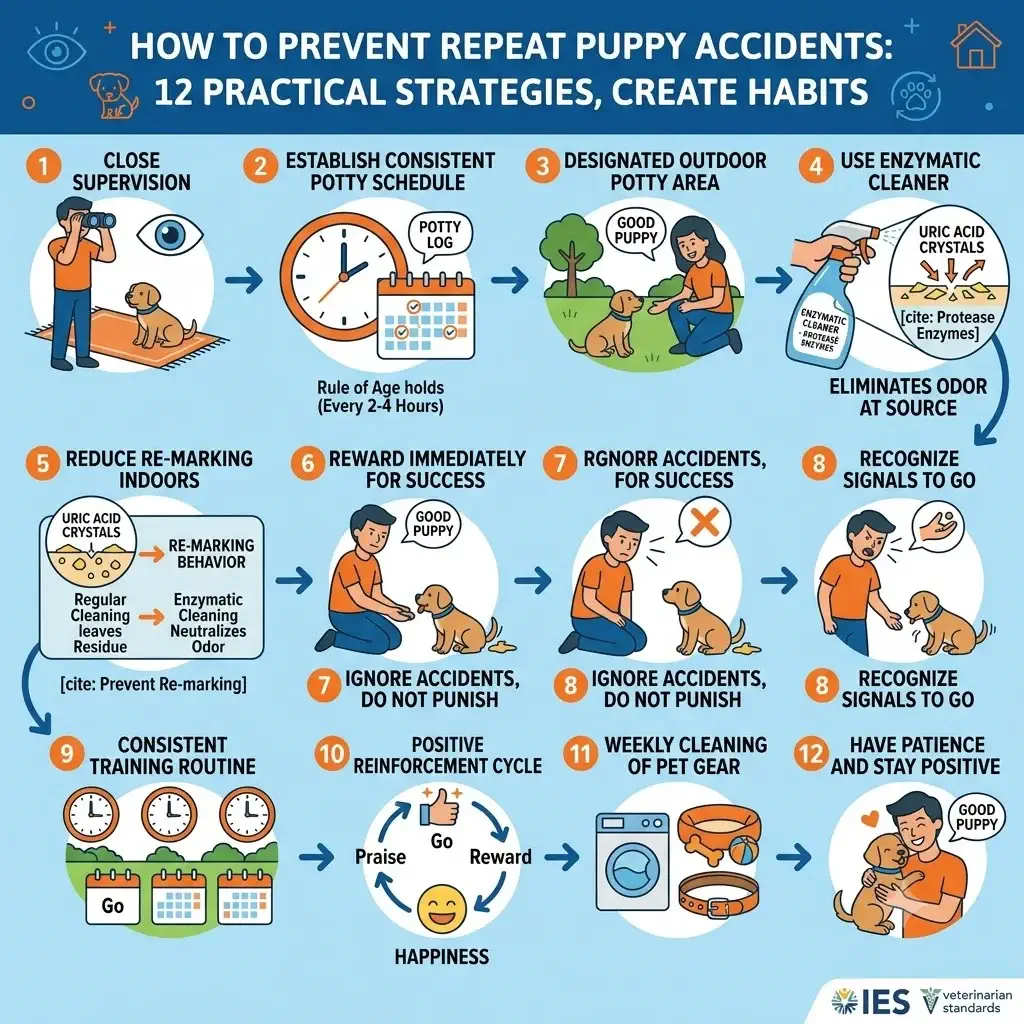
Quick Answer: How to Prevent Repeat Puppy Accidents
Systematic containment combined with proactive outdoor scheduling stops repeat accidents by removing opportunities for indoor elimination. When determining how to prevent repeat puppy accidents immediately, execute this twelve-step operational sequence:
- Increase potty-break frequency: Escort young puppies outdoors every 45 to 60 minutes during active daytime hours.
- Take your puppy out after waking, eating, playing, and naps: Exploit gastrocolic and urinary reflexes before bladder pressure exceeds voluntary control.
- Supervise closely indoors: Implement umbilical tethering with a 6-foot leash to keep the puppy within 3 feet of your sightline.
- Limit access to rooms where accidents occur: Erect sturdy freestanding baby gates to seal off carpeted bedrooms and hidden corridors.
- Learn your puppy’s pre-potty signals: Watch for abrupt halting of play, frantic floor sniffing, and tight circular posturing.
- Reward outdoor elimination immediately: Deliver a pea-sized high-value treat directly at ground level within 3 seconds of bladder emptying.
- Clean previous accidents thoroughly: Saturate contaminated areas with CRI-certified bio-enzymatic digesters to destroy uric acid crystals.
- Remove rugs and other attractive accident surfaces temporarily: Roll up porous woven area rugs that simulate outdoor lawn textures.
- Use the crate appropriately for short, structured rest—not as punishment: Leverage natural den instincts during unmonitored intervals.
- Give more freedom only after your puppy demonstrates reliability: Expand spatial access room-by-room only after 14 accident-free days.
- Track accidents to identify patterns: Maintain a 7-day elimination log documenting exact times, feeding schedules, and environmental triggers.
- Consider veterinary advice when accidents suddenly change or seem unusual: Rule out urinary tract infections (UTIs) or uroliths if urination becomes frequent or painful.
If accidents are happening repeatedly, temporarily make potty training easier rather than expecting the puppy to handle more freedom. Restricting spatial territory reduces cognitive overload while ensuring puppies consistently succeed.
Why Puppies Have Repeat Accidents
Underdeveloped urinary sphincters and residual pheromone markers cause puppies to re-soil familiar domestic areas involuntarily. Repeated accidents do not indicate stubbornness or spite; they reflect predictable physiological and environmental factors:
- Potty trips are spaced too far apart for the puppy’s physical bladder capacity (typically holding urine for 1 hour per month of age).
- The puppy has not developed voluntary muscular control over the urethral sphincter.
- Environmental stimuli (insects, leaf movement, street traffic) distract the puppy from voiding outdoors.
- The puppy is granted unsupervised freedom across expansive multi-room living areas.
- The puppy fails to recognize internal visceral pressure cues until bladder voiding is imminent.
- Crystallized uric acid salts from prior accidents remain trapped in carpet backing and padding.
- The handler fails to maintain continuous direct line-of-sight umbilical supervision.
- Food rewards are delivered inconsistently or delayed until returning indoors.
- Daily household routines and feeding schedules fluctuate wildly from day to day.
- Environmental stress, separation anxiety, or routine changes trigger excitement urination.
- Subclinical medical conditions (urinary tract infections, cystitis, vaginitis) cause painful incontinence.
The first step is therefore to determine when, where, and under what circumstances the accidents occur, diagnosing environmental failure points before altering the entire training regimen.
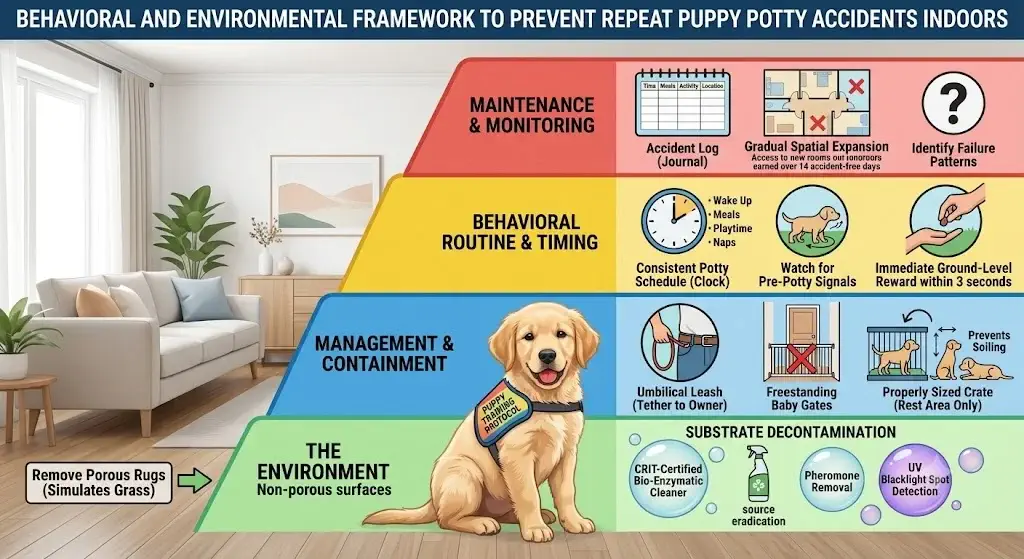
1. Reset the Potty Schedule
Shortening outdoor elimination intervals prevents physiological bladder capacity from exceeding voluntary containment thresholds. If your puppy experiences recurring accidents, immediately increase outdoor trip frequency rather than waiting for them to signal.
Young puppies lack the cognitive awareness to signal their need to eliminate until voiding is imminent. Construct a rigid, proactive schedule anchored directly to biological elimination triggers:
- Immediately upon morning waking (carry the puppy outside to prevent halfway accidents)
- Within 10 to 20 minutes following every scheduled meal
- Directly after the puppy drinks large quantities of water
- Immediately following vigorous indoor play, fetch, or tug sessions
- Promptly upon opening the crate door after a daytime nap
- Directly prior to nighttime crate confinement
Never rely on generic rule-of-thumb formulas during an active regression. If an 8-week-old puppy has accidents on a 2-hour interval, shorten the schedule to 45 minutes until consistency returns. For a complete time-calibrated routine, consult our master Puppy House Training Schedule.
2. Watch for Pre-Potty Signals
Distinct physiological displacement behaviors precede involuntary elimination by 10 to 30 seconds. Recognizing subtle pre-elimination cues allows handlers to intervene before accidents occur on floors:
- Abrupt cessation of play or mid-stride freeze while chewing a toy
- Intense, nose-to-floor scenting in concentrated square-foot patterns
- Tight circular pacing or compulsive tail-chasing maneuvers
- Directional drift toward previous accident locations or closed doors
- Restless agitation, pacing along perimeter baseboards, or whining
- Intentional drifting away from human handlers toward quiet rooms
- Subtle hindquarter dropping, hip tucking, or physical squat posturing
Pre-potty signals vary across breeds and temperaments. Learn your individual puppy’s specific behavioral tells. The moment you detect a recognized warning cue, calmly scoop or escort the puppy outdoors immediately without pausing to investigate.
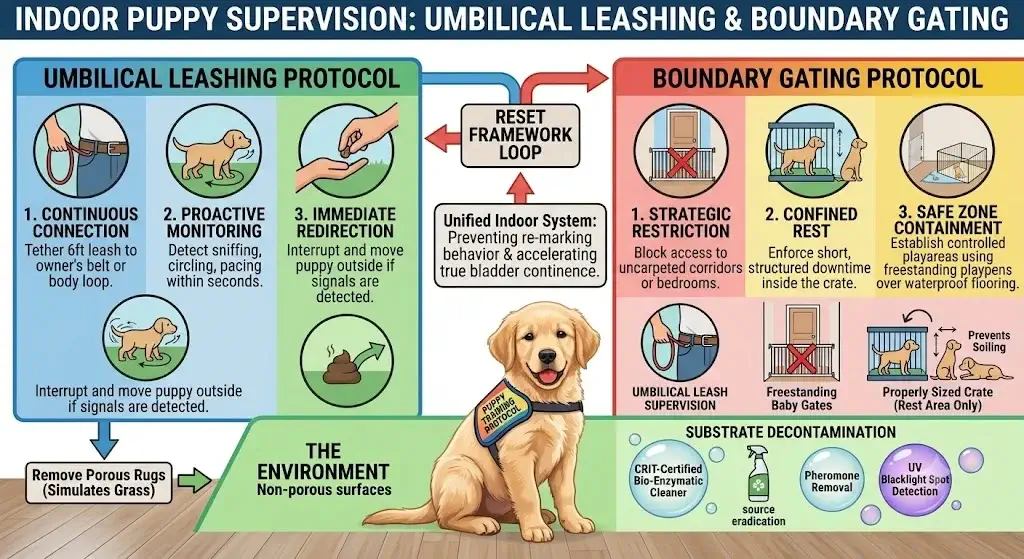
3. Supervise Your Puppy Closely Indoors
Continuous line-of-sight monitoring prevents puppies from drifting into concealed household corners to eliminate. Active supervision serves as the primary barrier against domestic housebreaking failures.
During active housebreaking, unrestricted, unmonitored indoor access is the leading cause of chronic regressions. If a puppy is out of sight for 15 seconds, they possess sufficient opportunity to soil. When direct human supervision is unavailable, enforce physical containment barriers:
- Umbilical Leashing: Fasten a 6-foot lightweight nylon leash to your belt loop, keeping the puppy tethered within 3 feet of your movement.
- Exercise Pens (X-Pens): Position a 4×4-foot wire playpen in your primary living space over a waterproof floor barrier.
- Gated Decontamination Zones: Confine the puppy to uncarpeted, tile, or vinyl rooms using pressure-mounted baby gates.
- Properly Sized Crates: Enforce short, structured downtime inside a crate that restricts elimination options.
Containment is a management protocol, not punishment; it provides structure while neurological bladder control matures.
4. Reduce Indoor Freedom Temporarily
Restricting environmental boundaries reduces territorial confusion and forces puppies to communicate elimination urgency. A puppy experiencing repeat accidents in the living room lacks the behavioral maturity required for unrestricted access:
Granting young dogs free rein across multi-room homes invites covert accidents. When a puppy wanders into an empty hallway or formal dining room, their natural den instinct diminishes, making elimination seem acceptable. Immediately contract your puppy’s physical footprint:
- Seal off wall-to-wall carpeted bedrooms and basements using solid pet barriers.
- Block access to dark corridors, recesses behind sofas, and low furniture clusters.
- Confine the dog to a single, easily sanitized, high-traffic room (such as a tile kitchen).
- Maintain restricted boundaries until the puppy achieves 14 consecutive accident-free days.
Gradually expand territorial access room by room only after the puppy demonstrates consistent outdoor reliability.
5. Reward Successful Potty Trips Immediately
Secondary operant conditioning requires positive reinforcement delivery within 3 seconds of bladder emptying to reinforce the behavior. Timing directly determines whether a puppy connects the reward to outdoor elimination:
When your puppy eliminates outdoors, wait until the stream completely finishes, then immediately deliver high-value reinforcement directly at ground level. Utilize rewards that carry immense motivational value:
- Pea-sized bites of freeze-dried beef liver, cooked chicken breast, or real cheddar cheese
- High-pitched, enthusiastic verbal praise (“Yes! Good potty!”) delivered calmly
- Brief, gentle chest petting that does not interrupt post-potty sniffing
Never delay rewards until you return inside the kitchen. A puppy rewarded at the backdoor associates the treat with crossing the threshold, not voiding their bladder on the grass. Mark the exact moment of completion outdoors.
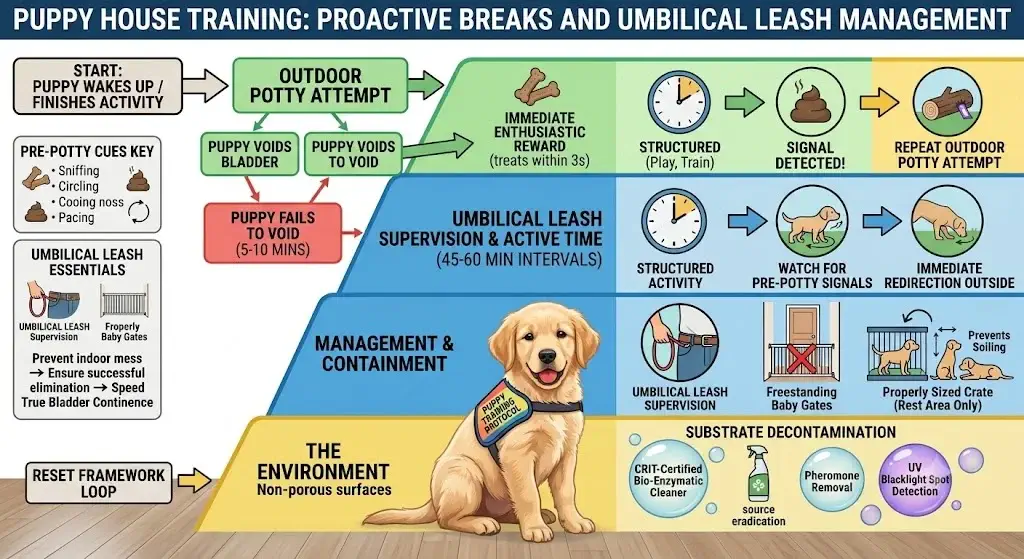
6. Stay Outside Long Enough for the Puppy to Finish
Environmental distractions delay canine elimination reflexes, causing puppies to void incomplete bladder volumes during short outdoor trips. Many puppies step outside, become overwhelmed by sensory stimuli, and forget to eliminate:
Puppies track fluttering leaves, passing cars, neighborhood dogs, and insect movement. If brought inside prematurely, the calming indoor environment allows bladder pressure to resurface, resulting in an accident within 3 minutes of re-entry. Enforce structured outdoor mechanics:
- Keep the puppy on a standard 6-foot fixed leash to restrict aimless roaming.
- Stand stationary in a dedicated, boring 10×10-foot potty patch without walking around.
- Ignore the puppy completely (no speaking, eye contact, or active play) for 5 full minutes.
- If they eliminate, reward immediately, followed by 2 minutes of celebratory play.
- If they fail to go within 5 minutes, escort them inside, place them in their crate for 10 minutes, and repeat the outdoor trip.
7. Clean Every Previous Accident Thoroughly
Residual uric acid crystal deposits emit pheromone cues that stimulate instinctual repeat canine marking. Even when flooring appears pristine under ambient light, dogs detect microscopic nitrogenous scent traces easily:
Standard household detergents, vinegar, and ammonia cleaners merely lift visible urochrome bile pigments while leaving insoluble uric acid salts bound to flooring polymers. Canine olfaction detects scent concentrations at one part per trillion, interpreting un-hydrolyzed urine deposits as an established toilet zone. Decontaminate previous accident sites thoroughly:
- Map out invisible dried salt perimeters using a 395nm UV blacklight in complete darkness.
- Saturate the zone with a CRI-certified bio-enzymatic cleaner containing active Bacillus cultures.
- Maintain damp contact for 15 minutes minimum to allow enzymatic digestion of urea and uric acid.
- Extract dissolved soils using clean microfiber towels or a motorized spot extraction vacuum.
If malodors persist inside fibrous flooring layers, review our detailed guide on Puppy Urine Smell in Carpet to extract sub-surface pad reservoirs.
8. Temporarily Remove Rugs
Porous textile substrates provide tactile claw grip and absorbency that mimic outdoor grass, triggering elimination reflexes. If your puppy repeatedly soils area rugs, roll them up and store them away during active training.
The AKC confirms that puppies develop strong tactile surface preferences during early developmental windows. Porous wool, jute, and tufted nylon rugs feel comfortable underfoot and instantly absorb urine puddles, allowing puppies to eliminate without splashing their paws. Removing area rugs achieves two vital goals: it eliminates prime accident targets and prevents costly damage to decorative textiles and underlying wood floor clearcoats. Keep rugs rolled up until your puppy achieves 30 consecutive accident-free days.
9. Use the Crate as a Management Tool
Canine denning instincts discourage dogs from soiling the immediate sleeping substrate inside a correctly sized enclosure. When handlers cannot maintain active umbilical supervision, the crate provides an effective management barrier:
To leverage the crate effectively without inducing confinement distress or soiling:
- Calibrate Dimensions Strictly: The crate must only provide enough space for the puppy to stand upright, turn around, and lie down comfortably.
- Utilize Divider Panels: Adjust internal wire dividers outward as the puppy grows physically. Excess room allows puppies to soil one corner and sleep in the other.
- Avoid Excessive Durations: Young puppies should never remain crated beyond their physical holding limit (maximum 2 to 4 hours during the day).
- Direct-to-Potty Transit: Always carry or walk the puppy on a leash directly from the crate to the outdoor elimination station.
Never utilize the crate as punitive isolation. The enclosure must remain a positive, comfortable den associated with safe chew toys and calm rest.
10. Use a Playpen When More Space Is Needed
Freestanding modular exercise pens establish safe, unsoiled containment zones when puppies require active daytime awake periods. A playpen bridges the gap between strict crate confinement and unmanageable household freedom:
- Position the exercise pen on a hard, washable floor or over a heavy-duty silicone floor mat.
- Equip the pen with a water bowl, an open crate with comfortable bedding, and safe enrichment toys.
- Permit the puppy to play inside the pen while you work or complete chores nearby.
- Escort the puppy outside to eliminate immediately before and after playpen sessions.
A playpen maintains spatial containment, preventing puppies from slipping behind furniture or accessing carpeted hallways while still providing room to stretch, play, and nap safely.
11. Track the Accidents
Empirical documentation of elimination intervals exposes hidden behavioral patterns and physiological digestion timelines. Keeping a simple 7-day log transforms subjective frustration into actionable management adjustments:
| Data Point to Record | Diagnostic Clinical Value |
|---|---|
| Time of Accident | Reveals whether scheduled outdoor intervals exceed bladder capacity |
| Prior Meal & Water Timing | Establishes individual digestive and gastrocolic reflex transit times |
| Preceding Activity | Pinpoints excitement, rough play, or post-nap triggers |
| Accident Room Location | Identifies repeat-target zones harboring residual urine odors |
| Supervision Status | Exposes lapses where handlers failed to maintain line-of-sight umbilical tethering |
| Successful Outdoor Trips | Measures genuine housebreaking progress and reinforcement consistency |
If tracking reveals that accidents consistently happen 40 minutes after lunch, adjust your schedule to take the puppy outside at the 30-minute mark, turning accidents into rewarded successes.
12. Increase Freedom Gradually
Systematic spatial expansion should reflect demonstrated continence reliability rather than arbitrary calendar timelines. Freedom must be earned through consistent housebreaking success:
When your puppy achieves 14 consecutive days of zero accidents in their primary confinement zone, expand access to an adjacent room. Maintain close supervision during initial integration. If an accident occurs, calmly contract the puppy’s boundaries back to the previous successful perimeter for 7 days. This stepwise progression ensures that canine spatial awareness expands in direct alignment with physical bladder development.
What to Do When a Puppy Has an Accident Again
Calm interruption and immediate redirection preserve the human-canine bond while reinforcing the correct outdoor elimination site. When you catch your puppy actively having an accident, stay composed:
- Interrupt Calmly: Make a neutral, sharp verbal noise (such as “Oops!”) to startle the puppy into contracting their urethral sphincter. Avoid screaming, throwing objects, or angry scolding.
- Redirect Outdoors Instantly: Scoop the puppy up immediately (most dogs will not void while suspended) and carry them directly to their outdoor potty spot.
- Reward Outdoor Completion: If the puppy finishes their bladder voiding outside, reward them enthusiastically with high-value treats and praise.
- Decontaminate Thoroughly: Clean the indoor mess using a CRI-certified bio-enzymatic spray, ensuring complete source eradication.
- Log and Adjust: Record the incident in your tracking log and shorten the outdoor interval by 15 minutes for the remainder of the day.
Never punish a puppy after discovering an old, cold accident. Dogs cannot associate delayed scolding with an action performed minutes or hours prior; physical punishment merely creates fear of eliminating in front of you.
What If My Puppy Goes Outside but Still Has Accidents?
Incomplete outdoor bladder evacuation combined with indoor sensory decompression triggers rapid elimination upon returning indoors. This frustrating phenomenon indicates that the puppy failed to empty their bladder fully while outside:
- Fractional Elimination: The puppy eliminated only a partial volume outdoors due to cold weather, wet grass, or distracting noises.
- Sensory Decompression: Stepping inside a quiet, warm living room allows tensed abdominal muscles to relax, triggering immediate voiding.
- Post-Potty Excitement: Returning inside induces a burst of energetic play, immediately stimulating gastrocolic and urinary reflexes.
Implement the “Crate Reset Protocol”: if your puppy fails to eliminate after 5 minutes outside, escort them indoors on-leash, place them in their crate for 10 to 15 minutes, and take them straight back outdoors. Repeat this cycle until successful outdoor voiding occurs, then grant supervised indoor freedom.
What If Accidents Keep Happening in One Room?
Isolated single-room accidents indicate residual sub-surface urine odors or a lack of functional habituation inside that specific space. When a puppy reliably avoids accidents everywhere except one room, investigate two variables:
- Sub-Surface Malodor Reserves: Dried uric acid salts trapped in carpet padding or hardwood seams continue off-gassing pheromones. Audit the room using a 395nm UV blacklight and apply deep bio-enzymatic extraction.
- Spatial Disconnection: The puppy does not yet view that specific room as part of their living “den.” Feed meals, practice training commands, and play interactive games in that room to change its psychological designation.
Erect baby gates to close off the room entirely until your puppy has demonstrated several weeks of flawless continence across primary living zones.
What If Puppy Accidents Suddenly Increase?
Sudden behavioral regressions typically signal acute medical distress, environmental disruption, or rapid changes in daily routines. When a previously reliable puppy suddenly begins having multiple accidents daily, audit recent household variables:
- Sudden dietary shifts, new high-sodium training treats, or changes in feeding times
- Environmental stress stemming from construction noise, houseguests, or travel
- Seasonal weather shifts (heavy rain, snow, freezing cold) that make outdoor elimination unpleasant
- Recent expansion of indoor territorial freedom granted before the puppy was truly ready
If environmental variables remain unchanged, schedule an immediate veterinary urinalysis to rule out urinary tract infections or bladder crystals before assuming the regression is behavioral.
When Repeat Accidents May Be a Health Issue
Pathological urological inflammation overrides voluntary muscular continence, causing involuntary, frequent, and painful urination. Never classify a medical housebreaking regression as stubbornness or disobedience.
Contact your veterinarian immediately if housebreaking regressions accompany any of the following clinical signs:
- Frequent, painful posturing with only tiny drops or dribbles produced (stranguria/dysuria)
- Pinkish, red, or cloudy urine discoloration indicating hematuria or heavy white blood cell counts
- Unusually pungent, sweet, or fishy urine odors noticeable from several feet away
- Excessive daily water consumption accompanied by massive urine output (polydipsia/polyuria)
- Licking the vulva or prepuce compulsively following urination attempts
- Uncharacteristic lethargy, loss of appetite, fever, or whimpering while voiding
Urinary tract infections (UTIs), bladder uroliths, juvenile vaginitis, congenital ectopic ureters, or systemic endocrine disorders require veterinary diagnostics and prescription therapeutics.
How Long Does It Take to Stop Repeat Puppy Accidents?
Neurological sphincter maturation and consistent habituation typically establish complete housebreaking reliability by 4 to 6 months of age. Training timelines vary significantly across individual dogs based on several core factors:
- Breed and Physical Size: Toy breeds (Yorkies, Chihuahuas) possess tiny bladders and higher metabolic rates, requiring longer training windows than large breeds.
- Handler Consistency: Enforcing strict schedule timing and umbilical supervision accelerates progress exponentially.
- Prior Substrate History: Puppies raised on concrete, newspaper, or dirty kennel runs require extra time to build outdoor grass preferences.
Focus on the trajectory of progress rather than an arbitrary calendar deadline. If accidents decrease in frequency and your puppy increasingly signals or waits at doors, your framework is succeeding. If regressions multiply, reset your management protocols immediately.
Repeat Accidents: A Simple Reset Plan
A structured 3-day environmental reset rebuilds reliable elimination habits by eliminating opportunities for failure. Execute this calibrated daily management routine:
Morning Protocol
- Carry the puppy directly from the crate to the outdoor potty spot upon waking.
- Deliver a high-value treat within 3 seconds of bladder emptying.
- Feed breakfast inside the crate or playpen; take the puppy outdoors 15 minutes post-meal.
Daytime Protocol
- Maintain 100% active supervision via umbilical leashes or exercise pen containment.
- Escort the puppy outside every 45 to 60 minutes, and immediately following active play or naps.
- Enforce structured 1-to-2-hour crate naps between active engagement sessions.
Evening Protocol
- Remove the water bowl approximately 2 hours before nighttime bedtime.
- Provide a final, quiet outdoor elimination trip directly before crating for the night.
Repeat Puppy Accident Prevention: Decision Guide
Systematic matching of diagnostic accident symptoms to targeted management interventions restores housebreaking consistency. Select your first corrective action based on your puppy’s specific failure point:
| Accident Scenario | Immediate Management Adjustment |
|---|---|
| Accidents between scheduled breaks | Shorten outdoor intervals by 15 to 30 minutes; carry puppy outside |
| Accidents immediately upon waking | Carry the puppy directly from crate to turf without letting feet touch floors |
| Accidents directly following play | Add a mandatory outdoor potty trip immediately upon stopping physical play |
| Accidents isolated to one room | Erect baby gates to close room; apply deep bio-enzymes to carpet padding |
| Accidents on decorative area rugs | Roll up and remove all area rugs temporarily until housebreaking is solid |
| Accidents when unsupervised | Deploy umbilical tethering or crate/playpen containment immediately |
| Accidents 2 minutes after outdoor trip | Implement crate reset protocol (5 mins out → 10 mins crate → 5 mins out) |
| Sudden massive spike in accidents | Collect sterile urine sample and schedule immediate veterinary urinalysis |
Common Mistakes That Cause Repeat Puppy Accidents
Procedural inconsistencies and delayed reinforcements derail housebreaking and reinforce indoor elimination habits. Avoid these eight operational errors during training:
- Granting Unearned Household Freedom: Allowing puppies to wander unmonitored invites accidents in hidden corners.
- Waiting for the Puppy to Signal: Expecting immature puppies to bark at doors before sphincter control develops leads to accidents.
- Maintaining Rigid, Inflexible Schedules: Failing to adjust intervals based on meals, weather, and activity levels causes predictable failures.
- Delaying Operant Rewards: Giving treats after returning indoors rewards crossing the threshold, not outdoor voiding.
- Cleaning With Incompatible Chemicals: Using ammonia, vinegar, or bleach leaves uric acid pheromones intact, prompting repeat marking.
- Punishing Accidents Retroactively: Scolding puppies over old messes creates fear and covert elimination behind furniture.
- Assuming One Morning Urination Is Sufficient: Failing to recognize that puppies often void their bladder in multiple fractional bursts.
- Overlooking Medical Indicators: Treating urinary tract infections or congenital defects as behavioral disobedience.
For safe cleaning practices that protect surfaces and remove odor sources, explore our guide on How to Prevent Puppy Urine Odor.
Repeat Puppy Accident Prevention Checklist
Standardized operational protocols maintain structural discipline and eliminate household accident triggers. Follow this complete procedural checklist:
- ☐ Shorten scheduled daytime potty intervals to every 45 to 60 minutes
- ☐ Escort the puppy outdoors immediately upon waking, feeding, and finishing play
- ☐ Maintain active line-of-sight supervision via umbilical leashes or exercise pens
- ☐ Seal off carpeted bedrooms and hidden corridors using sturdy baby gates
- ☐ Identify individual pre-potty cues (sniffing, circling, abrupt stillness)
- ☐ Deliver high-value treats at ground level within 3 seconds of outdoor voiding
- ☐ Stay outside for 5 full minutes in a boring 10×10-foot spot without distractions
- ☐ Decontaminate all past accidents with CRI-certified bio-enzymatic digesters
- ☐ Roll up and store decorative area rugs during active housebreaking
- ☐ Calibrate crate dimensions using dividers to prevent soiling corners
- ☐ Maintain a detailed 7-day elimination tracking log to identify failure points
- ☐ Expand household territorial freedom only after 14 accident-free days
- ☐ Schedule a veterinary consultation immediately if regressions accompany straining or cloudy urine
Frequently Asked Questions (FAQ)
How do I stop my puppy from having repeat accidents?
Why does my puppy keep having accidents after being house trained?
Should I take my puppy outside more often after an accident?
Why does my puppy pee in the same spot?
Should I remove rugs during puppy potty training?
Should I punish my puppy for another accident?
Why does my puppy have accidents after coming inside?
How do I know if my puppy is ready for more freedom?
Can crate training prevent puppy accidents?
Can a playpen help prevent puppy accidents?
How long does it take to stop repeat accidents?
Why did my puppy suddenly start having accidents?
How do I prevent puppy urine odor from repeat accidents?
When should I call a veterinarian about puppy accidents?
Bottom Line: Make Success Inevitable, Make Failure Impossible
Preventing repeat puppy accidents requires structuring the environment to make correct behavior easy while eliminating opportunities for failure. Increase outdoor potty frequency, supervise active indoor time with umbilical leashes, restrict unearned freedom with sturdy baby gates, reward outdoor elimination within 3 seconds, and completely eradicate residual scent markers from past accident locations.
If accidents persist, do not wait for the dog to “grow out of it.” Use an empirical tracking log to diagnose schedule gaps and spatial vulnerabilities. If a previously house-trained puppy experiences a sudden spike in accidents accompanied by straining or discomfort, seek veterinary diagnostics to rule out medical issues. Reset the schedule → supervise continuously → restrict freedom → reward immediately → clean completely → expand boundaries gradually. This disciplined framework ensures rapid housebreaking mastery while protecting your home investments.
