
BIOCHEMICAL ODOR REMEDIATION 2026
How to Remove Puppy Urine Smell: Step-by-Step Guide
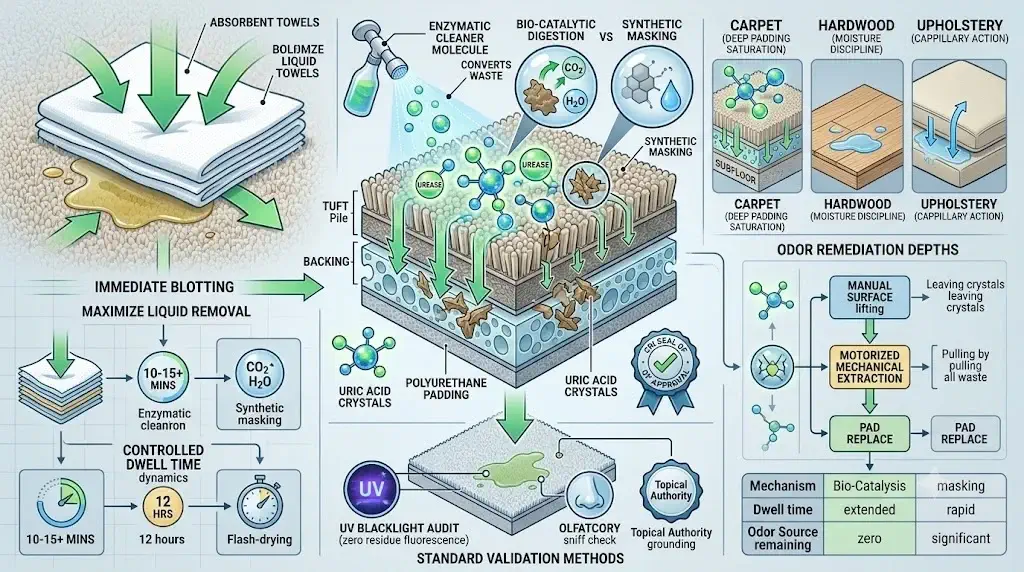
The best way to remove puppy urine smell is to eliminate the underlying uric acid crystals rather than masking the odor with synthetic fragrance. Blot fresh urine immediately, treat the contaminated area with a surface-compatible biological cleaner, allow sufficient contact dwell time, and let the area dry completely. When mastering how to remove puppy urine smell, diagnosing depth is essential: if the smell keeps returning, the liquid has migrated past surface fibers into carpet padding, upholstery foam, rug backing, or subfloor seams.
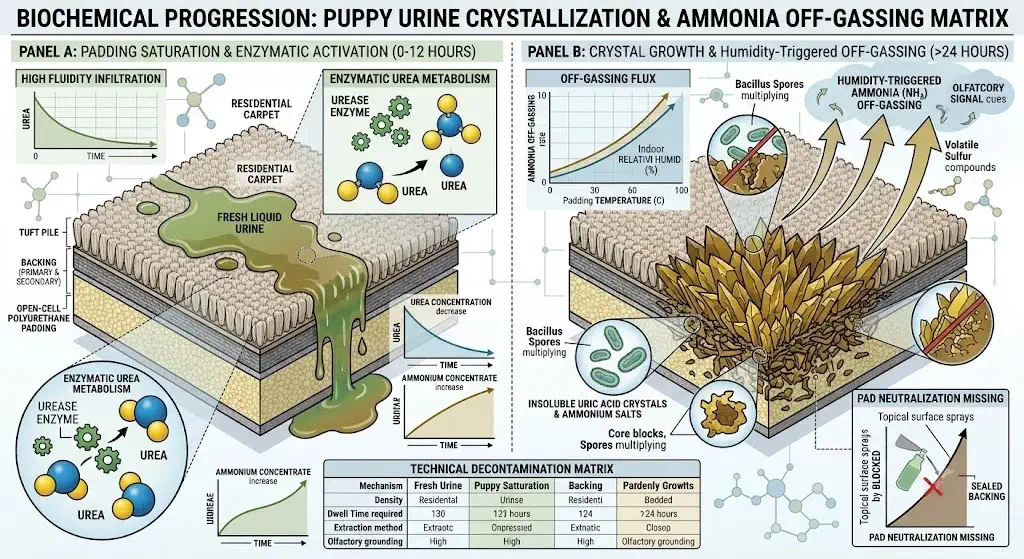
Puppy urine odor exhibits extreme environmental tenacity because dried urea and urochrome form insoluble crystalline salts. While a surface puddle may appear completely dry and sanitized, fluctuating atmospheric humidity continually reactivates these hygroscopic salts, triggering volatile ammonia off-gassing. Treating only the visible face fibers leaves an active biochemical reservoir untouched in the underlying open-cell polyurethane padding.
The American Kennel Club (AKC) recommends prompt cleanup and thorough odor eradication because lingering urine scent cues trigger instinctual re-marking in developing puppies. For dried deposits, the AKC advises rehydrating and extracting the area before applying an appropriate enzymatic formula, warning explicitly against steam cleaning because heat permanently denatures urine proteins into synthetic fibers. Independent 2026 laboratory testing proves that complete odor elimination requires catalytic biological digestion rather than masking deodorizers.
Quick Reference Specification: Puppy Urine Odor Remediation Matrix
This calibrated mechanical and chemical matrix benchmarks active remediation chemistry, necessary dwell windows, penetration depths, and standard validation protocols across residential surfaces.
| Affected Substrate | Optimal Remediation Chemistry | Required Dwell Window | Decontamination Method | Standard & Validation Protocol |
|---|---|---|---|---|
| Carpet Pile & Tufting | Bacillus bacterial spores + urease enzyme | 10–15 mins (up to 12 hrs covered) | Firm downward blot or wet extraction | CRI Seal of Approval / UV Blacklight Audit |
| Open-Cell Carpet Pad | High-potency bio-enzymatic deep flush | 8–12 hrs sustained moisture | Motorized sub-surface vacuum extraction claw | IICRC S300 Standard for Deep Odor |
| Finished Hardwood | Neutral-pH wood-safe enzyme or surfactant mist | 3–5 mins maximum (no pooling) | Immediate dry towel wipe + electric air mover | NWFA Finish Maintenance Protocol |
| Upholstery Cushioning | Low-moisture enzymatic foam encapsulation | 10–15 mins under damp towel | Downward compression blotting; avoid soaking | Furniture Care Code W/WS Validation |
| Washable Bedding | Enzymatic detergent additive (protease/lipase) | 30–45 min washing cycle | Cold pre-soak + high-spin mechanical rinse | Consumer Reports Laundry Benchmark |
Quick Answer: How to Remove Puppy Urine Smell
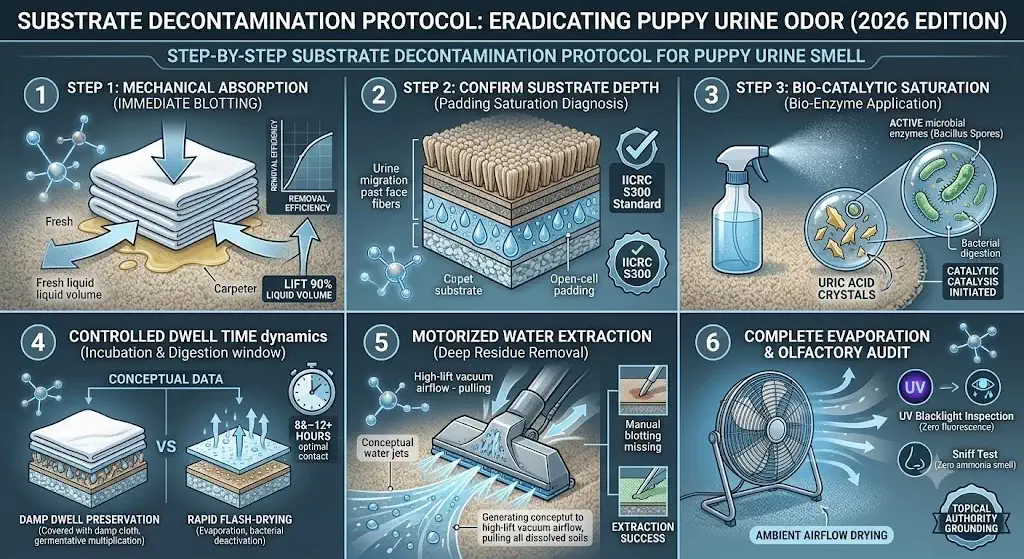
Systematic mechanical extraction combined with biological enzyme digestion eliminates urine odors by converting uric acid into harmless gases. When identifying how to remove puppy urine smell with permanent efficacy, follow this structured ten-step operational checklist:
- Find the entire contaminated area: Inspect perimeters with a 395nm UV blacklight to illuminate the invisible crystal footprint.
- Blot fresh urine immediately: Press clean paper towels downward to absorb liquid volume before capillary migration occurs.
- Remove as much liquid as possible: Continue applying vertical pressure until dry paper towels show no moisture transfer.
- Choose a cleaner appropriate for the surface: Select a neutral-pH bio-enzyme for carpets or a specialized mist for hardwood.
- Use an enzymatic odor-treatment product: Deploy active microbial formulas capable of breaking down stubborn uric acid salts.
- Follow the product’s required contact time: Maintain damp surface conditions for 10 to 15 minutes minimum to allow enzyme germination.
- Blot or extract the area as directed: Press clean white microfiber cloths down firmly or use a motorized spot-cleaning vacuum.
- Let the surface dry completely: Direct electric fans across the flooring to accelerate natural evaporation.
- Check the odor again after drying: Evaluate the zone with an olfactory sniff test and UV light once moisture has fully dissipated.
- Treat deeper contamination if the smell returns: Apply sub-surface extraction if fluid has saturated the underlying carpet pad.
Do not simply spray air freshener over puppy urine. A synthetic fragrance merely masks airborne volatile compounds without dismantling the bacterial food source producing the pungent ammonia smell.
Why Puppy Urine Smells So Bad
Canine urine releases pungent ammonia gas as environmental bacteria metabolize organic urea into volatile alkaline compounds. Fresh urine initially exhibits a mildly acidic to neutral pH with faint odor, but as moisture evaporates, chemical breakdown accelerates dramatically.
The biochemical progression shifts from liquid urea into insoluble uric acid crystal salts. These sharp crystal deposits bind tightly to synthetic carpet tufting and wood pores. Whenever relative humidity rises above 50%, these hygroscopic salts draw moisture from ambient indoor air, reactivating bacterial digestion and releasing renewed waves of pungent ammonia and mercaptans.
| Contamination Challenge | Primary Biochemical Target | Optimal Remediation Approach |
|---|---|---|
| Visible yellow stain | Urochrome bile pigments | Mild oxidizer or surfactant lifting |
| Fresh urine smell | Aqueous urea and liquid water | Immediate blot absorption and surface sanitization |
| Dried urine odor | Insoluble uric acid crystals | Bio-enzymatic digestion (urease catalysis) |
| Recurring smell | Padding or subfloor contamination | Sub-surface mechanical extraction or pad replacement |
| General pet room smell | Airborne volatile organic compounds (VOCs) | Molecular encapsulation spray and ventilation |
This biochemical distinction explains why stain removal and permanent odor neutralization must never be treated as the same mechanical task.
Why Does Puppy Urine Smell Come Back After Cleaning?
Sub-surface fluid penetration traps urine reservoirs inside open-cell padding and floor joints beyond the reach of topical surface sprays. If your room develops an intense urine smell days after cleaning, several hidden mechanical factors are typically responsible:
- Carpet Padding Saturation: Fluids seep through primary backing into the porous polyurethane foam pad, spreading into a puddle twice as large as the visible surface stain.
- Rug Backing & Underlay Absorption: Inexpensive latex rug backing traps urine against hardwood floors, fostering anaerobic bacterial growth.
- Upholstery Cushion Migration: Porous furniture foam acts as a sponge, pulling urine deep into seat cores via capillary action.
- Unsealed Floor Seams: Liquid cascades between tongue-and-groove hardwood planks, settling into structural plywood subfloors.
- Premature Cleaner Removal: Wiping away bio-enzymes within 2 to 3 minutes kills the bacterial culture before it can hydrolyze insoluble uric salts.
- Adjacent Unidentified Accidents: Puppies frequently eliminate near the perimeter of previous spots, leaving older urine deposits untreated nearby.
Good Housekeeping’s 2026 laboratory testing demonstrates that enzyme cleaners excel at neutralizing recurring odors precisely because they target the molecular components of stains rather than masking them with perfumes. However, their trials emphasize that bio-enzymes require extended damp dwell times to achieve total bacterial digestion.
How to Remove Fresh Puppy Urine Smell
Immediate downward blot absorption extracts liquid volume before capillary forces drive urine into carpet backing layers. When discovering a warm, fresh puddle, follow this 4-step decontamination protocol:
Step 1: Blot Immediately
Stack several layers of absorbent white paper towels or folded microfiber cloths directly over the puddle. Apply firm downward pressure using your palms or step gently onto the stack. Replace soaked towels continuously until zero moisture transfers to the paper. Never scrub or rub the urine aggressively. Friction frays textile tufts and drives liquid deep into carpet padding. AKC guidelines recommend absorbing as much liquid volume as possible before introducing chemical cleaners.
Step 2: Treat the Contaminated Zone
Once excess moisture is extracted, apply a bio-enzymatic urine cleaner formulated for the specific flooring material. Spray generously across the perimeter, working inward to avoid spreading the contaminant footprint. Bio-enzymatic solutions are essential because they deploy specialized urease enzymes to dismantle urea molecules immediately.
Step 3: Preserve Chemical Dwell Time
Allow the biological cleaner to remain damp for 10 to 15 minutes minimum. Never wipe an enzyme spray away immediately. Good Housekeeping’s 2026 evaluations highlight that while some surfactant cleaners lift color quickly, living bacterial cultures require sufficient time in a moist state to consume nitrogenous waste compounds.
Step 4: Dry Completely
Blot the area firmly with clean, dry microfiber cloths to lift dissolved residues. Allow the surface to dry completely under active room ventilation before assessing odor results. A damp carpet often emits a temporary biological scent while drying, so the final olfactory evaluation should occur only when fibers are bone dry.
How to Remove Dried Puppy Urine Smell
Dried urine deposits require controlled liquid rehydration to dissolve hardened uric crystals before bio-enzymes can digest them. Old, cured accidents present significant odor challenges because you cannot see the full subsurface perimeter under normal lighting:
- Identify the entire affected area: Darken the room and sweep a 395nm UV blacklight across the flooring to map out fluorescent salt boundaries.
- Rehydrate the dry stain: Mist lukewarm (not hot) distilled water over the zone to soften hardened crystal crusts.
- Extract initial dissolved moisture: Blot with dry microfiber towels or run a motorized vacuum extractor over the spot.
- Apply an enzymatic pet-odor cleaner: Saturate the fabric thoroughly, applying enough volume to reach the underlying backing.
- Preserve the active dwell window: Cover the wet spot with a damp towel for 6 to 12 hours to prevent premature evaporation.
- Blot or extract as directed: Press clean cloths down with body weight or run a water extraction machine to remove dissolved soils.
- Allow complete air-drying: Run an electric floor fan over the spot to ensure thorough evaporation.
- Reassess the odor: Perform an olfactory audit once completely dry; if faint ammonia remains, repeat the process.
The AKC specifically warns against using high-temperature steam cleaners on dried urine because intense heat denatures proteins and binds them permanently into synthetic carpet tufting.
How to Remove Puppy Urine Smell From Carpet
Carpet pile tufting and porous latex backing channel liquid downward into thick padding via gravity and capillary suction. When tackling carpet odor, differentiate between fresh puddles and deep-set stains:
Fresh Carpet Accidents
Blot immediately with stacked paper towels, apply a CRI-certified enzymatic pet cleaner, allow 15 minutes of dwell time, and blot dry with clean white microfiber towels. When addressed within minutes, fluid rarely breaches the primary backing.
Dried or Multi-Spot Carpet Accidents
Older urine seeps past carpet backing into the open-cell foam cushion below. When simple surface sprays fail to resolve recurring malodor, motorized water-extraction extractors become mandatory. Mechanical cleaners inject pressurized rinsing water and generate high-lift vacuum suction to draw embedded salts out of the backing. For vetted machine benchmarks, review our complete Best Carpet Cleaners for Dog Urine guide.
How to Remove Puppy Urine Smell From Carpet Padding
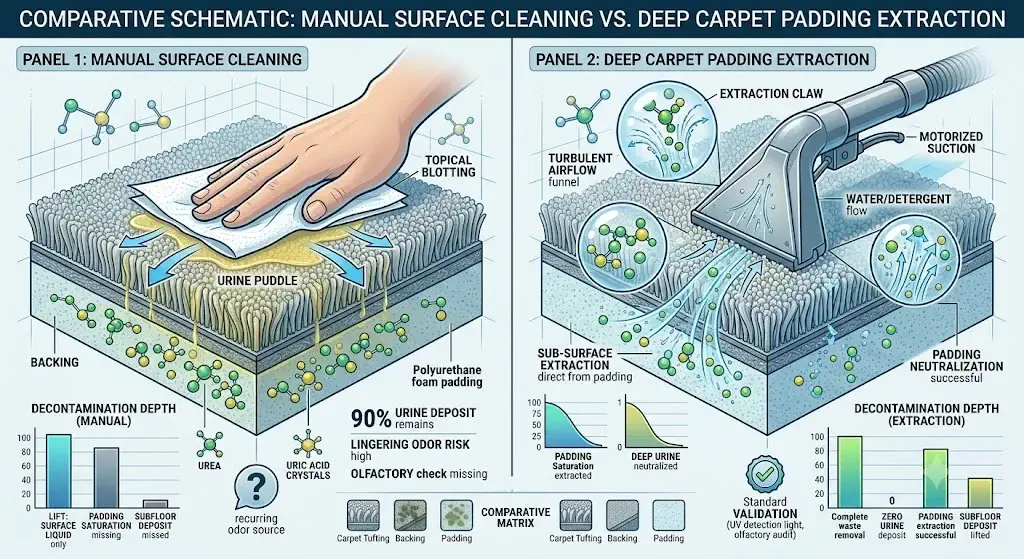
Open-cell polyurethane padding acts as a porous biochemical sponge that traps uric crystals beneath the carpet floor. If you have cleaned the carpet surface repeatedly but strong odors persist, the padding is almost certainly contaminated.
Common clinical indicators of deep padding contamination include:
- The ammonia scent is significantly stronger at floor level than standing height.
- Carpet face yarns look visually clean, but the room smells strongly during warm or humid afternoons.
- The odor vanishes while carpet is damp from cleaning but re-emerges aggressively once dried.
- The puppy consistently returns to sniff or scratch at the exact same location.
Surface trigger sprays cannot penetrate dense padding effectively. Resolving padding saturation requires a specialized sub-surface extraction tool (a vacuum claw attached to an extractor) or, in chronic cases, peeling back the carpet to replace the contaminated foam pad section entirely.
How to Remove Puppy Urine Smell From a Rug
Woven area rugs absorb urine through face pile and secondary backing, transferring liquids directly onto underlying pads and wood floors. Remediating area rugs requires a two-sided cleaning approach:
- Blot fresh liquid from the rug face immediately.
- Lift the rug corner and inspect the underside backing and floor pad.
- Place a waterproof plastic sheet beneath the rug to protect hardwood flooring during cleaning.
- Apply a wool-safe, neutral-pH enzymatic cleaner verified for delicate rug fibers.
- Allow 10 minutes of controlled dwell time without flooding foundation yarns.
- Blot thoroughly from both face and back with clean microfiber cloths.
- Elevate the rug over drying racks to facilitate continuous air circulation around both sides.
If the rug rests on an inexpensive foam or rubber underlay, inspect that pad immediately. In most cases, replacing a saturated underlay pad is far more effective than attempting to wash odor out of deteriorating rubber.
How to Remove Puppy Urine Smell From Hardwood Floors
Wood fibers absorb acidic urine through micro-fissures in polyurethane finishes, triggering dark black stains and persistent malodors. Hardwood requires strict moisture control to avoid board warping:
- Absorb all surface liquid immediately using dry microfiber towels.
- Repeat blotting until the wood feels completely dry to the touch.
- Apply a light mist of wood-safe, neutral-pH enzymatic cleaner from our vetted Best Hardwood Floor Cleaners for Pet Urine guide.
- Never pour liquid cleaner directly onto wood floor seams or allow puddles to dwell.
- Wipe away all residual moisture within 3 to 5 minutes using clean cloths.
- Direct an electric fan across the planks to ensure rapid, complete drying.
Never use standard carpet enzyme cleaners on hardwood floors. Their high moisture content and surfactant formulations can dull clear coats, strip wax, and cause permanent edge cupping along plank seams.
How to Remove Puppy Urine Smell From Upholstery
Furniture upholstery fabrics conceal thick foam cushions that pull urine deep into internal seating cores. Always check the manufacturer’s furniture care label (W, S, WS, or X) before introducing cleaning moisture:
- Blot liquid urine immediately with firm vertical pressure; do not scrub delicate fabric weaves.
- If cushions have zippers, remove the outer fabric cover immediately to prevent core saturation.
- Apply a low-moisture enzymatic upholstery foam to the fabric rather than heavy liquid saturations.
- Maintain a 10-minute damp dwell period under a clean, moist towel.
- Press dry microfiber towels firmly into the cushion using heavy body weight to extract fluid.
- Position an electric fan directly in front of the furniture until the cushion core is bone dry.
If strong urine odor remains after surface cleaning, the liquid has penetrated deep into the inner polyurethane block, requiring professional injection-extraction or replacement of the foam insert.
How to Remove Puppy Urine Smell From Bedding
Machine-washable pet bedding allows total chemical immersion, enabling biological laundry additives to dissolve embedded uric salts. Washing soiled textiles requires a disciplined protocol:
- Rinse excess fresh urine under cold running tap water before placing items in the washing machine.
- Inspect care labels for maximum fabric water temperature ratings.
- Add an enzymatic pet laundry detergent containing active proteases and lipases directly into the wash drum.
- Select a full wash cycle using cold or warm water; avoid hot water cycles.
- Perform an extra rinse cycle to purge all surfactant and uric residues from textile fibers.
- Tumble dry on low heat or dry naturally in outdoor sunlight.
- Perform a close olfactory sniff check before placing bedding back into the puppy playpen.
If bedding retains an ammonia odor after laundering, never cover it with fabric softener. Re-wash the item with an enzymatic laundry booster to eliminate the persistent biological source.
Should You Use an Enzyme Cleaner for Puppy Urine Smell?
Enzyme cleaners represent the most effective biochemical solution for pet urine because their bacterial catalysts actively consume uric acid. Unlike cosmetic detergents that merely disperse surface dirt, bio-enzymes hydrolyze organic bonds, converting urea and uric salts into inert water and carbon dioxide.
However, enzyme cleaners are not universally required for every household task. Consumer Reports’ 2026 laboratory testing of nine leading pet odor sprays proved that while bio-enzymes are essential for organic urine digestion, certain high-potency non-enzyme formulas (such as oxidizing agents) perform exceptionally well on visual surface stains. To explore how biochemical catalysts compare against standard detergents, review our detailed guide on Enzyme Cleaner vs Regular Pet Cleaner.
Enzyme Cleaner vs Odor Neutralizer
Enzymatic cleaners digest solid organic deposits, whereas odor neutralizers encapsulate airborne volatile malodor molecules chemically. Choosing between these complementary product categories depends on where the odor challenge resides:
| Product Chemistry Type | Primary Target | Optimal Domestic Use Case |
|---|---|---|
| Bio-Enzymatic Cleaner | Embedded uric acid crystals and proteins | Targeted decontamination of carpets, padding, and rugs |
| Molecular Odor Neutralizer | Airborne volatile sulfur and nitrogen compounds | Clearing ambient room air, kennels, and curtains |
| Surfactant Stain Remover | Surface dirt, track-in mud, and loose grime | Visible spot cleaning on hard surfaces and synthetic tiles |
| Carpet Extraction Solution | Deep sub-surface liquid reservoirs | Whole-room carpet extraction and rinse recovery |
If your home suffers from ambient pet smells beyond localized urine puddles, review our dedicated benchmark of the Best Puppy Odor Eliminators.
Why Air Freshener Doesn’t Really Solve Puppy Urine Smell
Aerosol air fresheners release volatile synthetic fragrances that overload olfactory receptors without chemically altering urine deposits. While a scented mist makes a living room smell pleasant for an hour, the microscopic uric acid crystals remain untouched within the carpet pile.
Consumer Reports explicitly distinguishes between cosmetic masking sprays and functional treatments for pet urine. If urine salts remain trapped in carpet backing, indoor humidity will continually reactivate bacterial off-gassing, creating an unpleasant blend of artificial fragrance and pungent ammonia. True odor remediation requires eliminating the chemical source.
Can Baking Soda, Vinegar, or Bleach Remove Puppy Urine Smell?
Common household remedies lack the biochemical enzymes required to hydrolyze crystallized uric salts embedded in textiles. Chemical evaluations reveal significant operational limitations across popular DIY solutions:
- Baking Soda (Sodium Bicarbonate): Absorbs mild surface moisture and temporarily buffers acidic odors, but cannot reach carpet padding. It often forms a gummy residue in carpet tufts that clogs vacuum filters.
- Distilled White Vinegar: Acetic acid temporarily neutralizes alkaline fresh urine, but Consumer Reports warns that strong pungent vinegar scents can trigger instinctual territorial marking in young puppies.
- Chlorine Bleach: Extremely dangerous. Bleach chemically reacts with the ammonia in pet urine to release toxic chloramine gases, while permanently stripping color from synthetic and wool textiles.
For safe, reliable decontamination, purpose-engineered enzymatic cleaners provide far superior and safer results than experimental household mixtures.
Should You Steam Clean Puppy Urine?
High-temperature steam permanently bonds biological urine proteins and yellow pigments into synthetic carpet fibers. Introducing boiling steam or heated water coagulates protein chains, fusing them directly to textile dye sites.
Both the AKC and Consumer Reports explicitly warn against using heat when remediating pet accidents. When running motorized carpet cleaning extractors on pet urine, always turn off the internal heating elements and use room-temperature water to flush dissolved soils safely.
What If the Puppy Urine Smell Comes Back After Enzyme Cleaner?
Odor recurrence after bio-enzymatic treatment indicates that liquid fluid volume penetrated deeper than the enzyme solution reached. If an area smells of urine days after applying an enzyme spray, systematically audit these diagnostic points:
- Volume Mismatch: You applied 4 ounces of surface spray to treat a 12-ounce urine accident, leaving the bottom half of the pad untreated.
- Insufficient Dwell Time: The solution dried within 10 minutes; re-apply and cover the spot with a damp towel for 8 to 12 hours.
- Chemical Deactivation: You applied vinegar, disinfectant, or detergent beforehand, killing the beneficial bacterial cultures.
- Peripheral Migration: Fluid expanded horizontally underneath the carpet, extending 4 to 6 inches beyond the surface stain.
- Subfloor Penetration: Urine soaked past the padding into structural plywood, requiring specialized subfloor sealing.
When Surface Cleaning Is Not Enough
Severe subfloor saturation requires motorized sub-surface extraction or physical pad replacement to eradicate persistent odors. Manual trigger sprayers are designed for isolated accidents, but fail under these extreme conditions:
- A puppy repeatedly eliminated in the same unsupervised room corner over several weeks.
- Liquid urine penetrated open-cell padding and wicked into porous concrete or plywood subflooring.
- Contamination saturated deep interior foam blocks of structural sofa cushions.
- Urine seeped beneath floor baseboards and wicked upward into gypsum drywall.
At this stage, repeated surface spraying only adds excess moisture. Deploying a commercial extraction machine or hiring professional remediation specialists is necessary to resolve structural contamination.
When to Call a Professional Cleaner
Professional remediation technicians utilize high-flow truck-mounted vacuum extractors and antimicrobial subfloor injections to restore heavily contaminated properties. Consider hiring professional restoration services when:
- Pungent urine odors persist after multiple enzymatic treatments and motorized spot extractions.
- Accidents span wall-to-wall carpeting across multiple rooms in a home.
- Priceless antique oriental wool or silk rugs require off-site total submersion washing.
- Carpet tack strips and subflooring require mechanical sealing with pigmented shellac.
The AKC recommends professional cleaning whenever deep structural odors resist thorough home decontamination efforts.
How to Prevent Puppy Urine Smell From Coming Back
Rigorous scent eradication combined with consistent crate management prevents puppies from establishing indoor elimination habits. Once the physical accident is sanitized, enforce strict housebreaking fundamentals:
- Maintain a rigorous outdoor potty schedule tailored to the puppy’s developmental age (every 1 to 2 hours).
- Take the puppy to the designated outdoor elimination spot immediately after waking, eating, and vigorous play.
- Maintain continuous indoor supervision using short leashes or playpens to prevent unmonitored wandering.
- Reward successful outdoor elimination immediately with high-value treats within 3 seconds.
- Restrict unsupervised access to previously soiled carpeted rooms using baby gates.
- Conduct regular UV blacklight sweeps to detect and decontaminate fresh accidents immediately.
What If a House-Trained Puppy Suddenly Starts Peeing Indoors?
Sudden loss of bladder control in previously housebroken puppies often signals an underlying veterinary medical condition. Never assume a sudden indoor elimination relapse is purely behavioral.
Urinary tract infections (UTIs), cystitis, bladder stones, or parasitic gastrointestinal distress can cause involuntary leakage. If an established routine suddenly breaks down, consult your veterinarian immediately to rule out medical issues before adjusting training protocols.
Puppy Urine Smell Removal Checklist
Standardized operational workflows ensure methodical decontamination across all domestic flooring substrates. Follow this complete procedural checklist:
- ☐ Locate the complete contaminated perimeter using a 395nm UV blacklight
- ☐ Blot fresh liquid immediately with clean paper towels (avoid scrubbing)
- ☐ Extract maximum moisture volume until towels lift dry
- ☐ Identify the exact substrate (synthetic carpet, wool, sealed wood, upholstery)
- ☐ Choose a surface-compatible bio-enzymatic urine cleaner
- ☐ Saturate the zone with fluid volume matching the original accident
- ☐ Maintain a moist dwell period for 10 to 15 minutes minimum (or covered overnight)
- ☐ Blot or extract dissolved residues with clean microfiber towels
- ☐ Provide continuous room ventilation with electric fans until completely dry
- ☐ Perform a post-drying sniff check and UV blacklight audit
- ☐ Deploy motorized sub-surface extraction if pad contamination persists
- ☐ Re-establish strict outdoor potty schedules and positive reinforcement
Frequently Asked Questions (FAQ)
What is the best way to remove puppy urine smell?
How do I get puppy urine smell out of carpet?
How do I get dried puppy urine smell out of carpet?
Why does my carpet smell like puppy pee after cleaning?
Does an enzyme cleaner remove puppy urine smell?
How long should an enzyme cleaner sit on puppy urine?
Can baking soda get rid of puppy urine smell?
Does vinegar remove puppy urine odor?
Can I use bleach on puppy urine?
Can I steam clean puppy urine from carpet?
How do I find a hidden puppy urine smell?
Why does puppy pee smell worse after it dries?
How do I get puppy urine smell out of hardwood?
What if puppy urine smell keeps coming back?
How do I stop my puppy from peeing in the same spot?
Bottom Line: Eliminate the Source, Not Just the Air
Permanent eradication of puppy urine odor requires destroying uric acid crystals rather than temporarily masking smells with perfumes. Fresh accidents must be blotted immediately with firm vertical pressure to halt liquid progression into backing layers. For dried or recurring carpet odors, enzymatic rehydration and extended covered dwell times are required to metabolize stubborn crystal deposits.
For sensitive flooring like hardwood and laminate, strict moisture discipline prevents joint swelling and black tannin burns. If odors persist despite thorough surface remediation, look below the surface to carpet padding and subfloors. Find the source, remove the urine, treat the correct substrate, preserve chemical dwell time, and let everything dry completely. This disciplined biochemical approach protects your home investments while setting a clean foundation for housebreaking success.
